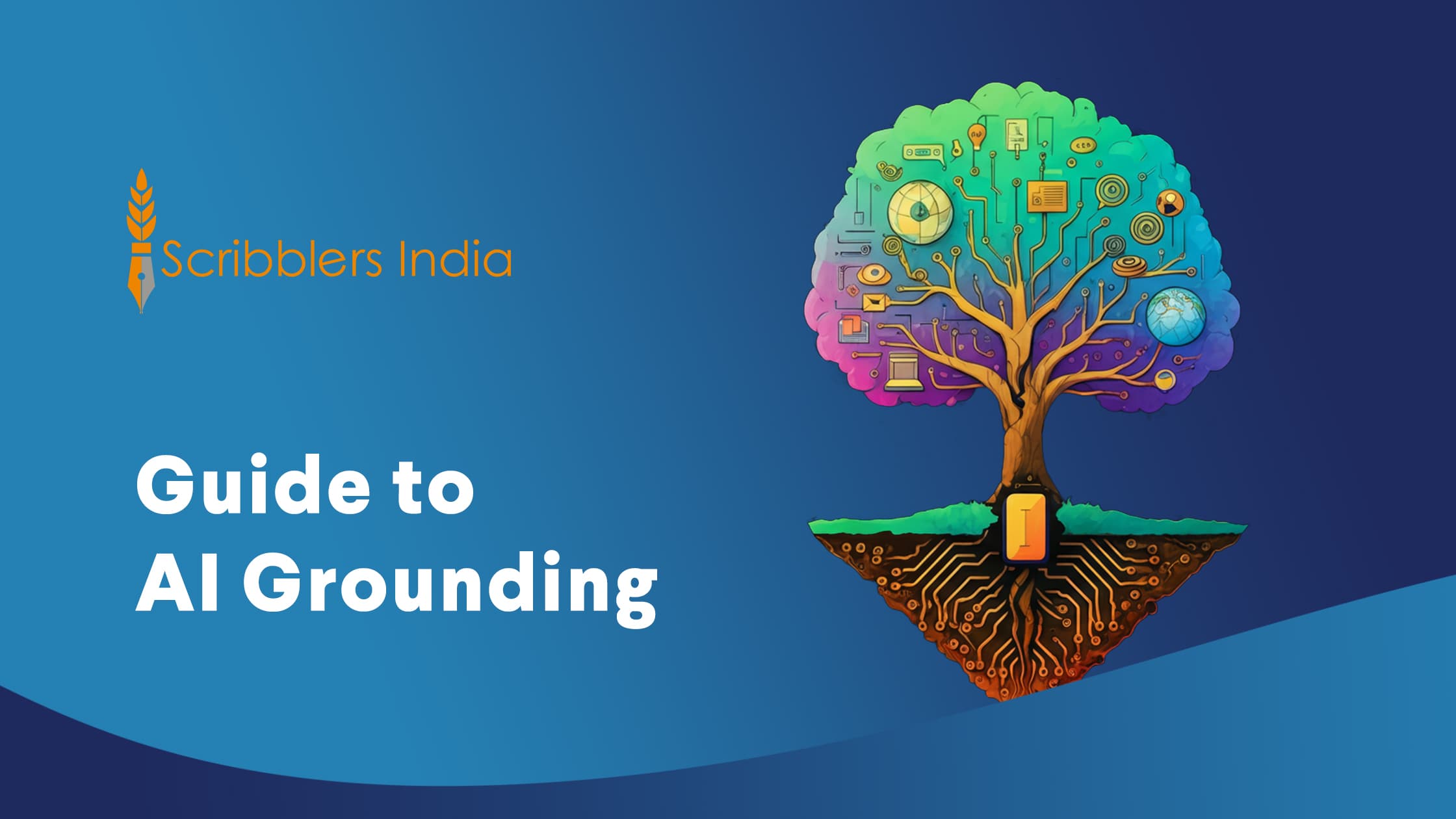
AI grounding connects a generated response with information that can be checked against external or supplied sources. Instead of relying only on knowledge learned during model training, a grounded system can use current webpages, databases, documents, or business information to provide stronger context before preparing its answer for users.
Grounding can improve freshness, factual support, and transparency, although it cannot guarantee that every response will be correct. Retrieval quality still affects the final answer. For search and content teams, grounding matters because current AI search experiences can retrieve web information, use it as supporting context, and reference relevant sources.
Key Takeaways
|
What Is AI Grounding and How Does It Work?
AI grounding connects model output with information that can be checked against a defined source. The source may include webpages, company documentation, databases, product records, research, or other information available to the AI system when preparing its response.
Google Cloud defines grounding as the process of connecting model output to verifiable information sources. Those sources can provide the model with current or context-specific information that may not be present in its original training data.
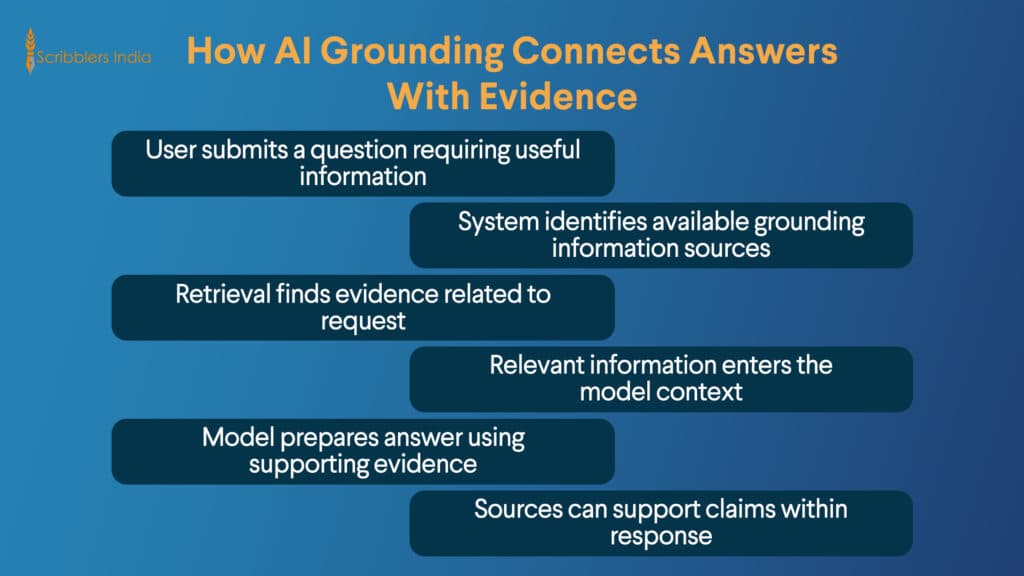
A grounded workflow therefore gives the model additional context before generation. The system retrieves or receives relevant information, places it within the model’s working context, and generates an answer using the source material alongside the user’s request.
This distinction matters because a model can otherwise depend on learned patterns that may be incomplete or outdated. Grounding introduces an external information layer that can support answers requiring current facts, company-specific information, or evidence connected with a user’s question.

How Is AI Grounding Different From RAG, Retrieval, and Citations?
Grounding, retrieval, RAG, and citations are related components of an AI information workflow, but they should not be treated as interchangeable terms. Separating them helps content teams understand how information reaches a model and how supporting evidence may appear within the final response.
| Concept | What It Means | Role in the Process | Important Distinction |
| Grounding | Connects generated output with information from verifiable supporting sources | Anchors model responses within available evidence | Describes the wider evidence connection |
| Retrieval | Finds information relevant to the user’s request from available sources | Supplies useful context before generation begins | Retrieval can occur without generating an answer |
| RAG | Retrieves relevant information before adding it to the model context | Combines retrieval with generation inside one workflow | RAG represents one common grounding technique |
| Citation | Identifies a source associated with information inside an answer | Gives users a route to inspect supporting material | A citation does not prove every claim is correct |
Google describes Retrieval-Augmented Generation as a technique for grounding that improves the quality, accuracy, and freshness of responses. Its Search systems can retrieve current webpages before generating responses supported by relevant links.
The distinction becomes clearer in our Retrieval-Augmented Generation analysis, which follows the retrieve-augment-generate sequence. Grounding refers to the broader objective of connecting the answer to supporting information.
Why Can AI Grounding Improve Freshness and Reduce AI Hallucinations?
AI Grounding addresses an important limitation of model-only responses, as training data reflects information available during earlier development stages. Connecting the model to current or specialized sources provides additional evidence to support questions about changing facts, business information, or recent developments.
- Grounding can provide information beyond what the training data contains, helping responses address facts that changed after model development.
- Retrieved sources can provide specific evidence for factual claims, reducing reliance on patterns learned from broad training data.
- Internal knowledge sources can provide company-specific facts and terminology that a general-purpose model may not know or understand.
- Grounding can reduce unsupported model generation when relevant source material gives the system stronger context for answering the request.
- Source links can improve response auditability for users, since readers can review supporting information behind important statements or recommendations.
- Retrieved context can improve domain relevance for specialized questions when relevant sources contain information not available in the general model’s knowledge.
Grounding can reduce hallucinations by connecting responses with specific data sources. RAG supports the same goal by retrieving relevant information and adding that context before generation.
AI Grounding still depends on the quality of the information retrieved. Outdated, irrelevant, incomplete, or conflicting sources can introduce problems even when the model follows a grounded workflow.
What Sources Can Be Used to Ground an AI Response?
AI Grounding sources depend on the AI system, application, and user request. A public search assistant may retrieve webpages from the open web, while an enterprise application can use internal documents or databases that outside users cannot access.
| Grounding Source | Information It Can Provide | Common Use Case | Main Consideration |
| Public webpages | Current articles, documentation, product information, and published facts | Web search and current information requests | Pages need accurate, accessible, current information |
| Internal documents | Policies, procedures, research, manuals, and company knowledge | Employee assistants and enterprise knowledge search | Access controls and document freshness remain important |
| Structured databases | Product records, inventory, customer data, or operational information | Questions requiring current structured business facts | Data quality directly affects generated responses |
| Knowledge bases | Curated information around defined topics or business processes | Support systems and specialist AI applications | Coverage gaps can leave questions without support |
| Search indexes | Relevant pages selected through search and ranking systems | Grounded generative search experiences | Retrieval quality influences available model context |
Microsoft describes grounding data as information provided to a model during inference to improve the relevance and accuracy of its responses. This information may come from internal systems or external sources rather than the original model training dataset.
For public AI search, website content is one of many possible sources of grounding. This makes source quality, up-to-date information, crawlability, and clear factual support important, without guaranteeing a route to generated answers.
How Does Grounding Work in Google AI Search?
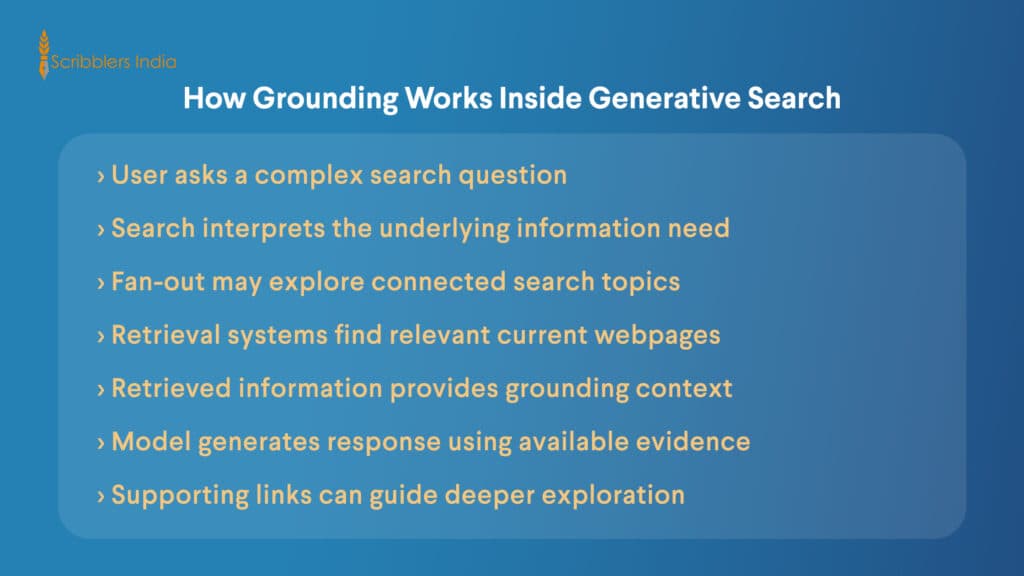
Google’s generative Search experiences can retrieve current webpages through existing Search systems before preparing a response. Relevant information from those pages provides grounding context, helping AI Overviews and AI Mode work with fresher evidence rather than relying only on previously learned model knowledge.
Complex questions can require information from several angles. In these cases, AI Mode and AI Overviews may use query fan-out to explore related searches and retrieve supporting information across connected subtopics. Our Query Fan-Out analysis explains how a single visible request can expand into multiple retrieval paths.
Website owners do not need special AI schema, separate AI-only content, or a dedicated technical file to be eligible. Standard Search foundations still apply, including crawlability, useful content, clear information, and established SEO practices. Grounding, therefore, underscores the importance of source quality rather than introducing a separate optimization formula.
What Does AI Grounding Mean for GEO and Content Strategy?
Grounding gives content teams a clearer way to think about generative visibility. If an AI search system retrieves external information before answering, brands need useful source material to support relevant questions without assuming that any individual page will receive a citation.
- Important pages should contain specific, verifiable information rather than broad promotional claims that offer little substantive value.
- Current dates, product details, research, and policies should remain accurate across owned sources when generated answers depend on changing information.
- Claims requiring evidence should include credible supporting sources or original proof, helping readers verify information without relying on assertion alone.
- Distinctive expertise can create source information unavailable elsewhere, giving search systems more useful material when addressing specialized questions.
- Topic coverage should reflect real user questions and connected information needs rather than producing pages for every possible prompt variation.
- External references can provide independent context around a brand, especially when generated answers compare providers, products, experts, or approaches.
Grounding also explains why an AI citation and a brand mention represent different visibility outcomes. Our analysis of AI brand mentions and citations shows why brands should monitor both source visibility and the organization’s representation in generated answers.
At Scribblers India, our Generative Engine Optimization services examine this source environment across owned content, external references, prompt coverage, and brand accuracy. Grounding readiness is one part of that wider visibility problem, rather than another isolated optimization tactic.

How Does Scribblers India Improve AI Grounding Readiness?
At Scribblers India, AI grounding readiness begins with assessing whether a brand has sufficient reliable information to address important search questions. The review focuses on source quality and evidence gaps before new content is recommended. Here is how we help improve your AI grounding readiness:
- Map questions to available evidence: We review high-value prompts and identify what a useful answer needs to establish. The next step is checking whether existing sources already provide that support. This helps separate well-covered questions from areas where the brand lacks enough credible information.
- Strengthen weak source pages: Some pages already target the right topic but do not provide enough evidence or depth. We improve these assets with clearer explanations and stronger supporting information. The aim is to make useful pages more complete before adding another URL around the same need.
- Separate citation gaps from content gaps: A missing AI citation does not automatically mean another article is required. The underlying problem may involve weak source depth or limited external support. We investigate the cause first so additional content is recommended only when it addresses a genuine information gap.
- Connect evidence across related content: Strong grounding rarely depends on one isolated page. We connect service content with relevant expert insights and supporting resources where those relationships help the reader. This creates a clearer evidence trail without forcing repetitive internal links or duplicating information across several pages.
- Monitor representation after changes: We track how brand visibility develops across important prompts and source patterns. Changes in citations or AI mentions are reviewed alongside current platform guidance. This keeps decisions tied to observable evidence without presenting hidden retrieval behavior as something marketers can measure directly.
This approach keeps grounding work focused on information quality and brand accuracy. It also gives GEO programs clearer evidence for deciding which content changes deserve attention first.
Book a 1:1 consultation with our team to drive your GEO strategy for better AI search visibility.
FAQs
Is AI Grounding the Same as Giving an AI Model More Training Data?
AI Grounding and model training occur at different stages. Training changes what a model learns before deployment, while grounding supplies supporting information when a request is processed. This allows systems to use current or specialized information without retraining the underlying model whenever available facts or business information change.
Does Every Grounded AI Answer Need a Visible Citation?
A grounded response does not always need to display a visible citation to the user. Some systems use supporting information internally without showing individual source links. A visible citation improves source transparency, although grounding describes the connection with supporting evidence rather than the presentation format used within the interface.
Can AI Grounding Remove Hallucinations Completely?
AI Grounding can reduce hallucinations by providing models with relevant evidence before generation, though it cannot eliminate all errors. Retrieval can surface weak sources, information may conflict, and models can misinterpret evidence. Grounding quality therefore depends on retrieval quality, source reliability, context selection, and how generated claims use the available information.
How Can Scribblers India Identify Weak Grounding Sources?
We review the pages and external sources available around priority prompts, then examine factual depth, freshness, supporting evidence, entity clarity, and source consistency. This helps identify whether weak AI representation comes from missing information, outdated content, poor corroboration, limited source coverage, or another visibility problem.
Does Scribblers India Recommend Creating Content Only for AI Grounding?
We do not recommend creating separate content solely because an AI system may use it for grounding. Content should first serve a genuine reader need and provide useful information. We then consider search intent, evidence quality, retrieval opportunities, AEO, GEO, and broader visibility when deciding how to develop the asset.