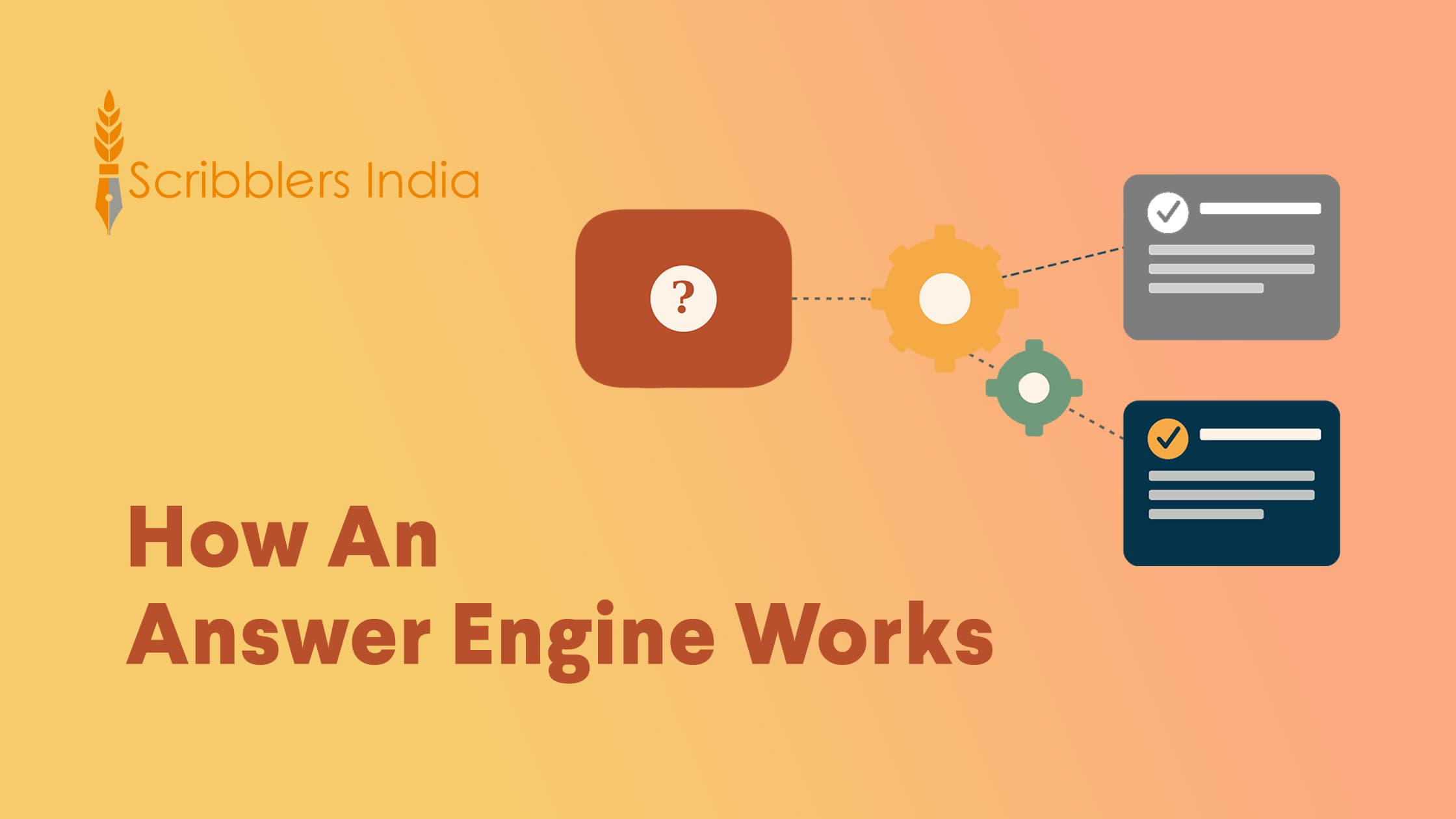
An answer engine is a system designed to respond directly to a user’s question instead of presenting links alone. Modern answer engines can interpret conversational requests, retrieve relevant information, combine details from several sources, and generate a synthesized response. Some also provide citations or links that help users explore supporting information further.
Answer engines now appear across AI assistants, AI-native search platforms, and generative features inside established search engines. Their capabilities differ by platform and query. Some rely on current web retrieval, while others may answer from model knowledge. This distinction affects how brands approach content visibility, source quality, AEO, and measurement.
Key Takeaways:
|
What Is an Answer Engine and What Does It Do?
An answer engine is a digital system that responds to a question with a direct answer rather than requiring users to examine several results independently. Current industry usage commonly includes ChatGPT, Perplexity, Google AI Overviews, Google AI Mode, Gemini, and other conversational AI experiences.
The term does not describe one fixed technical architecture. An answer engine may draw on information learned during model training, retrieve up-to-date information, access structured databases, use search indexes, or combine multiple information sources before generating its response.
This makes the concept broader than an AI chatbot. A chatbot can hold a conversation without searching external information, while a search-enabled answer engine may retrieve current sources when the question requires updated facts or evidence.
ChatGPT search can access current web information and surface relevant source links, while Google AI Mode and AI Overviews can retrieve supporting webpages before generating responses. These answer-led environments create the conditions that Answer Engine Optimization addresses by improving how useful brand information is structured, supported, and positioned for direct-answer visibility.

How Is an Answer Engine Different From a Search Engine?
The traditional distinction is simple: search engines help users find information, while answer engines aim to provide it directly. That separation has become less clear because Google Search now combines ranked results, featured snippets, AI Overviews, AI Mode, maps, products, and other answer-led features.
| Area | Traditional Search Engine | Modern Answer Engine | What Users Experience |
| Primary output | Returns ranked webpages and other relevant search result formats | Produces a direct or synthesized response to the question | Less manual research may be required initially |
| User journey | Users usually open results and compare information across different websites | Users can continue through conversational questions and follow-up requests | Research can remain inside one interface longer |
| Information source | Uses indexed webpages, structured databases, and other search systems | May combine model knowledge, retrieval, search, and connected information | Answers can reflect several information inputs |
| Source presentation | Website links form a central part of the result experience | Citations or supporting links may accompany generated information | Source visibility varies across platforms and queries |
The two models now coexist rather than operating as separate categories. Google describes AI Mode as bridging traditional Search with conversational AI, while continuing to provide supporting links throughout the experience.
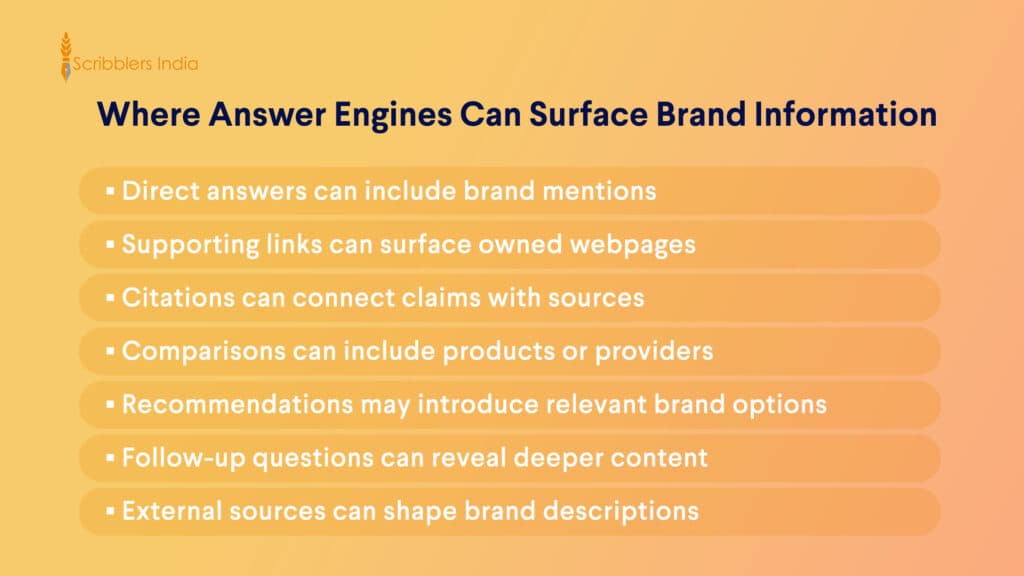
For marketers, the important change concerns visibility surfaces. A brand may appear as a ranked result, a supporting link, a cited source, a direct mention, a recommended provider, or a combination of several outcomes within a single research journey.
What Types of Answer Engines Do People Use?
Answer engines vary according to how users access them and where their information comes from. Several answer engine categories can overlap because platforms continue adding search, reasoning, conversational, multimodal, and task-oriented capabilities within the same product experience.
- Conversational AI assistants: Platforms such as ChatGPT can answer natural-language questions and support follow-up conversations. When web search is used, ChatGPT can retrieve up-to-date information and display citations that users can open to inspect the supporting sources.
- AI-native search experiences: Platforms designed around direct responses can combine search with generated explanations. The user typically receives a synthesized answer first, followed by citations, related questions, or links to sources for further research.
- Generative search features: Google AI Overviews and AI Mode bring answer-led experiences inside an established search environment. Google says these experiences can retrieve supporting webpages and help users explore complex topics through generated responses and related links.
- Traditional direct-answer features: Featured snippets can provide an answer before standard organic results without creating a conversational response. Google automatically selects suitable webpages and does not provide a special markup method that guarantees featured snippet appearance.
- Voice and assistant experiences: Voice systems can answer spoken questions using search information, internal knowledge, or connected services. Source visibility is often less prominent because the interface may prioritize a single spoken response over several visible links.
The categories therefore describe different answer experiences rather than a universal technical standard. A single platform can operate across several categories, depending on the question, interface, and required information.
How Does an Answer Engine Build a Direct Response?
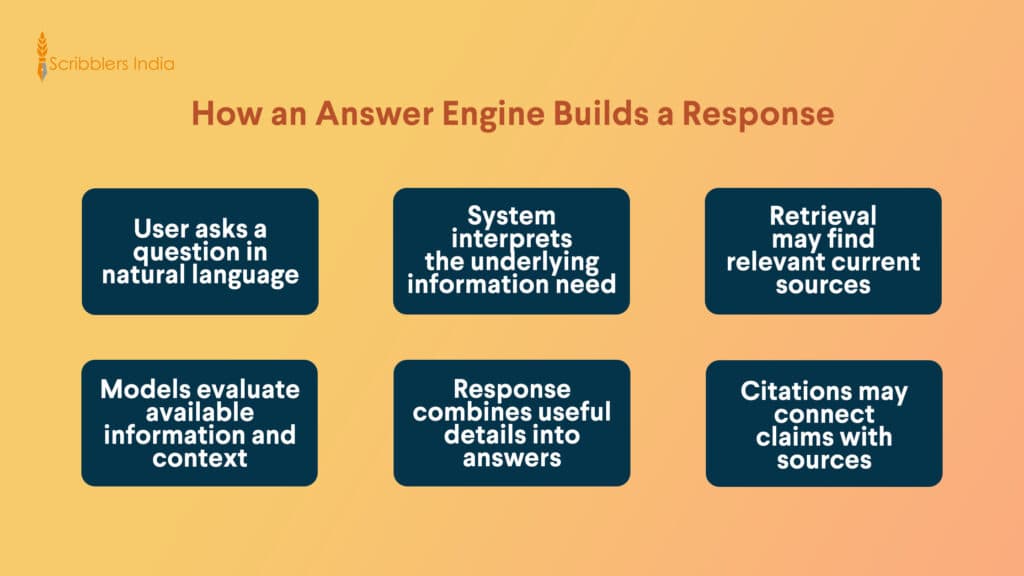
Answer engines do not all follow the same process, although search-enabled systems commonly combine query interpretation, retrieval, source evaluation, and generation. The exact workflow depends on the platform, available tools, user context, and whether the question requires current external information.
- The system first interprets the user’s underlying intent, including constraints, entities, comparisons, and the expected answer format.
- Search-enabled systems can retrieve current external information when model knowledge alone cannot provide sufficient or timely context.
- Complex questions may trigger several related retrieval paths when a single search cannot address every part of the request.
- Retrieved information can provide grounding context for generation, helping models work with evidence outside their original training knowledge.
- The language model then synthesizes relevant information into a response shaped around the user’s original request and context.
- Supporting links or citations can help users inspect the source material, although the presentation varies by platform and response type.
AI Overviews and AI Mode may use query fan-out when one question requires information across several related subtopics. Understanding how Query Fan-Out works helps explain why a single user request can lead to several retrieval paths before an answer appears.
Retrieval can also supply current information to a model before generation begins. This Retrieval-Augmented Generation process combines retrieved evidence with model context, helping answer engines work with information that may sit outside their underlying training knowledge.
How Do Sources and Citations Work Inside an Answer Engine?
Sources serve two related purposes inside answer-led systems. They can provide information used in response generation and give users a place to verify or explore the answer. These roles should remain separate because retrieved information does not always become a visible citation.
| Stage | What Can Happen | Role of the Source | Important Limitation |
| Retrieval | System finds information related to the user question | Supplies current or relevant supporting context | Retrieved pages may never appear visibly |
| Generation | Model uses available information when preparing its response | Helps ground statements within external evidence | Models can still misinterpret source material |
| Citation | Interface links selected claims or passages with supporting webpages | Gives users a route to inspect evidence | Citation presence does not prove every claim |
| Exploration | User opens sources for deeper research | Sends attention toward publishers and original information | Many users may remain inside the answer interface |
OpenAI advises users to verify important information because search results and citations can sometimes be incomplete, outdated, or incorrect. This highlights an important distinction between a sourced answer and a guaranteed accurate answer.
Google similarly emphasizes links throughout AI Mode and AI Overviews as routes for exploring supporting web content. Its systems can display a broader set of relevant webpages when generative responses require information spanning several connected subtopics.
For brands, citation visibility is therefore a useful metric rather than the complete answer-engine outcome. Mentions, descriptions, comparisons, recommendations, and the presence of sources can all affect how audiences encounter the organization.
What Does the Growth of Answer Engines Mean for Content Strategy?
Answer engines change content planning because a user question can now be resolved through generated information before a traditional website visit occurs. Brands therefore need useful source material that serves readers directly while remaining accessible across conventional and AI-led search experiences.
- Content should answer specific audience questions with enough depth, rather than adding broad copy that offers limited informational value.
- Important claims need clear evidence and current supporting information, especially when answers involve comparisons, statistics, policies, or technical guidance.
- Brand and product descriptions should maintain consistent entity information across key pages, reducing confusion during retrieval and generated representation.
- Supporting pages should address genuine follow-up information needs, rather than publishing separate URLs for minor variations of the same question.
- Internal links should connect related definitions, evidence, services, and deeper explanations so readers can continue their research naturally.
- Technical accessibility should remain part of the normal SEO foundation, since search-enabled answer systems still require retrievable, indexable source information.
Google’s current guidance explicitly says established SEO practices remain relevant across AI Overviews and AI Mode. It does not require separate AI-specific schema or special technical files for inclusion.
This makes Generative Engine Optimization a wider content and visibility exercise rather than a formatting shortcut. Strong answer-engine visibility can involve owned content, external representation, entity clarity, source quality, and prompt coverage together.

How Should Brands Measure Answer Engine Visibility?
Answer engines do not produce one stable ranking position that marketers can monitor like a traditional keyword result. Responses can vary based on prompt wording, user context, search freshness, location, platform behavior, and the sources available at the time.
| Measurement Area | What Teams Should Review | What It Helps Explain |
| Prompt coverage | Whether the brand appears across important question categories | Breadth of visibility across relevant user needs |
| Brand mentions | Whether generated answers name the organization or product | Representation without requiring a direct citation |
| Citation frequency | How often owned pages receive visible source attribution | Source visibility across answer-led experiences |
| Answer accuracy | Whether services, products, people, and claims appear correctly | Entity and source problems requiring correction |
| Competitor presence | Which alternative brands appear across comparable prompts | Category visibility gaps across answer journeys |
| Referral behavior | Whether answer platforms send measurable website visits | Direct traffic generated from answer-led discovery |
A controlled prompt set gives teams a more useful baseline than occasional searches. Prompts should represent informational, comparison, category, commercial, and brand-specific questions that actual buyers may ask during research.
Our AI Search Visibility Scorecard extends this review across entity clarity, content depth, answer readiness, external authority, and measurement. The framework helps separate visibility gaps from problems involving source quality or brand representation.
How Does Scribblers India Build Content for Answer Engines?
At Scribblers India, we treat answer-engine visibility as a connected content and search problem rather than a formula for writing short responses. We first identify what audiences ask, how current answer experiences respond, and which information gaps prevent the brand from contributing useful source material.
- Map real audience questions: Search queries, buyer journeys, competitor coverage, prompt testing, and client knowledge help identify the questions worth answering. We separate genuine information needs from minor keyword variations that do not deserve another page or content asset.
- Audit existing answer coverage: Important pages are reviewed for missing definitions, explanations, comparisons, evidence, examples, and follow-up questions. Existing content is strengthened before we recommend new production that could overlap with pages already targeting the same intent.
- Build a connected content architecture: Glossaries, guides, service pages, thought leadership, comparisons, research, and case studies each play distinct roles within the content ecosystem. Contextual internal links then help readers move between related questions without forcing exact-match anchors into every section.
- Strengthen evidence and entity clarity: Brand descriptions, expert information, claims, statistics, service details, and important entities should remain accurate across owned content. Where external corroboration affects discovery, we also review relevant public sources for conflicts or missing context.
- Measure answer visibility after execution: Prompt coverage, citations, mentions, answer accuracy, supporting sources, and referral data help show whether representation changes over time. Platform documentation remains the reference point when deciding whether an emerging tactic deserves broader implementation.
This approach connects our content execution with AEO, GEO, SEO, source readiness, and brand authority where those disciplines address the same search problem.
Get in touch with our team today to build content that answers real buyer questions while strengthening your AI search visibility.
FAQs
Is an Answer Engine Always Powered by an LLM?
Modern AI answer engines often use LLMs to interpret questions and generate conversational responses, although direct-answer technology existed earlier. Featured snippets and structured search features can provide answers without operating like current generative assistants. The broader term therefore covers several answer-led experiences with different underlying technologies.
Does an Answer Engine Always Search the Live Web?
An answer engine does not always need live web search for every question. Some responses can rely on model knowledge, connected databases, or previously indexed information. Search-enabled systems can retrieve current webpages when freshness or supporting evidence becomes useful, although exact retrieval behavior varies across platforms and requests.
Are Featured Snippets Considered Answer Engine Results?
Featured snippets represent an earlier direct-answer search experience because Google can display a webpage excerpt before regular results. They are not the same as generative answer engines, which can synthesize information through AI models. Both fall within the broader shift toward resolving questions directly in search interfaces.
How Can Scribblers India Identify Answer Engine Content Gaps?
We compare important buyer questions with existing website coverage, current search results, AI responses, supporting sources, and competitor content. The review identifies missing answers, weak evidence, duplicated intent, entity inconsistencies, and source gaps. Recommendations then separate pages requiring improvement from topics that deserve new content.
Does Scribblers India Optimize Content Only for Answer Engines?
We do not create content solely for answer engines because users and traditional search remain central to content performance. Our work connects audience needs with SEO, AEO, GEO, content strategy, and brand authority. Answer-engine visibility becomes one measurable outcome within a wider search and content program.