Online search has now transitioned into three disciplines, each targeting a different layer of how people now discover information. Ranking on Google is no longer the only form of search visibility that drives business outcomes. The GEO vs AEO vs SEO comparison represents three separate optimization strategies that together cover the full scope of modern search.
Search Engine Optimization (SEO) gets your content ranked in traditional search results. Answer Engine Optimization (AEO) gets your content surfaced as a direct answer in structured features like featured snippets. Generative Engine Optimization (GEO) gets your content cited inside the synthesized responses that AI platforms like ChatGPT, Perplexity, and Google AI Overviews generate for users. Each discipline targets a different output, platform, and user behavior.
Understanding all three is how modern content teams build search visibility that does not collapse when one layer shifts.
TL;DR: Understanding Core Differences Between GEO vs AEO vs SEO
|

What is the Importance of GEO in Digital Marketing: Why Is It Growing So Fast?
Generative Engine Optimization (GEO) is the practice of structuring content so that AI-powered platforms like ChatGPT, Perplexity, Gemini, and Google AI Overviews retrieve and cite it within the responses they generate for users.
The growth of this discipline reflects a key shift in search behavior. ChatGPT now processes over one billion queries daily and has reached 900 million weekly active users globally. That scale makes AI platforms a discovery channel that brands can no longer treat as secondary.
The GEO market was valued at $848 million in 2026 and is projected to reach $33.7 billion by 2034, growing at a 50.5% CAGR. These numbers reflect how rapidly organizations are recognizing that appearing inside AI-generated answers carries commercial value comparable to appearing on the first page of traditional search results.
When GEO is compared to traditional SEO, it operates on a fundamentally different principle. Traditional SEO competes for a ranked position that a user clicks. GEO competes to become the trusted source that an AI system selects when synthesizing a response. The user may never visit the site, yet the brand earns authority and recognition with every citation. For businesses investing in content marketing, GEO represents the next layer of return on that investment.
What Is the Core Difference Between GEO and SEO?
The difference between GEO vs SEO comes down to target output and optimization signals. SEO optimizes content so that search engines rank it highly. In practice, GEO vs SEO means one targets click-through traffic, while the other targets AI citation authority.
Here is how the GEO vs AEO vs SEO framework distinguishes the three disciplines across the dimensions that content strategy depends on:
Target Output and Platform
SEO targets a ranked link on Google or Bing that users click to reach a website. AEO targets a direct answer extracted from a single source and displayed in a featured snippet, People Also Ask box, or voice search response.
GEO targets inclusion in a synthesized, multi-source response that an AI platform generates for a user who may never see a traditional list of links.
Content Format and Structure
SEO rewards comprehensive, keyword-rich content that covers a topic with enough depth to satisfy a range of related queries. AEO rewards concise, directly answerable paragraphs of 40 to 60 words positioned immediately after a question-based heading.
GEO vs AEO comparison at the content level reveals that GEO additionally rewards original data, expert citations, and earned media mentions. These are signals that go well beyond format and structure into genuine information authority.
Authority Signals
SEO authority is built through backlinks, domain rating, internal linking, and on-page optimization signals. AEO authority is built through E-E-A-T signals of Experience, Expertise, Authoritativeness, and Trustworthiness that signal to Google that a source is credible enough to surface as a direct answer.
GEO authority additionally depends on how frequently a brand is cited across third-party, authoritative publications. Research shows that brands are 6.5 times more likely to be cited by AI platforms via third-party sources than on their own domains.
This means earned media and thought leadership content placements are direct GEO investments.
Success Metrics
SEO success is measured through keyword rankings, organic traffic volume, and click-through rates. On comparing SEO vs AEO, you will understand that AEO success is measured through featured snippet wins, voice search inclusion, and People Also Ask appearances.
GEO vs AEO comparison on measurement reveals that GEO success is measured through AI citation frequency, brand mention volume across AI platforms, share of voice in generated responses, and the downstream branded search volume that AI citations produce over time.
Relationship to Click Traffic
SEO and AEO both produce measurable website traffic, though AEO increasingly operates in a zero-click environment where the answer resolves the query without a visit. GEO operates almost entirely outside the click economy.
A brand cited inside a ChatGPT or Perplexity response earns authority and audience recognition without generating a trackable click in most cases. The value accumulates in brand trust, direct search behavior, and the purchasing decisions that AI recommendations influence before a user ever visits any website.
Comparing GEO vs AEO vs SEO
Here is a comparative analysis of GEO vs AEO vs SEO strategies for informed decision making:
| Category | SEO | AEO | GEO |
| Primary Target | Targets ranked links and clicks | Targets direct structured answer features | Targets AI-generated synthesized citations |
| Key Metrics | Measures rankings and organic traffic | Measures snippets and voice inclusion | Measures AI mention frequency and share |
| Optimization Focus | Rewards depth and keyword coverage | Optimizes for concise, structured answers | Rewards original data and earned media |
| Content Format | Long-form, keyword-rich content focus | Structured, schema-driven answer content | Data-backed, authoritative content signals |
| Visibility Channel | Search engine result pages visibility | Featured snippets and voice assistants | AI engines and generative search outputs |
How Is GEO Different from AEO and Does the Distinction Actually Matter?
A strategic comparison between GEO and AEO highlights that AEO optimizes for structured answer extraction from existing search features. GEO optimizes for synthesis and citation by generative AI platforms that create entirely new responses from multiple sources. The distinction is meaningful for content investment decisions.
AEO emerged when Google introduced featured snippets and knowledge panels in the mid-2010s. The goal was to structure content so that traditional search engines could extract and display a portion of it directly on the results page. The extraction is literal: the system lifts a block of text from a single source and displays it without significant modification.
GEO addresses a more complex behavior. When a user asks ChatGPT or Perplexity a question, the platform does not extract one block of text. It combines information from multiple sources, generates a new response in its own language, and attributes portions of that response to the sources it found most credible and relevant.
How do AEO vs GEO Work in Practice?
Getting cited in that synthesis requires a different optimization approach than getting selected for a featured snippet.
- Sourcing logic: AEO works when a concise paragraph directly answers a specific query. GEO works when a brand’s content appears consistently across multiple authoritative sources. It signals to AI retrieval systems that this brand is genuinely recognized in its field.
- Synthesis depth: AEO extraction is surface-level and format-dependent and GEO synthesis is meaning-dependent. The AI evaluates the content’s conceptual value rather than its structural presentation alone.
- Earned media requirement: AEO can be achieved through on-site content optimization. GEO also requires third-party validation through media placements, industry publications, and external citations that demonstrate the brand’s authority extends beyond its own website.
- Consistency across platforms: AEO primarily targets Google’s search surfaces. GEO requires a multi-platform strategy because ChatGPT, Perplexity, Gemini, and Google AI Overviews each exhibit distinct retrieval behaviors, citation preferences, and content-sourcing patterns that vary significantly by query type.
What Are the Key GEO Strategies to Improve AI Citation Rates?
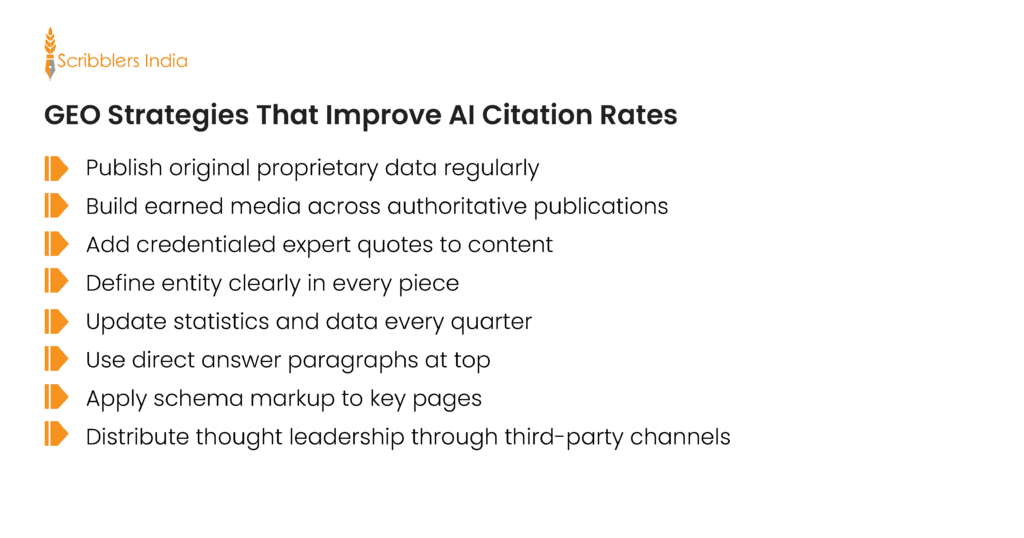
Now, it is time to compare the strategies as part of our GEO vs AEO vs SEO analysis. GEO requires a specific set of content practices that go beyond traditional SEO and extend AEO principles into the AI synthesis environment. These practices directly influence whether AI platforms cite your content.
Research from Princeton and Georgia Tech found that adding statistics to content increases AI visibility by 41%. At the same time, adding credentialed expert quotes increases the likelihood of a citation by 28%. These optimizations represent the specific content characteristics that GEO-ready content must consistently demonstrate to earn AI platform citations at scale.
GEO Strategies to Improve AI Visibility
Let’s have a look at some crucial GEO strategies to improve your AI visbility:
- Publish original data and proprietary research: AI platforms have no reason to cite sources that merely restate publicly available information. Original surveys, branded studies, and first-hand analysis give AI systems a specific, unique fact that only your brand has published. This information gain is one of the strongest GEO signals available to content marketers.
- Build a strong earned media presence: Distributing content across authoritative third-party publications significantly increases AI citation rates. A brand cited in industry publications, expert roundups, and credible news sources signals to AI retrieval systems that its authority extends across the web rather than residing only on its own domain.
- Use entity-clear, structured content: AI systems build knowledge associations between brands, topics, and attributes. Content that clearly defines what an organization is, what it does, who it serves, and its positions on key industry questions is critical. It gives AI platforms the clarity they need to represent the brand accurately in generated responses.
- Integrate expert quotes with full credentials: Named, credentialed authors and quoted experts signal that content reflects real human expertise rather than automated production. AI platforms consistently favor content with verifiable human authority attached to specific claims over anonymously published material on equivalent topics.
- Maintain content freshness systematically: AI retrieval systems value recent and accurate content. A quarterly content audit that updates statistics, corrects outdated information, and adds new original insights is vital. It keeps a brand’s content in the active retrieval pool of AI platforms that continuously re-index sources.
How Do GEO, AEO, and SEO Work Together as a Unified Strategy?
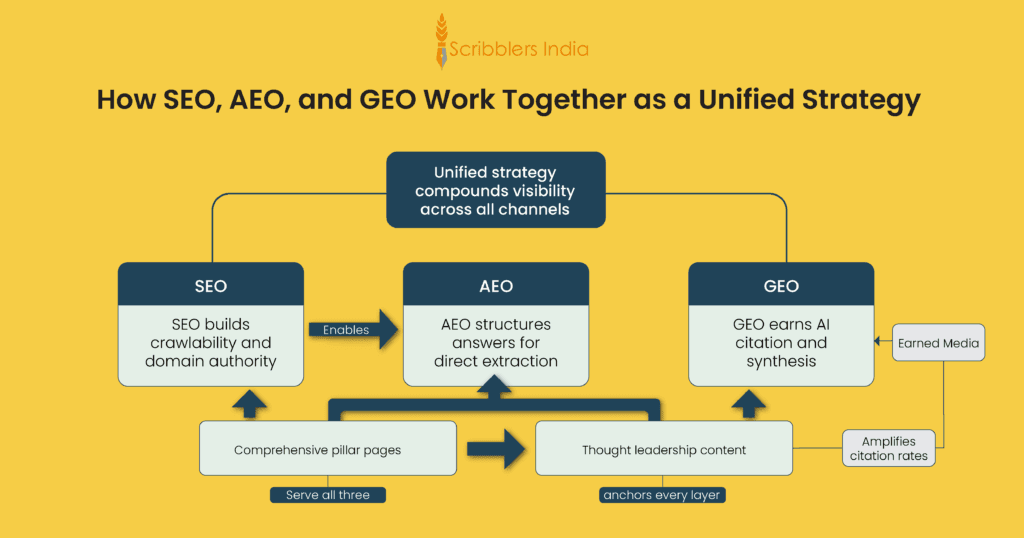
GEO vs AEO vs SEO do not compete with each other. They work best as connected layers of one search visibility strategy. SEO helps your content reach search engines through crawling, indexing, and ranking. AEO helps search engines extract clear answers from your content. GEO helps AI platforms understand, use, and cite your content in generated responses.
Strong SEO is still the base for both AEO and GEO. AI platforms are more likely to use content from websites that are technically strong, well-indexed, and trusted by search engines. If a website has poor technical SEO, weak authority, or thin content, it may struggle to earn visibility in AI-generated answers.
The connection is simple. SEO builds discoverability. AEO improves answer readiness. GEO increases the chances of being referenced by AI search platforms.
For example, a detailed pillar page can support all three. It can target SEO keywords, answer specific questions for AEO, and include original insights, expert views, data points, and clear definitions for GEO. This makes the content useful for traditional search, answer engines, and AI-led search experiences.
Why Do You Need GEO Services in India for Your Business Growth?
India is becoming one of the most active AI search markets, with users turning to ChatGPT, Gemini, Perplexity, and Google AI Overviews for answers. This shift changes how brands need to think about search visibility. Ranking on Google still matters, yet brands now need visibility across AI-led discovery too.
That is why brands need a clear GEO vs AEO vs SEO strategy. SEO improves content discoverability, AEO turns content into direct answers, and GEO increases the chances of AI platforms citing your brand. Scribblers India brings all three together through content, authority building, and thought leadership.
How Does the Scribblers India GEO Framework Work?
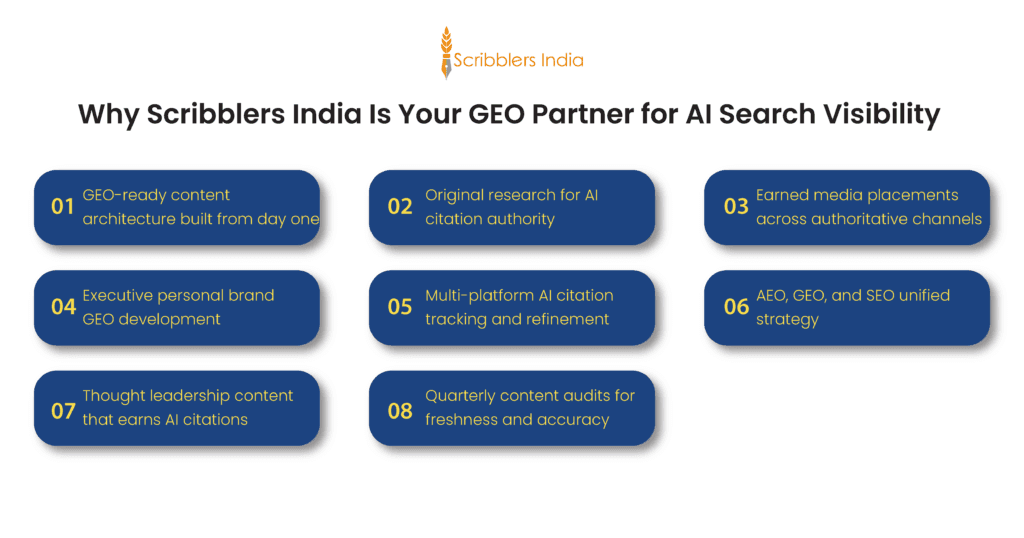
Our framework builds visibility across the signals that modern search systems read, extract, and cite. It connects content structure, brand authority, expert credibility, and AI visibility tracking into one unified execution model.
- GEO-ready content architecture: We structure every content piece around AI retrieval signals, direct-answer paragraphs, expert insights, original data, and clear entity definitions. This helps each asset support GEO, AEO, and SEO together.
- Original research and data assets: We identify topics where your brand holds strong expertise, then turn that knowledge into branded insights, data-led content, and citation-worthy assets that AI platforms can reference.
- Earned media and thought leadership placement: We build your external authority footprint through industry publications and trusted third-party platforms. This helps AI systems see your authority beyond your own website.
- Executive and personal brand development: We help founders and leaders publish expert-led content around focused topics. This strengthens the authority of individual entities and supports broader brand visibility in AI search.
- Multi-platform AI visibility tracking: We monitor brand citation patterns across ChatGPT, Perplexity, Gemini, and Google AI Overviews. These insights help refine your strategy around growing AI visibility opportunities.
Connect with Scribblers India today to build a well-rounded strategy that addresses the GEO vs AEO vs SEO differences. Our experts will position your brand as the trusted answer across both AI-powered and traditional search.