
Senior professionals rarely struggle because they have nothing worth saying. The problem is usually turning years of decisions, conversations, observations, and specialist knowledge into clear content that other people can encounter often enough. This is where professional ghostwriting services offer a robust solution.
A strong ghostwriter does more than remove writing from your calendar. They extract the thinking behind your expertise, organize it, challenge weak assumptions, research supporting evidence, and turn the result into content you can credibly publish under your name.
The need has become more relevant as publishing itself gets easier. Content Marketing Institute found that 96% of B2B marketers now create thought leadership, yet only 47% describe their programs as established, advanced, or leading. The constraint is increasingly the quality and depth of the thinking behind the output.
This blog explains when ghostwriting deserves investment, how a professional engagement should work, where AI can assist, and how executive content can support thought leadership and improve AI-led discovery.
Key Takeaways
|
What Are Professional Ghostwriting Services?
Professional ghostwriting services involve developing content for publication under another person’s name. The author remains responsible for the expertise, experiences, opinions, and final approval. The ghostwriter turns those inputs into clear material while handling much of the research, structure, drafting, editing, and editorial coordination.
The service is therefore different from asking a writer to invent a public persona. Good ghostwriting starts with something real. This may include operating experience, professional beliefs, customer observations, research, internal frameworks, stories, or decisions that the named author can explain and defend independently.
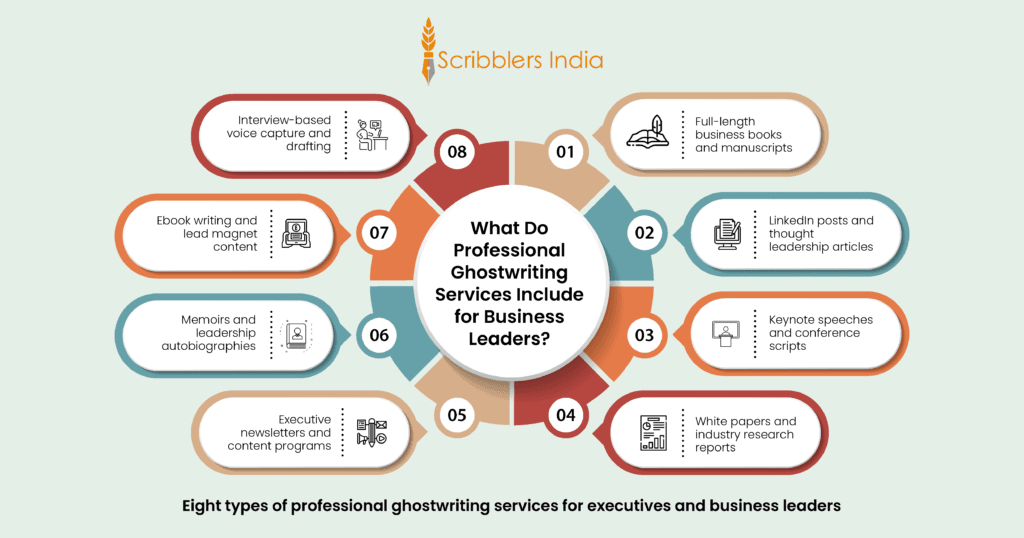
Formats also extend far beyond books. Executives can use ghostwriting for LinkedIn posts, articles, newsletters, speeches, reports, founder letters, opinion pieces, ebooks, or longer thought leadership. Each format requires different levels of source capture and review.
The common thread is authorship of the ideas rather than authorship of every sentence. The client supplies the intellectual source material and professional judgment. The writer supplies interviewing skill, editorial structure, research discipline, and writing craft needed to make those ideas usable.
When Are Professional Ghostwriting Services Worth Paying For?
Professional ghostwriting services become worthwhile when valuable expertise already exists but converting it into publishable material creates a recurring bottleneck. The strongest case usually appears when time pressure, reputation risk, complex subject matter, or multi-channel publishing makes informal writing support difficult to sustain.
The following five signals are helpful for you in making an informed decision:
- Your expertise already influences important decisions and contains observations, frameworks, or experience that audiences cannot obtain from generic secondary research alone.
- Writing repeatedly falls behind other priorities, even though ideas continue to emerge from meetings, customer conversations, projects, research, or leadership decisions.
- Published content carries significant reputational risk because inaccurate claims, careless examples, or poorly framed opinions could affect professional trust or the company’s perception.
- Several formats need a single recognizable voice across LinkedIn, articles, newsletters, speeches, reports, and other channels used by relevant professional audiences.
- Internal teams struggle to elicit executive thinking because interviewing an expert in depth requires different skills from managing calendars, distribution, campaigns, or social publishing.
The decision is therefore not limited to whether you can write. It is about whether personally managing research, structure, drafting, revision, and publishing is still the best use of your time.

Do You Need a Ghostwriter, Editor, Strategist, or AI Workflow?
A ghostwriter is only one type of editorial support. The right option depends on where your current process breaks down. Hiring professional ghostwriting services when you already produce strong drafts wastes budget, while asking an editor to extract undeveloped expertise leaves the actual problem unsolved.
Here is a detailed comparison to help you separate these roles:
| Your Situation | Best Support | Why It Fits |
| Strong ideas exist, but drafts rarely happen | Ghostwriter | Develops complete content from your source material |
| A solid draft already exists | Editor | Improves structure, clarity, evidence, and language |
| Topics and direction remain unclear | Content strategist | Defines positioning, audience, themes, and formats |
| You want another writer publicly credited | Co-writer | Shares visible authorship and development responsibility |
| You enjoy writing but need greater speed | AI-assisted workflow | Helps organize notes, outlines, and early drafts |
| Many formats require recurring support | Managed ghostwriting program | Connects source capture, writing, review, and continuity |
A useful diagnostic is simple. Determine whether the bottleneck sits in thinking, drafting, editing, or coordination before choosing support. This also prevents several people from solving different parts of the wrong problem.
How Should a Professional Ghostwriting Engagement Work?
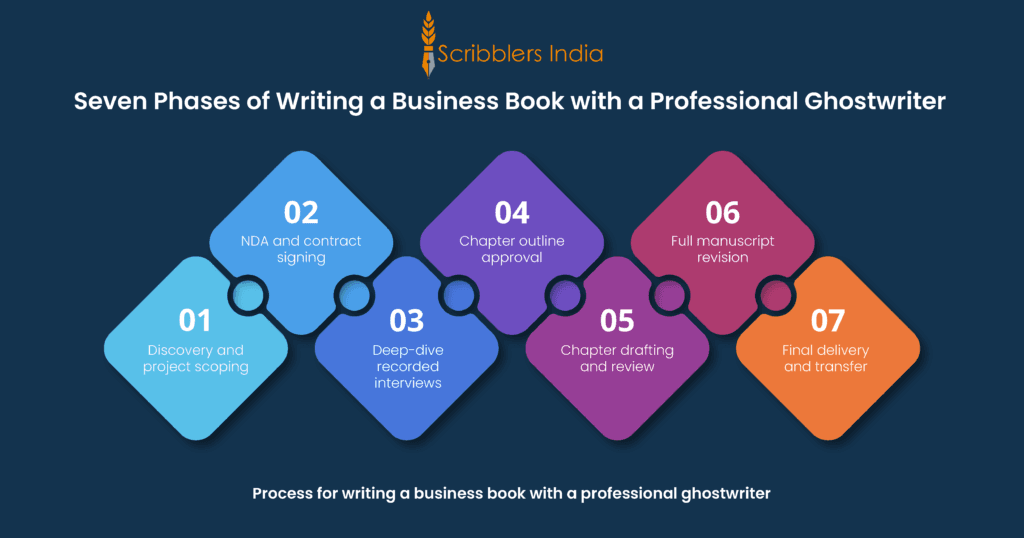
A professional engagement should establish a repeatable process for translating raw expertise into approved content. Professional ghostwriting services need more structure than receiving a topic and returning a finished document. The writer must first understand why the content exists, where the ideas come from, and what the author can credibly say.
Let’s have a look at a five-stage model that can be useful here:
- Set the objective and boundaries: Define the audience, desired professional association, content formats, publishing purpose, review responsibilities, and sensitive areas before drafting. A founder building category authority needs different editorial decisions from an executive preparing industry commentary or an expert developing a book.
- Capture the author’s knowledge: Interviews, presentations, emails, voice notes, existing articles, meeting observations, and internal documents can provide useful source material. The writer should first distinguish between firsthand experience and external claims that require verification, and identify gaps that warrant follow-up questions.
- Develop the argument before polishing prose: Raw expertise rarely arrives in publication order. The ghostwriter groups related ideas, tests the underlying logic, identifies missing evidence, and decides which examples strengthen the point. This stage separates substantive ghostwriting from polished transcript cleanup.
- Draft and calibrate the voice: Early drafts test both content and expression. The author should correct factual meaning, emphasis, certainty, vocabulary, and examples rather than merely adjusting isolated words. Specific feedback gives the writer useful evidence for future work.
- Preserve learning across future drafts: Recurring feedback should become part of a living editorial reference. Over time, repeated corrections should decrease as the writer comes to understand the author’s reasoning and boundaries more deeply. Longer projects can follow a more detailed book ghostwriting process.
How Can You Tell Whether a Ghostwriter Has Captured Your Voice?
Voice fidelity does not mean reproducing every pause, filler word, or spoken habit. The finished content should feel like a clearer version of how the author genuinely reasons and communicates. Strong ghostwriting preserves characteristic vocabulary, levels of certainty, explanatory habits, examples, and professional boundaries without turning them into caricatures.
A useful voice system is developed from evidence rather than from three adjectives. “Confident, knowledgeable, conversational” could describe thousands of executives. Existing emails, presentations, articles, meeting recordings, interviews, and direct feedback reveal much more about how someone explains difficult ideas.
Writers should also capture the author’s thinking patterns. Some executives begin with evidence before giving an opinion, while others start with a strong observation and then explain the reasoning. Some regularly use operational examples, while others prefer comparisons or short decision frameworks.
The guide should become more accurate over time. Preferred terms, disliked phrases, recurring beliefs, certainty boundaries, edits, examples, and sensitive areas can all be recorded. Later drafts should then require fewer voice corrections even as topics and formats change.
What Should Remain Human When Ghostwriting Uses AI?
AI can support parts of a modern ghostwriting workflow without becoming the source of the author’s expertise. Human judgment should still control professional positions, personal experiences, sensitive information, high-consequence claims, and final publication decisions. The distinction matters more than whether an agency describes its process as entirely human or AI-assisted.
Here is a practical division of responsibility:
| AI Can Support | Human Judgment Should Control | Why It Matters |
| Interview transcription | Meaning drawn from experience | Transcripts cannot determine which lesson matters |
| Organizing source notes | Professional opinions | Views must genuinely belong to the author |
| Grouping related ideas | Argument direction | Structure influences what the author appears to believe |
| Outline exploration | Sensitive examples | Context determines whether disclosure is appropriate |
| Repetition checks | Evidence selection | Strong claims require source judgment |
| Editorial analysis | Final approval | The named author remains accountable for publication |
The objective is source integrity, not the avoidance of technology for its own sake. A polished draft still fails when AI has manufactured the experience, opinion, or authority underneath it.
How Can Ghostwriting Support Executives Beyond Books?
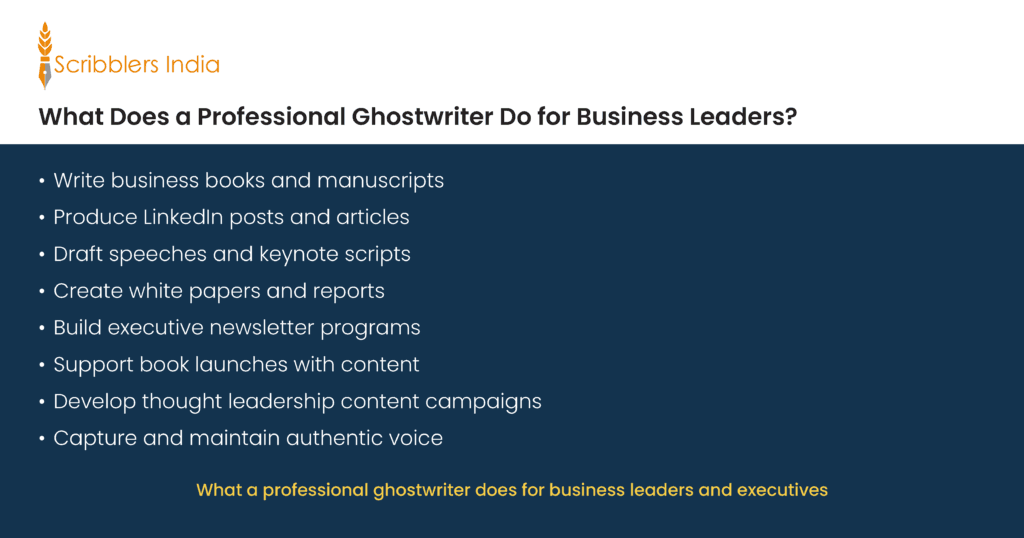
Books remain an important use case, but recurring executive communication creates a much wider role for professional ghostwriting services. One strong source conversation can sometimes support several distinct assets, with each format adding a different level of depth or serving another audience need. The objective should be adaptation rather than duplication.
- LinkedIn posts can introduce one sharp observation and invite professional discussion without compressing every supporting argument into a social format.
- Long-form articles can develop the reasoning further through evidence, examples, limitations, and practical implications for a more committed reader.
- Newsletters can connect recurring ideas with current developments while building a more direct relationship with an audience over time.
- Speeches can translate written thinking into spoken communication, with different pacing, transitions, examples, and requirements for audience interaction.
- Reports or ebooks can consolidate deeper intellectual assets when a topic deserves research, original frameworks, or a more permanent authority resource.
Recurring social publishing requires its own workflow, especially around source frequency and approval speed. Our LinkedIn ghostwriting agency guide covers this operating model in greater depth.
How Does Ghostwriting Strengthen Thought Leadership?
Ghostwriting strengthens thought leadership by making genuine expertise easier to publish without replacing the thinking behind it. The writer helps extract ideas and give them enough structure for others to evaluate. The author remains responsible for the underlying judgment, experience, and perspective that make those ideas worth reading.
This distinction matters because thought leadership has become common. Content Marketing Institute reports that 96% of B2B marketers create it, yet participation by internal experts remains limited in many organizations. The challenge is often accessing expertise consistently rather than finding another channel for generic marketing content.
The commercial relevance is also meaningful. Edelman and LinkedIn found that 56% of target buyers and 55% of hidden buyers use thought leadership during vendor evaluation. Hidden buyers may include finance, legal, compliance, procurement, or other stakeholders who never appear in a normal sales conversation.
A structured thought leadership content program can therefore give expert ideas a longer life. Ghostwriting handles editorial development, while positioning determines which ideas deserve to be repeatedly associated with the executive’s name.
Can Executive Ghostwriting Improve AI Search Visibility?
Executive ghostwriting can contribute to AI search visibility by creating more useful public information around a professional’s expertise. Articles, bylines, interviews, LinkedIn content, author pages, and credible external references can give search and AI systems more material for understanding who the person is and which topics are associated with them.
This should not be interpreted as a guarantee that publishing founder content will produce a ChatGPT mention or Google AI citation. AI visibility also depends on indexing, source availability, external corroboration, entity clarity, platform behavior, query context, and the broader information environment around the person or company.
Ghostwritten authority content becomes more valuable when it contains specific experience that generic AI-generated summaries cannot reproduce easily. Original frameworks, first-hand observations, research, defensible viewpoints, and well-supported explanations create stronger source material than another broad article covering familiar industry advice.
Teams can use an AI Search Visibility Scorecard to assess whether founder authority falls within a stronger visibility system. The wider assessment should also consider owned content, external references, answer readiness, entity consistency, and the quality of sources available across the web.
How Should Ghostwritten Content Support AEO and GEO?
Ghostwritten content can support AEO when executive knowledge is structured into direct, understandable answers to relevant questions. GEO expands the problem beyond one page by examining whether the person or brand appears consistently across sources that generative systems may use. Neither approach requires turning every founder article into formulaic search content.
Here are the key ways to connect the editorial work with search-led discovery:
- Make important answers self-contained: A reader should understand the executive’s conclusion without reading several preceding paragraphs. Direct answer blocks can help Answer Engine Optimization when the question naturally suits that structure, while deeper reasoning can follow below.
- Strengthen expert-entity clarity: Author biographies, company pages, LinkedIn profiles, bylines, and recurring subject associations should consistently describe the professional. Ghostwriting can reinforce those connections by publishing substantive material around areas the executive can credibly own.
- Create citation-worthy source material: First-hand observations, proprietary research, useful frameworks, detailed examples, and well-supported explanations give other publishers and retrieval systems stronger reasons to reference the content. Generic opinion pieces rarely create the same informational value.
- Extend authority beyond owned channels: Generative Engine Optimization also accounts for the broader source environment. Podcasts, interviews, media references, guest articles, customer evidence, and other credible third-party sources can reinforce expertise that self-published content first establishes.
The priority should remain useful human communication. AEO and GEO become stronger when the editorial structure makes genuine expertise easier to retrieve, verify, and understand, rather than by changing the author’s ideas to fit an artificial template.
How Should You Measure Professional Ghostwriting Quality?
Quality cannot be judged through writing polish alone. Professional ghostwriting services should reduce the author’s production burden while preserving source accuracy and improving the usefulness of published ideas. For recurring engagements, quality should become easier to observe over time because the writer accumulates context and revision effort should gradually fall.
A practical scorecard can include the following:
| Quality Dimension | What to Measure | Positive Signal |
| Source fidelity | Accuracy against interviews and approved inputs | Ideas remain traceable |
| Voice fidelity | Author corrections related to tone or meaning | Corrections decline over time |
| Argument quality | Depth and usefulness of reasoning | Draft adds interpretation |
| Evidence quality | Reliability of important external claims | Sources support actual wording |
| Editorial efficiency | Author review and rewrite time | Approval becomes easier |
| Content reuse | Value of source material across formats | Ideas adapt without duplication |
| Authority outcomes | Relevant engagement, citations, invitations | Content reaches useful audiences |
| Business relevance | Qualified conversations or opportunities | Visibility supports intended goals |
Not every article needs to produce a direct lead. Edelman’s research shows that thought leadership can influence people who never interact with sales directly, making authority and evaluation effects worth tracking alongside standard engagement metrics.

How Much Should Professional Ghostwriting Services Cost?
The cost depends on the amount of thinking and editorial work required rather than word count alone. Interview time, subject complexity, research, format, voice development, review intensity, writer experience, confidentiality requirements, and project duration can all change the scope. Comparing headline rates without comparing these inputs produces misleading conclusions.
Let’s have a look at the different pricing models you would have to choose from:
| Pricing Model | Usually Fits | Important Scope Question |
| Per project | Articles, reports, speeches, ebooks | What research and revision are included? |
| Milestone pricing | Books and larger intellectual assets | How are stages and approvals defined? |
| Monthly retainer | Recurring executive content | How much source capture and strategy are included? |
The dedicated guide to affordable ghostwriting services in India should own deeper pricing comparisons. This page only needs enough detail to help readers understand why apparently similar proposals may represent very different levels of work.
What Should a Professional Ghostwriting Agreement Cover?
A ghostwriting agreement should make responsibilities clear before sensitive ideas, interviews, or unpublished material begin moving between people and systems. Rights vary by engagement and jurisdiction, so important expectations should be recorded explicitly. A contract should address both the finished content and the source material created during the working relationship.
Review these areas before work begins:
- Scope and deliverables should clearly define formats, approximate volumes, research expectations, timelines, and services that fall outside the scope of the engagement.
- Payment and revision terms should explain changes, including milestones, feedback rounds included, extra work, cancellation, and delays due to approvals.
- Confidentiality provisions should cover sensitive source material, including recordings, transcripts, internal documents, unpublished arguments, and private professional information.
- Intellectual property terms should clarify ownership of final drafts, underlying research, voice guides, source files, and any reusable materials created during engagement.
- AI terms should explain tool boundaries when confidential inputs, interview material, or unpublished intellectual property could enter third-party systems.
- Handover provisions should protect continuity by specifying which files, recordings, research, editorial guides, and unfinished ideas are returned to the client afterward.
The newer guide on how to safely hire a ghostwriter in India covers due diligence and contract evaluation in greater depth. That page should remain the primary authority for procurement and risk questions.
When Should You Avoid Professional Ghostwriting Services?
A managed ghostwriting program is not automatically the right choice for every visible professional. It becomes difficult to justify when the source expertise remains weak, or the publishing need is occasional. Lighter editing, strategy, or AI-assisted writing may solve the actual problem at a lower cost and with lower complexity.
Here are the different situations in which you need to be careful:
- Your professional position is still unclear: A ghostwriter can sharpen real thinking but cannot manufacture durable expertise. If you are still deciding what you believe, who you serve, or which territory you want to own, positioning work should happen first.
- Writing helps you think: Some leaders use writing itself to clarify ideas. Fully outsourcing that process may remove something valuable. Research support, editing, or partial ghostwriting can preserve personal drafting while reducing lower-value editorial work.
- Your requirement is infrequent: A few speeches or occasional articles may not justify a managed program. Project-based support can provide sufficient depth without maintaining an ongoing system for interviewing, planning, and publishing.
- You expect expertise to be invented: Ghostwriters can research context and challenge incomplete arguments. They should not manufacture first-hand experiences, achievements, opinions, or professional positions for the client to present as genuine.
- Another business problem matters more: Authority content cannot compensate for unclear positioning, a weak offer, or poor customer fit. Addressing those foundations first will give a future ghostwriter stronger ideas and evidence to work with.
How Does Scribblers India Approach Professional Ghostwriting?
Scribblers India treats professional ghostwriting services as an expertise-extraction and editorial process rather than outsourced sentence production. We work with founders, executives, consultants, and subject experts who already have meaningful ideas but need a structured way to convert them into credible content across relevant professional formats.
Our approach develops through five connected areas:
- Start with the professional position: Before increasing output, we clarify what the person should become known for and which audiences matter. This keeps articles, LinkedIn posts, newsletters, speeches, or longer assets connected with one defensible area of authority.
- Extract thinking before drafting: Structured interviews, notes, previous communication, presentations, and approved internal material serve as sources. Good questions move beyond initial statements to uncover the examples, reasoning, disagreements, and practical observations that make the content specific.
- Build voice through repeated evidence: Early feedback helps refine vocabulary choices and argument patterns. It also identifies levels of certainty and editorial boundaries. The objective is not to copy spoken language exactly, but to make every draft feel consistent with how the professional thinks.
- Connect individual assets into authority: Our ghostwriting services can support LinkedIn content, articles, newsletters, speeches, ebooks, and related formats where the strategy calls for them. Strong ideas are adapted to each format rather than copied repeatedly.
- Extend visibility beyond publishing volume: Personal branding, thought leadership, AEO and GEO can connect executive content with wider professional discovery. The goal is a body of useful work that strengthens how relevant audiences understand the person, rather than a calendar filled with interchangeable posts.
Book a 1:1 consultation with our team to turn your expertise into clear, credible ghostwritten content that builds authority across search and professional channels.
Frequently Asked Questions
When are professional ghostwriting services worth the cost?
Professional ghostwriting services are worthwhile when valuable expertise is available, but consistent writing requires too much of senior time. They can also make sense when content carries reputational risk or requires in-depth research. Compare the fee with the time the service saves on writing, coordination, editing, and review.
What is the difference between a ghostwriter and an editor?
A ghostwriter can develop complete content from interviews, notes, recordings, research, or other source material. An editor usually starts with an existing draft and improves it. If your ideas are clear but you rarely produce drafts, ghostwriting is likely the better fit. If usable drafts already exist, editing may be sufficient.
How much input does an executive need to give a ghostwriter?
Enough input is required to establish genuine expertise, positions, examples, and professional context. Early engagements often require longer discovery interviews because the writer is still learning. As context accumulates, recurring source sessions can become more efficient, while existing materials and previous feedback reduce the need for repeated explanation.
Can a ghostwriter really match someone else’s voice?
A capable ghostwriter can become increasingly accurate by studying real communication and repeated feedback. Strong voice capture reflects vocabulary, argument patterns, examples, levels of certainty, and professional beliefs rather than superficial tone labels. The strongest signal is that later drafts require fewer corrections while still sounding natural across different formats.
Can ghostwriting support personal branding?
Yes. Ghostwriting can turn professional expertise into visible articles, posts, newsletters, and other authority assets. However, writing should sit inside a broader personal branding strategy that defines positioning and audience first. Publishing more cannot compensate for an unclear professional association.
Can professional ghostwriting use AI tools?
Yes, AI can assist transcription, note organization, outline exploration, or editorial analysis when appropriate. Human judgment should still control professional views, personal experiences, sensitive examples, evidence, and final approval. Clients should also understand whether confidential source material is entered into third-party AI systems during production.
Should one ghostwriter handle books and LinkedIn content?
The same writer can support both when they understand each format, but the operating models differ. Books require deeper structural development and longer review cycles. LinkedIn requires faster source capture, shorter approval loops, and stronger awareness of recurring public positioning. Evaluate relevant experience rather than assuming writing skill transfers automatically.
How can ghostwriting support AI search visibility?
Ghostwriting can create public, source-rich material that clarifies a professional’s expertise and recurring topics. That may support the information environment used during AI-led discovery. It does not guarantee citations or recommendations because external sources, indexing, entity clarity, query context, and platform behavior also influence visibility.