A founder can have strong opinions, years of experience, and useful stories without having time to turn them into LinkedIn posts every week. The difficult part is rarely finding something to say. It is capturing those ideas, developing them, and publishing them in a voice people recognize. A LinkedIn ghostwriting agency creates the system around that work.
The executive remains the source of expertise while writers handle interviews, research, drafting, editing, and content planning. The strongest engagements preserve the leader’s judgment rather than replace it with generic social content. This distinction has become crucial in 2026. LinkedIn is actively addressing low-effort AI content that sounds polished while offering little original perspective.
This guide explains how the process should work, which service model suits different requirements, what you should receive each month, and how to evaluate an agency before signing a retainer.
Key Takeaways:
|
What Does a LinkedIn Ghostwriting Agency Actually Do?
A LinkedIn ghostwriting agency helps founders and executives turn their knowledge into content published under their own names. The work can include positioning, interviews, idea development, research, writing, editing, content planning, and performance reviews. The leader supplies the expertise and retains final control over what becomes public.
This is different from sending a writer a topic and asking for ten posts.
Professional LinkedIn ghostwriting needs enough context to understand how the executive thinks. Writers need access to opinions, customer observations, industry experience, previous content, and current business priorities.
A useful division of responsibilities looks like this:
| The Executive Should Provide | The Ghostwriting Team Can Handle |
| Professional opinions and positions | Turning raw ideas into structured posts |
| First-hand experiences | Researching supporting context |
| Customer and market observations | Developing content angles |
| Examples from actual work | Drafting and editing |
| Sensitive-context decisions | Formatting and content sequencing |
| Final approval | Maintaining the publishing calendar |
The writer therefore works with existing expertise. They should never manufacture professional positions the executive would not defend in a real conversation.
This approach also connects naturally with LinkedIn personal branding. A recognizable public voice is more effective when the profile, content themes, and professional positioning reinforce one another. With the responsibilities clear, the next question is how raw executive knowledge becomes usable content.
How Does a LinkedIn Ghostwriting Agency Work?
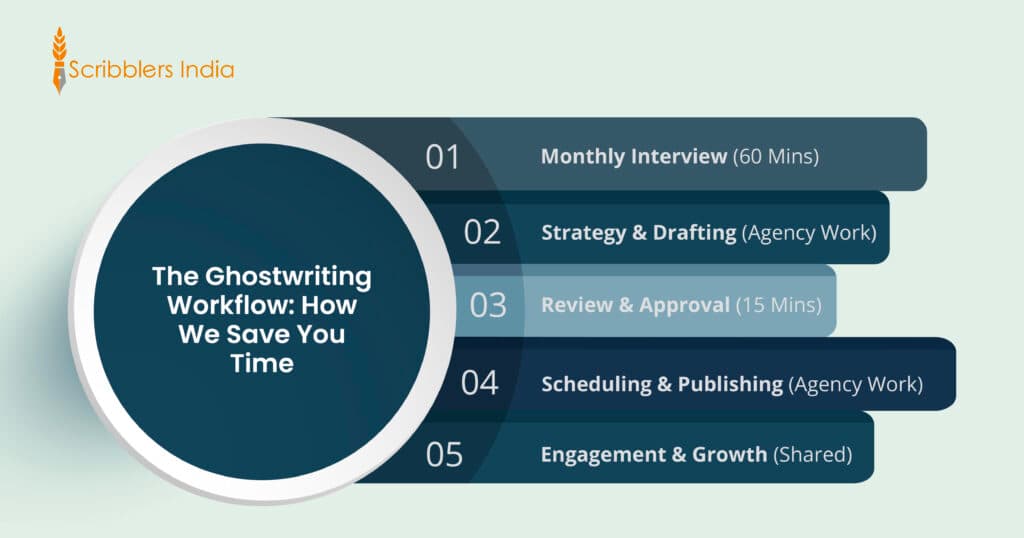
A capable LinkedIn ghostwriting agency should have a repeatable process for collecting ideas and improving them over time. The workflow usually requires more executive input during onboarding. Once the writer understands the voice, recurring source collection and batch approvals can make publishing easier to manage.
1. Define What the Executive Should Be Known For
Posting starts after positioning is clear.
A LinkedIn ghostwriting agency first identifies the executive’s audience, expertise, business context, and subjects worth owning. It should also define which topics sit outside the intended public position.
For example, a cybersecurity founder could build content around enterprise AI security, security operations, and emerging risk. Random leadership advice would add activity without strengthening that association.
A broader personal branding strategy can help establish these positioning decisions before regular LinkedIn publishing begins.
2. Capture the Executive’s Raw Knowledge
Interviews are among the most useful sources because executives often explain ideas better in conversation than in a blank document.
The writer can ask about recent customer discussions, decisions, failed assumptions, market shifts, internal debates, and professional opinions. Existing podcasts, presentations, articles, emails, sales calls, and conference appearances can add further context.
Published 2026 agency processes increasingly use detailed voice interviews during onboarding. Some describe initial voice-calibration sessions lasting around 60 to 90 minutes.
The duration will vary. The important point is depth. A five-question form rarely captures enough context for sustained executive ghostwriting.
3. Build a Working Voice Guide
Voice capture extends beyond labels such as “professional,” “friendly,” or “authoritative.”
A useful guide records how the executive explains ideas. It should capture preferred vocabulary, sentence patterns, recurring beliefs, examples, subjects to be avoided, and phrases the person would never use.
The guide should evolve as new drafts receive feedback. If every post requires the executive to rewrite entire sections, the system has not learned enough from previous reviews.
4. Develop Ideas Before Drafting Posts
Strong source material can produce several angles.
One customer conversation might lead to a market observation. A related operating decision could become a lesson for founders. The same underlying idea may later support an article or newsletter.
The agency should therefore maintain an idea bank rather than treating each publication date as a fresh search for a topic. Each idea also needs an editorial purpose. Some posts can explain expertise. Others can share a point of view or make a complex subject easier to understand.
5. Draft, Review, and Learn From Feedback
The first drafts establish the initial voice match. Executive feedback then becomes new information for the writer.
Comments such as “I would never say this,” “this example needs more context,” or “my position is stronger than this” should be included in the voice guide. Batch reviews can reduce repetitive approvals. The executive still retains final decision-making authority over what appears under their name.
Over several cycles, the goal is simple: the writer understands more context, while the executive needs fewer corrections. This learning loop is becoming especially valuable as LinkedIn fills with easily generated content.
Why Has LinkedIn Ghostwriting Become Harder in an AI-Saturated Feed?
LinkedIn is actively trying to reduce low-effort content that lacks real perspective. In May 2026, LinkedIn clarified its stance: AI can support writing, but posts and comments still need to reflect the member’s voice and expertise. Generic AI-like content may receive less distribution outside the member’s immediate network.
The Wall Street Journal reported in August 2026 that LinkedIn had also introduced a “seems like AI slop” reporting option and retired its AI-powered “enhance your post” feature.
This changes the job of a LinkedIn ghostwriting agency.
Producing polished sentences is becoming easier. Finding something specific enough to deserve professional attention remains difficult.
What Makes LinkedIn Content More Valuable in an AI-Saturated Feed?
- Firsthand observations: An executive can explain what customers are asking for today and where common assumptions fall short.
- Defensible opinions: Readers can learn what the person believes and why that position differs from conventional thinking.
- Specific examples: Real decisions, trade-offs, errors, and outcomes provide context that generic advice lacks.
- Professional judgment: Senior leaders often know when an argument needs qualification because they understand the underlying business environment.
- Editorial restraint: Some interesting information should remain private. An experienced writer needs to recognize confidentiality and reputation risks.
AI can still support parts of the workflow. The distinction lies in where human judgment remains necessary.
| AI Can Assist With | Human Input Should Control |
| Transcribing interviews | Professional opinions |
| Organizing research notes | First-hand experiences |
| Grouping related ideas | Interpretation of events |
| Testing alternative structures | High-consequence factual claims |
| Identifying gaps in a draft | Reputational and confidentiality decisions |
| Supporting editorial analysis | Final publication approval |
Our broader analysis of AI ghostwriting reaches the same conclusion: faster drafting increases the importance of source quality and editorial judgment. Once this principle is established, executives can compare the different ways to run the function.
Which LinkedIn Ghostwriting Model Fits Your Requirements?
Before hiring a LinkedIn ghostwriting agency, decide how much of the function you want to delegate. The market includes individual writers, managed agencies, growth-focused teams, internal employees, and AI-assisted workflows. Each model places different demands on the executive.
| Model | Where the Thinking Comes From | Who Develops the Content | Best Fit | Main Consideration |
| AI-assisted DIY | Executive | Executive with AI support | Leaders who still enjoy writing | Requires regular executive time |
| Freelance ghostwriter | Mainly executive | Individual writer | Stable, focused requirements | Continuity depends heavily on one person |
| Extraction-led agency | Executive interviews and source material | Writer plus editorial team | Founders building distinctive expertise | Requires meaningful onboarding input |
| Growth-led LinkedIn agency | Executive and marketing inputs | Content and growth team | Businesses prioritizing wider LinkedIn growth | Confirm how deeply founder voice is captured |
| In-house writer | Executive and company | Employee | High ongoing content volume | Requires sufficient work for a permanent role |
There is no universally stronger model.
A founder who already writes well may need an editor and AI-assisted workflow. Another executive may need a writer who conducts monthly interviews. A larger organization could benefit from internal ownership with external specialist support.
The buying question therefore shifts from “Who can write LinkedIn posts?” to “Which operating model removes the right work from my schedule?” This question should shape how you evaluate prospective agencies.
How Should You Evaluate a LinkedIn Ghostwriting Agency?
Evaluate a LinkedIn ghostwriting agency through the quality of its source collection, voice development, positioning, evidence standards, workflow, and measurement. Samples can show writing ability, but the engagement process tells you whether that quality can sustain beyond the first few posts.
The following six-part framework can make the comparisons easier.
1. Source Depth: Where Will the Ideas Come From?
Ask the agency to explain how it secures enough raw material to cover several months of content. Strong answers may include executive interviews, voice notes, existing presentations, customer observations, previous writing, podcasts, and internal source material. Be cautious when an agency promises a full content program after receiving little information from the executive.
2. Voice Continuity: How Will the Team Learn Over Time?
Find out who creates the drafts and how previous feedback is relayed to future writers. Ask whether the provider maintains a voice guide and how that document changes throughout the engagement. You should also know what happens when the assigned writer leaves.
3. Positioning: Is There a Clear Professional Association to Build?
An editorial calendar can remain full even as the executive’s public position remains unclear. Ask what themes the agency wants the market to associate with you after six months. The answer should connect with your expertise and professional objectives. For a broader authority program, our take on how a thought leadership agency works goes beyond positioning on LinkedIn.
4. Evidence Discipline: How Are Claims Checked?
Executives regularly discuss markets, regulation, technology, customers, and industry trends. Ask how the agency handles statistics and external research. It should also distinguish public evidence from the executive’s first-hand opinion. This becomes especially important in technical, financial, healthcare, and other high-consequence fields.
5. Workflow: How Much Executive Time Will Be Required?
Understand the complete monthly process before signing. Ask how often interviews occur, when drafts arrive, how revisions are managed, who schedules approved content, and what happens when an urgent topic appears. The objective is a predictable workflow that fits the executive’s schedule.
6. Measurement: What Happens After Publication?
Impressions can indicate exposure, but they cannot capture the full value of the program. Ask how the agency evaluates audience relevance, profile activity, inbound conversations, content themes, and eventual professional outcomes. This brings us to another procurement question that many service pages leave unclear: what are you actually buying each month?
What Should a LinkedIn Ghostwriting Agency Deliver Each Month?
A LinkedIn ghostwriting agency should provide more than a folder of finished posts. A managed program needs source material, strategic direction, approval records, and performance learning. The exact deliverables vary by package, although buyers should know which parts of the system they are paying for.
| Deliverable | Why It Is Useful |
| Executive interview or source-capture session | Supplies current ideas, experiences, and professional context |
| Idea bank | Preserves useful topics between publishing cycles |
| Voice guide | Records language preferences and editorial learning |
| Content calendar | Connects individual posts with broader themes |
| Draft posts | Converts source material into publishable content |
| Visual briefs where required | Gives designers the context behind carousels or supporting graphics |
| Batch approval system | Makes executive review easier to manage |
| Research or evidence records | Keeps important external claims traceable |
| Monthly performance review | Shows which topics and audiences deserve further attention |
Packages can also include profile optimization, scheduling, comment support, analytics, or wider content repurposing.
Confirm these items explicitly. Two agencies offering “12 posts per month” can provide very different levels of research and strategic support behind those posts. The same principle applies to price.
How Much Does a LinkedIn Ghostwriting Agency Cost?
There is no reliable standard price for a LinkedIn ghostwriting agency because service scopes differ widely. A package covering drafting alone should cost differently from one that includes positioning, interviews, research, visuals, profile work, publishing support, and performance analysis.
Current 2026 pricing guides also show large differences between freelance writers and managed agency programs. Instead of comparing the headline retainer, compare these factors:
| Cost Driver | Why It Changes the Price |
| Posting volume | More posts require more development and review capacity |
| Interview frequency | Deeper source capture requires senior editorial time |
| Research intensity | Evidence-led or technical posts require additional verification |
| Writer seniority | Experienced executive writers usually command higher fees |
| Strategy support | Positioning and content planning extend beyond drafting |
| Visual content | Carousels and custom graphics add design work |
| Publishing support | Scheduling or account management expands operational scope |
| Performance analysis | Deeper reporting adds strategy and review time |
For broader cost evaluation, our analysis of affordable ghostwriting services in India explains why internal editing time and weak source capture can make a cheap proposal expensive. Price tells you what the provider charges. The following warning signs indicate the risk behind that number.

What Are the Red Flags When Hiring a LinkedIn Ghostwriting Agency?
A LinkedIn ghostwriting agency should be able to explain where ideas come from, who writes the content, how claims are checked, and how the executive stays in control. Vague answers in these areas often become larger problems after regular publishing begins.
Look closely at these warning signs:
- The agency needs almost no executive input. Distinctive thought leadership requires access to genuine expertise and experience.
- Nobody explains who writes your posts. You should know how writer assignment and editorial review work.
- Every client sounds similar. Different executives should retain different language, viewpoints, and professional personalities.
- The provider guarantees virality or leads. Distribution and commercial outcomes depend on factors outside editorial control.
- Research standards remain unclear. Claims published under an executive’s name need defined verification responsibilities.
- Account access is broader than necessary. Understand exactly which permissions the agency needs and why.
- Feedback disappears after each review. Repeated corrections suggest the voice system is failing to learn.
- There is no handover process. Your voice guide, approved themes, and relevant source context should remain usable after the engagement.
A paid pilot can help when the long-term fit remains uncertain. Give the writer real source material and enough context to develop several posts. Then assess voice accuracy, thinking quality, and the amount of editing you still need to perform.
The same assessment should continue after the engagement begins.
How Should You Measure the ROI of LinkedIn Ghostwriting?
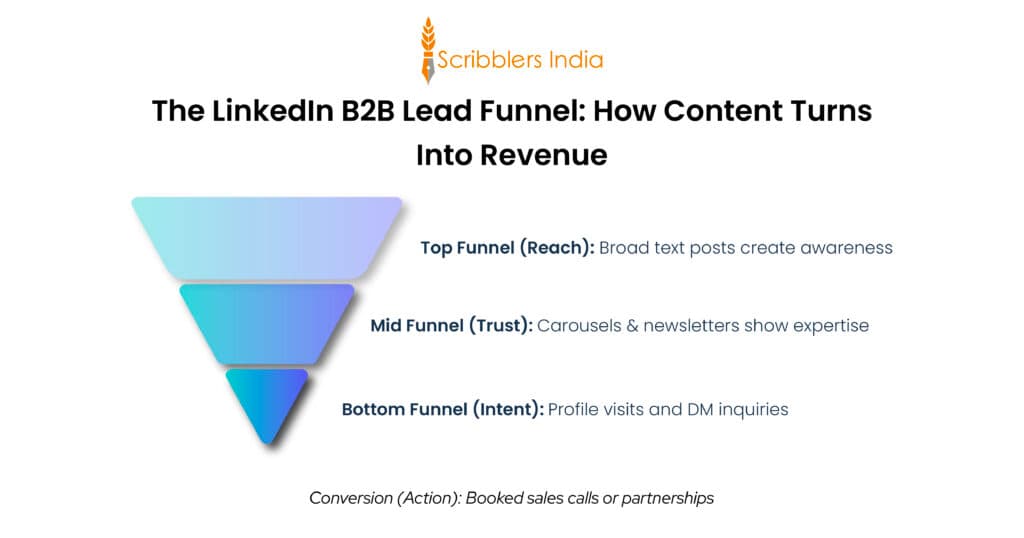
The ROI of a LinkedIn ghostwriting agency should be measured as a progression from discovery to professional response. Start with exposure, then evaluate whether relevant people visit the profile, engage with the ideas, start conversations, and eventually create measurable business or career outcomes.
A useful measurement path is:
Exposure → relevant profile activity → audience quality → conversations → opportunities → attributable outcomes
Each stage answers a different question.
| Stage | What to Review |
| Exposure | Impressions and reach trends |
| Professional curiosity | Relevant profile visits and search activity |
| Audience quality | Roles, industries, companies, and seniority engaging with content |
| Conversation | Useful comments, DMs, introductions, and discussion requests |
| Opportunity | Sales conversations, media requests, partnerships, hiring interest |
| Outcome | Opportunities with credible attribution to LinkedIn activity |
A smaller post can still perform valuable work when the right decision-maker reads it. Large reach can produce limited business value when the audience sits outside the executive’s professional goals.
This is why no single LinkedIn metric should represent the whole program. Our detailed guide to personal branding ROI explains how visibility, audience relevance, authority, and business outcomes can be measured together.
Measurement also helps reveal whether you need an agency at all.
Who Should Hire a LinkedIn Ghostwriting Agency?
Ghostwriting becomes useful when the executive already has expertise worth sharing and writing has become the bottleneck. It also suits leaders whose public content is sufficiently important to warrant consistent research, editing, and voice management.
Consider agency support when:
- You have valuable expertise but struggle to publish it consistently.
- Your LinkedIn presence plays a role in professional discovery or reputation.
- Several people currently chase you for content inputs every month.
- Drafting takes time away from work where your involvement creates greater value.
- Your subject requires careful research or editorial review before publication.
- You want one professional voice to remain consistent across recurring content.
Some executives need lighter support. If you enjoy writing and can protect the time, an editor may be enough. AI-assisted workflows can also help people who already know what they want to say and can review every draft carefully.
A professional ghostwriter becomes more useful when the central challenge is extracting and developing the thinking itself.
What Should Happen if You Stop Working With the Agency?
A clean exit process protects the knowledge accumulated during the engagement. Before signing, clarify what happens to your voice guide, approved content pillars, interviews, recordings, transcripts, research, unpublished drafts, and idea bank.
You should also understand whether the provider stores credentials or other account information and how that access is removed. The handover should provide an internal team or a future writer with enough context to continue without having to rebuild the entire system.
This question rarely receives much attention during sales conversations. It becomes important after months of interviews and editorial learning have created a detailed record of how an executive communicates.
How Does Scribblers India Work as a LinkedIn Ghostwriting Agency?
Scribblers India works as a LinkedIn ghostwriting agency for founders, CXOs, consultants, and B2B experts who want to turn their professional knowledge into consistent executive content. Our work begins with the person’s expertise and positioning before we develop posts around it.
We use interviews, existing content, research, and other approved source material to understand how the executive thinks. The editorial team then develops themes and drafts around subjects the person can credibly own.
Our process includes:
- Positioning before publishing: We clarify the audience and professional themes before building the regular content calendar.
- Executive source capture: Interviews and existing materials give writers enough context to develop specific ideas.
- Living voice documentation: Feedback from approved drafts improves future content and reduces repeated corrections over time.
- Evidence-led editing: Research-backed claims are reviewed before appearing under the executive’s name.
- Multi-format thinking: Strong LinkedIn ideas can inform articles, newsletters, reports, or other authority assets when deeper treatment makes sense.
- Performance review: We examine audience response and professional outcomes to improve future topic selection.
This approach also connects LinkedIn with our wider ghostwriting services, thought leadership, and personal branding agency work.
The goal is to help the executive build a recognizable body of public thinking while keeping the source of that thinking firmly rooted in their own experience.
If you need a structured LinkedIn ghostwriting program, connect with our team to discuss your current content process and the level of support you need.
Frequently Asked Questions (FAQs)
What should a LinkedIn ghostwriting agency ask during onboarding?
The agency should ask about your audience, professional position, expertise, current priorities, previous content, and views on important industry questions. It should also understand which subjects you avoid publicly. Good onboarding gathers enough source material to guide the first drafts while laying the foundation for future voice and editorial decisions.
How much time should I give a LinkedIn ghostwriting agency?
A LinkedIn ghostwriting agency usually needs more input during onboarding because the writer must learn your expertise and communication style. Ongoing involvement can then focus on interviews, source sharing, and batch approvals. The exact requirement depends on publishing volume and subject complexity. Ask for a clear monthly workflow before signing.
Should the same ghostwriter work with me every month?
Writer continuity can improve voice accuracy because the person accumulates context through interviews and feedback. Agencies can also use robust documentation to ensure continuity when teams change. Ask who owns your voice guide, how editorial knowledge is stored, and how a replacement writer would learn the account if required.
What happens if my assigned LinkedIn ghostwriter leaves?
The agency should have a handover process covering your voice guide, previous feedback, approved themes, source material, and active content plans. A replacement writer should review this context before drafting. Ask about this process during procurement because relying entirely on one person’s memory creates avoidable continuity risk during longer engagements.
How can I tell if my LinkedIn content sounds overly AI-generated?
Look for broad claims, repeated structures, generic leadership lessons, exaggerated openings, and ideas that could belong to almost any executive. Strong content includes details related to your actual work and opinions. LinkedIn itself is taking steps against low-effort AI content, so specific expertise and human editorial judgment deserve greater attention.
Should an agency post directly from my LinkedIn account?
Direct publishing can reduce operational work, although you should decide whether it is necessary for your engagement. Understand which permissions the agency receives, who can access the account, and how access is revoked later. Many executives prefer to approve final content before publishing, with responsibilities moved to an internal or external team.
How do I compare a freelancer, agency, and AI tool for LinkedIn ghostwriting?
Start with the work you want to remove from your schedule. AI supports leaders who still enjoy developing and reviewing content. Freelancers suit focused requirements with direct writer access. Agencies become more useful when you need source extraction, editorial coverage, strategic planning, and continuity across a recurring publishing program.
What assets should I keep when a LinkedIn ghostwriting engagement ends?
Keep approved drafts, unpublished ideas, your voice guide, content pillars, interview transcripts, source documents, and relevant research records where your agreement permits. Remove unnecessary third-party account access as well. These materials help internal teams or future writers preserve editorial context and reduce the need to repeat the entire onboarding process.