Building a strong professional reputation online is largely a matter of sequencing. Publishing more content cannot solve unclear positioning, while an impressive profile carries limited weight without credible proof. Expanding across several platforms also creates unnecessary work when the people you need to influence concentrate elsewhere.
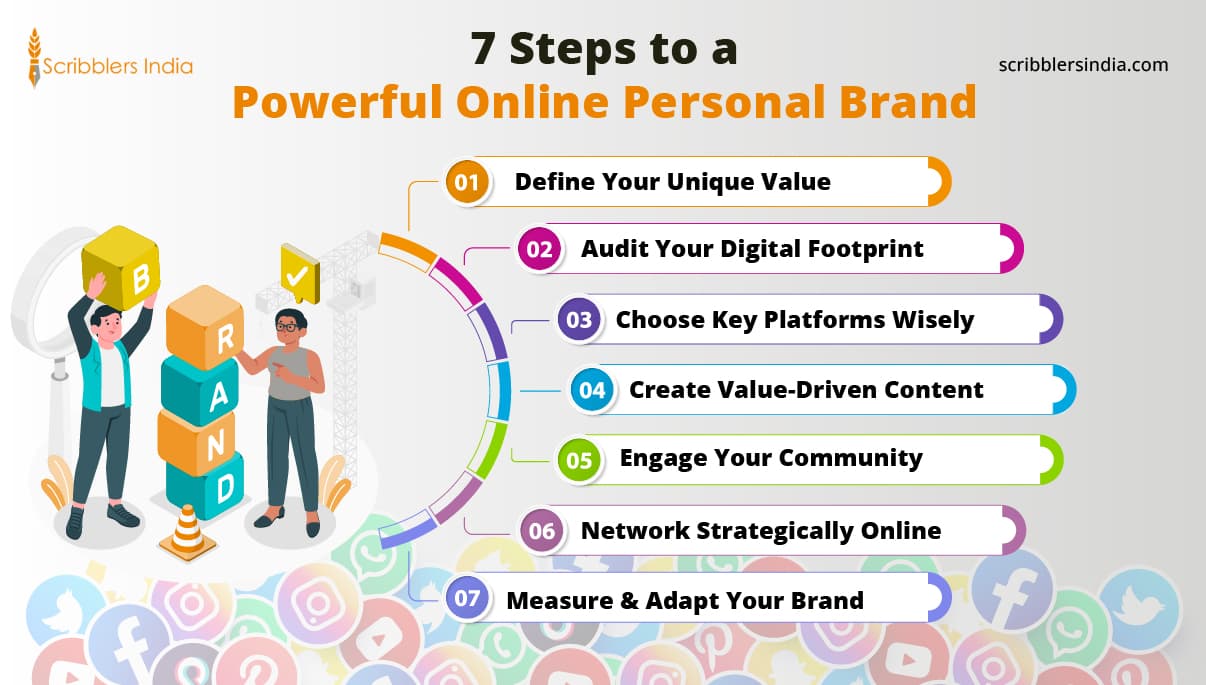
The practical approach to how to build personal brand online starts with understanding what people can already discover about you. You can then define the reputation you want, strengthen the evidence supporting it, choose appropriate channels, publish useful ideas, build relevant relationships, and improve discoverability across search.
This guide on how to build personal brand online focuses on that complete operating system rather than individual platform tactics. If you are still evaluating the broader business or career case, start with our analysis on why personal branding is important. The process below begins once you have decided to invest in your reputation.
Key Takeaways
|
How Should You Audit Your Digital Footprint Before You Build Personal Brand Online?
Before you build personal brand online, establish what people can already find and what those results communicate. Any practical approach to how to build personal brand online should begin with search results, major profiles, employer pages, author pages, published work, and prominent third-party mentions.
Compare that public footprint with the professional association you want to strengthen. Look for outdated information, conflicting descriptions, weak proof, useful existing assets, and prominent pages that no longer reflect your present role, expertise, audience, or professional direction.
What Should a Personal Brand Audit Review?
Start by searching for your full professional name and inspect the first several result pages. Then review the assets most likely to influence someone evaluating you for a role, project, partnership, speaking opportunity, media request, investment conversation, or professional recommendation.
| Audit Area | What to Review | Common Problem |
| Identity | Current name, title, company, and role | Prominent profiles conflict |
| Positioning | Expertise emphasized across visible assets | Each platform tells a different story |
| Biography | Current experience and specialization | Old career stages remain prominent |
| Proof | Work, results, research, recommendations | Claims have little visible support |
| Content | Subjects repeatedly associated with your name | Publishing covers unrelated themes |
| Third-Party Pages | Events, publications, podcasts, directories | Important information is outdated |
Prioritize high-visibility inaccuracies rather than trying to clean every historical mention. A dated conference biography that still ranks prominently deserves more attention than an obscure directory listing. The audit should finish with three practical decisions: which assets to keep, which to update, and which to de-emphasize.
Useful content, interviews, recommendations, case evidence, speaking videos, or research may already support the reputation you want. Identifying these assets before creating new material is an important part of how to build a personal brand online efficiently as it prevents unnecessary duplication and provides stronger evidence for later profile updates.
What Type of Reputation You Need Before Building Personal Brand Online?
A useful personal branding strategy starts with the association you want relevant people to make with your name. Understanding how to build personal brand online becomes easier once the audience, expertise territory, contribution, and supporting evidence are clear enough to guide later execution.
Positioning should be narrow enough to guide recognition without reducing your career to one skill. Choose the association that should lead now, while your biography, experience, portfolio, and broader content provide additional context after people understand the main professional territory.
Who Should Your Personal Brand Influence?
Define the people whose decisions your reputation needs to influence. A consultant may prioritize buyers facing one recurring problem, while a founder may need credibility with customers and industry peers. An executive may communicate simultaneously with employees, customers, board members, investors, and professional communities.
Audience definitions such as “professionals” or “business leaders” usually provide too little direction. A clearer audience helps determine what proof deserves prominence, which questions your content should answer, where you should publish, and which relationships should receive consistent attention over time.
What Expertise Should People Associate With Your Name?
Ask what someone should confidently approach you about after encountering your work several times. “Marketing” yields weak recall, while “category positioning for technical B2B companies” provides a more useful anchor for the reputation, guiding profile language, content topics, speaking opportunities, and professional introductions.
Once the territory is clear, translate it into a concise positioning idea. Our guide to personal brand statements explains in detail how to write such a statement, while this hub uses it as the strategic source for the broader online reputation system.
Where Should Your Online Personal Branding Home Base Live?
A strong online personal branding system needs one dependable place where people can understand your position, inspect proof, and take a logical next step. In how to build personal brand online, that home base may be a personal website or strong professional profile, depending on the level of control required.
The better decision is not website versus social media. Think in terms of owned and rented presence. Owned assets preserve long-term control, while established platforms provide discovery and network access. Most professionals benefit from combining both without building more infrastructure than they can maintain.
A useful home base normally needs three things: a current professional biography, visible evidence of expertise, and a clear next step. LinkedIn can handle these for simpler requirements, while a website is more useful when you need deeper control over proofing, long-form work, or inquiries.
Do You Need a Personal Website to Build Personal Brand Online?
You do not need a website simply because personal-brand advice recommends one. A site becomes valuable when it gives you control that existing profiles cannot provide, such as organizing case evidence, long-form ideas, speaking information, a portfolio, media resources, or a durable inquiry route.
Professionals with simpler needs can build personal brand online through LinkedIn, an employer biography, strong author pages, and selective external contributions. Add a website when it solves a clear ownership or proof problem, rather than because another domain makes the brand look more complete.
Which Channels Help You Build Personal Brand Online Most Effectively?
Choose channels according to audience fit, content fit, proof potential, sustainable effort, control, and discoverability. A useful answer to how to build personal brand online usually starts with one primary platform, one dependable home base, and a small number of supporting channels.
| Decision Factor | Question to Ask |
| Audience Fit | Are the people I need to influence active here? |
| Format Fit | Can my expertise be communicated naturally through this channel? |
| Proof Potential | Can people verify important professional claims here? |
| Sustainable Effort | Can I maintain useful activity with available resources? |
| Control | How dependent is the asset on another platform? |
| Discoverability | Can relevant people find useful material later? |
Is LinkedIn Enough to Build Personal Brand Online?
LinkedIn can be enough as the primary active channel for many B2B professionals, founders, and executives, especially when it is backed by stronger evidence elsewhere. The platform can support profile discovery, publishing, professional relationships, and visible recommendations without requiring the professional to maintain several daily social channels.
Detailed LinkedIn execution belongs on our LinkedIn personal branding guide. The wider question of how to build personal brand online is broader because LinkedIn still needs to connect with positioning, proof, search results, third-party validation, and professional opportunities outside the platform.
What Proof Do You Need to Build Personal Brand Online Credibly?
Professional proof allows people to verify the position you communicate. A credible approach to building a personal brand online should connect important claims to visible experience, documented outcomes, original thinking, recommendations, credentials, research, speaking appearances, or other relevant third-party evidence.
Different professional goals need different evidence. A consultant benefits from case studies and recommendations, while an executive may rely more on operating experience, industry commentary, or speaking invitations. Technical specialists can demonstrate expertise through projects, research, detailed explanations, and recognized professional credentials.
What Should Your Personal Brand Proof Library Include?
Organize proof around the claims you make publicly. Experience proof can include roles and operating environments; outcome proof can show documented results; intellectual proof can include research or frameworks; and third-party proof can include recommendations, media mentions, interviews, or speaking invitations.
Place the strongest evidence close to the claim it supports. If your profile positions you in enterprise AI governance, the Featured section, website, author page, or content library should quickly surface relevant research or project context that gives visitors concrete material to evaluate.
This relationship between positioning and evidence is central to how to build personal brand online without relying on self-description. Scribblers India’s personal branding case study for a study abroad consultant shows how positioning, content, profile development, and distribution can reinforce one another across a wider reputation system.
How Should a Personal Branding Strategy Turn Expertise Into Content?
A sustainable personal branding strategy builds content from real professional work rather than an empty weekly calendar. For how to build personal brand online, customer questions, decisions, research, recurring problems, industry changes, presentations, and informed disagreements provide stronger source material because audiences can connect them with real expertise.
The workflow should move from source capture to question development, argument building, format selection, publishing, and selective repurposing. This sequence helps professionals build personal brand online around useful expertise rather than reacting to platform trends that may generate attention without strengthening the intended professional association.
Where Should Personal Brand Content Ideas Come From?
Capture questions clients ask repeatedly, decisions that required judgment, useful research, recurring misconceptions, conference notes, operating lessons, or changes in your field. Store these inputs in a single, simple system so that content development starts from accumulated expertise rather than a blank-page brainstorming session every week.
Turn each source into a question the intended audience genuinely needs answered. “Five AI Trends” gives the author a limited role, whereas “Why do successful enterprise AI pilots stall during production governance?” allows for specialist experience, evidence, examples, limitations, and practical recommendations.
How Often Should You Publish Personal Brand Content?
There is no universal cadence. A senior executive may publish fewer, deeper pieces, while a consultant may have enough recurring customer questions to publish more often. The better standard is whether the system can sustain useful ideas without lowering research, evidence, or editorial quality.
Repurpose strong ideas when another format solves a different communication need. One article can support a framework, a newsletter section, a shorter argument, or a presentation slide. The source idea stays consistent while each version should add enough context to justify publishing it separately.
How Do Relationships Help You Build Personal Brand Online?
Publishing alone rarely creates enough distribution to build personal brand online. A complete approach to how to build personal brand online also involves peers, buyers, collaborators, experts, journalists, associations, conference organizers, and communities that can carry useful ideas into networks you do not directly control.
Map the relationships most relevant to your objective and participate where your expertise can improve a conversation. Useful participation may include answering a question, adding evidence, recommending someone else’s work, making an introduction, or contributing a perspective that helps the group understand a difficult issue clearly.
How Does Personal SEO Help You Build Personal Brand Online?
Personal SEO improves how clearly your professional identity appears in search results. It strengthens how to build personal brand online by keeping names, roles, expertise descriptions, author pages, employer biographies, published articles, and important external profiles aligned enough to reduce confusion.
This part of how to build personal brand online should focus on identity clarity rather than keyword repetition. Build substantive pages containing useful professional information, connect published work with identifiable author profiles, keep major biographies current, and periodically review prominent search results for outdated or misleading information.
What Should an Author Page Include for Better Personal SEO?
A useful author page should identify the person, explain their current role and expertise, surface relevant work, and provide enough context to distinguish them from others with similar names. It should serve readers first rather than exist mainly to carry structured data.
Google supports ProfilePage structured data for pages primarily focused on one person or organization, including author and employee pages. The markup describes visible information, while correct implementation does not guarantee a particular search appearance.
Can Your Personal Website Appear in ChatGPT Search?
Public websites can appear in ChatGPT Search when they are accessible and relevant. OpenAI currently advises publishers who want their content discoverable, surfaced, and cited to ensure they are not blocking OAI-SearchBot, while also making clear that placement in search results is not guaranteed.
For professionals considering how to build personal brand online, the implication is practical. Maintain useful public pages, keep information accurate, connect expertise with supporting evidence, and avoid thin pages created only for AI search discovery. Stronger identity signals start with better public information rather than a separate artificial “AI profile.”
How Should You Measure an Online Personal Branding Strategy?
Measure online personal branding against the professional outcome the system should support. The measurement side of how to build personal brand online should separate discovery, audience quality, authority, conversations, and opportunities because each represents a different stage of reputation growth.
A consultant seeking qualified inquiries should evaluate different outcomes from an executive seeking board visibility. Use the original objective to determine which leading signals deserve attention and which professional responses represent meaningful progress rather than selecting metrics simply because a platform makes them easy to report.
| Personal Brand Goal | Useful Leading Signals | Potential Outcome Signals |
| Build Specialist Recognition | Relevant searches, readership, peer response | Speaking requests, citations, expert inquiries |
| Generate Consulting Demand | Target-account engagement, profile visits, case activity | Qualified inquiries, referrals |
| Support Career Progression | Search visibility, recruiter activity, network quality | Interviews, senior role conversations |
| Build Executive Visibility | Stakeholder reach, thought-leadership response | Board, media, partnership invitations |
| Strengthen Founder Reputation | Buyer-relevant engagement, category conversations | Partnerships, customer or investor opportunities |
Measurement should change future decisions. If one subject consistently attracts relevant professional conversations while another generates broad low-value reach, the content strategy should become more selective. Detailed attribution belongs in our personal branding ROI guide, which separates visibility from financial return.
How Can Scribblers India Help You Build Personal Brand Online?
At Scribblers India, we approach the process of how to build personal brand online as a coordinated reputation system rather than a social-media publishing exercise. We begin with positioning, audience priorities, digital assets, and professional proof before deciding which channels and content formats deserve sustained investment.
Our personal branding services can connect profile development with thought leadership, ghostwriting, long-form content, search visibility, and measurement. This keeps LinkedIn, websites, author pages, media opportunities, and published ideas aligned around a recognizable professional association rather than separate content calendars.
We also help professionals use real expertise as the source of their content. Interviews, research, operating experience, and recurring audience questions can become useful assets without forcing an unsustainable publishing routine. Professionals starting small can also use our zero-followers personal branding analysis to prioritize proof and distribution.
Talk with our experts to build a personal brand online around clear positioning, credible proof, useful content, and stronger professional discovery.
Frequently Asked Questions
How long does it take to build personal brand online?
There is no fixed timeline because reputation depends on the starting point, audience, credibility, content quality, distribution, and professional objective. Early work should create a coherent system, while stronger recognition usually develops through repeated exposure to credible expertise over several months.
Do I need a personal website to build personal brand online?
No. You can build personal brand online without a personal website when LinkedIn, employer pages, author profiles, or other assets provide enough professional context and proof. A website becomes useful when you need greater control over long-form content, portfolio material, speaking information, or inquiry routes.
Is LinkedIn the best platform for online personal branding?
LinkedIn is particularly useful for many B2B professionals, founders, consultants, and executives. It combines professional profiles, publishing, networking, and AI search visibility. The best platform still depends on audience behavior and format fit. So, channel selection should follow professional objectives rather than universal platform recommendations.
How often should I publish to build a personal brand?
Publish often enough to maintain a credible flow of useful ideas without lowering research or editorial quality. A senior executive may publish less often than a consultant with recurring client questions. Sustainable consistency is more valuable than an aggressive cadence that produces repetitive material.
How do I build a personal brand if several people share my name?
Use consistent identifiers across prominent assets, including your full name, role, company, expertise, photograph, and relevant profile links. A substantive author or personal page can add context to your identity and help searchers distinguish your work from that of others with the same name.
Can I build a personal brand without posting on social media?
Yes. Articles, research, speaking, newsletters, podcasts, professional communities, media contributions, author pages, and direct relationships can all support a personal brand. Social platforms can improve distribution, although the wider reputation system should reflect where your intended audience discovers and evaluates professional expertise.
How do I know whether my personal branding strategy is working?
A personal branding strategy is working when relevant audiences increasingly associate your name with the intended expertise, and that recognition creates useful responses. Track discovery, audience quality, authority signals, professional conversations, invitations, referrals, and other outcomes connected with the original career or business objective.
What should I update first when my personal brand feels inconsistent?
Start with the assets people are most likely to encounter. This includes search results, LinkedIn, your current employer biography, website or author page, and prominent third-party profiles. Align the current role, expertise territory, evidence, and contact path before expanding content production or adding another social platform.