AI search visibility shows whether AI platforms mention, describe, recommend, or cite your brand when users ask relevant questions. It covers discovery across Google AI features, ChatGPT Search, Perplexity, Gemini, and other answer-led platforms where buyers now research brands before visiting websites.
This visibility matters because generated answers can shape early awareness, comparisons, and shortlists. A brand may appear during category research, problem-solving, vendor evaluation, or final validation. However, appearance alone does not prove that the platform described the brand correctly or cited the right source.
This glossary explains how AI search visibility works, which metrics matter, and how brands can improve it through AEO, GEO, content strategy, personal branding, and credible authority-building. It also explains why repeatable measurement matters more than occasional manual searches.
Key Takeaways
|
What is AI search visibility meaning?
AI search visibility measures how often and how accurately a brand appears inside AI-generated answers for relevant prompts. It includes direct mentions, recommendations, linked citations, and descriptions. Strong visibility means the brand enters useful buyer conversations before users visit its website.
AI search platforms do not present one fixed list of ten organic results. They create answers using retrieved sources, model behavior, user context, and prompt wording. Brands must therefore evaluate both the appearance rate and the quality of representation instead of treating every mention as positive.
A company may receive visibility without a citation to its website. Another may receive a citation without being recommended as a provider. This difference makes AI citations, brand mentions, and recommendation context separate parts of the same visibility review.
Why does AI search visibility matter for brands?
AI search visibility matters because generated answers can influence awareness, trust, and shortlisting before users reach a company website. Brands that appear accurately in relevant answers can shape early consideration. Brands absent from those answers may lose influence even when traditional rankings remain strong.
OpenAI reported more than 900 million weekly active ChatGPT users and over 9 million paying business users in February 2026. That scale shows why conversational discovery has become relevant for both consumer and professional research journeys.
Google also introduced dedicated Search Console generative AI performance reports in June 2026. These reports give eligible site owners dedicated views of impressions from AI Overviews, AI Mode, and generative AI features in Discover.
Visibility also matters because clicks may not reflect total influence. A 2026 study on Google AI Overviews and Wikipedia estimated that exposure to AI Overviews reduced daily traffic to English Wikipedia articles by about 15%. This reinforces the need to measure citations, mentions, and zero-click influence.
For brands, the message is clear. AI search visibility is not only a traffic question. It is a discovery, authority, positioning, and measurement question that sits beside SEO, AEO, GEO, and content strategy.
How is AI search visibility different from traditional SEO?
SEO measures how pages perform within conventional search results, while AI search visibility measures how brands appear inside generated answers. The two areas share technical and content foundations. However, their outputs differ because generated answers can influence users without producing a ranking or click.
- Search result format: SEO usually tracks pages within ranked search results. AI visibility tracks mentions, citations, descriptions, and recommendations inside synthesized answers across answer-led platforms.
- Primary unit: SEO uses keywords, pages, positions, impressions, and clicks. AI visibility uses prompts, answer sets, brand inclusion, cited URLs, and recommendation context across repeated checks.
- Competitive comparison: SEO compares ranking positions for chosen keywords. AI visibility compares brand presence, answer accuracy, and competitor inclusion across stable prompt libraries and relevant platforms.
- Content outcome: SEO aims to earn discoverability and qualified visits. Answer engine optimization services also prepare content for direct extraction within answers.
- Authority signals: Traditional SEO values crawlability, relevance, links, and content quality. Generative engine optimization extends the review across entity clarity, external authority, and source depth.
Google states that established SEO practices remain relevant for AI Overviews and AI Mode. It also says there are no additional special requirements for inclusion, which means strong SEO foundations still matter for AI search visibility.
Where can a brand gain AI search visibility?
Brands can gain AI search visibility across answer-led platforms where users ask questions, compare options, or validate decisions. Each platform has different source patterns and interface rules. A complete visibility review should focus on the channels that influence the brand’s actual buyers.
| Platform or Surface | Visibility Opportunity | What Brands Should Review |
| Google AI Overviews | Summary visibility and supporting links | Cited pages, answer accuracy, impressions |
| Google AI Mode | Conversational discovery inside Search | Prompt coverage and source inclusion |
| ChatGPT Search | Brand mentions and cited sources | Referral traffic, cited URLs, answer context |
| Perplexity | Research-style answers with citations | Source visibility and competitor presence |
| Gemini | Conversational discovery and web-informed answers | Brand descriptions and topic associations |
| Copilot | Workplace and browser-linked discovery | Professional queries and source context |
| YouTube or video search | Visual explanation visibility | Video titles, transcripts, and usefulness |
| LinkedIn and expert content | Public expertise signals | Founder visibility and topic consistency |
| Review platforms | Third-party validation | Sentiment, descriptions, and category fit |
| Industry publications | External source authority | Mentions, bylines, and cited claims |
Google explains that AI Overviews and AI Mode may use query fan-out to issue related searches across subtopics and data sources. This means a brand can gain visibility through supporting content that answers narrower questions within a larger user prompt.
Platform coverage should follow audience behavior. A B2B services firm may prioritize Google, ChatGPT, Perplexity, and LinkedIn. Another category may need different coverage based on customer interviews, analytics, sales calls, or referral evidence.
Which metrics measure AI search visibility?
No single number can explain how AI systems represent a brand. Teams need metrics covering presence, accuracy, citations, competitors, stability, and business outcomes. Together, these measures show whether visibility supports accurate and commercially useful discovery across prompts, platforms, markets, and reporting periods.
| Metric | What It Measures | Review Cycle | Recommended Action |
| Mention rate | Brand inclusion inside answers | Monthly | Improve entity and authority signals |
| Citation rate | Owned pages linked as sources | Monthly | Strengthen source-ready pages |
| Answer accuracy | Correctness of brand descriptions | Monthly | Fix unclear public messaging |
| Prompt coverage | Visibility across buyer questions | Quarterly | Fill content and authority gaps |
| AI share of voice | Brand presence against competitors | Monthly | Build stronger category assets |
| Recommendation context | How the brand is framed | Monthly | Improve proof and positioning |
| Citation stability | Repeat appearance across checks | Monthly | Confirm trends before acting |
| Referral quality | Visits from identifiable AI platforms | Monthly | Review engagement and conversion |
| Assisted conversions | Commercial influence before enquiry | Quarterly | Connect CRM and analytics data |
| Founder visibility | Expert recognition across prompts | Quarterly | Strengthen personal branding assets |
Google’s generative AI performance reports can support Google-specific measurement, but they do not replace platform-level prompt tracking across ChatGPT, Perplexity, Gemini, or other tools. Brands need both platform data and controlled testing.
The Scribblers India AI Visibility Scorecard helps teams organize these signals across mentions, citations, accuracy, prompt coverage, competitor presence, and visibility stability.
What factors influence AI search visibility?
AI search visibility reflects the information environment surrounding a brand. Strong owned pages help, yet external sources, expert profiles, and consistent positioning also shape how platforms describe a company. Teams should review the full public footprint before changing one page or campaign.
- Clear brand positioning: AI systems need consistent signals about the brand’s category, services, audience, and differentiators. Conflicting descriptions across service pages, founder profiles, directories, or external articles can weaken answer accuracy.
- Useful owned content: Strong pages answer complete questions with examples, proof, definitions, and clear explanations. Thin summaries provide little value beyond what answer systems can already synthesize from competing sources.
- Original expertise: Research, case evidence, frameworks, and founder insights create information that generic summaries cannot easily replace. These assets can support citations, mentions, and stronger topic associations.
- Technical access: Pages must be accessible to relevant crawlers and readable in text. OpenAI states that allowing OAI-SearchBot access is important for inclusion in ChatGPT Search results.
- External authority: Expert interviews, third-party mentions, review platforms, industry publications, and bylined articles can reinforce the brand’s credibility. These signals become especially important when users ask for recommendations or comparisons.
Google’s generative AI guidance emphasizes unique, compelling, and useful content over artificial tactics. It also warns against creating many pages for prompt variations mainly to manipulate generative responses. These principles support a content gap analysis for AEO and GEO that prioritizes real missing value.

How can brands measure AI search visibility correctly?
Brands should measure AI search visibility through stable prompts, repeated observations, and clear scoring rules. A single manual search cannot establish a trend because generated answers can vary across sessions. A dependable method preserves enough context to explain movement within every reporting cycle.
- Define the prompt set: Build prompts around buyer questions, category research, comparisons, objections, and purchase situations. Keep core wording stable during each reporting period.
- Choose relevant platforms: Test the answer engines that matter for your audience. Record platform mode, date, location, and account conditions where possible.
- Track multiple outcomes: Log brand mentions, cited URLs, answer accuracy, competitors, recommendation position, and response context. This prevents a single metric from masking important weaknesses.
- Repeat the test: Run prompts across several dates or sessions using comparable settings. This reduces the risk of mistaking routine variation in answers for strategic movement.
- Create the baseline: Use the first controlled review as the benchmark. Compare later results with that baseline instead of relying on isolated screenshots or one-off visibility wins.
A 2026 Google AI Overviews study found that AI Overviews were activated for 64.7% of question-form queries in its test dataset. It also found that nearly 30% of cited domains did not appear in the accompanying first-page results, showing why AI visibility needs separate measurement.
How can brands improve AI search visibility?
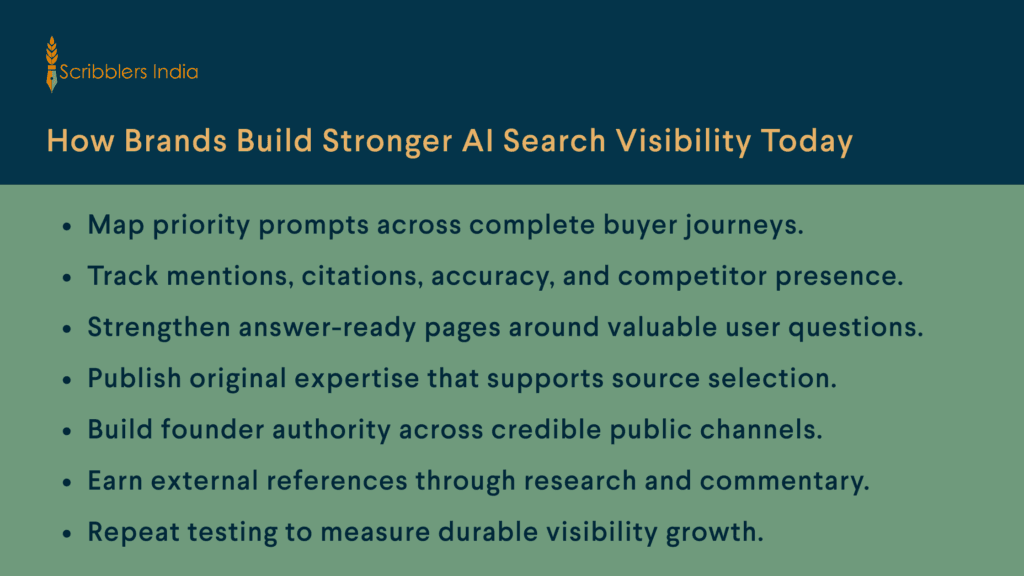
Brands improve AI search visibility by strengthening the information that AI systems can retrieve, interpret, verify, and connect with relevant user questions. Effective work combines SEO, AEO, GEO, content strategy, expert authority, and measurement, rather than relying on a single formatting tactic.
- Clarify important service pages: Each priority page should explain the audience, problem, process, evidence, outcomes, and next action without vague language. Clear service pages help AI systems understand what the brand offers and when users should consider it.
- Build complete topic coverage: A focused content marketing strategy should answer connected buyer questions across the full decision journey. Topic clusters help AI systems connect definitions, comparisons, objections, use cases, and service details into a single coherent brand-authority picture.
- Publish source-worthy expertise: Research, case studies, detailed guides, founder insights, and practical frameworks create distinct information that supports authority. These assets give AI platforms stronger evidence to summarize, cite, or associate with the brand across relevant prompts.
- Strengthen visible expert authority: Personal branding services connect credible people with defined topics, categories, and public signals of expertise. Founder profiles, LinkedIn content, interviews, and bylined articles help AI systems link individual authority with the company’s wider market position.
- Refresh older pages regularly: Update pages when services, examples, sources, product details, or customer needs change across important topics. Strategic refreshes protect existing search equity while aligning older assets with current prompts, stronger evidence, and improved buyer expectations.
- Earn credible external references: Useful contributions, expert commentary, partnerships, interviews, and digital PR activity expand the information ecosystem around the brand. These references reinforce trust beyond owned pages and help AI systems validate the brand’s expertise across public sources.
Improvement rarely comes from rewriting every page at once. Start with valuable prompts, then strengthen the pages and authority signals that support those questions.
How can Scribblers India improve your AI search visibility?
Scribblers India turns AI search visibility findings into practical content and authority actions. We identify discovery gaps, strengthen answer-ready pages, and connect measurement to AEO, GEO, personal branding, thought leadership, ghostwriting, and content strategy priorities to drive sustained visibility growth.
- AI visibility audits: We test priority prompts, cited pages, competitor appearances, recommendation context, and answer accuracy across relevant platforms. Our audits establish dependable baselines and reveal where content, authority, positioning, or entity signals require focused improvement across discovery channels.
- AEO content planning: We restructure important pages around direct answers, question-led headings, definitions, FAQs, and comparison content. This improves extraction while preserving editorial depth, factual accuracy, readability, and a clear journey from discovery to decision.
- GEO authority development: We develop original research, expert explainers, case-led resources, and external contribution plans around commercially important topics. This strengthens entity clarity and source credibility while expanding citation opportunities across owned, earned, and partner channels.
- Founder personal branding: We align founder profiles, LinkedIn content, bylines, interviews, and recurring themes around proven expertise. These programs connect individual authority with company positioning and strengthen recognition across public channels, search results, and AI-generated answers.
- Thought leadership and ghostwriting: We turn executive knowledge into articles, reports, opinion pieces, and platform-ready content that adds distinct value. Our thought leadership content and ghostwriting services preserve authentic expertise while supporting citations, brand trust, and category authority.
Talk to Scribblers India for an evidence-led roadmap connected with rankings, generated answers, citations, brand mentions, and measurable business priorities.
Frequently asked questions
Is AI Search Visibility the Same as an AI Ranking?
No, AI search visibility is not the same as one fixed ranking position. A brand may appear as a citation, recommendation, example, or comparison option across different answers. Teams should measure repeated inclusion, cited sources, answer context, and competitor presence, rather than assigning a single permanent position across changing responses.
How Long Does AI Search Visibility Take to Improve?
The timeline depends on crawl access, existing content quality, authority signals, and the size of the visibility gap. Some refreshed pages may gain citations after discovery and indexing. Broader entity recognition usually requires consistent content, credible external evidence, and repeated measurement over several review cycles before reliable progress becomes apparent.
Can a Small Brand Gain Visibility in AI Answers?
Yes, smaller brands can gain AI search visibility when their content answers specific buyer questions with stronger depth than broad competitor pages. Original experience, focused expertise, and clear proof can create citation value. The brand must also remain accessible, consistent, and credible across owned and external sources.
Do AI Citations Always Send Traffic to Websites?
No, AI citations create source visibility without guaranteeing a website visit. Users may read the generated answer and continue their research elsewhere. Teams should track citations alongside referrals, branded search, conversions, sales feedback, and assisted journeys to understand the broader commercial impact of answer-led discovery.
Should Brands Track Every Available AI Platform?
No, brands should not track every available AI platform without evidence that their buyers use it. Start with platforms that influence research, comparison, and referrals in your market. Expand coverage when customer interviews, analytics, sales conversations, or referral data show meaningful activity on another answer engine.
What Is the Difference Between AI Mentions and AI Citations?
AI mentions a name or describes a brand in generated answers, while AI citations link to a source that supports part of the response. A brand can be mentioned without its website being cited. It can also receive a citation without being recommended, so both signals need separate tracking.
How Often Should Teams Measure AI Search Visibility?
Teams should measure high-value prompts monthly and complete broader visibility reviews every quarter. Fast-moving categories may need more frequent checks after major launches, platform changes, or competitor movement. Keep prompt wording and platform conditions stable, so reports reflect real progress rather than shifting measurement methods.
Which Content Assets Improve AI Search Visibility Most?
The strongest assets usually include service pages, comparison guides, glossary pages, research reports, case studies, founder articles, and detailed educational guides. Each asset should answer a defined buyer question and include credible evidence. The goal is not volume, but useful source material that AI platforms can understand and reference.