
Personal branding ROI is the value created by building and maintaining a professional brand compared with the resources invested. The return can include direct financial outcomes and wider professional benefits. Useful measurement connects content activity with audience quality, authority growth, opportunities, saved time, search discovery, and commercial influence.
Traditional financial ROI can still apply when revenue is attributable.
However, personal branding often influences a longer decision journey. Someone may discover a founder through LinkedIn, read several articles, encounter an interview, and later contact the company through a referral.
This means personal branding ROI can include:
- Qualified inbound inquiries
- Sales opportunities influenced by content
- Speaking or media invitations
- Partnership discussions
- Recruiting outcomes
- Investor interest
- Referral quality
- Branded search growth
- Relevant professional network development
- Search and AI discovery
You can better understand these broader measurement layers with our detailed guide to the returns on personal branding initiatives. The framework begins by defining what the professional expects personal branding to influence before selecting metrics.
Defining return first prevents teams from celebrating numbers with little connection to their goals. That distinction becomes clearer when meaningful business indicators are compared with likes, impressions, and follower counts that primarily describe attention rather than impact.

Why Are Followers and Engagement Insufficient for Measuring Personal Branding ROI?
Followers and engagement indicate whether people encounter or react to content, but they alone cannot establish business value. Personal branding ROI requires context around who engaged, what happened afterward, and whether visibility improved professional outcomes. A smaller relevant audience can create greater value than broad attention from unrelated users.
| Metric | What it can show | What it cannot prove alone |
| Impressions | Distribution volume | Audience relevance |
| Follower growth | Increasing audience size | Professional authority |
| Likes | Lightweight content response | Buyer intent |
| Comments | Conversation around an idea | Commercial influence |
| Profile visits | Interest in the professional | Opportunity quality |
| Qualified inquiries | Relevant business interest | Final revenue without attribution |
| Speaking requests | Growing external authority | Direct financial return |
| Assisted opportunities | Influence during evaluation | Complete causal attribution |
An executive attracting 200 relevant decision-makers can create more strategic value than another reaching 20,000 unrelated users.
The same principle appears across our personal branding case studies. They provide context on positioning, audience fit, content direction, and resulting visibility, rather than presenting reach as the sole measure of progress.
Attention provides an early signal, while stronger measurement follows what that attention produces. This creates the need for a layered scorecard separating visibility from audience relevance, authority development, commercial influence, and AI-led discovery.
Which Metrics Should You Use to Measure Personal Branding ROI?
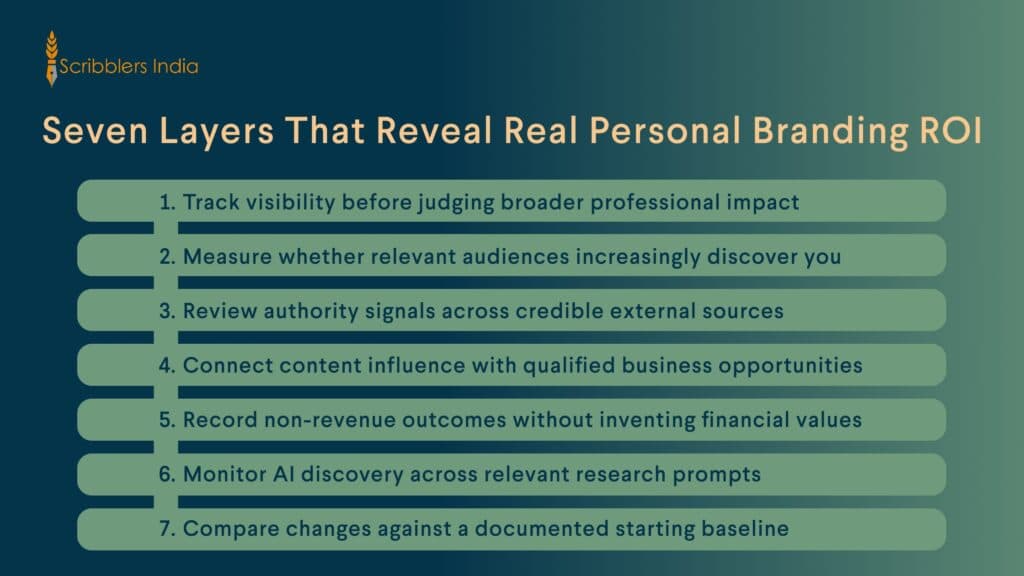
Personal branding ROI should be measured across connected layers rather than a single headline metric. Visibility shows whether discovery is expanding. Relevance shows who is arriving. Authority indicates stronger professional association, while commercial influence reveals whether that recognition contributes to meaningful business or career opportunities.
| Measurement layer | Useful metrics | What they reveal |
| Visibility | Profile views, content reach, website discovery, branded search | Whether professional discovery is expanding |
| Audience relevance | Roles, industries, seniority, target-account engagement | Whether the right people are arriving |
| Authority | Backlinks, citations, media requests, expert mentions, speaking invitations | Whether professional recognition is strengthening |
| Commercial influence | Qualified inquiries, referrals, assisted opportunities, hiring conversations | Whether authority affects decisions |
| Owned audience | Newsletter subscribers, repeat readers, direct traffic | Whether the professional builds durable audience access |
| AI discovery | Prompt coverage, mentions, citations, source diversity, description accuracy | Whether expertise appears during AI-led research |
Different personal branding goals require different weighting. A consultant may emphasize qualified leads. A CEO may value speaking requests and stakeholder visibility. A founder preparing to raise capital may care more about investor discovery and category authority.
Metrics should therefore follow the original objective rather than be selected solely because they are easy to extract from a platform dashboard. Choosing the right metrics makes reporting more useful, although measurement still requires a financial framework in which revenue can be traced.
How Do You Calculate the Financial ROI of Personal Branding?
Financial personal branding ROI compares attributable financial value with the total investment required to create it. The calculation should include service fees and internal time. Revenue attribution should remain conservative because personal branding often supports a decision alongside referrals, company marketing, sales activity, and existing relationships.
A simple calculation is:
Personal Branding ROI = (Attributed Value − Total Investment) ÷ Total Investment × 100
For example, total investment may include:
- Strategy fees
- Ghostwriting or content production
- Design and video support
- Internal review time
- Founder or executive interview time
- Distribution support
- Analytics or measurement tools
- External media support
Attributed value might include revenue from inquiries where the personal brand clearly influenced discovery or evaluation.
Suppose a company invests ₹6 lakh in a founder branding program and can conservatively attribute ₹15 lakh of influenced business value to it. The calculation would be:
(₹15 lakh − ₹6 lakh) ÷ ₹6 lakh × 100 = 150% ROI
The calculation is useful only when attribution rules remain consistent. Counting every deal that happened during the program would exaggerate the return.
Businesses researching personal branding services should therefore evaluate the total program investment against its intended outcomes rather than comparing providers solely by monthly fees.
How Should You Measure Personal Branding Outcomes Without Direct Revenue?
Personal branding can create meaningful value before direct revenue appears. Media requests, speaking opportunities, stronger referrals, senior hiring conversations, partnership interest, and relevant network growth can indicate rising authority. These outcomes should be recorded separately rather than assigned arbitrary financial values simply to inflate an ROI calculation.
A practical scorecard can record:
- Authority Indicators: Track whether journalists, event organizers, peers, or industry organizations increasingly approach the professional because of their expertise.
- Opportunity Quality: Compare the relevance and seniority of inbound conversations before and after the personal branding program begins.
- Referral Strength: Record whether introductions increasingly reference specific content, areas of expertise, interviews, or frameworks.
- Hiring Influence: For founders and executives, track candidate conversations where leadership visibility affected interest in the company.
- Sales Support: Ask sales teams whether founder articles, LinkedIn posts, ebooks, or interviews help explain expertise during active opportunities.
- Audience Access: Review whether newsletters, direct traffic, or returning readers create channels that the professional controls more directly than social reach does.
These indicators reveal authority development that revenue attribution may miss. They can also explain why a program with limited immediate revenue may still be moving toward its intended objective.
For founders, some value may be realized indirectly through the company’s credibility. Scribblers India’s guide to founder personal branding and company credibility examines how leadership visibility can influence how audiences interpret the wider business.
How Does AI Search Visibility Fit Into Personal Branding ROI?
AI search visibility adds a discovery layer to personal branding ROI. Professionals can track whether relevant prompts produce accurate mentions, which sources support those answers, and how visibility compares with peers. These metrics do not directly represent revenue, but they indicate whether authority appears in emerging research journeys.
Useful AI discovery indicators include:
- Relevant prompt coverage
- Mention frequency
- Citation presence
- Citation share
- Description accuracy
- Source diversity
- Competitor visibility
- Missing expertise associations
A founder may receive limited website traffic from an AI response while still appearing during an important comparison or category-research journey. This means teams should avoid evaluating AI visibility through clicks alone. AI-generated answers can influence awareness and evaluation without producing the same referral path as traditional organic search.
Using an AI Search Visibility Scorecard can provide a broader framework for examining entity clarity, expert authority, content depth, answer readiness, and other signals that affect visibility across AI-led discovery.
AI search discovery becomes a more useful ROI indicator when evaluated alongside authority and business signals. Repeated mentions of irrelevant topics add little value, while accurate visibility of priority expertise can support the professional association the wider strategy aims to build.
How Long Should You Measure Personal Branding ROI Before Evaluating Results?
Personal branding ROI should be reviewed across different time horizons. Publishing and visibility indicators can change relatively quickly, while authority growth and commercial influence often require repeated exposure. Monthly reviews should track leading indicators, while quarterly reviews can evaluate stronger professional and business outcomes.
A practical cadence is:
- Monthly: Publishing consistency, audience relevance, profile activity, and content response
- Quarterly: Authority signals, qualified inquiries, referrals, AI discovery, and assisted opportunities
- Six-month review: Topic association, source growth, network quality, and recurring opportunities
- Annual review: Commercial contribution, authority development, strategic opportunities, and total program efficiency
Teams should also compare changes against a starting baseline. Without baseline data, later improvements become difficult to interpret. Record existing search presence, audience quality, inbound activity, authority signals, and AI visibility before major work begins.
A structured personal brand audit can establish this starting point by examining existing positioning, profiles, content, public proof, search results, and discovery signals before further investment begins.
Baseline measurement should also reflect the objective. A founder pursuing investor visibility needs different starting indicators from an executive seeking speaking opportunities or a consultant aiming to generate qualified inbound leads.

How Can Scribblers India Help Improve and Measure Personal Branding ROI?
Scribblers India approaches personal branding ROI by connecting professional visibility with outcomes each program is expected to influence. Our personal branding services combine positioning, content, authority development, search readiness, and AI visibility with measurement frameworks to help founders and executives understand what is improving, where value appears, and what needs refinement.
That measurement system usually brings five areas of work together:
- Baseline and Goal Definition: Measurement begins with a clear picture of current performance. We record where the professional already has visibility and which outcomes matter most to the business. This gives future reviews a useful reference point, rather than judging progress by follower growth or engagement alone.
- Content and Audience Measurement: Once the baseline is clear, attention shifts to what the content is actually achieving. We look at which topics attract the right audience and which ideas earn stronger response from decision-makers. This helps separate useful visibility from publishing activity that adds little strategic value.
- Authority and Opportunity Tracking: Strong content should gradually create signs of recognition outside the publishing platform. Media interest, expert references, speaking opportunities, and relevant inquiries can show whether that shift is happening. These signals help us understand when repeated visibility is starting to translate into professional authority.
- Commercial Attribution Framework: Business impact often emerges over a longer decision journey, so attribution needs to be handled carefully. We look at how prospects first discovered the professional and what influenced later conversations. CRM notes and discovery questions can provide useful evidence without overstating content-led revenue.
- AI Discovery and Strategic Reviews: Search and AI visibility add another layer to the measurement process. We review how the professional appears across relevant prompts and whether those descriptions remain accurate. Regular reviews then help us refine positioning and decide where future content effort should be concentrated.
Scribblers India’s guide explaining how a personal branding agency works provides additional context on how research, positioning, content systems, distribution, and measurement fit within a structured engagement.
Get in touch with our team to start building a measurable personal branding program that connects professional authority with relevant audiences and business outcomes.
Frequently Asked Questions
Can Personal Branding ROI Be Negative?
Yes. A program can produce negative financial ROI when costs exceed attributable value during the measurement period. Weak targeting, unclear positioning, or excessive production can also reduce efficiency. Review authority and opportunity indicators alongside financial return before deciding whether the strategy needs refinement or the investment itself should change.
How Do You Attribute a Lead to Personal Branding?
Add discovery questions to lead forms and CRM records, then ask sales teams to capture relevant touchpoints during conversations. Record posts, articles, search results, events, referrals, or AI discovery where known. Multi-touch attribution usually provides a more realistic picture when several interactions occur before direct contact begins.
Should Speaking and Media Opportunities Count Toward Personal Branding ROI?
They should count as authority outcomes, although assigning an arbitrary monetary value can distort financial ROI. Track their frequency, relevance, audience quality, and resulting opportunities separately. A speaking invitation becomes financially attributable when it creates measurable revenue or another documented business outcome connected with the engagement.
What Baseline Should You Record Before Starting Personal Branding?
Record existing profile visibility, audience composition, branded searches, inbound inquiries, media mentions, backlinks, speaking requests, referral activity, and AI discovery. Add metrics connected with the program’s specific objective. This baseline allows later reporting to measure genuine change rather than compare results against memory or isolated platform statistics.
How Should Different Personal Branding Goals Change ROI Measurement?
ROI metrics should change with the professional objective. Consultants may prioritize qualified inquiries and influenced revenue, while executives may track industry recognition or board opportunities. Founders may emphasize investor visibility, company credibility, or hiring influence. Define the desired outcome first, then weight supporting metrics around that objective.
How Can Teams Separate Personal Branding Influence From Company Marketing?
Use discovery questions, CRM notes, referral information, content touchpoints, and prospect interviews to identify where leadership visibility contributed. Avoid claiming exclusive attribution when company marketing also influenced the journey. Personal branding can be recorded as an assisted source when professional content strengthened awareness, trust, or evaluation before conversion.