
A personal branding strategy gives a professional presence a clear purpose, rather than allowing visibility to grow without direction. Profiles may look polished and content may appear regularly, yet audiences can still struggle to understand what the person stands for or why their expertise deserves sustained attention across relevant channels.
The strategy connects the desired position to the people who need to recognize it and to the evidence that supports it. Content, profiles, distribution, and measurement then work toward the same professional association. This creates a more coherent presence that can build recognition, authority, and trust over time across discovery channels.
Key Takeaways:
|
What Is a Personal Branding Strategy?
A personal branding strategy is a structured plan for building, communicating, and measuring a professional identity. It defines who the person wants to reach, what expertise they should become known for, which evidence supports that position, where they should appear, and how progress should be evaluated over time.
The strategy converts professional expertise into a deliberate authority system rather than a collection of unrelated activities.
It should clarify questions such as:
- Which audiences can influence the professional’s goals?
- What expertise should become associated with their name?
- Which experiences provide credible supporting proof?
- What content can consistently demonstrate that expertise?
- Which channels deserve sustained attention?
- Which external opportunities can strengthen validation?
- How should search and AI discovery support visibility?
- Which indicators will show meaningful progress?
A professional may express part of this direction through a personal brand statement, although the wider strategy determines how that message becomes visible through content, profiles, proof, and repeated audience interactions.
Once the strategy defines the desired outcome, the next step is separating it from positioning. The two work together, although positioning decides the professional association while strategy determines how that association will be built and reinforced.

How Is Personal Branding Strategy Different From Personal Brand Positioning?
Personal brand positioning defines what a professional should become known for and why that association is credible. Personal branding strategy determines how the position will be communicated, supported, distributed, and measured. Positioning therefore gives the brand its direction, while strategy organizes the work required to build it.
| Area | Personal brand positioning | Personal branding strategy |
| Core question | What should this person be known for? | How will that association be built? |
| Primary focus | Audience, expertise, differentiation, and proof | Content, channels, authority building, and measurement |
| Main output | Clear professional position | Coordinated execution plan |
| Content role | Defines which topics fit the position | Determines formats, cadence, and distribution |
| Measurement role | Clarifies desired perception | Tracks whether that perception is developing |
| Review trigger | Professional direction changes | Performance or audience behavior changes |
Positioning should therefore come before large-scale publishing. Without it, teams can produce substantial content without building a memorable professional association.
What Should a Personal Branding Strategy Include?
A personal branding strategy should connect positioning to audience understanding, authoritative content, distribution, credible evidence, and performance measurement. Each element performs a different job. Together, they ensure that visibility supports a defined professional association rather than producing disconnected impressions across social platforms, search results, and external appearances.
- Audience Definition: Identify the people whose decisions affect the professional’s goals. A founder seeking investors needs different visibility from an executive pursuing board roles. Audience clarity influences examples, proof requirements, channel choices, and the questions content should address.
- Authority Position: Define the expertise territory and perspective the person should own. The position should reflect real experience and future goals. Broad labels such as “business leader” provide little guidance for content creation or audience recognition.
- Content System: Translate the position into recurring themes and useful formats. Short posts can maintain familiarity, while articles, interviews, reports, or ebooks can provide deeper evidence of expertise.
- Proof System: Support public claims with first-hand experience, case evidence, research, external recognition, and documented outcomes. Proof prevents personal branding from becoming self-description without credible evidence.
- Distribution Plan: Decide where each asset should appear and how stronger ideas should spread through appropriate channels. Distribution should follow audience behavior rather than spreading every piece across every available platform.
- Measurement Framework: Track whether the intended audience increasingly discovers and associates the professional with the desired expertise. Measurements should include recognition quality, authority development, commercial influence, and AI discovery where relevant.
At Scribblers India, we combine these areas in our personal branding services, where profile positioning and content production sit within a broader authority-building system rather than operating as isolated deliverables.
How Do You Build a Personal Branding Strategy?
Building a personal brand positioning approach starts with evidence of the professional’s current position and desired direction. The process should move from diagnosis into positioning, then content planning and distribution. Measurement comes after the system has enough activity to reveal whether the intended audience association is developing.
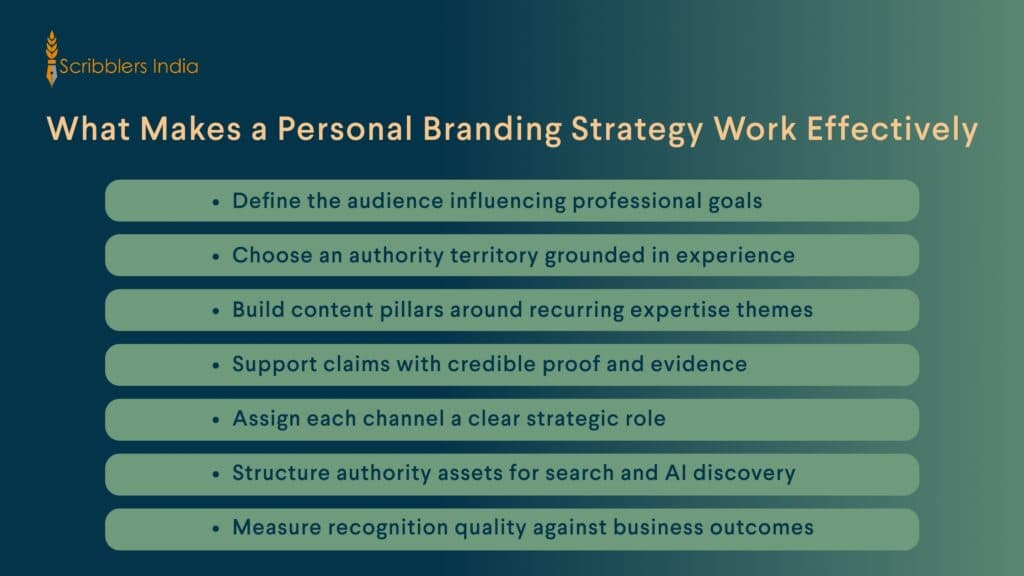
A practical sequence looks like this:
- Audit the existing presence: Review search results, LinkedIn, biographies, published content, media appearances, and external references.
- Define the intended audience: Identify whose decisions can advance the professional’s business or career objectives.
- Choose the authority territory: Determine which problems and areas of expertise should be associated with the person.
- Document supporting proof: Map direct experience, cases, frameworks, research, and credible third-party validation.
- Create content pillars: Build recurring themes around the selected authority territory.
- Assign channel roles: Decide where discovery, depth, interaction, and owned authority should develop.
- Establish production workflows: Define responsibilities for interviews, drafting, approvals, repurposing, and publishing.
- Set measurement criteria: Track audience fit, authority signals, business influence, search discovery, and AI visibility.
Existing activity should be examined before adding more. A personal brand audit can reveal outdated positioning or weak evidence that additional publishing would otherwise continue to reinforce.
A workable sequence prevents teams from treating every channel as equally urgent. Once the foundation is ready, the next decision is where to publish, because channel choice should follow audience behavior rather than personal preference or platform popularity.
Which Channels Should a Personal Branding Strategy Use?
A personal branding strategy should use the channels where relevant audiences discover, evaluate, and verify professional expertise. LinkedIn may lead for many B2B leaders, while owned websites, newsletters, industry publications, podcasts, events, or search-led content can play stronger roles for different audiences and objectives.
Each channel should have a specific job.
| Channel | Strategic role |
| Regular professional discovery and audience interaction | |
| Personal website | Owned authority, biography, proof, and deeper content |
| Articles | Detailed expertise and search-led discovery |
| Newsletter | Direct audience relationship and recurring communication |
| Podcasts | Voice, perspective, and third-party exposure |
| Industry publications | Independent validation and wider category reach |
| Speaking opportunities | Live authority and professional network expansion |
| Reports or ebooks | Deep expertise and durable intellectual property |
LinkedIn deserves particular attention when the intended audience researches professionals there. A structured LinkedIn personal branding approach can connect the profile, publishing themes, featured proof, and network activity with the wider authority position.
The professional still does not need to create every asset personally. Professional ghostwriting services can turn interviews and first-hand knowledge into regular content while keeping the ideas grounded in the leader’s own experience and perspective.
Channel discipline keeps the strategy focused, yet discovery now extends beyond social platforms and traditional search results. The next layer is AI search visibility, where consistent identity signals and well-structured, authoritative content can influence how expertise is perceived.
How Does a Personal Branding Strategy Support Search and AI Discovery?
A personal branding strategy supports search and AI discovery by creating consistent public evidence around a professional’s identity and expertise. Connected profiles, bylined content, original insights, author pages, external mentions, and source-backed authority assets provide search systems with clearer information for interpreting relevant people or topics.
This is not limited to adding keywords to a LinkedIn profile. A search-ready personal brand should create consistent connections between:
- The professional’s full name and current role
- Their expertise and recurring subject areas
- Owned content and detailed author information
- First-hand frameworks and supporting evidence
- Relevant interviews and third-party mentions
- Service or company relationships where appropriate
- Search questions connected with their expertise
- Public sources that confirm professional claims
AEO can help structure content around specific audience questions and direct answers. GEO broadens the focus to evidence, source relationships, and entity clarity that can support generative discovery.
Measurement is equally important. The AI Search Discovery Benchmark provides a framework for reviewing prompt coverage, citation patterns, source visibility, and description accuracy across AI-led discovery environments.

How Should You Measure a Personal Branding Strategy?
A personal branding strategy should be measured across several interconnected layers rather than by follower growth alone. Visibility shows whether distribution is expanding. Audience relevance confirms whether the right people are arriving. Authority signals indicate professional recognition, while business influence shows whether that recognition translates into meaningful opportunities.
| Measurement layer | What to track | What it indicates |
| Visibility | Profile views, search appearances, content reach, and website discovery | Whether more people encounter the professional |
| Audience relevance | Roles, industries, seniority, and target-account engagement | Whether visibility reaches useful audiences |
| Authority | Branded searches, backlinks, citations, media requests, and invitations | Whether expertise is gaining recognition |
| Business influence | Qualified inquiries, referrals, hiring interest, and assisted opportunities | Whether authority affects business outcomes |
| AI discovery | Prompt coverage, mentions, citations, source diversity, and description accuracy | Whether expertise appears correctly in AI research |
Review leading indicators monthly and business influence quarterly. Changes should be interpreted together.
For example, increasing reach with weak audience relevance suggests targeting problems. Strong recognition without commercial conversations may indicate unclear next steps. Growing mentions of AI with inaccurate descriptions may point to inconsistent public information.
How Can Scribblers India Help Build a Personal Branding Strategy?
At Scribblers India, personal branding starts with understanding how a professional is currently perceived and what needs to change. From there, positioning shapes the profile, content, and authority-building work. Each element supports a clearer professional identity rather than operating as a separate marketing activity.
- Positioning and visibility audit: The starting point is the professional’s existing public presence. We review how current profiles and published content describe them, then compare that picture with the authority they want to build. This reveals where positioning feels unclear or lacks enough supporting proof.
- Audience and authority mapping: Strong positioning requires a clear idea of who should recognize the professional and for what expertise. We narrow that authority territory around relevant audience needs. This gives future messaging a stronger focus and prevents the personal brand from becoming too broad.
- Profile and messaging alignment: Once the positioning is clear, the same core idea should carry across important discovery points. LinkedIn profiles and professional biographies need to reinforce that identity naturally. Websites and speaker profiles can then provide deeper evidence when someone researches the professional further.
- Founder and executive ghostwriting: Firsthand experience provides the strongest raw material for credible personal-brand content. Our ghostwriting services turn those ideas into posts and longer viewpoints while retaining the professional’s perspective. The content stays connected with their chosen authority territory and audience.
- Thought leadership and authority assets: Social posts can start conversations, although deeper expertise often needs more room. We develop stronger ideas into articles or original frameworks that demonstrate how the professional thinks. These assets can also support media evaluation and strengthen the evidence available during online research.
- AEO, GEO, and AI visibility: A personal brand now needs to remain understandable when discovery happens through search or generated answers. We review how expertise appears across relevant prompts and supporting sources. This helps identify where content or public information needs refinement for more accurate representation.
Where deeper expertise needs development, our thought leadership content writing services turn first-hand experience and original viewpoints into substantial authority content that can support industry recognition beyond frequent social publishing.
Get in touch with our team to build a personal branding strategy that turns your expertise into consistent authority across content, search, and AI.
Frequently Asked Questions
How Long Does a Personal Branding Strategy Take to Show Results?
Early visibility changes can appear within several weeks, while stronger professional association usually develops over longer periods. Timing depends on existing authority, publishing consistency, audience fit, proof quality, and external validation. Review progress quarterly rather than judging individual posts or short-term changes in engagement.
How Often Should a Personal Branding Strategy Be Reviewed?
Review the strategy formally every quarter and whenever professional priorities change significantly. Content performance may need monthly checks, while positioning should remain more stable. A role change, a company transition, a new market, or a different target audience may justify a deeper strategic review.
Does Every Personal Branding Strategy Need LinkedIn?
No. LinkedIn is useful for many B2B professionals, founders, consultants, and executives, although audience behavior should determine channel selection. Some strategies may depend more heavily on industry publications, speaking, newsletters, owned websites, podcasts, or specialist professional communities.
Can a Personal Branding Strategy Change Over Time?
Yes. The strategy should evolve when expertise, audiences, professional goals, or market conditions change. The core authority position should not shift without reason, although content themes and distribution channels can adapt as new opportunities emerge and performance evidence becomes clearer.
How Is a Personal Branding Strategy Different From a Content Strategy?
A personal branding strategy defines the professional position, target audiences, proof, channels, and measurement system. A content strategy focuses specifically on what to publish, in which formats, and how often. Content, therefore, supports the personal branding strategy rather than replacing the broader plan for building authority and recognition.
Can a Personal Branding Strategy Work Without Frequent Posting?
Yes. Frequent posting can support visibility, although a strong personal brand can also grow through fewer, higher-value assets. Original articles, speaking appearances, expert commentary, reports, podcasts, and credible third-party mentions can build authority when they consistently reinforce the same expertise territory and reach the right audiences.