
Personal brand positioning helps professionals shape the association they want audiences to make with their name. Instead of being remembered for a long list of roles or skills, a clear position connects the person to a specific audience, problem, area of expertise, and perspective that others can recognize and trust.
That position then guides profiles, content, speaking opportunities, media contributions, and professional proof. A strong personal branding strategy keeps these signals aligned so the same authority territory appears across search, social platforms, external references, and AI-led discovery. Over time, this consistency can make professional expertise easier to understand, verify, and remember.
Key Takeaways:
|
What Is Personal Brand Positioning?
Personal brand positioning is the strategic process of defining how a professional should be understood within their field. It identifies the audience, expertise territory, differentiated perspective, and evidence that should become associated with the person’s name across search, social platforms, professional content, and industry conversations.
Positioning is deeper than a tagline or biography. It answers three essential questions:
- Who should remember this professional?
- What should they remember them for?
- Why should they believe that association?
Those answers become the filter for future profiles, content topics, speaking opportunities, media contributions, and professional proof.
Strong positioning also requires selection. Trying to become known for every skill usually creates a vague identity. A clearer authority territory gives audiences one strong reason to remember the person while leaving room for related expertise.

How Is Personal Brand Positioning Different From a Personal Brand Statement?
Personal brand positioning defines the professional association a person wants to build. A personal brand statement expresses part of that position concisely and can appear in biographies, profiles, websites, presentations, or professional introductions.
The distinction is important because a strong statement cannot repair weak positioning.
| Element | Personal brand positioning | Personal brand statement |
| Purpose | Defines the desired professional association | Communicates that position concisely |
| Scope | Covers audience, expertise, differentiation, proof, and goals | Condenses the position into a short message |
| Role | Guides content and wider visibility | Supports introductions and profile communication |
| Longevity | Changes when professional direction changes | Can adapt across different contexts |
| Core question | What should I become known for? | How should I describe that clearly? |
For example, someone may want to become known for helping SaaS companies improve customer retention. That is positioning. The sentence used to communicate that expertise on LinkedIn becomes the personal brand statement.
The statement therefore works best after the positioning decisions are settled. To make those decisions well, professionals need to clearly define the audience, expertise territory, differentiating perspective, supporting proof, and future direction behind the brand.
What Are the Core Elements of Personal Brand Positioning?
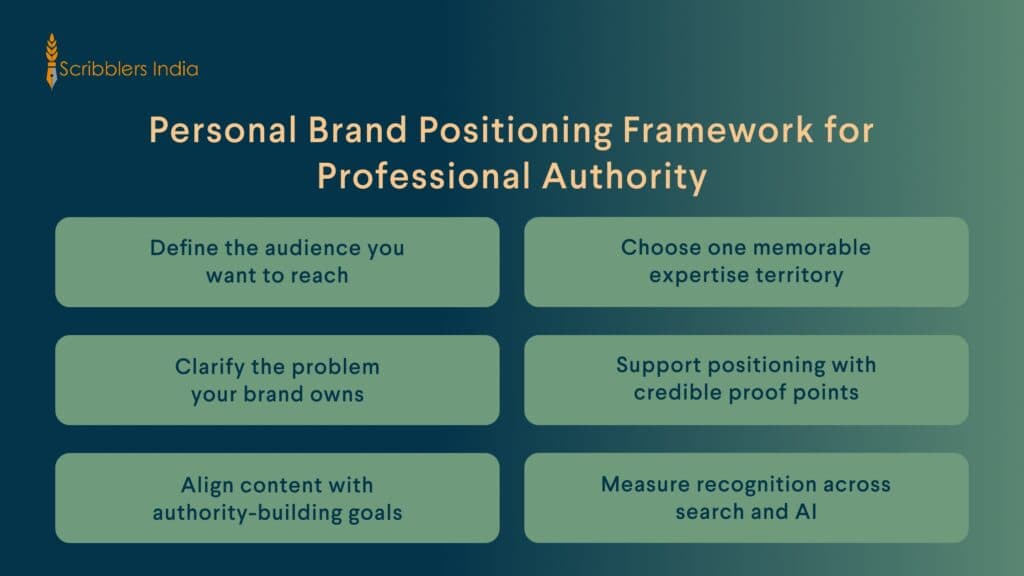
Personal brand positioning requires a clear audience, relevant expertise, credible differentiation, supporting proof, and alignment with future goals. These elements ensure the chosen position reflects real capability while giving the intended audience a specific reason to recognize and remember the professional.
Here are some key questions that help define the position:
- Who Is the Priority Audience? Positioning becomes weak when it tries to appeal to everyone equally. Buyers, investors, employers, industry peers, and potential partners may value different experiences. The position should reflect the audience most connected with the professional’s next goals.
- Which Problem Should the Person Own? Job titles rarely create enough differentiation. Stronger positioning connects the person with a recurring problem or area of expertise that audiences already consider important.
- What Makes Their Perspective Different? Two professionals can understand the same problem while approaching it differently. First-hand experience, operating philosophy, methodology, or informed market interpretation can create a more recognizable point of view.
- What Evidence Supports the Position? Cases, outcomes, published research, media recognition, original frameworks, and relevant professional experience make positioning believable. Without proof, even well-written positioning remains a claim.
- Where Should the Position Lead Next? A founder building category authority requires different emphasis from an executive seeking board opportunities. The position should support future opportunities rather than merely describe experience.
These elements create a practical filter for choosing what deserves attention. The next step is deciding which expertise to prioritize, especially when a professional has several credible skills, experiences, or future opportunities.
How Do You Decide What You Want to Be Known For?
Deciding what to be known for requires an overlap among proven expertise, audience demand, future goals, and available evidence. The strongest position usually comes from work the professional understands deeply and can explain with greater authority than people repeating commonly available industry advice.
Start by reviewing the following areas:
- Repeated Problems: Which questions do clients or colleagues repeatedly ask you to solve?
- Strongest Evidence: Where can you show direct experience or measurable outcomes?
- Audience Relevance: Which problems are important enough to influence decisions?
- Future Direction: Which expertise should support your next professional opportunities?
The final position should be specific without becoming restrictive.
For example, “technology leader” is difficult to remember. “Enterprise AI governance leader” provides more clarity while still allowing content around implementation, regulation, risk, organizational readiness, and operational lessons.
A clear choice makes later content planning much easier because every topic can be tested against the desired association. That creates the bridge from positioning strategy into content strategy, where authority becomes visible through repeated public evidence.
How Does Personal Brand Positioning Shape Content Strategy?
Personal brand positioning gives content a clear purpose. Once the authority territory is defined, every topic can be assessed against one question: does this strengthen the association the professional wants to own? That filter prevents frequent publishing from creating a scattered or contradictory public identity.
A positioning-led content system can include:
- Core questions connected with the authority territory
- First-hand lessons from professional experience
- Original frameworks around recurring problems
- Industry developments the person can interpret credibly
- Cases that demonstrate expertise in practice
- Adjacent topics required for wider understanding
Different formats can play different roles. LinkedIn posts can introduce an idea. Articles can develop the reasoning. Ebooks can turn expertise into a deeper owned asset. Interviews can extend the viewpoint into external channels.
Leaders who need regular publishing without having to write every asset themselves can combine positioning with ghostwriting services. More substantial expertise can then be developed through thought leadership content writing when the idea requires greater depth.
When content repeatedly supports the same authority territory, audiences gain a clearer reason to remember the professional. That consistency also affects digital discovery, which makes search and AI visibility the next layer of positioning to examine.
How Does Personal Brand Positioning Affect Search and AI Visibility?
Personal brand positioning can strengthen search and AI visibility by creating consistent public associations between a person and specific expertise. Profiles, bylined articles, author pages, external references, and original content give search systems more connected information about who the professional is and what they know.
The objective is not repeating one keyword across every profile.
A professional positioned around cybersecurity governance, for example, may reinforce that association through:
- A detailed author biography
- Articles answering governance questions
- First-hand frameworks
- Relevant conference appearances
- External expert contributions
- Consistent descriptions across profiles
- Owned reports or research assets
This creates a wider evidence trail around the same expertise.
Teams can use the AI Search Discovery Benchmark to compare prompt coverage, source patterns, citation visibility, competitor presence, and description accuracy across AI platforms. These findings can reveal whether the intended position is also visible during AI-led research.
AI search visibility can expose whether public sources describe the professional consistently or reinforce an outdated position. When that gap appears, repositioning becomes necessary so future content and profiles support the direction the professional now wants.
When Should You Reposition Your Personal Brand?
Professionals should reconsider their personal brand positioning when their current public identity no longer matches their expertise, audience, or future goals. Repositioning does not require removing previous experience. It determines which parts of that experience should shape how people understand the professional going forward.
Common triggers include:
- Moving into a senior leadership role
- Starting a company or consultancy
- Entering a different market
- Moving from execution into advisory work
- Pursuing board positions
- Developing expertise in a new category
- Attracting poorly matched opportunities
- Seeing outdated descriptions across search results
Repositioning should begin with evidence rather than by immediately rewriting every profile.
A personal brand audit can reveal whether biographies, search results, content themes, public profiles, and external references still reinforce an earlier professional identity. These findings help determine what needs changing and what should remain.
Repositioning should therefore begin with evidence, not instinct. Before changing every profile or content pillar, professionals should test whether the current position is unclear, attracting the wrong audience, or failing to support relevant opportunities.

How Can You Test Whether Personal Brand Positioning Is Working?
Personal brand positioning is working when relevant audiences increasingly associate the professional with the intended expertise. Testing should therefore examine recognition quality, discovery patterns, content response, inbound opportunities, and description accuracy rather than depending on follower growth or engagement rates alone.
Useful checks include:
- Ask trusted contacts what expertise they associate with your name.
- Review whether search results reflect your current professional direction.
- Examine which topics generate relevant inbound conversations.
- Compare your positioning with credible peers serving similar audiences.
- Review whether published content reinforces the same authority territory.
- Test how AI platforms describe your expertise.
- Track which sources appear within relevant AI responses.
- Compare inbound opportunities with the audience you want to attract.
Case evidence can add another layer of validation. Our EdTech leader personal branding case study shows how clearer audience positioning can guide content toward wider and more relevant professional discovery.
Testing turns positioning into a measurable business decision rather than a branding preference. Once the gaps are visible, a structured personal branding program can connect the revised position with profiles, content, authority assets, and ongoing discovery measurement.
How Can Scribblers India Help with Personal Brand Positioning?
Scribblers India begins personal brand positioning by defining what a professional should become known for before increasing content output. Our personal branding services connect audience priorities, authority territory, differentiated perspective, proof, and goals so that every profile, content asset, and visibility effort reinforces a single professional position.
That positioning foundation then guides five areas of execution:
- LinkedIn Profile Positioning: Our team refines the headline, About section, experience framing, proof points, and featured assets so the profile communicates expertise quickly. The objective is to help relevant audiences understand the professional’s authority without reading the full career history.
- Content and Ghostwriting: We turn recurring audience questions, first-hand experience, and professional viewpoints into focused content pillars. Structured interviews then provide material for LinkedIn posts, articles, and other assets that sound credible because they begin with the professional’s own thinking.
- Thought Leadership and Authority Assets: Strong ideas deserve more depth than routine social posts allow. We develop articles, frameworks, ebooks, reports, and research-led resources that give professionals room to explain distinctive perspectives and build stronger evidence around their chosen expertise.
- Media, Search and AI Discovery: Scribblers India extends your positioning beyond owned content by identifying speaking themes, interview angles, and expert opportunities that reinforce the same authority territory. Search and AI considerations help make those associations clearer across relevant professional discovery journeys.
- Performance Refinement: We review audience response, search visibility, AI descriptions, inbound conversations, and opportunity quality to see whether the intended position is becoming recognizable. Those signals help us adjust content themes, proof points, messaging, and priorities without unnecessarily changing direction.
Get in touch with our team to create a personal brand position that connects your expertise with the right audiences and opportunities.
Frequently Asked Questions
Can Someone Have More Than One Personal Brand Position?
A professional can have several areas of expertise, although the primary position should remain easy to understand. Closely related topics can fall under a single authority’s territory. Completely unrelated positions may require separate communication paths when they serve different audiences or professional goals.
How Narrow Should Personal Brand Positioning Be?
The position should be specific enough to gain recognition without trapping the professional in a single temporary topic. Start with the audience and recurring problem, then define the expertise that addresses it. The position should support several related themes while retaining one clear association.
Should Personal Brand Positioning Change Across Platforms?
The core position should remain consistent, although its expression can change. LinkedIn may emphasize professional expertise, while a conference biography may emphasize credentials. A website can provide deeper proof. Each format should reinforce the same professional identity rather than creating conflicting versions.
Can Strong Personal Brand Positioning Improve Inbound Opportunities?
Yes. Clear positioning helps relevant audiences understand expertise before making contact. This can improve the fit of inquiries, partnerships, media requests, or speaking opportunities. Results still depend on visibility, credible proof, consistent publishing, and whether the intended audience actually encounters the professional.
How Long Does Personal Brand Positioning Usually Take?
Initial positioning can often be defined within a focused strategy exercise. Building recognition takes longer because audiences need repeated proof across profiles, content, search results, speaking opportunities, and external references before the association becomes familiar.
Does Personal Brand Positioning Matter for Professionals Outside Leadership Roles?
Yes. Consultants, specialists, creators, freelancers, and senior professionals can use positioning to clarify expertise, attract better-fit opportunities, and make their work easier to understand across platforms where decision-makers discover talent.