Founders and executives must build a strong personal brand that provides clients, investors, partners, and employees with sufficient evidence to understand their professional value before meeting them. It also shapes what appears when they search your name. Without that evidence, outdated profiles or irrelevant results may carry more influence than your actual work.
Building that presence requires more than regular social posting. You need a clear authority position, an owned website, consistent thought leadership, independent proof, and technical search foundations. Each layer provides audiences with another credible source while reducing dependence on a single profile, article, directory, or platform.
This guide outlines the complete architecture that Scribblers India uses to build strong personal brands for founders and business leaders. It explains how to structure your website, optimize your LinkedIn presence, choose content pillars, earn third-party mentions, support AI discovery, and measure whether your reputation is strengthening over time.
Key Takeaways:
|
Why You Need to Build a Strong Personal Brand Online?
By building a strong personal brand online, you create a clear, evidence-based association between your name and a valuable area of expertise. People quickly understand whom you help and what you know. They can also find sufficient credible information to verify that impression across several digital sources.
The following signals show whether your current personal branding strategy has that strength and useful depth.
- Your name becomes associated with a single clear professional problem across all important profiles and publications.
- Public claims link your name to cases, results, credentials, research, and firsthand professional experience.
- The content shows how you think, rather than repeating advice available across generic industry blogs.
- Your website and social profiles carry consistent role descriptions, biographies, topics, and professional photographs.
- Independent sources confirm your expertise through interviews, event pages, media quotes, and credible references.
- The personal branding content helps the intended audience make decisions instead of generating broad, irrelevant social engagement.
- Search results provide several useful ways to understand your work, values, experience, and current professional focus.
A large following can improve reach. It cannot create authority without relevance and proof. Understanding the core elements of a personal brand is crucial to learn how positioning, voice, credibility, and consistency create this foundation.
What Is the Difference Between a Strong Personal Brand and a Large Following?
When you build a strong personal brand online, it establishes trust through defined expertise, while a large following primarily indicates audience reach. Followers can increase content distribution without proving authority or relevance. A credible personal brand connects clear positioning with useful insight, visible evidence, and qualified opportunities across owned platforms and professional networks.
The comparison below shows why follower count offers an incomplete measure of professional influence and authority.
| Comparison area | Strong personal brand | Large following | Why the difference matters |
| Core association | Connected with defined expertise | Known by many platform users | Recognition becomes more useful when audiences remember specific value |
| Audience quality | Attracts relevant buyers and industry peers | May include broad or unrelated audiences | Relevant attention creates stronger business opportunities |
| Content depth | Shares original insight and first-hand lessons | May depend on frequent, accessible content | Depth helps audiences assess professional judgment |
| Supporting proof | Includes cases, outcomes, credentials, and external validation | Engagement numbers may provide the main proof | Business claims need evidence beyond popularity |
| Platform ownership | Uses websites, newsletters, articles, and social profiles | Often depends heavily on one social platform | Owned assets preserve authority beyond algorithm changes |
| Search visibility | Builds clear associations around professional expertise | May rank mainly through social profiles | Searchers need detailed context beyond follower counts |
| AI discovery | Creates consistent information across credible sources | High engagement may offer limited expertise context | AI platforms need accessible evidence related to specific questions |
| Business influence | Supports qualified inquiries, referrals, and speaking opportunities | Produces reach with variable commercial value | Commercial relevance carries greater value than broad visibility |
A relevant audience creates stronger authority than broad attention. This distinction becomes critical when AI platforms select sources and connect professionals with the right professionals for specific questions during user research journeys.

How Do You Build a Strong Personal Brand From Scratch?
To build a strong personal brand, start by auditing what already appears around your name and defining the authority you want to build. Publishing should begin after those two views become clear. Otherwise, new content may reinforce outdated positioning, attract the wrong audience, or create another disconnected version of your professional identity.
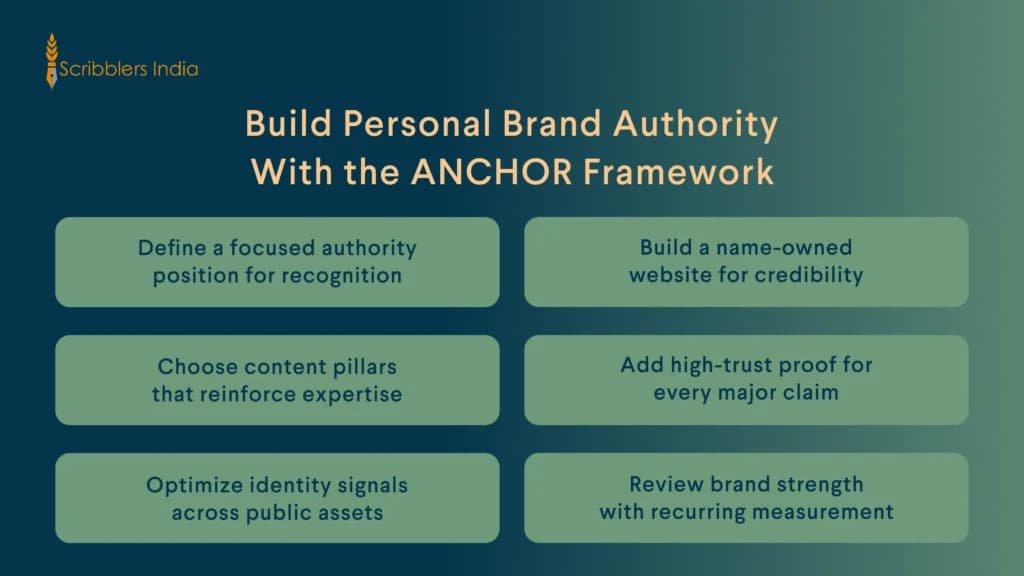
The Scribblers India ANCHOR framework organizes this work into the following foundation layers:
- Authority Position: Define the specific problem, audience, experience, and viewpoint you want associated with your name. Your position should reflect current business priorities and genuine expertise. The personal branding strategy guide from Scrubblers India provides a deeper process for translating that direction into content.
- Name-Owned Website: Create a central digital property that presents current facts, original ideas, proof, and contact information. This website becomes the controlled reference point for professional discovery. It should connect every major external profile with your deeper body of work.
- Content Pillars: Select four or five themes where your experience intersects with audience demand. Each theme should support several recurring questions. This structure helps search systems and readers form stronger associations between your name and a defined professional territory.
- High-Trust Proof: Build cases, frameworks, testimonials, credentials, research, and documented professional lessons. Every important claim needs suitable evidence. High-trust proof separates genuine authority from polished self-description and gives future content more substance.
- Optimization Layer: Make important pages crawlable, clearly structured, internally connected, and attributed to the correct author. Align names, titles, biographies, images, and external profiles. These details help people and search systems accurately understand the identity.
- Review Rhythm: Track discovery, audience relevance, authority signals, search visibility, AI descriptions, and business outcomes. Use these findings to update weak assets. Regular reviews prevent the brand from drifting away from its current expertise or commercial priorities.
What Should Your Professional Position Be When You Build a Strong Personal Brand?
Choose a professional position where your strongest experience meets a costly or important audience problem. The position needs enough focus to create recognition and enough range to support sustained content. It should also connect naturally with your current business goals and future opportunities.
Here are the key decisions that turn broad experience into an authority position when you build a strong personal brand:
Define the Audience Before the Topic
Start with the people whose trust can create meaningful professional outcomes. A SaaS founder may prioritize enterprise technology buyers. A consultant may focus on family businesses. Audience choice shapes vocabulary, proof, examples, formats, and distribution. Without this decision, content often attracts peers who engage without buying or referring.
Choose a Problem With Consequences
Your topic should address a problem that affects revenue, cost, risk, growth, or decision quality. “Leadership” remains too broad. “Helping operations leaders introduce AI without weakening process controls” is more relevant. Consequence-led positioning gives readers a practical reason to remember the person behind the content.
Identify Your Defensible Experience
List the decisions, failures, customer patterns, research, results, and operating lessons you understand through direct work. These inputs create materials that competitors cannot easily reproduce. Your position becomes stronger when the evidence reflects several years of repeated exposure rather than a single successful project or a trending opinion.
Write a Clear Authority Statement
Combine the intended audience, important problem, distinctive approach, and credible outcome within one sentence. This personal brand statement should guide your headline, website introduction, author biography, speaker profile, and editorial choices. Every major asset should reinforce its central professional association.
Do You Need a Personal Website to Build a Strong Personal Brand?
A personal website should serve as the central hub for your identity, expertise, proof, and published work. Social platforms create discovery, while the website provides depth and editorial control. Its structure should help visitors quickly understand your relevance, then explore evidence supporting that first impression.
Use these six pages to build a strong personal brand authority hub around your professional name:
- Home Page: Explain who you help, which problem you understand, and why your experience deserves attention. Add clear paths to your strongest articles, proof assets, current role, and contact option. The page should communicate relevance within several seconds.
- About Page: Present your professional journey through decisions and outcomes rather than a chronological résumé. Explain the experiences that have shaped your current perspective. Include accurate credentials, selected milestones, and the principles guiding your work.
- Insights Library: Publish original articles, frameworks, commentary, and research under your name. Organize pages around defined content pillars. Each article should answer a real audience question and connect with related resources through descriptive internal links.
- Proof Section: Show anonymized cases, documented outcomes, testimonials, selected projects, and practical examples. Give enough context for readers to understand the problem and your role. Avoid broad praise that offers no inspectable evidence.
- Media and Speaking Page: Collect interviews, podcast appearances, guest articles, event pages, and approved media assets. This page helps journalists, organizers, buyers, and AI systems connect independent appearances with the correct person.
- Contact and Current Focus: Explain which conversations, projects, speaking opportunities, or partnerships currently fit. A focused call to action prevents attention from becoming unqualified demand and helps relevant visitors take the next step.
How to Optimize LinkedIn When You Build a Strong Personal Brand?
LinkedIn should provide immediate professional clarity and guide interested visitors toward more substantive evidence. Every profile section should support the same authority position. LinkedIn personal branding content should then reinforce that promise through practical insight, useful commentary, and recognizable viewpoints rather than disconnected updates about professional activity.
These profile and publishing choices help LinkedIn support the wider authority system effectively:
- Write a headline that identifies your audience, expertise area, current role, and useful professional outcome clearly.
- Use the banner to reinforce positioning with a single statement rather than several competing service claims.
- Structure the About section around audience problems, relevant experience, key beliefs, evidence, and one next step.
- Place your strongest website resource, case study, framework, and newsletter inside the Featured section.
- Rewrite Experience entries around decisions and outcomes instead of copying responsibilities from an old résumé.
- Publish content from defined pillars and adjust its depth to suit the specific LinkedIn format.
- Add thoughtful comments where your audience already discusses relevant problems, changes, risks, and decisions.
The 2026 Content Marketing Institute research found LinkedIn was the most effective thought leadership channel for 76% of surveyed B2B marketers. This finding supports using LinkedIn for professional discovery while deeper assets remain on owned properties. Referring to our comprehensive LinkedIn personal branding guide ensures that you know how profile clarity and publishing help build a strong personal brand.
What Thought Leadership Pillars Should You Use to Build a Strong Personal Brand?
Thought leadership pillars should represent recurring areas where your experience can help an audience make better decisions. Strong pillars create several content directions without weakening your professional position. They should combine first-hand knowledge, audience demand, business relevance, and enough depth for sustained publishing.
The following pillars can help create a balanced thought leadership system for founders and leaders:
Operating Lessons Show Real Experience
Explain decisions made during product development, customer delivery, hiring, growth, or market change. Include the original context and available options. Then show the reasoning and result. Operating content gives audiences access to judgment that polished success stories usually hide. It also creates unique material grounded in direct professional work.
Decision Frameworks Make Expertise Reusable
Turn repeated problem-solving methods into clear frameworks, checklists, scoring models, or diagnostic questions. Useful frameworks help readers apply your thinking without immediately hiring you. Their value makes them memorable and shareable. A signature framework can also create a recognizable intellectual asset connected closely with your name.
Market Interpretation Builds Category Authority
Explain what an industry change means for a defined audience. Avoid repeating announcements available elsewhere. Interpret consequences, trade-offs, timing, and likely next actions. This content shows whether you understand the wider market and can help others separate important developments from temporary attention.
Evidence-Led Cases Prove Application
Use cases to connect an idea with implementation and results. Include relevant constraints and limitations. A case should explain why an approach worked within that situation. The study abroad consultant personal branding case study shows how positioning and channel roles can turn quiet expertise into measurable discovery.
Which Digital Assets Help You Build a Strong Personal Brand?
Create assets according to the role each one plays across discovery, depth, validation, and conversion. LinkedIn can create early visibility, while a personal website establishes ownership. Long-form content proves expertise. Case studies confirm application, while third-party mentions provide independent validation.
The comparison below helps prioritize assets based on their strategic contribution and the effort required to build a strong personal brand:
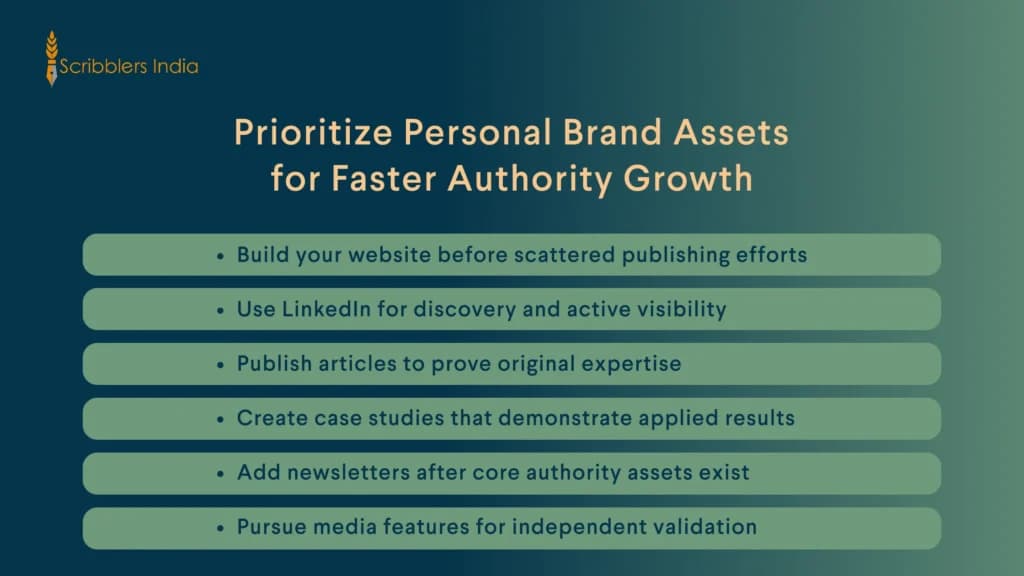
| Personal brand asset | Primary role | Level of control | Search value | Recommended priority |
| Personal website | Establish identity and ownership | High | High | Build first |
| LinkedIn profile | Create professional discovery | Medium | High | Build first |
| Thought leadership articles | Prove depth and original thinking | High | High | Build early |
| Case studies | Confirm applied expertise | High | High | Build early |
| Newsletter | Develop an owned audience | High | Medium | Add after core assets |
| Media features | Provide independent validation | Low | High | Pursue continuously |
| Podcast and event pages | Expand authority signals | Low | Medium | Add selectively |
| Short social content | Maintain reach and recognition | Medium | Variable | Publish consistently |
The sequence reduces scattered effort. Once the foundational assets exist, publishing can connect them into a wider discovery path rather than creating isolated attention.
How to Turn an Idea into a Connected Personal Branding Content System?
To build a strong personal brand, you need a connected content system that develops a single useful idea across several formats without repeating the same copy. Every format should answer a different question or serve another stage of audience understanding.
The process begins with a substantial source idea and ends with linked assets that strengthen one authority association.
Start with an interview, a customer question, an operating lesson, or an original framework. Develop the complete argument inside an owned article. That article should include context, reasoning, examples, evidence, and a practical conclusion. It becomes the canonical source for later adaptations.
LinkedIn can introduce the central observation through a concise post. A carousel can explain the framework. A newsletter can explore a related implication. A short video can answer one objection. A case study can demonstrate application, while a podcast pitch can connect the topic with wider industry discussion.
Each adaptation should link readers toward the next useful depth level. The LinkedIn post can lead to the article. The article can be connected to a case study and a relevant service. The newsletter can return readers to an updated framework or new example.
This system also protects voice consistency. A professional ghostwriting service can distill several related ideas from a single structured interview. The founder provides judgment, while the editorial team manages research, structure, adaptation, and publishing continuity.
How to Build a Strong Personal Brand For Better AI Search Visibility?
A strong personal brand improves AI search visibility by giving platforms clear, verifiable information about your identity and expertise. Consistent profiles and original content help systems understand your professional relevance. Owned authority assets and credible external references help them verify evidence and include you in more suitable generated answers.
- Keep identity details consistent across websites, biographies, LinkedIn profiles, and author pages to reduce identity ambiguity.
- Use a clear expertise description so AI systems can connect your name with relevant professional topics.
- Publish original authority content that shows your reasoning through real problems and informed industry interpretation.
- Share first-hand professional insights and case-based lessons to strengthen topic association around specific questions and decisions.
- Build a strong owned presence with a current biography, author page, published thinking, and evidence of expertise.
- Connect related authority assets with clear internal links that reinforce a single professional identity throughout digital discovery.
- Earn credible external mentions through interviews, guest articles, event profiles, and media quotes linked to your expertise.
- Review AI search results each month to identify outdated descriptions, missing associations, or weak evidence around priority topics.
Together, these signals give AI systems reliable evidence about who you are, what you know, and where your expertise is most relevant.

How to Optimize Your Personal Brand for AEO and GEO Mentions?
A strong personal brand earns AEO and GEO mentions when platforms can identify the person, understand their expertise, and verify the supporting evidence. Optimization requires consistent identity details, answer-ready owned content, independent validation, clear content relationships, and technical accessibility across the wider authority ecosystem.
Here is how you can build a strong personal brand that makes your expertise easier for answer engines to retrieve and reference:
- Create consistent identity signals: Use the same professional name, current title, company relationship, photograph, and expertise description across major profiles. Consistency helps platforms connect separate pages with the correct person. It also reduces confusion from outdated biographies, similar names, or conflicting professional details.
- Build an answer-ready author hub: Create a detailed author page that links to your biography, credentials, articles, case studies, media features, and verified profiles. Connect every article with a unique author URL. Add ProfilePage structured data when the page represents a single person and meets Google’s requirements.
- Publish direct and source-backed answers: Structure content around specific audience questions and provide a clear response near the beginning. Support significant claims with credible sources. Add original frameworks, first-hand lessons, and detailed cases that offer information beyond existing summaries.
- Contribute expertise to credible external platforms: Publish original insights through industry publications, research reports, professional associations, and specialist newsletters. Relevant external contributions link your name to defined topics beyond your owned website and provide useful, independent context.
- Connect the wider authority ecosystem: Add contextual internal links between author pages, articles, case studies, glossary entries, and relevant company pages. Use the sameAs property to connect to accurate external profiles. These relationships clarify how your identity, expertise, evidence, and organization fit together.
- Keep priority content accessible and measurable: Ensure important pages remain crawlable, indexed, internally linked, and included within XML sitemaps. Track them through Google Search Console. Review mentions, citations, factual gaps, competing experts, and missing topic associations through our AI search visibility scorecard.
Google recommends unique and useful content grounded in first-hand expertise. Strong SEO foundations continue to support discovery across AI Overviews and Google AI Mode. These practices improve eligibility for AEO and GEO mentions, although platforms do not guarantee citations or inclusion.
How Do You Know Whether You Have a Strong Personal Brand Online?
Measure the success of your personal branding efforts through identity clarity, authority depth, audience relevance, search visibility, external validation, AI accuracy, and business influence. No single metric captures the complete result. A useful online visibility scorecard combines platform signals with owned website data, qualitative feedback, and commercial outcomes.
This measurement model separates publishing activity from meaningful progress in personal brand over time.
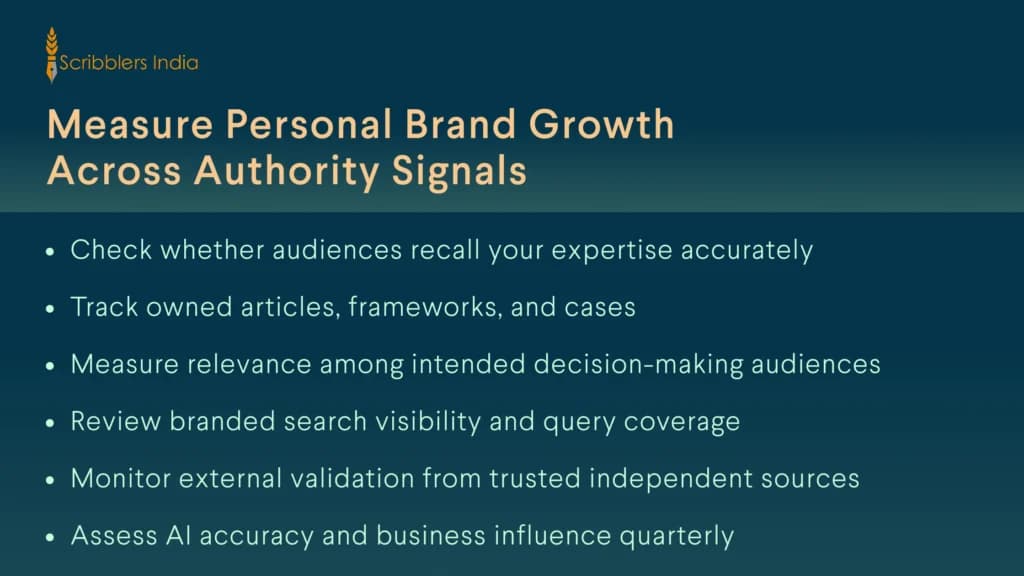
| Measurement layer | What to track | What progress looks like |
| Identity clarity | Profile consistency and message recall | Audiences describe your expertise accurately |
| Owned authority | Articles, frameworks, cases, and returning visitors | More engagement with deeper resources |
| Audience relevance | Roles, industries, seniority, and account fit | More attention from intended decision-makers |
| Search visibility | Owned results and relevant query coverage | Accurate assets appear across more searches |
| External authority | Media requests, citations, backlinks, and invitations | Independent recognition grows |
| AI visibility | Description accuracy, topic associations, and cited pages | Generated answers reflect current expertise |
| Commercial influence | Referrals, qualified inquiries, and assisted opportunities | Content supports valuable business conversations |
The EdTech leader personal branding case study shows why reach needs context. In that campaign, 99.6% of viewers came from outside the existing follower base. The result indicated discovery among new audiences rather than repeated exposure within the established community.
Review leading indicators monthly and commercial influence quarterly. Add a discovery field to inquiry forms and CRM records. Ask new contacts which article, platform, recommendation, or search introduced them to the professional.
How Can Scribblers India Help You Build a Strong Personal Brand?
Scribblers India helps founders and business leaders turn private expertise into a connected public authority system. We combine positioning, ghostwriting, thought leadership, website content, LinkedIn strategy, SEO, AEO, GEO, and performance review. Every asset supports a defined audience need and professional reputation goal.
Our approach connects multiple workstreams to help you build a strong personal brand in the following ways:
- Positioning Before Publishing: Scribblers India defines your target audience, professional territory, core viewpoints, evidence base, and future goals. This foundation gives every profile and content asset one direction. Our personal branding services focus on building authority rather than on generic social posting.
- Founder Voice Development: Our team uses structured interviews, existing communication, and direct feedback to understand how you think. Our team documents vocabulary, sentence patterns, argument style, recurring beliefs, and sensitive boundaries before scaling production.
- Owned Authority Content: We create author pages, articles, case studies, frameworks, newsletters, and website resources that preserve expertise beyond social feeds. Each asset receives a clear role within the wider information architecture.
- Thought Leadership Distribution: Our thought leadership content writing services turn first-hand insight into useful market perspectives. LinkedIn posts, long-form articles, guest contributions, and media inputs reinforce the same authority position across channels.
Get in touch with our experts to build a strong personal brand grounded in clear positioning, credible evidence, useful content, and measurable professional authority.
Frequently Asked Questions
How Long Does It Take to Build a Strong Personal Brand?
Early signals can appear within several months, including increased profile visits, more relevant engagement, and better inbound conversations. Durable authority usually develops across a longer publishing period. Existing reputation, content quality, audience fit, search visibility, and third-party validation all influence how quickly recognition grows.
Do You Need a Personal Website with an Active LinkedIn Profile?
Yes, when professional authority carries meaningful business value. LinkedIn supports discovery and professional interaction. A personal website provides greater control over identity, articles, case studies, media proof, and conversion paths. The two properties should connect rather than compete for the same role.
How Often Should You Publish on LinkedIn?
Choose a cadence you can sustain without weakening insight quality. Two useful weekly posts can build stronger authority than daily generic observations. Review audience response, profile activity, saves, relevant comments, and qualified conversations. Adjust frequency after identifying which topics and formats create meaningful professional interest.
Should You Use Your Name as the Personal Website Domain?
A name-based domain usually creates a clear relationship between the website and professional identity. Availability, name ambiguity, and future career plans may affect the choice. Keep the URL simple and memorable. Use consistent naming across the page title, biography, author information, and external profiles.
What Do Founders Ask About Content, Search, and Reputation?
Founders usually ask whether personal branding can influence search results, how ghostwriting preserves authenticity, and which ideas deserve publication. They also need to understand how AI discovery changes the way authority is built. These answers address the operational questions that appear after the foundation is clear. Each answer separates realistic personal branding outcomes from unsupported search or reputation guarantees for leaders.
Can Personal Branding Push Negative Google Results Down?
Strong owned and third-party assets can compete for relevant name searches over time. No provider can guarantee displacement or ranking positions. Address false, harmful, or private information through suitable source, platform, search, security, or legal processes. Personal branding builds wider context rather than deleting source content.
Can Ghostwritten Content Still Feel Authentic?
Yes, when the ideas and experiences come from the person receiving the byline. A skilled ghostwriter captures language, beliefs, reasoning, examples, and professional boundaries through interviews. The writer provides research and editorial structure. The founder reviews accuracy and retains responsibility for the final published message.
How Should Founders Choose Thought Leadership Topics?
Start with recurring customer questions, difficult operational decisions, category changes, common misconceptions, and experiences competitors rarely explain. Select topics where direct knowledge can improve audience decisions. Avoid chasing every trend. Recognition develops when useful ideas are repeatedly reinforced within a defined area of expertise.
How Does a Strong Personal Brand Support AI Search Visibility?
A strong personal brand creates public evidence that connects a person to defined expertise. Author pages, original articles, cases, structured data, consistent profiles, and external mentions help systems understand those relationships. Visibility still depends on the prompt, available sources, platform behavior, and content accessibility.