A personal brand statement explains the professional association you want people to make with your name. It can guide your positioning internally, while shorter versions can shape LinkedIn profiles, websites, portfolios, resumes, speaker materials, and other places where people encounter your professional identity.
One sentence rarely performs all those jobs equally well. An internal positioning statement can provide more context about your audience, expertise, and contribution, while a LinkedIn headline needs to be clearer more quickly. The underlying professional position should remain consistent even when the wording changes.
This guide starts with that core position and then explains how to build it on evidence rather than adjectives. You will also find role-specific formulas, practical personal brand statement examples, weak-to-strong rewrites, channel adaptations, and a simple framework for testing whether the statement communicates what you intend.
Key Takeaways
|
What Is a Personal Brand Statement?
A personal brand statement is a concise expression of the professional position you want associated with your name. It can communicate your expertise, intended audience, contribution, perspective, or relevant differentiation. Its exact length depends on whether it guides internal positioning or appears publicly.
Different personal branding frameworks interpret the statement differently. William Arruda, writing in Forbes, treats it primarily as an internal positioning guide, while Shopify recognizes its role across both strategic positioning and outward professional communication.
A useful way to reconcile these approaches is to separate the core position from its public expression:
| Layer | Main Question | Purpose |
| Core Positioning | What should people associate with your name? | Guides the wider personal brand |
| Channel Expression | How should that idea appear here? | Adapts positioning to the context |
Your core statement becomes the source of truth. A LinkedIn profile, a website, a speaker biography, a portfolio, or an email introduction can then express that position differently without forcing one sentence to carry every communication requirement.

How Is a Personal Brand Statement Different From a Bio or Tagline?
A personal brand statement defines your professional position within your broader communication. A headline conveys the position quickly, while a professional bio provides evidence and context. A tagline focuses more heavily on memorability, and a value proposition emphasizes usefulness for a defined audience.
These assets should reinforce the same professional association without repeating identical wording. When the underlying position shifts with every format change, the problem usually runs deeper than copywriting. The professional identity itself still needs a clearer strategic center.
| Asset | Primary Job | Typical Expression |
| Personal Brand Statement | Defines professional positioning | One or several short sentences |
| LinkedIn Headline | Communicates relevance quickly | Short searchable profile field |
| Professional Bio | Adds evidence and context | Short or long paragraph |
| Tagline | Improves memorability | Very short phrase |
| Elevator Introduction | Explains relevance conversationally | Short spoken explanation |
| Value Proposition | Shows value for an audience | Audience and outcome focused |
Senior leaders often need an even broader positioning system because their reputation can influence employees, customers, investors, and industry peers simultaneously. Our personal branding vs executive branding analysis explains how those stakeholder expectations change the branding approach.
What Are the Five Components of a Strong Personal Brand Statement?
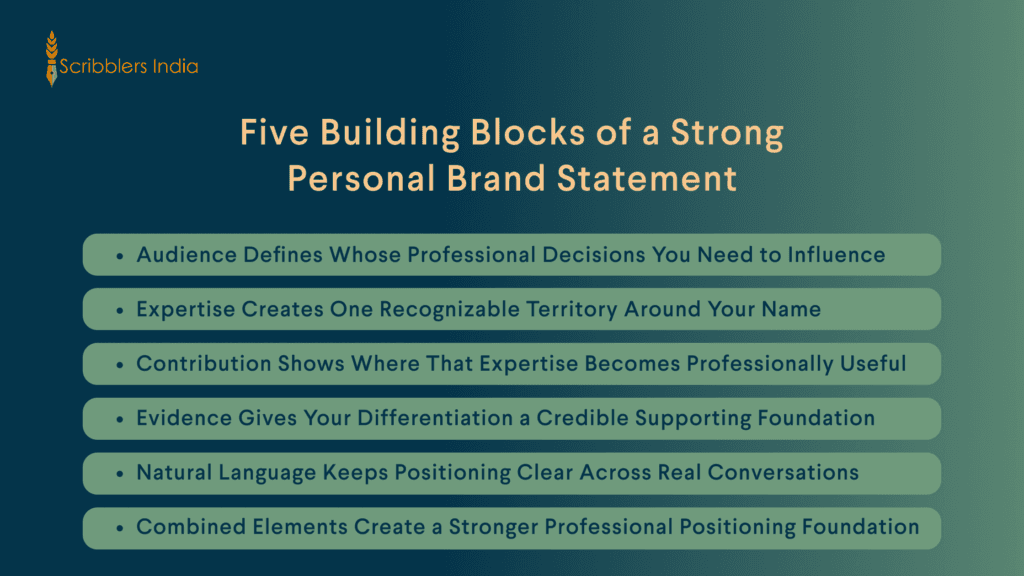
A strong personal brand statement usually reflects five foundations: audience, expertise territory, professional contribution, credible differentiation, and natural voice. Every element does not need to appear literally in the final sentence, although each should be clear before you start refining the wording.
1. Who Is the Relevant Audience for Your Personal Brand?
Start with the people whose decisions your reputation needs to influence. “Business leaders” creates limited direction, while “CFOs at growth-stage SaaS companies” creates a useful boundary. Executives may need several audiences, while consultants can often define their commercial audience more narrowly.
2. What Expertise Should People Associate With Your Name?
Choose an expertise territory rather than compiling a list of skills. “Marketing” covers too much, while “B2B category positioning for enterprise software” provides a clearer association. Ask which professional subject you want someone to connect with your name six months from now.
3. Where Does Your Expertise Create Professional Value?
Expertise becomes more meaningful when people understand where it applies. Instead of describing yourself as an experienced organizational consultant, explain the context you understand, such as helping scaling leadership teams clarify decision ownership when rapid growth makes coordination increasingly difficult.
4. What Makes Your Personal Positioning Credible?
Differentiation does not require claiming that nobody else performs similar work. Credibility can come from specialized industry exposure, repeated experience with one difficult problem, documented outcomes, original research, cross-functional experience, or a professional perspective your career can genuinely support.
5. Does the Personal Brand Statement Sound Like You?
Avoid depending on adjectives such as “visionary,” “dynamic,” or “results-driven” to create authority. Specific professional language carries more information. Read the statement aloud and ask whether you could use similar language when someone asks what you do in a real conversation.
Which Personal Brand Statement Formula Should You Use?
The right formula depends on your role and the professional decision your reputation needs to support. Consultants can lead with an audience problem, while founders may express a market belief. Executives usually need an expertise territory that avoids sounding like a sales proposition.
Use these formulas as scaffolds rather than finished templates:
| Role | Formula | Example |
| Consultant | I help [audience] address [problem] through [expertise]. | I help B2B SaaS teams clarify category positioning when product complexity makes enterprise value difficult to explain. |
| Executive | I work at the intersection of [expertise] and [business problem]. | I work at the intersection of enterprise AI governance and product adoption, helping organizations introduce AI with clearer accountability. |
| Founder | I am building [company/category] around the belief that [market perspective]. | I am building clinic software around one idea: administrative technology should reduce work at the point of care. |
| Career Professional | I bring [experience] to [problem], with depth in [context]. | I bring supply-chain experience to manufacturing transformation, with particular depth in supplier planning and operational execution. |
| Advisor or Board Candidate | I bring [experience] to organizations navigating [environment]. | I bring B2B software operating experience to leadership teams navigating scale, with a focus on category strategy. |
Founders face an additional consideration because their professional position can influence how people interpret the business. Our analysis of how founder personal branding builds company credibility explains how positioning, visible evidence, and repeated professional viewpoints can strengthen trust around both the individual and the company they lead.
How Do You Write a Personal Brand Statement Step by Step?
Learning to write a personal brand statement becomes easier when you delay finalizing the wording. Define the direction first, gather credible evidence, understand the intended audience, and identify repeated professional strengths. The writing stage should organize those decisions rather than replace them.
Step 1: Define What Your Personal Brand Needs to Achieve
Start with the next one to three years. Your reputation may need to support deeper category recognition, progression into leadership, advisory work, board opportunities, consulting demand, founder visibility, or a move into another industry. Different goals create different positioning requirements. Understanding why personal branding becomes strategically important can also help you decide which professional decisions your reputation actually needs to influence before you begin writing the statement.
Step 2: Build an Evidence Inventory Before Writing
Review the professional history behind the position you want to claim. Look at industries you understand, recurring problems solved, important projects, specialist knowledge, research, supported outcomes, published thinking, credentials, and repeated feedback. Several related experiences often reveal a stronger expertise territory.
Step 3: Ask Others What They Already Associate With You
Professional reputation exists partly outside your own interpretation. Ask trusted colleagues or clients which problems they seek your advice on and which part of your expertise stands out. Experts similarly recommend gathering external input when developing expert positioning.
Step 4: Choose One Leading Audience and Expertise Territory
Narrowing creates recognition. “Technology leader helping businesses transform” could describe thousands of professionals. “Enterprise technology leader modernizing data infrastructure for regulated financial-services companies” gives the audience a clearer professional association and provides stronger direction for future content and profile development.
Step 5: Draft Several Different Personal Brand Statements
Write versions that begin from different angles before polishing anything. One can lead with the audience, another with expertise, while a founder might start with a market belief. Comparing structures helps reveal which part of the professional position deserves to become the leading idea.
Step 6: Remove Claims Your Professional Evidence Cannot Support
Terms such as “leading,” “renowned,” “visionary,” or “world-class” create proof requirements without explaining much. Replace status language with professional context. A fintech leader who describes the lending systems they understand gives readers more useful information than one who calls themselves a transformative industry visionary.
Step 7: Test the Statement With the Intended Audience
Show the draft to people resembling the audience you want to influence. Ask what they think you understand, who they believe you help, and what they would approach you about. Large differences between those answers and your intention indicate a positioning issue.
Following these steps gives you a core position before you start adapting the message to platforms. That distinction is important because personal branding is stronger when profile copy, thought leadership, and professional introductions all reinforce a single recognizable expertise territory.
What Do Strong Personal Brand Statement Examples Look Like?
Strong personal brand statement examples convey a recognizable professional association rather than relying on abstract claims. The structure changes depending on the role, because founders, executives, consultants, investors, and career professionals need their reputations to influence different decisions and audiences.
The following examples are original and should be adapted to genuine professional experience:
| Role | Personal Brand Statement Example |
| B2B SaaS Founder | I build workflow software for operations teams that have outgrown spreadsheets but don’t want six-month enterprise implementations. |
| Fintech Founder | I am building infrastructure that helps lenders make more consistent credit decisions from fragmented borrower data. |
| Technology Executive | I lead enterprise technology programs that move AI experimentation into governed production environments. |
| CHRO | I focus on workforce systems that help growing organizations make clearer talent decisions as roles and skills change. |
| CFO | I work with growth-stage businesses on financial decisions that determine how quickly they can scale without weakening operating discipline. |
| Cybersecurity Leader | I specialize in identity governance for enterprises where access complexity has outpaced security ownership. |
| Product Leader | I build B2B products for complex workflows where adoption depends on making expert processes easier for everyday users. |
| Management Consultant | I help leadership teams redesign decision ownership when rapid growth creates too many meetings and unclear accountability. |
| Marketing Consultant | I help technical B2B companies turn complex product capabilities into category narratives buyers can understand and remember. |
| Independent Advisor | I advise founder-led B2B companies during the shift from founder-driven sales to a repeatable commercial operating model. |
| Investor | I invest in enterprise software teams solving operational problems where deep domain expertise creates durable product advantage. |
| Board Candidate | I bring operating experience across regulated technology businesses to boards navigating growth, governance, and major platform transitions. |
The strongest examples give readers enough information to understand the professional territory without explaining an entire career. That same principle becomes easier to see when weak statements are compared directly with stronger versions built around clearer audience, expertise, and context.
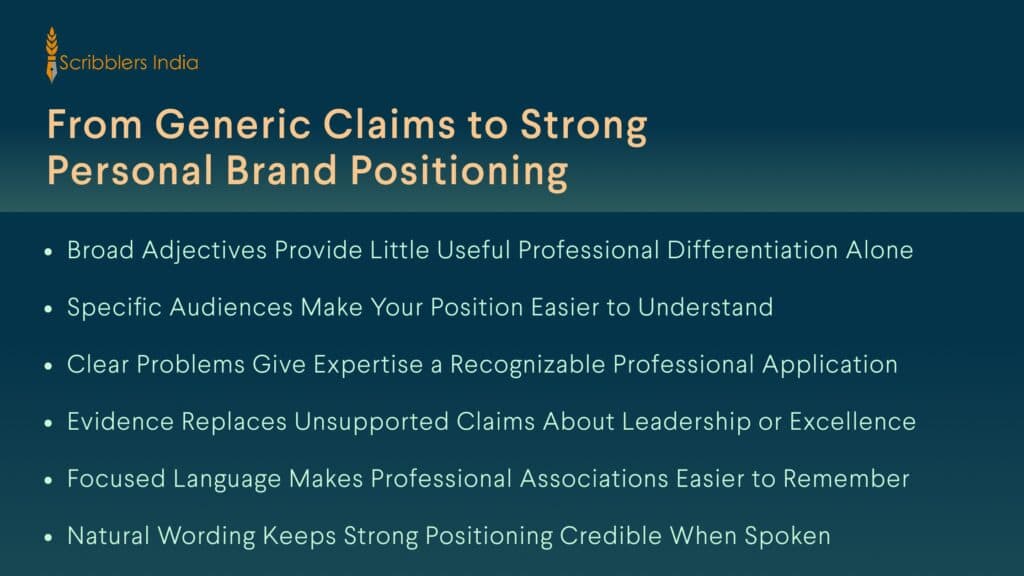
How Can You Improve a Weak Personal Brand Statement?
A weak personal brand statement usually depends on adjectives, broad audiences, or unsupported status claims. Improve it by replacing abstract language with audience context, professional problems, expertise, or evidence. The objective is greater clarity rather than making the sentence sound more impressive.
| Weak Statement | Stronger Version | What Improved |
| Passionate, results-driven leader committed to innovation. | I lead supply chain transformation programs for manufacturers facing fragmented planning across suppliers and commercial teams. | Context replaces adjectives. |
| I help businesses grow through innovative marketing strategies. | I help founder-led B2B companies clarify category positioning when technical products are difficult for buyers to understand. | Audience and problem become specific. |
| Technology visionary driving digital transformation. | I lead modernization programs for banks replacing legacy data infrastructure while maintaining required controls. | Professional substance replaces status language. |
| People-first HR leader building great cultures. | I design workforce systems for companies moving from founder-led teams into multi-layer management. | Organizational context clarifies expertise. |
| Entrepreneur, speaker, mentor, investor, and strategist. | I work with first-time B2B founders on commercial decisions shaping positioning, early sales, and investor communication. | One association organizes wider experience. |
A useful rewrite usually removes more than it adds. The strongest version identifies what the audience should remember, then lets your bio, work history, portfolio, content, and supporting evidence provide the wider professional story around that central association.
How Should a Personal Brand Statement Change Across Channels?
Your personal brand statement should remain strategically consistent while its expression changes across channels. LinkedIn needs immediate professional clarity, while a website can emphasize audience value. Speaker materials require third-person context, and an email introduction should sound natural enough for conversation.
Consider this core position:
I help technical B2B companies clarify category positioning when complex products are difficult for enterprise buyers to understand.
The professional association remains consistent below, while the wording changes according to the job each channel needs to perform.
| Channel | Adapted Expression |
| LinkedIn Headline | B2B Category Strategist | Positioning Complex Technology for Enterprise Buyers |
| LinkedIn About | My work focuses on clarifying the category and commercial narrative around complex B2B technology. |
| Website Hero | Make Complex B2B Technology Easier for Buyers to Understand |
| Speaker Bio | Maya Rao is a B2B category strategist who works with technical companies on enterprise positioning. |
| Email Introduction | I work on category positioning for technical B2B companies, especially when product complexity complicates buyer communication. |
LinkedIn deserves particular attention because the headline, About section, experience, featured assets, and recurring content collectively shape professional discovery. Our LinkedIn personal branding guide explains how those elements can reinforce the same position without repeating the same wording throughout the profile.
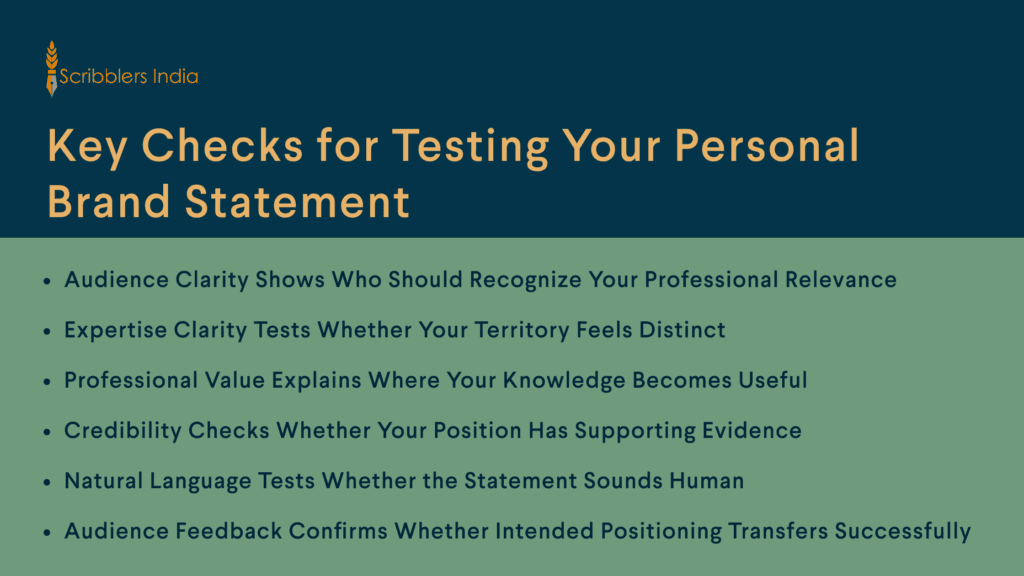
How Can You Score Your Personal Brand Statement?
You can score a personal brand statement across audience clarity, expertise, professional value, credibility, and natural language. The exercise is diagnostic rather than scientific. Its purpose is to expose where the positioning remains vague before you invest time polishing individual words or channel versions.
| Criterion | 0 | 1 | 2 |
| Audience Clarity | Could describe anyone | Audience implied | Relevant audience clear |
| Expertise Clarity | Expertise vague | Broad field visible | Specific territory recognizable |
| Professional Value | Application unclear | General value visible | Clear contribution shown |
| Credibility | Depends on self-description | Some context exists | Position has credible support |
| Natural Language | Sounds corporate | Mostly natural | Sounds credible when spoken |
Scores from 0–4 suggest that the positioning itself needs more work, while scores of 5–7 usually indicate a usable idea with gaps in specificity. An 8–10 statement is ready for wider audience testing, although external interpretation remains more important than your own score.
Show the statement to several people who resemble the intended audience and ask what professional association they draw from it. Their answers reveal whether your positioning transfers beyond the page, which is ultimately more useful than asking whether they find the wording impressive.
What Mistakes Make Personal Brand Statements Sound Generic?
Generic statements usually emerge when polished language receives more attention than professional information. Broad audiences, status adjectives, long skill lists, abstract values, and attempts to represent an entire career make positioning harder to remember because too many ideas compete for the same limited attention.
Common mistakes include:
- Including Everything: A personal statement should lead with one professional association, not compress your complete resume.
- Using Adjectives: Terms such as “strategic” or “innovative” need evidence before they create meaningful differentiation.
- Choosing Everyone: Audiences such as businesses, leaders, or individuals provide limited guidance on positioning.
- Writing for Keywords: Relevant professional language helps clarity, while repetition makes the statement artificial.
- Copying Formulas: A framework can organize thinking, although the final wording should remain individual.
- Changing Constantly: Strong positioning requires enough consistency for others to remember the association.
The goal is not to remove complexity from your career. Your experience can remain broad while one professional association leads your public position. Supporting assets can then reveal additional skills, interests, and accomplishments after the audience understands the central expertise territory.
When Should You Update Your Personal Brand Statement?
Update your personal brand statement when your professional direction changes enough to alter what you want people to associate with your name. A new leadership role, business model, target audience, area of expertise, or career objective can justify a revision, while routine content changes usually do not.
Useful triggers include moving into senior leadership, starting an advisory practice, changing industries, preparing for board opportunities, entering a new market, or developing substantial expertise in another area. Small wording refinements can happen more frequently while the underlying professional position remains stable enough to build recognition.
For established professionals, the decision should also consider the return created by the wider reputation system. Our guide to personal branding ROI explains how to evaluate visibility, audience quality, authority, and professional opportunities beyond impressions alone.
How Should a Personal Brand Statement Guide Your Wider Personal Brand?
A strong personal brand statement should make other communication decisions easier. It can guide your LinkedIn headline, emphasis on experience, website messaging, thought leadership topics, professional bio, speaker introductions, media commentary, and portfolio choices by giving each asset a consistent strategic direction.
Use the position as an editorial filter rather than a rigid script. Before publishing something or changing a profile, ask whether the decision strengthens the expertise association you want to build. This creates consistency while leaving enough room for your professional interests and career to evolve.
Once that positioning is defined, our take on how to build a personal brand online explains how LinkedIn, search visibility, thought leadership, owned assets, and other digital touchpoints can reinforce the same professional reputation over time.
How Can Scribblers India Help Build a Clear Personal Brand Position?
At Scribblers India, we treat a personal brand statement as one part of a wider positioning system. We begin by identifying what you want to become known for, which professional decisions that reputation should influence, and which parts of your experience provide credible evidence.
That position can then guide LinkedIn development, executive profiles, founder-led content, thought leadership, and ghostwriting. Our personal branding services connect these touchpoints around a single recognizable expertise domain while adapting the expression to each channel and its intended audience.
We also use recurring editorial work to strengthen the evidence behind the position. Articles, commentary, research, and professional insights can demonstrate expertise over time, helping the wider brand provide substance behind the concise statement people encounter first.
Get in touch with our team to define your professional position, strengthen the evidence behind it, and build a consistent personal brand.
Frequently Asked Questions
Should a Personal Brand Statement Be Public or Remain an Internal Tool?
Either approach can work. Some professionals use the statement primarily as an internal positioning guide, while others publish a shorter version. A practical approach is to maintain a single core statement and adapt its central idea for LinkedIn, websites, speaker materials, portfolios, and other public channels.
Can I Use Different Personal Brand Statement Versions Across Platforms?
Yes. Keep the expertise territory and professional position consistent while adapting the expression. A LinkedIn headline needs to be concise, while a website can emphasize audience value. Speaker materials may require third-person context, so consistency should come from the idea rather than identical sentences everywhere.
How Can I Tell Whether My Personal Brand Statement Is Specific Enough?
Remove your name and ask whether the statement could describe hundreds of professionals in your field. Then show it to someone from your intended audience and ask what they think you understand deeply. Vague or inconsistent answers usually signal that the positioning needs greater specificity.
What Should I Do if My Work Covers Several Specialties?
Look for the professional problem, audience, or perspective that connects to your experience. Your statement does not need to list every skill or role. Choose the association that should lead your reputation now, while your bio, work history, content, and portfolio provide the broader professional context.
Should a Personal Brand Statement Include Achievements?
Include achievements when they strengthen credibility without making the statement difficult to understand. Relevant experience, specialization, scale, or supported outcomes can provide useful evidence. Detailed accomplishments usually belong in the surrounding bio, LinkedIn Experience section, case material, portfolio, or other supporting professional assets.
How Long Should a Personal Brand Statement Be?
There is no universal word count. A public-facing version may fit into one sentence, while an internal positioning statement can be longer. Include enough information to establish expertise and professional relevance, then remove anything that does not help the intended audience understand the position.
Can a Personal Brand Statement Change Over Time?
Yes. Update it when your professional direction changes materially, such as entering leadership, entering a new market, or building a new area of expertise. Avoid frequent changes across individual campaigns, as strong positioning requires sufficient consistency for audiences to connect your name with a recognizable professional territory.
What Is the Difference Between a Personal Brand Statement and a Value Proposition?
A personal brand statement defines the professional association you want attached to your name, while a value proposition focuses more directly on value delivered to an audience. Consultants may use similar language for both, whereas executives often need a broader position that reflects expertise, judgment, and professional influence.