Many founders decide to hire a personal branding agency after low visibility begins to affect sales and hiring. By then, scattered profiles and inconsistent content already shape buyer perception. The stronger decision comes earlier, when leadership expertise still needs a clear public position and a repeatable publishing system.
An ORM company serves a different need. It monitors harmful information and supports correction, removal, privacy, or crisis response. Those services become important during active risk. They do not replace the strategic work required to build authority, relevance, trust, and recognition before that risk appears.
This blog explains how both service models create value. It compares deliverables, costs, timelines, capabilities, and measurable returns. You will also learn when personal branding deserves priority, when ORM support becomes necessary, and how Scribblers India builds founder authority across search, LinkedIn, and AI-led discovery.
Key Takeaways:
|
Why You Need to Hire a Personal Branding Agency?
When you hire a personal branding agency, you gain a strategic team that turns professional expertise into a recognizable public identity. The agency defines your position, captures your voice, creates authority content, and connects every asset with business goals. This work builds visibility before reputation concerns demand urgent intervention.
- Expertise receives a clear market position: A strategist identifies which audience should recognize your expertise and which problem should define that association. The resulting position guides your profiles, content pillars, proof assets, and public commentary. This foundation prevents different platforms from presenting unrelated versions of your professional identity.
- Ideas become a publishing system: Founder interviews capture experience that rarely reaches public content. The agency turns those conversations into articles, LinkedIn posts, newsletters, case studies, and signature frameworks. Each format performs a distinct role across discovery and evaluation, creating greater value from every hour the founder contributes.
- Public voice becomes consistent: A voice framework records vocabulary, sentence patterns, professional beliefs, and editorial boundaries. Writers then use that guidance across every asset. Consistency helps audiences recognize the founder across formats without making the content feel manufactured or detached from the person’s natural communication.
- Visibility connects with business outcomes: A serious agency tracks audience quality, profile discovery, branded searches, authority signals, and qualified conversations. Publishing decisions then respond to evidence instead of platform activity alone. The personal branding agency process explains how these strategic and editorial layers work together.
Many current hiring guides treat agencies as content-scaling partners after demand already exists. That framing misses founders who need positioning before any content can perform effectively.

Why Should You Hire a Personal Branding Agency Before You Need ORM?
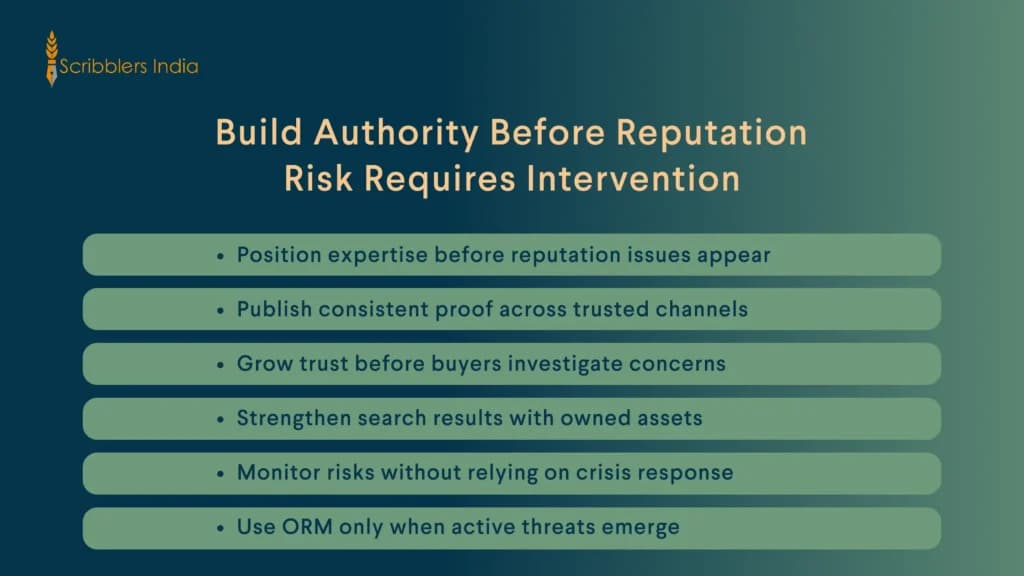
You should hire a personal branding agency before reputation risks appear because authority needs time to develop. Profiles, articles, case studies, and external references gradually create a credible professional record. That record gives audiences useful context before isolated criticism or outdated information receives greater attention.
A founder with limited public evidence remains vulnerable to whatever appears first. One old biography or unfavorable article may become the main reference point. A broader authority system provides searchers with several credible sources to understand the founder’s work, experience, current role, and professional judgment.
Early personal branding also improves commercial discovery. The 2025 Edelman and LinkedIn report found that 95% of hidden buyers become more receptive after strong thought leadership. These buyers often influence decisions without speaking directly with sales teams. Founder content can reach them before formal evaluation begins.
Waiting for a problem changes the available options. ORM specialists may manage urgent monitoring, correction, or removal processes. They cannot immediately create several years of trusted thought leadership. A proactive agency builds that credibility reserve through useful work published consistently over time.
This timing difference explains why the two services should never share one vague reputation budget.
What Is the Difference Between a Personal Branding Agency and an ORM Company?
When you hire a personal branding agency, it builds the intended authority, audience, and public body of work. An ORM company protects the existing digital reputation when inaccurate or harmful information creates risk. Their work overlaps around AI search visibility, although their starting points, specialist skills, deliverables, and success measures remain different.
The comparison below shows which provider best fits each business objective and operating situation.
| Comparison area | Personal branding agency | ORM company | What the difference means |
| Primary goal | Build authority and relevant visibility | Protect accuracy and manage risk | Choose according to the current problem |
| Starting question | What should this leader represent? | What harmful information exists now? | One starts with future positioning |
| Core work | Strategy, ghostwriting, content, and distribution | Monitoring, correction, privacy, and response | Teams require different capabilities |
| Main assets | Profiles, articles, cases, and newsletters | Alerts, audits, requests, and response plans | Deliverables should remain clearly separated |
| Time horizon | Long-term authority development | Issue-led or continuous risk protection | Branding gains value through consistency |
| Main metrics | Discovery, relevance, authority, and opportunities | Accuracy, exposure, resolution, and response speed | Reporting requires separate scorecards |
| Suitable trigger | Weak visibility or unclear positioning | Active misinformation or privacy exposure | Urgency determines service priority |
| Business value | Creates future opportunity | Protects existing trust | One builds value, while one limits damage |
When Should You Hire a Personal Branding Agency Instead of an ORM Company?
Hire a personal branding agency when your digital presence is accurate yet unclear, inconsistent, or commercially weak. You need an ORM first when false information, impersonation, exposure of personal information, or a crisis creates an immediate risk. Most founders without active threats derive greater long-term value from proactive authority-building.
These situations indicate that strategic personal branding should be a priority in your next visibility investment.
- Your expertise remains difficult to understand across profiles, search results, company pages, and professional introductions.
- Search results remain accurate, yet they provide little evidence supporting your present expertise or business direction.
- Your content receives occasional engagement without creating relevant inquiries, referrals, media interest, or hiring conversations.
- AI platforms describe your role correctly, although they rarely associate you with important category questions.
- Your LinkedIn profile shows experience, but it lacks a clear authority position or concrete evidence.
- Publishing repeatedly stops because nobody owns interviews, writing, approvals, distribution, and performance reviews.
- Your strongest ideas remain inside sales calls, leadership meetings, customer conversations, and internal documents.
Referring to a comprehensive personal branding strategy guide can help leaders identify the positioning and content foundations required before consistent publishing begins. Once these gaps become visible, the business case should focus on value creation rather than emergency protection.
Why Does a Personal Branding Agency Deliver Better Long-Term ROI?
Before you hire a personal branding agency, it is crucial to know that the service provider can deliver stronger long-term returns when the main problem involves weak authority or limited discovery. Its work creates reusable assets that support sales, hiring, partnerships, search visibility, and AI discovery. ORM spending protects reputation during risk, while proactive branding can create new commercial opportunities over time.
Thought Leadership Builds Trust Before Outreach
Strong content gives buyers a way to assess your thinking without scheduling a call. The Edelman and LinkedIn report found that 64% of hidden buyers trust thought leadership more than product sheets. That trust can improve outreach receptivity and strengthen internal buyer confidence.
One Interview Creates Several Useful Assets
A structured founder conversation can support an article, a LinkedIn series, a newsletter section, a case narrative, and a speaking brief. The agency adapts the central idea for each format. This process reduces the leadership time required for consistent visibility and increases the usable value of existing expertise.
Owned Content Continues Working After Publication
A strong article or framework can support search discovery and sales enablement for months. Social posts create immediate reach, while owned assets provide lasting depth. Internal links can connect that depth with relevant services, cases, author information, and conversion paths throughout the buyer journey.
Consistent Authority Reduces Routine Reputation Gaps
A developed public presence cannot prevent every crisis. It can reduce problems caused by weak information, outdated profiles, or limited professional context. Audiences gain more credible evidence for evaluating the founder. Specialist ORM remains available when active risks exceed the branding team’s remit.
ROI, therefore, depends on selecting the service that best matches the business problem at hand.
What Work Does a Personal Branding Agency Handle for You?
A personal branding company manages the strategic and editorial workload required to build a credible founder presence. This includes positioning, voice development, idea extraction, content production, distribution planning, and performance review. The agency should reduce leadership effort while keeping the founder responsible for ideas and factual accuracy.
When you hire a personal branding agency, it is likely to handle the following activities for you:
- Positioning and audience strategy: The agency defines what the founder should become known for and who needs that expertise. It maps out business goals, audience problems, market gaps, credible evidence, and useful perspectives before content production begins.
- Voice capture and founder interviews: Regular conversations uncover experience, observations, customer questions, and current opinions. A practical voice guide captures the founder’s explanations of ideas. This process allows professional ghostwriting services to preserve authenticity while reducing writing pressure.
- Content planning and production: The team creates LinkedIn posts, articles, newsletters, case studies, and founder frameworks. Every format receives a clear purpose. Thought leadership content writing supports deeper authority beyond short platform updates.
- Profile and authority asset development: LinkedIn profiles, author pages, website biographies, speaker pages, and Featured sections receive consistent positioning. These assets help audiences quickly understand the leader and guide interested visitors to stronger evidence.
- Distribution and performance refinement: The agency plans publishing, contextual internal links, repurposing, and review cycles. It tracks relevant discovery and commercial influence. Performance data then improves future topics, formats, calls to action, and channel priorities.
Why Is Personal Branding Difficult to Manage Internally?
Personal branding becomes difficult internally because it requires regular access to the founder and several specialized capabilities. Strategy, interviewing, writing, editing, distribution, and measurement need consistent ownership. Internal teams often prioritize company campaigns, leaving founder content dependent on spare time and irregular approvals.
It is likely that your decision on whether or not to hire a personal branding agency is based on some or all of the following reasons:
- Someone must extract original ideas before the editorial calendar becomes filled with generic industry commentary.
- A strategist must connect the founder’s topics with audience questions and current business priorities.
- Writers need enough subject context to preserve accuracy without producing safe, repetitive, or shallow content.
- Editors must protect voice consistency across LinkedIn, articles, newsletters, case studies, and speaking material.
- Marketing teams need clear approval rules that prevent founder content from being delayed for several weeks.
- Search specialists must connect author pages, structured content, internal links, and relevant company resources.
- Analysts must separate broad engagement from authority growth, qualified discovery, and business influence.
Content Marketing Institute reported that 96% of surveyed B2B marketers create thought leadership. Widespread participation does not mean every organization has a mature operating system. Many teams still struggle to consistently involve internal expertise.
A personal branding company creates value by removing these execution gaps without separating content from the founder’s real thinking.
How Personal Branding Services Turn Your Expertise Into Content?
A personal branding services provider turns expertise into content through structured extraction, editorial development, channel adaptation, and continuous refinement. The founder supplies experience and judgment. The agency identifies useful ideas, develops clear arguments, validates supporting evidence, and publishes each insight in formats suited to different audience needs.
- Interviews capture ideas hidden inside daily work: A skilled interviewer asks about decisions, trade-offs, customer patterns, failed approaches, and emerging concerns. These conversations reveal material that standard questionnaires rarely uncover. Recorded interviews also preserve the founder’s natural language, which helps writers reproduce voice and reasoning more accurately across later drafts.
- Content pillars create a recognizable position: The agency organizes ideas into four or five authority areas. Each pillar should connect first-hand expertise with a meaningful audience problem. Stable pillars build recognition, while changing examples keep the content current. The resulting system avoids random posting without forcing every idea into one narrow subject.
- Different formats support different decisions: A LinkedIn post can introduce an observation. An article can explain the complete argument. A case study can prove practical application. A newsletter can develop an owned audience relationship. The agency connects these formats instead of publishing identical messages across every channel.
- Editorial learning improves with each publishing cycle: Founder feedback should be incorporated into a living voice guide and content knowledge base. Audience responses should influence future questions, examples, and depth. This process speeds up production without creating formulaic content. The brand becomes more recognizable as its editorial system learns from every completed cycle.
This study abroad consultant case study from Scribblers India clearly shows how well-planned positioning and channel roles can turn quiet expertise into stronger discovery.
How Can a Personal Branding Agency Improve Search and AI Visibility?
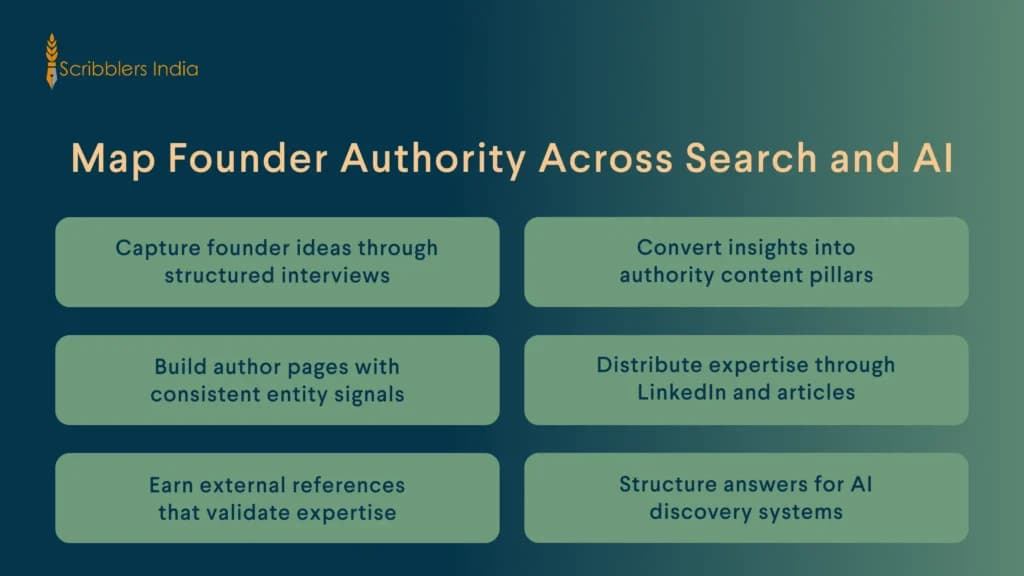
A personal branding agency improves search and AI visibility by creating consistent, accessible evidence around the founder’s identity and expertise. Author pages, original articles, case studies, aligned profiles, and external references help platforms understand professional relevance. AEO and GEO planning makes those assets easier to retrieve and summarize.
Here is how your decision to hire a personal branding agency improves your AI search visibility:
Clear Entity Signals Improve Identity Recognition
The founder’s name, role, company relationship, biography, and expertise should remain consistent across important profiles. A complete author page can connect published work, credentials, case evidence, and verified accounts. These signals reduce confusion across Google Search and AI-led discovery platforms.
Answer-Ready Content Expands Prompt Coverage
Question-led articles help answer engines find direct responses related to the founder’s expertise. Original frameworks and first-hand examples provide deeper evidence than generic summaries. Each asset can support a different prompt across Google AI Mode, ChatGPT, Perplexity, Gemini, and related search experiences.
Connected Assets Build a Stronger Evidence System
Contextual links should connect author pages with articles, cases, glossary resources, and relevant services. External profiles should confirm the same identity. This structure helps platforms interpret how the person, expertise, organization, and supporting proof relate across the wider public web.
Visibility Reviews Reveal Missing Associations
A strong agency tests relevant prompts and records descriptions, cited sources, competing experts, and factual gaps. The AI Search Visibility Scorecard helps structure this review across entity clarity, content depth, answer readiness, and external authority.
Google recommends useful, unique content grounded in first-hand expertise for AI features. Its guidance also confirms that standard SEO foundations remain relevant across AI Overviews and AI Mode. These capabilities create proactive visibility. ORM companies address a different set of risks when harmful information appears.
What Can an ORM Company Do That a Personal Branding Agency Cannot?
An ORM company is better suited to active reputation threats that need investigation, platform escalation, privacy action, or crisis management. You may hire a personal branding agency to strengthen accurate public context and long-term authority but it should not replace legal, security, or specialist reputation-response work.
- Investigate Active Reputation Threats: ORM teams can trace harmful results, repeated claims, impersonation attempts, or coordinated attacks. They document sources and monitor how information spreads. This work requires incident assessment rather than an editorial calendar, especially when personal safety or commercial harm may increase quickly.
- Manage Eligible Removal Processes: Specialists can help prepare platform reports or search removal requests where applicable. Google permits requests for defined categories of personal information. Approved removal affects Google Search results, while the original source may remain online.
- Coordinate Crisis Communication: An active crisis may require factual statements, stakeholder updates, media handling, and executive response planning. ORM providers or crisis specialists can support that coordination. The work should reflect verified facts and clear ownership rather than defensive content designed to create search volume.
- Escalate Legal or Security Concerns: Defamation concerns, fraud, doxxing, impersonation, or compromised accounts may require qualified legal or security advice. A personal branding agency should recognize these boundaries and escalate appropriately. Ethical agencies never promise guaranteed suppression through artificial websites, purchased mentions, or fabricated positive reviews.
Founders facing weak visibility alongside an active reputation problem may need two coordinated workstreams. ORM can address the immediate risk, while personal branding rebuilds credible authority and strengthens the public information audiences encounter over time.
How Do Personal Branding and ORM Costs Compare?
Personal branding and ORM costs reflect different forms of work. Branding programs price ongoing strategy, interviews, content production, distribution, and measurement. ORM pricing depends on risk severity, source complexity, monitoring intensity, and specialist involvement. Comparing monthly quotes without considering scope can lead to the wrong investment decision.
Here is a comparative analysis to understand where each budget creates value and which hidden costs require closer review.
| Cost area | Personal branding agency | ORM company | Buyer consideration |
| Initial assessment | Positioning and visibility audit | Reputation risk audit | The audit questions differ |
| Recurring work | Interviews and authority content | Monitoring and issue handling | Frequency changes cost |
| Specialist input | Strategists, writers, editors, and SEO experts | ORM analysts, crisis advisers, security, and legal coordination | Risk affects team seniority |
| Main value created | Authority and qualified discovery | Risk reduction and information accuracy | Compare value type |
| Asset ownership | Articles, frameworks, profiles, and cases | Reports, requests, evidence, and protocols | Confirm usage rights |
| Hidden internal cost | Founder interviews and approvals | Executive response and evidence gathering | Include leadership time |
| Engagement pattern | Usually several months | Project-based or continuous | Timelines should match urgency |
A lower monthly fee can become expensive when internal teams rewrite drafts or manage unclear workflows. ORM can also become costly when a weak digital footprint needs continuous intervention without any proactive authority system.
Request a task-level scope before comparing providers. Separate setup, recurring deliverables, optional distribution, monitoring, crisis work, and external specialist fees. This structure makes the complete cost easier to understand.
How Do You Measure ROI After You Hire a Personal Branding Agency?
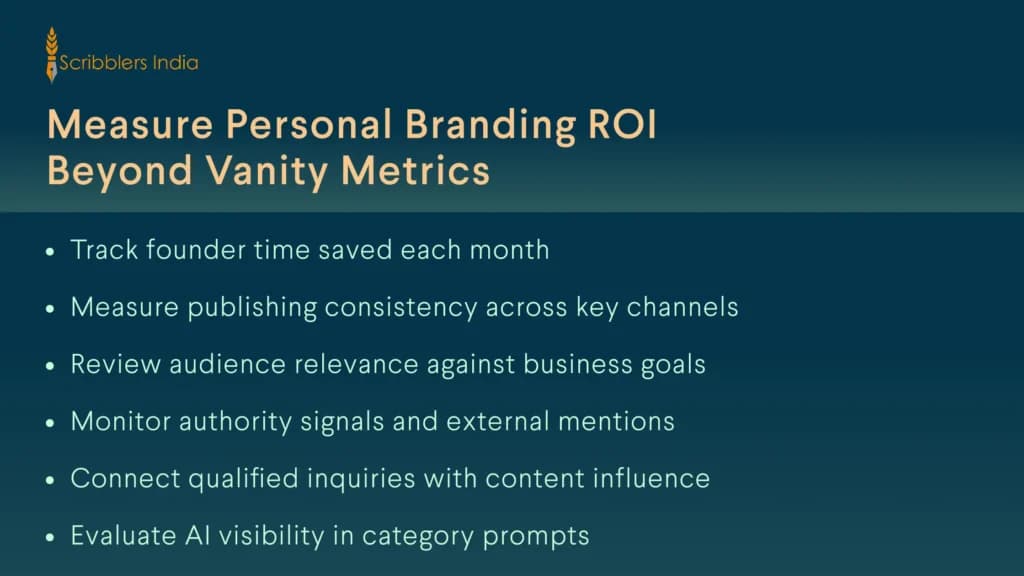
Measure personal branding ROI across production efficiency, audience relevance, authority growth, and commercial influence. Reach alone cannot show whether the agency creates business value. A useful personal branding visibility scorecard connects leadership time saved with stronger professional discovery, trusted expertise, qualified conversations, and opportunities influenced by founder content.
Production Efficiency Shows Whether the System Works
Track interview time, review effort, revision volume, approval speed, and publishing consistency. The agency should reduce friction after early calibration. Repeated delays or extensive rewrites indicate weak voice capture, poor subject understanding, or an unclear working process.
Audience Quality Shows Whether Positioning Works
Review the roles, industries, seniority levels, and company types that engage with the founder. Relevant attention deserves greater weight than broad impressions. Content should increasingly attract the buyers, partners, employees, investors, and professional peers defined in the strategy.
Authority Signals Show Growing Market Recognition
Track branded search growth, citations, backlinks, media requests, speaking invitations, and expert mentions. These signals indicate whether external audiences associate the founder with a specific subject. AI descriptions and topical recommendations can add another layer of visibility.
Commercial Influence Shows Business Value
Record qualified inquiries, referrals, hiring interest, partnerships, and content-assisted opportunities. Ask each new contact how they discovered the founder. Add attribution fields inside the CRM. Compare changes quarterly rather than assigning a commercial value to a single post.
Content Marketing Institute reports that stronger thought leadership teams measure business impact and brand authority more consistently. That approach separates publishing activity from strategic performance.
How Can You Choose the Right Personal Branding Agency?
You must select personal branding services in India through positioning depth, voice process, content quality, search capabilities, measurement model, and ethical boundaries. Attractive samples reveal writing skill, although they do not prove strategic fit. A paid pilot should test how well the team extracts expertise and converts feedback into publishable work.
These evaluation points help identify a partner that can support sustained founder authority.
- Assess the strategy process: Ask how the agency defines audience, authority territory, proof, and business goals. A provider that begins with a posting calendar may lack the foundation required for distinctive content.
- Review relevant work: Examine samples created for similar audiences or comparable subject complexity. Look for clear arguments and first-hand insights to identify the best personal branding agencies in India.
- Test voice capture: Use a paid pilot involving one real interview and a meaningful topic. Review question quality, factual accuracy, voice fit, revision handling, and final usability before signing a longer retainer.
- Confirm the delivery team: Identify who conducts interviews, develops strategy, writes drafts, completes editing, and reviews performance. Large agency credentials mean little when junior generalists handle every daily task.
- Examine search and AI capabilities: Ask how author pages, owned content, internal links, AEO structure, GEO planning, and prompt monitoring are integrated into the program. Social publishing alone creates an incomplete system of authority.
- Clarify ownership and confidentiality: The agreement should cover content rights, access to recordings, source materials, portfolio permissions, and data handling. Founders should retain final approval over all published claims.
- Reject unrealistic promises: Avoid guaranteed virality, rankings, AI citations, or search suppression. Credible agencies explain the work they control and the platform outcomes they cannot guarantee.
The right agency should become easier to evaluate after a defined pilot, transparent scope, and clear measurement baseline.

How Can Scribblers India Help You Build Founder Authority?
Scribblers India helps founders and business leaders build proactive authority before reputation gaps limit discovery. Our personal branding services connect positioning, founder voice, thought leadership, ghostwriting, owned content, SEO, AEO, GEO, and AI visibility measurement. Every engagement begins with business goals rather than a generic social publishing package.
Here is why you must consider Scribblers India before making your decision to hire a personal branding agency:
- Positioning and authority strategy: We define who you need to reach and which expertise should shape market recognition. Our personal branding services connect that position with profiles, content pillars, proof assets, and future opportunities.
- Founder-led content production: Our team uses structured interviews to capture experience, judgment, and original viewpoints. Our writers create LinkedIn posts, articles, case studies, newsletters, and signature frameworks without separating the final content from your natural professional voice.
- Owned authority development: We build deeper resources that remain discoverable beyond social feeds. Author pages, thought leadership articles, case evidence, and connected website content give buyers several ways to assess your expertise before starting a conversation.
- AEO and GEO readiness: Our experts structure content around real audience questions and clear answers. We add entity consistency, source-backed claims, contextual links, author signals, and prompt coverage that support Google Search and AI-led discovery.
- Performance-led refinement: Our team reviews relevant reach, authority signals, branded discovery, AI mentions, and qualified conversations. Those findings guide topic selection, content refreshes, distribution choices, and the next editorial cycle.
An ORM company remains valuable in the event of misinformation, impersonation, privacy exposure, or a crisis. We focus on building the proactive authority system that reduces weak visibility and creates long-term professional value.
Talk with our experts when you are ready to hire a personal branding agency that connects founder expertise with trust, search discovery, AI visibility, and measurable business outcomes.
Frequently Asked Questions
Is It Worth Hiring a Personal Branding Agency?
Hiring an agency can be worthwhile when leadership expertise lacks clear positioning or consistent public expression. The agency should reduce your workload and improve the quality of your content. Value becomes easier to prove when the engagement tracks relevant discovery, authority signals, qualified inquiries, and leadership time saved.
When Should a Founder Hire a Personal Branding Agency?
A founder should hire an agency when visibility supports sales, fundraising, recruitment, partnerships, or category leadership. The need becomes stronger when publishing stops repeatedly or profiles communicate an outdated position. Founders should start before an important announcement creates urgent attention.
Can a Personal Branding Agency Replace an ORM Company?
No. A branding agency builds positioning, authority content, and long-term visibility. An ORM company manages active threats, inaccurate information, privacy concerns, or crisis response. A founder may need both providers when long-term authority-building continues alongside a material reputational issue.
Can a Personal Branding Agency Push Negative Results Down?
Strong authority assets may compete for relevant name searches over time. No agency can guarantee movement in rankings or suppression. False information and privacy exposure require suitable source, platform, search, security, or legal processes. Personal branding creates accurate context rather than deleting third-party content.
What Should You Confirm Before Signing an Agency Contract?
Before signing, confirm the scope, working team, approval process, rights, confidentiality terms, timelines, and measurement model. A clear agreement prevents strategic work from becoming an undefined content retainer. The founder should also understand which outcomes depend on consistent participation and which are outside the founder’s agency.
What Services Should a Personal Branding Agency Include?
A complete engagement may include positioning, voice development, interviews, profile optimization, ghostwriting, long-form content, distribution planning, and performance review. Search and AI visibility may require author pages, internal linking, AEO structure, external authority, and prompt monitoring. Confirm every deliverable separately.
Is a Personal Branding Agency Better Than a Ghostwriter?
A ghostwriter fits leaders who already understand their position and only need writing support. An agency fits leaders who need strategy, multiple formats, distribution planning, and measurement. Some agencies include specialist ghostwriters. Choose according to the actual bottleneck rather than the provider’s size.
How Long Does a Personal Branding Agency Take to Show Results?
Early improvements may appear through stronger profiles, consistent publishing, and better audience engagement. Durable authority usually develops over several months. Search discovery, external recognition, and qualified opportunities require repeated evidence. Set quarterly milestones rather than expecting one post or profile update to transform visibility.
What Should a Personal Branding Agency Contract Cover?
The agreement should define deliverables, interview access, revision rounds, approval timelines, ownership, confidentiality, and termination terms. It should also identify the working team and reporting schedule. Include separate pricing for publishing, media outreach, design, monitoring, or crisis support when those services remain optional.