When someone searches a founder’s name, they rarely separate branding from reputation. They judge whatever appears across profiles, articles, reviews, and generated answers. Undertaking a comparison between personal branding vs reputation management helps leaders shape that experience. It prevents incomplete information from defining their identity across digital touchpoints.
Personal branding gives the market a clear reason to remember and trust someone. Reputation management monitors the information environment and responds when accuracy or public confidence is at risk. One builds the narrative over time, while the other protects it when pressure rises during important business decisions.
The strongest approach starts before a crisis. It builds searchable expertise, proof, case evidence, and third-party validation, then adds monitoring and response rules. This guide explains the differences between personal branding and reputation management, the overlap, the right order of investment, and the practical boundaries. It also covers measurement across search and AI discovery channels.
Key Takeaways:
|
Is Personal Branding Same as Reputation Management?
Personal branding defines how relevant audiences should understand a professional’s expertise, values, goals, and point of view. Online reputation management tracks how digital information currently shapes public perception. The first creates recognizable authority across public platforms, while the second protects accuracy and reduces reputational risk.
A strong personal branding strategy begins with positioning. It identifies the audience, professional territory, useful viewpoints, and evidence supporting the desired identity. Content then turns that strategy into visible proof across LinkedIn, owned websites, interviews, newsletters, and industry publications. A sustained publishing cycle strengthens recognition.
Online reputation management, often called ORM, begins with the existing information environment. It reviews search results, media coverage, public comments, outdated profiles, privacy exposure, and impersonation risks. This strategy explains how monitoring, correction, response, and escalation fit together across relevant digital channels.
The comparison between personal branding vs reputation management becomes clearer when reputation is understood as the audience’s accumulated judgment. Leaders shape evidence through communication and conduct. Audiences interpret it through expectations and experience. This distinction prepares the reader to compare how the two disciplines operate in daily business operations.

What are the Key Differences Between Personal Branding vs Reputation Management?
Personal branding develops the authority a leader wants to own over time. Online reputation management protects the accuracy and stability of the leader’s existing digital footprint. Their goals overlap around trust, although their triggers, processes, specialists, deliverables, success measures, and budget choices remain distinctly different.
A detailed analysis of personal branding vs reputation management shows where each discipline begins and how its work creates practical value.
| Comparison area | Personal branding | Reputation management | What this means for leaders |
| Primary goal | Build recognition and authority | Protect accuracy and reduce risk | Each needs a separate strategy |
| Starting point | Desired future position | Current public information | One begins with intent, the other with evidence |
| Typical trigger | Growth, visibility, or category leadership | Inaccuracy, criticism, privacy, or crisis | Timing changes the work required |
| Main activities | Positioning, content, profiles, and thought leadership | Monitoring, correction, response, and escalation | Team capabilities differ considerably |
| Level of control | High control over owned communication | Limited control over third-party information | ORM influences perception within clear limits |
| Main metrics | Authority, discovery, audience quality, and opportunities | Accuracy, exposure, response speed, and resolution | Reporting should use two scorecards |
This analysis will help you understand the key differences between the two strategies. The personal branding vs online reputation management decision now depends on why proactive authority should usually come first.
How Does Personal Branding Build Trust Before a Reputation Problem?
Personal branding builds trust by giving audiences repeated evidence of a leader’s judgment before any sensitive event occurs. Clear positioning creates recognition, while useful content demonstrates expertise. Cases and external validation strengthen credibility. This public record helps stakeholders assess new information against established professional evidence.
The following trust signals help turn a visible profile into a credible authority system over time:
- Clear professional positioning: A leader becomes easier to remember when audiences can connect one name with a specific business problem. Broad labels create weak recall. A focused personal brand statement gives profiles, content, interviews, and professional introductions one consistent direction.
- Useful first-hand insight: Strong content explains decisions, constraints, lessons, and trade-offs drawn from real professional work. The 2025 Edelman and LinkedIn report found that 91% of hidden buyers value insights revealing overlooked challenges or opportunities. That finding rewards experience-led publishing.
- Visible evidence and validation: Case studies, documented outcomes, customer patterns, and practical frameworks make claims easier to assess. Media mentions, client references, event invitations, and expert citations add outside confirmation. Together, these signals create trust more reliably than repeated descriptions of expertise.
- Consistent content over time: Repeated publishing gives audiences several opportunities to evaluate the leader’s thinking. The same study found that 95% of hidden buyers become more receptive to outreach after strong thought leadership. Consistency therefore supports trust before sales contact
Why a Digital Reputation Shield is Crucial for Personal Branding vs Reputation Management Comparison?
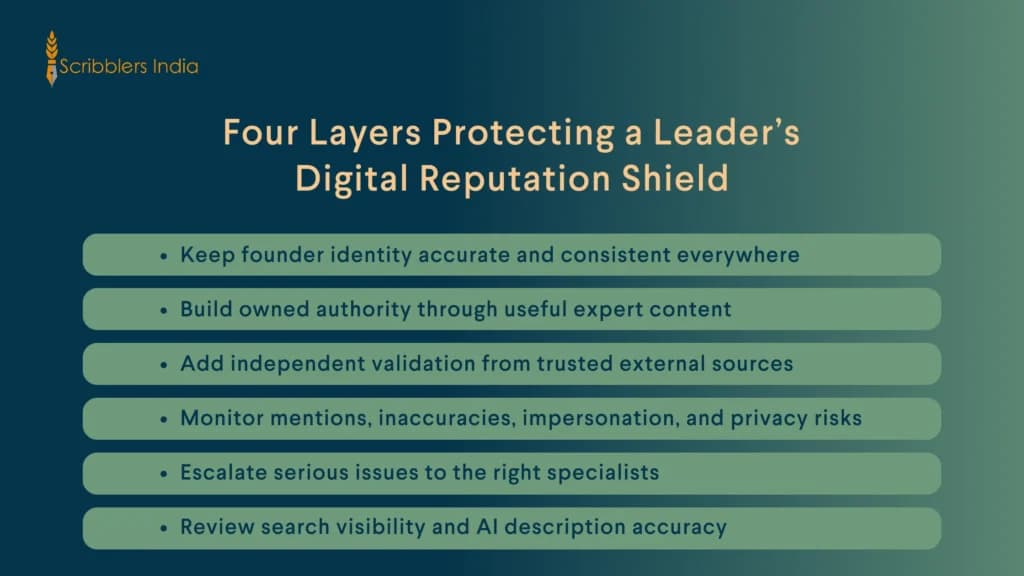
A digital reputation shield connects accurate profiles, owned content, credible proof, independent validation, and monitoring. Together, these assets surround a professional name with useful context. Audiences can form a balanced view from several reliable signals. The shield improves resilience before reputation pressure appears and reduces dependence on crisis-led repair.
These connected layers make that protection useful and credible across the wider digital information environment:
Clear Identity Signals
Every major profile should carry the same current name, role, organization, expertise, and professional description. Consistency reduces confusion across Google Search, LinkedIn, directories, author pages, and AI-generated answers. It also helps audiences distinguish the real professional from old profiles or possible impersonation. Accurate identity details improve correction requests when third-party pages carry outdated information.
Owned Authority Content
Articles, newsletters, guides, case studies, and founder commentary explain what the leader knows and how they think. Owned assets create durable evidence beyond temporary social reach. The study abroad consultant case study shows how focused positioning can turn quiet expertise into stronger professional discovery. That depth gives buyers more context during sensitive evaluation.
Credible External Confirmation
A digital shield gains strength when reputable outside sources confirm the leader’s expertise. Media coverage, guest articles, event pages, customer references, and podcast appearances create independent context. These signals should reflect genuine work and accurate claims. Paid mentions created solely for search coverage weaken the system. Each signal should contribute new evidence and useful context.
Continuous Monitoring and Response
Monitoring identifies changes before they become larger problems. Regular reviews should cover name searches, profile accuracy, media mentions, privacy exposure, impersonation, and AI descriptions. Clear escalation rules then determine whether the issue belongs to marketing, communications, security, legal counsel, or specialist ORM support. Documented ownership helps the right team respond without delay.
The personal branding vs reputation management comparison shows that this shield reduces routine vulnerability. Active threats still require specialist action when the risk exceeds the limits of brand content.
When Do You Need Online Reputation Management?
The comparative analysis of personal branding vs. reputation management shows that ORM becomes necessary when public information raises clear risks to accuracy, privacy, trust, or commercial interests. Routine brand building can handle weak visibility and outdated positioning. Specialist ORM suits issues requiring source correction, platform reporting, structured monitoring, or coordinated crisis communication.
The following situations usually require faster, more specialized reputation support during a careful incident assessment.
- False or misleading high-visibility information: An inaccurate allegation, outdated report, or repeated false claim may influence customers and investors. Document every source and trace how the information spreads. Pursue supported corrections first, then reinforce accurate context through credible owned and third-party pages.
- Sensitive personal information: Home addresses, phone numbers, government identifiers, and related details can create significant privacy or safety concerns. Google’s Results About You process accepts eligible removal requests. Approved removal affects Google Search, while the information may remain on the source page.
- Impersonation or identity misuse: Fake profiles, copied photographs, fraudulent messages, and misleading domains can harm the professional and their contacts. Response work may involve platform reports, domain complaints, customer warnings, evidence preservation, security support, and qualified legal guidance.
- High-impact public controversy: A lawsuit, data incident, leadership dispute, regulatory concern, or operational failure can move faster than ordinary publishing. These events need coordinated facts, approved messaging, stakeholder communication, media monitoring, and clear executive ownership throughout the response period.
Which Should You Choose First: Personal Branding vs Reputation Management?
For business leaders, the analysis of personal branding vs. reputation management starts with the current risk. Choose personal branding when the footprint is accurate yet weak. Choose ORM when harmful information creates immediate risk. Public-facing leaders often need both, with brand building continuous and ORM monitoring as a separate protective workstream.
The actual problem determines the right starting point and the service required during business planning.
- Choose personal branding when an accurate search reveals weak positioning, limited content, or little evidence of expertise.
- Start ORM when false information, impersonation, privacy exposure, or harmful coverage creates immediate professional risk.
- Use both workstreams before funding rounds, leadership changes, market launches, or other events that increase scrutiny.
- Keep brand building active during routine monitoring, since authority assets need time to gain visibility and trust.
- Pause normal publishing during serious incidents until communications, security, legal, or other specialists confirm the response.
- Maintain shared facts and separate owners as AI systems begin combining information from several public sources.
How is AI Search Visibility Changing the Personal Branding vs Reputation Management Debate?
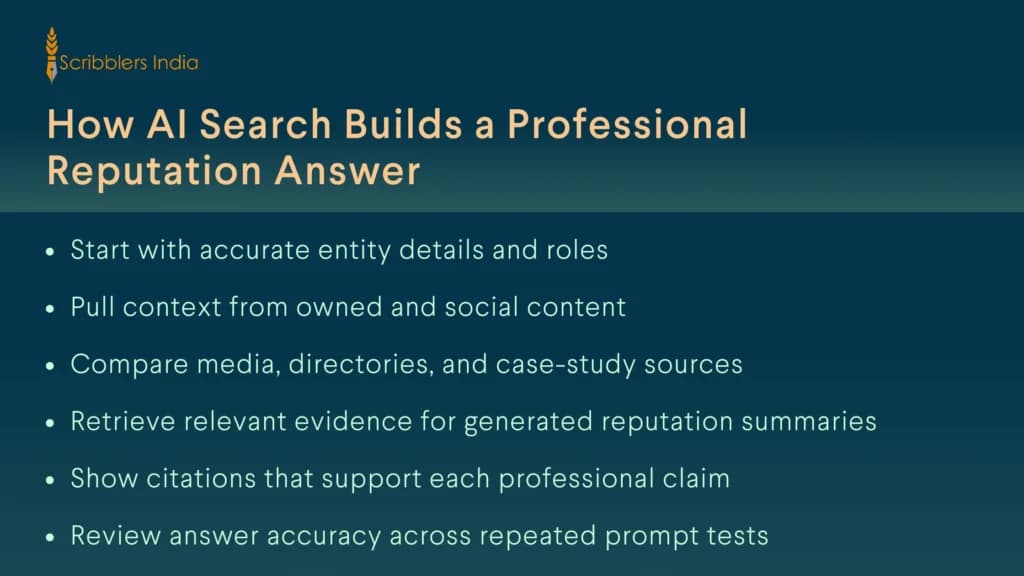
AI search discovery is expanding the discussion between personal branding and online reputation management. It can combine several public sources into one generated description or recommendation. This synthesis increases the value of accurate entity signals, original expertise, source consistency, and crawlable owned content. Reputation monitoring must therefore examine generated answers alongside conventional search results.
Here are the key changes to consider when leaders plan personal branding and online reputation management together.
AI Answers Combine Several Sources
Google explains that its generative search features retrieve relevant pages through Search systems. Those pages help ground generated responses. Query fan-out can explore several related questions from a single prompt. A leader’s reputation may therefore reflect information gathered across profiles, articles, directories, videos, and third-party pages. This wider retrieval path can surface old information unexpectedly.
Consistent Entity Details Improve Clarity
Names, job titles, organizations, biographies, and areas of expertise should remain consistent across authoritative pages. Conflicting facts can make the professional harder to understand. Consistency supports accurate interpretation across Google AI Mode, ChatGPT, Perplexity, Gemini, and other answer-led discovery environments. Author pages and company biographies should consistently confirm the same essential facts.
Original Expertise Creates Better Evidence
Google recommends unique, expert-led, non-commodity content that offers first-hand value. Founder frameworks, detailed case analysis, original research, and informed commentary create stronger public evidence than generic summaries. These assets support personal branding while giving AI systems clearer material for grounded answers. Content should explain what the leader learned and how others can apply it.
Generated Descriptions Need Repeated Review
AI answers can vary with prompts, sessions, locations, and available sources. Reviews should track professional descriptions, topic associations, cited pages, factual errors, competitor appearances, and recommendation context. The AI Search Visibility Scorecard provides a structured framework for this wider audit. Fixed prompts make changes easier to compare across reporting periods.
These new signals require repeatable reviews. A structured personal branding audit shows where identity, authority, accuracy, or reputation risk needs attention.

How Can You Audit Your Personal Branding vs Online Reputation Management Strategy?
A combined audit makes personal branding vs reputation management easier to manage. It compares intended positioning with the information audiences find. It should review search results, profiles, content, external mentions, AI descriptions, and active risks. The final output needs priorities, owners, deadlines, and specific actions.
These audit areas clearly reveal where authority building or reputation protection needs immediate attention today.
- Search and compare identity signals: Review several result pages using common name variations and professional qualifiers. Check LinkedIn, company biographies, speaker pages, directories, and author profiles. Record outdated results, unrelated names, missing details, conflicting titles, images, and sensitive information.
- Review the authority evidence: Assess whether visible content proves the desired position. Look for first-hand insight, case evidence, credible sources, and useful frameworks. The personal branding agency guide explains how strategy, ghostwriting, thought leadership, and search readiness support that evidence system.
- Test answer-led discovery: Ask realistic questions across Google AI Mode, ChatGPT, Perplexity, and Gemini. Record how each platform describes the professional, which sources appear, which pages receive citations, and where important details remain inaccurate. Use a fixed prompt set for later comparison.
- Map risk and ownership: Classify every issue by urgency and responsible team. Marketing can update positioning. Communications can manage public clarification. Security handles impersonation or access threats. Legal advisers assess applicable rights, while specialist ORM teams manage complex monitoring and response work.
How to Handle Negative Information During Personal Branding vs Reputation Management Audit?
Negative information discovered during Personal Branding vs Reputation Management efficiency audit requires a measured response. The approach should be based on verified facts, source credibility, reach, and potential harm. Immediate emotional replies can expand attention across search and public discussion.
A better process classifies the issue, addresses the source, assigns ownership, and monitors changes before public action begins. These steps can help leaders move from uncertainty to a controlled and defensible response.
- Verify the claim and preserve evidence: Capture the URL, publication date, screenshots, search position, author, and exact language. Confirm whether the information is accurate, misleading, outdated, or false. Evidence preservation supports later reviews by communications, security, legal advisers, or platform teams.
- Classify the issue before responding: Separate criticism from factual error, impersonation, privacy exposure, defamation concerns, and a genuine operational failure. Each category needs a different response. An unhappy customer deserves resolution and context. Identity misuse requires platform action. A serious legal matter needs professional guidance.
- Address the original source first: Correction at the source creates the most durable outcome. Contact the publisher when a factual amendment has support. Use platform reporting for impersonation or policy violations. Search removal processes can help eligible cases, while source content may remain available online.
- Communicate with proportion and continue monitoring: Public statements should explain what happened and which facts are confirmed. They should also state the next action and update timing. Avoid speculation and personal attacks. Track search results and audience questions until normal ownership resumes.
Which Mistakes to Avoid During Your Personal Branding vs Reputation Management Strategy Selection?
Reputation problems often grow through delayed ownership, weak evidence, emotional communication, or unrealistic expectations. Leaders can reduce avoidable damage by separating routine criticism from material risk. They should also address operational causes before publishing defensive content, issuing public statements, seeking suppression, or creating more exposure.
These mistakes create additional exposure across branding, search, media, and stakeholder communication for business leaders.
- Responding publicly before verifying facts can introduce errors that become harder to correct as coverage is copied.
- Publishing large volumes of generic positive content can appear artificial and provide little useful context for audiences.
- Treating valid criticism as an attack prevents operational learning and can deepen distrust among customers or employees.
- Making authority claims without evidence weakens the personal brand long before any visible reputation problem develops.
- Leaving old biographies and inactive profiles online creates conflicting identity signals across search and AI answers.
- Pursuing fake reviews or inauthentic mentions creates ethical risk and may trigger platform or search quality systems.
- Tracking follower growth alone hides inaccurate search results, privacy exposure, impersonation risks, and unresolved high-risk information online.
Avoiding these mistakes during personal branding vs. ORM strategy analysis helps protect response quality. Clear measurement then shows whether authority is growing and whether exposure of reputation is becoming easier to control.
How Should You Measure the Success of Personal Branding vs Reputation Management Strategy?
Measuring personal branding vs online reputation management requires separate scorecards. Branding metrics should reflect authority, audience quality, relevance in discovery, and business influence. ORM metrics should show accuracy, exposure, response readiness, and resolution. A combined dashboard can contain both views. Every metric needs a clear owner and a defined follow-up.
This scorecard keeps proactive growth separate from protective reputation work without disconnecting them over time.
| Measurement area | Personal branding metric | ORM metric | What the combined view reveals |
| Name search | Growth in owned authority assets | Accuracy of prominent results | Whether visibility is both strong and correct |
| Audience | Relevant profile visitors and subscribers | Stakeholder concern patterns | Whether the right people find useful context |
| Authority | Citations, invitations, mentions, and backlinks | Credibility of harmful sources | Whether trusted evidence outweighs weak information |
| AI search | Topic association and cited owned pages | Description accuracy and repeated errors | Whether generated answers reflect current positioning |
| Business influence | Referrals, opportunities, and hiring interest | Lost opportunities linked to reputation concerns | Whether public perception affects commercial outcomes |
| Resolution | Stronger intended professional association | Correction, removal, or reduced exposure | Whether the information environment has improved |
Measurement reveals the remaining capability gaps. Those gaps should guide partner selection, since branding and ORM providers need different skills, methods, ethical boundaries, and reporting models.
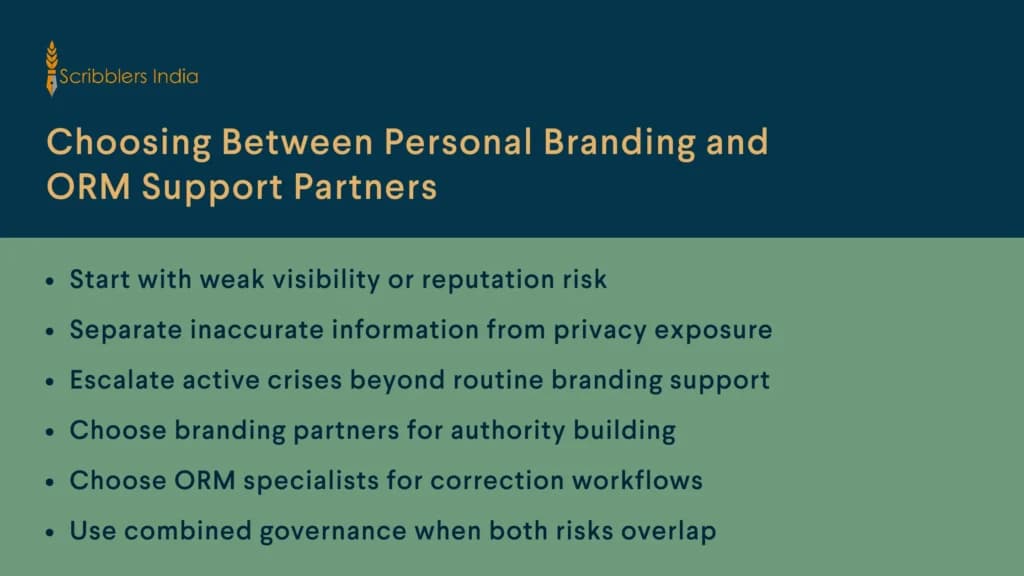
Personal Branding vs Reputation Management: How to Choose the Right Partner?
Choose a partner according to the problem, risk level, required expertise, and available budget. A personal branding agency should demonstrate positioning, voice capture, content depth, and authority measurement. An ORM provider should explain monitoring, correction, privacy handling, escalation, search limitations, and ownership before any long-term engagement begins.
These evaluation areas separate credible support from vague packages that combine unrelated services during selection.
- Match capability with the need: Ask who handles positioning, writing, search audits, monitoring, privacy issues, or media response. Confirm how legal coordination works. One provider may cover several areas. Confirm access to relevant specialists for high-risk incidents before signing.
- Inspect the working process: Request the discovery method, information requirements, approval workflow, reporting schedule, and escalation route. A reliable partner should explain how publishing changes during an active reputation issue. The process should also identify who owns final decisions.
- Review evidence of strategic depth: Samples should demonstrate clear positioning and original thinking through useful, audience-specific work. Case studies should explain the starting problem, work completed, reasoning, and results. Strong output begins with diagnosis before production and audience understanding.
- Confirm ethical operating boundaries: Avoid providers offering fake reviews, undisclosed websites, fabricated coverage, or guaranteed suppression. Credible teams strengthen accurate information, pursue valid corrections, and follow platform policies. They also explain when legal or security support becomes necessary.
How Can Scribblers India Help Build Your Personal Branding Strategy?
Scribblers India helps founders and business leaders build proactive personal brand authority before reputation concerns shape the conversation. Our approach connects positioning with credible content, owned authority assets, search readiness, and AI visibility. This distinction becomes important when you evaluate personal branding vs reputation management for different visibility needs.
- Positioning and Narrative Strategy: A strong program begins by defining the audience, authority territory, professional viewpoint, and available proof. Our personal branding services translate that foundation across profiles, content themes, author pages, and professional introductions, so that future publishing strengthens a single recognizable identity.
- Founder Voice and Ghostwriting: Structured interviews help us capture the leader’s experiences, decision patterns, and language. Through our ghostwriting services, those inputs become LinkedIn posts, articles, newsletters, and signature resources without replacing the professional’s authentic judgment.
- Thought Leadership and Authority Assets: Deeper expertise needs formats that allow substantial explanation beyond regular social publishing. Our thought leadership content writing develops original arguments, first-hand lessons, frameworks, and evidence-backed perspectives that give audiences stronger reasons to associate the leader with specific expertise.
- Search and AI Discovery: Profiles and authority content should reinforce the same expertise across public discovery channels. We connect relevant articles, case evidence, and professional information, structuring suitable content for AEO and GEO to help search and generative platforms understand the leader’s intended position of authority.
- Visibility Measurement and Refinement: Search results, AI descriptions, authority signals, content performance, and emerging topic gaps show whether the public evidence system is working. Regular reviews help refine positioning and future content priorities as business goals change or new discovery opportunities appear.
Our experts help build the proactive authority and monitoring foundation for founders and leaders. Book a 1:1 consultation with our team to strengthen your digital presence through credible expertise, clearer discovery, and consistent professional authority.
Frequently Asked Questions
Is personal branding the same as online reputation management?
No. Personal branding defines the professional identity a leader wants to build and communicate. Reputation management in the digital world monitors and addresses information affecting public perception. Both influence search visibility and trust. They still begin with different problems and use distinct processes, specialists, deliverables, and success measures.
Can personal branding remove negative Google results?
Personal branding creates accurate, useful content that can broaden the context around a professional name. Removal follows separate publisher, platform, search, or legal processes. Google reviews eligible requests in accordance with defined policies. Approved search removal does not erase information from the original source page.
Does every founder need online reputation management?
Every public-facing founder benefits from basic monitoring and regular profile reviews. Full reputation repair becomes relevant when misinformation, exposure of personal information, impersonation, or sustained hostile coverage creates a material risk. Major crises also require specialist support. Most founders should build authority early and maintain a clear escalation plan.
What Should Leaders Ask Before Hiring a Branding or ORM Partner?
Leaders should clarify the problem, desired outcome, risk level, working process, and measurement approach before hiring. Strong proposals explain which tasks belong to brand building and which belong to reputation protection. They also set realistic boundaries around search movement, removal requests, crisis work, and AI visibility.
Which service should a leader invest in first?
Personal branding should come first when the digital footprint is accurate yet weak or unclear. ORM should come first when harmful information creates immediate exposure. Established public leaders often need both, with brand building operating continuously and reputation monitoring following separate escalation rules.
How long does a personal branding strategy take to work?
Early indicators may appear within several months through stronger profile discovery, branded search, relevant engagement, and better inbound conversations. Durable authority develops through consistent positioning and useful proof over longer periods. Progress should be reviewed quarterly using audience quality, authority signals, search visibility, and business influence.
How should businesses compare personal branding vs online reputation management agencies?
Compare agencies through their stated scope, team skills, methods, and escalation boundaries. One provider can coordinate positioning, content, search audits, monitoring, and routine corrections. High-risk incidents may require crisis communicators, security teams, legal advisers, or platform specialists. Buyers should ask who handles each workstream and how escalation decisions are made.
How does AI search affect personal reputation management?
AI platforms can combine information from multiple sources into a single professional description or recommendation. Reviews should therefore test realistic prompts and record factual accuracy, topic associations, cited sources, and missing context. Consistent identity details and useful owned content improve the available public evidence.
How Should FAQ Schema and Final Publishing Checks Be Applied?
FAQ schema should match the questions and answers visible on the published page. The final review should verify metadata, sources, links, service descriptions, and keyword use. Editors should also confirm that no section promises guaranteed removal, search control, ranking outcomes, or inclusion within AI-generated answers.