
Finding a reliable answer for GEO services cost in India has become difficult because agencies package very different work under the same label. One provider may offer prompt tracking and basic technical checks. Another may combine research, content development, authority building, page optimization, and ongoing visibility measurement.
That difference explains why published prices can range from a few thousand rupees for basic audits to several lakh rupees monthly. Comparing those numbers without understanding their scope can therefore create a misleading view of the actual market.
Businesses need a better pricing framework. The right question is not simply, “How much do GEO services cost in India?” The more useful question asks what level of GEO work your current visibility gaps require.
Key Takeaways
|
How Much Do GEO Services Cost in India in 2026?
GEO services in India can cost around ₹15,000–₹60,000 for a substantive one-time audit. Focused monthly programs often start near ₹35,000–₹80,000. Broader growth retainers may reach ₹75,000–₹1.5 lakh, while scaled programs can exceed ₹1.5–₹3.5 lakh monthly.
These ranges for GEO services cost in India should be treated as planning benchmarks rather than fixed industry prices. Publicly listed Indian offers currently show monthly pricing starting around ₹18,000, ₹35,000, and ₹40,000 across different providers. Other published GEO pricing frameworks set higher retainers at ₹1.5 lakh per month or above.
The table below normalizes those public offers by the likely depth of engagement.
| Engagement Type | Indicative 2026 Budget | Typical Scope | Suitable For |
| Focused GEO audit | ₹15,000–₹60,000 one-time | Visibility baseline, prompt testing, competitor review, prioritized roadmap | First-time GEO buyers |
| Focused retainer | ₹35,000–₹80,000 monthly | Priority prompts, key-page updates, basic tracking, limited new content | Smaller brands |
| Growth program | ₹75,000–₹1.5 lakh monthly | Content creation, refreshes, competitor tracking, deeper source analysis | Growing B2B brands |
| Scaled GEO program | ₹1.5–₹3.5 lakh+ monthly | Larger topic coverage, authority assets, cross-platform measurement, deeper execution | Competitive categories |
| Enterprise engagement | ₹3 lakh+ monthly | Multiple markets, complex portfolios, extensive authority work, dedicated reporting | Larger organizations |
UpGrowth, for example, places Indian mid-market GEO and AEO retainers at ₹75,000 to ₹3.5 lakh per month. Other providers publish lower starting rates because their entry packages cover narrower workloads. This range makes one point clear. Price begins making sense only after you understand exactly what the agency intends to deliver.

What Does GEO Services Cost in India Cover?
GEO agency pricing should fund work that changes how your brand is understood and represented across generative discovery. That normally includes diagnosis and execution. A useful engagement should not be limited to improving the owned content and external information sources that influence important buyer questions.
Understanding this distinction becomes easier after reviewing what generative engine optimization services involve. GEO examines buyer prompts, competing brands, relevant sources, content gaps, entity accuracy, and measurable representation across selected platforms.
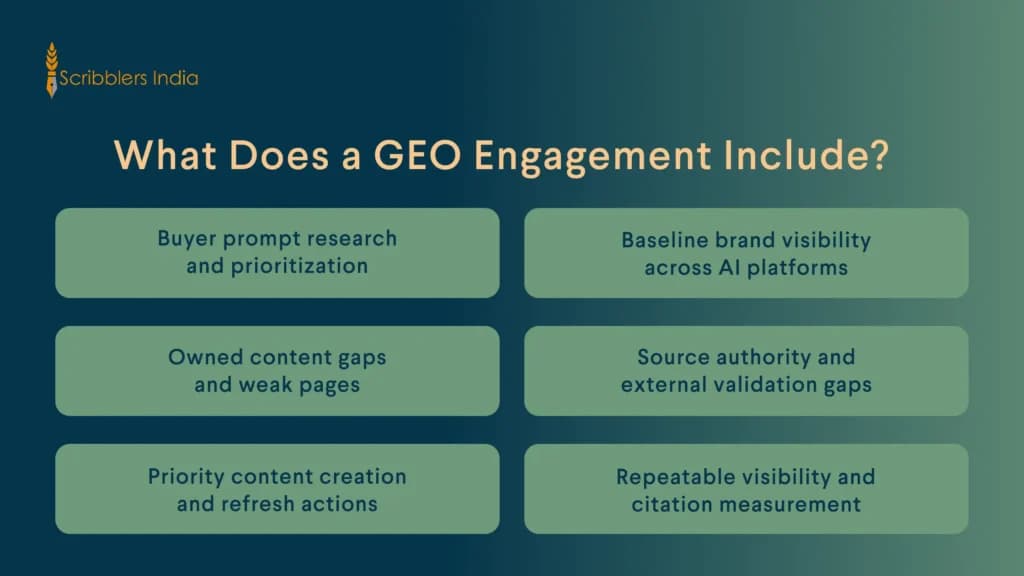
A robust GEO engagement in India generally covers several connected workstreams:
- Buyer Prompt Research: Commercially relevant prompts should reflect how buyers research problems and evaluate providers. The agency should separate high-value questions from broad informational queries. This keeps tracking connected with actual business priorities rather than producing an impressive prompt count with limited commercial value.
- Visibility Baseline: Initial testing should document where the brand appears across agreed AI experiences. It should also record competitor presence, citations where available, and answer context. These observations create the controlled baseline needed for later comparisons after content or authority improvements.
- Content Gap Mapping: Existing pages should be reviewed against the questions AI systems and buyers need answered. Scribblers India explains this process further in its AI content gap analysis framework, which identifies missing answers, weak evidence, and incomplete content coverage.
- Content Execution: GEO programs often require existing pages to be refreshed or new assets created. The scope may include comparison pages, expert guides, original research, case-led resources, service content, or commercially focused articles designed around verified information gaps.
- Measurement Cycles: Priority prompts must be tested again under comparable conditions after implementation. A useful report should show changes in brand representation and competitor presence. It should also connect those observations with referral traffic or commercial outcomes where attribution is available.
Why Does GEO Pricing in India Vary So Widely?
GEO services cost in India varies because the underlying workload changes considerably across brands. Prompt coverage, content requirements, existing authority, website complexity, market competition, and measurement depth can all increase execution needs. Agencies also differ in how much implementation they include inside the monthly fee.
Consider two B2B companies paying for GEO. The first already has strong organic rankings and extensive expert content. Its main requirement may involve restructuring existing pages and improving measurement. The second may lack comparison pages, evidence-backed guides, founder expertise, and external validation.
Those companies should not receive the same scope or price.
| Cost Driver | Lower-Complexity Situation | Higher-Complexity Situation |
| Prompt portfolio | Small set of priority buyer questions | Large multi-product prompt library |
| Existing content | Strong library needing targeted refreshes | Major informational and commercial gaps |
| Market complexity | Narrow service category | Multiple services, regions, or audiences |
| Authority position | Recognized brand with external coverage | Limited independent validation |
| Website condition | Strong search fundamentals | Indexing or architecture problems |
| Measurement depth | Periodic manual checks | Wider recurring platform analysis |
The same principle applies to content planning. Scribblers India’s content strategy services start by connecting assets with business priorities rather than treating publishing volume as the objective. Once these variables are clear, businesses can decide whether they require diagnosis first or an ongoing execution program.
How Is GEO Audit Cost Different From a Monthly GEO Retainer?
A GEO audit diagnoses the current visibility problem, while a monthly retainer funds recurring implementation and measurement. Audit pricing should therefore reflect the depth of research and diagnostic coverage. GEO services cost in India must also account for content creation, page improvements, authority work, and repeated evaluation of agreed-upon buyer questions.
Published Indian audit prices show substantial variation. Arinjay Business Systems currently lists a ₹15,000 audit covering AI visibility, competitor comparison, raw prompt evidence, and an action roadmap. Another provider lists audits between ₹25,000 and ₹60,000 for broader visibility and source analysis.
A strong audit should help answer several practical questions:
- What commercially important buyer prompts currently mention your brand across selected AI search experiences?
- Where do competitors appear repeatedly but your company receives weak or inconsistent visibility?
- Which owned pages or external sources influence answers around your priority commercial categories?
- What missing answers or weak evidence should receive the earliest content investment?
- Which problems require content changes rather than technical fixes or additional measurement?
Businesses with capable internal teams may stop after the audit and implement the roadmap themselves. That makes the one-time engagement commercially sensible.
A retainer becomes more useful when execution capacity is limited. It can support content refreshes, new assets, prompt reviews, authority development, and continuous prioritization. This naturally makes the monthly commitment greater than that of a diagnostic engagement.
What Should Different GEO Pricing Tiers Include?
Different GEO pricing tiers should be defined by measurable scope rather than vague claims of “advanced optimization.” A larger GEO services retainer should usually provide greater content capacity, wider prompt coverage, deeper source analysis, stronger authority development, or more demanding measurement.
Buyers should expect these differences to appear clearly inside GEO services proposals. The following framework helps compare proposals against the work purchased.
| Monthly Budget | Reasonable Scope to Expect | Important Question to Ask |
| ₹35,000–₹80,000 | Narrow prompt portfolio, priority page work, limited content output, recurring tracking | How much implementation is included? |
| ₹75,000–₹1.5 lakh | Broader content development, larger prompt coverage, competitor analysis, recurring strategy reviews | Which assets are created monthly? |
| ₹1.5–₹3.5 lakh | Multi-topic execution, original authority assets, broader tracking, deeper editorial resources | Which specialist capabilities are included? |
| ₹3 lakh+ | Multi-market coverage, extensive content programs, governance support, advanced reporting | What dedicated resources support the account? |
Prompt quantity should remain secondary to prompt value. Tracking hundreds of low-intent questions can consume budget without influencing meaningful discovery. This distinction becomes especially important when companies start deciding how much GEO their own business model needs.
How Should Different Businesses Decide Their GEO Budget?
Businesses should set their GEO budget around commercial search complexity rather than company size alone. A smaller specialist firm can require substantial work in a highly competitive category. A larger company with established authority may need more targeted improvements. Existing content maturity, therefore, considerably affects the cost of GEO services in India.
Smaller Businesses Should Start With a Narrow Commercial Scope
Smaller businesses should first identify whether generative search influences meaningful buyer decisions in their category. A focused audit, followed by a limited implementation phase, can determine whether deeper investment makes sense. This approach avoids funding broad prompt monitoring before the important visibility gaps are understood.
B2B Brands Should Map Budget Against Buying Journeys
B2B companies usually have more complex research journeys because buyers compare capabilities before contacting sales teams. Their GEO scope may need educational guides and commercial comparison assets. Source-backed service content and expert authority may also become important across multiple stages of decision-making.
Scribblers India’s AI Search Discovery Benchmark 2026 recommends connecting AI visibility with actual discovery behavior rather than chasing citations in isolation. That approach is especially useful for SaaS and professional services brands with longer evaluation cycles.
Established Brands Should Prioritize Coverage Gaps Over Volume
Mature brands may already have strong search authority and large content libraries. Their biggest requirement may therefore involve identifying inaccurate AI representation or weak commercial prompt coverage. A targeted GEO program can sometimes create more value than a significant increase in publishing volume.
Correct budgeting for GEO services cost in India should consequently reflect the information gaps that need fixing rather than the largest package an agency can sell.
Is GEO Services Cost in India Higher Than SEO or AEO?
GEO is not inherently more expensive than SEO or AEO, as these disciplines overlap significantly. A GEO program becomes more expensive when it adds wider platform monitoring and substantial authority development. Content production, original research, and additional source work can further increase engagement beyond conventional SEO execution.
The relationship between these disciplines becomes clearer in Scribblers India’s analysis of GEO vs AEO vs SEO. Traditional SEO supports discoverability, while AEO improves answer readiness. GEO examines how brands appear across wider generative discovery and source environments.
Google’s latest guidance strengthens this connection. Google says its generative AI Search features remain rooted in core Search ranking and quality systems. It recommends continuing foundational SEO practices rather than treating generative search as a separate technical ecosystem.
This becomes crucial while evaluating GEO agency pricing. Businesses should question proposals that charge separately for work already included inside an existing SEO engagement without adding meaningful new analysis or implementation. A good provider should explain the overlap openly. The proposal should show which activities extend current search work and which require additional resources.
Which GEO Costs Are Actually Worth Paying For?
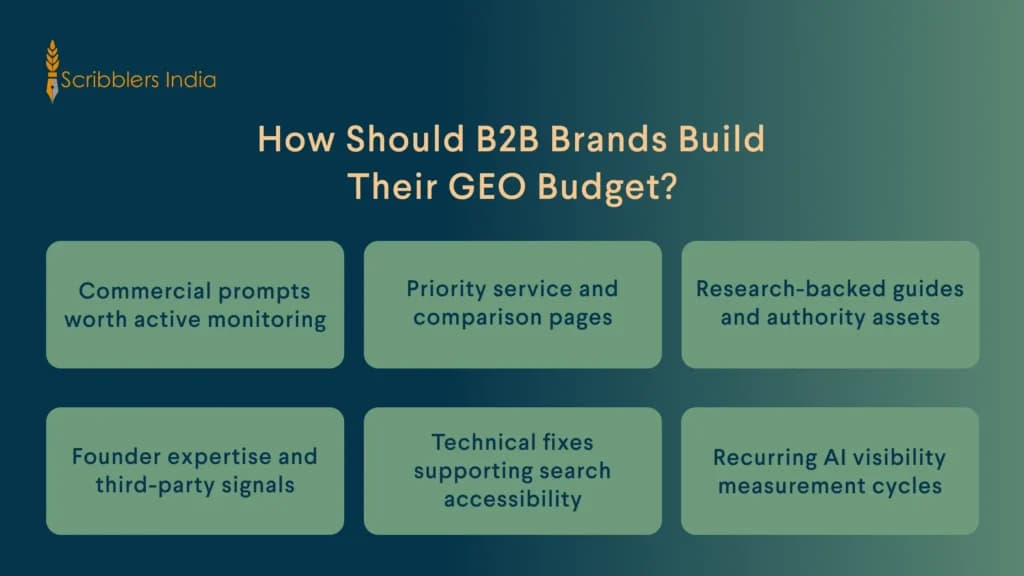
GEO services cost in India are worth paying for when they improve useful source material, brand clarity, search accessibility, authority, or measurable visibility. Businesses should be more cautious when a provider attaches premium fees to unsupported shortcuts. Every charge should connect with a confirmed problem and an understandable change to the information environment.
Several areas can justify deeper investment.
Research-Heavy Content Can Create Durable Source Value
Well-researched commercial content requires more than just rewriting headings to fit AI keywords. Strong assets may need subject-matter interviews and original examples. Current external evidence and clear comparisons can further increase the editorial workload while giving readers more useful information.
Original Authority Assets Can Fill Information Gaps
Benchmark reports and proprietary frameworks can give a brand information competitors cannot easily reproduce. The Scribblers India AI Visibility Scorecard provides an example of how to build a reusable authority asset around an identifiable market problem.
Repeatable Measurement Can Improve Decision Quality
Recurring prompt testing becomes valuable when the same commercial questions are reviewed under controlled conditions. Measurement should reveal where visibility changes and what content may have contributed. Random screenshots from different prompts cannot provide a reliable trend.
These investments share one characteristic. They improve information quality or decision quality rather than selling a technical shortcut. This principle provides a useful filter for spotting questionable line items inside GEO proposals.
What Red Flags Should You Avoid in GEO Agency Pricing?
Avoid proposals for GEO Services Cost in India that guarantee citations, hide actual content output, or inflate prompt counts without commercial reasoning. AI-generated responses can vary with model, timing, prompt wording, and other factors. Credible agencies should therefore explain measurement limitations while showing exactly what work they control and how they prioritize it.
The following warning signs require careful review:
- Guaranteed AI Recommendations: No agency controls whether a generative system mentions or recommends a specific company. Providers can improve the quality and representation of sources. Guaranteed placements usually overstate the degree of control any external optimization partner actually possesses.
- Unexplained Prompt Volume: Tracking hundreds of prompts sounds substantial until those prompts are inspected. Agencies should show why each prompt family matters commercially. A smaller library of buyer-led questions may provide far more useful direction for content investment.
- Vague Monthly Optimization: Phrases such as “continuous GEO enhancement” offer little pricing transparency without measurable deliverables. Ask how many pages are reviewed or created. Also confirm what research depth and reporting work the monthly commitment actually funds.
- Monitoring Without Implementation: A report can expose weak visibility without improving the underlying sources that cause it. Monitoring therefore becomes valuable only when someone owns the resulting changes. Confirm whether that execution sits with the agency or your internal team.
- Large Content Volumes Without Evidence: Publishing additional articles does not automatically improve generative visibility. Google’s current guidance prioritizes useful, unique, non-commodity content. High volume without meaningful information gain can therefore consume budget without strengthening the underlying source environment.
Removing these weaker offers makes agency comparison easier. Buyers can then focus on whether the remaining proposal matches their commercial priorities.
How Can You Compare GEO Agency Pricing Fairly?
Compare GEO services cost in India by normalizing every proposal against the same workload. The monthly fee alone provides limited information, as one provider may deliver strategy and monitoring, while another may include extensive writing. Buyers need a simple evaluation framework that reveals those differences before contracts are compared.
Use the following GEO Budget Fit Framework during agency evaluation.
1. Define the Commercial Prompt Portfolio
Start with questions that influence discovery and vendor evaluation rather than every possible keyword variation. Group prompts by buyer intent and commercial importance. The final portfolio should help the agency identify where visibility could affect real consideration or buying decisions.
2. Separate Diagnosis From Implementation
Confirm which tasks identify problems and which tasks actively fix them. An audit may reveal weak service pages or missing comparisons. The proposal should state whether the agency will then create those assets or expects your internal team to execute them.
3. Quantify Monthly Content Capacity
Ask how many existing pages receive meaningful refreshes and how many new assets are included. The answer should also explain expected research depth. This prevents a monthly “content optimization” line item from hiding extremely limited production support.
4. Clarify External Authority Responsibilities
Determine whether the agency reviews gaps in external sources or actively supports the development of authority. Digital PR and expert visibility require different resources from onsite writing. Understanding that ownership prevents two providers from appearing comparable when their scopes are fundamentally different.
5. Document the Measurement Method
Ask which AI experiences are reviewed and which prompts remain fixed between cycles. The method should also document relevant testing conditions. Comparable observations matter far more than isolated screenshots showing a single favorable answer on a given day.
6. Confirm Delivery Ownership
Publishing delays can prevent a well-designed GEO program from producing useful learning. Establish who is responsible for CMS updates and technical implementation. Approval responsibilities and ownership of external outreach should also be clear before work begins.
This framework shifts the buying conversation away from headline retainers. The next question is whether the money spent actually produces measurable business value.

How Should Businesses Measure the Return From GEO Services?
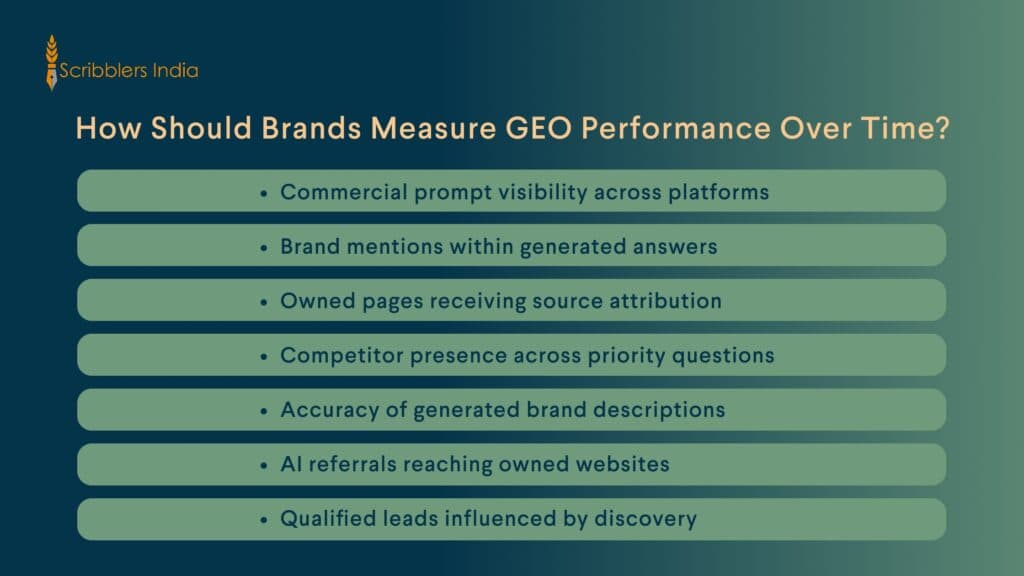
Businesses should measure GEO success by consistent visibility patterns and commercial response, rather than by citations alone. Useful measurements can include brand appearance, source inclusion, competitor share, answer accuracy, referral activity, and qualified conversions. The exact model should reflect how AI-led discovery contributes to the buying journey.
The scale of these discovery experiences now makes structured measurement increasingly relevant. Google reported in June 2026 that AI Overviews had more than 2.5 billion monthly active users. AI Mode had also surpassed one billion monthly users.
OpenAI separately stated in August 2026 that more than a billion people were using ChatGPT each week. These figures do not prove that every business needs a large GEO retainer. They do show why generative discovery deserves to be measured alongside conventional organic search.
A practical measurement model can include:
| Metric | What It Reveals | Decision It Supports |
| Brand mention rate | Frequency across tracked buyer prompts | Overall discovery presence |
| Owned citation share | Whether brand pages receive attribution | Source effectiveness |
| Competitor visibility | Who appears when your brand does not | Content and authority priorities |
| Answer accuracy | Whether brand information appears correctly | Entity and positioning improvements |
| AI referral activity | Sessions arriving through AI platforms | Traffic contribution |
| Qualified conversions | Leads or sales connected with discovery | Commercial return |
Google also introduced dedicated generative AI performance reporting for a subset of Search Console properties in June 2026. The report provides greater visibility into impressions from Google’s generative Search features. This measurement layer helps businesses decide whether their budget for GEO services cost in India should expand or become more focused.
How Can Scribblers India Help You Build a Right-Sized GEO Program?
Scribblers India helps businesses scope GEO based on confirmed visibility gaps rather than forcing every brand into the same package. We connect buyer prompt research with content strategy and recurring measurement. Our goal is to identify which information problems deserve investment before recommending how much ongoing execution is required.
Our GEO services begin by examining brand representation across selected generative experiences. We review which competitors appear, which sources influence important questions, and where inaccurate or incomplete information limits the brand’s visibility.
The resulting roadmap may require improvements to service pages and source-backed guides. Other brands may need comparison assets, original research, or stronger expert-led authority. Our content marketing approach for AI search helps connect those assets into a larger discovery system rather than producing isolated articles.
Founder expertise can also support that information ecosystem when the category depends heavily on professional authority. Scribblers India’s personal branding services help turn executive expertise into clearer public authority across relevant channels.
We then measure changes through controlled prompt reviews rather than treating a single favorable AI response as a success. This keeps the engagement tied to evidence and makes future budget decisions easier to defend.
The right GEO services cost in India should reflect the work required to close your most important discovery gaps. Get in touch with our team to build a GEO strategy around your content reality and commercial priorities.
Frequently Asked Questions
How Much Should a Small Business Budget for GEO Services in India?
A small business can often begin with a ₹15,000–₹60,000 audit before committing to ongoing work. Focused retainers may start at around ₹35,000 per month when execution is required. The appropriate budget depends on search competition and content maturity. Internal execution capacity can considerably reduce the external scope.
What Is Normally Included in GEO Agency Pricing?
GEO agency pricing can include prompt research, visibility benchmarking, content gap analysis, page optimization, new content, authority planning, and recurring measurement. The exact combination varies significantly between providers. Buyers should therefore request measurable deliverables and ownership details before comparing one monthly quote against another.
Why Is Generative Engine Optimization Cost So Different Between Agencies?
Generative engine optimization cost differs because agencies use very different service models. Some primarily track AI visibility, while others handle strategy and ongoing content execution. Wider prompt coverage or authority work adds further complexity. Comparing the monthly fee without comparing those responsibilities can therefore produce misleading conclusions.
Is a One-Time GEO Audit Enough for Most Businesses?
A one-time GEO audit can be enough when an internal team has the expertise and capacity to implement its recommendations. The audit should establish visibility gaps and priorities. Businesses usually need ongoing support when new content, recurring measurement, page updates, or external authority work exceeds internal resources.
How Long Should Businesses Test a GEO Agency Before Evaluating Progress?
Businesses should allow enough time for diagnosis, implementation, and comparable remeasurement before judging progress. A three-month initial cycle can provide a useful starting point for many content-led programs. Evaluation should focus on patterns across fixed commercial prompts rather than expecting guaranteed citations within a predetermined period.
Should GEO Services Include Traditional SEO Work?
GEO services should remain connected with SEO because Google’s generative Search experiences still depend on core Search ranking and quality systems. The exact division of work depends on the engagement. Businesses should determine whether technical SEO and standard on-site optimization are included in the GEO proposals before comparing them.
Can an Internal Content Team Manage GEO Without an Agency?
An internal team can manage GEO when it has strong research and content capabilities alongside reliable measurement processes. The team must also maintain disciplined testing of prompts and source analysis. External support is useful when specialized research or production capacity is lacking, preventing the internal team from acting consistently.
How Can I Tell Whether a GEO Quote Is Too Expensive?
A GEO quote becomes difficult to justify when the deliverables do not match the monthly fee. Compare content output and research depth first. Then review prompt coverage, authority work, implementation ownership, and measurement quality. Higher fees can still offer stronger value when they replace several fragmented workflows.