Getting mentioned by a publication can create temporary attention. Building sustained authority requires a digital PR strategy that connects the right stories with journalists, credible publications, expert voices, and audiences that influence your business. Every media opportunity should strengthen a recognizable reputation rather than add another isolated logo.
That approach is becoming more important as discovery spreads across search, social platforms, traditional media, and AI-generated answers. Strong PR can give founders and companies credible third-party visibility while creating public evidence around their expertise. The value increasingly extends beyond the publication date.
Key Takeaways
|
What Is a Digital Public Relations Strategy and How Does It Work?
A digital public relations strategy defines how you will earn relevant third-party visibility through credible stories and expert contributions. It connects business objectives with suitable publications, media angles, spokespersons, outreach, and measurement. The strategy gives every PR activity a clear reason beyond securing coverage.
Start with the outcome
Media coverage should support a specific business or reputation goal. You may need stronger founder recognition, category authority, international credibility, or better search discovery. Naming the intended outcome helps you decide which publications and stories deserve resources, rather than treating every media mention equally.
Define the audience before publications
A large publication can deliver limited value when its readership has little connection with your market. Start with people whose opinions or decisions matter. Then identify the business media, trade publications, newspapers, podcasts, and specialist channels that already reach those audiences.
Find credible story territory
Your strongest story territory usually sits where genuine expertise meets wider public interest. Internal data, customer patterns, founder experience, market changes, and defensible viewpoints can create useful angles. Promotional announcements need greater relevance before journalists can turn them into valuable editorial coverage.
Prepare sources before outreach
Journalists often need evidence and responsive experts more than polished marketing copy. Prepare approved spokespersons, supporting data, short biographies, visual assets, and source material before pitching begins. Faster access to useful information can make your organization easier to work with during short editorial deadlines.
Measure the result after publication
Coverage is the start of the value cycle. Review whether important messages were conveyed accurately and reached the relevant audiences. Then examine referral activity, branded discovery, backlinks, stakeholder responses, and later media opportunities. These signals reveal whether the coverage strengthened the authority you intended to build.
Our Digital PR services follow a story-first approach, connecting credible expertise with media relevance and post-publication measurement.

Why Does a Digital PR Strategy Matter More in 2026?
A digital PR strategy matters more because media teams now operate with heavier workloads, widespread AI use, and increasingly selective attention. Brands also need visibility across more discovery environments. Effective PR, therefore, depends on relevance, genuine expertise, useful evidence, and relationships rather than on high-volume outreach.
Muck Rack’s 2026 State of Journalism found that 86% of journalists said at least some of their work began with a PR pitch. PR still influences editorial discovery when the idea genuinely fits the reporter and readership.
The same research found that 82% of journalists now use AI tools in their work, up from 77% during the previous year. Generic AI-assisted pitches therefore enter newsrooms alongside increasingly AI-enabled editorial workflows. Human insight and source quality become stronger differentiators in that environment.
Communications teams are changing as well. Muck Rack’s 2026 State of PR research found that 73% of PR professionals consider GEO at least somewhat important to communications strategy. PR teams increasingly recognize that earned visibility can intersect with AI-led discovery.
The practical implication is straightforward. You need stories that deserve independent coverage, expert journalists you can trust, and an authority system that continues to work after publication. That approach creates more durable value than chasing a high number of unrelated media mentions.
What Should a Digital PR Strategy Include?
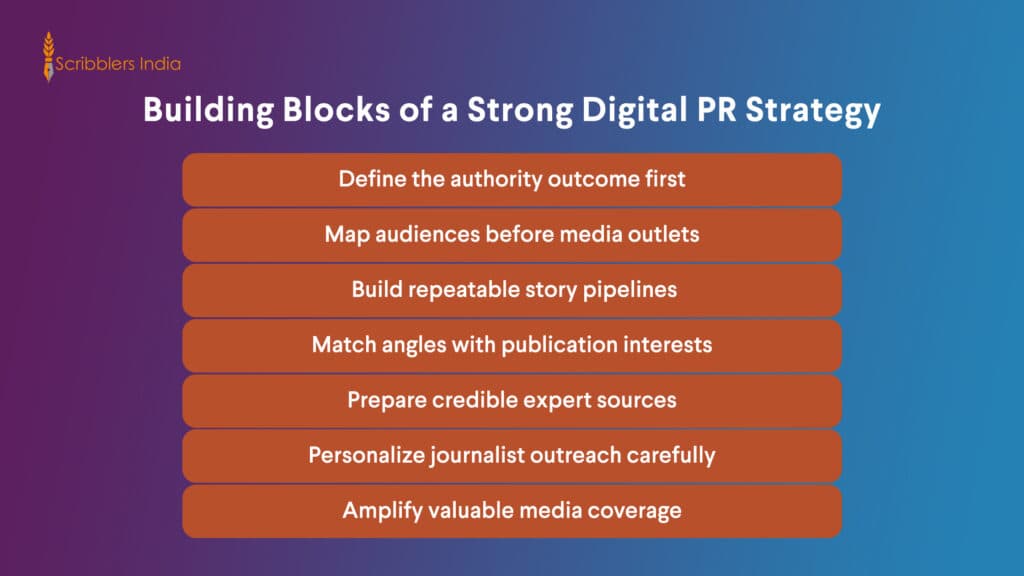
A digital PR strategy should connect authority positioning, story development, publication research, media outreach, and performance measurement. Each part solves a different problem. Removing one layer often creates wasted activity, such as pitching excellent research to unsuitable publications or earning coverage that supports no wider reputation goal.
- Authority Positioning: Decide what your brand or spokesperson should become known for before developing stories. This gives media outreach a recognizable subject territory. Repeated coverage around connected expertise builds stronger associations than unrelated comments across whichever news opportunities appear that week.
- Story Pipeline: Build multiple sources of media ideas rather than waiting for company announcements. Original research, internal data, market observations, expert opinions, and timely reactions can provide ongoing material. Each idea still needs editorial relevance before it enters the outreach calendar.
- Publication Mapping: Group publications by readership and editorial fit instead of perceived prestige alone. Include national media, business publications, relevant trade titles, regional outlets, and specialist platforms where appropriate. Different stories can then move toward publications whose audiences genuinely care about them.
- Spokesperson Preparation: Identify leaders who can contribute real experience to each topic. Prepare concise biographies and clear areas of expertise before journalists respond. Executives should also understand the boundaries of confidentiality, approval processes, and which statements require supporting evidence before appearing under their names.
- Measurement Framework: Decide what success means before outreach begins. Track coverage quality, message accuracy, relevant links, referral behavior, branded discovery, and repeat media interest. For founder-focused programs, also review whether journalists increasingly approach the leader as an expert source.
How Do You Find Stories Journalists Will Cover in a Digital PR Strategy?
A successful digital PR strategy treats newsworthiness as an audience question rather than a company question. Journalists need material that gives their readers something timely or useful. Your internal milestone becomes stronger when it reveals a broader trend, new evidence, a meaningful consequence, or an informed expert interpretation.
Cision’s 2025 global research found that 86% of journalists reject pitches that do not match their beat or audience. The same research found strong demand for compelling data and distinctive story angles. Relevance should therefore shape the story before outreach begins.
| Story source | Weak approach | Stronger editorial angle |
| Company data | We analyzed our customers | What the data reveals about changing buyer behavior |
| Founder experience | Our founder has expertise | What repeated operating experience reveals about the market |
| Product launch | We launched a feature | Which emerging customer problem made the change necessary |
| Industry news | Our CEO comments | What the development changes for affected decision-makers |
| Customer patterns | Clients face challenges | Which recurring problem companies are underestimating |
| Original research | We ran a survey | Which unexpected finding challenges common assumptions |
Your story does not need to become dramatic. It needs a clear reason for the publication’s audience to care now. That distinction keeps editorial relevance ahead of promotional language.
How Should an Earned Media Strategy Build Journalist Relationships?
An earned media strategy should make journalists’ work easier through relevance, responsiveness, and credible sources. Strong relationships usually develop after useful interactions rather than networking alone. Your goal is to become a dependable source on defined topics, rather than repeatedly contacting reporters with unrelated company updates.
- Research the journalist’s recent work before proposing an angle that clearly matches their established coverage area.
- Offer direct access to relevant experts when the journalist needs context beyond prepared written statements.
- Keep outreach concise enough for editors to understand the news value during a crowded working day.
- Respond quickly when a reporter requests clarification, evidence, images, or additional subject-matter expertise.
- Respect declined pitches and editorial independence while remaining available for genuinely relevant future opportunities.
- Record previous interactions so that future outreach reflects established interests rather than restarting the relationship each time.
Muck Rack found that 62% of journalists prefer one-to-one email pitches, while 69% prefer pitches below 200 words. That favors selective outreach with clear relevance over large, generic distribution lists.
Which Media Coverage Should Digital PR for Brands Target?
Digital PR for brands should target coverage based on the authority outcome and the intended audience. A founder profile can build leadership familiarity, while expert commentary demonstrates subject knowledge. Research coverage may support category authority, while trade media can reach specialist buyers more efficiently than larger general publications.
| Media opportunity | Best use | What strengthens the pitch |
| Founder interview | Personal authority | Distinct experience and relevant opinions |
| Expert quote | Fast credibility | Clear specialist knowledge and responsiveness |
| Bylined article | Deeper expertise | Original argument with practical evidence |
| Company feature | Business visibility | Genuine development with wider relevance |
| Research coverage | Category authority | Useful methodology and notable findings |
| Trade publication | Specialist reach | Strong fit with sector concerns |
| Podcast interview | Extended perspective | Articulate expert with clear stories |
| Print feature | Broader stakeholder recognition | Strong editorial story with lasting relevance |
A good program rarely depends on one format. The coverage mix should reflect how different audiences discover and evaluate expertise while preserving consistent positioning across all appearances.
How Can a Digital PR Strategy Support Personal Branding and Thought Leadership?
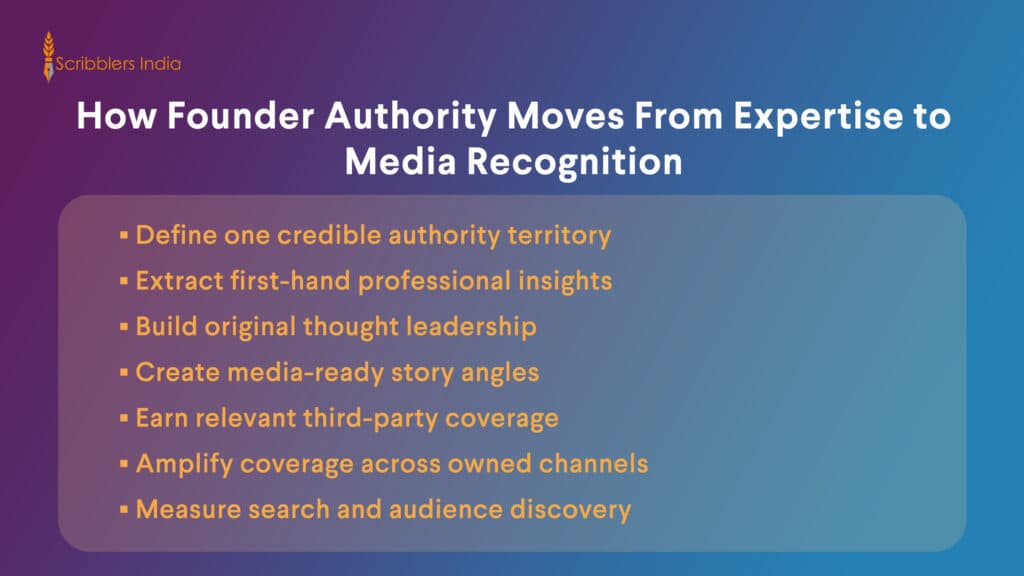
A digital PR strategy can provide independent validation for personal branding and thought leadership beyond owned channels. Your profiles and articles show what you say about your expertise. Relevant media coverage shows that editors, journalists, or industry platforms considered your experience useful enough to include in their coverage for their audiences.
Personal branding defines the authority
Your public profile needs a clear professional association before PR can reinforce it. Our personal branding services help founders and leaders define that position across content and discovery. Media outreach can then concentrate on topics that strengthen the same professional reputation.
Thought leadership develops the ideas
A journalist needs more than a senior job title. Original interpretations, operating lessons, evidence, and useful frameworks give leaders something worth contributing. Our thought leadership content writing services help turn genuine expertise into arguments that can work across owned content and external media.
Ghostwriting protects publishing consistency
Expertise often doesn’t allow time to convert every insight into publishable material. Structured interviews can capture experiences and opinions before editorial development. Our ghostwriting services can extend those ideas into articles or executive content while preserving the leader’s reasoning.
Media creates external proof
A published interview or expert contribution adds another public source of information about the professional’s expertise. Repeated coverage can make that association easier for people to verify. It also gives future journalists additional context when deciding whether the executive fits an upcoming story.
Edelman and LinkedIn found that 95% of hidden B2B buyers become more receptive to outreach after strong thought leadership. PR can expand the distribution and independent validation surrounding those ideas.
Can a Digital PR Strategy Improve SEO and AI Search Visibility?
A digital PR strategy can support SEO and AI discovery by creating relevant links, brand mentions, expert associations, and independent web sources. These outcomes expand the public information available around your brand. They can strengthen search visibility without guaranteeing that an AI system will cite you.
For SEO, online editorial coverage can create backlinks and referral paths that conventional PR reporting may overlook. The strongest links come from genuine editorial relevance rather than placements created primarily for link acquisition. Search value becomes one outcome of a credible media story rather than its only purpose.
AI-led discovery adds another layer. Google explains that AI Overviews and AI Mode can use query fan-out across related searches and data sources. Supporting links may therefore come from a wider set of useful web pages than a conventional results page.
This creates a practical reason to connect PR with AEO services and GEO services. Owned content explains your expertise directly, while credible external sources can provide additional corroboration around the same topics.
Our AI Search Discovery Benchmark treats external authority as one part of wider AI visibility. Brands still need accurate owned content, clear entities, useful evidence, accessible pages, and recurring visibility measurement.

How Should an Online PR Strategy Change Across International Markets?
An online PR strategy should adapt its angles and evidence to each target market. A story that earns interest in India may offer limited relevance in the United States. Local business conditions, reader concerns, publication priorities, and expert expectations should influence how the same underlying expertise gets presented.
- Start with market relevance: Explain why the issue affects readers in that geography instead of leading with your expansion plans.
- Adapt supporting evidence: Use local statistics or customer examples where permissions and reliable data make those references appropriate.
- Map media by audience: Include specialist titles alongside major publications when trade audiences more directly influence purchasing or partnerships.
- Prepare executives carefully: Spokespeople should understand the local context before offering opinions on unfamiliar regulations or business conditions.
- Respect editorial differences: Publication formats, contribution policies, lead times, and disclosure requirements can differ significantly across markets.
- Preserve core positioning: Adapt the story angle while keeping the expertise and professional identity recognizable across regions.
International reach becomes more credible when the founder has something relevant to contribute in each market. Media relationships can improve access, while editorial value still determines whether a story deserves attention.
How Do You Measure a Digital PR Campaign Beyond Media Mentions?
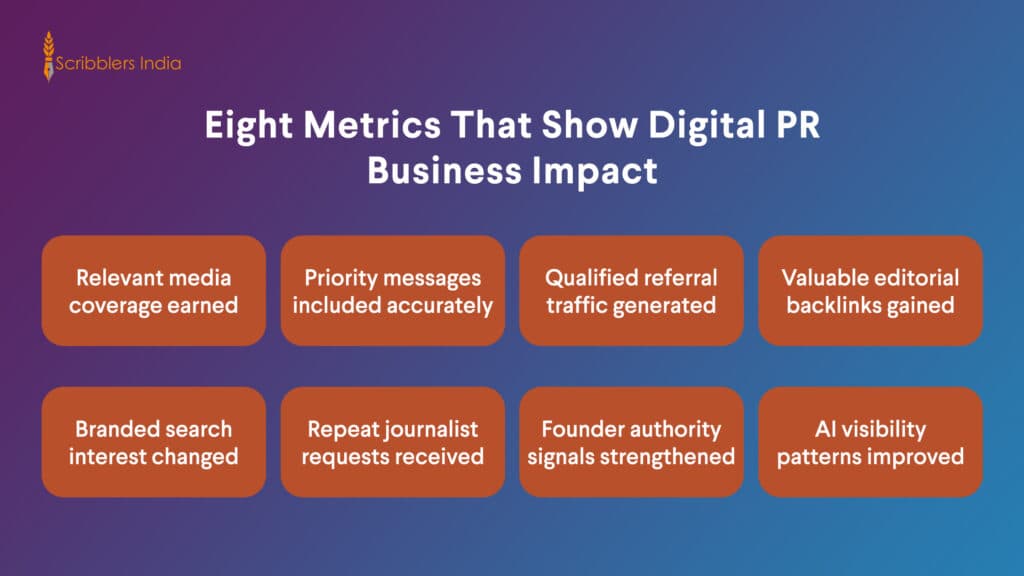
A digital PR campaign should be measured by the quality and influence of coverage rather than placement volume alone. Your dashboard should show whether relevant publications conveyed the right message, valuable audiences encountered it, and the coverage generated measurable signals in reputation, search discovery, or business conversations afterward.
| Measurement area | What to review | Why it matters |
| Coverage quality | Publication relevance and story prominence | Separates strategic coverage from vanity placements |
| Message accuracy | How the brand or expert was described | Protects positioning and reputation |
| Audience fit | Whether the publication reaches priority stakeholders | Connects coverage with business relevance |
| Earned links | Relevant editorial links and destination pages | Shows potential search and referral value |
| Referral behavior | Visits and useful actions after coverage | Identifies direct audience response |
| Branded discovery | Changes in searches for company or leaders | Indicates later interest |
| Media relationships | Repeat requests and journalist engagement | Shows growing source credibility |
| AI visibility | Mentions, descriptions, and citations where observable | Tracks emerging discovery outcomes |
Coverage should be reviewed over time rather than judged by a single publication cycle. A strong program can create cumulative authority even when individual stories produce very different traffic levels.
When Should You Hire an Agency for Your Digital PR Strategy?
You should consider external support when valuable expertise exists inside your business, yet media strategy and execution remain inconsistent. An agency becomes useful when internal teams lack access to journalists, story-development capacity, editorial resources, or the time to maintain outreach across multiple publications and markets.
- Your expertise stays within the company: Leaders have valuable experience, though no one regularly turns it into strong media angles. External editorial support can extract those insights and convert them into stories that suit different publication needs.
- Media outreach remains occasional: Sending a press release during major announcements rarely builds sustained authority. An agency can maintain a story pipeline throughout the year, covering research, expert commentary, planned campaigns, and relevant market developments.
- You need broader market access: Expansion into the United States, United Kingdom, Hong Kong, or another market requires more than translating a pitch. Strong programs map the relevant publications and adapt the story to local audience interests.
- Internal teams need specialist capacity: Marketing leaders may understand brand strategy while lacking dedicated time for journalist research and follow-up. External specialists can manage these workflows without removing subject-matter ownership from company experts.
- PR needs wider measurement: When leadership expects evidence beyond media logos, the program needs stronger reporting. Search visibility, source quality, referral behavior, founder discovery, and AI representation can offer additional perspectives on long-term authority.
How Can Scribblers India Build Your Digital PR Strategy?
At Scribblers India, we connect PR with the authority your company or leadership team needs to build. Our digital PR strategy starts with credible expertise and media relevance. We then develop suitable stories, prepare sources, pursue relevant opportunities, and connect published coverage with wider discovery goals.
Our approach covers five connected areas:
- Media Positioning: We clarify which topics your company or leaders can credibly own before outreach begins. This gives journalists a clearer reason to consider your experts and prevents unrelated appearances from weakening the professional association you want audiences to remember.
- Story and Campaign Development: We turn original research, internal knowledge, expert viewpoints, and market developments into media-ready angles. Every idea is assessed for audience relevance before outreach, helping separate genuine editorial opportunities from company announcements that need a stronger public-interest connection.
- Media Outreach: Our team maps relevant journalists and publications across India and international markets, including the US, UK, and Hong Kong. Existing media relationships can support access, while every opportunity still requires editorial fit and a story appropriate for the publication.
- Founder and Executive Authority: PR can naturally connect with personal branding and thought leadership when leaders have expertise worth sharing. Media interviews, contributed perspectives, and expert commentary can extend credible professional ideas beyond channels the individual already owns.
- Search and AI Visibility: Online coverage can create searchable third-party evidence around your expertise. We connect these signals to AEO and GEO measurements where relevant, while avoiding unsupported promises about rankings, citations, recommendations, or permanent placement amid changing AI-generated answers.
You can also review our HR leader’s personal branding case study to see how structured authority-building can improve professional discovery before external media amplification begins.
Get in touch with our team to book a 1:1 call to build a media strategy centered on credible authority.
Frequently Asked Questions
Is Digital PR the Same as Traditional PR?
Digital PR places greater emphasis on online publications, searchable coverage, backlinks, referral behavior, and measurable digital discovery. Traditional PR can also include newspapers, magazines, broadcast media, and offline reputation work. Many modern programs use both. The right mix depends on which channels influence your target audience and align with your business goals.
Does Digital PR Require a Large Budget?
A large budget is not required for every PR program. Costs depend on research requirements, target markets, outreach volume, content production, and campaign complexity. A focused program around credible experts can start narrower. Larger data campaigns and international outreach usually require additional research, coordination, and media relations resources.
How Long Does It Take to Get Digital PR Results?
Timelines vary because editorial coverage depends on story quality, news cycles, journalist interest, and publication schedules. Reactive opportunities can move within hours, while contributed articles may require several weeks. Research campaigns can take longer to prepare. Evaluate PR over multiple outreach cycles rather than expecting predictable placement dates.
Should You Pay Publications for Media Coverage?
Paid placements and independent editorial coverage serve different purposes and should be identified clearly. Sponsored articles can offer controlled distribution when disclosed appropriately. Earned coverage depends on editorial decisions and carries different third-party validation. Brands should understand which model applies before presenting any publication appearance as independent media recognition.
Do You Need a Press Release for Every PR Story?
No. A press release works well when you have a formal announcement that journalists need to reference. Expert commentary, data stories, trend analysis, and interview ideas could benefit from more direct outreach. The format should match the story. Creating a press release without meaningful news rarely improves editorial relevance.
Can Small Companies Earn Coverage in Major Publications?
Yes, company size does not automatically determine whether a journalist covers a story. Smaller businesses still need credible expertise or useful evidence that matters to the publication’s readers. Original data, distinctive customer insights, timely expert commentary, and unusual operating experience can create stronger opportunities than company size alone.
What Happens If a Journalist Writes Something You Disagree With?
Earned media gives journalists editorial control, so brands cannot expect complete control over the wording of published content. You can reduce avoidable errors by providing accurate facts, written supporting material, and clear source information. If an article contains a factual mistake, contact the publication professionally and request a correction with supporting evidence.
Can One Media Feature Create Long-Term Brand Value?
One strong feature can support discovery, credibility, sales conversations, and later media outreach for an extended period. Its value depends on relevance and how you use it afterward. Sustainable authority still requires repeated evidence from owned content and credible external sources, rather than relying on a single publication appearance.