AI search discovery is becoming a measurable part of how Indian audiences research problems, compare options, and encounter brands. Google AI Mode is established in India, generative Search reporting is now available in Search Console, and multimodal search is becoming easier to measure.
India also presents a distinct search environment. Google expanded AI Mode from English into Hindi and seven additional Indian languages during 2025. Search Live expanded further across Indian languages in March 2026, while visual and voice-led discovery continues developing alongside conventional typed search.
This AI Search Discovery Benchmark brings together current platform documentation, behavioral research, India-specific digital data, and practical measurement frameworks. It does not claim that one optimization technique can guarantee citations or recommendations.
The central question is more useful: What information, authority, and measurement systems should Indian brands build when discovery no longer begins and ends with a traditional search results page?
Key Takeaways
|
How Was the AI Search Discovery Benchmark Developed?
This report is a secondary research benchmark, not a primary survey of Indian consumers or businesses. Scribblers India reviewed evidence published through October 2026 and synthesized findings relevant to search, generative discovery, content strategy, and Indian digital behavior.
The research gives preference to four source categories:
| Source Type | How It Is Used |
| Platform documentation | Current product behavior and publisher guidance |
| Independent behavioral research | How people interact with emerging search experiences |
| India-specific digital research | Language, internet adoption, and AI-enabled behavior |
| Recent measurement studies | Citation, click, and generative visibility patterns |
The term “benchmark” therefore refers to an evidence-led reference point for evaluating current readiness. It does not mean Scribblers India conducted a nationally representative field survey.
Older forecasts are excluded where observed evidence for 2025 or 2026 now provides a stronger basis. Where international studies are used, we identify the geography rather than presenting those findings as India-specific behavior.
Scribblers India frameworks within this report are also labeled separately. They are practical models for applying the research, not externally validated industry standards.

How Is AI Search Discovery Changing in India?
AI search discovery in India has moved beyond an experimental feature. Google opened AI Mode to users across India in July 2025 after an initial Labs rollout. It subsequently expanded the experience into Hindi and seven additional Indian languages.
The way people can search has expanded at the same time. AI Mode accepts longer conversational questions and supports text, voice, and image inputs. Google reported that AI Mode questions globally were nearly three times as long as traditional searches by October 2025.
India has also received several search capabilities unusually early. Google said India was the first country outside the United States to receive Search Live. By March 2026, Search Live had expanded into Bengali, Gujarati, Kannada, Malayalam, Marathi, Odia, Tamil, Telugu, Urdu, and other supported languages.
These developments change the unit of search optimization. A business is no longer preparing only for short typed queries. Audiences can express complex needs in conversation, follow up with questions, use images, or speak in their preferred language.
Understanding how the generation layer works also helps teams avoid simplistic assumptions. Our large language model glossary explains how LLMs interact with retrieval and surrounding application systems.
Why Does AI Search Discovery Matter for Indian Businesses?
AI search discovery matters because search interfaces can now shape understanding before someone reaches a company website. Users can ask for explanations, comparisons, recommendations, implementation guidance, or local information and receive synthesized responses supported by selected web sources.
Google reported that AI Overviews increased usage by more than 10% for query types where they appeared in major markets including India and the United States. Google also said commercial query volume was increasing as people used newer AI-enabled Search experiences.
India’s wider digital environment also increases the potential reach. The IAMAI-Kantar Internet in India Report 2025 reported 958 million active internet users, with rural India accounting for about 548 million. The study also found that 44% of users had engaged with AI-enabled features such as voice search, image search, chatbots, or AI filters.
These figures do not mean 44% of Indians are using generative search for vendor research. The category is much broader. However, it shows that AI-assisted interfaces are entering everyday digital behavior at substantial scale.
For brands, the practical risk is not simply “losing rankings.” A company can rank conventionally yet remain absent from a generated comparison. Another can receive a mention through third-party sources even when its own page is not cited.
How Are AI Overviews Changing Search Behavior?
AI Overviews can resolve more of an information need directly within the search results. That changes how marketers should interpret impressions and clicks, particularly in defining terms, answering factual questions, and conducting introductory research.
Pew Research Center analyzed browsing data from 900 U.S. adults during March 2025. Searchers clicked a traditional result in 8% of visits where an AI summary appeared, compared with 15% where no AI summary appeared. Only 1% of visits containing an AI summary led to a click on a cited source.
These are U.S. findings, not Indian click-through benchmarks. We have not found comparable public India-specific clickstream research robust enough to apply those percentages directly to Indian users.
The strategic implication still matters. Visibility and traffic can increasingly move separately. A brand may appear in the discovery layer without resulting in an immediate website visit. Our guide to zero-click content marketing explains how to separate content designed for answer visibility from assets that should retain stronger continuation value.
Does Traditional SEO Still Matter for AI Search?
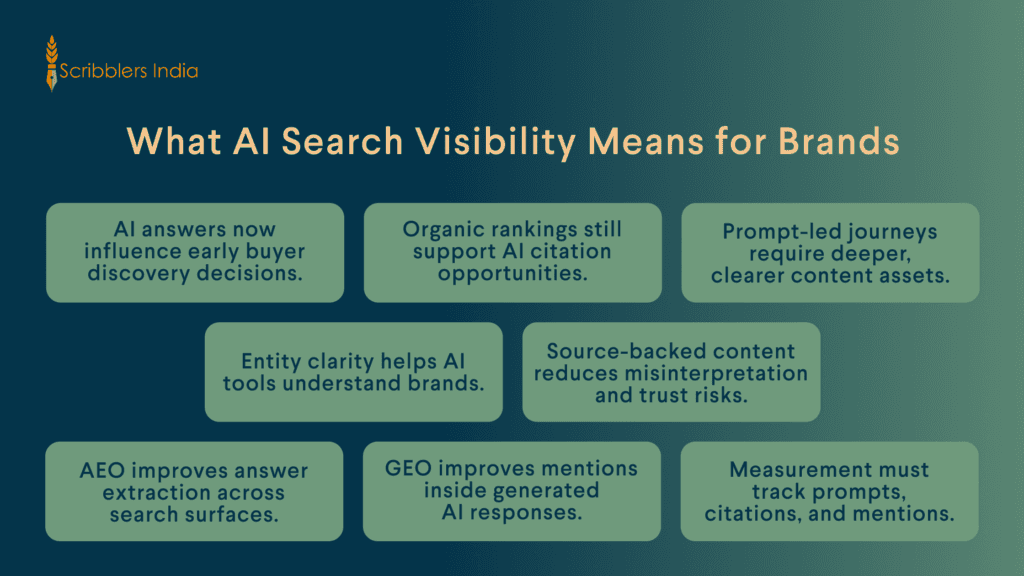
Yes. Modern generative search does not make established search fundamentals irrelevant. Google states that AI Overviews and AI Mode remain grounded in its core Search systems and that publishers do not need special AI markup to become eligible.
The relationship is better understood by separating the jobs involved:
| Discipline | Primary Job | Typical Question |
| SEO | Make useful pages discoverable and competitive | Can search systems find and rank the page? |
| AEO | Improve answers within owned content | Does the page answer the important question clearly? |
| GEO | Improve wider generative representation | Which sources support the brand across AI discovery? |
These disciplines overlap. A strong AEO strategy still depends on useful content and search accessibility, while GEO frequently depends on authority beyond the brand’s own website.
The practical operating model is therefore SEO foundations alongside AEO and GEO, not three disconnected campaigns. Our AEO strategy for businesses explains that owned content should be prioritized before expanding specialist optimization.
How Do AI Citations Change What Visibility Means?
An AI citation is different from a conventional ranking because it usually supports part of a generated answer. The cited page can change even when the prompt remains similar, and the same brand can remain visible through another source.
Brands should therefore distinguish several outcomes, such as:
- Cited owned source: A page from the company’s website directly supports the generated response. This can strengthen source visibility but does not automatically mean the brand receives a recommendation.
- Cited external source: An independent publication references the company and becomes the cited evidence. This can strengthen third-party authority even when the company site receives no direct citation.
- Uncited brand mention: The company appears in the generated response without a visible source attribution. This still creates exposure, but measurement requires different treatment.
- Recommendation context: The brand appears during selection or comparison. This can be commercially more significant than a citation supporting a basic factual definition.
The distinction prevents teams from treating every citation as equally valuable. Our dedicated AI Citation glossary explains these source roles in greater depth.
How Stable Is AI Search Visibility?
AI-generated source selection can change between observations. A page cited during one check may disappear later, while another page from the same domain or an entirely different publisher takes its place.
Ahrefs tracked more than 43,000 keywords and found that when a Google AI Overview changed, only 54.5% of cited URLs overlapped between consecutive observations. The remaining 45.5% were different. This is one platform and one methodology, but it illustrates why source stability deserves separate measurement.
That volatility changes reporting practice. A screenshot proves that a citation occurred. It does not establish durable visibility.
Teams should monitor URL persistence, domain continuity, brand presence, and answer context across repeated checks. A disappearing page may be less concerning when another owned page replaces it. A continuing citation may still require attention if the generated description becomes inaccurate.
Our citation volatility in AI search framework provides practical methods for measuring source movement without reacting to individual changes.
What Signals Help Search Systems Understand a Brand?
There is no public universal “AI trust score” that brands can optimize. A better approach is to make important information accurate, accessible, well-supported, and consistent enough for humans and machine systems to interpret correctly.
Four areas deserve particular attention:
- Clear entity information: Important pages should accurately identify the company, products, people, locations, and professional relationships. Material contradictions across prominent sources can make the public information environment harder to interpret.
- Useful original information: First-hand examples, original data, detailed methodologies, expert analysis, and proprietary frameworks contribute information beyond generic summaries. Google’s 2026 guidance explicitly emphasizes unique and non-commodity content.
- Accurate, structured information: An appropriate schema can help Google understand the visible page content and entities. It should match what users see rather than introduce information solely for machine consumption.
- Accessible source material: Public information must remain available to the systems through which discovery is intended. OpenAI advises publishers wanting eligibility for ChatGPT Search summaries and citations not to block OAI-SearchBot.
These foundations cannot guarantee a mention. They improve the information environment from which search and generative systems operate.
Why Do Query Fan-Out and Multimodal Search Matter?
One conversational prompt may lead to several underlying searches before an answer is assembled. Google describes this process as query fan-out, allowing AI Mode to explore several related aspects of a question and synthesize the resulting information.
This changes content planning because a business may need to satisfy several related information needs rather than repeat the exact same prompt phrase. Our query fan-out glossary explains that mechanism in greater detail.
Multimodal behavior expands the issue further. Users can search with photographs, screenshots, voice, and other inputs. Google added dedicated web multimodal Search reporting to Search Console in September 2026, covering Lens, Circle to Search, image uploads, and Chrome image searches.
For Indian brands, this matters particularly in ecommerce, travel, local services, education, automotive, fashion, home improvement, and other visually researched categories. Content teams should therefore review useful images, product visuals, diagrams, captions, surrounding text, and image accessibility rather than treating AI search as a text-only optimization problem.
Why Do Indian Languages Matter for AI Search Discovery?
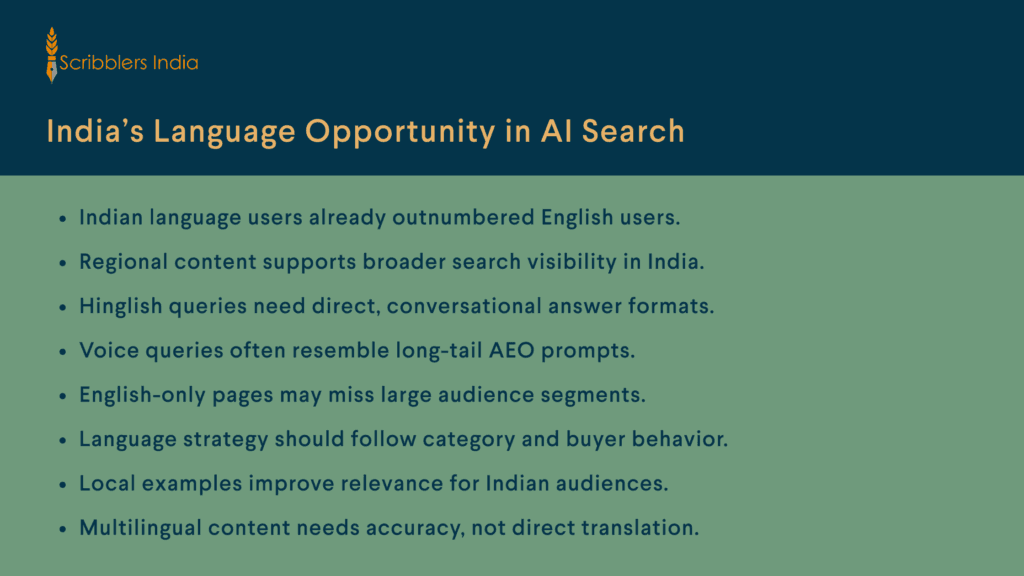
Indian-language AI search discovery is moving beyond translation. Google launched AI Mode in Hindi during September 2025 and expanded it to seven additional Indian languages the following month. Search Live then widened multilingual conversational access further during 2026.
The audience environment also supports closer attention to language. IAMAI-Kantar reported that 870 million internet users accessed content in Indic languages during 2024. Among urban internet users, 57% said they preferred accessing internet content in Indic languages.
That does not mean every B2B company needs ten translated websites.
Language investment should follow actual customer behavior. A B2B SaaS business serving English-speaking enterprise buyers may continue prioritizing English. Education, finance, healthcare, retail, travel, or local-service businesses may find Hindi or regional-language discovery commercially relevant much earlier.
Localization also needs more than literal translation. Search intent, terminology, mixed-language behavior, examples, and regional context can change how the same information should be expressed.
What Can Indian Brands Measure in Search Console Now?
One major change since the first version of this report is that Google now provides dedicated generative AI performance reporting.
Google introduced Search Generative AI reports in June 2026 and completed the worldwide rollout by August 31. The reports provide dedicated views of impressions within generative Search features, including AI Overviews and AI Mode.
In September 2026, Google added multimodal search reporting as another filter. Publishers can now inspect visibility from searches involving Lens, Circle to Search, uploaded images, and related visual-search experiences.
That creates a stronger first-party measurement foundation for AI search discovery than brands had one year earlier. Search Console still does not answer every question, however. Teams may need separate monitoring for:
- Brand mentions across other generative platforms,
- Citations and cited URLs,
- Competitor appearance,
- Description accuracy,
- Prompt coverage,
- Referral traffic,
- Assisted conversions,
- And citation persistence.
The key change is that AI-search reporting no longer needs to rely entirely on third-party visibility tools for Google.
How Should Indian Brands Measure AI Search Discovery?
AI search discovery should be measured across several layers, as a single metric cannot capture the entire journey. A citation can occur without a click, whereas a later branded search can reflect earlier exposure that analytics cannot perfectly attribute.
Here is what a practical model looks like:
| Measurement Layer | What to Track | Main Question |
| Search exposure | Generative AI impressions | Is the site being surfaced? |
| Brand visibility | Mentions across tracked prompts | Does the brand enter the answer? |
| Citation visibility | Cited domains and URLs | Which sources support visibility? |
| Representation | Description and recommendation accuracy | Is the brand portrayed correctly? |
| Stability | Citation and mention persistence | Does visibility repeat? |
| Traffic | Organic and AI referrals | Which experiences send visits? |
| Commercial impact | Leads, demos, pipeline, sales | Does discovery influence outcomes? |
Prompt testing should use a stable core question set, defined platforms, and repeatable measurement rules. New prompts can be added when buyer behavior changes, but changing the entire test set every month makes trend analysis unreliable.
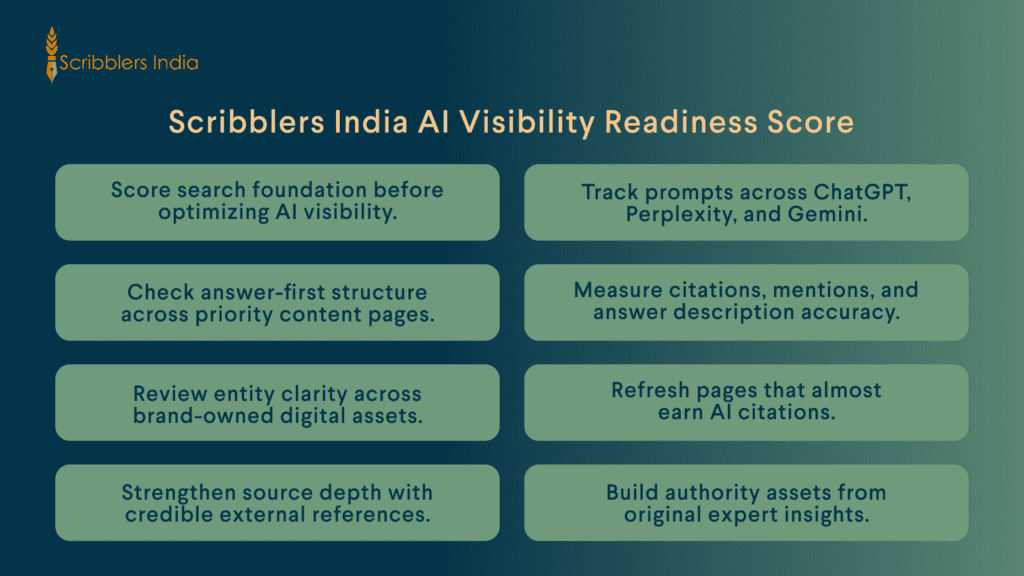
The full AI Search Visibility Scorecard provides the deeper diagnostic framework. This report should not duplicate that scoring system.
AI Search Discovery Readiness Check
Instead of reproducing the complete scorecard here, Indian brands can use six questions to identify where deeper analysis is required.
| Readiness Area | Question to Ask |
| Search foundation | Are important pages indexed and already discoverable? |
| Answer readiness | Do priority pages answer meaningful audience questions clearly? |
| Entity clarity | Can someone identify what the brand does and serves? |
| Evidence depth | Does the site contribute information beyond generic summaries? |
| External authority | Do credible third parties support important expertise claims? |
| Measurement | Can the team track visibility repeatedly across relevant surfaces? |
A weakness in one dimension should determine the next investigation.
For example, poor AI visibility does not automatically mean the company needs more content. The real issue may be weak indexing, unclear services, limited evidence, or poor coverage of external sources. This diagnosis-first approach prevents brands from purchasing an AI-search tactic before understanding the problem.
Which Content Assets Can Support AI Search Discovery?
Different assets contribute different forms of evidence. Rather than assigning universal “citation scores,” brands should understand the role each asset can play in AI search discovery.
- Glossary pages support concept clarity: Well-researched definitions can establish terminology and link readers toward deeper guidance. Their usefulness depends on accuracy and contextual depth rather than having a short definition alone.
- Original research creates unique evidence: Surveys, product data, benchmarks, experiments, and transparent methodologies provide information other publishers may need to reference. These assets can support both citations and third-party coverage.
- Comparison content supports evaluation: Detailed comparisons can help when users ask about suitability, trade-offs, alternatives, costs, or implementation differences. Generic feature tables provide less defensible value.
- Case studies demonstrate applied expertise: Cases explain how a problem was approached and what happened. They can provide evidence that generic explanatory content cannot recreate.
- Expert explainers add interpretation: Strong experts can explain uncertainty, operational consequences, and where standard advice does not apply. Their value comes from judgment rather than title alone.
- Service pages clarify commercial entities: They help systems and buyers understand what the company offers, whom it serves, and how its services differ.
An AI content gap analysis can help determine whether a new asset is necessary or whether an existing page needs better evidence.
What Should Indian Brands Expect From AI Search in 2027?
AI search in 2027 is likely to become more deeply embedded within normal discovery rather than remaining a separate user behavior. Indian brands should prepare for more conversational, multimodal, and multilingual journeys while expecting source selection, citation patterns, and measurement capabilities to continue changing across platforms.
- AI discovery becomes less distinguishable from search: Users may increasingly move between conventional results, generated answers, follow-up questions, images, and voice without thinking about them as separate search modes. Brands will need a single discovery strategy that supports multiple interfaces rather than isolated SEO and AI search programs.
- Multimodal discovery gains greater commercial importance: Product images, diagrams, screenshots, videos, and visual explanations should matter more as search interfaces become better at combining visual inputs with conversational follow-ups. This will particularly affect Indian ecommerce, travel, automotive, education, healthcare, and local-service discovery.
- Indian-language AI search becomes harder to ignore: Hindi and regional-language generative interfaces should create new discovery opportunities as platform support improves. Brands should still prioritize languages based on real audience demand rather than translating entire websites simply because additional languages are technically available.
- AI visibility becomes more competitive and less static: More publishers will actively optimize for generative discovery during 2027. Citation availability alone may therefore become less differentiating. Original evidence, strong entities, independent authority, useful product information, and distinctive expert perspectives should increasingly matter as many competitors improve basic answer structure.
How Should Indian Brands Prepare Their AI Search Strategy for 2027?
Indian brands should prepare for 2027 by strengthening the foundations that support discovery across search, AI answers, external sources, and multimodal experiences. The priorities below focus on practical areas where teams can improve readiness without chasing speculative tactics or treating every new AI feature as a separate strategy.
| 2027 Priority | What Brands Should Do | Why It Matters |
| Protect SEO foundations | Maintain indexing, technical quality, useful architecture, and strong pages | Generative discovery still depends heavily on searchable source material |
| Build original evidence | Publish research, cases, proprietary data, and expert analysis | Commodity explanations will become easier to reproduce |
| Strengthen entity clarity | Align products, services, experts, locations, and company information | Clear relationships improve consistent brand understanding |
| Expand multimodal assets | Improve useful images, diagrams, video, captions, and supporting text | Discovery is moving beyond typed text queries |
| Test language demand | Measure Hindi and regional-language opportunities by audience | Localization should follow commercial relevance |
| Monitor citation stability | Track URLs, domains, brands, and answer context repeatedly | Individual citations remain too volatile for one-time reporting |
| Measure downstream influence | Connect AI visibility with branded search, direct traffic, leads, and pipeline | Immediate referrals show only part of AI-search impact |
| Build external authority | Develop credible third-party references around important expertise | Owned content alone may not support wider generative representation |
The strongest 2027 programs should therefore expand from AI optimization tactics into AI discovery systems. Content, search, external authority, measurement, and conversion need to work together rather than operating as separate initiatives.
Which AI Search Developments Should Brands Watch in 2027?
AI search will continue changing through new interfaces, measurement features, retrieval models, publisher controls, and more commercial use cases. Rather than reacting to every product update, brands should monitor developments most likely to affect discoverability, source visibility, user behavior, and the way buyers move from research to action.
- More granular first-party reporting: Monitor whether Google and other platforms expose deeper query, citation, referral, or generative visibility data.
- Greater agentic search behavior: Monitor whether assistants increasingly research, compare, and complete multi-step tasks instead of answering isolated questions.
- Changing publisher controls: Track crawler, licensing, citation, and attribution policies as publishers seek greater control over AI use.
- More local and multilingual retrieval: Review whether Indian-language and location-sensitive generative results materially change which sources receive visibility.
- Stronger commercial AI experiences: Watch how product comparison, shopping, local discovery, financial research, and B2B evaluation become integrated into generated answers.
What Should Indian Brands Do in the First Half of 2027?
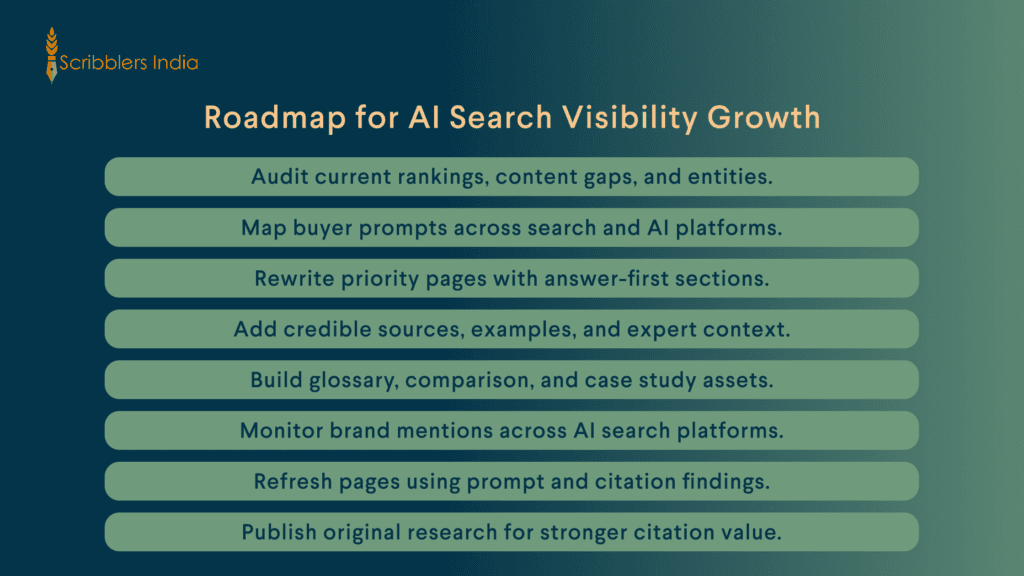
Businesses should treat generative visibility as an operating process rather than a one-time optimization project. The sequence below prioritizes diagnosis before expansion.
| Phase | Main Objective | Priority Actions |
| First 30 days | Establish baseline | Review Search Console, important pages, entity consistency, and priority prompts |
| Days 31–60 | Strengthen existing assets | Improve answer clarity, evidence, examples, internal relationships, and outdated information |
| Days 61–90 | Expand measurement | Track citations, mentions, competitors, accuracy, generative impressions, and referrals |
| Months 4–6 | Build stronger authority | Add research, cases, comparison assets, expert content, or external source development |
The sequence should change when the evidence points elsewhere. A company with weak service pages should not begin with an expensive research report. Another, with strong owned content but no external authority, may need a broader sourcing strategy sooner.
This is where Generative Engine Optimization becomes useful. GEO should address the source and representation gaps that owned-page improvements alone cannot solve.

What Should Brands Avoid When Optimizing for AI Search?
Several emerging practices can create activity without improving useful visibility. Indian brands should be especially cautious about tactics presented as universal AI-search requirements.
- Do not create one page for every prompt variation. Related questions often belong inside one stronger resource rather than several overlapping URLs.
- Do not treat short answers as a citation formula. Clear answers help readers, but no fixed paragraph length guarantees retrieval.
- Do not publish generic AI summaries at scale. Search systems already have abundant commodity information and Google now explicitly emphasizes differentiated value.
- Do not confuse structured data with authority. Schema helps describe visible information but cannot manufacture expertise or external recognition.
- Do not react to one lost citation. Source selection can change between observations, so repeated monitoring should precede major rewrites.
- Do not optimize for mentions without accuracy. Being included incorrectly can create a more serious reputation problem than temporary absence.
The strongest strategy improves information quality first and uses measurement to determine what deserves additional investment.
How Does Scribblers India Approach AI Search Discovery?
Scribblers India approaches AI search discovery as a connected visibility and content problem. We first establish what buyers ask, what the brand already publishes, where it appears across search and generative systems, and which gaps limit discovery.
- Start with evidence rather than assumptions: Existing rankings, generative impressions, priority prompts, citations, mentions, and competitor visibility establish the baseline. This helps distinguish an owned-content issue from a wider authority problem.
- Improve useful assets before creating more: Strong pages are refreshed for clearer answers, current evidence, deeper examples, and better content relationships. New pages are introduced only when a separate information need cannot be addressed properly elsewhere.
- Separate AEO from wider GEO work: Owned answers receive attention when the content itself is weak. External source coverage and brand representation become priorities when the issue sits beyond the company website.
- Develop citation-worthy information: Research, expert interpretation, detailed cases, and useful frameworks can create stronger source material than generic explanations. The objective is substantive information rather than content volume.
- Measure visibility as a changing system: Mentions, citations, source stability, description accuracy, generative Search impressions, referral traffic, and commercial outcomes are reviewed together before priorities change.
Get in touch with our team and start building measurable AI visibility around stronger content, clearer authority, and evidence buyers can trust.
Frequently Asked Questions
What is AI search discovery?
AI search discovery describes how a brand, page, product, or expert becomes visible through AI-assisted search and generative research experiences. It can include Google AI Overviews, AI Mode, ChatGPT Search, Perplexity, Gemini, and other systems where users receive synthesized answers supported by web information.
How is AI search discovery different from SEO?
SEO primarily helps useful pages become discoverable and competitive in search results. AI-led discovery adds generated answers, citations, brand mentions, source selection, and representation accuracy. Strong SEO remains important because many generative experiences still depend on search and retrieval systems rather than entirely replacing them.
Is Google AI Mode available in India?
Yes. Google rolled AI Mode out to users across India in July 2025. It subsequently expanded beyond English into Hindi and seven additional Indian languages. Search Live has also expanded across more Indian languages, making conversational and multimodal search increasingly relevant to Indian audiences.
Can businesses measure AI visibility in Google Search Console?
Yes. Google introduced dedicated Generative AI performance reports during 2026 and completed the worldwide rollout by August 31. Eligible sites can inspect visibility from AI Overviews and AI Mode separately from broader Search performance. Google subsequently added multimodal search reporting as another measurement layer.
Does appearing in AI search guarantee more website traffic?
No. AI-generated answers can influence discovery without producing an immediate click. International research has found lower click activity when Google AI summaries appear, though those findings should not be automatically applied to India. Brands should measure both website visits and wider visibility or assisted outcomes.
Should every Indian brand create regional-language AI content?
No. Language strategy should follow actual audience behavior, commercial relevance, and search demand. Indian-language discovery is expanding, but an English-first B2B company may have different requirements from a consumer, education, finance, healthcare, travel, retail, or local-service business.
What content is most useful for AI search visibility?
Useful assets can include accurate glossaries, original research, detailed comparisons, expert explainers, cases, and clear service pages. The appropriate format depends on the question being answered. Original information and first-hand expertise generally create stronger differentiation than reproducing summaries already widely available online.
How often should brands measure AI search visibility?
There is no universal schedule. High-value commercial prompts may justify frequent monitoring, while broader informational queries can be checked less often. The important requirement is consistency. Keep a stable core prompt set and separate platforms so changes can be interpreted meaningfully over time.
Editorial and Methodology Note
This report is based on secondary research reviewed through October 2026. Platform functionality, AI-search interfaces, crawler policies, and reporting capabilities can change quickly.
Statistics should be interpreted within their original geography and methodology. U.S. clickstream studies are labeled accordingly and are not presented as Indian behavioral benchmarks.
Scribblers India frameworks included here are practical models for strategy and measurement. They should not be interpreted as nationally representative survey findings or universal AI-ranking factors.