AI citations are becoming an important part of how brands appear inside AI-generated search results. When platforms such as Google AI features, ChatGPT Search, and Perplexity reference a source, that citation can influence brand discovery, perceived authority, and how users verify information before visiting another page.
For brands, AI citation visibility depends on more than publishing large volumes of content. Pages need relevant answers, credible evidence, clear source signals, and accurate brand information. Tracking where citations appear, what they support, and how consistently they return helps teams connect content quality with wider AEO, GEO, and AI search visibility goals.
Key Takeaways:
|
What Does an AI Citation Mean in Search?
An AI citation is a visible source reference connected with a generated answer. It helps users verify information and explore supporting pages. For brands, citations create source visibility before users reach conventional search listings or visit the company website directly.
A citation may support one definition, statistic, comparison, or procedural step within the answer. It does not confirm that the platform endorses the publisher or recommends its services. Teams must review the surrounding wording to determine whether the source provides evidence, context, or support for recommendations during each buyer interaction today.
AI citations differ from organic rankings because the platform filters sources before presenting a synthesized response. This shift makes citation tracking part of wider AI search visibility measurement. Brands should review source ownership, answer accuracy, citation stability, and repeated inclusion across valuable prompts before reporting a durable performance gain.
Which Types of AI Citations Should Brands Track?
AI citations can support several answer functions across research and evaluation. Each type creates a different visibility outcome. Teams should classify citations before comparing value, stability, source ownership, or business influence across prompts in every reporting cycle to ensure reliable analysis.
| Citation Type | What It Supports | What Brands Should Review |
| Definitional citation | A term or category explanation | Accuracy and topical association |
| Factual citation | A statistic, date, or verified claim | Currency and source fidelity |
| Explanatory citation | A concept, framework, or detailed answer | Context and meaning preservation |
| Procedural citation | Steps, methods, or implementation guidance | Completeness and practical usefulness |
| Comparison citation | Differences between providers or approaches | Fairness and decision criteria |
| Recommendation citation | A shortlist or suggested provider | Position and qualifying language |
| Product citation | Features, integrations, or service details | Description accuracy |
| Evidence citation | Research findings, case results, or proof | Methodology and claim support |
| Third-party citation | Independent coverage about the brand | Credibility and message consistency |
| Supporting citation | Background context without brand emphasis | Repeated use and later visibility |
Citation classification prevents teams from treating every source link as equal. A recommendation citation may influence shortlisting, while a factual citation strengthens topic authority. Our AI visibility measurement framework reports these roles separately across selected platforms and priority prompts.
What Factors Influence AI Citation Selection?
AI citation selection depends on relevance, accessibility, evidence quality, and source context for each prompt during retrieval cycles. Formatting alone cannot secure inclusion because answer engines need useful, retrievable evidence across platforms. Brands should create pages that answer questions, support claims, and help users evaluate information across changing search environments.
- Strong topical alignment improves selection when the page answers the prompt and supporting questions with focused, useful detail today.
- Indexed and accessible pages remain eligible for retrieval, whereas blocked or unavailable content cannot be used to generate search answers.
- Original evidence creates distinct value through research, expert experience, verified examples, or practical frameworks that competitors cannot easily replicate.
- Current information supports trustworthy answers when dates, service details, evidence, and examples accurately reflect present market conditions.
- Clear passages improve source usability by consistently placing concise definitions, comparisons, procedures, and numerical evidence near relevant headings.
Our AEO services integrate these factors into a single editorial system. We strengthen direct answers, evidence blocks, section structure, and source clarity. This approach helps priority pages support readers while making it easier for answer engines to retrieve, interpret, and cite them.
How Should Brands Judge AI Citation Quality?
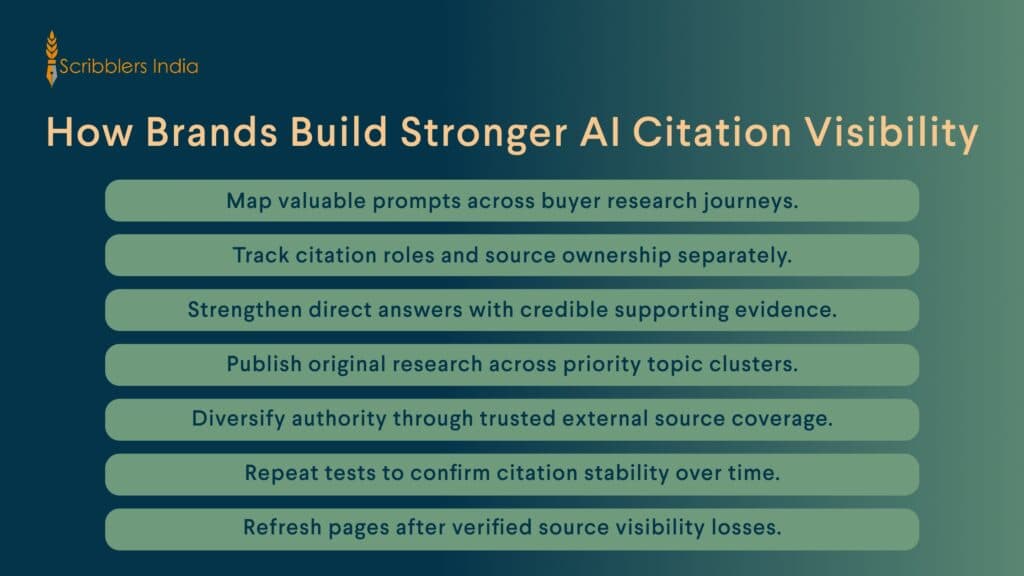
Citation counts show source selection, yet they do not reveal how much the page shaped the generated answer. Measurement must assess source influence. Teams should review whether the citation contributes evidence, structure, wording, or factual support within the final response.
A 2026 research framework distinguishes between citation selection and citation absorption. Selection records whether a platform chooses the source for an answer. Absorption measures whether the page contributes language, evidence, structure, or factual support across ChatGPT, Google AI Overviews, Gemini, and Perplexity. Marketing teams can assess both outcomes during structured reviews.
A separate 2026 Google AI Overviews study found that 11.0% of the examined claims lacked support from the cited pages. Brands should compare each generated claim with the cited passage. This check reveals whether a visible citation preserves context, supports the statement, or creates an accuracy risk around the brand for users.
How Should Brands Measure AI Citation Performance?
Brands should measure citations across fixed prompts, repeated tests, selected platforms, and defined reporting periods. One observation cannot establish durable performance. A useful review combines source presence with answer context, stability, accuracy, and later commercial signals across priority buyer journeys.
- Citation rate: Track the percentage of observed answers that cite an owned page or approved external source. Separate platform results so the metric shows source inclusion across the fixed prompt library without hiding channel differences.
- Cited-page mix: Record which service pages, reports, blogs, case studies, or expert assets receive links. This distribution shows whether citation visibility depends on a single page or consistently extends across the wider content system over time.
- Citation influence: Review whether the source contributes definitions, evidence, comparisons, procedures, or support for recommendations. This measure separates visible links from sources that shape the answer meaningfully for users, brands, and later decisions across buyer journeys.
- Citation stability: Repeat the same prompt under comparable conditions and track whether the citation returns. This measure prevents teams from treating a single appearance as permanent or from reporting routine variation in answers as meaningful strategic growth today.
- Commercial contribution: Compare citation visibility with referrals, branded searches, conversions, and sales feedback. This wider view shows whether source inclusion supports later buyer action even when users do not open every cited page directly today.
Our content strategy services connect these findings with page priorities and authority assets. We assign clear review cycles to every metric. Teams can then improve confirmed gaps rather than publishing disconnected content for every short-term citation movement across platforms.
What Should Brands Do When AI Citations Disappear?
AI citations can disappear after source updates, prompt changes, indexing issues, or stronger competing content enters the retrieval pool. One missing link does not confirm lasting decline. Teams should repeat the test, inspect the replacement source, and confirm the pattern before changing valuable content in future reviews across priority pages.
- Confirm the loss across repeated tests using the same prompt, platform, location, language, and session conditions before acting.
- Check crawl and indexing eligibility to ensure the page remains accessible, indexed, up to date, and available for search snippets.
- Carefully compare the replacement source for stronger relevance, fresher evidence, clearer passages, or wider coverage of supporting questions.
- Refresh only confirmed content gaps that involve outdated facts, missing context, weak evidence, or unclear answers across priority sections.
- Expand credible authority signals through research, expert commentary, independent coverage, and consistent founder positioning across trusted public sources.
Our thought leadership services and personal branding programs diversify evidence beyond one owned page. We build credible expert sources around priority topics. This broader information environment supports stronger recognition and reduces reliance on a single citation pathway for future changes to answers.
How Can Scribblers India Support AI Citation Growth?
Scribblers India turns citation findings into focused content and authority actions. We test valuable prompts, assess the influence of sources, and strengthen citation-ready assets. Each service connects AI citation tracking to measurable AEO, GEO, content strategy, and expert-authority priorities for brands.
- AI citation audits: Our team checks which pages AI platforms cite for important buyer prompts, what those citations support, and which competing sources appear instead. This gives teams a clearer view of where citation visibility is strong and where it is missing.
- AEO content planning: We improve pages so key answers, definitions, evidence, and comparisons are easier to find and understand. The goal is to make useful content clearer for readers without flattening it into repetitive answer-engine copy.
- GEO authority development: Strong citations can come from sources beyond the brand website. We build research, expert-led resources, case-based content, and external contributions that strengthen authority around priority topics.
- Content refresh programs: Existing pages often need improvement rather than replacement. We update weak evidence, outdated claims, unclear sections, and internal links so valuable content stays current and better aligned with citation opportunities.
- Expert authority programs: Founder knowledge can become another source of credible brand information. We develop bylines, interviews, commentary, and thought leadership that make expertise more visible across the wider information ecosystem.
Get in touch with our team to start building an evidence-led AI citation program. Strengthen source visibility, protect answer accuracy, expand credible authority, and connect citation growth with priority buyer questions across relevant platforms.
Frequently Asked Questions
What Do Brands Ask About AI Citations?
These FAQs address practical questions that arise after teams begin tracking citations across AI platforms. Each response clarifies one measurement or optimization concern. They also show why brands should avoid making assumptions based on a single citation, session, or source.
Do All AI-Generated Answers Include Visible Source Citations?
No, citation behavior differs across platforms, modes, and response types. Some answers show inline links, source cards, or separate panels, while others provide no visible references. Teams should record the exact product experience before comparing citation rates across prompts, dates, locations, or platforms. This method supports fair analysis for teams.
Can a Page Earn AI Citations Without Ranking First?
Yes, AI platforms can retrieve pages beyond the leading conventional result when another source better supports a subquestion. Google states that AI features may use query fan-out across related searches. Strong relevance, useful evidence, and accessible content can therefore create citation opportunities outside the top organic position across relevant searches.
Are AI Citations Permanent After a Page Earns One?
No, AI citations can change when prompts, sources, models, indexes, or session conditions change. One appearance confirms visibility during that observation, not permanent inclusion. Teams should repeat fixed prompts across comparable settings. They should measure citation stability before treating the result as a durable gain within formal performance reports today.
Should Every Website Page Target AI Citations?
No, brands should prioritize pages that address valuable buyer questions and demonstrate verifiable expertise. Service pages, research assets, comparisons, case studies, and detailed guides often deserve attention first. This focus protects editorial quality. It also prevents low-value rewrites across pages offering limited citation or commercial potential within the wider content program.
Do More AI Citations Always Increase Website Traffic?
No, users may receive enough information inside the generated answer without opening every source. Citations can still support awareness, trust, and later branded discovery. Teams should compare citation growth with referrals, conversions, branded searches, assisted journeys, and sales feedback. This wider view supports stronger commercial analysis across future reporting cycles.