AI search platforms shape how buyers discover brands before they visit websites. Traditional ranking reports capture only part of that influence across generated answers. An AI visibility measurement framework gives teams a structured tracking method for clearer reporting. It connects prompts, citations, accuracy, competitors, and outcomes across answer-led platforms.
This glossary explains how the framework works and which metrics matter. It also shows why one-time prompt checks create misleading confidence. Repeatable testing and prompt weighting turn scattered signals into priorities. Clear review cycles consistently connect AI search visibility data to better content and authority decisions across buyer journeys every quarter.
Key Takeaways:
|
What Does an AI Visibility Measurement Framework Cover?
An AI visibility measurement framework organizes how brands track mentions, citations, recommendations, accuracy, and competitor presence across generated answers. It defines prompts, platforms, scoring rules, and review cycles. These elements create consistent reporting across changing AI search experiences over time.
The framework replaces isolated searches with repeatable observations across priority buyer questions. It records where a brand appears and which sources support that appearance. It also checks whether the answer reflects current positioning and whether competitors receive stronger placement, creating clearer evidence behind every reported movement within each review cycle.
A useful framework also connects visibility signals with business outcomes. Referral traffic, branded searches, conversions, and sales feedback indicate whether the generated answers influence subsequent action. Our content strategy services align measurement with the pages and authority assets that support each buyer stage and the wider commercial priorities across the program each quarter.

Why Do Traditional SEO Dashboards Miss AI Search Performance?
Traditional SEO dashboards measure rankings, impressions, clicks, and website sessions across conventional search results. They rarely capture the wording of answers or brand recommendations. This limitation leaves AI-led discovery influence outside the reports that marketing teams use for planning and performance reviews.
- Ranking-Led Reporting: SEO dashboards show where a page ranks for a tracked keyword. AI platforms may mention a brand without ranking its website, so teams need prompt-level observation to understand that additional visibility layer across generated answers and buyer journeys over time.
- Click-Dependent Measurement: Analytics records visits after users open a page. Generated answers may complete part of the research without prompting a click, so brands need visibility measures that capture influence before traffic reaches the website, during early evaluation stages, and in later consideration.
- Missing Answer Context: Conventional tools cannot always show how an AI system describes a company. Frequent mentions may still reflect outdated positioning, so manual accuracy reviews protect brand perception when automated counts appear positive across monthly reports and future content planning reviews.
- Limited Competitor Visibility: Ranking tools compare webpages for selected keywords. AI answers can introduce unfamiliar brands, publishers, directories, or adjacent solutions, so a separate competitor log shows which sources enter the answer and which sources support stronger visibility across the complete set of tracked prompts.
Our AI search visibility scorecard closes these gaps by connecting rankings with mentions, citations, accuracy, prompt coverage, competitor presence, and commercial outcomes. This combined view gives marketing teams a stronger basis for monthly reviews and content decisions across reporting cycles.
Which Metrics Belong Inside an AI Visibility Measurement Framework?
A useful framework for evaluating AI platforms combines presence, source selection, accuracy, competition, stability, and business impact. No single metric explains the full performance picture. Teams should report each measure individually before combining selected signals into an executive score.
| Metric | What It Shows | Review Cycle | Business Question |
| Mention frequency | Brand appearances in answers | Monthly | Are relevant answers naming us? |
| Citation rate | Owned pages cited | Monthly | Which pages earn citations? |
| Owned-source share | Owned versus external citations | Monthly | Do our pages support inclusion? |
| AI share of voice | Brand presence compared with competitors | Monthly | Who leads category visibility? |
| Prompt coverage | Buyer-question visibility | Quarterly | Which journey stages remain uncovered? |
| Answer accuracy | Correctness of brand descriptions | Monthly | Is the brand description correct? |
| Recommendation position | Placement within generated shortlists | Monthly | Where do we appear during evaluation? |
| Citation stability | Repeat appearance of cited pages | Monthly | Are citation gains durable? |
| Source diversity | Range of supporting domains | Quarterly | Is authority concentrated or broad? |
| AI referral quality | AI visits and conversions | Quarterly | Does visibility support valuable action? |
The AI search discovery benchmark can establish the first baseline across these metrics. Teams should preserve definitions and scoring rules so later movement reflects performance rather than methodology changes, dashboard redesigns, or shifting internal expectations across reporting periods over time.
How Should Brands Build and Weight Their Tracking Prompt Set?
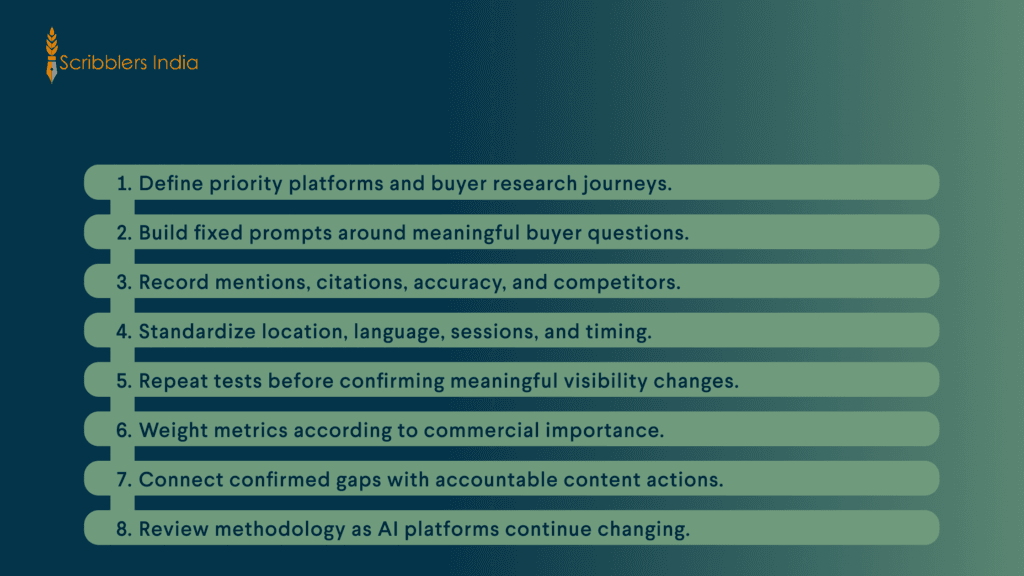
Brands should build prompts around buyer questions and assign weights according to business importance. A balanced AI visibility measurement framework covers education, problem discovery, comparisons, objections, use cases, and decision validation without allowing broad informational prompts to dominate the final score over time.
Start with questions collected from sales calls, search data, customer interviews, and support conversations. Group them by buyer stage and audience type. Keep a fixed core set for trend reporting, then test emerging language in a separate set before adding new prompts to the permanent benchmark in future planned review cycles.
Weight prompts according to their role within the decision journey. A vendor recommendation may deserve more influence than a broad definition. Document every weighting rule before reporting results, then review whether those weights still reflect current commercial priorities and buyer behavior across target markets and evolving customer groups over time.
Our AEO services connect uncovered prompts with direct answers, comparison content, definitions, and structured page improvements. This approach turns prompt gaps into measurable content priorities rather than another list of disconnected editorial ideas.
How Should Teams Control Testing Conditions and Confidence for AI Visibility Measurement?
AI platforms can return different answers when prompts, locations, accounts, models, or sessions change. A dependable framework records these conditions before comparison. Teams should standardize controllable factors and disclose any remaining uncertainty when reporting visibility gains, losses, or competitive movement.
- Prompt Wording: Preserve the exact wording of every core prompt during each reporting cycle. Small changes can shift intent or the sources retrieved. Test paraphrases in another set when you want to explore natural language variation without weakening the core benchmark over time.
- Platform and Mode: Record the platform, product mode, model, and search setting used for every observation. ChatGPT Search differs from non-search conversations, while Google AI Overviews require separate reporting from other Google results and AI experiences within the same monthly or quarterly report.
- Location and Language: Record the country, language, and local context behind every test. Regional availability and source selection can change recommendations. Separate markets whenever location affects services, regulations, pricing, or category relevance because combined reporting may hide meaningful differences across distinct target markets.
- Session Conditions: Use comparable account and session conditions whenever possible. Conversation history or personalization can influence certain experiences, so fresh sessions help reduce uncontrolled context when running repeated benchmark tests across platforms, dates, prompts, and target markets within the broader visibility measurement framework.
- Repeated Observations: Run important prompts several times before confirming meaningful movement. A 2026 study recommends repeated measurement because brand appearances and cited sources can vary across runs, prompts, dates, and platforms. One-off observations cannot support dependable strategic content decisions across repeated reviews.
This testing discipline strengthens AI search benchmarking by separating persistent patterns from routine variation. It gives leaders confidence that reported gains, losses, citation shifts, and competitor movements are based on comparable evidence rather than on inconsistent testing conditions across planned review cycles.

How Should Teams Review AI Visibility Results and Turn Them Into Action?
AI visibility reviews work best when teams check key prompts regularly and analyse broader patterns every month or quarter. Some metrics change quickly, while others need more time. This rhythm helps teams spot real issues without reacting to a single unusual answer or a change in a citation.
Use the review plan below as a starting point, then adjust it based on your category, platforms, team capacity, and reporting needs. Every review should use the same prompts and recorded testing conditions. Confirm sudden changes through repeat checks before changing content or positioning.
- Weekly priority checks: Review high-value prompts for sudden drops in visibility, cited pages, answer accuracy, and competitor appearances. These checks help teams catch urgent issues before they affect important buyer questions or leadership reports.
- Monthly performance reviews: Compare core metrics across platforms, prompts, competitors, cited sources, and testing conditions. Monthly reviews show whether visibility changes reflect a real pattern or one temporary shift inside a platform response.
- Quarterly strategy reviews: Check buyer-journey coverage and connect visibility gaps to content priorities, authority-building, and resource allocation. These reviews help teams decide which pages, assets, or external signals need focused investment next.
- Annual framework reviews: Analyze prompt groups, metric weights, platforms, scoring rules, ownership, and reporting needs once a year. This keeps the framework aligned with buyer behaviour, platform changes, and updated business priorities.
Our GEO services connect each review cycle with source development and external authority priorities. This rhythm turns measurement into consistent action without forcing teams to rewrite content after every routine fluctuation or isolated platform change across all planned reporting cycles.
How Can Scribblers India Build an AI Visibility Measurement Framework?
Scribblers India turns AI visibility data into clear measurement and content priorities for growing brands. We establish reliable baselines and repeatable methods. Each service connects findings with AEO, GEO, content strategy, personal branding, and thought leadership actions across buyer journeys.
- AI Visibility Baseline Audits: Scribblers India tests priority prompts, mentions, citations, competitors, and answer accuracy across relevant platforms. The baseline shows where the brand appears, how systems describe it, and which gaps need immediate action across the buyer journey.
- Prompt and Metric Frameworks: A structured prompt library provides marketing teams with a reliable basis for future reporting. Scribblers India builds metric definitions, scoring rules, and review cycles around buyer journeys so results remain comparable across planned reporting periods.
- AEO Content Action Planning: Weak prompt coverage becomes clearer when each gap connects with a specific content action. Our team maps direct answers, page improvements, FAQs, and comparison assets to measurable goals across extraction, citation, accuracy, or referral performance.
- GEO Authority Measurement Programs: Strong AI visibility also depends on source diversity, expert citations, and competitor authority across generated answers. Scribblers India uses these findings to guide research, digital PR, expert content, and authority assets around priority category topics.
- Founder and Thought Leadership Tracking: Founder recognition can strengthen a company’s visibility when AI systems connect credible people with specific topics. Our tracking reviews expert associations, cited bylines, and topic consistency to identify where stronger thought leadership content can support future visibility growth.
Get in touch with our team to build an evidence-led AI visibility measurement framework that connects dependable data with focused content, credible authority, and measurable commercial priorities across priority buyer journeys.
Frequently Asked Questions
How Many Prompts Should an AI Visibility Framework Cover?
There is no universal prompt count for every brand or category. Begin with a balanced set covering important buyer stages, audiences, markets, and services. Expand it when repeated testing reveals missing journeys. A smaller, well-designed library provides more dependable insight than hundreds of repetitive prompts with limited commercial relevance across reporting periods.
Which Tools Support AI Visibility Measurement for Brands?
Google Search Console now provides dedicated generative AI performance reports for eligible Search visibility. Analytics platforms can identify some AI referrals, while controlled prompt tracking covers mentions, citations, and answer accuracy elsewhere. Teams should compare platform coverage, sampling methods, exports, and scoring rules before selecting any measurement tool across future reviews.
Can Brands Measure AI Referral Traffic Across Platforms?
Brands can identify some AI referrals when platforms pass recognizable referral information. OpenAI states that ChatGPT Search links include a utm_source=chatgpt.com parameter. However, referral traffic captures visits rather than zero-click influence. Teams should combine sessions with mentions, citations, branded demand, conversions, and sales feedback across future reporting periods.
How Long Does It Take to Build a Reliable AI Visibility Measurement Framework?
The timeline depends on platform coverage, prompt volume, markets, competitors, and reporting complexity. Teams need enough time to design the method and collect repeated baseline observations. A rushed framework can create a misleading sense of certainty. Reliability improves after several review cycles confirm which patterns persist across comparable testing conditions over several quarters.
Should Small Brands Track the Same Visibility Metrics?
Small brands should track the same core outcomes, including mentions, citations, accuracy, prompt coverage, competitor presence, and referrals. However, they can use a narrower prompt library and fewer platforms. The AI visibility measurement framework should reflect business priorities, available resources, category maturity, and the questions most likely to influence qualified buyers over time.