
AI search stats now influence decisions beyond SEO teams. Marketing leaders use this data to evaluate discovery, traffic quality, brand visibility, and content investment. They also need evidence before shifting budgets toward optimization, reporting tools, or authority-building campaigns.
However, AI search data changes quickly. A current platform announcement may conflict with an older independent study. Reports may measure users, visits, searches, sessions, or citations differently. Without context, impressive numbers can produce weak forecasts, misplaced priorities, and misleading targets.
This guide brings together 80+ verified data points across Google Search, ChatGPT, Gemini, Perplexity, Claude, and Microsoft Copilot. Each section explains what the numbers mean for marketers. It also shows when brands should respond and how they should measure progress.
Key Takeaways
|
How Were These AI Search Stats Selected and Fact-Checked?
We collected these AI search stats through a structured research and verification process. Our priority was recent evidence with clear sources, dates, sample details, and collection periods. Official platform announcements and earnings reports helped us assess adoption, feature reach, usage, and geographic availability.
To balance those disclosures, we reviewed academic papers, analytics datasets, institutional surveys, and recognized industry research. These sources helped us examine search behavior, referral traffic, citation patterns, click activity, and commercial outcomes. Each source was assessed within its stated methodology, timeframe, and scope.
The next step was separating metrics that appear similar but measure different things. Weekly users differ from monthly users. Website visits cannot represent app usage. Queries, sessions, accounts, and people also describe distinct behaviors. We checked every publication date against the actual data collection period behind it.
Finally, we prioritized evidence from 2025 and 2026. Older figures were included only when they showed meaningful change over time. Where credible sources reported different outcomes, we preserved the context rather than forcing a single conclusion. This method helped us separate platform scale, observed behavior, measured outcomes, and forward-looking projections for readers.
What Do Global AI Search Adoption Stats Reveal About User Behavior?
AI-search discovery is moving beyond early experimentation. Large audiences now use conversational systems for research, guidance, comparisons, planning, and everyday questions. Adoption still varies by age, income, location, and task. Brands therefore need audience-specific conclusions rather than one global assumption.
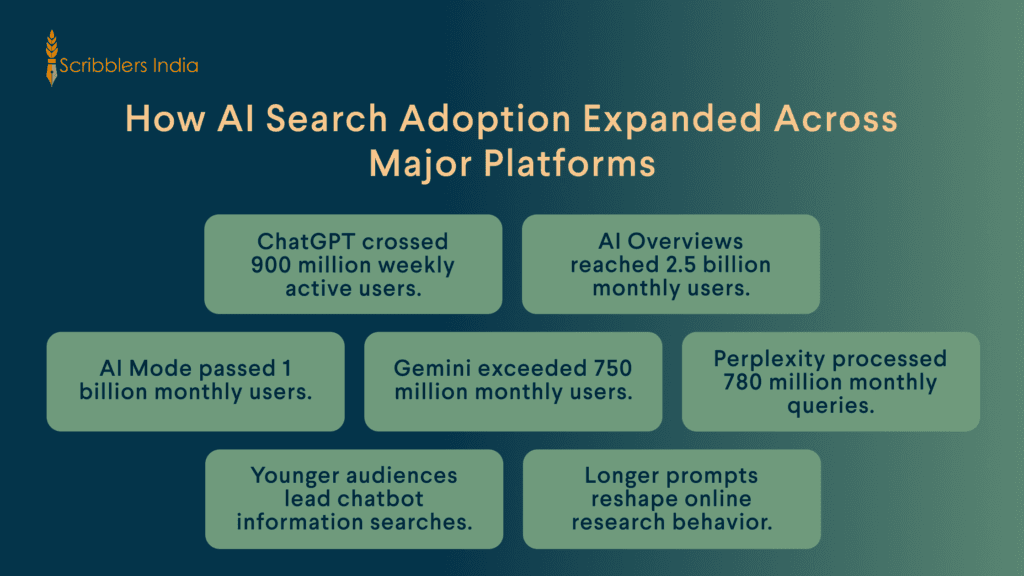
- ChatGPT exceeded 900 million weekly active users by March 2026. (OpenAI, 2026)
- OpenAI reported more than 50 million consumer subscribers to ChatGPT. (OpenAI, 2026)
- ChatGPT generated 6 times as many monthly web visits and mobile sessions as the next AI application. (OpenAI, 2026)
- Users spent 4 times as long with ChatGPT as with the next-largest AI application. (OpenAI, 2026)
- ChatGPT captured 4 times as much user time as all other AI applications combined. (OpenAI, 2026)
- 34% of American adults had used ChatGPT by mid-2025. (Pew Research Center, 2025)
- ChatGPT adoption reached 58% among American adults younger than 30. (Pew Research Center, 2025)
- 57% of American teenagers used chatbots to search for information. (Pew Research Center, 2026)
These AI search stats show that AI discovery now reaches broad consumer groups. Brands should map category questions, comparison prompts, and decision-stage concerns within an AI search visibility strategy. Keyword demand still matters, but prompt behavior adds a second layer of audience insight.
How Widely Are Google AI Overviews Used in 2026?
Google AI Overviews now operate at global scale. Their reach matters because users receive synthesized answers before opening websites. However, monthly reach differs from query activation. Marketers must separate availability, triggering frequency, geography, and click behavior when interpreting AI Overviews stats.
- AI Overviews reached more than 2.5 billion monthly active users by May 2026. (Google, 2026)
- Google reported 1.5 billion monthly users of AI Overviews in May 2025. (Google, 2025)
- AI Overviews reached 2 billion monthly users by July 2025. (Alphabet, 2025)
- The feature became available across more than 200 countries and territories. (Google, 2025)
- Google supported AI Overviews in more than 40 languages by May 2025. (Google, 2025)
- Eligible query types showed more than 10% usage growth within the United States and India. (Google, 2025)
- A 2026 academic study measured overall AI Overview activation at 13.7%. (Xu, Iqbal, and Montgomery, 2026)
- Question-form searches triggered AI Overviews at a rate of 64.7%. (Xu, Iqbal, and Montgomery, 2026)
- Non-question searches triggered them at only 9.5%. (Xu, Iqbal, and Montgomery, 2026)
- Question phrasing increased activation by 6.8x within the dataset. (Xu, Iqbal, and Montgomery, 2026)
These AI search stats show why reach does not guarantee clicks. AI Overviews may reach billions while appearing for only a small share of queries. Visibility changes by topic, wording, location, and intent. Our AI Overviews visibility guide explains how content structure affects inclusion opportunities.
What Do Google AI Mode Stats Reveal About Prompt-Led Search?
Google AI Mode encourages longer and more complex questions. Users can continue with follow-up prompts without restarting their research. This behavior shifts content planning away from isolated keyword pages. Brands need complete decision journeys with supporting explanations, comparisons, definitions, use cases, and evidence.
Let’s have a look at some critical AI search stats to understand the road ahead for AI Mode in 2026 and beyond:
- AI Mode surpassed 1 billion monthly users within 1 year of launch. (Google, 2026)
- AI Mode queries more than doubled during every quarter after launch. (Google, 2026)
- Early Indian users submitted queries that were 2 to 3 times longer than those in traditional searches. (Google India, 2025)
- AI Mode expanded to more than 200 countries and territories by October 2025. (Google, 2025)
- Google added support for more than 35 languages during that expansion. (Google, 2025)
- The October rollout covered more than 40 additional countries and territories. (Google, 2025)
- Personal Intelligence expanded across nearly 200 countries and 98 languages during 2026. (Google, 2026)
Content implication: A page targeting a single phrase may miss the broader decision journey. Strong AI search optimization covers requirements, alternatives, risks, examples, comparisons, and implementation questions. It should also connect related pages through clear internal links. Each supporting section must answer a distinct need without repeating the same definition.
Is ChatGPT Becoming a Mainstream Search and Discovery Platform?
ChatGPT influences information discovery at significant scale. Its conversational interface supports research, planning, follow-up questions, and decision support. However, ChatGPT search stats show that users do much more than search. Brands must separate information-seeking behavior from writing, planning, analysis, and personal use.
ChatGPT Usage Shows Mainstream Research Adoption
ChatGPT adoption now extends across large and diverse user groups. These AI search stats also show faster growth beyond early high-income markets, expanding its relevance for global discovery.
- OpenAI’s 2025 usage study analyzed 1.5 million consumer conversations. (OpenAI, 2025)
- ChatGPT had 700 million weekly active users when that study appeared. (OpenAI, 2025)
- Users with typically feminine names accounted for 37% of classified accounts in January 2024. (OpenAI, 2025)
- Their share reached 52% by July 2025, indicating a narrowing adoption gap. (OpenAI, 2025)
- Adoption growth in the lowest-income countries exceeded that in the highest-income countries by more than 4 times. (OpenAI, 2025)
ChatGPT Usage Reveals Several Forms of Intent
ChatGPT users rely on the platform for more than search. Their conversations include guidance, information requests, writing support, task completion, and personal use.
- 75% of conversations involved practical guidance, information seeking, or writing. (OpenAI, 2025)
- OpenAI classified 49% of analyzed messages as “Asking.” (OpenAI, 2025)
- Task-focused “Doing” accounted for 40% of the analyzed usage. (OpenAI, 2025)
- Personal reflection and play represented the remaining 11%. (OpenAI, 2025)
- Work accounted for about 30% of activity, while non-work use represented 70%. (OpenAI, 2025)
Marketers should track prompts tied to category education, vendor selection, product comparisons, and buying objections. A focused AI search visibility strategy for ChatGPT measures brand mentions, competitor inclusion, cited sources, and answer accuracy. It should not treat every ChatGPT interaction as a conventional search visit.
How Are Other AI Search Platforms Changing User Discovery?
AI discovery does not happen on a single platform. Gemini, Perplexity, Claude, and Microsoft Copilot support different research contexts. Each platform uses distinct interfaces, retrieval patterns, user contexts, and citation behavior. Brands need platform-level measurement rather than a single blended AI visibility score.
| S. No. | Platform | Key statistic | Main discovery role | What brands should track |
| 36. | Gemini | Gemini exceeded 650 million monthly users by November 2025. (Google, 2025) | Google ecosystem research | Mentions and cited pages |
| 37. | Gemini | The application passed 750 million monthly users during Q4 2025. (Alphabet, 2026) | Google ecosystem research | Mentions and cited pages |
| 38. | Perplexity | Perplexity served more than 100 million weekly queries by October 2024. (Perplexity, 2024) | Source-led research | Citations and referrals |
| 39. | Perplexity | It processed 780 million queries during May 2025. (Perplexity, 2025) | Source-led research | Citations and referrals |
| 40. | Claude | Claude web traffic grew about 770% between September 2024 and March 2026. (Similarweb, 2026) | Detailed research | Brand references |
| 41. | Claude | Estimated monthly users reached 18.9 million during early 2026. (DataReportal, 2026) | Detailed research | Brand references |
| 42. | Copilot | Microsoft researchers examined 37.5 million deidentified Copilot conversations. (Microsoft Research, 2025) | Workplace discovery | Enterprise mentions |
| 43. | Copilot | Another study analyzed about 5.5 million enterprise Copilot sessions. (Microsoft Research, 2026) | Workplace discovery | Enterprise mentions |
These figures use different measurement methods. Monthly users, visits, queries, conversations, and sessions cannot support a direct market-share comparison. Teams should maintain separate platform views within their AI visibility measurement framework.
How Much Website Traffic and Revenue Does AI Search Influence?
AI platforms still send less traffic than traditional search. However, referred visitors may arrive with stronger intent. AI answers often complete early research before users click. Brands should compare conversion quality, engagement, landing-page patterns, and assisted outcomes instead of measuring referral volume alone.
| S. No. | Category | Verified AI search data |
| 44. | Traffic growth | Generative AI platforms attracted about 7 billion monthly website visits by Q4 2025. (Similarweb, 2026) |
| 45. | Traffic growth | That volume represented 76% year-over-year growth. (Similarweb, 2026) |
| 46. | Traffic growth | Generative AI referrals to transactional websites grew 357% year over year. (Similarweb, 2026) |
| 47. | Conversion quality | ChatGPT referral traffic converted at 7.1% during April and May 2026. (Similarweb, 2026) |
| 48. | Conversion quality | Paid search led the comparison with a 7.8% conversion rate. (Similarweb, 2026) |
| 49. | Referral shift | ChatGPT referrals increased 157.7% after clickable brand links appeared. (Similarweb, 2026) |
| 50. | Referral shift | Homepage referrals increased 354.7% during the same comparison period. (Similarweb, 2026) |
| 51. | Engagement | Page views per ChatGPT-referred visit increased 24%. (Similarweb, 2026) |
| 52. | Engagement | Average time on site from ChatGPT referrals increased 11%. (Similarweb, 2026) |
This pattern suggests that AI can function as a brand discovery channel. Homepage clarity, visible proof, concise positioning, and conversion paths deserve attention. Strong AEO visibility connects referral volume with direct answer inclusion, citation presence, brand mentions, description accuracy, and commercial outcomes.
How Do AI Overviews Affect Click-Through Rates and Zero-Click Searches?
AI-generated summaries can reduce the number of clicks because users receive answers directly. The effect still varies by query, ranking position, citation presence, intent, and device. Teams should compare several studies. One dataset cannot provide a universal traffic forecast for every website or search category.
- Users clicked traditional results in 8% of visits that contained an AI summary. (Pew Research Center, 2025)
- Traditional-result clicks reached 15% when no AI summary appeared. (Pew Research Center, 2025)
- Users clicked an AI summary citation during only 1% of summary visits. (Pew Research Center, 2025)
- About 26% of AI-summary searches ended without another action. (Pew Research Center, 2025)
- The comparable no-action rate for traditional results was 16%. (Pew Research Center, 2025)
- Seer measured a 61% decline in organic CTR for queries that show AI Overviews. (Seer Interactive, 2025)
- Paid CTR declined 68% across the same study period. (Seer Interactive, 2025)
- Ahrefs found that AI Overviews had a 58% lower position-1 CTR in December 2025. (Ahrefs, 2026)
These AI search stats need context because CTR effects vary across search conditions. The table below explains the main factors that can change how AI Overviews influence clicks.
| Factor | Why results may differ |
| Query intent | Simple informational questions often require fewer clicks. |
| Device | Mobile layouts can compress traditional search results. |
| Citation presence | Cited brands may receive stronger click outcomes. |
| Measurement period | Interfaces and answer layouts change frequently. |
These findings do not mean AI Overviews eliminate website traffic across every query. Brands should compare affected searches, citation visibility, landing-page performance, conversion quality, and assisted outcomes before deciding whether AI summaries create meaningful traffic loss or stronger discovery opportunities.
What Do AI Citation Stats Reveal About Rankings and Source Selection?
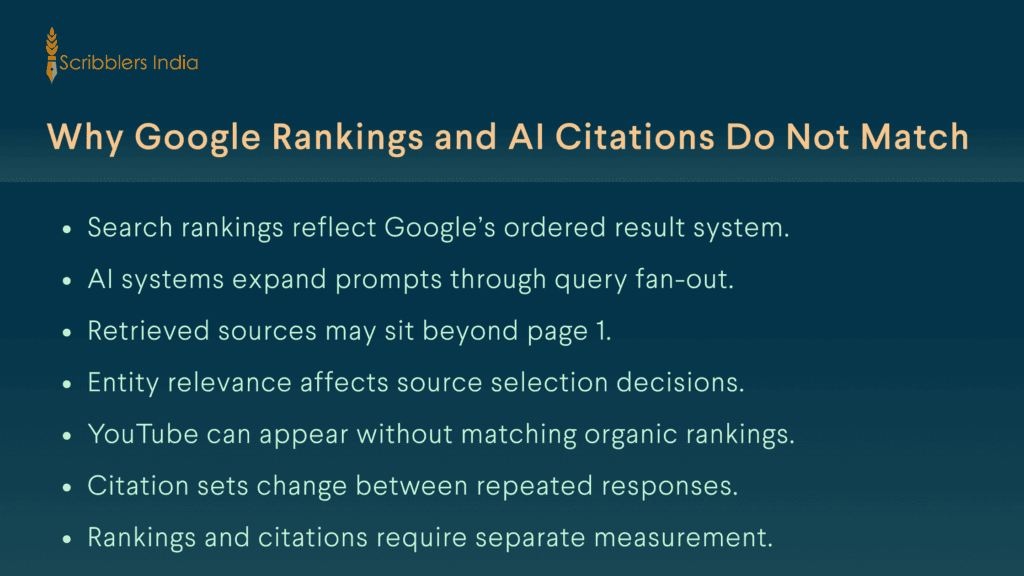
AI citations do not consistently mirror organic rankings. Search authority still matters, but AI systems may retrieve sources beyond page 1. Brands need accessible pages, entity clarity, source depth, and external authority. Each visibility type requires separate measurement.
| S. No. | Finding | Strategic implication |
| 61. | 37.9% of cited URLs appeared within Google’s first 10 result blocks. (Ahrefs, 2026) | Track citations separately from rankings. |
| 62. | 31.2% ranked between positions 11 and 100. (Ahrefs, 2026) | Page-1 presence is insufficient. |
| 63. | 31% did not rank within the first 100 result blocks. (Ahrefs, 2026) | Query fan-out expands retrieval. |
| 64. | 36.7% of organic-link citations ranked outside the top 100. (Ahrefs, 2026) | Exact rankings miss important sources. |
| 65. | YouTube represented 18.2% of non-ranking AI Overview citations. (Ahrefs, 2026) | Video can support visibility. |
| 66. | YouTube contributed 5.6% of all cited AI Overview URLs. (Ahrefs, 2026) | Review video transcripts and descriptions. |
| 67. | YouTube citation visibility grew 34% across 6 months. (Ahrefs, 2026) | Platform influence changes quickly. |
| 68. | AI Overview citations changed by 45.5% after responses refreshed. (Ahrefs, 2025) | Repeat visibility audits. |
| 69. | Only 54.5% of cited URLs overlapped between consecutive responses. (Ahrefs, 2025) | Monitor fixed prompt sets. |
| 70. | Researchers found 11% of analyzed claims lacked citation support. (Xu, Iqbal, and Montgomery, 2026) | Review answer accuracy. |
Organic rankings show where pages appear, while AI citations reveal which sources systems select for answers. A strong GEO strategy for AI citations tracks both signals and identifies gaps in authority, relevance, and source coverage. This combined view helps brands improve citability without weakening established SEO performance.
What Do AI Search Stats Reveal About Content Quality and Brand Authority?
AI visibility depends on more than page-level optimization. Systems evaluate owned content, external references, expert profiles, videos, reviews, and community discussions. An AEO strategy for answer-ready content improves extraction, while founder personal branding helps clarify expertise across trusted surfaces.
Original Research Strengthens AI Citation Potential
Original datasets provide AI systems with distinctive evidence that can distinguish one brand’s expertise from repetitive content across competing sources.
- Ahrefs analyzed 75,000 brands to assess AI Overview visibility factors. (Ahrefs, 2025)
- Branded web mentions showed a correlation of 0.664 with AI Overview visibility. (Ahrefs, 2025)
External Brand Mentions Reinforce Entity Recognition
Independent references help AI systems more confidently connect a brand with relevant topics, services, experts, and market categories.
- Branded anchors produced a 0.527 correlation with visibility. (Ahrefs, 2025)
- Web mentions correlated more strongly than backlinks, with a correlation of 0.218. (Ahrefs, 2025)
Founder Visibility Strengthens Perceived Expertise
Consistent founder coverage can strengthen the relationship between a founder and their company while clarifying both parties’ expertise.
- Brands within the top web-mention quartile averaged 169 AI Overview mentions. (Ahrefs, 2025)
- Brands within the next quartile averaged only 14 mentions. (Ahrefs, 2025)
Structured Content Supports Extraction Across AI Surfaces
Clear formatting helps AI systems interpret content, but structured pages still need authority signals and relevant external validation.
- 26% of studied brands had no AI Overview mentions. (Ahrefs, 2025)
- YouTube mentions showed a correlation of about 0.737 across major AI search surfaces. (Ahrefs, 2025)
Brands should publish original research, expert explanations, strong service pages, and founder-led insights. External coverage and video can reinforce those assets. Thought leadership content and ghostwriting services for founders can turn internal knowledge into visible authority without disrupting the section’s flow.

What Do AI Search Stats Reveal About Indian AI Ecosystem?
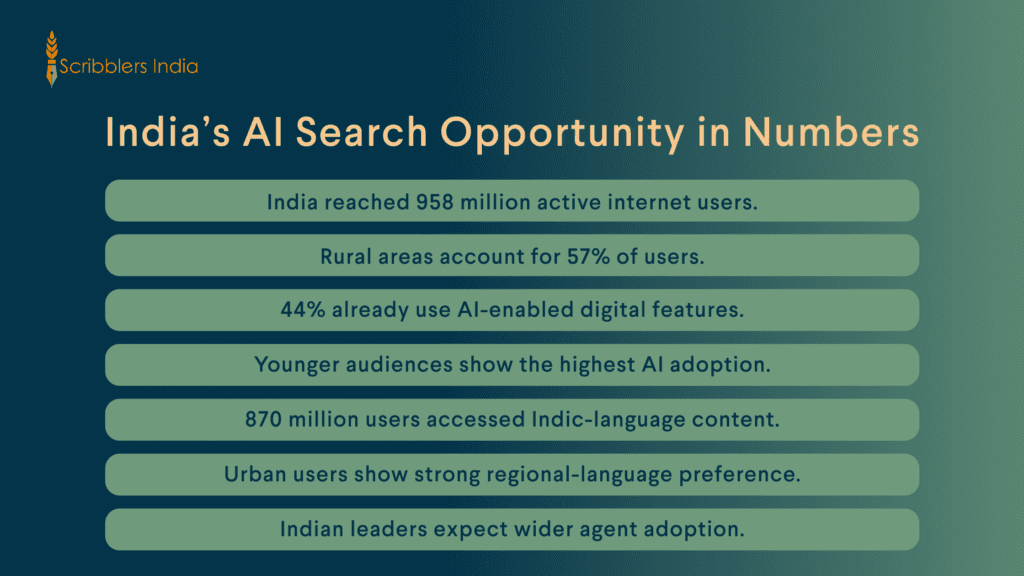
India is a major AI search market due to its scale, mobile behavior, language diversity, and rapid adoption of features. Brands should assess demand for English, Hindi, Hinglish, and regional languages by category. One national content strategy may overlook important differences in audiences and search habits.
| S. No. | Aspect | India-focused AI search statistic |
| 79 | Internet scale | India reached 958 million active internet users during 2025. (IAMAI-Kantar, 2026) |
| 80 | Internet scale | Active internet users increased by about 8% year over year. (IAMAI-Kantar, 2026) |
| 81 | Rural adoption | Rural India accounted for about 548 million active internet users. (IAMAI-Kantar, 2026) |
| 82 | Rural adoption | Rural users represented more than 57% of India’s active internet population. (IAMAI-Kantar, 2026) |
| 83 | AI engagement | 44% of users engaged with AI-enabled features. (IAMAI-Kantar, 2026) |
| 84 | AI engagement | AI feature usage reached 57% among users aged 15 to 24. (IAMAI-Kantar, 2026) |
| 85 | Language behavior | 870 million users accessed Indic-language content during 2024. (IAMAI-Kantar, 2025) |
| 86 | Language behavior | 57% of urban users preferred Indic-language content. (IAMAI-Kantar, 2025) |
| 87 | Business adoption | 90% of Indian business leaders called 2025 pivotal for strategic change. (Microsoft, 2025) |
| 88 | Business adoption | 93% expected AI agents to expand workforce capacity within 12 to 18 months. (Microsoft, 2025) |
SaaS brands may begin with English. Financial services, education, healthcare, and local providers should test regional prompts earlier. Language investment should follow measurable demand, content accuracy, audience needs, and conversion value.
How Should Brands Interpret These AI Search Stats?
No single AI search stat should determine your strategy. Brands need to connect adoption, visibility, traffic quality, citation presence, and conversions. The useful question is whether content influences discovery and supports business outcomes. A connected framework prevents teams from chasing isolated platform updates without measurable value.
- Protect the Organic Search Foundation: Maintain crawlability, indexing, internal links, technical clarity, and focused page intent. AI retrieval still relies heavily on accessible web content. Strong pages also provide source material for summaries, citations, and follow-up questions.
- Build an AEO Strategy Around Complete Buyer Questions: Add direct answers, descriptive headings, definitions, tables, and FAQs. Cover questions buyers ask before selecting a provider. Each answer should work independently while leading naturally into deeper explanation.
- Build a GEO Strategy Around Authority and Citability: Publish research, expert views, source-backed explanations, comparison guides, and case studies. Strengthen consistent brand descriptions across trusted external sources. Avoid fabricated community mentions or unsupported authority claims.
- Strengthen Founder Visibility Across Trusted Channels: Connect founder biographies, LinkedIn insights, interviews, ghostwritten articles, and expert commentary. These assets clarify who owns the expertise and where that expertise appears publicly.
Start with pages closest to revenue. Then test whether improvements affect mentions, citations, answer quality, referrals, and conversions.
How Should Marketing Teams Measure AI Search Visibility in 2026?
Rankings and organic traffic remain useful but incomplete. Teams should add brand mentions, cited URLs, answer accuracy, competitor inclusion, referral quality, and assisted conversions. Test the same prompt set regularly. Otherwise, citation volatility and platform differences can distort conclusions.
| Metric | What it measures | Review frequency | Recommended action |
| Brand mentions | Inclusion within answers | Monthly | Improve entity signals |
| Cited URLs | Source visibility | Monthly | Refresh cited pages |
| Answer accuracy | Brand description quality | Monthly | Correct unclear messaging |
| Prompt coverage | Topic visibility | Quarterly | Fill content gaps |
| AI referrals | Website visits | Monthly | Assess traffic quality |
| Assisted conversions | Commercial impact | Quarterly | Connect CRM attribution |
| Competitor presence | Share of answer | Monthly | Build authority assets |
| Citation volatility | Visibility stability | Monthly | Repeat prompt testing |
One-time prompt checks cannot establish a dependable trend. Repeat important questions across platforms, sessions, locations, and dates while keeping wording consistent enough for meaningful comparisons. The Scribblers India AI Visibility Scorecard helps teams organize these checks across mentions, citations, accuracy, prompt coverage, competitor presence, and visibility stability.
How Does Scribblers India Turn AI Search Stats Into an Actionable Strategy?
AI search stats only matter when they change what a brand does next. A report may show rising AI Overview usage, lower click-through rates, or stronger buyer reliance on ChatGPT, but those numbers are not useful until they shape content priorities, authority-building, and measurement.
Scribblers India helps brands translate AI search stats into practical visibility decisions. We study how search behavior is shifting, how AI-generated answers influence discovery, and which content assets need stronger answers, greater source depth, clearer entity clarity, and expert authority to stay visible across changing buyer journeys.
Our work connects data with execution across SEO, AEO, GEO, thought leadership, personal branding, and content refreshes. Instead of treating AI search stats as isolated trends, we use them to identify visibility gaps, strengthen priority pages, and build content systems that support rankings, citations, mentions, and qualified demand.
Scribblers India AI Search Visibility Framework
Scribblers India uses this framework to turn AI search stats into practical actions for content, authority, and measurement. Each layer addresses a specific visibility gap across rankings, generated answers, citations, brand mentions, and buyer-facing search journeys.
- Answer-Ready Content Structure: Our team builds answer-ready content with question-led headings, direct explanations, source requirements, tables, and contextual internal links. These structures help each page answer complete buyer questions while improving extraction, readability, clarity, and logical flow across sections.
- GEO Authority Content Development: We develop research reports, expert explainers, comparison guides, case studies, and authority-led pages that support important claims. This GEO content connects source quality with brand clarity and strengthens the external evidence AI systems may select across generated answers.
- Distinct Founder Thought Leadership: Our experts turn founder knowledge into original frameworks, informed commentary, research-led articles, and source-worthy perspectives. This thought leadership strategy reduces dependence on generic content and makes expertise easier for readers, journalists, buyers, and AI systems to recognize.
- Founder Brand Positioning Strategy: We align founder profiles, LinkedIn content, bylines, interviews, and category messaging around a defined area of expertise. This personal branding approach connects individual authority with market position while reducing confusion across public-facing channels and search systems.
- Strategic Content Refresh Planning: Our team strengthens older blog posts by providing clearer answers, using current sources, adding stronger examples, including relevant internal links, and improving conversion paths. These refreshes protect existing search equity, correct outdated claims, and align each page with current AI search behavior and audience needs.
Get in touch with our team for a personalized 1:1 call to identify visibility gaps across traditional rankings, AI-generated answers, citations, and brand mentions.
Frequently Asked Questions
What Are AI Search Stats?
AI search stats measure adoption, traffic, citations, answer behavior, and visibility across AI-led discovery platforms. They cover Google AI Overviews, AI Mode, ChatGPT, Gemini, Perplexity, Claude, and Copilot. Marketers use them to understand changing research behavior, compare platforms, assess content performance, and identify visibility gaps against business goals.
How Many People Use AI Search in 2026?
No single number captures every AI search user because platforms report different metrics. ChatGPT reports weekly users, while Google reports monthly users. Other platforms report visits, queries, or sessions. Compare timeframes, definitions, geographic coverage, device inclusion, product overlap, and reporting methods before combining audience figures or estimating total reach.
Is AI Search Replacing Google Search?
AI search is changing Google rather than replacing it. Google now integrates AI Overviews and AI Mode into its core experience. Users can still open websites, inspect sources, or review traditional results. Brands, therefore, need organic and AI search visibility within a single strategy. It should support discovery before and after generated answers.
How Common Are AI Overviews in Google Search?
AI Overviews reach billions of users each month, but they do not appear for every query. A 2026 study reported an overall activation rate of 13.7%. Question-form queries triggered them far more often. Appearance also varies by topic, wording, intent, location, user context, device, and Google’s assessment of usefulness for each search.
Does ChatGPT Send Valuable Website Traffic?
ChatGPT sends less traffic than major traditional channels. However, Similarweb measured a 7.1% referral conversion rate within its panel. Users may complete substantial research before clicking. Compare conversion quality, landing-page behavior, assisted outcomes, referral volume, homepage readiness, and lead quality before judging its commercial value. Context matters across industries.
How Are AI Search Stats Different From SEO Stats?
SEO statistics track rankings, impressions, clicks, backlinks, and organic conversions. AI search stats add mentions, citations, answer accuracy, prompt coverage, referral quality, and competitor inclusion. Teams need both groups because strong rankings do not always produce citations, recommendations, accurate descriptions, or measurable AI-referred conversions. Together, they show visibility and business impact.
Which AI Search Metrics Should Brands Track?
Track brand mentions, cited URLs, answer accuracy, competitor presence, prompt coverage, AI referrals, assisted conversions, and citation volatility. Review mentions, citations, and answer accuracy monthly. Assess prompt coverage and assisted revenue quarterly. Keep prompt wording, location, platform, testing frequency, device, and account conditions consistent across each comparison period.
How Can Scribblers India Improve AI Search Visibility?
We audit AI search visibility, map buyer prompts, create AEO content, develop GEO authority assets, and strengthen founder expertise. We also refresh existing pages, improve internal links, and track changing citations. Talk to Scribblers India to build a measurable strategy around discovery gaps, buyer questions, citation opportunities, and authority needs.