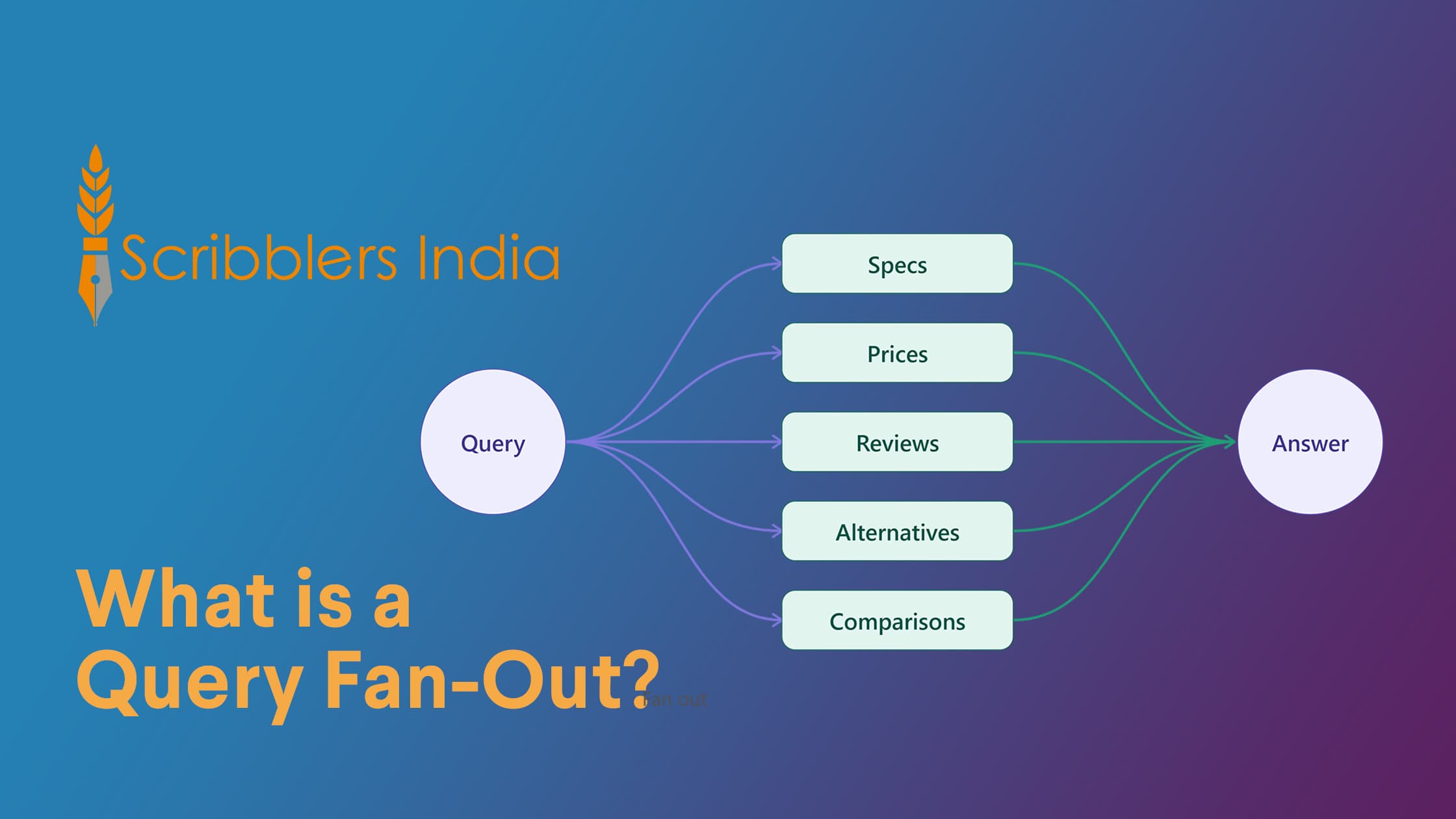
Query fan-out is a search technique that expands a single user question into several related searches or subtopics before generating a response. Instead of relying on the original wording alone, an AI search system can gather information across different angles, helping it address complex questions that would previously require several separate searches.
Google uses query fan-out within AI Mode and says AI Overviews may also use the technique. For content teams, this changes how search demand should be interpreted. One visible prompt can represent several hidden information needs, making useful topic coverage and connected supporting content more important than targeting a single phrase.
Key Takeaways
|
What Is Query Fan-Out and How Does It Work?
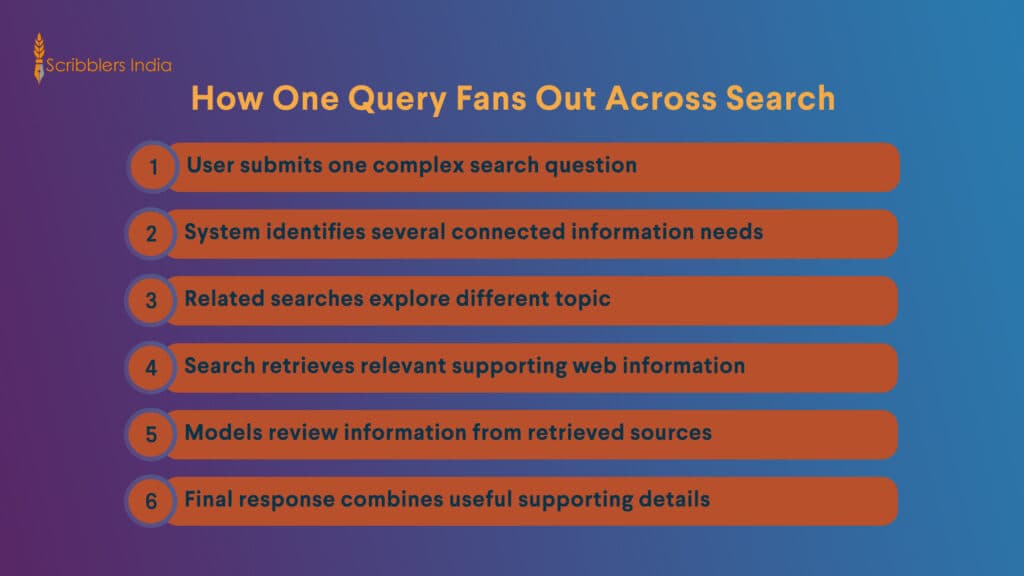
Query fan-out allows an AI search system to explore multiple aspects of a single request before preparing an answer. Google defines it as concurrent related queries generated to request more information and retrieve additional search results relevant to the original user question.
For example, a question about repairing a weed-filled lawn might lead Google to explore herbicides, chemical-free removal, and prevention methods. The user enters one question, while Search gathers supporting information across several connected angles before producing the response.
This retrieval stage connects query fan-out with Retrieval-Augmented Generation. Both involve gathering external information before generation, although query fan-out describes how a single information need can expand into several retrieval paths rather than a single search request.

How Is Query Fan-Out Different From Traditional Search?
Traditional search usually begins with one visible query and returns results relevant to that search. Query fan-out can expand the same request into several related searches before an AI-generated response appears. This creates a broader retrieval process behind a single visible user interaction.
| Area | Traditional Search | Query Fan-Out | Content Implication |
| Starting point | One submitted query guides the initial search results returned | One query can trigger several connected background searches | One visible prompt may contain several information needs |
| Search scope | Results primarily address the submitted search and interpreted intent | Searches can explore multiple subtopics around the original question | Supporting angles can become relevant within one journey |
| User effort | People may perform additional searches as their research develops | The system can perform related searches on the user’s behalf | Content should anticipate natural follow-up information needs |
| Final experience | Users usually review individual search results before continuing research | AI systems can combine retrieved information into one response | Different pages may contribute to the same generated answer |
Query fan-out is also narrower than the broad concept of query expansion. Search engines have expanded and interpreted queries for years. Query fan-out refers to concurrent, related searches used in newer generative Search experiences to gather broader supporting information.
What Does Query Fan-Out Look Like in a Real Search Journey?
A useful way to understand query fan-out is to examine a complex buyer question that contains several hidden decisions. The exact searches generated remain platform-controlled, so marketers should treat possible fan-out questions as research hypotheses rather than a list of queries Google has confirmed.
Consider this prompt: “Which payroll system works for a growing company with remote employees across several US states?”
| Possible Subtopic | Illustrative Related Search | Information Required | Useful Content Asset |
| Multi-state compliance | Payroll software for employees across multiple US states | State payroll requirements and compliance capabilities | Detailed product or compliance guide |
| Scalability | Payroll platforms suitable for growing employee numbers | Limits, workflows, automation, and expansion support | Product capability page or comparison |
| Remote workforce | Payroll software supporting distributed employee teams | Employee access, onboarding, and location requirements | Remote payroll or workforce guide |
| Integrations | Payroll systems connecting with HR and accounting tools | Supported platforms, workflows, and data connections | Integration pages or platform documentation |
| Evaluation | Features businesses should compare before choosing payroll software | Selection criteria, costs, support, and implementation | Buyer guide or comparison page |
These examples illustrate possible branches rather than Google’s internal searches. Google does not publish a single universal fan-out formula, and search results can vary with the original question, available context, Search systems, and the information needed for the response.
Why Does Query Fan-Out Change SEO Content Planning?
Query fan-out broadens the information space surrounding a single visible search. Content teams therefore need to understand the questions connected with a topic without turning every possible variation into another page. Google specifically warns against producing separate content for every fan-out query primarily to influence generative Search.
- Keyword research should identify the central search need before teams expand coverage into connected questions and supporting information.
- Related queries must reveal missing information within existing pages before they automatically become topics for separate new articles.
- Broader buyer questions can reveal several related decision criteria that warrant coverage in a single useful guide or content cluster.
- Separate pages remain appropriate when the underlying intent changes enough to require a distinct answer, format, or user journey.
- Internal links can connect supporting resources within a single topic when several pages contribute useful information to the same research journey.
- Content calendars should prioritize meaningful information gaps over query volume to reduce duplicate pages created by minor wording variations.
This is where a broader content strategy becomes more useful than keyword expansion alone. Teams need to decide what belongs on one page, what deserves supporting content, and which apparent gaps already have sufficient coverage.
How Can Teams Find Likely Query Fan-Out Opportunities?
Google does not provide marketers with a complete list of every background search generated for each user prompt. Teams can still identify probable information branches by studying real search behavior, customer questions, existing content gaps, and the supporting decisions users make around important topics.
- Search results might reveal recurring subtopics and related questions that Google already associates with a broader information need.
- Search Console data can reveal different queries that reach the same page, showing where a single asset already satisfies several search variations.
- Customer calls and sales conversations reveal questions buyers ask next, especially when complex decisions require comparisons or additional context.
- Competitor coverage may uncover useful subject areas that are missing internally, provided teams assess reader value rather than copying another website’s structure.
- AI prompt testing can surface recurring answer themes and sources, although generated outputs should not be treated as verified internal subqueries.
- Existing page audits can identify shallow sections that need stronger coverage before teams commission another article with the same underlying intent.
An AI content gap analysis can combine these inputs to distinguish missing answers from missing pages. That distinction becomes important when one fan-out journey touches several questions that may belong inside an existing resource.
Should Every Fan-Out Query Have Its Own Page?
Every fan-out query should not become a separate page. Google advises website owners to avoid creating content for every possible search variation when the primary purpose is to manipulate rankings or to generate responses. Its systems can understand relevant pages without exact matches for every generated query.
The stronger decision depends on search intent and the depth of information. Several closely related questions may fit within one comprehensive resource, while a distinct comparison, implementation process, product category, or specialized audience can justify separate supporting content with its own purpose.
Content architecture therefore matters more than raw page volume. A useful cluster assigns each asset a defined role while avoiding repetitive pages that answer the same question in different ways. Query fan-out should inform coverage decisions rather than become another excuse for mass publishing.
How Should Content Be Structured Around Query Fan-Out?
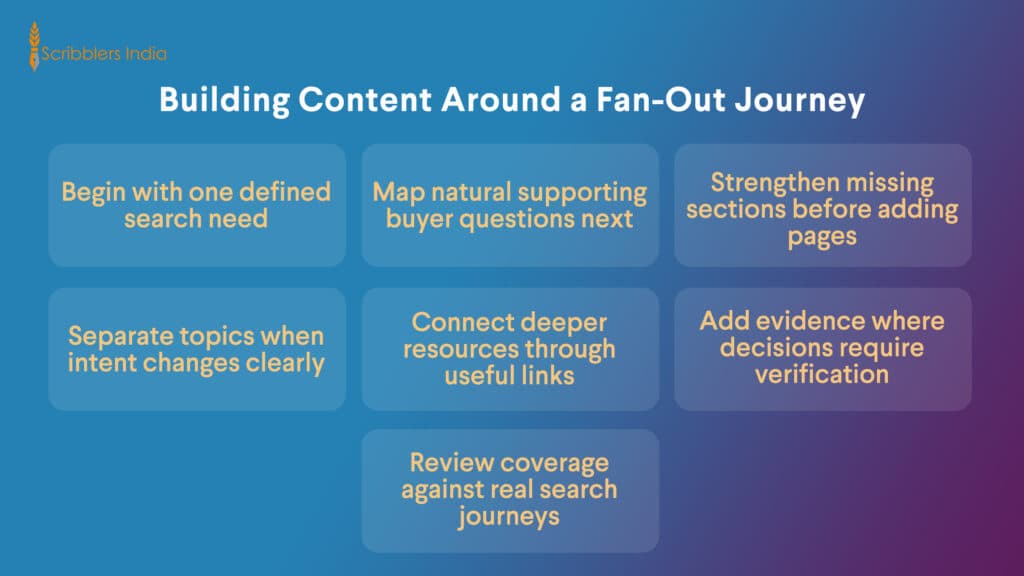
Content designed for fan-out environments should answer the central question while giving readers enough supporting information to continue their research. The goal is topic completeness where useful, rather than forcing every possible subquery into one oversized page or splitting minor variations across several thin resources.
- Start with one clear primary information need so the page retains focus while related sections address useful supporting questions.
- Use question-led sections when real follow-up questions deserve direct answers, rather than converting every heading into an assumed fan-out query.
- Add comparisons and examples where they resolve genuine buyer uncertainty instead of increasing page length without additional informational value.
- Connect supporting pages when a subtopic requires deeper treatment, allowing one resource to remain focused while preserving useful topic relationships.
- Keep important claims supported because generated answers may require current evidence, especially for comparisons, regulations, statistics, or product information.
- Review entity references so brands, products, people, and concepts remain clear, reducing ambiguity as systems retrieve information across related searches.
Our Generative Engine Optimization services apply this broader approach by mapping prompts, source patterns, content gaps, and supporting search journeys. Query fan-out becomes one planning input within the program rather than a standalone content formula.

How Can Brands Measure Query Fan-Out Visibility?
Query fan-out itself is difficult to measure directly because Google does not expose every internally related search behind each generated response. Measurement should therefore examine observable outcomes across pages, prompts, impressions, citations, and the visibility of supporting sources, rather than inventing a fan-out ranking metric.
| Measurement Area | What Teams Can Track | Useful Tool or Method | What It Cannot Prove |
| Generative impressions | Which pages appear within Google generative Search features | Search Console Generative AI performance report | Which internal fan-out query triggered each page |
| Prompt coverage | Whether the brand appears across controlled prompt groups | Recurring manual or platform-based prompt testing | Every background search generated by the platform |
| Source citations | Which owned or external pages support generated responses | Citation monitoring across relevant AI platforms | Why one source was selected over another |
| Content coverage | Which related questions existing pages answer or miss | Content audits and search-result analysis | The exact internal weighting of each subquery |
Google introduced dedicated generative AI reporting in Search Console during 2026. The report shows impressions by page, country, device, and date for supported generative Search features, although it does not expose a complete fan-out query list.
The AI Search Visibility Scorecard can add a broader review of content depth, entity clarity, answer readiness, external trust, and measurement gaps alongside these Google-specific performance signals.
How Does Scribblers India Use Query Fan-Out in Content Strategy?
At Scribblers India, we use query fan-out as a research lens rather than a promise of predictable AI citations. We study how a single buyer question can branch into related information needs, then compare those needs against existing content before recommending new pages or major content expansion.
- Prompt and intent mapping: We begin with questions that reflect real search and buyer needs. Each one is reviewed to understand what the user is trying to resolve. This helps us identify natural follow-up questions without turning every possible search variation into another content target.
- Existing coverage review: Priority pages are checked to see whether they already answer the connected questions well. Some gaps need a stronger explanation rather than another URL. Updating existing content can often improve coverage while reducing unnecessary overlap between pages targeting similar search intent.
- Content architecture decisions: A new page is recommended only when the topic deserves its own search journey. The existing content structure is reviewed first. Related resources are then connected in ways that genuinely help readers move from a broader question to deeper supporting information.
- Source and visibility review: Owned pages are compared with sources that appear across relevant generated answers. This can reveal where the brand lacks useful supporting information. It may also show that stronger external evidence is needed before another piece of owned content adds real value.
- Recurring measurement: Visibility is reviewed over time rather than judged by a single prompt test. We compare changes across important search questions and source appearances. Current platform guidance then helps us interpret those shifts without claiming access to hidden fan-out behavior that platforms do not expose.
This keeps query fan-out grounded in useful content planning. It helps us find areas where a brand needs better answers without converting every possible search branch into another page.
Book a 1:1 consultation with our team today to map your connected search needs into focused content that improves coverage.
FAQs
Does Google Use Query Fan-Out for Every AI Overview?
Google says that AI Overviews and AI Mode may use query fan-out, so publishers should not assume that every generated response follows the same process. The mechanism can support complex searches requiring additional information across subtopics. Google does not publish a rule stating that every AI Overview triggers the same fan-out process.
How Many Queries Does Google Generate During Query Fan-Out?
Google does not publish a universal number of queries generated during query fan-out. Its documentation describes concurrent, related searches and sometimes refers to multiple queries. The number can depend on the question and search experience, so fixed numerical claims should not be treated as Google requirements.
Is Query Fan-Out the Same as People Also Ask?
Query fan-out and People Also Ask can both reveal related questions, although they are different Search mechanisms. People Also Ask is a visible search feature that users can interact with. Fan-out queries operate behind generative Search experiences and can retrieve information across subtopics before the response appears.
Can Scribblers India Identify Query Fan-Out Gaps Without Knowing Google’s Hidden Queries?
Yes. We can map likely information branches using search results, customer questions, prompt testing, Search Console data, competitor coverage, and existing content audits. We label these as research-led opportunities rather than confirmed Google subqueries. This approach identifies useful gaps without claiming access to platform information Google does not expose.
Does Scribblers India Create Separate Pages for Every Fan-Out Query?
We do not recommend separate pages by default. Several related searches may represent a single shared intent and belong within the same resource. We recommend another page when the audience, search intent, depth, or format changes enough to justify it. This approach reduces cannibalization while preserving useful topical coverage.