An AEO strategy for businesses should make important information easier to discover, understand, retrieve, and reference across answer-led search experiences. It requires more than adding question headings or purchasing AEO services in India before identifying which visibility problems need attention.
Businesses need to understand what their audiences ask, which existing pages already answer those questions, and where information remains weak. They also need credible evidence, accessible pages, clear content relationships, and a repeatable way to measure whether answer visibility changes.
Google’s 2026 guidance reinforces this broader approach. Its generative search features remain rooted in core Search ranking and quality systems. Google recommends useful, original content and established SEO fundamentals rather than a separate collection of AI-only optimization tricks.
AEO therefore works best as an extension of content and search strategy. The goal is not to make every paragraph look extractable. It is to create better information around the questions that influence discovery, evaluation, and purchase decisions.
Key Takeaways
|
What Should an AEO Strategy for Businesses Actually Achieve?
An AEO strategy for businesses should improve how clearly a company answers valuable questions while strengthening its eligibility for answer-led discovery. It cannot control whether Google, ChatGPT, Perplexity, or another platform selects a particular source, so it should focus on factors the business can influence.
Useful information comes first. A page should answer the actual question rather than contain a short passage designed solely for extraction. Important answers should be easy to locate, while enough context should remain for readers who need comparisons, risks, limitations, examples, or implementation guidance.
The strategy should also connect individual answers with wider subject authority. A payroll software company, for example, may need definitions, implementation guidance, comparison pages, compliance explanations, cases, and expert commentary. Each asset performs a different role while supporting the same broader expertise.
Finally, AEO needs a measurement loop. Teams should know which questions matter, which brands currently appear, which pages receive citations, and where competitors have stronger source coverage. Those observations should guide future updates instead of allowing isolated screenshots to drive strategy.
How Should AEO and SEO Work Together?
AEO and SEO should work as connected disciplines rather than competing approaches. Google states that its generative Search features use core Search ranking and quality systems. Pages also need normal Search eligibility before they can appear as supporting links within AI Overviews or AI Mode.
The differences become clearer when you compare their primary roles:
| Area | SEO Focus | AEO Focus |
| Audience need | Search intent and query relevance | Specific questions and answer needs |
| Content | Useful pages covering search intent | Clear answers with supporting depth |
| Technical foundation | Crawling, indexing, page accessibility | Retrieval-ready accessible information |
| Authority | Relevant reputation and useful supporting signals | Evidence and trustworthy source material |
| Internal structure | Discovery and contextual relationships | Connections between answers and deeper evidence |
| Measurement | Impressions, rankings, clicks, conversions | Mentions, citations, cited URLs, outcomes |
The relationship is important, but it is not deterministic. Ahrefs analyzed 4 million AI Overview URLs in March 2026 and found that about 38% of cited URLs also appeared in the first 10 result blocks for the same query. Ranking strongly can help, but citation selection clearly extends beyond page-one positions.
Our AEO vs SEO comparison explores that distinction in greater detail without repeating it here.
Where Should an AEO Strategy for Businesses Begin?
An AEO strategy for businesses should begin with questions that matter to customers rather than a massive prompt spreadsheet. Teams need to understand where audiences need information, which questions influence decisions, and whether existing content already provides useful answers before commissioning more pages.
Here are the critical areas you must assess to get started:
- Start with real customer questions: Sales calls, support conversations, consultations, product demos, Search Console data, and customer research can reveal questions with genuine business relevance. These sources often produce better priorities than converting every keyword into a question and assuming each variation requires separate content.
- Separate discovery from decision questions: Definitions may attract broad interest, while pricing, suitability, limitations, implementation, integrations, or alternatives can influence evaluation more directly. Both have value, but they should not automatically receive the same production priority or measurement weight.
- Record current answer visibility: Test a controlled set of important questions across relevant platforms. Note brand mentions, linked sources, cited URLs, competing brands, and the context of the answer. This gives the team a baseline before edits begin.
- Map questions against existing pages: Many apparent gaps are weak answers inside otherwise valuable pages. An AI content gap analysis can distinguish between missing subjects, shallow coverage, outdated information, weak evidence, and genuinely absent content.
- Prioritize business relevance: Give greater weight to questions connected with important customer decisions. A high-volume informational prompt should not automatically outrank a lower-volume question that consistently appears during vendor evaluation or purchase discussions.
How Should You Map Questions Without Creating Thin Content?
Question mapping should organize information rather than create a page for every possible prompt. Several questions can express the same underlying information need, especially when users phrase problems differently across traditional search and conversational AI interfaces.
Google explicitly warns against creating separate pages for every possible query or fan-out variation when the main purpose is to manipulate rankings or generate responses. Its systems can understand related meanings even when a page does not contain every possible phrasing.
The better approach is to group questions by the information required to answer them. “What is payroll automation?” may belong inside a foundational guide. “Which payroll system fits a 5,000-person multinational?” involves different evidence and could justify a separate comparison or solution page.
A strong content strategy should therefore decide which questions become sections, which deserve dedicated pages, and which add no meaningful information beyond what already exists.
Which Pages Should an AEO Strategy for Businesses Optimize First?
An AEO strategy for businesses should prioritize pages where useful authority already exists and improvement could influence meaningful discovery. Optimizing every URL equally can waste editorial resources. A strong page with existing visibility can present a better opportunity than another generic article created from scratch.
Use this framework to identify where your AEO effort should go first:
| Page Type | Why Review It | Useful AEO Improvement |
| Service pages | Buyers ask fit and process questions | Clarify scope, suitability, process, limitations |
| High-performing blogs | Search visibility already exists | Improve answers, evidence, freshness, examples |
| Comparison pages | Decision intent is stronger | Add trade-offs and selection criteria |
| Pricing pages | Buyers need commercial context | Explain variables, exclusions, and value |
| Glossaries | Definitions often answer direct queries | Improve accuracy and conceptual relationships |
| Case studies | First-hand proof is difficult to replicate | Surface problem, approach, and outcomes |
| Research assets | Original information can earn references | Make findings easier to understand and reuse |
The objective is not to make every page follow one AEO template. Different assets solve different information problems, so their structures should reflect the reader’s decision rather than a universal publishing format.
What Should an AEO Audit Actually Evaluate?
An AEO audit should explain where valuable questions are poorly served and why. Counting question headings or schema implementations reveals very little by itself. The audit should connect audience needs with content quality, accessibility, evidence, page relationships, and current answer visibility.
A useful review should cover the following areas:
- Question coverage should reveal missing or weak answers across discovery, comparison, evaluation, implementation, pricing, and other commercially relevant information needs.
- Answer quality should assess clarity and depth, and check whether evidence, examples, caveats, and next steps support the initial response.
- Search readiness should verify accessibility and eligibility through crawling, indexing, internal discovery, canonicalization, rendering, and appropriate snippet controls.
- Evidence quality should expose unsupported or outdated claims that weaken trust and leave competing pages with stronger source material.
- Visibility measurement should establish a repeatable baseline that covers mentions, citations, cited pages, competitors, and answer context across agreed-upon prompts.
The output should become an implementation plan. Automated scores can highlight patterns, but editorial judgment still determines whether the real problem is missing information, poor structure, weak evidence, or an entirely unnecessary page.
How Should AEO Content Optimization Improve Existing Pages?
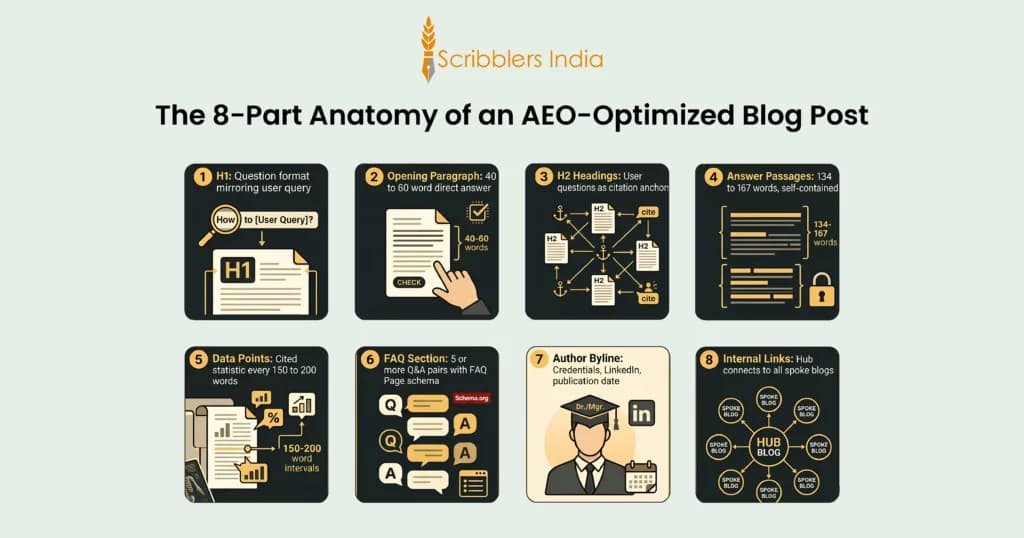
AEO content optimization should improve information quality without forcing every page into the same formula. Direct answers can help when users need a clear response quickly, but fixed requirements such as 40-word answers or 150-word passages have no reliable basis as universal AI-search rules.
Google’s 2026 guidance explicitly challenges similar assumptions. It says there is no requirement to “chunk” content into tiny pieces for AI systems. Google also states that there is no ideal page length and recommends writing for audiences rather than creating a special AI-oriented version of the page.
The same principle applies to headings. Questions work naturally for definitions, comparisons, objections, and practical problems. Descriptive headings often work better for frameworks, models, stages, or named processes. AEO should improve comprehension rather than make every page resemble the same generated template.
Content quality also needs differentiation. Generic summaries add little when dozens of pages repeat the same information. Firsthand examples, current sources, original data, expert interpretation, and useful limitations can provide additional information that readers cannot obtain from other comparable articles.
Which Technical Requirements Actually Matter for AEO?
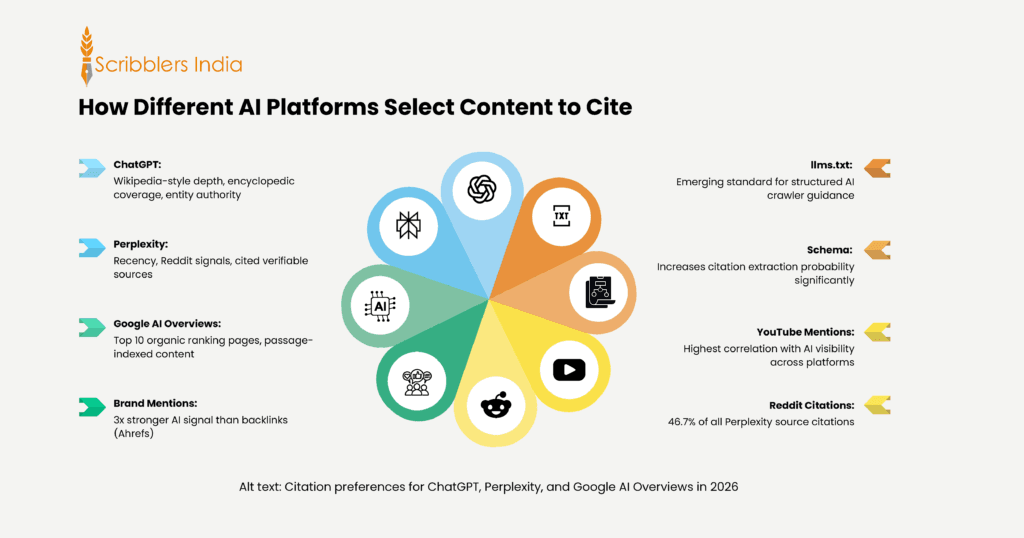
Technical AEO should focus on accessibility and accurate, machine-readable information rather than on special markup created solely because it sounds AI-specific. Google says there are no additional technical requirements for AI Overviews or AI Mode beyond normal Search eligibility.
Here is what the key technical considerations for AEO strategy for businesses look like:
| Technical Area | What to Check |
| Google eligibility | Page is crawlable, indexed, and snippet-eligible |
| Internal discovery | Important pages can be reached through contextual links |
| Structured data | Markup accurately matches visible page information |
| Rendering | Important content remains available after rendering |
| ChatGPT Search | OAI-SearchBot access reflects desired search visibility |
| llms.txt | Do not treat it as a Google visibility requirement |
| Robots controls | Different crawler permissions reflect business policies |
| Snippet controls | nosnippet and related directives match intended exposure |
Google specifically says that sites do not need special AI files, new machine-readable markup, or dedicated schema for AI Overviews and AI Mode. It also clarified in June 2026 that llms.txt neither improves nor harms visibility in Google Search.
OpenAI separately advises publishers who want their pages eligible for ChatGPT Search discovery not to block OAI-SearchBot. OpenAI also distinguishes that search crawler from GPTBot, which relates to potential model training.
These differences are crucial. Technical access should follow each company’s publishing and AI policies rather than a blanket policy allowing every crawler.
How Does Better Evidence Improve Answer Readiness?
Evidence makes important claims easier to trust and verify. A source link does not automatically improve quality, however. The information should support the claim, remain current enough for the subject, and contribute something more useful than decorative citation volume.
Here are four crucial evidence types that require particular attention in an AEO strategy for businesses:
- Primary sources reduce the risk of interpretation: Regulations, official product documentation, platform guidance, government data, and original research should support important factual claims where available. Secondary commentary can add interpretation, but it should not replace the original evidence when the source remains accessible.
- Firsthand examples demonstrate applied expertise: Real decisions, implementations, experiments, cases, or observed outcomes can provide information that competing summaries cannot easily reproduce. Confidential details can be removed while preserving the professional insight behind the example.
- Named expert perspectives add useful judgment: Complex decisions often require interpretation rather than another collection of facts. Relevant subject-matter experts can explain trade-offs, uncertainty, implementation challenges, or circumstances in which common advice may not apply cleanly.
- Limitations improve credibility: Useful content explains when a recommendation does not apply. Showing boundaries helps readers make better decisions and prevents the page from sounding as though one approach will work equally well for every organization.
How Should Internal Linking Support Answer Engine Optimization?
Internal linking should help readers move from a concise answer into the supporting information needed for a deeper decision. That makes links part of the information architecture rather than an SEO quota added after the page is finished.
A general AEO article, for example, does not need to reproduce an entire explanation of external AI-source ecosystems. When that question becomes relevant, readers can continue into Generative Engine Optimization services for deeper coverage of prompt visibility, source gaps, representation, and wider generative discovery.
The same principle should guide the relationships among glossary, blog, framework, and service. A glossary defines a concept. A strategy guide explains implementation. A service page explains commercial delivery. These assets can support a single topic without competing to address the same search intent.
Strong internal architecture therefore depends on distinct page ownership. Linking becomes more useful when the destination genuinely extends the current discussion rather than sending readers to another page containing nearly the same information.
How Should an AEO Strategy for Businesses Measure Results?
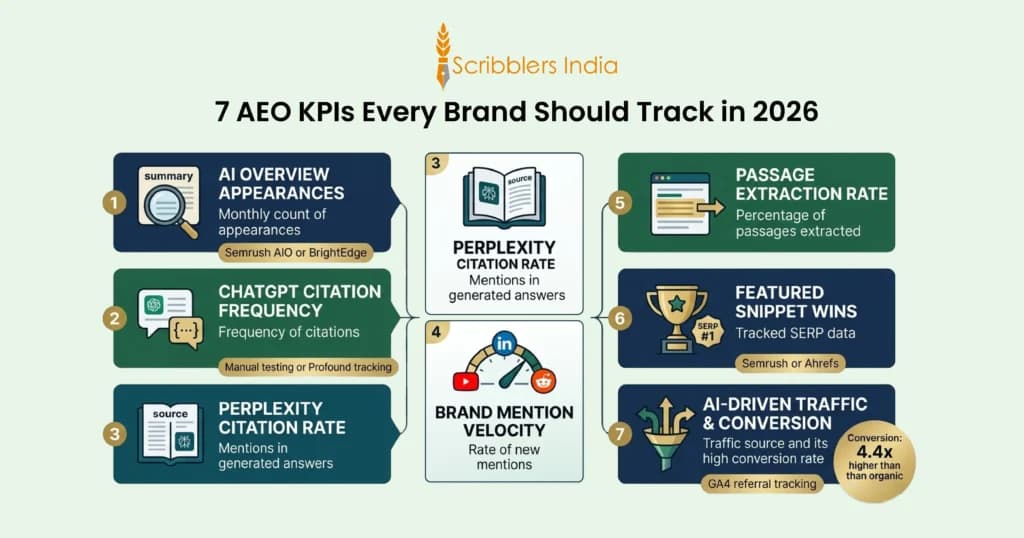
An AEO strategy for businesses should repeatedly measure key questions rather than treat a single favorable result as proof of success. Answers and citations can vary by platform, prompt wording, time, model behavior, user context, and the sources retrieved for a particular response.
Here is what an actual measurement framework should look like:
| Metric | What It Shows | Important Limitation |
| Answer visibility | Whether the brand appears | Presence can change between observations |
| Citation frequency | How often sources receive attribution | Platforms cite differently |
| Cited URLs | Which assets receive visibility | URL changes do not always mean brand loss |
| Brand mentions | Visibility without direct citation | Mention context still matters |
| Competitor presence | Relative representation | Prompt selection affects the comparison |
| Search performance | Changes in Google discovery | AI visibility needs separate interpretation |
| AI referrals | Visits from identifiable AI sources | Much AI exposure remains clickless |
| Conversions | Downstream business impact | Attribution may involve several touchpoints |
Google now provides a Generative AI performance report in Search Console for relevant generative Search and Discover visibility. Google still recommends combining Search Console data with broader analytics and conversion metrics rather than relying on a single AI metric in isolation.
For broader diagnosis, the AI Search Visibility Scorecard can help teams assess entity clarity, content depth, answer readiness, external validation, and conversion infrastructure together.
When Do AEO Services in India Make Sense?
AEO services in India become useful when a business has identified meaningful answer-visibility opportunities but lacks the research, editorial, technical, or measurement capacity to address them consistently. External support should solve known execution gaps rather than introduce another service before the underlying problem is understood.
The following situations justify specialist support:
- A large content estate needs prioritization: Hundreds of pages may contain useful information while answering current buyer questions poorly. An external team can identify the most commercially relevant opportunities, separate refreshes from genuine content gaps, and prevent unnecessary new pages from creating further overlap.
- Internal teams lack repeatable measurement: SEO and content teams may already produce strong work but have no process for tracking prompts, mentions, citations, cited URLs, or competitor visibility. Specialist support can build the measurement layer without replacing established internal expertise.
- Complex content requires deeper editorial work: Financial, technical, legal, enterprise, or regulatory topics often demand more thorough research and expert review. Automated rewriting cannot create first-hand knowledge or resolve weak evidence where the source material itself remains incomplete.
- Several teams need to be coordinated for execution: Answer optimization can involve writers, SEO specialists, developers, analysts, subject-matter experts, and commercial stakeholders. External support is useful when no one owns the entire process, from question research through implementation and measurement.
A strong AEO strategy for businesses should therefore identify the capability gap before deciding what to outsource. Companies reaching that stage can evaluate specialist AEO services in India against the problems documented during the audit.
Teams comparing external support can also review AEO pricing in India to distinguish focused audits from wider implementation and measurement programs.
What Should You Ask an AEO Agency Before Hiring It?
An AEO agency should explain the work it controls without pretending to control answer engines. Buyers need to understand how questions are researched, which pages change, who performs the work, and how visibility gets measured before discussing citation targets.
Five questions can reveal whether the operating model is credible:
- How do you prioritize questions beyond search volume? The provider should connect prompt research with customer needs, buying stages, and commercial relevance.
- What changes on an optimized page? Strong work may involve rewriting, research, evidence, examples, tables, technical fixes, or internal relationships.
- How does this differ from our existing SEO work? The provider should identify genuinely additional responsibilities rather than rebundling current deliverables.
- What gets measured repeatedly after implementation? Ask about prompts, platforms, citations, mentions, competitors, URLs, and the conditions used for comparisons.
- Which outcomes do you explicitly refuse to guarantee? No agency controls whether a specific AI or search system selects a particular source.
A credible answer engine optimization strategy should make those boundaries clear before a contract begins.
How Does Scribblers India Build an AEO Strategy for Businesses?
Scribblers India builds an AEO strategy for businesses based on confirmed information and visibility gaps, rather than on universal formatting rules. We connect audience-question research with existing content, source quality, technical accessibility, and repeated measurement, so that recommendations address an identifiable problem rather than another optimization checklist.
Here is how we develop AEO strategy for your business:
- Map questions against real decisions: Buyer questions are grouped around discovery, evaluation, objections, implementation, and other relevant stages. Existing search and AI visibility is then reviewed so priorities reflect commercial value rather than prompt volume alone.
- Improve valuable existing pages first: Pages with useful authority or search equity are assessed before new URLs are proposed. Updates may strengthen answers, evidence, examples, comparisons, freshness, or relationships with supporting content while preserving what already performs well.
- Create content only for genuine gaps: New glossaries, comparison resources, case studies, reports, or guides are recommended when current assets cannot adequately serve a distinct information need. This reduces cannibalization while giving each page a clearer role.
- Connect search with broader AI discovery: Technical accessibility, conventional search visibility, answer readiness, and external-source coverage are considered together. The process does not assume that schema, FAQs, or question-led headings can generate citations on their own.
- Measure before expanding the program: A controlled set of questions establishes the baseline. Later reviews compare mentions, citations, source selection, competitor presence, search performance, referrals, and useful business signals before prioritizing further work.
This approach keeps AEO services in India connected with useful content and search strategy rather than positioning AEO as another volume-based content product. Get in touch with our team today to build an AEO program around real buyer questions, stronger evidence, and measurable answer visibility.
Frequently Asked Questions
What Is an AEO Strategy for Businesses?
An AEO strategy for businesses identifies valuable audience questions, maps them to relevant pages, improves answer quality, strengthens evidence, maintains technical accessibility, and repeatedly measures visibility. It builds on strong SEO and content foundations rather than treating answer optimization as a separate set of formatting tricks.
When Should a Company Hire AEO Services in India?
Companies should consider AEO services in India when internal teams lack enough capacity for question research, content audits, editorial improvements, technical coordination, or recurring visibility measurement. External support is most useful once the business understands which gaps need to be solved, rather than buying AEO as an undefined service.
Does Every AEO Section Need a Short Direct Answer?
No. Direct answers work well when readers need an immediate response, but there is no universal word-count requirement. Some definitions can remain concise, while comparisons or technical questions need more explanation. Structure should follow the information need rather than an arbitrary extraction formula.
Does Google Require Special AEO Schema?
No. Google says there is no special schema.org markup required for AI Overviews or AI Mode. Existing structured data should accurately reflect visible page content. Normal Search accessibility and eligibility remain more important than creating an AI-specific markup layer.
Do FAQs Still Help With AEO?
FAQs remain useful when they answer genuine reader questions that are not adequately covered elsewhere. However, they should not be added simply to obtain FAQ rich results. Google removed documentation for the FAQ rich-results feature in June 2026 after it stopped appearing in Search.
Can an Internal SEO or Content Team Manage AEO?
Yes. Internal teams can manage AEO when they understand customer questions, can substantively improve content, have technical support, and maintain consistent measurement. Specialist help becomes more useful when content scale, research depth, implementation capacity, or cross-team coordination becomes the limiting factor.
Can AEO Services Guarantee AI Citations?
No. Agencies can improve the usefulness, accessibility, evidence, structure, and source coverage of content, but they cannot control which pages an AI or search system chooses. Any provider promising guaranteed citations should explain which part of that outcome it genuinely controls.
Should Businesses Use AEO and GEO Together?
They can complement each other when different gaps exist. AEO primarily improves how owned content serves important questions. GEO examines wider generative visibility, source ecosystems, competitive representation, and external authority. Businesses should add each discipline when evidence shows a corresponding need rather than automatically bundling both.