
Aeo Strategy Posts
How Improved AI Visibility for Personal Brands Strengthens Founder’s Authority?
Buyers no longer wait until a sales call to research founders. They ask ChatGPT for opinions, check LinkedIn feeds, and read AI Overviews before opening the vendor’s website. This shift means AI visibility for personal brands now sits at the heart of every founder-led growth program. Founders who stay invisible across AI systems lose influence before conversations begin. The problem cuts across categories, from B2B SaaS to consulting and professional services. Buyers form opinions inside AI answers, and those opinions shape shortlists. This blog explains what AI visibility for personal brands means for founders and executives, how it works across major platforms, and how founders can build a program that supports long-term authority. Every section connects strategy to specific actions your team can start this quarter. Key Takeaways: AI systems increasingly influence how buyers discover and evaluate founders online. Clear entity signals connect names, roles, expertise, and supporting evidence. Consistent publishing builds stronger topic associations across generative search platforms. LinkedIn content supports discovery when profiles reinforce clear professional authority. Original frameworks give AI systems useful material beyond generic summaries. Third-party mentions strengthen credibility across recommendations and generated professional answers. Owned websites provide deeper context than social profiles alone can. Inconsistent biographies can confuse platforms and weaken professional entity recognition. Prompt testing reveals missing topics, weak sources, competing experts, and inaccurate descriptions. Ghostwriting helps busy founders publish consistently without losing authentic perspective. What is AI Visibility for Personal Brands? AI visibility for personal brands measures how often a founder appears within AI-generated answers across professional queries. It covers mentions, citations, description accuracy, and share of voice against category peers. It also reveals whether platforms associate the founder with the right expertise and business context. The concept extends personal branding into a new discovery layer. Traditional personal branding focused heavily on LinkedIn reach and speaking visibility. AI visibility adds another question: how do ChatGPT, Perplexity, Gemini, and Google AI Overviews describe the founder during buyer research? Accurate visibility depends on entity clarity across the public web. AI systems need reliable evidence linking a founder with their category, company, professional role, and expertise. Consistent biographies, author pages, expert bylines, and regular public content help platforms build that picture. Weak signals may produce inaccurate answers or complete omission. Building those signals requires a connected strategy rather than isolated profile updates. Professional personal branding services help founders align their positioning, profiles, thought leadership, owned content, and external authority signals. This creates a clearer professional identity across search engines and AI-led discovery platforms. What is the Importance of AI Visibility for Personal Brands? AI visibility for personal brands is crucial, as buyers now use AI systems to conduct early founder research across the category. Absent founders lose influence during the earliest, most impressionable stages of the buyer journey. The evidence keeps building across major platforms. OpenAI reported more than 900 million weekly ChatGPT users in March 2026, with search usage nearly tripling across the previous year. Google AI Mode also crossed one billion monthly users by May 2026. Professional platforms now feed AI answers at meaningful scale. Recent Profound data, covered by Axios, showed that LinkedIn citations in ChatGPT responses had doubled since November 2025 for professional queries. This trend confirms that AI systems increasingly pull founder content into vendor research answers. The commercial implication runs deep. When a buyer asks ChatGPT to compare vendors, the AI answer often names founders alongside companies. When a buyer asks Perplexity about a category expert, the answer often cites LinkedIn profiles and published articles. Founders’ absence from these answers hands influence to competitors during the shortlisting stage. How Do AI Systems Discover and Cite Personal Brands? AI systems discover personal brands through training data patterns, live retrieval, entity signals, and third-party validation. Each pathway shapes how often a founder appears inside answers across generative platforms. Training data feeds foundational model behavior. AI systems learn from web content across large datasets during model training cycles. Founders with steady mentions across trusted sources appear more often in category prompts. Consistent messaging across the web strengthens this pattern over time. Live retrieval covers current information across recent pages. ChatGPT Search, Perplexity, and Google AI Mode retrieve information from indexed sources when generating answers. Well-structured LinkedIn articles, expert bylines, and interviews with clear positioning earn retrieval priority across professional queries. Entity signals help platforms connect that evidence with the correct person. Consistent biographies across LinkedIn, personal websites, speaker pages, and company profiles reduce ambiguity. Clear author pages, contextual internal links, and suitable schema markup further explain how the founder, organization, expertise, and published content relate. Independent validation strengthens this information trail by confirming expertise beyond self-published claims. Industry articles, podcast appearances, event profiles, and expert contributions provide additional context during professional research. A comprehensive thought leadership content strategy helps founders build credible external and owned signals through a single, connected authority program. Which Signals Strengthen AI Visibility for Personal Brands? Four signal categories shape AI discovery for personal brands across every generative platform. Founders who address each category build steady visibility gains over time. Consistent entity signals: Aligned bios across LinkedIn, personal websites, About pages, and speaker profiles reduce ambiguity across AI systems. This clarity helps ChatGPT and Perplexity describe the founder accurately across category prompts. Original expert content: LinkedIn articles, blog posts, and bylined pieces with distinct frameworks give AI systems attributable expertise signals. Generic commentary offers no such distinction across the wider category. External authority coverage: Industry publications, podcast appearances, and expert roundups strengthen credibility in response to professional queries. AI systems often prioritize third-party validation over founder-owned content when generating answers. Structured, extractable formatting: Question-led headings, direct answers, and clear definitions inside founder content improve extraction odds across AI Overviews. Well-formatted articles feed clean text chunks into generative answers. Founders who address these four signals together see stronger visibility gains than those working across a single channel. Scattered efforts across single signals produce scattered results across AI platforms over time. How Is AI Visibility Different from Traditional
Buyers no longer wait until a sales call to research founders. They ask ChatGPT for opinions, check LinkedIn feeds, and read AI Overviews before opening the vendor’s website. This shift means AI visibility for personal brands now sits at the heart of every founder-led growth program. Founders who stay invisible across AI systems lose influence before conversations begin. The problem cuts across categories, from B2B SaaS to consulting and professional services. Buyers form opinions inside AI answers, and those opinions shape shortlists. This blog explains what AI visibility for personal brands means for founders and executives, how it works across major platforms, and how founders can build a program that supports long-term authority. Every section connects strategy to specific actions your team can start this quarter. Key Takeaways: AI systems increasingly influence how buyers discover and evaluate founders online. Clear entity signals connect names, roles, expertise, and supporting evidence. Consistent publishing builds stronger topic associations across generative search platforms. LinkedIn content supports discovery when profiles reinforce clear professional authority. Original frameworks give AI systems useful material beyond generic summaries. Third-party mentions strengthen credibility across recommendations and generated professional answers. Owned websites provide deeper context than social profiles alone can. Inconsistent biographies can confuse platforms and weaken professional entity recognition. Prompt testing reveals missing topics, weak sources, competing experts, and inaccurate descriptions. Ghostwriting helps busy founders publish consistently without losing authentic perspective. What is AI Visibility for Personal Brands? AI visibility for personal brands measures how often a founder appears within AI-generated answers across professional queries. It covers mentions, citations, description accuracy, and share of voice against category peers. It also reveals whether platforms associate the founder with the right expertise and business context. The concept extends personal branding into a new discovery layer. Traditional personal branding focused heavily on LinkedIn reach and speaking visibility. AI visibility adds another question: how do ChatGPT, Perplexity, Gemini, and Google AI Overviews describe the founder during buyer research? Accurate visibility depends on entity clarity across the public web. AI systems need reliable evidence linking a founder with their category, company, professional role, and expertise. Consistent biographies, author pages, expert bylines, and regular public content help platforms build that picture. Weak signals may produce inaccurate answers or complete omission. Building those signals requires a connected strategy rather than isolated profile updates. Professional personal branding services help founders align their positioning, profiles, thought leadership, owned content, and external authority signals. This creates a clearer professional identity across search engines and AI-led discovery platforms. What is the Importance of AI Visibility for Personal Brands? AI visibility for personal brands is crucial, as buyers now use AI systems to conduct early founder research across the category. Absent founders lose influence during the earliest, most impressionable stages of the buyer journey. The evidence keeps building across major platforms. OpenAI reported more than 900 million weekly ChatGPT users in March 2026, with search usage nearly tripling across the previous year. Google AI Mode also crossed one billion monthly users by May 2026. Professional platforms now feed AI answers at meaningful scale. Recent Profound data, covered by Axios, showed that LinkedIn citations in ChatGPT responses had doubled since November 2025 for professional queries. This trend confirms that AI systems increasingly pull founder content into vendor research answers. The commercial implication runs deep. When a buyer asks ChatGPT to compare vendors, the AI answer often names founders alongside companies. When a buyer asks Perplexity about a category expert, the answer often cites LinkedIn profiles and published articles. Founders’ absence from these answers hands influence to competitors during the shortlisting stage. How Do AI Systems Discover and Cite Personal Brands? AI systems discover personal brands through training data patterns, live retrieval, entity signals, and third-party validation. Each pathway shapes how often a founder appears inside answers across generative platforms. Training data feeds foundational model behavior. AI systems learn from web content across large datasets during model training cycles. Founders with steady mentions across trusted sources appear more often in category prompts. Consistent messaging across the web strengthens this pattern over time. Live retrieval covers current information across recent pages. ChatGPT Search, Perplexity, and Google AI Mode retrieve information from indexed sources when generating answers. Well-structured LinkedIn articles, expert bylines, and interviews with clear positioning earn retrieval priority across professional queries. Entity signals help platforms connect that evidence with the correct person. Consistent biographies across LinkedIn, personal websites, speaker pages, and company profiles reduce ambiguity. Clear author pages, contextual internal links, and suitable schema markup further explain how the founder, organization, expertise, and published content relate. Independent validation strengthens this information trail by confirming expertise beyond self-published claims. Industry articles, podcast appearances, event profiles, and expert contributions provide additional context during professional research. A comprehensive thought leadership content strategy helps founders build credible external and owned signals through a single, connected authority program. Which Signals Strengthen AI Visibility for Personal Brands? Four signal categories shape AI discovery for personal brands across every generative platform. Founders who address each category build steady visibility gains over time. Consistent entity signals: Aligned bios across LinkedIn, personal websites, About pages, and speaker profiles reduce ambiguity across AI systems. This clarity helps ChatGPT and Perplexity describe the founder accurately across category prompts. Original expert content: LinkedIn articles, blog posts, and bylined pieces with distinct frameworks give AI systems attributable expertise signals. Generic commentary offers no such distinction across the wider category. External authority coverage: Industry publications, podcast appearances, and expert roundups strengthen credibility in response to professional queries. AI systems often prioritize third-party validation over founder-owned content when generating answers. Structured, extractable formatting: Question-led headings, direct answers, and clear definitions inside founder content improve extraction odds across AI Overviews. Well-formatted articles feed clean text chunks into generative answers. Founders who address these four signals together see stronger visibility gains than those working across a single channel. Scattered efforts across single signals produce scattered results across AI platforms over time. How Is AI Visibility Different from Traditional
10 AI Search Trends Driving Brand Visibility in 2026 and 2027
AI search trends now shape how buyers discover categories, compare providers, assess credibility, and shortlist brands. Visibility no longer starts or ends with ranked links. AI systems can influence perception before a website receives a visit, shaping branded searches, consideration, and later conversion paths. This makes early visibility commercially meaningful, even before measurable traffic appears. That shift does not make SEO less important. Technical accessibility, useful pages, internal linking, and clear positioning still provide the foundation for discoverability. However, rankings alone cannot reveal whether ChatGPT recommends a brand, whether Google cites its content, or whether AI systems describe its services accurately across different buyer questions and decision stages. This guide examines observed developments in 2026 alongside 10 evidence-based projections for 2027. It explains what each trend means for B2B brands, founders, content teams, and marketing leaders. It also shows how stronger AI search visibility can translate changing search behavior into a practical roadmap for content, measurement, authority building, and brand growth. Key Takeaways AI search increasingly shapes brand discovery before buyers visit websites or begin branded searches. SEO remains foundational, but rankings alone cannot measure AI mentions, citations, or accuracy. AI Overviews now influence informational, commercial, comparison, navigational, and product research journeys. ChatGPT visibility requires tracking mentions, recommendation positions, competitors, citations, and description accuracy. SEO, AEO, GEO, and brand strategy increasingly operate as one visibility program. Founder expertise, third-party validation, and original research strengthen AI credibility and differentiation. AI search volatility demands recurring monitoring across prompts, platforms, geographies, models, and citations. Indian brands should prepare for longer prompts, voice, images, and regional-language discovery. Brands need phased roadmaps combining audits, answer-ready content, authority building, and recurring measurement. #1: AI Search Trends Are Reshaping Brand Discovery AI search is becoming a discovery layer because users ask systems to explain categories and identify options. They also compare providers, assess trade-offs, review evidence, and request recommendations. A brand can enter or miss the shortlist before a website visit. AI search visibility therefore includes influence without an immediate click. Prompt-led category research: Buyers can explore an unfamiliar market through one detailed question. AI systems combine definitions, provider types, evaluation criteria, use cases, and risks. Brands need content that addresses the full research need rather than a single isolated keyword. Provider comparison before website visits: AI Mode surpassed one billion monthly users and queries more than doubled every quarter after launch. Follow-up questions let users compare providers without restarting research or opening several result pages. AI-first product discovery: 35% of US consumers started product discovery with an AI tool. Only 13.6% began with traditional search. This shift can influence the initial shortlist before branded research begins. Influence beyond referral traffic: An AI answer may name a brand without sending a visit. That mention can shape awareness, credibility, sales conversations, and later branded searches. Traffic therefore measures only one part of AI-led discovery. 2027 projection: As per AI search trends for 2027, AI-led shortlisting will likely become a standard measurement area for categories with complex research cycles. Marketing teams may track which brands appear, how often they are recommended, and which sources support those recommendations. This view will help connect early discovery influence with later commercial outcomes across the funnel. #2: AI Overviews Are Expanding Beyond Informational Searches AI Overviews increasingly appear for instructional, commercial, comparison, and navigational searches. This creates more opportunities for useful content to surface. It also increases the chance that Google answers part of the query before users open a result. The shift changes which pages influence later evaluation. Query type Likely AI behavior Content opportunity Recommended format Informational Summarizes a concept Provide an extractable definition Definition with examples Instructional Builds a process Explain stages and decisions Step-by-step guide Comparison Contrasts options Clarify real selection factors Comparison table Commercial Supports evaluation Explain fit, limits, proof, and pricing Buyer guide Navigational Explains an entity Clarify brand or product details Strong entity page Product research Combines evidence Address use cases and risks Evidence-led review AI Overviews appeared for 6.49% of tracked keywords in January 2025 and reached nearly 25% by July. This growth shows why brands should strengthen content for AI Overviews while measuring citations and clicks separately. 2027 projection: As per AI search trends for 2027, AI Overviews will likely appear across more comparison and decision-stage searches. Their expansion will remain uneven because activation varies across query types, industries, devices, and user intent. Marketing teams should monitor where summaries appear, which pages earn citations, and how those placements influence later visits and conversions. #3: ChatGPT Visibility Is Becoming a Core Brand Metric ChatGPT influences research, recommendations, category education, and vendor discovery at mainstream scale. Marketing teams need to know whether their brand appears and which competitors receive recommendations. They should also verify sources and descriptions. Referral traffic cannot answer those questions alone. Brands need a dedicated view of visibility and accuracy. Metric What it reveals Review cycle Recommended action Mention frequency How often the brand appears Monthly Strengthen missing topics AI share of voice Visibility against competitors Monthly Build distinct authority Recommendation position Placement within answers Monthly Improve category relevance Cited domains Sources shaping answers Monthly Strengthen source ecosystems Description accuracy How ChatGPT explains the brand Monthly Clarify entity messaging Competitor inclusion Brands appearing nearby Monthly Review competitor signals Prompt coverage Questions containing the brand Quarterly Fill content gaps Referral quality Value of generated visits Monthly Improve landing pages ChatGPT reached more than 900 million weekly users by March 2026. Use a fixed prompt set within a ChatGPT visibility strategy and repeat tests across dates and sessions. A few manual searches cannot prove lasting visibility. 2027 projection: By 2027, AI share of voice will likely become a standard metric for complex buying journeys. Teams may track recommendation frequency, competitor presence, citation sources, and answer accuracy across repeat prompts. This view can connect early brand influence with later searches, qualified visits, sales conversations, and revenue outcomes. #4: AI Search Trends Are Bringing SEO, AEO, GEO, and Brand Strategy Together
AI search trends now shape how buyers discover categories, compare providers, assess credibility, and shortlist brands. Visibility no longer starts or ends with ranked links. AI systems can influence perception before a website receives a visit, shaping branded searches, consideration, and later conversion paths. This makes early visibility commercially meaningful, even before measurable traffic appears. That shift does not make SEO less important. Technical accessibility, useful pages, internal linking, and clear positioning still provide the foundation for discoverability. However, rankings alone cannot reveal whether ChatGPT recommends a brand, whether Google cites its content, or whether AI systems describe its services accurately across different buyer questions and decision stages. This guide examines observed developments in 2026 alongside 10 evidence-based projections for 2027. It explains what each trend means for B2B brands, founders, content teams, and marketing leaders. It also shows how stronger AI search visibility can translate changing search behavior into a practical roadmap for content, measurement, authority building, and brand growth. Key Takeaways AI search increasingly shapes brand discovery before buyers visit websites or begin branded searches. SEO remains foundational, but rankings alone cannot measure AI mentions, citations, or accuracy. AI Overviews now influence informational, commercial, comparison, navigational, and product research journeys. ChatGPT visibility requires tracking mentions, recommendation positions, competitors, citations, and description accuracy. SEO, AEO, GEO, and brand strategy increasingly operate as one visibility program. Founder expertise, third-party validation, and original research strengthen AI credibility and differentiation. AI search volatility demands recurring monitoring across prompts, platforms, geographies, models, and citations. Indian brands should prepare for longer prompts, voice, images, and regional-language discovery. Brands need phased roadmaps combining audits, answer-ready content, authority building, and recurring measurement. #1: AI Search Trends Are Reshaping Brand Discovery AI search is becoming a discovery layer because users ask systems to explain categories and identify options. They also compare providers, assess trade-offs, review evidence, and request recommendations. A brand can enter or miss the shortlist before a website visit. AI search visibility therefore includes influence without an immediate click. Prompt-led category research: Buyers can explore an unfamiliar market through one detailed question. AI systems combine definitions, provider types, evaluation criteria, use cases, and risks. Brands need content that addresses the full research need rather than a single isolated keyword. Provider comparison before website visits: AI Mode surpassed one billion monthly users and queries more than doubled every quarter after launch. Follow-up questions let users compare providers without restarting research or opening several result pages. AI-first product discovery: 35% of US consumers started product discovery with an AI tool. Only 13.6% began with traditional search. This shift can influence the initial shortlist before branded research begins. Influence beyond referral traffic: An AI answer may name a brand without sending a visit. That mention can shape awareness, credibility, sales conversations, and later branded searches. Traffic therefore measures only one part of AI-led discovery. 2027 projection: As per AI search trends for 2027, AI-led shortlisting will likely become a standard measurement area for categories with complex research cycles. Marketing teams may track which brands appear, how often they are recommended, and which sources support those recommendations. This view will help connect early discovery influence with later commercial outcomes across the funnel. #2: AI Overviews Are Expanding Beyond Informational Searches AI Overviews increasingly appear for instructional, commercial, comparison, and navigational searches. This creates more opportunities for useful content to surface. It also increases the chance that Google answers part of the query before users open a result. The shift changes which pages influence later evaluation. Query type Likely AI behavior Content opportunity Recommended format Informational Summarizes a concept Provide an extractable definition Definition with examples Instructional Builds a process Explain stages and decisions Step-by-step guide Comparison Contrasts options Clarify real selection factors Comparison table Commercial Supports evaluation Explain fit, limits, proof, and pricing Buyer guide Navigational Explains an entity Clarify brand or product details Strong entity page Product research Combines evidence Address use cases and risks Evidence-led review AI Overviews appeared for 6.49% of tracked keywords in January 2025 and reached nearly 25% by July. This growth shows why brands should strengthen content for AI Overviews while measuring citations and clicks separately. 2027 projection: As per AI search trends for 2027, AI Overviews will likely appear across more comparison and decision-stage searches. Their expansion will remain uneven because activation varies across query types, industries, devices, and user intent. Marketing teams should monitor where summaries appear, which pages earn citations, and how those placements influence later visits and conversions. #3: ChatGPT Visibility Is Becoming a Core Brand Metric ChatGPT influences research, recommendations, category education, and vendor discovery at mainstream scale. Marketing teams need to know whether their brand appears and which competitors receive recommendations. They should also verify sources and descriptions. Referral traffic cannot answer those questions alone. Brands need a dedicated view of visibility and accuracy. Metric What it reveals Review cycle Recommended action Mention frequency How often the brand appears Monthly Strengthen missing topics AI share of voice Visibility against competitors Monthly Build distinct authority Recommendation position Placement within answers Monthly Improve category relevance Cited domains Sources shaping answers Monthly Strengthen source ecosystems Description accuracy How ChatGPT explains the brand Monthly Clarify entity messaging Competitor inclusion Brands appearing nearby Monthly Review competitor signals Prompt coverage Questions containing the brand Quarterly Fill content gaps Referral quality Value of generated visits Monthly Improve landing pages ChatGPT reached more than 900 million weekly users by March 2026. Use a fixed prompt set within a ChatGPT visibility strategy and repeat tests across dates and sessions. A few manual searches cannot prove lasting visibility. 2027 projection: By 2027, AI share of voice will likely become a standard metric for complex buying journeys. Teams may track recommendation frequency, competitor presence, citation sources, and answer accuracy across repeat prompts. This view can connect early brand influence with later searches, qualified visits, sales conversations, and revenue outcomes. #4: AI Search Trends Are Bringing SEO, AEO, GEO, and Brand Strategy Together
80+ AI Search Stats for a Smarter AEO and GEO Strategy
AI search stats now influence decisions beyond SEO teams. Marketing leaders use this data to evaluate discovery, traffic quality, brand visibility, and content investment. They also need evidence before shifting budgets toward optimization, reporting tools, or authority-building campaigns. However, AI search data changes quickly. A current platform announcement may conflict with an older independent study. Reports may measure users, visits, searches, sessions, or citations differently. Without context, impressive numbers can produce weak forecasts, misplaced priorities, and misleading targets. This guide brings together 80+ verified data points across Google Search, ChatGPT, Gemini, Perplexity, Claude, and Microsoft Copilot. Each section explains what the numbers mean for marketers. It also shows when brands should respond and how they should measure progress. Key Takeaways AI search now reaches mainstream audiences, making answer visibility a board-level content priority for brands. Google AI Overviews are reshaping discovery by changing how users evaluate answers before clicking websites. ChatGPT referrals may carry stronger intent because users often arrive after focused, conversational research journeys. Traditional rankings do not guarantee generative citations because AI systems select sources differently across prompts. Question-led queries trigger AI summaries more often, making direct answers critical for AEO-ready content. Indian users are adopting AI-enabled discovery quickly, creating new visibility pressure for domestic brands. Brands need recurring mention and citation tracking to separate temporary movement from durable AI visibility. Original expertise strengthens AI visibility signals by giving answer engines clearer evidence to cite. How Were These AI Search Stats Selected and Fact-Checked? We collected these AI search stats through a structured research and verification process. Our priority was recent evidence with clear sources, dates, sample details, and collection periods. Official platform announcements and earnings reports helped us assess adoption, feature reach, usage, and geographic availability. To balance those disclosures, we reviewed academic papers, analytics datasets, institutional surveys, and recognized industry research. These sources helped us examine search behavior, referral traffic, citation patterns, click activity, and commercial outcomes. Each source was assessed within its stated methodology, timeframe, and scope. The next step was separating metrics that appear similar but measure different things. Weekly users differ from monthly users. Website visits cannot represent app usage. Queries, sessions, accounts, and people also describe distinct behaviors. We checked every publication date against the actual data collection period behind it. Finally, we prioritized evidence from 2025 and 2026. Older figures were included only when they showed meaningful change over time. Where credible sources reported different outcomes, we preserved the context rather than forcing a single conclusion. This method helped us separate platform scale, observed behavior, measured outcomes, and forward-looking projections for readers. What Do Global AI Search Adoption Stats Reveal About User Behavior? AI-search discovery is moving beyond early experimentation. Large audiences now use conversational systems for research, guidance, comparisons, planning, and everyday questions. Adoption still varies by age, income, location, and task. Brands therefore need audience-specific conclusions rather than one global assumption. ChatGPT exceeded 900 million weekly active users by March 2026. (OpenAI, 2026) OpenAI reported more than 50 million consumer subscribers to ChatGPT. (OpenAI, 2026) ChatGPT generated 6 times as many monthly web visits and mobile sessions as the next AI application. (OpenAI, 2026) Users spent 4 times as long with ChatGPT as with the next-largest AI application. (OpenAI, 2026) ChatGPT captured 4 times as much user time as all other AI applications combined. (OpenAI, 2026) 34% of American adults had used ChatGPT by mid-2025. (Pew Research Center, 2025) ChatGPT adoption reached 58% among American adults younger than 30. (Pew Research Center, 2025) 57% of American teenagers used chatbots to search for information. (Pew Research Center, 2026) These AI search stats show that AI discovery now reaches broad consumer groups. Brands should map category questions, comparison prompts, and decision-stage concerns within an AI search visibility strategy. Keyword demand still matters, but prompt behavior adds a second layer of audience insight. How Widely Are Google AI Overviews Used in 2026? Google AI Overviews now operate at global scale. Their reach matters because users receive synthesized answers before opening websites. However, monthly reach differs from query activation. Marketers must separate availability, triggering frequency, geography, and click behavior when interpreting AI Overviews stats. AI Overviews reached more than 2.5 billion monthly active users by May 2026. (Google, 2026) Google reported 1.5 billion monthly users of AI Overviews in May 2025. (Google, 2025) AI Overviews reached 2 billion monthly users by July 2025. (Alphabet, 2025) The feature became available across more than 200 countries and territories. (Google, 2025) Google supported AI Overviews in more than 40 languages by May 2025. (Google, 2025) Eligible query types showed more than 10% usage growth within the United States and India. (Google, 2025) A 2026 academic study measured overall AI Overview activation at 13.7%. (Xu, Iqbal, and Montgomery, 2026) Question-form searches triggered AI Overviews at a rate of 64.7%. (Xu, Iqbal, and Montgomery, 2026) Non-question searches triggered them at only 9.5%. (Xu, Iqbal, and Montgomery, 2026) Question phrasing increased activation by 6.8x within the dataset. (Xu, Iqbal, and Montgomery, 2026) These AI search stats show why reach does not guarantee clicks. AI Overviews may reach billions while appearing for only a small share of queries. Visibility changes by topic, wording, location, and intent. Our AI Overviews visibility guide explains how content structure affects inclusion opportunities. What Do Google AI Mode Stats Reveal About Prompt-Led Search? Google AI Mode encourages longer and more complex questions. Users can continue with follow-up prompts without restarting their research. This behavior shifts content planning away from isolated keyword pages. Brands need complete decision journeys with supporting explanations, comparisons, definitions, use cases, and evidence. Let’s have a look at some critical AI search stats to understand the road ahead for AI Mode in 2026 and beyond: AI Mode surpassed 1 billion monthly users within 1 year of launch. (Google, 2026) AI Mode queries more than doubled during every quarter after launch. (Google, 2026) Early Indian users submitted queries that were 2 to 3 times longer than those
AI search stats now influence decisions beyond SEO teams. Marketing leaders use this data to evaluate discovery, traffic quality, brand visibility, and content investment. They also need evidence before shifting budgets toward optimization, reporting tools, or authority-building campaigns. However, AI search data changes quickly. A current platform announcement may conflict with an older independent study. Reports may measure users, visits, searches, sessions, or citations differently. Without context, impressive numbers can produce weak forecasts, misplaced priorities, and misleading targets. This guide brings together 80+ verified data points across Google Search, ChatGPT, Gemini, Perplexity, Claude, and Microsoft Copilot. Each section explains what the numbers mean for marketers. It also shows when brands should respond and how they should measure progress. Key Takeaways AI search now reaches mainstream audiences, making answer visibility a board-level content priority for brands. Google AI Overviews are reshaping discovery by changing how users evaluate answers before clicking websites. ChatGPT referrals may carry stronger intent because users often arrive after focused, conversational research journeys. Traditional rankings do not guarantee generative citations because AI systems select sources differently across prompts. Question-led queries trigger AI summaries more often, making direct answers critical for AEO-ready content. Indian users are adopting AI-enabled discovery quickly, creating new visibility pressure for domestic brands. Brands need recurring mention and citation tracking to separate temporary movement from durable AI visibility. Original expertise strengthens AI visibility signals by giving answer engines clearer evidence to cite. How Were These AI Search Stats Selected and Fact-Checked? We collected these AI search stats through a structured research and verification process. Our priority was recent evidence with clear sources, dates, sample details, and collection periods. Official platform announcements and earnings reports helped us assess adoption, feature reach, usage, and geographic availability. To balance those disclosures, we reviewed academic papers, analytics datasets, institutional surveys, and recognized industry research. These sources helped us examine search behavior, referral traffic, citation patterns, click activity, and commercial outcomes. Each source was assessed within its stated methodology, timeframe, and scope. The next step was separating metrics that appear similar but measure different things. Weekly users differ from monthly users. Website visits cannot represent app usage. Queries, sessions, accounts, and people also describe distinct behaviors. We checked every publication date against the actual data collection period behind it. Finally, we prioritized evidence from 2025 and 2026. Older figures were included only when they showed meaningful change over time. Where credible sources reported different outcomes, we preserved the context rather than forcing a single conclusion. This method helped us separate platform scale, observed behavior, measured outcomes, and forward-looking projections for readers. What Do Global AI Search Adoption Stats Reveal About User Behavior? AI-search discovery is moving beyond early experimentation. Large audiences now use conversational systems for research, guidance, comparisons, planning, and everyday questions. Adoption still varies by age, income, location, and task. Brands therefore need audience-specific conclusions rather than one global assumption. ChatGPT exceeded 900 million weekly active users by March 2026. (OpenAI, 2026) OpenAI reported more than 50 million consumer subscribers to ChatGPT. (OpenAI, 2026) ChatGPT generated 6 times as many monthly web visits and mobile sessions as the next AI application. (OpenAI, 2026) Users spent 4 times as long with ChatGPT as with the next-largest AI application. (OpenAI, 2026) ChatGPT captured 4 times as much user time as all other AI applications combined. (OpenAI, 2026) 34% of American adults had used ChatGPT by mid-2025. (Pew Research Center, 2025) ChatGPT adoption reached 58% among American adults younger than 30. (Pew Research Center, 2025) 57% of American teenagers used chatbots to search for information. (Pew Research Center, 2026) These AI search stats show that AI discovery now reaches broad consumer groups. Brands should map category questions, comparison prompts, and decision-stage concerns within an AI search visibility strategy. Keyword demand still matters, but prompt behavior adds a second layer of audience insight. How Widely Are Google AI Overviews Used in 2026? Google AI Overviews now operate at global scale. Their reach matters because users receive synthesized answers before opening websites. However, monthly reach differs from query activation. Marketers must separate availability, triggering frequency, geography, and click behavior when interpreting AI Overviews stats. AI Overviews reached more than 2.5 billion monthly active users by May 2026. (Google, 2026) Google reported 1.5 billion monthly users of AI Overviews in May 2025. (Google, 2025) AI Overviews reached 2 billion monthly users by July 2025. (Alphabet, 2025) The feature became available across more than 200 countries and territories. (Google, 2025) Google supported AI Overviews in more than 40 languages by May 2025. (Google, 2025) Eligible query types showed more than 10% usage growth within the United States and India. (Google, 2025) A 2026 academic study measured overall AI Overview activation at 13.7%. (Xu, Iqbal, and Montgomery, 2026) Question-form searches triggered AI Overviews at a rate of 64.7%. (Xu, Iqbal, and Montgomery, 2026) Non-question searches triggered them at only 9.5%. (Xu, Iqbal, and Montgomery, 2026) Question phrasing increased activation by 6.8x within the dataset. (Xu, Iqbal, and Montgomery, 2026) These AI search stats show why reach does not guarantee clicks. AI Overviews may reach billions while appearing for only a small share of queries. Visibility changes by topic, wording, location, and intent. Our AI Overviews visibility guide explains how content structure affects inclusion opportunities. What Do Google AI Mode Stats Reveal About Prompt-Led Search? Google AI Mode encourages longer and more complex questions. Users can continue with follow-up prompts without restarting their research. This behavior shifts content planning away from isolated keyword pages. Brands need complete decision journeys with supporting explanations, comparisons, definitions, use cases, and evidence. Let’s have a look at some critical AI search stats to understand the road ahead for AI Mode in 2026 and beyond: AI Mode surpassed 1 billion monthly users within 1 year of launch. (Google, 2026) AI Mode queries more than doubled during every quarter after launch. (Google, 2026) Early Indian users submitted queries that were 2 to 3 times longer than those
How to Create an Effective AEO Strategy for Better AI Search Visibility
An effective AEO strategy helps brands appear inside direct answers, AI summaries, cited sources, and answer-led search experiences. It connects user questions to content that search engines and AI platforms can quickly understand. This approach expands visibility beyond traditional rankings without replacing established SEO foundations. Search behavior now begins with longer questions, comparisons, recommendations, and follow-up prompts. Buyers may evaluate several options before opening a website or contacting a provider. Brands therefore need pages that answer clearly, show credible expertise, and guide readers through each stage of the decision journey. Strong AEO planning combines prompt research, answer-first structure, technical accessibility, original evidence, and consistent authority signals. It also requires repeatable measurement across mentions, citations, answer accuracy, prompt coverage, and referral quality. This article explains how businesses can build an evidence-led system for stronger visibility across Google Search and leading conversational discovery platforms. TL;DR AEO strategy turns buyer questions into answer-ready content. SEO foundations still support every AI search surface. Prompt research should follow complete buyer decision journeys. Original evidence creates stronger citation and trust signals. Technical access determines whether content can be retrieved. AEO and GEO need one connected content system. Performance tracking needs prompt coverage and citation accuracy. Focused quarterly updates outperform random page rewrites. What Is an AEO Strategy and How Does It Work? An AEO strategy is a structured plan to make content easy to discover, understand, extract, and reference within answer-led search experiences. It combines question research with answer-first writing, technical accessibility, source quality, and performance measurement. SEO remains the foundation because answer engines still depend on accessible web content. A comprehensive strategy usually connects five operating areas. Question portfolio: Map buyer questions across category education, problem discovery, comparisons, objections, and implementation needs. This portfolio keeps AEO planning tied to complete research journeys rather than to isolated keywords or high-volume topics lacking clear commercial relevance. Answer architecture: Create direct answer blocks beneath question-led headings, then add evidence, examples, and practical guidance. Each section should remain understandable on its own while contributing to a larger page that supports deeper research and confident decisions. Evidence system: Define which claims need original data, expert input, case evidence, or credible external sources. This prevents vague summaries and gives answer engines clearer material for factual responses, comparisons, recommendations, or procedures across important prompts. Authority network: Connect owned pages with founder expertise, partner contributions, reviews, and relevant external coverage. Consistent information across these surfaces helps answer engines understand the brand, its category, intended audience, and expertise supporting each claim. Measurement loop: Track prompts, mentions, citations, answer accuracy, competitor presence, and referral quality through repeatable reviews. Use confirmed gaps to guide updates, then compare later results against the original baseline rather than relying on isolated screenshots or one-time wins. A strong answer engine optimization strategy therefore functions as a content system. It connects user demand with useful answers, dependable evidence, technical access, and ongoing visibility measurement across every priority topic. Why Do Businesses Need an AEO Strategy in 2026? Businesses need an AEO strategy because answer-led search now influences discovery before a website visit occurs. Buyers can research categories, compare providers, or address objections in a single generated response. Brands need useful content that supports these conversations while preserving strong SEO foundations and accurate public positioning. Google now explicitly recognizes AEO and GEO as terms used for AI search visibility work. However, its guidance states that established SEO practices still support generative search because AI features use core ranking systems, retrieval, and indexed web content. A 2026 study of 55,393 trending queries found AI Overviews appeared for 64.7% of question-form searches. Nearly 30% of cited domains did not appear within the accompanying first-page results, suggesting that citation selection can differ from conventional ranking outcomes. This does not mean businesses should chase every question or platform. The opportunity lies in answering commercially relevant prompts with distinctive evidence and clear positioning. A strong content strategy connects that visibility work with buyer needs and business outcomes. How Should Businesses Research Prompts Before Creating AEO Strategy? Prompt research identifies the real questions buyers ask across education, evaluation, implementation, and purchase decisions. It prevents teams from building AEO content solely around keyword variations. A strong prompt map connects user language with business value, suitable content formats, and measurable visibility goals across each buyer stage. Map the buyer journey: Group questions around problem discovery, category education, comparisons, implementation, objections, and final validation. This framework reveals whether existing content supports the complete journey or concentrates on broad informational demand without helping buyers evaluate available options. Use customer-facing inputs: Review sales calls, support tickets, discovery notes, customer interviews, and proposal discussions. These sources reveal detailed questions that keyword tools may miss, including concerns about costs, implementation effort, expected outcomes, and service suitability. Separate prompt intents: Distinguish definitional questions from comparison, recommendation, troubleshooting, and procedural prompts. Each intent needs a different content response. A definition page cannot replace a balanced comparison, while a service page cannot answer every implementation concern. Study query fan-out: Google explains that AI features may issue related searches across connected subtopics before producing an answer. Your research should therefore cover the main question and the supporting questions needed for a complete response. Score commercial importance: Prioritize prompts using buyer stage, business relevance, current visibility, content gaps, and authority potential. This step prevents broad educational questions from consuming resources that should be allocated to high-value comparison or decision-stage conversations. Our content strategy services turn these findings into connected pillar pages, supporting articles, glossary assets, comparison resources, and refresh priorities. Every planned asset should close a defined information or visibility gap. Which Content Types Should an AEO Strategy Prioritize? Your AEO strategy should prioritize formats that answer complete questions and contribute distinctive evidence. The strongest mix depends on buyer intent rather than one universal template. Businesses should combine foundational explainers with decision-stage resources, original expertise, and proof assets that answer engines can retrieve for different research needs. Definition and glossary pages: Explain
An effective AEO strategy helps brands appear inside direct answers, AI summaries, cited sources, and answer-led search experiences. It connects user questions to content that search engines and AI platforms can quickly understand. This approach expands visibility beyond traditional rankings without replacing established SEO foundations. Search behavior now begins with longer questions, comparisons, recommendations, and follow-up prompts. Buyers may evaluate several options before opening a website or contacting a provider. Brands therefore need pages that answer clearly, show credible expertise, and guide readers through each stage of the decision journey. Strong AEO planning combines prompt research, answer-first structure, technical accessibility, original evidence, and consistent authority signals. It also requires repeatable measurement across mentions, citations, answer accuracy, prompt coverage, and referral quality. This article explains how businesses can build an evidence-led system for stronger visibility across Google Search and leading conversational discovery platforms. TL;DR AEO strategy turns buyer questions into answer-ready content. SEO foundations still support every AI search surface. Prompt research should follow complete buyer decision journeys. Original evidence creates stronger citation and trust signals. Technical access determines whether content can be retrieved. AEO and GEO need one connected content system. Performance tracking needs prompt coverage and citation accuracy. Focused quarterly updates outperform random page rewrites. What Is an AEO Strategy and How Does It Work? An AEO strategy is a structured plan to make content easy to discover, understand, extract, and reference within answer-led search experiences. It combines question research with answer-first writing, technical accessibility, source quality, and performance measurement. SEO remains the foundation because answer engines still depend on accessible web content. A comprehensive strategy usually connects five operating areas. Question portfolio: Map buyer questions across category education, problem discovery, comparisons, objections, and implementation needs. This portfolio keeps AEO planning tied to complete research journeys rather than to isolated keywords or high-volume topics lacking clear commercial relevance. Answer architecture: Create direct answer blocks beneath question-led headings, then add evidence, examples, and practical guidance. Each section should remain understandable on its own while contributing to a larger page that supports deeper research and confident decisions. Evidence system: Define which claims need original data, expert input, case evidence, or credible external sources. This prevents vague summaries and gives answer engines clearer material for factual responses, comparisons, recommendations, or procedures across important prompts. Authority network: Connect owned pages with founder expertise, partner contributions, reviews, and relevant external coverage. Consistent information across these surfaces helps answer engines understand the brand, its category, intended audience, and expertise supporting each claim. Measurement loop: Track prompts, mentions, citations, answer accuracy, competitor presence, and referral quality through repeatable reviews. Use confirmed gaps to guide updates, then compare later results against the original baseline rather than relying on isolated screenshots or one-time wins. A strong answer engine optimization strategy therefore functions as a content system. It connects user demand with useful answers, dependable evidence, technical access, and ongoing visibility measurement across every priority topic. Why Do Businesses Need an AEO Strategy in 2026? Businesses need an AEO strategy because answer-led search now influences discovery before a website visit occurs. Buyers can research categories, compare providers, or address objections in a single generated response. Brands need useful content that supports these conversations while preserving strong SEO foundations and accurate public positioning. Google now explicitly recognizes AEO and GEO as terms used for AI search visibility work. However, its guidance states that established SEO practices still support generative search because AI features use core ranking systems, retrieval, and indexed web content. A 2026 study of 55,393 trending queries found AI Overviews appeared for 64.7% of question-form searches. Nearly 30% of cited domains did not appear within the accompanying first-page results, suggesting that citation selection can differ from conventional ranking outcomes. This does not mean businesses should chase every question or platform. The opportunity lies in answering commercially relevant prompts with distinctive evidence and clear positioning. A strong content strategy connects that visibility work with buyer needs and business outcomes. How Should Businesses Research Prompts Before Creating AEO Strategy? Prompt research identifies the real questions buyers ask across education, evaluation, implementation, and purchase decisions. It prevents teams from building AEO content solely around keyword variations. A strong prompt map connects user language with business value, suitable content formats, and measurable visibility goals across each buyer stage. Map the buyer journey: Group questions around problem discovery, category education, comparisons, implementation, objections, and final validation. This framework reveals whether existing content supports the complete journey or concentrates on broad informational demand without helping buyers evaluate available options. Use customer-facing inputs: Review sales calls, support tickets, discovery notes, customer interviews, and proposal discussions. These sources reveal detailed questions that keyword tools may miss, including concerns about costs, implementation effort, expected outcomes, and service suitability. Separate prompt intents: Distinguish definitional questions from comparison, recommendation, troubleshooting, and procedural prompts. Each intent needs a different content response. A definition page cannot replace a balanced comparison, while a service page cannot answer every implementation concern. Study query fan-out: Google explains that AI features may issue related searches across connected subtopics before producing an answer. Your research should therefore cover the main question and the supporting questions needed for a complete response. Score commercial importance: Prioritize prompts using buyer stage, business relevance, current visibility, content gaps, and authority potential. This step prevents broad educational questions from consuming resources that should be allocated to high-value comparison or decision-stage conversations. Our content strategy services turn these findings into connected pillar pages, supporting articles, glossary assets, comparison resources, and refresh priorities. Every planned asset should close a defined information or visibility gap. Which Content Types Should an AEO Strategy Prioritize? Your AEO strategy should prioritize formats that answer complete questions and contribute distinctive evidence. The strongest mix depends on buyer intent rather than one universal template. Businesses should combine foundational explainers with decision-stage resources, original expertise, and proof assets that answer engines can retrieve for different research needs. Definition and glossary pages: Explain
We Audited 100+ AI Mode Queries and Found These 10 Content Formats That Win Citations
Google AI Mode has rewritten how users interact with search, and its visibility now determines which brands enter the consideration set. Buyers type long questions rather than short keyword phrases. Google reads each prompt, breaks it into subtopics, and synthesizes a response from multiple sources at once. According to Google, AI Mode has surpassed 1 billion monthly active users globally, and AI Mode queries run longer than traditional Search queries. That growth has reshaped what counts as useful content for Google search across every industry vertical we work with today. Brands that still write for single keywords lose visibility within these AI Mode answers. Brands that write for full questions and complete decision journeys win more citations across the subqueries AI Mode generates from every user prompt during a research session. This requires a broader AI search visibility strategy that connects content structure with the prompts buyers use throughout their research. This blog covers the ten content formats that win the most Google AI Mode citations across the audits we run for SaaS, services, and B2B brands in 2026. TL;DR AI Mode changes how users search Google. Prompts replace short keyword searches today. Query fan-out splits prompts into subtopics. Detailed, modular content earns more citations. Comparison and decision content perform strongly. Outdated examples and weak structure hurt visibility. Topical depth across pages improves AI Mode coverage. We help brands build AI Mode-ready content. What Is Google AI Mode and How Does It Work? Google AI Mode is an AI-powered search experience built on Gemini that handles long, conversational queries. It breaks each prompt into smaller subtopics, runs parallel searches, and combines results into a synthesized answer. Users can ask follow-up questions inside the same session. AI Mode lives in a separate tab in Google Search and handles queries that require reasoning, comparison, or planning depth. The experience supports text, voice, and image inputs, letting users mix media across layered questions about location, style, or fit. AI Mode does not show a list of blue links; instead, it displays a single synthesized answer plus a small set of cited sources. The brands cited in the answer gain visibility even when no clicks occur, which shifts the entire content ROI model. Follow-up questions hold session context, so AI Mode keeps refining answers as users add constraints or shift research direction. Why Is AI Mode Different From Regular Google Search? AI Mode answers the broader intent behind a query instead of presenting only a ranked list of pages. It synthesizes information from multiple sources, so Content built only for traditional rankings may need AEO optimization before it can perform consistently within AI-generated answers. Comparison area Regular Google Search Google AI Mode Query length Queries typically contain three to four words and often target a specific keyword or topic. Queries may reach 70 to 80 words because users can ask detailed, conversational questions. Response format Google displays ranked links, snippets, and other search features that encourage users to visit external pages. AI Mode produces a consolidated answer that addresses the question by synthesizing information from multiple sources. Source selection Pages are primarily ranked using established SEO signals, including relevance, authority and technical performance. Sources may be selected for their ability to answer individual subtopics, even when they do not rank on page one. User journey Users move between search results and websites as they research different aspects of a topic. Users can continue asking follow-up questions and move from research to evaluation within the same interaction. Visibility outcome Visibility is commonly measured through rankings, impressions, clicks, and website sessions. Visibility may come from a brand mention or citation within the generated answer, even when the user does not click. Content requirements A focused page can rank when it matches a target keyword and satisfies the immediate search intent. Comprehensive content performs better when it answers the main question and covers the related subtopics AI Mode may investigate. What Are the 10 Content Formats That Perform Best in Google AI Mode? Ten content formats consistently win the most Google AI Mode citations across the audits we run for SaaS, services, and B2B brands. Each format answers a specific type of subquery generated by AI Mode through query fan-out. Together, they cover the prompt journey from research through decision across every category we work in. 1. Detailed Explainers Detailed explainers cover a topic from definition to use case in a single comprehensive resource. They answer the core question and the follow-up questions readers would ask next. AI Mode favors these pages because they satisfy several subtopics from a single source. A good explainer covers what the topic means, why it matters, how it works, and where it applies. It includes named entities, current examples, and clear sections. Brands publishing explainers as central hub pages earn citations across many Google AI Mode answers in the same category over time. For founder-led brands, these explainers can also support a broader thought-leadership content strategy by turning specialist knowledge into accessible category education. 2. Step-by-Step Guides Step-by-step guides walk readers through a process in clear, ordered stages. AI Mode pulls from these pages when users ask how-to or process questions. The structure helps the engine extract clean, citation-ready instructions across procedural prompts. A structured AEO content strategy can help identify the process questions, prerequisite queries, and follow-up prompts each guide should answer. Each step uses a short heading, a clear instruction, and a brief example. Pages following this format appear across procedural prompts where users search for setup, configuration, or onboarding help within their workflow. 3. Comparison Content Comparison content covers how two or more options differ on price, features, use cases, and support. Google AI Mode relies on these pages to answer middle-funnel prompts. Users often ask questions such as “X versus Y for small teams” or “alternatives to X for enterprise scale”. These pages are more effective when they are part of a broader GEO optimization strategy that covers evaluation- and purchase-stage prompts.
Google AI Mode has rewritten how users interact with search, and its visibility now determines which brands enter the consideration set. Buyers type long questions rather than short keyword phrases. Google reads each prompt, breaks it into subtopics, and synthesizes a response from multiple sources at once. According to Google, AI Mode has surpassed 1 billion monthly active users globally, and AI Mode queries run longer than traditional Search queries. That growth has reshaped what counts as useful content for Google search across every industry vertical we work with today. Brands that still write for single keywords lose visibility within these AI Mode answers. Brands that write for full questions and complete decision journeys win more citations across the subqueries AI Mode generates from every user prompt during a research session. This requires a broader AI search visibility strategy that connects content structure with the prompts buyers use throughout their research. This blog covers the ten content formats that win the most Google AI Mode citations across the audits we run for SaaS, services, and B2B brands in 2026. TL;DR AI Mode changes how users search Google. Prompts replace short keyword searches today. Query fan-out splits prompts into subtopics. Detailed, modular content earns more citations. Comparison and decision content perform strongly. Outdated examples and weak structure hurt visibility. Topical depth across pages improves AI Mode coverage. We help brands build AI Mode-ready content. What Is Google AI Mode and How Does It Work? Google AI Mode is an AI-powered search experience built on Gemini that handles long, conversational queries. It breaks each prompt into smaller subtopics, runs parallel searches, and combines results into a synthesized answer. Users can ask follow-up questions inside the same session. AI Mode lives in a separate tab in Google Search and handles queries that require reasoning, comparison, or planning depth. The experience supports text, voice, and image inputs, letting users mix media across layered questions about location, style, or fit. AI Mode does not show a list of blue links; instead, it displays a single synthesized answer plus a small set of cited sources. The brands cited in the answer gain visibility even when no clicks occur, which shifts the entire content ROI model. Follow-up questions hold session context, so AI Mode keeps refining answers as users add constraints or shift research direction. Why Is AI Mode Different From Regular Google Search? AI Mode answers the broader intent behind a query instead of presenting only a ranked list of pages. It synthesizes information from multiple sources, so Content built only for traditional rankings may need AEO optimization before it can perform consistently within AI-generated answers. Comparison area Regular Google Search Google AI Mode Query length Queries typically contain three to four words and often target a specific keyword or topic. Queries may reach 70 to 80 words because users can ask detailed, conversational questions. Response format Google displays ranked links, snippets, and other search features that encourage users to visit external pages. AI Mode produces a consolidated answer that addresses the question by synthesizing information from multiple sources. Source selection Pages are primarily ranked using established SEO signals, including relevance, authority and technical performance. Sources may be selected for their ability to answer individual subtopics, even when they do not rank on page one. User journey Users move between search results and websites as they research different aspects of a topic. Users can continue asking follow-up questions and move from research to evaluation within the same interaction. Visibility outcome Visibility is commonly measured through rankings, impressions, clicks, and website sessions. Visibility may come from a brand mention or citation within the generated answer, even when the user does not click. Content requirements A focused page can rank when it matches a target keyword and satisfies the immediate search intent. Comprehensive content performs better when it answers the main question and covers the related subtopics AI Mode may investigate. What Are the 10 Content Formats That Perform Best in Google AI Mode? Ten content formats consistently win the most Google AI Mode citations across the audits we run for SaaS, services, and B2B brands. Each format answers a specific type of subquery generated by AI Mode through query fan-out. Together, they cover the prompt journey from research through decision across every category we work in. 1. Detailed Explainers Detailed explainers cover a topic from definition to use case in a single comprehensive resource. They answer the core question and the follow-up questions readers would ask next. AI Mode favors these pages because they satisfy several subtopics from a single source. A good explainer covers what the topic means, why it matters, how it works, and where it applies. It includes named entities, current examples, and clear sections. Brands publishing explainers as central hub pages earn citations across many Google AI Mode answers in the same category over time. For founder-led brands, these explainers can also support a broader thought-leadership content strategy by turning specialist knowledge into accessible category education. 2. Step-by-Step Guides Step-by-step guides walk readers through a process in clear, ordered stages. AI Mode pulls from these pages when users ask how-to or process questions. The structure helps the engine extract clean, citation-ready instructions across procedural prompts. A structured AEO content strategy can help identify the process questions, prerequisite queries, and follow-up prompts each guide should answer. Each step uses a short heading, a clear instruction, and a brief example. Pages following this format appear across procedural prompts where users search for setup, configuration, or onboarding help within their workflow. 3. Comparison Content Comparison content covers how two or more options differ on price, features, use cases, and support. Google AI Mode relies on these pages to answer middle-funnel prompts. Users often ask questions such as “X versus Y for small teams” or “alternatives to X for enterprise scale”. These pages are more effective when they are part of a broader GEO optimization strategy that covers evaluation- and purchase-stage prompts.
We Studied 200+ AI Answers and Found These 10 Content Types That Earn the Most Brand Mentions
AI brand mentions now influence which companies enter the buyer’s consideration set before a website visit happens. People ask ChatGPT, Perplexity, Gemini, Google AI Overviews, and Google AI Mode for recommendations long before opening a traditional search result. The brands named inside those answers gain visibility. The brands left out quietly lose demand. According to a 2025 BrightEdge study, ChatGPT mentions brands in 99.3% of eCommerce responses, while Google AI Overview mentions them in only 6.2%. That spread shows how much your platform mix matters when planning content for AI visibility. The opportunity is wide, yet most brands still write for traditional keyword rankings. Content marketing decides whether your brand earns these mentions. The right mix of blog posts, thought leadership pieces, and comparison content helps AI tools recognize your name as a trusted source in the category. Skip the work, and competitors fill the gap. This blog explains the ten content types behind almost every AI brand mention we see in 2026 audits. TL;DR AI tools mention brands they trust the most. Educational content builds early-stage brand recognition. Thought leadership shapes how AI defines categories. Comparison pages drive middle-funnel brand mentions. Original data improves AI citation share quickly. Consistent publishing builds long-term mention authority. Sentiment around your brand affects AI descriptions. We help brands publish citation-ready content assets. What Are AI Brand Mentions and Why Do They Matter? AI brand mentions are references to your company inside answers generated by ChatGPT, Perplexity, Gemini, Google AI Overviews, and Google AI Mode. They shape buyer perception during research and decision stages. A mention reaches the user even when no click ever happens. A mention names your brand inside the answer, while a citation links your domain as a supporting source. Both signals matter yet mentions carry stronger commercial weight because they deliver brand exposure with zero click dependency. AI tools transfer trust to the brands they name, so users read the mention as a vetted recommendation. Mentions reach buyers across every research stage, from category discovery to final shortlist comparisons. Brands that earn mention share enjoy a sharp visibility advantage that traditional analytics dashboards rarely capture cleanly. Why Do Brand Mentions Matter More Than Backlinks in AI Search? Brand mentions matter more than backlinks in AI search because AI tools weigh consensus across the open web. They check whether several independent sources agree on a brand. A page with mentions across many trusted domains earns higher visibility than one resting on backlink authority alone. Consensus signals beat single authority: AI tools cross-check several independent sources before naming a brand. A backlink from a single strong site cannot replace agreement from many sources covering your category. Sentiment shapes brand descriptions: AI tools describe brands using language drawn from source content. Pages that frame your personal or corporate brand with clear, positive context improve the words AI tools assign to your name. Mentions reach zero-click users: Most AI answers end without any click. A brand mentioned inside the answer still reaches the buyer. A backlink that goes unclicked delivers zero impact. Cross-platform coverage compounds value: A brand mentioned across reviews, blogs, and forums earns recognition across ChatGPT, Perplexity, and AI Overviews. Backlinks support one channel while mentions support every AI tool. Entity strength outranks domain authority: AI tools treat brands as entities tied to topics, examples, and outcomes. A high-domain-rating site without entity clarity loses to a smaller brand with consistent mention coverage. What Are the 10 Content Types That Help AI Tools Recognize Your Brand? When we studied 200+ AI answers, we found that 10 content types recurred alongside strong AI tool brand visibility. Each format gives AI systems a different reason to recognize, describe, cite, or recommend your brand. Educational blogs build category context, comparisons support decision-stage prompts, and research, reviews, and third-party mentions create the agreement signals needed for stronger AI brand mentions. 1. Educational Blogs Educational blogs explain core topics in your category. They define terms, clarify processes, and help users learn what they need before buying anything. AI tools rely on these blogs to build category context around your brand name. When your brand publishes deep educational content, AI tools associate your name with the topic itself. A SaaS brand that writes the clearest blog on “what is product-led growth” becomes a likely mention when users ask AI tools about the term across follow-up prompts. 2. Thought Leadership Articles Thought leadership articles share original insight, expert framing, and category opinions. They help AI tools position your brand as a category voice rather than another vendor competing for keyword rankings. A founder-led blog on industry shifts often earns more mentions than a polished company page ever does. AI tools value content with named authors, specific opinions, and verifiable expertise. Pages built around founder views or unique frameworks give AI tools a reason to cite your brand on shaping questions. 3. Comparison Content Comparison content shows how your product stacks against alternatives across price, features, and use cases. AI tools rely on these pages to answer middle-funnel prompts such as “best CRM for SaaS” or “alternatives to platform X” with confidence. A clean comparison page with tables, pricing notes, and use cases helps AI tools generate accurate answers. Brands that publish honest comparison content earn mentions even when prompted to name competitors. Skipping comparisons hands the category narrative to aggregator sites. 4. Service-Led Explainers Service-led explainers describe what your service does, who it helps, and how the process works. They give AI tools the context needed to recommend your brand for solution-focused prompts across discovery and decision stages. A clear service explainer covers scope, pricing logic, ideal client fit, and outcomes. AI tools use this content to match user prompts with relevant providers. Vague service pages lose recommendation share to those that explain the work plainly with specific deliverables and timelines. 5. Original Research and Data Reports Original research builds the strongest entity authority of any content format we track. AI tools cite
AI brand mentions now influence which companies enter the buyer’s consideration set before a website visit happens. People ask ChatGPT, Perplexity, Gemini, Google AI Overviews, and Google AI Mode for recommendations long before opening a traditional search result. The brands named inside those answers gain visibility. The brands left out quietly lose demand. According to a 2025 BrightEdge study, ChatGPT mentions brands in 99.3% of eCommerce responses, while Google AI Overview mentions them in only 6.2%. That spread shows how much your platform mix matters when planning content for AI visibility. The opportunity is wide, yet most brands still write for traditional keyword rankings. Content marketing decides whether your brand earns these mentions. The right mix of blog posts, thought leadership pieces, and comparison content helps AI tools recognize your name as a trusted source in the category. Skip the work, and competitors fill the gap. This blog explains the ten content types behind almost every AI brand mention we see in 2026 audits. TL;DR AI tools mention brands they trust the most. Educational content builds early-stage brand recognition. Thought leadership shapes how AI defines categories. Comparison pages drive middle-funnel brand mentions. Original data improves AI citation share quickly. Consistent publishing builds long-term mention authority. Sentiment around your brand affects AI descriptions. We help brands publish citation-ready content assets. What Are AI Brand Mentions and Why Do They Matter? AI brand mentions are references to your company inside answers generated by ChatGPT, Perplexity, Gemini, Google AI Overviews, and Google AI Mode. They shape buyer perception during research and decision stages. A mention reaches the user even when no click ever happens. A mention names your brand inside the answer, while a citation links your domain as a supporting source. Both signals matter yet mentions carry stronger commercial weight because they deliver brand exposure with zero click dependency. AI tools transfer trust to the brands they name, so users read the mention as a vetted recommendation. Mentions reach buyers across every research stage, from category discovery to final shortlist comparisons. Brands that earn mention share enjoy a sharp visibility advantage that traditional analytics dashboards rarely capture cleanly. Why Do Brand Mentions Matter More Than Backlinks in AI Search? Brand mentions matter more than backlinks in AI search because AI tools weigh consensus across the open web. They check whether several independent sources agree on a brand. A page with mentions across many trusted domains earns higher visibility than one resting on backlink authority alone. Consensus signals beat single authority: AI tools cross-check several independent sources before naming a brand. A backlink from a single strong site cannot replace agreement from many sources covering your category. Sentiment shapes brand descriptions: AI tools describe brands using language drawn from source content. Pages that frame your personal or corporate brand with clear, positive context improve the words AI tools assign to your name. Mentions reach zero-click users: Most AI answers end without any click. A brand mentioned inside the answer still reaches the buyer. A backlink that goes unclicked delivers zero impact. Cross-platform coverage compounds value: A brand mentioned across reviews, blogs, and forums earns recognition across ChatGPT, Perplexity, and AI Overviews. Backlinks support one channel while mentions support every AI tool. Entity strength outranks domain authority: AI tools treat brands as entities tied to topics, examples, and outcomes. A high-domain-rating site without entity clarity loses to a smaller brand with consistent mention coverage. What Are the 10 Content Types That Help AI Tools Recognize Your Brand? When we studied 200+ AI answers, we found that 10 content types recurred alongside strong AI tool brand visibility. Each format gives AI systems a different reason to recognize, describe, cite, or recommend your brand. Educational blogs build category context, comparisons support decision-stage prompts, and research, reviews, and third-party mentions create the agreement signals needed for stronger AI brand mentions. 1. Educational Blogs Educational blogs explain core topics in your category. They define terms, clarify processes, and help users learn what they need before buying anything. AI tools rely on these blogs to build category context around your brand name. When your brand publishes deep educational content, AI tools associate your name with the topic itself. A SaaS brand that writes the clearest blog on “what is product-led growth” becomes a likely mention when users ask AI tools about the term across follow-up prompts. 2. Thought Leadership Articles Thought leadership articles share original insight, expert framing, and category opinions. They help AI tools position your brand as a category voice rather than another vendor competing for keyword rankings. A founder-led blog on industry shifts often earns more mentions than a polished company page ever does. AI tools value content with named authors, specific opinions, and verifiable expertise. Pages built around founder views or unique frameworks give AI tools a reason to cite your brand on shaping questions. 3. Comparison Content Comparison content shows how your product stacks against alternatives across price, features, and use cases. AI tools rely on these pages to answer middle-funnel prompts such as “best CRM for SaaS” or “alternatives to platform X” with confidence. A clean comparison page with tables, pricing notes, and use cases helps AI tools generate accurate answers. Brands that publish honest comparison content earn mentions even when prompted to name competitors. Skipping comparisons hands the category narrative to aggregator sites. 4. Service-Led Explainers Service-led explainers describe what your service does, who it helps, and how the process works. They give AI tools the context needed to recommend your brand for solution-focused prompts across discovery and decision stages. A clear service explainer covers scope, pricing logic, ideal client fit, and outcomes. AI tools use this content to match user prompts with relevant providers. Vague service pages lose recommendation share to those that explain the work plainly with specific deliverables and timelines. 5. Original Research and Data Reports Original research builds the strongest entity authority of any content format we track. AI tools cite
Scribblers India AI Search Discovery Benchmark 2026
AI search discovery is becoming a new competitive layer for Indian brands. Buyers no longer rely only on blue links, paid ads, or traditional rankings. They now ask Google AI Overviews, Google AI Mode, ChatGPT, Perplexity, Gemini, and other answer engines to summarize options, compare vendors, explain categories, and recommend next steps. This report is a secondary research benchmark for founders, marketers, SEO teams, content leaders, and B2B service businesses in India. It explains how AI search is changing visibility, what signals matter, and how brands can prepare content for SEO, AEO, and GEO together. McKinsey reported in 2025 that half of consumers already use AI-powered search, and that AI search could influence $750 billion in revenue by 2028. This makes AI search discovery a business priority, not a technical side project. Scribblers India created this report to help Indian brands understand the shift without hype. The focus is simple: how to build content that is useful for readers, clear for search engines, and credible enough for AI systems to mention, summarize, and cite. TL;DR AI search is reshaping discovery and consideration. Google AI Mode is already live in India. SEO still matters, but needs AEO and GEO. AI citations do not always mirror rankings. Cited brands can earn stronger click outcomes. AI search discovery needs recurring measurement. Entity clarity improves brand understanding across systems. Indian language content is a long-term opportunity. Executive Summary AI search discovery is changing what visibility means. Ranking on Google still matters, but it is no longer the full picture. Brands now need to appear inside summaries, citations, generated answers, comparison responses, and prompt-led journeys. These surfaces compress research and influence buyer perception before a website visit happens. The central finding is clear. AI search discovery depends on a connected system of SEO strength, answer-first structure, source quality, entity clarity, original expertise, and ongoing measurement. Brands that treat AI search as a separate trick will struggle. Brands that integrate SEO, AEO, and GEO into a single content strategy will be better positioned. For Indian businesses, the opportunity is immediate. Google rolled out AI Mode to everyone in India in July 2025, making prompt-led search part of the mainstream Google experience. Google also said AI Overviews drive more than 10% growth in usage for query types where they appear in major markets such as the US and India. Scribblers India recommends a practical approach. Audit current content, map buyer prompts, strengthen important pages, add direct answers, improve source depth, clarify brand entities, and measure AI visibility across platforms. The goal is not more content. The goal is more trusted, extractable, citation-ready content. How Is AI Search Changing Discovery in India? AI search is changing discovery because users can now ask complex questions and receive synthesized answers before reviewing multiple websites. In India, this shift matters because Google AI Mode is already available, enterprise AI adoption is accelerating, and decision-makers are becoming more comfortable with AI-assisted research. India is not waiting for AI search discovery to mature elsewhere. Google started rolling out AI Mode to everyone in India in July 2025, giving users a more conversational Search experience with follow-up questions and AI-powered responses. Google said AI Mode is its most powerful AI search experience, with advanced reasoning, multimodality, follow-up questions, and helpful web links. (Google, 2025) Google stated that AI Overviews had over 2 billion monthly users across more than 200 countries and territories by Q2 2025. (Alphabet Q2 earnings, 2025) Gartner predicted that traditional search engine volume would drop 25% by 2026 because of AI chatbots and virtual agents. (Gartner, 2024) Scribblers India Takeaway: Indian brands should not wait for AI search to become a separate category in analytics dashboards. Search behavior is already moving toward longer questions, summaries, and AI-assisted journeys. Content must answer specific buyer prompts and help search systems understand why a brand deserves inclusion. Key Finding: AI search changes the first point of brand discovery. A buyer may form an opinion before clicking any website. Why Does AI Search Discovery Matter for Indian Businesses? AI search discovery matters because AI-generated answers can shape which brands buyers notice, trust, and compare. For Indian businesses in SaaS, fintech, HR tech, education, consulting, and professional services, early absence from AI answers can reduce consideration before sales teams enter the conversation. This shift is especially important because AI adoption in India is moving from experimentation to enterprise planning. Marketing teams need to understand how AI-assisted research may influence vendor discovery, category education, and trust-building. Microsoft’s India Work Trend Index reported that 90% of Indian business leaders see 2025 as a pivotal year to rethink strategy and operations, while 93% expect to use digital agents to expand workforce capacity in the next 12 to 18 months. (Microsoft, 2025) Deloitte India reported that over 80% of Indian organizations were exploring autonomous agents, according to its State of GenAI India perspective. (Deloitte India, 2025) Zinnov, Z47, and OpenAI reported in 2026 that 46% of Indian enterprises were early adopters still scaling pilots, while only 5% had not started. (Zinnov, Z47 and OpenAI, 2026) Scribblers India Takeaway: AI search discovery is not only about appearing in ChatGPT or Perplexity. It is about being discoverable in the research environment decision-makers are learning to trust. Brands that clearly explain their expertise now will have greater visibility as AI-assisted buying behavior grows. AI Discovery Risk: If AI systems cannot understand your brand category, they may instead mention better-structured competitors. How Are AI Overviews Changing Organic Search Visibility? AI Overviews are changing organic visibility because they summarize information above traditional results and cite selected sources. SEO remains important, but ranking alone does not guarantee inclusion. Brands now need answer-first content, credible sources, clear entities, and sections that AI systems can extract without confusion. Google says AI features such as AI Overviews and AI Mode are part of Search experiences, and site owners should focus on content inclusion through helpful, reliable content and standard Search best practices.
AI search discovery is becoming a new competitive layer for Indian brands. Buyers no longer rely only on blue links, paid ads, or traditional rankings. They now ask Google AI Overviews, Google AI Mode, ChatGPT, Perplexity, Gemini, and other answer engines to summarize options, compare vendors, explain categories, and recommend next steps. This report is a secondary research benchmark for founders, marketers, SEO teams, content leaders, and B2B service businesses in India. It explains how AI search is changing visibility, what signals matter, and how brands can prepare content for SEO, AEO, and GEO together. McKinsey reported in 2025 that half of consumers already use AI-powered search, and that AI search could influence $750 billion in revenue by 2028. This makes AI search discovery a business priority, not a technical side project. Scribblers India created this report to help Indian brands understand the shift without hype. The focus is simple: how to build content that is useful for readers, clear for search engines, and credible enough for AI systems to mention, summarize, and cite. TL;DR AI search is reshaping discovery and consideration. Google AI Mode is already live in India. SEO still matters, but needs AEO and GEO. AI citations do not always mirror rankings. Cited brands can earn stronger click outcomes. AI search discovery needs recurring measurement. Entity clarity improves brand understanding across systems. Indian language content is a long-term opportunity. Executive Summary AI search discovery is changing what visibility means. Ranking on Google still matters, but it is no longer the full picture. Brands now need to appear inside summaries, citations, generated answers, comparison responses, and prompt-led journeys. These surfaces compress research and influence buyer perception before a website visit happens. The central finding is clear. AI search discovery depends on a connected system of SEO strength, answer-first structure, source quality, entity clarity, original expertise, and ongoing measurement. Brands that treat AI search as a separate trick will struggle. Brands that integrate SEO, AEO, and GEO into a single content strategy will be better positioned. For Indian businesses, the opportunity is immediate. Google rolled out AI Mode to everyone in India in July 2025, making prompt-led search part of the mainstream Google experience. Google also said AI Overviews drive more than 10% growth in usage for query types where they appear in major markets such as the US and India. Scribblers India recommends a practical approach. Audit current content, map buyer prompts, strengthen important pages, add direct answers, improve source depth, clarify brand entities, and measure AI visibility across platforms. The goal is not more content. The goal is more trusted, extractable, citation-ready content. How Is AI Search Changing Discovery in India? AI search is changing discovery because users can now ask complex questions and receive synthesized answers before reviewing multiple websites. In India, this shift matters because Google AI Mode is already available, enterprise AI adoption is accelerating, and decision-makers are becoming more comfortable with AI-assisted research. India is not waiting for AI search discovery to mature elsewhere. Google started rolling out AI Mode to everyone in India in July 2025, giving users a more conversational Search experience with follow-up questions and AI-powered responses. Google said AI Mode is its most powerful AI search experience, with advanced reasoning, multimodality, follow-up questions, and helpful web links. (Google, 2025) Google stated that AI Overviews had over 2 billion monthly users across more than 200 countries and territories by Q2 2025. (Alphabet Q2 earnings, 2025) Gartner predicted that traditional search engine volume would drop 25% by 2026 because of AI chatbots and virtual agents. (Gartner, 2024) Scribblers India Takeaway: Indian brands should not wait for AI search to become a separate category in analytics dashboards. Search behavior is already moving toward longer questions, summaries, and AI-assisted journeys. Content must answer specific buyer prompts and help search systems understand why a brand deserves inclusion. Key Finding: AI search changes the first point of brand discovery. A buyer may form an opinion before clicking any website. Why Does AI Search Discovery Matter for Indian Businesses? AI search discovery matters because AI-generated answers can shape which brands buyers notice, trust, and compare. For Indian businesses in SaaS, fintech, HR tech, education, consulting, and professional services, early absence from AI answers can reduce consideration before sales teams enter the conversation. This shift is especially important because AI adoption in India is moving from experimentation to enterprise planning. Marketing teams need to understand how AI-assisted research may influence vendor discovery, category education, and trust-building. Microsoft’s India Work Trend Index reported that 90% of Indian business leaders see 2025 as a pivotal year to rethink strategy and operations, while 93% expect to use digital agents to expand workforce capacity in the next 12 to 18 months. (Microsoft, 2025) Deloitte India reported that over 80% of Indian organizations were exploring autonomous agents, according to its State of GenAI India perspective. (Deloitte India, 2025) Zinnov, Z47, and OpenAI reported in 2026 that 46% of Indian enterprises were early adopters still scaling pilots, while only 5% had not started. (Zinnov, Z47 and OpenAI, 2026) Scribblers India Takeaway: AI search discovery is not only about appearing in ChatGPT or Perplexity. It is about being discoverable in the research environment decision-makers are learning to trust. Brands that clearly explain their expertise now will have greater visibility as AI-assisted buying behavior grows. AI Discovery Risk: If AI systems cannot understand your brand category, they may instead mention better-structured competitors. How Are AI Overviews Changing Organic Search Visibility? AI Overviews are changing organic visibility because they summarize information above traditional results and cite selected sources. SEO remains important, but ranking alone does not guarantee inclusion. Brands now need answer-first content, credible sources, clear entities, and sections that AI systems can extract without confusion. Google says AI features such as AI Overviews and AI Mode are part of Search experiences, and site owners should focus on content inclusion through helpful, reliable content and standard Search best practices.
Scribblers India AI Visibility Scorecard
AI search visibility is changing how customers discover, compare and trust brands. Search is no longer limited to blue links, featured snippets and organic rankings. Buyers now ask Google AI Overviews, AI Mode, ChatGPT, Perplexity, Gemini and Copilot for recommendations, summaries and shortlists. Google said in 2026 that AI Overviews had crossed 2.5 billion monthly active users, while AI Mode had crossed 1 billion monthly active users. This matters because AI systems do not simply “rank” websites. They interpret entities, compare sources, retrieve supporting evidence and generate answers. A brand can rank on Google and remain invisible inside AI-generated recommendations. The Scribblers India AI Visibility Scorecard helps founders, marketing teams, consultants, agencies and B2B service firms evaluate whether their brand is ready for AI-led discovery. You will learn how to assess entity clarity, content depth, answer readiness, third-party trust, expert authority and conversion infrastructure. At Scribblers India, we use this framework to integrate SEO, AEO, GEO, thought leadership, ghostwriting, and personal branding into a single measurable visibility system. TL;DR AI visibility now extends beyond Google rankings. LLMs need clear, consistent brand entities. Thin content weakens answer engine inclusion chances. Third-party validation improves brand citation readiness. Founder authority supports trust and recommendation signals. Structured answers improve AEO and GEO performance. Measurement must include prompts, mentions and citations. Scorecard gaps should guide content priorities. Executive Summary AI search has created a new layer of visibility between brands and buyers. Traditional SEO still matters, but it no longer explains the full discovery journey. A brand must now be findable, understandable, and trustworthy across search engines, AI answer engines, and generative assistants. This shift is already visible. OpenAI reported that ChatGPT had 700 million weekly active users by mid-2025, based on a privacy-preserving analysis of 1.5 million conversations. The same study found that three-quarters of ChatGPT conversations focus on practical guidance, information seeking and writing. For businesses, this means prospects may form opinions before visiting the website. They may ask AI search visibility tools which agency, consultant, SaaS platform, service provider or expert they should consider. If the brand lacks structured content, credible proof and external validation, AI systems may ignore it. This resource provides a practical scoring model for AI visibility readiness. It does not claim to predict exact LLM rankings. Instead, it helps teams identify where their brand is weak across the signals that commonly support AI discovery. Scribblers India recommends that brands move from “keyword-first SEO” to “entity-first authority building.” This means clear positioning, answer-led pages, expert authorship, original insights, comparison assets, third-party mentions and measurable prompt testing. The scorecard can support content planning, AEO audits, GEO strategy, personal branding, founder-led visibility and lead-generation campaigns. Why does AI search visibility matter now? AI search visibility matters because buyers increasingly receive answers before they reach a website. Brands must now influence what AI systems understand, summarize and recommend, not only where their pages rank in search results. McKinsey’s 2025 global AI survey found that nearly nine out of ten respondents said their organizations regularly use AI, although adoption depth remains uneven. [McKinsey, 2025] HubSpot reported that more than 92% of marketers plan to use or already use SEO optimization for traditional and AI-powered search engines. [HubSpot, 2026] Statcounter’s May 2026 AI chatbot market share showed ChatGPT at 79.08%, Perplexity at 7.67%, Gemini at 7.03%, Copilot at 3.23% and Claude at 2.98%. [Statcounter, 2026] Key Finding: AI visibility is not a future SEO trend. It is already part of how customers ask, compare, and shortlist. How is AI search visibility different from traditional SEO? AI search visibility differs from traditional SEO because it retrieves, compares and synthesizes information across multiple sources. A brand does not win only by ranking. It wins by being easy to understand, verify and cite. Google says AI Overviews and AI Mode may use query fan-out, in which multiple related searches are run across subtopics and data sources to develop a response. [Google Search Central, 2026] Semrush analyzed more than 10 million keywords and found that AI Overviews appeared for 6.49% of keywords in January 2025, peaked near 25% in July and stood at 15.69% in November. [Semrush, 2025] Semrush also found that informational queries fell from 91.3% of AI Overview-triggering queries in January to 57.1% by October, while commercial and transactional AI Overviews increased. [Semrush, 2025] Ahrefs re-ran its AI Overview CTR study using December 2025 data and found a 58% lower average click-through rate for the top-ranking page when an AI Overview appeared. [Ahrefs, 2026] Scribblers India Takeaway: SEO still forms the foundation, but AEO and GEO determine whether a brand is visible within answer-led environments. Brands need content that answers sharply, cites credible sources, builds entity confidence and gives AI systems enough context to describe them correctly. What do LLMs need to trust a brand? LLMs need consistent brand identity, expert authorship, clear service pages, credible third-party mentions and source-backed content. If a brand appears differently across its website, social profiles and external mentions, AI systems may struggle to classify it. Google’s structured data guidance says structured data gives explicit clues about the meaning of a page and helps Google understand people, companies and content. [Google Search Central, 2026] Google’s helpful content guidance says ranking systems prioritize reliable, people-first content created for users, not content created mainly to manipulate rankings. [Google Search Central, 2026] Similarweb launched AI chatbot traffic as a distinct analytics source in 2025, covering traffic from platforms such as ChatGPT, Perplexity and Claude. [Similarweb, 2025] LinkedIn Ads says the platform reaches more than 1 billion professionals worldwide. [LinkedIn, 2026] What LLMs Need to Trust a Brand AI systems need repeated, verifiable signals. These include a clear organization entity, expert profiles, detailed service pages, structured answers, external mentions, source-backed articles, public reviews, case studies and consistent language across platforms. Which content assets improve AI search visibility? The strongest AI search visibility assets answer buyer questions, define category expertise, compare options and show proof.
AI search visibility is changing how customers discover, compare and trust brands. Search is no longer limited to blue links, featured snippets and organic rankings. Buyers now ask Google AI Overviews, AI Mode, ChatGPT, Perplexity, Gemini and Copilot for recommendations, summaries and shortlists. Google said in 2026 that AI Overviews had crossed 2.5 billion monthly active users, while AI Mode had crossed 1 billion monthly active users. This matters because AI systems do not simply “rank” websites. They interpret entities, compare sources, retrieve supporting evidence and generate answers. A brand can rank on Google and remain invisible inside AI-generated recommendations. The Scribblers India AI Visibility Scorecard helps founders, marketing teams, consultants, agencies and B2B service firms evaluate whether their brand is ready for AI-led discovery. You will learn how to assess entity clarity, content depth, answer readiness, third-party trust, expert authority and conversion infrastructure. At Scribblers India, we use this framework to integrate SEO, AEO, GEO, thought leadership, ghostwriting, and personal branding into a single measurable visibility system. TL;DR AI visibility now extends beyond Google rankings. LLMs need clear, consistent brand entities. Thin content weakens answer engine inclusion chances. Third-party validation improves brand citation readiness. Founder authority supports trust and recommendation signals. Structured answers improve AEO and GEO performance. Measurement must include prompts, mentions and citations. Scorecard gaps should guide content priorities. Executive Summary AI search has created a new layer of visibility between brands and buyers. Traditional SEO still matters, but it no longer explains the full discovery journey. A brand must now be findable, understandable, and trustworthy across search engines, AI answer engines, and generative assistants. This shift is already visible. OpenAI reported that ChatGPT had 700 million weekly active users by mid-2025, based on a privacy-preserving analysis of 1.5 million conversations. The same study found that three-quarters of ChatGPT conversations focus on practical guidance, information seeking and writing. For businesses, this means prospects may form opinions before visiting the website. They may ask AI search visibility tools which agency, consultant, SaaS platform, service provider or expert they should consider. If the brand lacks structured content, credible proof and external validation, AI systems may ignore it. This resource provides a practical scoring model for AI visibility readiness. It does not claim to predict exact LLM rankings. Instead, it helps teams identify where their brand is weak across the signals that commonly support AI discovery. Scribblers India recommends that brands move from “keyword-first SEO” to “entity-first authority building.” This means clear positioning, answer-led pages, expert authorship, original insights, comparison assets, third-party mentions and measurable prompt testing. The scorecard can support content planning, AEO audits, GEO strategy, personal branding, founder-led visibility and lead-generation campaigns. Why does AI search visibility matter now? AI search visibility matters because buyers increasingly receive answers before they reach a website. Brands must now influence what AI systems understand, summarize and recommend, not only where their pages rank in search results. McKinsey’s 2025 global AI survey found that nearly nine out of ten respondents said their organizations regularly use AI, although adoption depth remains uneven. [McKinsey, 2025] HubSpot reported that more than 92% of marketers plan to use or already use SEO optimization for traditional and AI-powered search engines. [HubSpot, 2026] Statcounter’s May 2026 AI chatbot market share showed ChatGPT at 79.08%, Perplexity at 7.67%, Gemini at 7.03%, Copilot at 3.23% and Claude at 2.98%. [Statcounter, 2026] Key Finding: AI visibility is not a future SEO trend. It is already part of how customers ask, compare, and shortlist. How is AI search visibility different from traditional SEO? AI search visibility differs from traditional SEO because it retrieves, compares and synthesizes information across multiple sources. A brand does not win only by ranking. It wins by being easy to understand, verify and cite. Google says AI Overviews and AI Mode may use query fan-out, in which multiple related searches are run across subtopics and data sources to develop a response. [Google Search Central, 2026] Semrush analyzed more than 10 million keywords and found that AI Overviews appeared for 6.49% of keywords in January 2025, peaked near 25% in July and stood at 15.69% in November. [Semrush, 2025] Semrush also found that informational queries fell from 91.3% of AI Overview-triggering queries in January to 57.1% by October, while commercial and transactional AI Overviews increased. [Semrush, 2025] Ahrefs re-ran its AI Overview CTR study using December 2025 data and found a 58% lower average click-through rate for the top-ranking page when an AI Overview appeared. [Ahrefs, 2026] Scribblers India Takeaway: SEO still forms the foundation, but AEO and GEO determine whether a brand is visible within answer-led environments. Brands need content that answers sharply, cites credible sources, builds entity confidence and gives AI systems enough context to describe them correctly. What do LLMs need to trust a brand? LLMs need consistent brand identity, expert authorship, clear service pages, credible third-party mentions and source-backed content. If a brand appears differently across its website, social profiles and external mentions, AI systems may struggle to classify it. Google’s structured data guidance says structured data gives explicit clues about the meaning of a page and helps Google understand people, companies and content. [Google Search Central, 2026] Google’s helpful content guidance says ranking systems prioritize reliable, people-first content created for users, not content created mainly to manipulate rankings. [Google Search Central, 2026] Similarweb launched AI chatbot traffic as a distinct analytics source in 2025, covering traffic from platforms such as ChatGPT, Perplexity and Claude. [Similarweb, 2025] LinkedIn Ads says the platform reaches more than 1 billion professionals worldwide. [LinkedIn, 2026] What LLMs Need to Trust a Brand AI systems need repeated, verifiable signals. These include a clear organization entity, expert profiles, detailed service pages, structured answers, external mentions, source-backed articles, public reviews, case studies and consistent language across platforms. Which content assets improve AI search visibility? The strongest AI search visibility assets answer buyer questions, define category expertise, compare options and show proof.
Our AI Content Gap Analysis Uncovered These 10 Issues Killing Your AEO and GEO Visibility
AI search has rewritten the rules of brand visibility, but most websites still play by old ones. An AI content gap analysis shows where your pages fail to answer the questions users now ask across ChatGPT, Perplexity, Gemini, and Google AI Overviews. These platforms read the open web, weigh sources, and cite the clearest answer. Your brand wins when those gaps no longer exist on your pages. The shift is sharper than most teams realize. According to Conductor’s analysis of 21.9 million queries, AI Overviews appear in 25.11% of Google searches, up from 13.14% in March 2025. That growth has exposed weak content libraries across every industry. Most brands continue writing for keywords, while answer engines reward structure, examples, and verified detail. A page can rank on page one of Google and still earn zero AI citations. The two visibility games are connected yet measured differently. This blog covers 10 problems we most often see during AI content gap analysis audits. Each gap quietly cuts citation share and is fixable inside the next content sprint. TL;DR AI content gap analysis decides brand visibility today. Direct answers improve citation odds significantly. Comparison depth wins middle-funnel AI mentions. Original insights drive GEO content strategy gains. Topical coverage signals authority to AI tools. Schema and clean structure help AI extraction. Outdated examples weaken citation worthiness fast. Scribblers India builds gap-led content that earns citations. What Is AI Content Gap Analysis? AI content gap analysis is the process of finding missing answers, weak details, and shallow sections that stop AI engines from citing your page. It maps your coverage against real prompts and flags gaps that prevent ChatGPT, Perplexity, and AI Overviews from extracting clean answers. Closing these gaps lifts brand mention share. Traditional gap analysis focused on missing keywords. Content gap analysis for AI search works differently because engines look for ideas, facts, and context rather than match density. Missing direct answer means your page covers the topic without ever stating the actual answer cleanly. Shallow comparison mentions options without showing real differences across price, scope, or fit. Outdated example uses 2022 references while users want fresh, grounded proof tied to current behavior. Missing entity skips the brand, tool, or expert name AI engines link to the topic. Claim without a source forces AI tools to verify your statement against stronger competing pages. Why Does AI Content Gap Analysis Matter More Than Traditional SEO? Content gaps in AI search are crucial because answer engines reward useful detail over keyword matches. AI tools synthesize answers from several sources at once. A page with gaps loses to one with sharper coverage, even when both rank closely. AI content gap analysis matters more than traditional SEO because answer engines reward useful detail over keyword matches. AI tools synthesize answers from several sources at once. A page with gaps loses to one with sharper coverage, even when both rank closely on classic search. Pages compete for inclusion, not clicks: AI Overviews summarize multiple sources, so weak sections lose citation share even on terms where your page ranks well in classic search. Click loss compounds visibility loss: Ahrefs data shows AI Overviews reduce clicks to sites listed below them by 34.5%, hurting brands whose content stops at the surface. Information gain determines citation order: Engines favor pages that add new facts, fresh framing, or original data rather than pages that repeat the same definitions everyone else publishes. Brand pages own the consideration stage: BrightEdge analysis found brand-owned commercial pages capture between 42% and 79% of consideration-stage citations across most industries studied. Generic explainers lose to specialist content: AI tools cite sources with named brands, structured comparisons, and verifiable outcomes, leaving thin definitional content with little chance of inclusion. Which AI Search Content Gaps Do Most Brands Miss? Most brands miss 10 crucial AI search content gaps that quietly cut citation share across results. These gaps appear on pages that already rank in Google. They block AI engines from extracting the clean, structured answers needed for citation inside ChatGPT, Perplexity, Gemini, or AI Overviews. Closing them lifts visibility across answer engines. 1. Missing Direct Answers Many pages still open with long introductions before answering the main question. That creates friction for readers and answer engines. A stronger section gives the direct answer within the first few lines after the H2, then expands on it with context, examples, and supporting evidence. For example, a section titled “What is AI search visibility?” should define the term first. It can then explain why it matters, where it appears, and how brands can improve it. This structure helps users get value faster and gives AI systems a cleaner answer to extract. 2. Weak or Generic Examples Generic examples make content sound safe, but they rarely build trust. Phrases such as “many brands use this strategy” or “companies see better results” do not help readers understand what actually works. AI systems also struggle to treat vague statements as citation-worthy. Useful examples should name the situation, audience, channel, and outcome. For example, instead of saying “a SaaS company improved visibility,” explain that “a B2B SaaS brand refreshed comparison pages to answer buyer objections before demo calls.” Specificity helps the content feel grounded and easier to trust. 3. Shallow Comparison Depth Comparison pages often fail because they list options without explaining trade-offs. Buyers want to know which option fits their size, budget, use case, maturity level, and risk tolerance. AI tools also prefer sources that explain differences clearly rather than offering surface-level statements. A strong comparison should cover fit, features, limitations, pricing logic, support, integrations, and decision triggers. For example, a “freelancer vs agency” section should explain when a founder needs speed, when they need strategy, and when they need a broader editorial system. That makes the content genuinely helpful. 4. Poor Topical Coverage One blog post is rarely enough to build authority around a subject. AI systems look for depth across the website, not only
AI search has rewritten the rules of brand visibility, but most websites still play by old ones. An AI content gap analysis shows where your pages fail to answer the questions users now ask across ChatGPT, Perplexity, Gemini, and Google AI Overviews. These platforms read the open web, weigh sources, and cite the clearest answer. Your brand wins when those gaps no longer exist on your pages. The shift is sharper than most teams realize. According to Conductor’s analysis of 21.9 million queries, AI Overviews appear in 25.11% of Google searches, up from 13.14% in March 2025. That growth has exposed weak content libraries across every industry. Most brands continue writing for keywords, while answer engines reward structure, examples, and verified detail. A page can rank on page one of Google and still earn zero AI citations. The two visibility games are connected yet measured differently. This blog covers 10 problems we most often see during AI content gap analysis audits. Each gap quietly cuts citation share and is fixable inside the next content sprint. TL;DR AI content gap analysis decides brand visibility today. Direct answers improve citation odds significantly. Comparison depth wins middle-funnel AI mentions. Original insights drive GEO content strategy gains. Topical coverage signals authority to AI tools. Schema and clean structure help AI extraction. Outdated examples weaken citation worthiness fast. Scribblers India builds gap-led content that earns citations. What Is AI Content Gap Analysis? AI content gap analysis is the process of finding missing answers, weak details, and shallow sections that stop AI engines from citing your page. It maps your coverage against real prompts and flags gaps that prevent ChatGPT, Perplexity, and AI Overviews from extracting clean answers. Closing these gaps lifts brand mention share. Traditional gap analysis focused on missing keywords. Content gap analysis for AI search works differently because engines look for ideas, facts, and context rather than match density. Missing direct answer means your page covers the topic without ever stating the actual answer cleanly. Shallow comparison mentions options without showing real differences across price, scope, or fit. Outdated example uses 2022 references while users want fresh, grounded proof tied to current behavior. Missing entity skips the brand, tool, or expert name AI engines link to the topic. Claim without a source forces AI tools to verify your statement against stronger competing pages. Why Does AI Content Gap Analysis Matter More Than Traditional SEO? Content gaps in AI search are crucial because answer engines reward useful detail over keyword matches. AI tools synthesize answers from several sources at once. A page with gaps loses to one with sharper coverage, even when both rank closely. AI content gap analysis matters more than traditional SEO because answer engines reward useful detail over keyword matches. AI tools synthesize answers from several sources at once. A page with gaps loses to one with sharper coverage, even when both rank closely on classic search. Pages compete for inclusion, not clicks: AI Overviews summarize multiple sources, so weak sections lose citation share even on terms where your page ranks well in classic search. Click loss compounds visibility loss: Ahrefs data shows AI Overviews reduce clicks to sites listed below them by 34.5%, hurting brands whose content stops at the surface. Information gain determines citation order: Engines favor pages that add new facts, fresh framing, or original data rather than pages that repeat the same definitions everyone else publishes. Brand pages own the consideration stage: BrightEdge analysis found brand-owned commercial pages capture between 42% and 79% of consideration-stage citations across most industries studied. Generic explainers lose to specialist content: AI tools cite sources with named brands, structured comparisons, and verifiable outcomes, leaving thin definitional content with little chance of inclusion. Which AI Search Content Gaps Do Most Brands Miss? Most brands miss 10 crucial AI search content gaps that quietly cut citation share across results. These gaps appear on pages that already rank in Google. They block AI engines from extracting the clean, structured answers needed for citation inside ChatGPT, Perplexity, Gemini, or AI Overviews. Closing them lifts visibility across answer engines. 1. Missing Direct Answers Many pages still open with long introductions before answering the main question. That creates friction for readers and answer engines. A stronger section gives the direct answer within the first few lines after the H2, then expands on it with context, examples, and supporting evidence. For example, a section titled “What is AI search visibility?” should define the term first. It can then explain why it matters, where it appears, and how brands can improve it. This structure helps users get value faster and gives AI systems a cleaner answer to extract. 2. Weak or Generic Examples Generic examples make content sound safe, but they rarely build trust. Phrases such as “many brands use this strategy” or “companies see better results” do not help readers understand what actually works. AI systems also struggle to treat vague statements as citation-worthy. Useful examples should name the situation, audience, channel, and outcome. For example, instead of saying “a SaaS company improved visibility,” explain that “a B2B SaaS brand refreshed comparison pages to answer buyer objections before demo calls.” Specificity helps the content feel grounded and easier to trust. 3. Shallow Comparison Depth Comparison pages often fail because they list options without explaining trade-offs. Buyers want to know which option fits their size, budget, use case, maturity level, and risk tolerance. AI tools also prefer sources that explain differences clearly rather than offering surface-level statements. A strong comparison should cover fit, features, limitations, pricing logic, support, integrations, and decision triggers. For example, a “freelancer vs agency” section should explain when a founder needs speed, when they need strategy, and when they need a broader editorial system. That makes the content genuinely helpful. 4. Poor Topical Coverage One blog post is rarely enough to build authority around a subject. AI systems look for depth across the website, not only
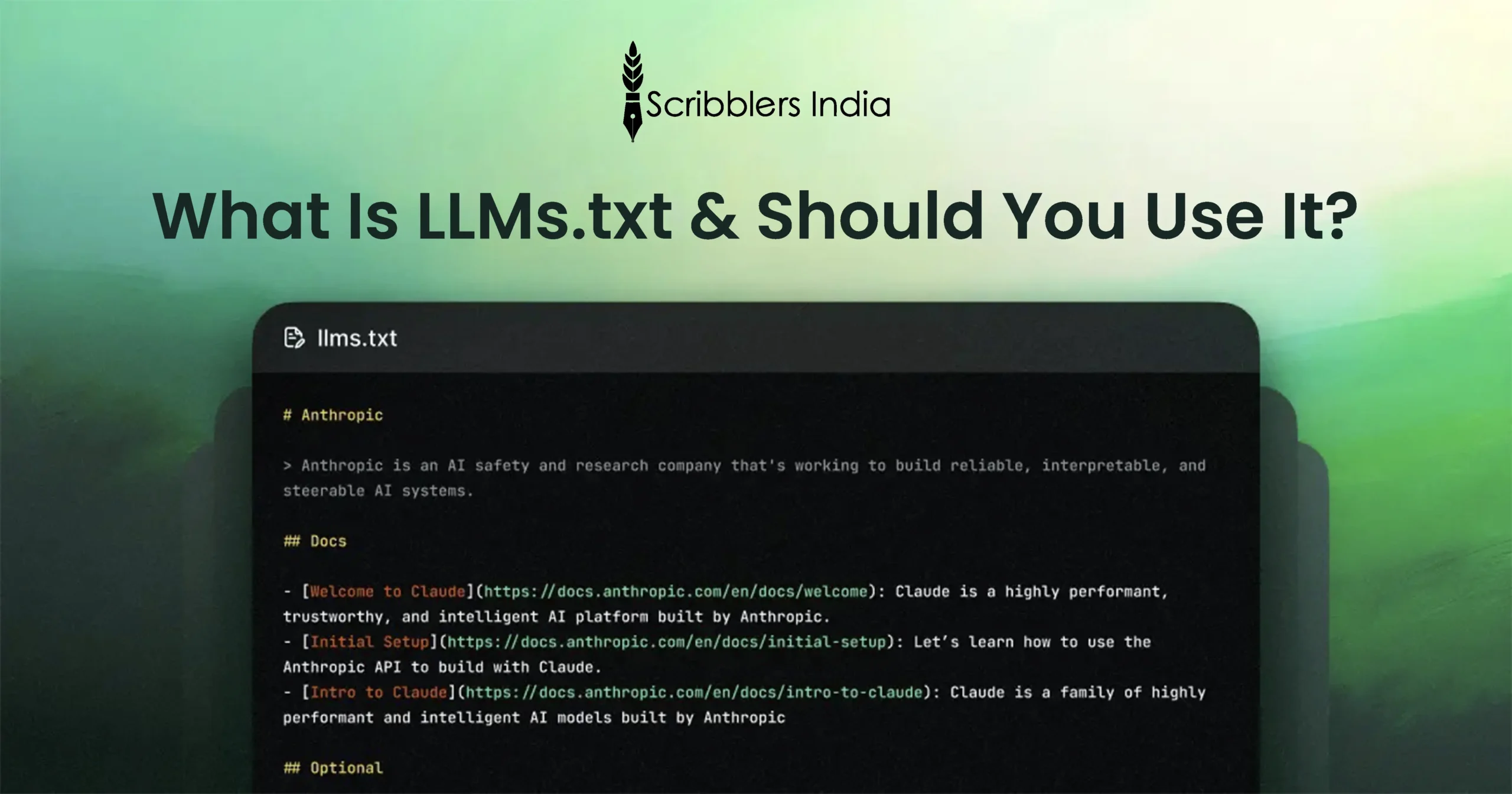
What Is llms.txt and Why It Matters for GEO
Your website was built for human visitors. Every design decision, from the navigation layout to the hero image, serves a person who sees, scrolls, and clicks through a visual experience. A different class of visitor is now reading your site, and they experience it in an entirely different way. This brings new considerations, such as managing llms.txt for GEO and how these visitors interact with website content. AI agents powering ChatGPT, Claude, Perplexity, and Gemini do not see your design. They process raw code. When an AI crawler visits a modern website, it must parse through kilobytes of JavaScript and CSS, navigation menus, and footer content before it reaches the required information. This friction in the processing creates a barrier to accurate retrieval, which is precisely the problem that llms.txt for GEO is designed to solve. Understanding what this file does and how to implement it correctly is becoming a crucial step in any serious Generative Engine Optimization strategy for 2026. TL;DR llms.txt is a Markdown file at your website’s root directory. It gives AI crawlers a clean, structured map of your content. The file was proposed by Jeremy Howard on September 3, 2024. It is fundamentally different from robots.txt in purpose and format. llms.txt for GEO reduces AI hallucinations about your brand content. Early adopters include Anthropic, Vercel, Stripe, and Hugging Face. Creating the file takes under 60 minutes and costs nothing. The file works best alongside strong schema markup and content authority. Update the file quarterly to maintain AI retrieval accuracy over time. What Is llms.txt and Why Does It Matter for GEO? LLMs.txt is a simple Markdown-formatted file placed at the root of your website. It gives AI language models a clean and curated summary of your most important content. It tells AI systems what your site is, who it serves, and where to find its most relevant pages without parsing through HTML noise. llms.txt for GEO matters because Generative Engine Optimization targets citations in AI-generated answers rather than ranking positions in traditional search results. AI crawlers reading cluttered HTML pages face significant computational friction. A well-structured llms.txt file removes that friction. It improves the probability that the AI accurately retrieves and cites your content. AI crawlers now play a measurable role in how websites are discovered and accessed. Latest report from Cloudflare found that AI bots accounted for 4.2% of HTML request traffic in 2025, while Googlebot alone accounted for 4.5%. For brands investing in AI visibility, llms.txt is a simple technical addition that can help AI systems better understand website content. It costs nothing to implement and can usually be created in less than an hour. How llms.txt Supports AI Search Visibility A detailed llms.txt file gives brands greater control over how their information is discovered, interpreted, and surfaced across AI-generated answers. As AI search platforms increasingly rely on structured retrieval methods, a well-maintained llms.txt file can improve content accessibility and strengthen citation opportunities. Functions as a sitemap for AI language models: XML sitemaps help search engines like Googlebot find and understand important website pages. An llms.txt file plays a similar role for AI models. It directs them to your most reliable and citation-worthy pages without requiring them to scan the complete website. Establishes a machine-readable brand identity: The file explains what your company does, who it serves, and how AI systems should understand your content. This clarity helps AI platforms describe your business accurately in generated answers. It also reduces the chances of incorrect or misleading descriptions of your services. Gives you content control in the AI retrieval environment: You can choose which pages to include in the llms.txt file. This helps you guide AI systems toward your strongest and most reliable content. It also keeps them away from duplicate, outdated, or less useful pages that may misrepresent your brand. How Is llms.txt Different from robots.txt on Your Website? llms.txt and robots.txt are both text files located at your site’s root. They both communicate with automated systems visiting your domain. They serve opposite purposes and use different formats to achieve desired outcomes for varied audiences. Understanding the distinction between these two files is crucial. It will help you seamlessly implement llms.txt for GEO as part of your broader AI crawler optimization website strategy. robots.txt controls access by telling crawlers where to avoid: It uses directives like User-agent, Allow, and Disallow to manage crawler access to specific URL paths. It acts as a gatekeeper, indicating to search crawlers which pages they can access or avoid. AI crawlers like GPTBot, ClaudeBot, and PerplexityBot may also follow robots.txt when configured correctly. llms.txt provides context by showing AI models your best content: It uses Markdown formatting instead of directive syntax and focuses on guidance rather than restriction. It does not block access to any page. Instead, it creates a curated list of important and authoritative pages that AI systems can retrieve and cite when generating answers about your brand or category. The two files work together rather than against each other: Your robots.txt file should allow the AI crawlers you want to access your content. Your llms.txt for GEO then guides those permitted crawlers to the pages that best represent your brand. Using both correctly creates a stronger technical foundation for websites optimizing for AI search visibility. robots.txt is established, while llms.txt is still emerging: Every major search engine recognizes robots.txt as a long-standing web standard. llms.txt for GEO is newer, voluntary, and still gaining adoption. Tech-forward companies such as Anthropic, Vercel, Stripe, and Hugging Face have already added it to their website infrastructure. How Does llms.txt for GEO Work with AI Crawlers in Practice? AI crawlers process websites under strict token limitations, making full-site parsing inefficient and often inaccurate for content retrieval. An llms.txt file simplifies this process by presenting clean, structured Markdown content without unnecessary scripts or navigation clutter. This improves retrieval efficiency and reduces parsing overhead. It helps AI systems represent brands accurately across GEO and AI-driven search experiences. Reduced
Your website was built for human visitors. Every design decision, from the navigation layout to the hero image, serves a person who sees, scrolls, and clicks through a visual experience. A different class of visitor is now reading your site, and they experience it in an entirely different way. This brings new considerations, such as managing llms.txt for GEO and how these visitors interact with website content. AI agents powering ChatGPT, Claude, Perplexity, and Gemini do not see your design. They process raw code. When an AI crawler visits a modern website, it must parse through kilobytes of JavaScript and CSS, navigation menus, and footer content before it reaches the required information. This friction in the processing creates a barrier to accurate retrieval, which is precisely the problem that llms.txt for GEO is designed to solve. Understanding what this file does and how to implement it correctly is becoming a crucial step in any serious Generative Engine Optimization strategy for 2026. TL;DR llms.txt is a Markdown file at your website’s root directory. It gives AI crawlers a clean, structured map of your content. The file was proposed by Jeremy Howard on September 3, 2024. It is fundamentally different from robots.txt in purpose and format. llms.txt for GEO reduces AI hallucinations about your brand content. Early adopters include Anthropic, Vercel, Stripe, and Hugging Face. Creating the file takes under 60 minutes and costs nothing. The file works best alongside strong schema markup and content authority. Update the file quarterly to maintain AI retrieval accuracy over time. What Is llms.txt and Why Does It Matter for GEO? LLMs.txt is a simple Markdown-formatted file placed at the root of your website. It gives AI language models a clean and curated summary of your most important content. It tells AI systems what your site is, who it serves, and where to find its most relevant pages without parsing through HTML noise. llms.txt for GEO matters because Generative Engine Optimization targets citations in AI-generated answers rather than ranking positions in traditional search results. AI crawlers reading cluttered HTML pages face significant computational friction. A well-structured llms.txt file removes that friction. It improves the probability that the AI accurately retrieves and cites your content. AI crawlers now play a measurable role in how websites are discovered and accessed. Latest report from Cloudflare found that AI bots accounted for 4.2% of HTML request traffic in 2025, while Googlebot alone accounted for 4.5%. For brands investing in AI visibility, llms.txt is a simple technical addition that can help AI systems better understand website content. It costs nothing to implement and can usually be created in less than an hour. How llms.txt Supports AI Search Visibility A detailed llms.txt file gives brands greater control over how their information is discovered, interpreted, and surfaced across AI-generated answers. As AI search platforms increasingly rely on structured retrieval methods, a well-maintained llms.txt file can improve content accessibility and strengthen citation opportunities. Functions as a sitemap for AI language models: XML sitemaps help search engines like Googlebot find and understand important website pages. An llms.txt file plays a similar role for AI models. It directs them to your most reliable and citation-worthy pages without requiring them to scan the complete website. Establishes a machine-readable brand identity: The file explains what your company does, who it serves, and how AI systems should understand your content. This clarity helps AI platforms describe your business accurately in generated answers. It also reduces the chances of incorrect or misleading descriptions of your services. Gives you content control in the AI retrieval environment: You can choose which pages to include in the llms.txt file. This helps you guide AI systems toward your strongest and most reliable content. It also keeps them away from duplicate, outdated, or less useful pages that may misrepresent your brand. How Is llms.txt Different from robots.txt on Your Website? llms.txt and robots.txt are both text files located at your site’s root. They both communicate with automated systems visiting your domain. They serve opposite purposes and use different formats to achieve desired outcomes for varied audiences. Understanding the distinction between these two files is crucial. It will help you seamlessly implement llms.txt for GEO as part of your broader AI crawler optimization website strategy. robots.txt controls access by telling crawlers where to avoid: It uses directives like User-agent, Allow, and Disallow to manage crawler access to specific URL paths. It acts as a gatekeeper, indicating to search crawlers which pages they can access or avoid. AI crawlers like GPTBot, ClaudeBot, and PerplexityBot may also follow robots.txt when configured correctly. llms.txt provides context by showing AI models your best content: It uses Markdown formatting instead of directive syntax and focuses on guidance rather than restriction. It does not block access to any page. Instead, it creates a curated list of important and authoritative pages that AI systems can retrieve and cite when generating answers about your brand or category. The two files work together rather than against each other: Your robots.txt file should allow the AI crawlers you want to access your content. Your llms.txt for GEO then guides those permitted crawlers to the pages that best represent your brand. Using both correctly creates a stronger technical foundation for websites optimizing for AI search visibility. robots.txt is established, while llms.txt is still emerging: Every major search engine recognizes robots.txt as a long-standing web standard. llms.txt for GEO is newer, voluntary, and still gaining adoption. Tech-forward companies such as Anthropic, Vercel, Stripe, and Hugging Face have already added it to their website infrastructure. How Does llms.txt for GEO Work with AI Crawlers in Practice? AI crawlers process websites under strict token limitations, making full-site parsing inefficient and often inaccurate for content retrieval. An llms.txt file simplifies this process by presenting clean, structured Markdown content without unnecessary scripts or navigation clutter. This improves retrieval efficiency and reduces parsing overhead. It helps AI systems represent brands accurately across GEO and AI-driven search experiences. Reduced