AI brand mentions now influence which companies enter the buyer’s consideration set before a website visit happens. People ask ChatGPT, Perplexity, Gemini, Google AI Overviews, and Google AI Mode for recommendations long before opening a traditional search result. The brands named inside those answers gain visibility. The brands left out quietly lose demand.
According to a 2025 BrightEdge study, ChatGPT mentions brands in 99.3% of eCommerce responses, while Google AI Overview mentions them in only 6.2%. That spread shows how much your platform mix matters when planning content for AI visibility. The opportunity is wide, yet most brands still write for traditional keyword rankings.
Content marketing decides whether your brand earns these mentions. The right mix of blog posts, thought leadership pieces, and comparison content helps AI tools recognize your name as a trusted source in the category. Skip the work, and competitors fill the gap.
This blog explains the ten content types behind almost every AI brand mention we see in 2026 audits.
TL;DR
|
What Are AI Brand Mentions and Why Do They Matter?
AI brand mentions are references to your company inside answers generated by ChatGPT, Perplexity, Gemini, Google AI Overviews, and Google AI Mode. They shape buyer perception during research and decision stages. A mention reaches the user even when no click ever happens.
- A mention names your brand inside the answer, while a citation links your domain as a supporting source.
- Both signals matter yet mentions carry stronger commercial weight because they deliver brand exposure with zero click dependency.
- AI tools transfer trust to the brands they name, so users read the mention as a vetted recommendation.
- Mentions reach buyers across every research stage, from category discovery to final shortlist comparisons.
- Brands that earn mention share enjoy a sharp visibility advantage that traditional analytics dashboards rarely capture cleanly.

Why Do Brand Mentions Matter More Than Backlinks in AI Search?
Brand mentions matter more than backlinks in AI search because AI tools weigh consensus across the open web. They check whether several independent sources agree on a brand. A page with mentions across many trusted domains earns higher visibility than one resting on backlink authority alone.
- Consensus signals beat single authority: AI tools cross-check several independent sources before naming a brand. A backlink from a single strong site cannot replace agreement from many sources covering your category.
- Sentiment shapes brand descriptions: AI tools describe brands using language drawn from source content. Pages that frame your personal or corporate brand with clear, positive context improve the words AI tools assign to your name.
- Mentions reach zero-click users: Most AI answers end without any click. A brand mentioned inside the answer still reaches the buyer. A backlink that goes unclicked delivers zero impact.
- Cross-platform coverage compounds value: A brand mentioned across reviews, blogs, and forums earns recognition across ChatGPT, Perplexity, and AI Overviews. Backlinks support one channel while mentions support every AI tool.
- Entity strength outranks domain authority: AI tools treat brands as entities tied to topics, examples, and outcomes. A high-domain-rating site without entity clarity loses to a smaller brand with consistent mention coverage.
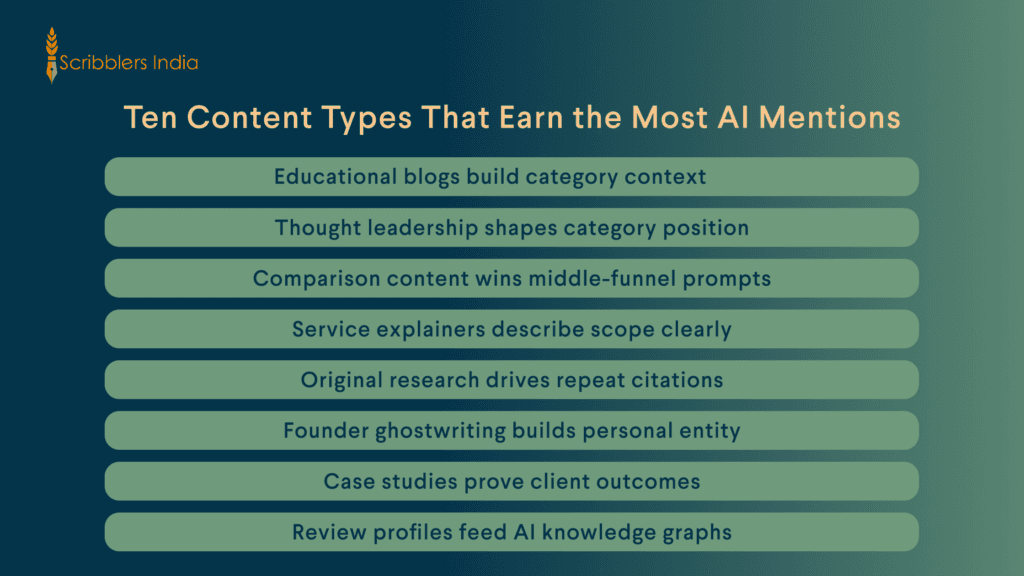
What Are the 10 Content Types That Help AI Tools Recognize Your Brand?
When we studied 200+ AI answers, we found that 10 content types recurred alongside strong AI tool brand visibility. Each format gives AI systems a different reason to recognize, describe, cite, or recommend your brand.
Educational blogs build category context, comparisons support decision-stage prompts, and research, reviews, and third-party mentions create the agreement signals needed for stronger AI brand mentions.
1. Educational Blogs
Educational blogs explain core topics in your category. They define terms, clarify processes, and help users learn what they need before buying anything. AI tools rely on these blogs to build category context around your brand name. When your brand publishes deep educational content, AI tools associate your name with the topic itself. A SaaS brand that writes the clearest blog on “what is product-led growth” becomes a likely mention when users ask AI tools about the term across follow-up prompts.
2. Thought Leadership Articles
Thought leadership articles share original insight, expert framing, and category opinions. They help AI tools position your brand as a category voice rather than another vendor competing for keyword rankings. A founder-led blog on industry shifts often earns more mentions than a polished company page ever does. AI tools value content with named authors, specific opinions, and verifiable expertise. Pages built around founder views or unique frameworks give AI tools a reason to cite your brand on shaping questions.
3. Comparison Content
Comparison content shows how your product stacks against alternatives across price, features, and use cases. AI tools rely on these pages to answer middle-funnel prompts such as “best CRM for SaaS” or “alternatives to platform X” with confidence. A clean comparison page with tables, pricing notes, and use cases helps AI tools generate accurate answers. Brands that publish honest comparison content earn mentions even when prompted to name competitors. Skipping comparisons hands the category narrative to aggregator sites.
4. Service-Led Explainers
Service-led explainers describe what your service does, who it helps, and how the process works. They give AI tools the context needed to recommend your brand for solution-focused prompts across discovery and decision stages. A clear service explainer covers scope, pricing logic, ideal client fit, and outcomes. AI tools use this content to match user prompts with relevant providers. Vague service pages lose recommendation share to those that explain the work plainly with specific deliverables and timelines.
5. Original Research and Data Reports
Original research builds the strongest entity authority of any content format we track. AI tools cite proprietary data, benchmarks, and surveys because they add information that no other source can replicate quickly across the web. A single original report can drive citations across hundreds of related prompts for years. Brands that publish quarterly research become the default source AI tools pull from when users ask category questions. The investment compounds because each citation increases the probability of future mentions.
6. Founder and Executive Ghostwriting
Founder ghostwriting builds personal brand authority that maps back to the company’s brand inside AI knowledge graphs. AI tools link named founders to companies through bylines, interviews, and bio pages across the web. When a founder publishes consistent thought leadership content, AI tools learn to mention the brand whenever the founder appears in queries about strategy, vision, or category direction. This dual-entity signal lifts mentions on both branded and unbranded prompts across ChatGPT and Perplexity.
7. Customer Case Studies and Success Stories
Case studies provide the named-brand examples AI tools need to answer outcome-focused prompts. They cover the client’s situation, the work delivered, and the measurable results in verifiable detail. AI tools reward case studies because they ground claims in real-world proof. A page describing how a named client achieved a specific outcome becomes citation-ready content. Generic testimonials fail this test, so structured case study pages with named clients deliver far stronger lift in mentions over time.
8. Third-Party Publication Features
Earned placements in trusted publications carry the consensus weight AI tools look for. Guest posts, industry features, and expert quotes in recognized outlets help AI tools link your brand to category topics from outside your own domain. A brand mentioned only in owned content signals self-promotion to AI tools. The same brand mentioned across owned content, industry publications, and partner blogs signals real authority. The mix moves your name from candidate source to confident citation across answers.
9. Community and Forum Presence
AI tools scan Reddit, Quora, LinkedIn, and niche forums when generating answers across many categories. Genuine contributions from your team or founders create mentions that AI tools pick up across many prompt variations over time. A consistent presence in category communities builds the agreement signal AI tools need before naming a brand. Active community contributors earn mentions on prompts that owned content never reaches. The work feels slow yet compounds into reliable mention share across answer engines within two quarters.
10. Review and Listing Profile Optimization
Updated listings on G2, Capterra, TrustRadius, and similar platforms feed AI tools with structured brand data. These profiles provide pricing, feature lists, and verified reviews that AI engines extract for comparison and recommendation prompts. Regular updates with current features, pricing, and review responses keep your brand description fresh and accurate inside AI knowledge graphs. Outdated profiles create wrong descriptions that follow your brand into AI answers for months. The maintenance work pays back through cleaner middle-funnel mentions.
How Can You Increase Brand Mentions Across AI Tools?
You can increase AI brand mentions across platforms like ChatGPT, Perplexity, Gemini, and others by publishing consistent, useful content across topics, formats, and platforms. Mentions grow when AI tools see your brand across blogs, reviews, communities, and trusted publications. A multi-channel content effort builds the agreement signals that AI tools need to confidently mention your brand in their answers.
Let’s have a look at the key strategies that directly impact the AI brand mentions you can earn in a quarter.
- Publish question-led blog content weekly: AI tools reward sites with regular publishing on relevant topics. A weekly cadence builds entity strength and gives AI tools more opportunities to find your content when generating answers to category prompts.
- Earn placements in trusted third-party publications: These tools place greater weight on independent sources when generating answers. Guest posts, industry features, and expert quotes in trusted publications help AI tools link your brand to category topics from outside your own domain.
- Build active presence in category communities: AI platforms scan Reddit, Quora, and niche forums when generating answers. Genuine contributions from your team or founders create mentions that AI tools pick up across many prompt categories over time.
- Maintain updated comparison and review profiles: Listings on G2, Capterra, and similar platforms feed AI tools with structured brand data. Regular updates with current features, pricing, and reviews keep the brand description AI tools use about your company fresh and accurate.
- Run original research that other sites cite: Original data, surveys, and benchmarks earn organic citations across the web. Each citation strengthens the mention signal AI tools use when answering prompts in your category over the long term.
How Can You Turn These Insights into Measurable AI Brand Visibility?
You can turn these insights into measurable AI brand visibility by tracking mention count, citation rate, share of voice, and sentiment across AI platforms. Traditional analytics tools miss these signals. AI visibility tools fill the gap by running prompts on a schedule and recording how your brand performs.
| Metric | What It Tracks | Why It Matters |
| Mention count | Times your brand is named inside AI answers | Shows raw visibility and content impact |
| Citation rate | Percentage of answers citing your domain as source | Reflects how often AI tools trust your pages |
| Share of voice | Your mention count versus direct competitors | Reveals competitive position in AI conversation |
| Sentiment | Tone AI tools use describing your brand | Signals whether source content needs refresh |
| Prompt coverage | Share of priority prompts where your brand appears | Measures category presence across answer engines |

What Mistakes Stop Brands From Earning AI Mentions?
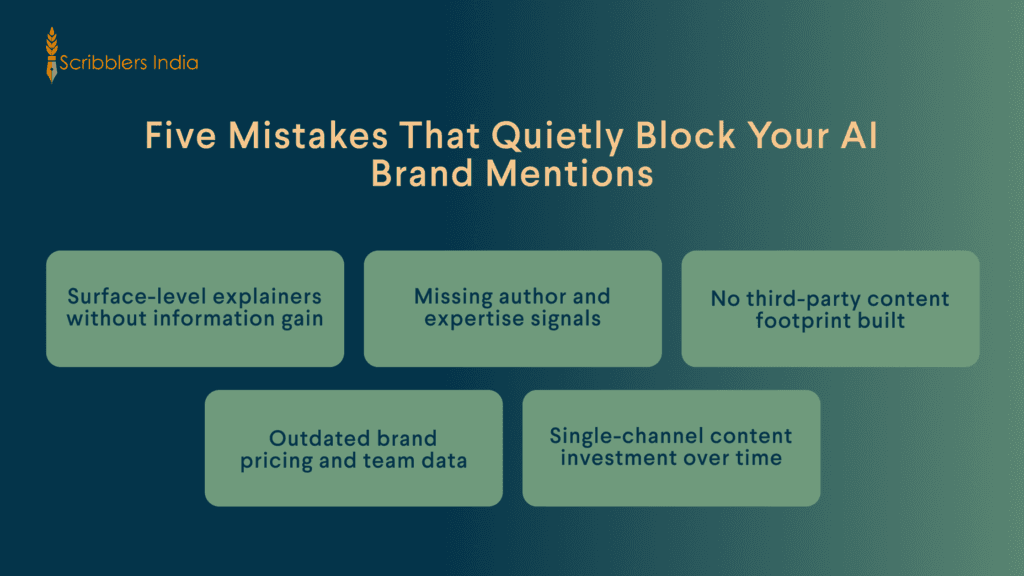
Common mistakes that block AI brand mentions include thin content, keyword-led writing, a lack of entity clarity, and overreliance on a single channel. These habits prevent AI tools from learning your brand position. Fixing them improves mention share across ChatGPT, Perplexity, Gemini, and Google AI Mode within a quarter of consistent work.
Each mistake feeds the next. A thin content library leads to weak entity signals, forcing over-reliance on owned channels and limiting the consensus AI tools need before citing a brand. The fix begins with treating multi-channel publishing as the new visibility floor.
- Surface-level explainers: Blogs that repeat what every other site says give AI tools no reason to pick your brand. Information gain matters more than word count for AI mention probability across answer engines.
- Missing author and expertise signals: AI tools weigh content more heavily when it includes named authors, credentials, and clear expertise. Anonymous content struggles to earn citations in fields where trust drives buying decisions.
- No third-party content footprint: Brands publishing only on owned domains miss the consensus signal AI tools need. Mentions grow when your brand appears across blogs, communities, podcasts, and trusted publications.
- Outdated brand information: AI tools often repeat descriptions from the source content. Old pricing, outdated team pages, or obsolete product details create wrong AI descriptions that follow your brand for months.
- Single-channel content investment: Pouring resources into one channel leaves AI tools with limited source variety. A balanced mix across owned, earned, and community content lifts mention share faster than any single bet.
Research from SEMrush has shown that AI platforms scan for agreement across multiple independent sources before confidently citing a brand.
How Does Scribblers India Help You Get More AI Brand Mentions?
At Scribblers India, we help brands build content libraries that AI tools recognize, trust, and cite across every major answer engine. Our work blends content strategy, thought leadership writing, AEO planning and GEO development. We start with research and end with citation-ready content.
We work with founders, SaaS teams, and service brands that want AI visibility without depending on paid placements or shortcuts. Each engagement begins with a prompt audit across ChatGPT, Perplexity, and Google AI Mode. We then map the content gaps stopping your brand from earning mentions in your category today.
- Content strategy planning for AI search: We map your category, identify the prompts AI tools answer most often, and design a calendar built around those prompts so each blog earns its place in the AI answer set.
- Question-led blog writing for AEO: We write blogs with structured direct answers, clear examples, and citation-friendly sections. This approach helps your pages earn mentions and citations without forcing keyword density anywhere.
- Thought leadership ghostwriting for founders: We craft founder-led articles sharing original thinking, opinions, and category frameworks. AI tools recognize these pieces and use them to define category positions inside answers your buyers see.
- Comparison and service page development: We build comparison pages, service explainers, and decision guides that fill middle-funnel gaps. These assets earn brand mentions for prompts where buyers ask AI tools for recommendations.
- Content gap audits and refresh cycles: We run prompt-led content gap audits across your category, find missing answers, and rebuild weak pages. This work closes the gaps, stopping AI tools from naming your brand inside generated responses.
Talk with our team today to build content that earns mentions across every AI tool.
FAQs
How do AI tools decide which brands to mention?
AI tools usually mention brands they can understand across reliable sources. They look for clear positioning, repeated category associations, useful content, third-party references, and consistent entity signals. If your website, articles, reviews, profiles, and expert content all clearly explain the same value, your brand becomes easier to include in relevant answers.
How long does it take to earn AI brand mentions?
AI brand mentions usually grow once a brand has built enough content depth and source consistency. The timeline depends on category competition, current authority, publishing quality, and whether trusted third-party sources mention you. Early progress often appears as better answer accuracy, stronger citations, and more consistent inclusion across priority prompts over time.
Do AI tools mention small brands or only large companies?
Yes, smaller brands can earn AI brand mentions when their content shows specific expertise and solves clear buyer questions. Large brands often have wider recognition, but smaller companies can compete through sharp positioning, helpful comparisons, original insights, and active community presence. Clarity often matters more than company size inside AI answers.
How are AI brand mentions different from SEO rankings?
Traditional SEO rankings show where a web page appears in search results, while AI brand mentions show whether your brand appears inside generated answers. A page can rank well and still be ignored by AI tools. Mentions depend on content depth, entity clarity, source agreement, and usefulness across the wider web.
Which AI platforms should brands prioritize for growth in mentions?
Brands should prioritize the AI platforms their buyers use during research. For many B2B teams, that may include ChatGPT, Perplexity, Gemini, Google AI Overviews, or Google AI Mode. A prompt audit helps identify where your competitors already appear and where your content can build the fastest visibility over time.
What content helps brands earn more AI brand mentions?
The best content for AI brand mentions usually answers buyer questions clearly and proves authority from several angles. Educational blogs, service explainers, comparison pages, case studies, original research, founder content, and third-party features all help. Together, these assets show AI tools what your brand does, who it helps, and why it matters.
How should brands measure progress in AI brand mentions?
Measure AI brand mentions by tracking where your brand appears across a fixed set of prompts. Review mention count, cited pages, competitor presence, answer sentiment, and whether the description matches your positioning. This helps you see whether content improvements are increasing visibility or only adding more pages to the website.