Traditional link building focuses heavily on securing backlinks to individual pages. Digital PR for SEO takes a comprehensive approach. It earns editorial coverage around useful research, credible experts, original insights, or timely stories. Those placements can create links while strengthening how people and search systems understand your brand.
That wider footprint now matters across conventional search and AI-assisted discovery. Relevant coverage can create third-party references around your company and expertise. The strongest programs therefore connect media relations with SEO goals while measuring where earned authority appears across search results and AI-generated answers.
Key Takeaways
|
What Does Digital PR for SEO Mean?
Digital PR for SEO uses media relations and editorial storytelling to earn credible online coverage that supports search performance. Links remain valuable, although the wider objective includes brand references, source authority, referral discovery, and searchable third-party evidence that strengthens your presence beyond pages published on your website.
Digital PR for SEO differs from conventional outreach in the following ways:
- Editorial Value: You need a story that a journalist can use rather than a request for a backlink. Original data, expert analysis, timely commentary, or a useful market finding gives the publication an independent reason to cover your organization.
- Relevant Authority: A specialist publication can create more useful authority than a larger website covering an unrelated audience. Topic alignment gives the mention stronger context while exposing the brand to people already researching the industry, category, or problem.
- Natural Links: Strong coverage may include editorial links to supporting research, reports, tools, or expert resources. The journalist controls whether a link appears. This distinction separates earned editorial value from links placed primarily to influence search rankings.
- Searchable Evidence: Online coverage creates another public page where your expertise, research, company, or spokesperson appears. That evidence can influence human research while expanding the information available to search and AI-led retrieval systems.
- Compounding Value: One article can generate referral traffic and branded searches while supporting future media outreach. Relevant coverage may also attract secondary links when other publishers reference the original story or underlying research later.
Our Digital PR services connect story development with targeted outreach and post-publication measurement, rather than treating backlinks as the sole campaign outcome.

Why Does Digital PR for SEO Matter More in 2026?
Digital PR for SEO matters more because search visibility now extends beyond traditional result pages. AI search experiences retrieve information from wider source sets, while branded queries increasingly trigger generated summaries. Earned media gives brands another way to create credible public evidence around their expertise and market relevance.
Muck Rack’s 2026 State of PR found that 73% of PR professionals consider GEO at least somewhat important to communications strategy. The same research found that 29% of organizations still have no clear owner for GEO.
That gap creates an organizational problem. SEO teams understand rankings and technical discovery. PR teams understand journalists, narratives, and external authority. AI-led discovery increasingly requires both disciplines to examine the same public information environment.
Recent search behavior reinforces this need. Ahrefs analyzed 232.8 million US desktop result crawls from July through September 2026. Its study found AI Overviews appeared for 83% of the branded queries examined. Third-party sources therefore have growing opportunities to influence how people encounter brands during direct research.
A stronger strategy does not replace SEO with PR. It connects technical eligibility and useful owned content with credible external evidence that supports discovery across a wider search journey.
How Does Digital PR for SEO Earn Backlinks That Matter?
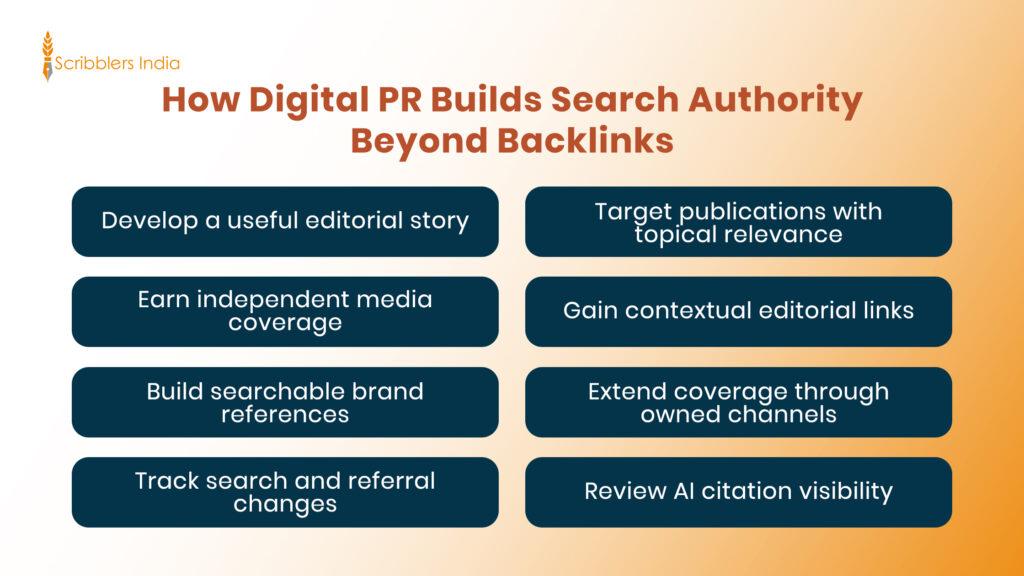
Digital PR for SEO earns stronger links when the linked resource provides journalists with something essential for their story. Research, data, interactive resources, original frameworks, or authoritative explanations provide natural reasons for citation. This approach produces earned media backlinks through editorial usefulness rather than backlink requests attached to weak stories.
Five factors usually determine whether those links have lasting value:
- Topical Fit: Coverage should sit close to the subject where you want authority. A relevant trade publication can provide stronger contextual value than unrelated coverage secured mainly because the website has attractive SEO metrics.
- Editorial Context: The surrounding story should explain why your company or resource matters. A contextual link within meaningful reporting conveys greater relevance than a company name placed in a broad directory, roundup, or unrelated article.
- Destination Quality: Give journalists a useful page worth referencing. Original reports and detailed research pages often create stronger link destinations than homepages because they let readers examine the evidence behind the story directly.
- Source Independence: Journalists should decide whether your evidence deserves inclusion. Editorial control creates a meaningful distinction between earned coverage and placements where the publication outcome was purchased primarily for distribution or SEO value.
- Secondary Discovery: Strong research can continue earning links after initial outreach ends. Other writers may find the published story and follow its sources, creating additional references without needing to make another direct pitch to each publisher.
How Do Brand Mentions in SEO Matter Without Links?
Brand mentions in SEO can still matter because they create searchable context around a company, product, founder, or area of expertise. An unlinked mention cannot provide the same direct linking signal as a backlink. It can still strengthen brand discovery while contributing to the wider public information environment.
This distinction becomes more interesting in AI-led search.
Ahrefs studied 75,000 brands across ChatGPT, Google AI Mode, and AI Overviews. It found branded web mentions showed correlations of roughly 0.66 to 0.71 with AI visibility, stronger than several traditional backlink metrics in the same analysis. Correlation does not establish direct causation.
For marketing teams, the real-life implications are extensive:
- A relevant mention can associate your brand with a topic even when no hyperlink appears.
- Founder quotes can connect individual expertise with recurring industry questions over time.
- Product references can clarify how third parties describe capabilities or category positioning.
- Independent descriptions can reveal whether your intended messaging survives outside owned channels.
- Repeated mentions can create more searchable evidence around the same professional or company entity.
- Coverage monitoring can identify descriptions that require correction through stronger future public information.
Links remain important. The key lesson is that measuring digital PR exclusively through linked placements can hide useful authority signals.
How Can Digital PR for SEO Support AI Search Visibility?
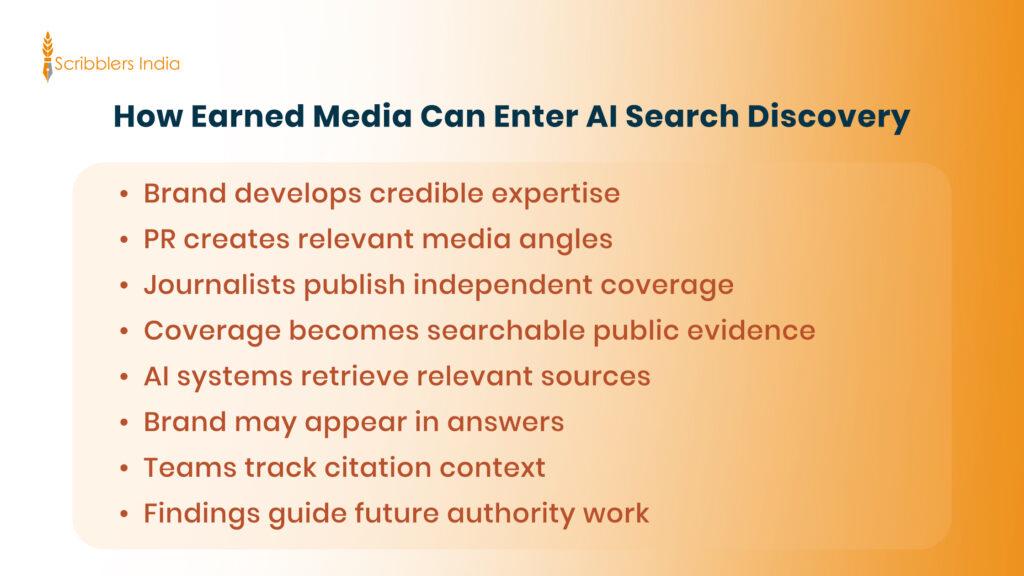
Digital PR for SEO can support AI search visibility by creating independent online sources around your expertise, research, products, or leaders. AI systems may retrieve these pages when answering relevant questions. Coverage expands the available evidence, although no publication can guarantee a specific AI citation, mention, or recommendation.
Earned media expands the source environment
Muck Rack’s May 2026 research analyzed more than 25 million links from responses by ChatGPT, Claude, and Gemini across 17 industries. It found 84% of citations came from earned media, with journalistic sources representing 27%. Citation patterns still differed substantially by model and query type.
Relevant journalism can support current questions
The same research found that journalism accounted for a larger share of citations for time-sensitive questions. This makes current expert commentary and fresh industry coverage particularly interesting when buyers ask AI systems about recent market developments or changing category conditions.
Third-party descriptions provide independent context
Your website explains how you position the company. An external article may describe your expertise differently. Comparing both views can reveal whether outside sources reinforce the intended position or create gaps that need stronger future evidence.
Citation quality still requires interpretation
A media link inside an AI response does not automatically mean the platform is recommending your company. Teams should assess the role of each AI citation, the surrounding answer context, factual accuracy, and whether the source appears consistently before treating the visibility as meaningful.
How Should Digital PR for GEO Work With AEO and SEO?
Digital PR for GEO works best when PR, SEO, and AEO support different parts of the same authority system. SEO makes owned pages discoverable, AEO improves answer usefulness, and GEO examines wider generative visibility. PR contributes third-party evidence that teams cannot create entirely through their own website.
| Discipline | Primary role | Typical assets | Useful measurement |
| SEO | Organic discovery | Service pages, guides, research | Rankings, clicks, conversions |
| AEO | Answer readiness | Definitions, FAQs, direct answers | Extracted answers, cited pages |
| GEO | Generative visibility | Owned and external source ecosystem | Mentions, citations, accuracy |
| Digital PR | External authority | Media coverage, interviews, research | Coverage, links, source visibility |
Google’s current guidance reinforces the connection between SEO and generative search. It states that established SEO practices remain relevant for AI Overviews and AI Mode. Supporting pages still need indexing, snippet eligibility, useful content, and normal search accessibility.
Google also explains that AI Mode and AI Overviews can use query fan-out across related searches and data sources. This makes clear, well-structured owned content increasingly important, which is where Answer Engine Optimization services can help strengthen question coverage and answer readiness.
The wider discovery layer extends beyond the company website. External authority, third-party sources, citations, and brand representation can all influence how a business appears across generative systems, making Generative Engine Optimization relevant when the challenge involves broader visibility across sources rather than owned content alone.

Which Digital PR SEO Campaigns Earn Useful Links and Mentions?
Strong digital PR and SEO campaigns provide journalists with material they would struggle to create independently. The best format depends on available expertise, data quality, media timing, and audience relevance. Expensive interactive assets are optional. A smaller, evidence-led campaign can outperform a larger production when its findings are genuinely useful.
Original research
Surveys, proprietary data, and anonymized customer patterns can create evidence journalists want to reference. The methodology needs enough detail to withstand scrutiny. Strong research also gives other publishers a reason to cite the original asset after the first coverage cycle ends.
Expert-led analysis
Specialists can interpret regulatory changes, technological shifts, operational challenges, or changing buyer behavior. This works best when the expert contributes first-hand knowledge rather than summarizing public articles. Timely commentary can establish a repeatable media role around defined areas of expertise.
Data-led comparisons
Public datasets can become useful stories when analysis reveals a meaningful pattern. Methodology and selection criteria should remain transparent. Avoid creating rankings in which arbitrary scoring exists primarily to generate headlines rather than to help the audience understand a genuine difference.
News-responsive commentary
Fast reactions can work when your expert adds consequences or practical implications missing from the initial announcement. Teams need approval processes before news breaks. Delayed responses often lose value because journalists complete their stories while internal reviewers are still discussing wording.
Useful tools and resources
Calculators, benchmarks, templates, databases, and frameworks can attract references when they solve a persistent problem. The asset should remain useful after media outreach finishes. Long-term utility gives journalists and later researchers stronger reasons to revisit the source.
How Should You Choose Publications for Digital PR for SEO?
Digital PR for SEO should prioritize publications using topical relevance, audience fit, editorial credibility, search discoverability, and source influence. Domain authority alone cannot tell you whether a placement supports your actual goals. A smaller specialist publication may have greater value when it consistently reaches and informs your category.
A useful publication scorecard should feature the following questions:
- Does the publication cover this subject regularly? Beat alignment indicates whether your story fits the outlet’s normal editorial work rather than relying on a one-off opportunity with weak topical connection.
- Does the right audience read it? Customer relevance should influence media value. A publication reaching your decision-makers can support stronger commercial authority than a larger outlet serving an unrelated general audience.
- Does its coverage remain discoverable? Review whether articles are indexed and searchable over time. Online coverage that disappears quickly or blocks useful access creates different long-term value from accessible editorial archives.
- Does the source appear in relevant AI answers? Citation patterns can add another useful signal. Muck Rack found that journalism citations spanned more than 20,000 outlets, with source preferences varying by industry and model.
This approach avoids treating media selection as a simple highest-authority-domain exercise. Your target list should reflect the questions audiences actually research.
How Should You Measure Digital PR for SEO?
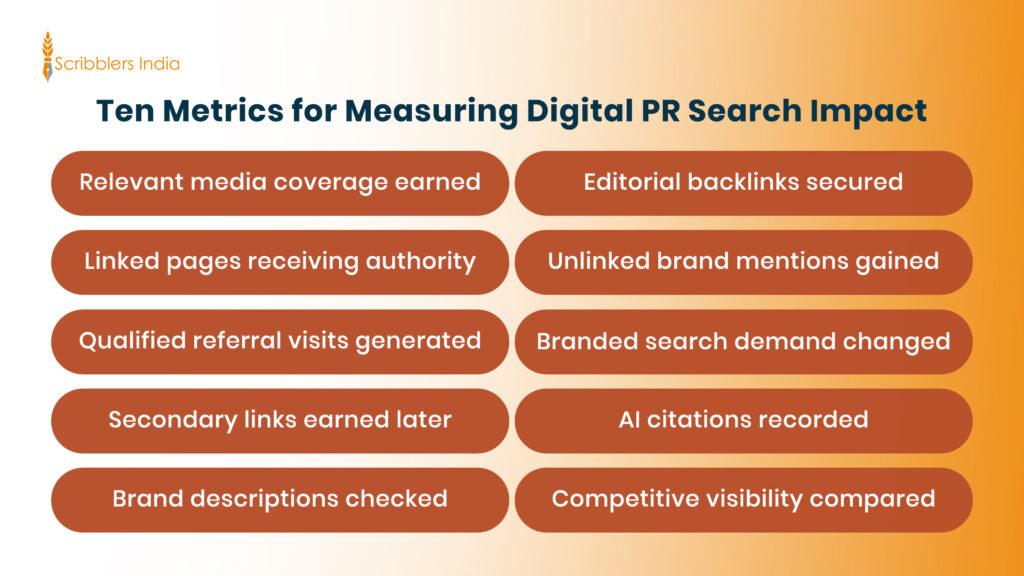
Digital PR for SEO measurement should combine media quality with search and discovery outcomes. Backlink counts reflect only one aspect of performance. You also need to know whether coverage reinforces relevant expertise, reaches useful audiences, sends qualified visitors, earns secondary references, and improves visibility across priority search journeys.
| Metric | What it tells you | Why it matters |
| Relevant coverage | Whether suitable publications use the story | Measures editorial fit |
| Earned links | Which coverage links to owned assets | Tracks direct search value |
| Linked destinations | Which pages receive editorial links | Shows authority distribution |
| Brand mentions | Where the company appears without links | Captures wider external evidence |
| Referral visits | Whether readers reach owned pages | Shows direct discovery |
| Branded search | Whether later brand research changes | Captures delayed interest |
| Secondary links | Whether later publishers cite the asset | Shows compounding authority |
| AI citations | Which sources appear across tracked prompts | Adds generative visibility context |
| Description accuracy | How AI systems explain the brand | Protects representation |
| Competitive visibility | How frequently rivals appear nearby | Adds market context |
Traffic alone does not explain how a brand performs across AI-led discovery. A stronger measurement model should combine search performance with prompt coverage, citation patterns, source visibility, and description accuracy, as outlined in the AI Search Discovery Benchmark.
Which Mistakes Weaken Digital PR for SEO?
Digital PR for SEO loses value when teams chase SEO metrics before editorial relevance. Weak stories, unsuitable publication targets, forced links, disconnected landing pages, and inflated reporting can produce impressive-looking dashboards with limited authority. Effective campaigns need a credible reason for coverage before search outcomes enter the measurement process.
- Choosing publications by authority score alone: Website metrics can help with screening. They cannot replace topical fit or audience relevance. A specialist outlet can strengthen category authority even when its overall domain metrics are lower than those of a general publication.
- Building stories around backlink needs: Journalists need useful material for readers. Starting with a target URL often forces the campaign to align with internal SEO requirements. Start with a credible finding, then decide which supporting asset naturally deserves reference.
- Sending coverage to weak destination pages: Editorial links create greater value when the destination answers the reader’s next question. Research pages need methodology and context. Tools need usability. Generic commercial pages often provide limited support for evidence-led editorial stories.
- Counting every mention equally: A passing company reference and a detailed expert citation confer different levels of authority. Measurement should capture prominence, relevance, sentiment, message accuracy, link presence, and likely audience, rather than converting every article into a single identical placement unit.
- Assuming media coverage guarantees AI inclusion: External authority can expand the source ecosystem around a brand, but it does not guarantee citations or mentions. AI systems can select different sources across prompts and platforms, so teams should distinguish citation eligibility from actual and repeated AI Overview visibility before judging whether media coverage is improving discovery.
How Can Scribblers India Support Digital PR for SEO?
At Scribblers India, we connect digital PR for SEO with media strategy, credible content, search authority, and generative visibility. We begin with stories and expertise that deserve external attention. Search outcomes then become part of a broader authority program rather than turning journalist outreach into disguised link acquisition.
We structure international PR around five priorities that support long-term visibility:
- Search and Media Opportunity Mapping: We identify topics where search demand, business relevance, available expertise, and journalist interest overlap. This helps determine which campaigns deserve investment and which existing assets can provide credible evidence when a publication covers the story.
- Research and Story Development: We turn company data, expert knowledge, original research, and market observations into editorial angles. Each story needs enough evidence to stand on its own, giving journalists a reason to reference the underlying asset without needing to make forced backlink requests.
- Relevant Media Outreach: We target publications based on beat relevance, audience fit, geography, and overall authority value. Our strategic media relationships can support access across India and international markets while editorial decisions remain with each independent publication.
- Search and AI Integration: Earned coverage is reviewed alongside backlinks, brand references, source visibility, and AI citation patterns. Our digital PR for GEO approach connects these external signals to owned AEO and GEO priorities, rather than treating generative discovery as a separate campaign.
- Authority Measurement: We evaluate the quality of coverage and earned media backlinks alongside referral behavior, branded discovery, and relevant AI visibility. This broader scorecard helps you identify which campaigns created durable authority rather than merely producing publication logos.
We can also connect media-led authority with thought leadership services when original executive expertise provides the strongest foundation for external coverage.
Get in touch with our team and book a 1:1 call to connect earned media with stronger search authority.
Frequently Asked Questions
Can Digital PR Help a New Website With Little Existing Authority?
Yes. A newer website can use credible media coverage to build external awareness while its owned content develops. Strong research or expert insight can earn attention without established rankings. The site still needs solid technical foundations and useful destination pages so earned links have somewhere credible and relevant to point.
Is a Homepage Backlink Better Than a Link to a Research Page?
The better destination depends on the editorial context. Research stories usually benefit from links to the original study, as readers can verify the methodology and findings. Company profiles may naturally link to a homepage. Relevance matters more than forcing every publication to link to whichever URL the SEO team currently wants to strengthen.
Should You Ask a Journalist to Add a Backlink After Coverage Goes Live?
You can politely provide the relevant source when a story references your research without linking to it. Avoid making backlink requests the center of the relationship. Journalists and editors control their linking policies. A useful source URL and clear reader benefit create a stronger reason for consideration than SEO language.
Are Nofollow Links Worth Earning Through Digital PR?
Yes. A nofollow attribute does not erase the audience, referral, brand, or discovery value of credible coverage. Publications use different linking policies, and editorial teams should respect them. Evaluate placement by relevance, readership, brand context, referral activity, and broader authority, rather than judging value by link attributes alone.
Can Digital PR Replace Conventional Link Building Completely?
The right mix depends on your site and market. Digital PR works especially well for authority-led links from editorial coverage. Other legitimate link acquisition methods can still include partnerships, inclusion of useful resources, or naturally referenced tools. The search strategy should select methods based on relevance and sustainability rather than forcing every link through PR.
Should Old Media Coverage Be Updated for SEO?
You usually cannot control editorial pages after publication. Focus first on keeping the owned source accurate and available. When outdated media information creates a factual problem, contact the publication with evidence. For changing topics, newer coverage can provide current context without requiring historical articles to be continually rewritten.
Can Offline Newspaper Coverage Support SEO?
Print coverage has limited direct SEO value when no searchable online article exists. It can still strengthen reputation and stakeholder trust. If the publication also creates an indexed digital version, the coverage may contribute searchable evidence, referral pathways, or links. Track print and online outcomes separately to avoid overstating digital impact.
How Long Should You Measure Search Results After a PR Campaign?
Measure immediate outcomes after publication, then continue reviewing search and authority signals over several months. Referral traffic may peak quickly, while secondary links, branded searches, and later source citations can emerge gradually. Maintaining a consistent reporting window helps compare campaigns without judging long-term authority from first-week activity alone.