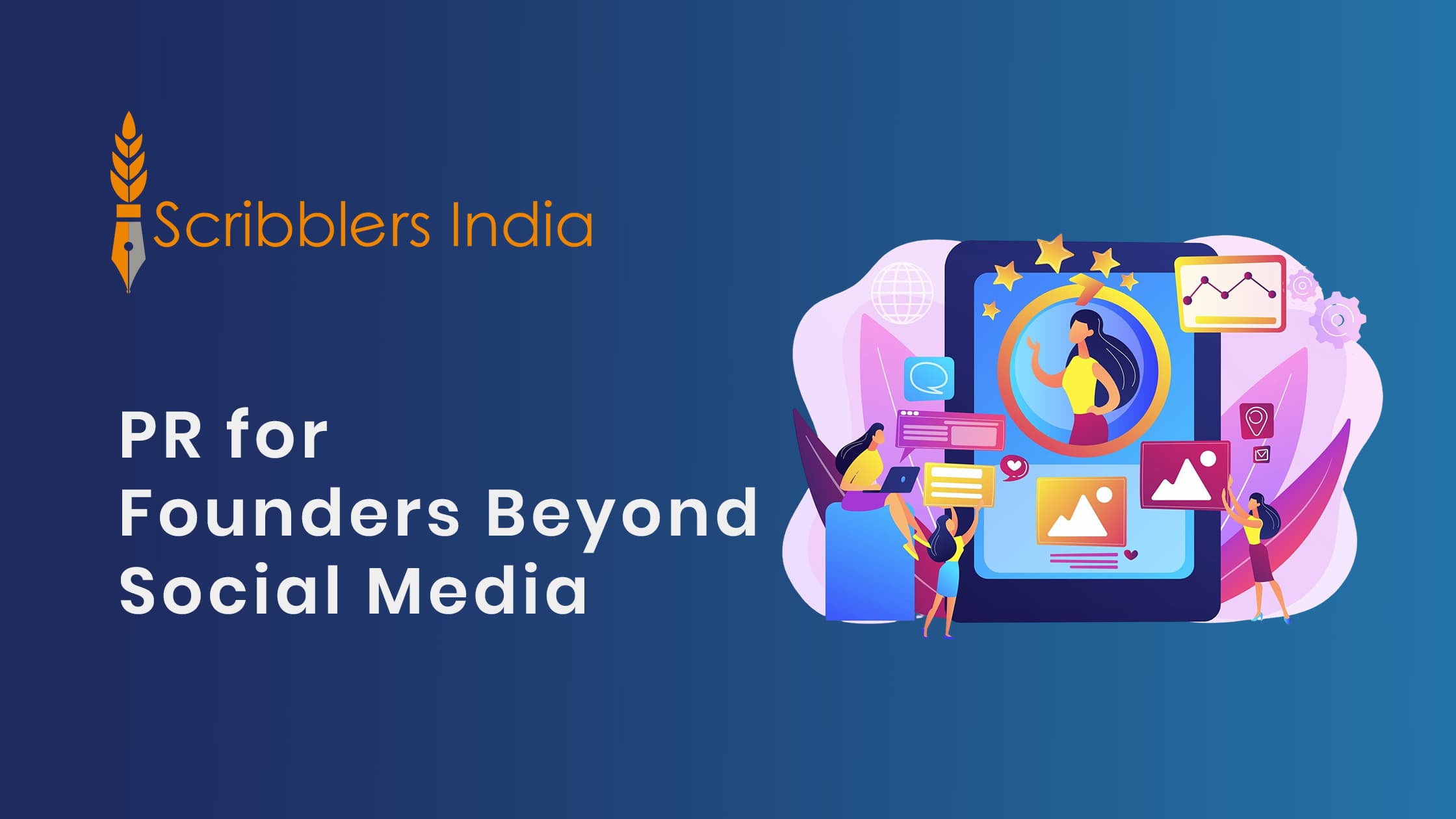
LinkedIn can help founders share ideas, build professional networks, and speak directly to their followers. However, audiences still know that founders control what appears on their own profiles. Independent media coverage adds a different layer because another publication decides the founder is relevant to its readers. PR for founders connects that third-party visibility with a clear professional position.
Interviews, expert commentary, profiles, contributed articles, and company-related coverage can introduce a founder to audiences beyond existing followers. When those appearances reinforce genuine expertise, they strengthen the founder’s reputation rather than creating short-lived publicity.
Key Takeaways
|
What Does PR for Founders Actually Mean?
PR for founders is a focused media strategy that builds recognition around the person behind a company. It uses relevant interviews, expert commentary, profiles, contributed insights, and other editorial opportunities to connect the founder’s experience with issues that matter to journalists and their audiences.
This differs from publishing company announcements whenever something happens internally. Effective founder coverage develops around expertise that remains useful beyond a product launch or funding milestone.
A strong personal PR usually includes these areas:
- Founder Positioning: The founder needs a recognizable professional territory before media outreach starts. Journalists should understand which topics the person can discuss credibly. Our founder’s personal branding glossary explains how experience, proof, and public visibility work together to support that position.
- Media Narrative: A founder biography explains what someone has done. A media narrative explains why their experience matters now. It identifies recurring market questions where the founder can contribute evidence, practical observations, or informed interpretations that create genuine editorial value.
- Opportunity Mapping: Different publications need different contributions. A national business publication may want a wider market trend. A specialist title may value technical depth. Podcasts may need strong personal experiences that support a longer discussion around one important theme.
- Source Preparation: Journalists may need facts, examples, background information, or a fast interview. Founders should have approved evidence and useful supporting material available. Preparation improves responsiveness without turning interviews into rehearsed corporate messaging or prewritten promotional statements.
- Authority Measurement: Coverage should reinforce the professional reputation the founder wants to develop. Track whether publications increasingly associate the founder with priority expertise, alongside referral activity, media inquiries, branded searches, and relevant business conversations after publication.
Our Digital PR services connect these elements with journalist research, story development, targeted outreach, and post-publication measurement.
Why Is PR for Founders Becoming More Important?
PR for founders is becoming more important because audiences increasingly encounter business leaders across media, creator platforms, search results, and AI-led research. Founders now operate inside a fragmented discovery environment where personal visibility can influence how people interpret the business before visiting its website.
The Reuters Institute’s 2026 Digital News Report found that 27% of people globally get some of their news from news-focused individual creators. The figure reaches 46% when creators of any type are included. Traditional media remains important because most creator audiences use both sources rather than replacing one completely.
This creates an important founder-branding lesson. Audiences increasingly expect to encounter identifiable people behind ideas while still looking to established publications for stronger verification and editorial context.
Journalists also remain receptive to useful external sources. Muck Rack’s 2026 State of Journalism found that 86% of journalists said at least some of their work began with a PR pitch. Media outreach still creates real opportunities when the proposed source fits the story.
The opportunity therefore sits between two channels. Founders can build direct familiarity through their own content while credible editorial coverage provides independent context around the expertise behind that visibility.
When Is a Founder Ready for Media Coverage?
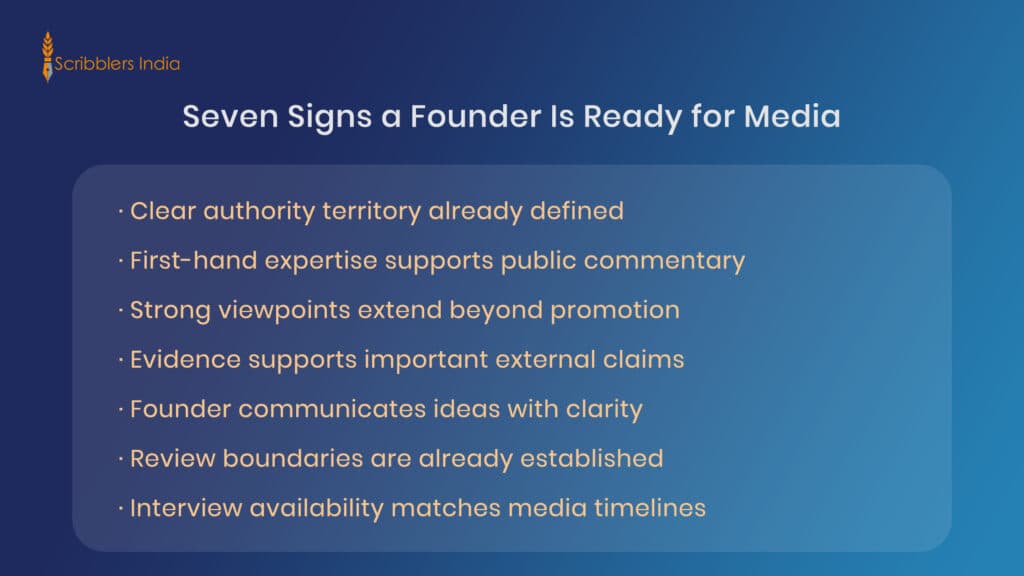
A founder is ready for media coverage when their public expertise goes beyond a desire for publicity. They should have a clear authority position, relevant experience, useful perspectives, defensible evidence, and sufficient availability to properly support journalists. Without those foundations, outreach can create attention without strengthening professional authority.
A defined authority territory
The founder should know which problems deserve their public attention. Broad positioning, such as “entrepreneur” or “innovator,” gives journalists little editorial direction. A stronger position connects genuine experience to a recognizable issue affecting customers, industries, technologies, or business decisions.
Evidence behind the expertise
Founders need material beyond personal opinion. Customer observations, operating lessons, public research, company data, or documented outcomes can support useful media conversations. Sensitive information requires appropriate approval, while every external claim should be supported by evidence the founder can confidently explain.
Distinct viewpoints
Journalists rarely need another executive repeating widely accepted commentary. Founders become stronger sources when experience has produced an interpretation worth examining. That viewpoint can challenge an assumption, explain a developing problem, or show how market behavior differs from common industry narratives.
Media-ready communication
Expertise loses value when the founder cannot explain it clearly. Strong sources answer questions directly while separating evidence from personal interpretation. They also understand which subjects remain confidential and which claims need qualification before publication in a public editorial environment.
Reliable availability
News cycles often move faster than executive schedules. A founder who needs several days to approve one short response may miss reactive opportunities. Teams should define access, review boundaries, and backup procedures before active pitching begins.
What Makes a Founder Story Newsworthy?
A founder story becomes newsworthy when the founder’s experience helps explain something larger than the individual. Strong stories connect first-hand knowledge with market change, original evidence, unusual decisions, emerging risks, or timely audience concerns. The founder remains the source, while the broader issue becomes the editorial rationale.
Cision reports that 82% of journalists consider relevance essential before they evaluate a story, while 72% say fewer than one-quarter of the pitches they receive are relevant. That gap shows why media targeting alone cannot rescue a weak angle.
Here are five key story sources that can help create stronger foundations:
- Original Evidence: Proprietary research or anonymized operational data can reveal patterns journalists cannot obtain elsewhere. The methodology needs enough transparency for someone outside the company to understand what the figures represent and which conclusions they can reasonably support.
- Market Interpretation: Founders often observe changes before public research captures them. Repeated buyer objections, procurement shifts, implementation problems, or customer behavior can become useful commentary when the founder explains the pattern carefully and avoids turning anecdotes into universal claims.
- Unusual Decisions: A meaningful operating decision can reveal broader lessons when the reasoning extends beyond the company’s history. A founder explaining why the team rejected a popular model or changed direction can offer useful insight when the market context supports wider relevance.
- Timely Expertise: Regulatory changes, market developments, new technologies, or industry events create opportunities for qualified interpretation. Reactive commentary works best when the founder explains the consequences that affected audiences need to understand, rather than repeating the announcement already publicly available.
- Counterintuitive Findings: Strong stories sometimes emerge when credible evidence challenges common assumptions. The founder needs enough proof to explain the difference responsibly. The value comes from helping readers understand a market more accurately, rather than manufacturing controversy for attention.
Which Types of Media Coverage Work Best for Founders?
The best media format depends on the founder’s expertise, communication style, audience, and current authority goals. Some founders benefit from detailed interviews, while others work better as expert sources. PR for founders should select formats according to what the leader can genuinely contribute.
| Media format | What it can demonstrate | Best suited for |
| Founder profile | Journey and professional context | Building wider personal recognition |
| Expert interview | Judgment and subject expertise | Complex or evolving industry topics |
| Journalist quote | Fast specialist perspective | Timely news and reactive PR |
| Contributed article | Deeper argument or framework | Strong original viewpoints |
| Company feature | Leadership within business context | Genuine milestones with wider relevance |
| Research coverage | Evidence-led category authority | Proprietary data or credible studies |
| Podcast appearance | Personality and extended reasoning | Founders comfortable with conversation |
| Print interview | Broader stakeholder credibility | Markets where established media carries weight |
A balanced founder media strategy rarely relies on a single format throughout the year. Media opportunities should evolve alongside stronger proof and more recognizable expertise.
How Is Founder PR Different From Company PR?
Founder PR builds authority around the individual’s expertise, while company PR focuses on the organization’s news, products, growth, and reputation. The two should reinforce each other without becoming identical. A founder needs enough professional independence to remain credible beyond repeated company promotion.
| Area | Founder-focused PR | Company PR |
| Main subject | Founder or business leader | Company or brand |
| Core narrative | Expertise and professional perspective | Business developments and company story |
| Common opportunities | Interviews and expert commentary | Announcements and corporate features |
| Long-term asset | Individual professional authority | Organizational reputation |
| Content connection | Personal brand and thought leadership | Corporate marketing and communications |
The distinction matters because the founder’s reputation often extends beyond a single company moment. Their experience can support future ventures, speaking opportunities, advisory work, investor conversations, and broader category leadership.
Company communication also requires different editorial judgment. A journalist may value a founder’s view on an industry problem without wanting to cover the company itself. Keeping these narratives connected without merging them gives both brands more room to build credibility.
How Does Personal Branding Support PR for Founders?
Personal branding gives PR for founders a consistent direction before media outreach begins. It defines what audiences should associate with the founder, which expertise deserves emphasis, and which proof supports that position. PR can then reinforce the same authority through sources the founder does not directly control.
Our personal branding services begin with positioning because publication volume cannot repair an unclear professional identity.
Positioning creates media focus
Strong personal brand positioning identifies the audience and authority territory the founder wants to build. This helps PR teams reject opportunities that create attention without strengthening the intended professional association.
Owned content demonstrates consistency
LinkedIn posts, articles, reports, and founder pages give journalists useful context before an interview. A developed content history shows whether the leader has engaged seriously with a topic beyond a single opportunistic comment made for current media interest.
Media adds independent validation
Personal platforms show how founders describe themselves. Editorial coverage shows how independent publications contextualize their expertise. Strong personal branding PR, therefore, connects controlled communication with credible external visibility rather than treating the two as competing channels.
Public evidence compounds over time
Repeated coverage around connected themes can create a richer professional evidence trail. Future journalists, customers, partners, and other stakeholders can access several sources to understand the founder’s expertise and track how that perspective has developed.
How Can Thought Leadership Create Better PR Opportunities for Founders?
Thought leadership gives PR for founders stronger material by turning experience into ideas journalists can examine, challenge, and develop. A founder with a recognizable point of view offers more editorial value than someone available only to discuss company announcements, personal achievements, or prepared promotional messaging.
The relationship works best as a recurring system:
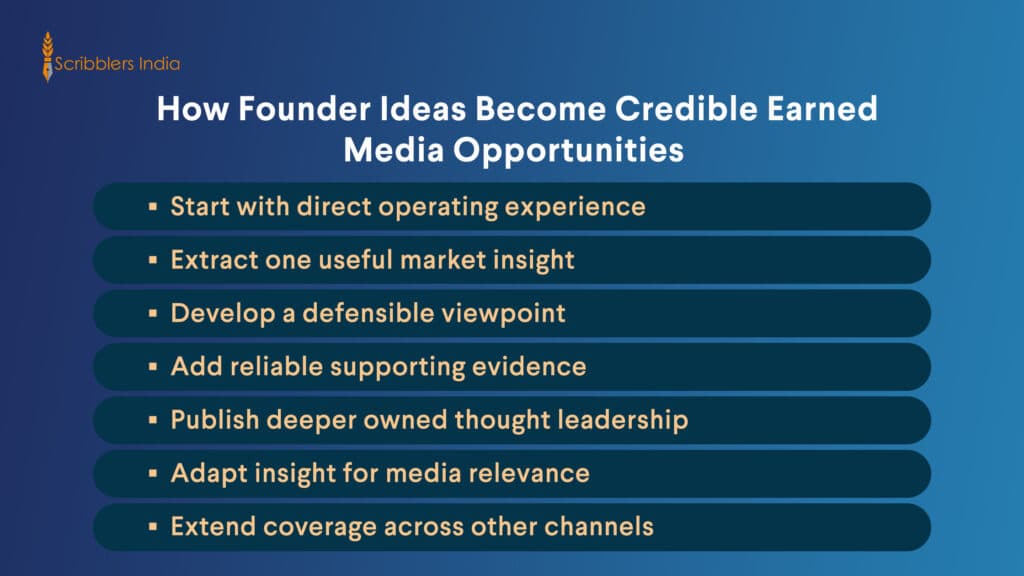
Expertise → founder interview → original viewpoint → owned content → media angle → external coverage → wider amplification
Our thought leadership content writing services help founders develop the ideas behind that sequence before wider distribution begins.
Useful thought leadership can support PR through these routes:
- Original frameworks can provide journalists with a clearer way to explain complicated or emerging industry problems.
- Firsthand operating lessons can reveal changes that published market reports have not yet clearly captured.
- Research-led articles can establish evidence before related findings become suitable for wider media outreach.
- Strong opinions can create interview angles when the founder can defend them using experience and credible evidence.
- Recurring themes help journalists understand which topics the founder can reliably discuss in future news cycles.
- Detailed owned content can provide background when a short quote cannot capture the founder’s complete reasoning.
Thought leadership therefore does more than fill a content calendar. It can become the intellectual source material that keeps external media opportunities relevant between major company announcements.
How Can Ghostwriting Help Founders Prepare for Media Opportunities?
Ghostwriting helps founders organize their expertise before publication without manufacturing opinions on their behalf. Structured interviews can capture experiences, decisions, examples, and unfinished ideas. Skilled editorial work then turns those inputs into clear arguments that remain consistent across owned content and later media conversations.
Our ghostwriting services can support this preparation when founders have valuable knowledge but limited time to write.
The value is not limited to publishing LinkedIn posts. A developed writing process can create:
- Clear explanations of topics the founder regularly discusses with customers or industry peers.
- Documented examples that journalists can understand before conducting a deeper interview.
- Stronger vocabulary around complex ideas without reducing the founder’s expertise into marketing slogans.
- Content themes that reveal which subjects consistently generate audience interest and useful professional conversations.
- Draft thinking that can later support bylines, interview preparation, newsletters, or media commentary.
The founder still owns the thinking. Ghostwriting gives that thinking enough structure to become easier for wider audiences and journalists to understand.
How Should Founders Prepare for Media Interviews?
Founders should prepare for interviews by clarifying their evidence, professional boundaries, likely questions, and core viewpoint beforehand. Preparation should improve accuracy rather than script every sentence. Journalists generally need responsive experts who can explain an issue naturally and answer follow-up questions without returning repeatedly to company talking points.
- Know the publication: Review its audience and recent coverage before the conversation. Understanding the reporter’s previous work helps the founder anticipate the expected depth and avoid repeating information already covered extensively in earlier articles.
- Prepare evidence: Keep important figures, dates, definitions, and sources available during the discussion. Memory can become unreliable under interview pressure, particularly when questions involve market size, historical developments, company performance, or changing regulatory requirements.
- Set boundaries: Decide which customer details, commercial information, internal decisions, or future announcements remain confidential. Founders should know these limits before the interview, rather than improvising restrictions after sensitive information has already entered the conversation.
- Practice explanation: Complex expertise becomes useful when a wider audience can follow the reasoning. Prepare examples and analogies where appropriate, while ensuring simplification does not distort the underlying fact or create a claim the available evidence cannot support.
- Expect follow-ups: Journalists may challenge assumptions or request more detail after the first response. Founders should treat these questions as part of the editorial process rather than expecting the conversation to follow a prepared sequence.
How Should You Use Founder Media Coverage After Publication?
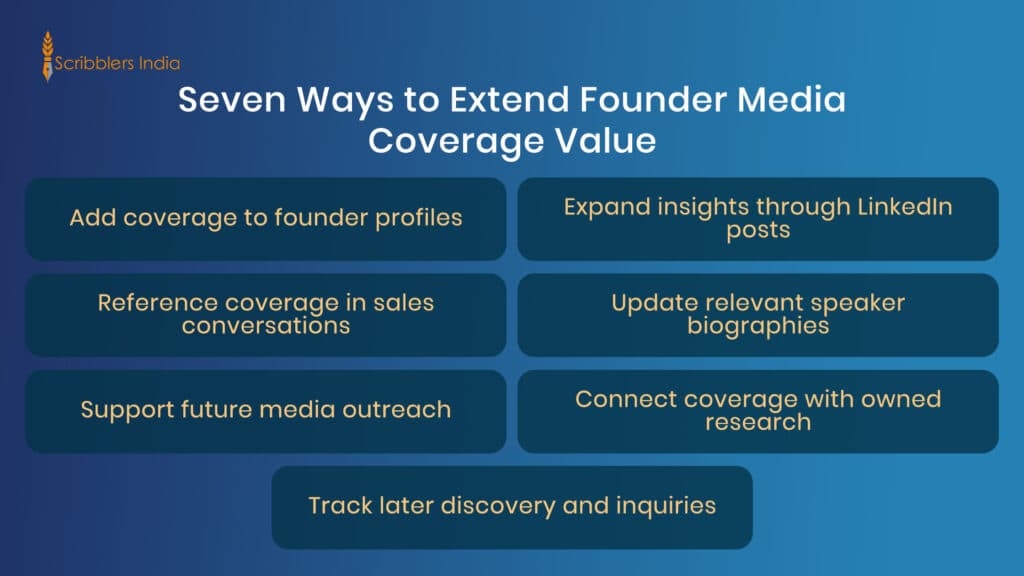
Media coverage creates more value when you integrate it into the founder’s wider authority system after publication. One strong interview can support social distribution, website credibility, investor materials, sales conversations, speaker profiles, and future media pitches without having to repeatedly republish the same article across every channel.
The most useful approach is to extract different forms of evidence from the coverage:
- Founder profile: Add it to an appropriate media page and professional biography where relevant stakeholders can discover it.
- Expert quote: Share the underlying insight through a LinkedIn post that expands the founder’s reasoning instead of announcing the coverage alone.
- Podcast interview: Extract approved themes for future articles, presentations, or newsletter discussions after respecting the publication’s content rights.
- Industry feature: Use relevant coverage within sales or partnership conversations when the article genuinely supports the expertise under discussion.
- Research citation: Connect the publication to the original report or owned evidence so interested readers can examine the wider methodology and findings.
This process turns media visibility for founders into a source of reusable authority rather than a short celebration immediately after publication.
Can PR for Founders Improve Search and AI Visibility?
PR for founders can expand the public information available about a leader through credible third-party pages, expert quotes, interviews, and bylined contributions. These sources may help people verify expertise and give search or AI systems additional material to retrieve. They cannot guarantee specific rankings or AI recommendations.
This distinction becomes increasingly important as PR and generative search start converging. Muck Rack’s 2026 State of PR found that 73% of PR professionals consider GEO at least somewhat important to their communications strategies.
Online media can support several useful discovery signals:
- Searchable pages can connect the founder’s name with recurring areas of expertise.
- Independent articles can provide descriptions that do not originate from company-controlled pages.
- Bylines can strengthen associations between the founder and specific professional topics.
- Relevant citations can create additional pathways between owned expertise and external public sources.
- Consistent coverage can reveal whether external descriptions match the founder’s intended professional position.
- Current media mentions can add fresh public evidence around developing areas of expertise.
Our AI Search Discovery Benchmark provides a broader framework for tracking descriptions, source patterns, citations, and prompt-level visibility across AI platforms.
Which PR for Founders Mistakes Can Weaken Credibility?
PR for founders becomes less effective when attention takes precedence over relevance. Common mistakes include pursuing unrelated publication logos, exaggerating expertise, making every appearance promotional, and confusing sponsored placement with independent editorial coverage. These choices can produce visibility while weakening the trust the program was designed to build.
- Chasing publication prestige: A famous publication has limited strategic value when the founder appears for a topic unrelated to their authority. Relevance should influence opportunity selection alongside audience quality and the publication’s credibility within that subject area.
- Pitching the founder without a story: Seniority alone rarely creates editorial value. The founder needs useful evidence or a timely perspective that adds to the journalist’s existing coverage, rather than requesting visibility because they lead a successful company.
- Overpromoting the business: Interviews lose credibility when every response returns to the company. Founders should explain the wider issue first. The business can provide useful context when it genuinely supports the story or demonstrates relevant first-hand experience.
- Blurring paid and earned coverage: Sponsored content can serve legitimate distribution goals when disclosed properly. Independent coverage operates differently because editors retain control. Teams should label each opportunity accurately rather than presenting every published article as equivalent third-party endorsement.
- Ignoring media consistency: A founder who takes conflicting positions across interviews creates confusion. Views can evolve as evidence changes, although unexplained contradictions weaken authority. Maintain clear records of recurring themes and update important positions when the market changes.
How Should You Measure PR for Founders?
PR for founders should be measured against the professional authority and business outcomes the program intends to influence. Placement counts alone cannot show whether stronger audiences discovered the founder, whether important expertise became recognizable, or whether media exposure created meaningful activity after publication.
| Metric | What it helps you understand |
| Relevant earned coverage | Whether the right publications consider the founder useful |
| Expertise association | Whether coverage reinforces priority authority themes |
| Journalist re-engagement | Whether reporters return to the founder as a source |
| Branded search | Whether interest in the founder grows after exposure |
| Referral activity | Whether media audiences explore owned pages afterward |
| Quality inbound inquiries | Whether visibility reaches relevant stakeholders |
| Speaking invitations | Whether authority extends into professional opportunities |
| AI description accuracy | Whether public discovery reflects the intended expertise |
Review these indicators over several months. Founder reputation grows through accumulated signals rather than one high-profile appearance. The strongest measurement question remains simple: Are more relevant people encountering the founder for the expertise they want to own?
How Can Scribblers India Help With PR for Founders?
At Scribblers India, we connect PR for founders with positioning, thought leadership, media outreach, and wider digital discovery. We use each founder’s real experience as the starting point, then develop relevant stories and target media opportunities that reinforce the professional authority they want to build.
Our approach covers the following five connected areas:
- Positioning and Media Narrative: We establish the topics a founder can credibly own before active outreach. Existing expertise, public proof, company context, and future goals shape a focused media narrative that gives journalists a clearer reason to consider the founder.
- Story Development: Founder interviews help us uncover operating lessons, market observations, distinctive decisions, and useful evidence. We develop these inputs into media angles rather than forcing routine business achievements into stories that offer limited relevance outside the company.
- Targeted Media Outreach: We identify publications and journalists according to audience fit, recent coverage, geography, and subject relevance. Our media relationships across India and international markets can support access, while editorial decisions always remain with the publication.
- Founder Content Integration: Media activity works alongside owned authority. We can connect external coverage with personal branding, executive ghostwriting, and thought leadership so LinkedIn posts or deeper articles reinforce the same expertise rather than creating disconnected professional identities.
- Discovery Measurement: We review media coverage alongside branded discovery and, where appropriate, relevant AI search visibility. This helps show whether external sources increasingly associate the founder with priority topics without making unsupported promises around rankings, citations, or recommendation placement.
Get in touch with our team and book a 1:1 call to build credible founder authority through strategic media coverage.
Frequently Asked Questions
How Early Should a Startup Founder Begin PR?
A founder can begin preparing for PR before the company has major announcements, provided useful expertise already exists. Early work can focus on positioning, source preparation, journalist research, and relevant commentary. Active outreach should begin when the founder has enough evidence or perspective to contribute meaningfully to external conversations.
Can Introverted Founders Build Strong Media Visibility?
Yes. Founder authority does not require an outgoing public personality or daily media appearances. Introverted founders can focus on written commentary, structured interviews, contributed articles, research, and carefully selected podcasts. The format should match the founder’s communication strengths while still giving journalists direct access when verification or clarification becomes necessary.
Does Every Founder Need to Become the Public Face of Their Company?
No. Some businesses benefit from a visible founder, while others rely more heavily on technical experts or several executive spokespeople. The decision should reflect customer expectations and available expertise. Founders should not create an artificial public role when another qualified leader can represent important topics more credibly.
How Long Does Founder PR Usually Take to Show Results?
Timelines vary according to the founder’s existing reputation, story quality, target publications, and news cycles. Reactive commentary may create opportunities quickly, whereas profiles or contributed articles may require longer lead times. Measure progress over several months by tracking coverage quality and source relationships, rather than expecting fixed placement dates.
Should Founders Accept Every Interview Opportunity?
No. Evaluate the publication’s audience, credibility, format, topic, and expected time commitment before accepting. An interview outside the founder’s genuine expertise may create little useful authority. Founders should also assess whether sensitive company information could arise and establish appropriate boundaries before the conversation begins.
Can Two Co-Founders Have Separate PR Strategies?
Yes. Separate strategies work particularly well when co-founders bring different expertise to the company. One founder may become associated with a product or technology, while another may be associated with market strategy or customer problems. Their positioning should remain compatible so external coverage strengthens the company without creating conflicting leadership narratives.
Is Podcast Coverage as Valuable as Newspaper or Magazine Coverage?
Podcast value depends on audience relevance, host credibility, distribution, and discussion depth. A specialist podcast can confer greater authority within a narrow professional audience than broad media coverage. Newspapers and magazines provide different forms of third-party validation, so evaluation should focus on strategic fit rather than format prestige alone.
Should a Founder Remove Older Media Coverage After Repositioning?
Usually, older coverage should remain unless it contains material inaccuracies or creates a serious reputational issue. Repositioning works better when you add stronger current evidence to support the founder’s new direction. Updated profiles, recent interviews, and new expert content can gradually change which professional associations audiences encounter most often.