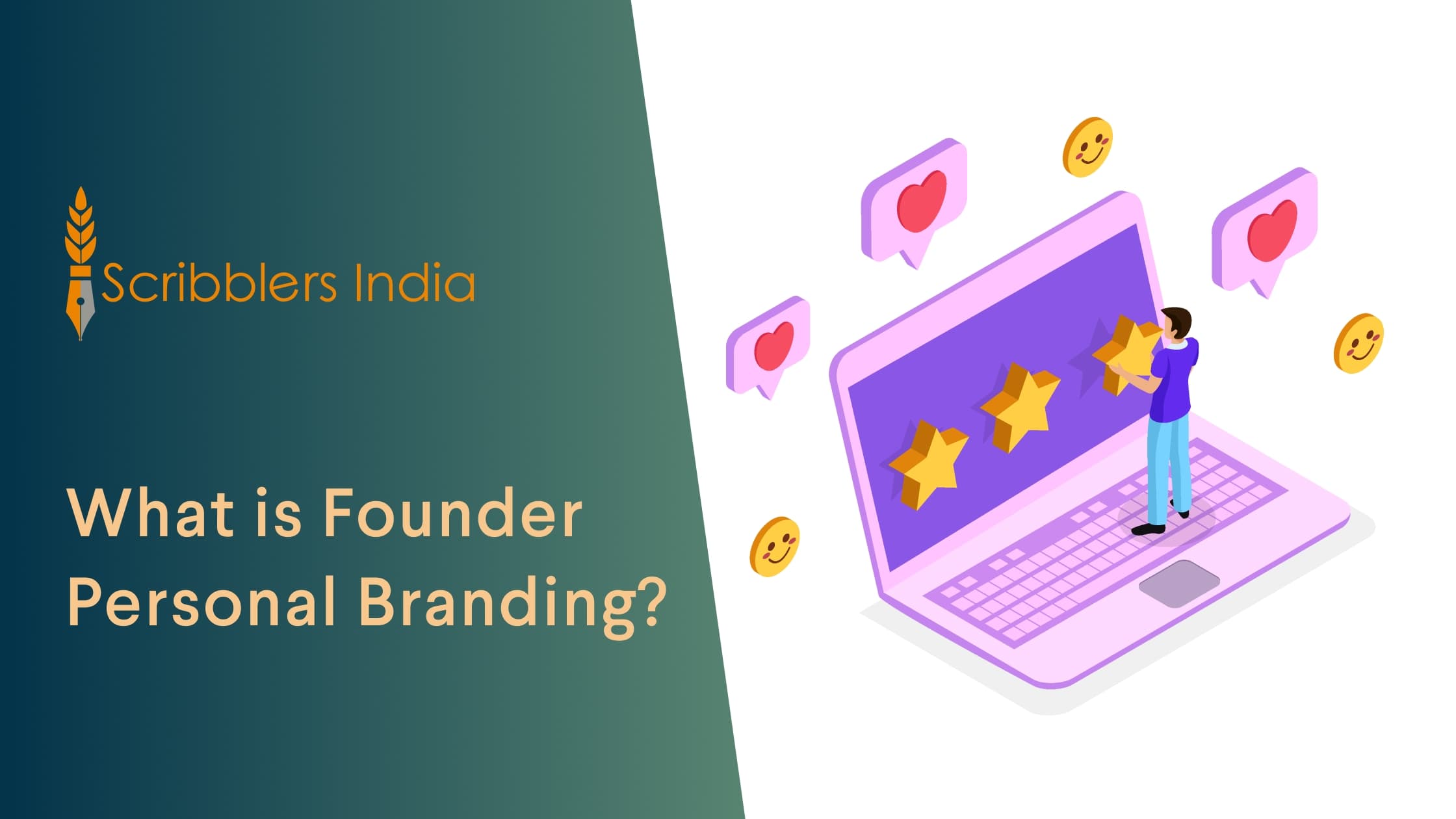
A founder can become one of the most visible signals behind a company. Buyers may discover the founder through LinkedIn posts, articles, interviews, podcasts, search results, or AI-generated answers before visiting the business website. Founder personal branding gives those encounters a consistent professional context and helps audiences understand the expertise behind the company.
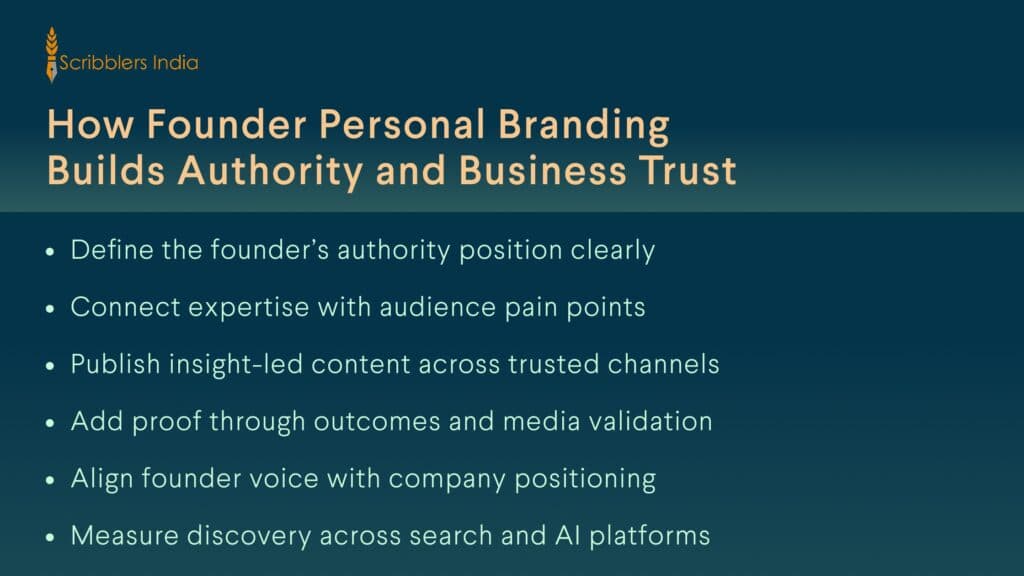
At its core, founder personal branding connects a founder’s experience, viewpoints, and subject expertise with the problems they are qualified to discuss. Done consistently, it can build professional authority, strengthen company trust, and make the founder easier to discover across search, social platforms, media, and AI-led research.
Key Takeaways
|
What Is Founder Personal Branding?
Founder personal branding is the structured process of shaping how a company founder is understood, remembered, and discovered professionally. It connects expertise, positioning, public content, and credible proof around a defined authority position. The founder retains a distinct professional identity, and their visibility can also strengthen confidence in the company.
The process starts by defining why the founder should become known. That position then guides profiles, interviews, LinkedIn content, long-form articles, speaking opportunities, and external contributions.
A strong founder personal brand should make several points clear:
- Which audience should recognize the founder?
- What expertise should they associate with the founder?
- Which experience supports that authority?
- What viewpoints belong distinctly to the founder?
- How does that expertise connect with the company?
- Where can audiences verify the founder’s experience?
This makes founder personal branding different from frequent social posting. Publishing creates visibility, while positioning determines what that visibility should build toward.
Once that foundation is clear, the next question is how founder branding differs from other leadership branding models. The distinction is crucial because founders carry a different relationship with company identity, market story, and business risk.

How Is Founder Personal Branding Different From Executive Branding?
Founder personal branding focuses on the individual who created or leads a business. Executive branding applies more broadly to CEOs, CXOs, senior professionals, and organizational leaders whose public authority extends beyond ownership or creation of a company.
Both approaches build individual authority, though the founder’s identity is often more closely linked to the company’s origins and market direction.
| Area | Founder personal branding | Executive branding |
| Business relationship | Connected closely with a company the person founded | Connected with a leadership role or organization |
| Common themes | Founder lessons, market interpretation, company direction, category thinking | Leadership expertise, organizational insight, functional knowledge, industry perspective |
| Portability | Moves with the founder across future ventures | Evolves across roles and organizations |
| Business influence | Can shape how audiences perceive the company itself | Can strengthen confidence in organizational leadership |
| Content emphasis | Building experience and founder judgment | Leadership expertise and professional perspective |
Founder branding also carries a different balance between personal and company identity. The founder can discuss decisions or lessons that extend beyond the company’s marketing while remaining connected to the problems the business addresses.
Why Can Founder Personal Branding Influence Company Trust?
Founder personal branding can influence trust in the company by giving audiences insight into the thinking behind the business. Product pages explain capabilities and offers. Founder content can reveal how leadership interprets customer problems, responds to market change, and makes decisions when the answer is less obvious.
This becomes especially relevant for startups, SaaS companies, consulting firms, and expertise-led businesses. Buyers often evaluate the people behind the company alongside the solution itself. Founder content can support trust through several signals:
- First-hand explanations of recurring customer problems
- Clear opinions supported by direct experience
- Documented lessons from building the company
- Original frameworks derived from practical work
- Consistent viewpoints across different public channels
- External validation through interviews or industry contributions
The quality of the audience also matters. Our EdTech leader personal branding case study shows how sharper positioning and audience-focused content can extend discovery beyond people already following the leader.
Trust grows more reliably when the founder’s public presence is supported by clear positioning and visible proof. That makes the next question practical: what elements should sit inside a founder personal brand from the start?
What Should a Founder Personal Brand Include?
A founder personal brand should combine clear positioning with credible proof and a repeatable publishing system. Each element should help audiences understand the founder’s expertise without forcing them to piece together an identity from disconnected profiles, posts, biographies, and appearances across different channels.
The following areas create a strong foundation for founder personal branding:
- Clear Positioning: The founder needs a defined audience and authority territory. Broad labels such as “entrepreneur” or “business leader” offer limited differentiation. Stronger positioning connects the founder with a recognizable problem, relevant experience, and a credible professional perspective.
- First-Hand Proof: Operating decisions, customer patterns, company-building lessons, frameworks, and documented outcomes give the founder something original to contribute. These signals separate experience-led authority from commentary that anyone could recreate through secondary research.
- Consistent Content: Articles, newsletters, LinkedIn posts, reports, interviews, and speaking appearances should reinforce related themes of expertise. Founders who cannot write every asset themselves can use ghostwriting services to turn structured interviews into publishable content without losing their original perspective.
- Independent Validation: Media coverage, podcast appearances, conference profiles, industry contributions, and relevant third-party references add evidence beyond channels controlled by the founder. This helps audiences verify authority rather than relying entirely on self-published claims.
Together, these elements create a clearer system of authority around the founder’s name. Once that system exists, it can also influence how search engines and AI platforms understand, retrieve, and describe the founder’s expertise more accurately.
How Does Founder Personal Branding Support Search and AI Discovery?
Founder personal branding can support search and AI discovery by creating clearer public evidence about the person’s expertise. Consistent profiles, original content, detailed author pages, external references, and connected owned assets help search systems understand who the founder is and which topics are associated with their professional experience.
This becomes increasingly important when professional research happens through answer-led environments.
A buyer may ask Google AI Mode, ChatGPT, Gemini, or Perplexity questions such as:
- Which founders have experience in this category?
- Who explains this business problem clearly?
- Which leaders are associated with this market?
- Who has practical experience solving this challenge?
Founder visibility within these results is never guaranteed. However, accessible evidence gives AI systems more reliable material to retrieve and interpret.
Teams can use the AI Search Discovery Benchmark to compare prompt coverage, citation patterns, source visibility, and description accuracy when evaluating how consistently a founder appears across AI-led discovery journeys.
AI discovery becomes stronger when the underlying authority system has enough time to develop across owned and external sources. That makes timing important, especially when founders expect upcoming pressure from fundraising, hiring, sales, or category-building.
When Should Founders Start Building Their Personal Brand?
Founders should start building their personal brand before an urgent need for visibility arises. Authority develops through repeated exposure and credible proof over time. Starting during a fundraising round, hiring push, or important market launch leaves less time for audiences to become familiar with the founder’s expertise.
Several business situations signal that founder personal branding deserves attention:
- The company enters a crowded category.
- Buyers need education before understanding the product.
- Sales conversations depend heavily on leadership confidence.
- Fundraising is expected within the coming year.
- Recruitment requires access to specialized professionals.
- Competitors dominate important industry conversations.
- Media visibility becomes important for company growth.
- Referral growth depends on stronger category recognition.
Founders should still check whether their existing public presence supports the intended direction before increasing output. A personal brand audit can reveal inconsistent profiles, outdated positioning, weak proof, or topic gaps that should be corrected first.
Starting early gives founders room to build recognition without forcing every post to serve an immediate campaign. The next challenge is keeping that growing personal presence aligned with the company brand without turning it into corporate messaging.

How Should Founder Personal Branding Align With the Company Brand?
Founder personal branding should reinforce the company’s direction while preserving a distinct personal voice. The company explains capabilities and delivery. The founder can explain the judgment, experience, and market interpretation behind those priorities without turning every article or LinkedIn post into promotional company messaging.
Alignment usually requires agreement across four areas:
- Audience: Both brands should understand the same priority stakeholders.
- Problem: Both should consistently describe the customer challenge.
- Promise: Public communication should support compatible expectations.
- Proof: Cases and operating evidence should reinforce each other.
The founder still needs room for personal experience. Leadership lessons, difficult decisions, market concerns, and informed opinions can extend beyond company messaging when they remain connected to the founder’s position of authority.
Clear governance also prevents avoidable conflicts. Teams should define confidential topics, regulatory restrictions, customer permissions, and approval requirements before regular publishing begins.
Clear alignment allows the founder to add interpretation without creating conflicting promises about the company. Once those boundaries are defined, the remaining challenge is building a repeatable system that protects the founder’s time while expanding authority.
How Can Scribblers India Support Founder Personal Branding?
Scribblers India builds founder personal brands around positioning before increasing publishing volume. Our personal branding services connect positioning, founder voice, ghostwriting, thought leadership, authority assets, and AI search visibility so different channels build toward the same professional reputation.
A founder personal branding program can include:
- Positioning foundation: We first clarify what the founder should be known for, which audience matters, and what experience can credibly support that position.
- LinkedIn strategy: Profile messaging and content themes should reinforce the same authority position. We also define a realistic publishing rhythm around the founder’s time and audience.
- Founder interviews: Founders do not need to arrive with finished content ideas. Structured conversations help uncover experiences, observations, stories, and viewpoints worth developing further.
- Ghostwritten content: Useful interview material can be repurposed into LinkedIn posts, articles, newsletters, or other formats while preserving the founder’s judgment and natural way of explaining ideas.
- Thought leadership: Strong founder brands need ideas people can associate with them. We develop recurring themes, original viewpoints, frameworks, and category perspectives from genuine operating experience.
- Authority assets: Longer resources, such as ebooks, reports, guides, and research-led content, give important ideas more depth and provide useful evidence beyond regular social publishing.
- Search and AI discovery: Relevant founder content can be structured around the questions audiences research. AEO and GEO considerations help make that expertise clearer across search and AI-led discovery environments.
- AI visibility measurement: We review how selected AI platforms describe the founder, which topics they associate with the founder’s name, and which sources appear in response to important research prompts.
- Performance refinement: Audience response, discovery patterns, profile activity, and business signals help determine which topics deserve greater emphasis in future content cycles.
Founders with deeper expertise can also use our thought leadership content writing services to develop substantial articles, frameworks, and authority assets that extend their ideas beyond frequent social publishing.
Get in touch with our team today to build a founder personal branding program that makes your expertise easier to understand, trust, and discover across search, social platforms, owned content, and AI-led research.
Frequently Asked Questions
How Do You Measure the Success of Founder Personal Branding?
Measure the founder’s personal branding by tracking changes in relevant profile discovery, audience quality, inbound opportunities, speaking invitations, media requests, branded searches, referral conversations, and commercial influence. Engagement alone provides an incomplete picture. The strongest measurement links increased visibility to the professional outcomes the founder originally sought.
How Long Does It Take to Build a Recognizable Founder Personal Brand?
There is no fixed timeline because recognition depends on existing reputation, publishing consistency, audience size, category competition, and distribution. Founders should evaluate progress across several months rather than individual posts. Early indicators may include better audience relevance and increased profile discovery before larger opportunities or stronger market recognition emerge.
Should Co-Founders Build Separate Personal Brands?
Yes, when each co-founder brings distinct expertise, responsibilities, or perspectives to the business. Separate positioning prevents their content from sounding interchangeable. One founder might own product or technology conversations while another focuses on customers, operations, or industry change. Their individual brands can remain complementary without repeating identical company messages.
Can a Founder’s Personal Brand Become Bigger Than the Company Brand?
Yes, particularly when the founder already has substantial industry recognition or a large professional audience. That visibility can benefit the company, but excessive dependence creates concentration risk. Teams should continue building independent company authority so that customer trust, search visibility, and market recognition do not rely entirely on a single individual.
Does a Founder Need a Personal Website to Build Their Brand?
Not necessarily. A strong LinkedIn profile, company biography, author pages, published articles, interviews, and credible third-party references may provide sufficient foundations initially. A personal website becomes more useful when the founder needs a central place for speaking credentials, publications, media appearances, advisory work, or a growing body of independent intellectual property.
Can Founder Personal Branding Work in Highly Regulated Industries?
Yes, but the publishing system requires clearer boundaries. Founders in financial services, healthcare, legal, security, or other regulated sectors should establish review processes before publishing. Thought leadership can still demonstrate expertise through market interpretation, operational lessons, and educational content without making prohibited claims, revealing confidential information, or creating compliance concerns.
How Should Founder Personal Branding Change After an Acquisition or Exit?
The positioning should evolve from the founder’s previous company role toward the expertise earned through that experience. Content may gradually emphasize category knowledge, investing, advisory work, board roles, or future ventures. Maintaining continuity in established expertise helps audiences understand the transition without permanently tying the founder to a single company identity.
Can Founder Personal Branding Support Investor and Partner Relationships?
Yes. A visible body of informed commentary can provide investors and potential partners with additional context on how a founder understands the market, communicates ideas, and approaches important business questions. It does not replace diligence, financial performance, or operating evidence, but it can strengthen familiarity before formal conversations begin.