
Startups face a different AI search problem from established companies. They need visibility while building the product, refining positioning, and managing limited marketing resources. A large GEO program can therefore consume budget before the company knows which discovery gaps deserve serious investment. GEO for startups should begin with ruthless prioritization.
A young company needs enough public information for buyers and AI systems to understand its category, product, audience, expertise, and proof. It does not need hundreds of optimized pages or an expensive monitoring stack from the first month. The strongest early approach is to build a small information system around real commercial questions. Startups can then expand after evidence shows where AI-led discovery is influencing their market.
Key Takeaways
|
What Does GEO for Startups Mean When the Budget Is Limited?
GEO for startups improves how a young company is understood and surfaced during AI-assisted research without treating every possible visibility tactic as urgent. The work should focus first on commercial pages, buyer questions, credible proof, founder expertise, and simple measurement. Broader content investment can follow these foundations to produce useful learning.
The wider principles behind Generative Engine Optimization still apply. Startups need useful content, clear entity information, and credible public evidence. Their smaller budget changes the sequence rather than the basic requirement.
The shift is already visible in how people search. Deloitte predicts that 29% of adults in developed markets will use AI-enhanced search daily during 2026. That makes AI-assisted discovery part of routine search behavior rather than a separate experimental channel.
The better starting point is understanding which information buyers need before they can confidently consider the company.

Why GEO for Startups Is a Sequencing Problem?
Limited budgets make sequencing more important than volume. A startup can spend heavily on AI visibility tools or new blogs while its positioning remains unclear. GEO for startups works better when each investment removes the next obstacle stopping buyers and AI systems from understanding, validating, or considering the company.
The difference becomes clearer when activities are separated by timing.
| Spend Now | Why It Deserves Priority | Delay Until |
| Clear product or service pages | Buyers need accurate category and value information first | Core positioning becomes stable |
| Commercial question research | Reveals which information can influence buyer consideration | Priority journeys are already mapped |
| Existing-page improvements | Builds on assets already available to search systems | Important pages are already strong |
| Founder expertise content | Adds credible public expertise around emerging brands | Founder has no differentiated insight |
| Basic visibility measurement | Creates evidence before larger investments begin | A baseline already exists |
| Large prompt-monitoring platforms | Useful after the prompt portfolio becomes meaningful | Recurring tracking needs justify cost |
This sequence also fits Google’s current guidance. Google states that AI Overviews and AI Mode need no special technical optimization beyond normal Search eligibility. Strong SEO fundamentals and useful content remain the foundation. Startups can therefore avoid paying early for technical tactics presented as mandatory “AI hacks.”
What Is the Minimum Viable GEO System for a Startup?
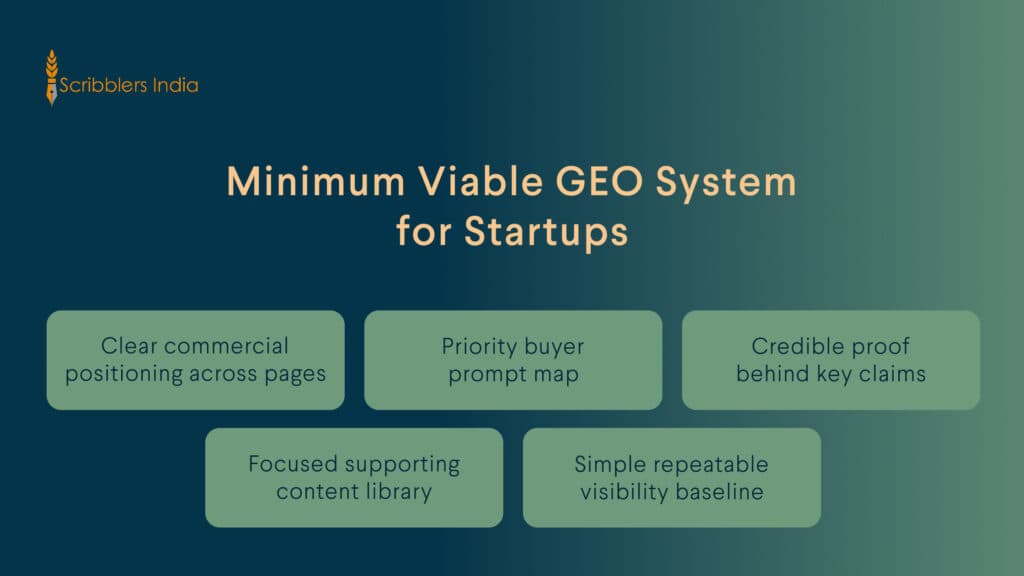
A minimum viable GEO system for startups contains the smallest set of assets needed to accurately describe the startup and support relevant buyer research. It should cover category positioning, commercial questions, product proof, founder expertise, and repeatable visibility checks. Everything else should earn its place after this system works.
- Clear Commercial Information Layer: The homepage and core product pages should explain what the startup provides and who should consider it. Buyers should understand the problem being solved and the major use cases without having to interpret vague category language or conflicting descriptions across the website.
- Commercial Prompt Map: Start with 20–30 questions buyers may ask before contacting the company. Include category discovery and product-fit questions alongside comparisons or objections. Our GEO audit checklist explains why commercial prompts should define the audit before teams examine broad visibility metrics.
- Enough Proof to Support Important Claims: Case evidence, customer outcomes, founder experience, technical documentation, or original insights should support the company’s strongest claims. A startup with limited brand recognition needs verifiable information because buyers cannot rely on years of established market reputation.
- Small Supporting Content Library: Publish content only where important buyer questions lack a suitable answer. The AI content gap analysis framework helps startups separate genuine information gaps from topics that already have adequate coverage on existing pages.
- Repeatable Baseline: Record whether the startup appears across selected commercial prompts and which sources support relevant answers. A simple spreadsheet can establish the first benchmark without purchasing another platform before the team knows what deserves recurring measurement.
Which Startup Pages Should You Fix Before Publishing More Content?
Startups should improve pages closest to commercial evaluation before expanding their blog library. Buyers and AI systems first need accurate information about the company, product, audience, use cases, proof, and commercial model. Missing details on these pages create larger problems with GEO for startups than an incomplete top-of-funnel publishing calendar.
Review pages in this order:
| Page | Question It Must Answer | Common Startup Gap |
| Homepage | What does this company actually do? | Vague category or outcome language |
| Product or service page | How does the solution work? | Feature claims without enough explanation |
| Use-case page | Does this fit my problem? | Generic scenarios without buyer context |
| Pricing page | How does the commercial model work? | Important buying conditions remain unclear |
| Case study | Has this worked before? | Testimonials without enough supporting detail |
| Founder page | Why trust this company’s expertise? | Founder experience remains disconnected from category |
SaaS startups can go deeper with our GEO for SaaS guide, which maps pricing, comparisons, integrations, documentation, and validation pages across the software buying journey. The rule is simple. Fix pages buyers already need before creating more pages for people who may never become buyers.
Which Content Assets Give Highest Early Value with GEO for Startups?
A limited budget should favor assets that answer several important questions or provide information competitors cannot easily reproduce. GEO for startups should therefore focus on commercial explainers, comparison content, customer proof, and founder-led expertise before building broad publishing volume across loosely related informational topics.
- Commercial Explainers: Create detailed pages around what the company does, who needs it, and how the process works. These assets can support both search discovery and AI recommendation prompts while giving prospects a useful destination after they discover the startup.
- Comparison Content: Publish comparisons when real prospects consider the startup against another solution or approach. Explain differences in fit and implementation without forcing every row to favor your company. Honest comparisons create stronger decision support than promotional “why we win” pages.
- Customer Evidence: Build case studies with enough detail to explain the original problem and meaningful outcome. Strong evidence can support several downstream assets while giving AI systems a clearer source for claims that company marketing pages cannot independently substantiate.
- Founder Expertise: Convert useful founder knowledge into articles or research-backed commentary around category problems. Our analysis of content formats that support AI brand mentions found founder-led and expert content can strengthen the wider information environment surrounding a brand.
This is also where a focused content marketing strategy for AI search becomes useful. Every new asset should have a clear job within the buying journey rather than filling an empty publishing slot.
How Can Founder Authority Support GEO for Startups Without a Large Content Team?
Founder authority can give startups credible public expertise before the company has years of independent market coverage. A focused founder strategy turns real experience into searchable ideas, explanations, frameworks, and commentary. It should support company positioning without forcing the founder to become a full-time social media creator.
This approach to GEO for startups works especially well when the founder already carries valuable category knowledge. AI systems and buyers can find evidence of that expertise through bylined articles, interviews, public profiles, and relevant external commentary.
Our thought leadership content writing services focus on turning expertise into defensible ideas rather than generic opinion posts. Startups can use the same principle by selecting one or two areas where the founder has genuine experience and a useful viewpoint.
The guide to hiring a thought leadership agency explains how this work can also support search visibility and buyer confidence. A founder does not need to publish daily for this system to work.
For startups where the founder’s reputation strongly influences buying decisions, personal branding services can align professional positioning with the company’s broader information footprint.
What Should Startups Avoid Spending GEO Budget on Too Early?
Startups should delay work that increases complexity without fixing a confirmed visibility problem. Expensive tools, mass content production, advanced schema projects, and broad digital PR can quickly consume limited resources. Each item should be added to the plan only when a clear information gap or measurement requirement justifies it.
| Delay This Expense | Why It Can Wait | Spend When |
| Enterprise AI tracking platform | Early prompt sets remain small | Manual tracking becomes difficult |
| Hundreds of new blog posts | Volume cannot fix unclear positioning | Topic gaps are validated |
| Advanced schema expansion | Google requires no special AI markup | Normal search use case exists |
| Broad PR retainers | Mentions without category relevance add little | Authority gaps are clearly identified |
| Multi-market GEO program | Early startups often serve narrower ICPs | Real geographic demand expands |
| Daily prompt monitoring | Daily movement rarely changes weekly actions | Fast-moving visibility becomes material |
Google’s 2026 generative search guidance specifically warns against unnecessary AI text files and unsupported optimization hacks. It recommends unique content and strong search fundamentals instead.
This makes limited-budget GEO for startups easier to manage. Spend first where better information can change buyer understanding.
How Should Startups Allocate a Limited GEO Budget?
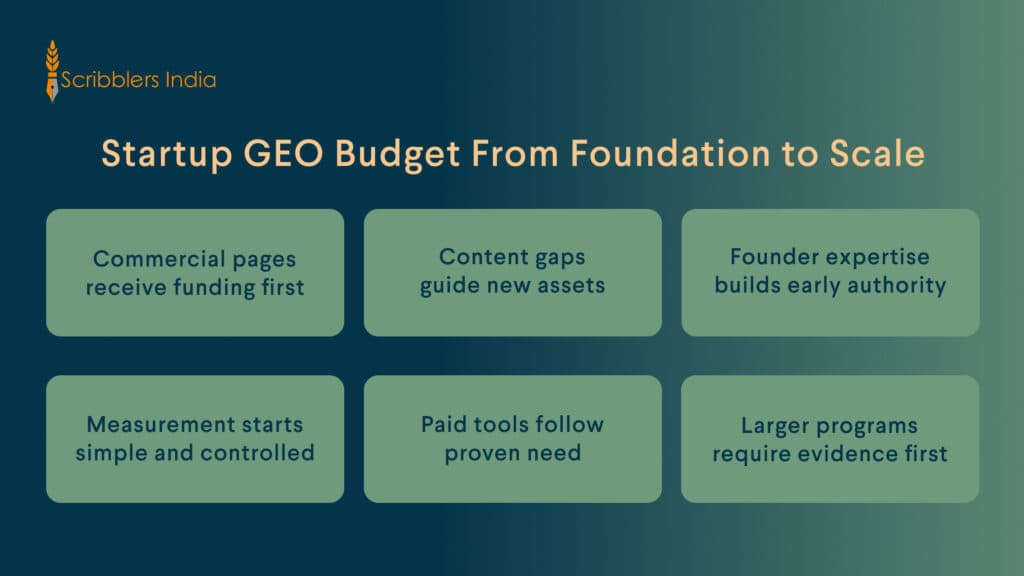
A startup GEO strategy should allocate most early resources toward information buyers can use. Measurement needs enough budget to establish direction without dominating the plan. Authority work should grow gradually as the startup develops stronger proof, clearer founder expertise, and wider category relevance.
Here is a pricing model you can follow for GEO for startups:
| Budget Share | Priority | What It Can Fund |
| 40% | Core commercial content | Product pages, use cases, pricing explanations, comparisons |
| 25% | Gap-led supporting content | Guides, FAQs, objection handling, decision-stage content |
| 20% | Founder and proof assets | Thought leadership, case studies, expert commentary |
| 15% | Measurement and refreshes | Prompt testing, analytics review, targeted page updates |
This allocation should change after the first two or three review cycles. A startup with excellent commercial pages may shift more resources toward authority. Another company may discover serious gaps in its product information and keep most of its spending focused on its website.
Our AI Search Discovery Benchmark provides a broader readiness model to determine where additional effort belongs. It evaluates AI visibility as a connected system rather than rewarding a single isolated tactic.
Can Startups Measure GEO Success Without Expensive AI Visibility Tools?
Yes. Startups can establish a useful baseline with a controlled prompt sheet, Search Console, analytics, and manual source review before buying specialist software. Paid tools become more useful when prompt volume expands or repeated measurements consume enough staff time to justify automation.
Google now directs website owners to its Generative AI performance report in Search Console for relevant AI Search visibility. This gives brands first-party information from Google without another paid subscription.
Companies should combine this information with simple monthly checks as a part of their GEO for startups strategy:
- Track the same 20–30 commercial questions across the AI platforms buyers use.
- Record whether the startup appears and whether its description remains factually accurate.
- Note which company pages or third-party sources appear inside relevant generated answers.
- Compare recurring competitor visibility rather than reacting to a single favorable response.
- Review identifiable AI referral traffic alongside qualified inquiries or product sign-ups monthly.
The AI Search Visibility Scorecard provides a practical framework for reviewing entity clarity and answer readiness, as well as content depth, external validation, and conversion readiness. This provides a startup with enough evidence to decide whether a larger monitoring platform would improve decision-making.
What Metrics Should a Startup Track During Its First GEO Cycle?
The first measurement cycle should show whether the startup is becoming easier to find and describe across commercially relevant questions. GEO for startups does not need a complicated composite score at this stage. A few understandable metrics can reveal whether content work is improving discovery or creating activity without movement.
| Metric | What to Review | Useful Early Signal |
| Commercial prompt presence | Does the startup appear? | More relevant prompt coverage |
| Description accuracy | Is the company explained correctly? | Fewer incorrect representations |
| Competitor share | Who appears more frequently? | Smaller important visibility gaps |
| Cited-page mix | Which assets support answers? | More useful commercial pages |
| AI referral traffic | Are visits arriving from AI platforms? | Qualified discovery begins appearing |
| Business response | Do relevant leads reference AI research? | Visibility connects with consideration |
McKinsey reported in 2025 that half of surveyed consumers already used AI-powered search. It estimated that AI search could influence $750 billion in revenue by 2028. Startups therefore need measurement, but it needs to be tied to decisions rather than to vanity reporting.
The first objective is learning where the brand is absent or misunderstood. Growth in visibility comes after that diagnosis becomes actionable.

When Should a Startup Increase Its GEO Investment?
A startup should increase GEO spending once evidence shows that AI-assisted discovery meaningfully affects buyer journeys and that current execution capacity is limiting progress. Higher investment should follow recurring visibility gaps, stronger referral activity, clearer opportunities for authority, or additional markets. Market excitement alone is a weak justification for scaling.
Use the following scale triggers for your GEO for startups strategy:
- Commercial Prompt Gap: Competitors repeatedly appear in high-value recommendation or comparison questions, while the startup is absent. The team should first confirm that the company genuinely fits those prompts before expanding content or external authority work.
- AI-Referred Demand: Analytics begins to show useful visitors from AI platforms, while sales or sign-up behavior confirms relevant intent. This signal provides stronger justification for continued investment than general assumptions about how fast AI search is growing.
- Content Capacity Constraint: Audits reveal several useful pages or evidence assets, yet the internal team cannot consistently produce them. Additional external support becomes sensible when the bottleneck is execution rather than unclear strategy.
- Category Authority Gap: The startup explains its product well, yet independent sources rarely connect the brand with its category. Carefully selected research or founder visibility can then become a more important part of the next budget stage.
How Can Scribblers India Help Startups Build GEO Without Overspending?
Scribblers India helps startups build a right-sized AI visibility program around their current stage, buyer questions, and existing content. We begin by identifying where the company is missing or unclear during AI-assisted research. The resulting roadmap prioritizes useful fixes before recommending more production or software.
Our approach to GEO for startups can begin with a limited prompt audit and a commercial page review. We examine how the company is described and which competitors appear. We then identify whether the gap comes from positioning, missing answers, weak proof, limited founder authority, or insufficient external context.
Where new content is needed, we focus on high-value assets instead of large publishing calendars. Existing pages receive priority when they can answer the same question with stronger evidence or clearer structure.
We also connect startup GEO with founder authority where that expertise can strengthen the company’s public information environment. This keeps the program focused on credible knowledge rather than manufactured brand mentions.
For teams new to this work, our guide to what GEO services include can help separate useful strategic work from unnecessary activity before a larger engagement begins.
GEO for startups should make a limited budget work harder. Talk with our experts to build an AI search roadmap around the visibility gaps most likely to influence buyer consideration.
Frequently Asked Questions
What Is GEO for Startups?
GEO for startups improves how a young company is perceived in AI-assisted discovery and research. It focuses on clear positioning, strong commercial pages, useful answers, credible proof, founder authority, and basic measurement. Startups should prioritize the information buyers need most before building larger content libraries or expensive monitoring systems.
How Much Should a Startup Spend on GEO?
There is no single required GEO budget for startups. The right level depends on existing content, buyer complexity, internal capacity, and category competition. Early-stage companies should usually fund a focused audit and high-priority content fixes before committing to large recurring programs or expensive AI visibility software.
When Should a Startup Start GEO?
A startup should start when its positioning is stable enough to explain publicly and potential buyers use AI-assisted search during research. The first step can remain small. Audit commercially important prompts, review core pages, correct inaccurate information, and identify the few content gaps most likely to affect consideration.
Should Startups Focus on SEO or GEO First?
Startups should establish sound SEO foundations while preparing important content for AI-led discovery. Google says its generative Search experiences still rely on core Search systems. GEO should therefore extend strong search and content fundamentals rather than compete with them for an entirely separate technical budget.
Does a Startup Need an AI Visibility Tool?
A startup does not necessarily need paid AI visibility software during its first GEO cycle. Manual prompt testing and first-party analytics can establish the initial baseline. Paid tools become more useful when prompt portfolios expand, several competitors require monitoring, or manual measurement starts consuming too much internal time.
Which Content Should Startups Create First for GEO?
Start with commercial pages and proof assets that help buyers understand the company. Product or service pages, use cases, comparisons, case evidence, and founder expertise often deserve priority. Add educational articles only where a genuine buyer question cannot be answered effectively through an existing higher-value page.
Can Founder Content Improve Startup AI Visibility?
Founder content can strengthen the public evidence surrounding a startup when it communicates genuine expertise. Useful articles, interviews, expert commentary, and original frameworks help connect the founder with relevant category topics. The content should reflect real experience rather than generic opinions created mainly to increase publishing frequency.
How Long Should Startups Test GEO Before Increasing Spend?
A 90-day initial cycle can provide a useful checkpoint for many startups. Establish the baseline first, improve priority pages during the next phase, then repeat comparable prompt checks. Increase spending only when results reveal a meaningful opportunity or when internal execution capacity becomes the primary constraint.