A software buyer rarely needs another article explaining that automation saves time. They want to understand whether a product fits their workflow, accommodates their constraints, integrates with existing systems, and delivers enough value to justify switching or spending. This is where SaaS content writing becomes different from generic business writing.
Good SaaS content connects the buyer’s problem with the product’s actual capabilities while answering the questions that appear before a trial, demo, purchase, implementation, or renewal. Those questions now appear across more places than Google alone. G2’s 2025 buyer research found that AI search had changed research behavior for 79% of surveyed software buyers. Enterprise buyers also ranked review sites and AI search among their leading research sources.
The writing, therefore, has a broader role in 2026. It must remain useful on the page while being clear enough for search engines, AI systems, sales teams, prospects, and existing customers to understand consistently.
Key Takeaways
|
What Is SaaS Content Writing?
SaaS content writing is the process of creating content that helps people understand, evaluate, adopt, or use a software product. It combines subject knowledge with buyer context and product detail. Strong writing explains the problem clearly, then shows where the software genuinely fits without turning every article into promotional copy.
Here is how it differs across common content goals:
| Content Goal | Reader Needs | Writing Priority | Typical Asset |
| Understand a problem | Clear explanation and context | Education | Blog or guide |
| Explore possible solutions | Approaches and trade-offs | Category understanding | Pillar article |
| Compare products | Evidence and differentiation | Evaluation | Comparison page |
| Validate a vendor | Product depth and proof | Confidence | Case study or use case |
| Start using the product | Clear steps and limits | Adoption | Help article or tutorial |
A SaaS writer, therefore, needs to understand more than just grammar and SEO. The work sits between buyer education, product communication, and commercial decision support, with the emphasis shifting depending on the page’s role.

How Is SaaS Content Writing Different From General B2B Writing?
The main difference between Saas content writing and normal B2B writing is that software often needs to be understood before it can be valued. SaaS content writing must explain an intangible product, changing features, workflows, integrations, limitations, and outcomes without overwhelming the reader. It must also support buying groups that may evaluate the same platform differently.
A finance leader may want to understand cost exposure and return, while an IT buyer checks integration or security implications. The daily user may care more about usability and workflow changes. Strong content addresses these different questions rather than describing a single generic “target audience.”
Software also changes more often than many traditional B2B offers. Features are added, packaging evolves, interfaces move, integrations change, and AI capabilities develop quickly. Writers therefore need stronger access to product owners, documentation, release information, and subject experts before making specific claims.
Evaluation can also happen before a vendor knows the buyer exists. 6sense found that B2B buyers still complete most of their journey before contacting sellers, even as first contact moved earlier during 2025. Content may therefore influence the shortlist before sales receives any buying signal.
This makes writing part of the product evaluation experience. Buyers should finish a useful page with clearer answers, fewer uncertainties, and a logical next step rather than another collection of broad marketing claims.
SaaS Content Writing vs General B2B Writing: Comparative Analysis
The differences between the two become clearer when you compare what each content type needs to accomplish.:
| Difference | SaaS Content Writing | General B2B Writing |
| Product complexity | Explains software workflows, features, integrations, limits, and outcomes clearly | Often explains services, expertise, processes, or broader business solutions |
| Buying group | Addresses users, IT, finance, security, and operational stakeholders differently | Usually serves fewer stakeholder groups with less technical variation |
| Product change | Requires frequent updates as features, interfaces, and integrations evolve | Usually changes less often after core messaging is established |
| Technical depth | Often needs product documentation, screenshots, demos, and expert input | Can rely more heavily on interviews and general subject research |
| Evaluation role | Helps buyers understand fit before they contact sales teams | Often supports awareness, credibility, and broader lead generation |
| Commercial intent | Moves from education toward detailed product and vendor evaluation | Often remains focused on expertise, category education, or services |
| Proof requirements | Needs product evidence, use cases, integrations, limitations, and outcomes | Usually relies more on case studies, expertise, and industry evidence |
| Refresh frequency | Requires regular review as product reality changes quickly | Often stays relevant longer without major structural updates |
Should SaaS Content Writing Start With the Buyer’s Real Decision?
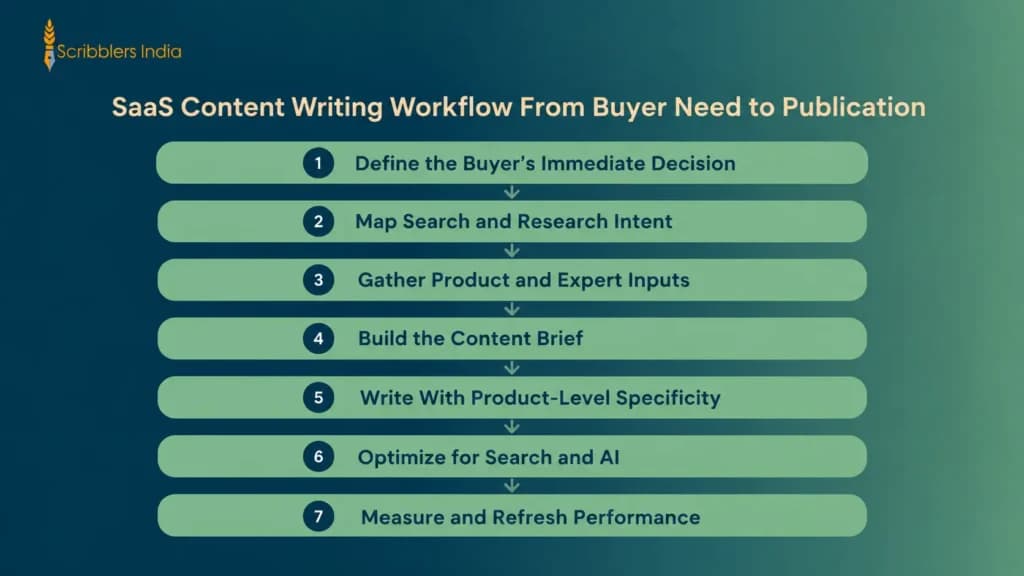
Strong SaaS content writing starts by identifying the decision behind the search, not by expanding a keyword into 2,000 words. A reader may be learning about a problem, comparing approaches, validating a vendor, or preparing to buy. The content should make that next decision easier.
Here are five questions you must answer before research begins:
- Define the immediate problem clearly so the article addresses what changed, failed, slowed down, or created new pressure for the buyer.
- Identify the buyer’s awareness level before deciding how much category education, product explanation, or comparison detail the page requires.
- Clarify the decision being supported because learning, comparing, shortlisting, purchasing, or adopting software each require different information.
- Map the unanswered concerns first around implementation, integrations, security, switching effort, support, pricing, or realistic business outcomes.
- Choose a logical next action based on buyer readiness, rather than repeating the same demo request across every SaaS page.
This decision-first approach should also shape the wider content strategy. It helps teams decide which questions deserve new pages and which existing assets need stronger answers.
Why SaaS Content Writing Must Focus on Buying Situations, Not Personas?
A broad persona provides useful background, but it rarely gives a writer enough context for one specific page. “HR leader at a mid-sized company” does not explain what triggered the search or what decision follows. A buying situation adds that missing context.
Let’s break down the four parts writers should capture:
- Problem situation: Describe the event or friction that made the issue important now. A payroll team may be entering another country, while an IT team may be managing rising integration complexity. This creates a stronger opening than repeating general pain points that could apply to almost any buyer.
- Current workaround: Show how the buyer handles the problem today and where that approach starts failing. Spreadsheets, manual reviews, disconnected platforms, custom scripts, or another vendor often form the basis of the real comparison. Understanding the workaround gives writers a more realistic basis for explaining why change becomes necessary.
- Decision constraints: Identify what can block adoption even when the solution looks attractive. Security requirements, migration effort, implementation capacity, procurement rules, budget limits, or integration dependencies may carry more weight than another feature. Good B2B content writing makes those evaluation concerns visible rather than writing for a generic job title.
- Success definition: Clarify what improvement the buyer is seeking. One team may want fewer processing errors, while another may need faster reporting or stronger controls. This keeps the article focused on the outcome that matters instead of describing every possible benefit the software can provide.
How Much Product Detail Should SaaS Content Include at Each Buyer Stage?
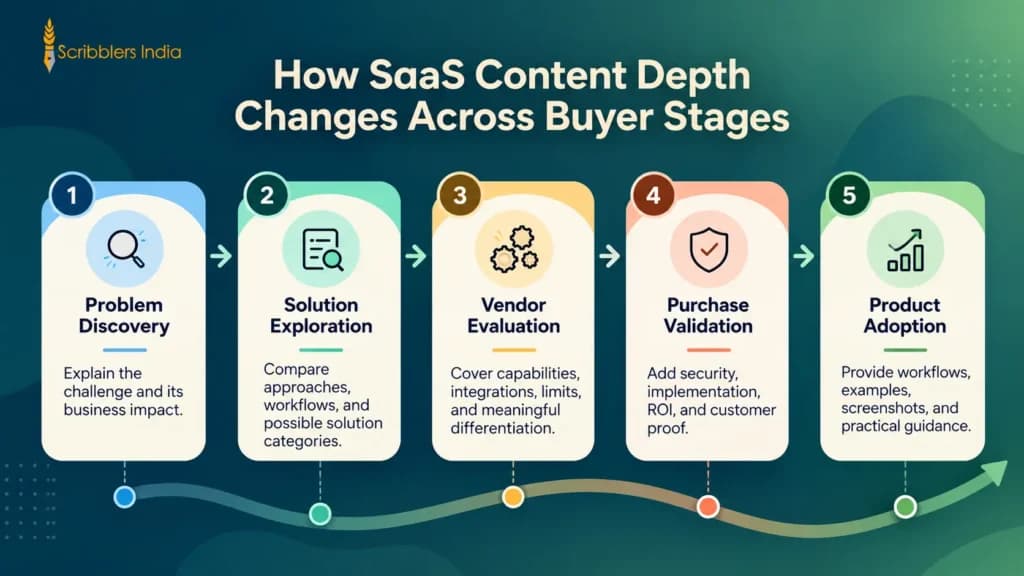
Product depth should increase as the buyer approaches a decision. Early-stage content needs enough detail to explain the problem and available approaches. Comparison or validation content requires much deeper information around product fit, evidence, implementation, and limitations. The table below shows how that depth should change.
| Buyer Stage | Product Depth | Information the Buyer Needs | What to Avoid |
| Problem discovery | Light | Problem context, causes, impact, useful benchmarks | Introducing product features before establishing relevance |
| Solution exploration | Moderate | Approaches, workflows, category options, important trade-offs | Explaining the category without meaningful distinctions |
| Vendor comparison | High | Capabilities, integrations, limitations, proof, differentiation | Hiding meaningful differences behind broad marketing claims |
| Purchase validation | Very high | Security, implementation, pricing logic, ROI, customer evidence | Repeating features already covered during evaluation |
| Product adoption | Operational | Steps, screenshots, workflows, examples, practical troubleshooting | Continuing to sell instead of helping users succeed |
The content does not need to become more promotional as product depth increases. It should become more specific. Buyers closer to a decision need enough detail to judge fit, risk, and implementation rather than another general explanation of why the category matters.
How Do You Explain SaaS Features Without Creating a Feature Dump?
A feature list tells buyers what software contains, but it rarely explains what changes when someone uses it. Strong SaaS content writing connects each important capability with a real workflow, limitation, or decision. This makes technical detail useful without turning the page into product documentation.
An actionable explanation can follow these four stages:
- Begin with the operating problem: Explain what the user is trying to complete and where the existing workflow creates friction. The reader needs this context before the feature appears. Otherwise, product terminology arrives before there is a clear reason to care about the capability.
- Explain how the capability works: Describe what the software actually does in plain language. Technical terminology is useful when it adds precision, but explain it when necessary. Avoid replacing real product detail with phrases such as “powerful platform,” “seamless experience,” or “advanced solution.”
- Show where the capability fits: Discuss dependencies, supported integrations, user roles, workflow conditions, or important limits when they affect product fit. Buyers often value these boundaries because they help determine whether the software can work inside their existing environment.
- Connect the feature with its consequence: Elaborate what becomes easier, faster, safer, or more visible because of the capability without promising unsupported outcomes. The same principle matters across website content writing, especially on product and feature pages where technical clarity influences evaluation.

How Should SaaS Content Be Structured for Answer Engine Optimization?
SaaS content supports AEO by providing clear, self-contained answers to key buyer questions before deeper explanations begin. The goal is not shortening every section into a snippet. Writers should make the central answer easy to identify, then provide sufficient product context, evidence, and limitations so readers can understand it properly.
Here are five actionable strategies to improve your answer readiness:
- Use question-led headings for real queries when buyers naturally ask about comparisons, integrations, implementation, security, pricing, or product fit.
- Answer the question within 40–55 words before adding examples, supporting evidence, workflows, or deeper technical context below.
- Name entities and products precisely so an extracted passage still makes sense without readers seeing several paragraphs before it.
- Support important answers with evidence through product documentation, customer proof, original data, expert input, or credible external sources.
- Link related questions to stronger pages instead of forcing one article to answer every possible variation of the buyer’s problem.
A wider Answer Engine Optimization strategy can then map high-value questions to the most suitable existing pages. That avoids creating several thin articles for closely related queries and keeps answer optimization connected with commercial value.
How Does SaaS Content Support AI Search Visibility and GEO?
AI search visibility requires more than making one page easy to extract. Generative systems can combine information from vendor websites with reviews, publications, customer evidence, comparison resources, and other sources. SaaS content writing, therefore, needs to make the product understandable while contributing to a broader, consistent information footprint around the brand.
Here are the key areas where SaaS writing can strengthen that footprint:
- Clarify the product entity: Keep category terms, product names, audiences, capabilities, and differentiators consistent across important pages. Conflicting descriptions can make a platform harder to understand. Clear entity information also helps readers compare what the product actually offers without having to decode different marketing language across the site.
- Create source-worthy information: Generic category summaries provide little reason for another system to reference the page. Original research, detailed implementation guidance, product comparisons, customer evidence, expert explanations, and practical frameworks provide stronger information. These assets can also support wider AI search visibility beyond conventional ranking positions.
- Strengthen the wider source ecosystem: Owned content is only one part of generative discovery. Reviews, specialist publications, customer stories, credible industry mentions, and expert contributions can reinforce important brand claims. A Generative Engine Optimization strategy examines broader sources rather than treating every visibility problem as an on-page writing issue.
- Keep important claims consistent: Pricing models, integrations, supported use cases, company positioning, security information, and product capabilities should remain current across priority pages. When important facts change, outdated pages can send conflicting signals to buyers and to generative systems that read different parts of the web.
This changes the goal of SaaS publishing. A page should still satisfy the human reader first, but it should also provide reliable information to support discovery, comparison, and accurate brand representation in AI-led research.
How Should Internal Linking Support SaaS AEO and GEO?
Internal links should show how buyer questions connect across the website, rather than appear solely because a keyword needs an anchor. For SaaS brands, that means linking educational pages with comparisons, feature explanations, use cases, case studies, and commercial pages where the relationship genuinely helps someone continue evaluating the product.
A useful internal-linking structure can follow these five AEO and GEO optimization principles:
- Link from broad questions toward specific answers when readers need deeper information about features, implementation, comparisons, or individual use cases.
- Connect educational content with proof assets when a case study, research finding, or customer example supports the explanation.
- Use descriptive anchor text consistently so readers understand what information they will find before opening the linked SaaS resource.
- Strengthen the context of priority commercial pages with relevant informational articles rather than placing unrelated service links throughout every piece.
- Review orphaned and competing pages regularly because weak internal relationships can make both topic ownership and buyer navigation less clear.
The same internal architecture helps a content strategy establish which page should answer each important question. It also reduces duplication when several articles have gradually started targeting the same buyer intent.
When Should SaaS Content Be Refreshed for Search and AI Discovery?
SaaS content can become inaccurate faster than many other B2B assets because the product keeps changing. Features move, integrations expand, pricing evolves, competitors reposition, and buyer questions become more sophisticated. A useful refresh process should therefore review product accuracy alongside search performance and AI visibility. These five signals usually justify another editorial review:
- Product information has changed materially, and the page now describes capabilities, interfaces, workflows, integrations, or limitations users no longer experience.
- Buyer questions have become more specific because new risks, technologies, regulations, integrations, or category expectations now influence software evaluation.
- Search intent has shifted noticeably toward comparisons, implementation guidance, tools, alternatives, examples, or another format the existing article does not satisfy.
- Organic performance declines without technical causes while competing pages provide stronger evidence, fresher product detail, deeper answers, or clearer decision support.
- AI answers describe the product inaccurately or repeatedly favor competing sources for commercially important category, comparison, or recommendation questions.
A refresh does not mean rewriting every section. An AI content gap analysis can first identify missing questions, thin evidence, weak answer structures, or source gaps. Teams can then preserve strong sections while improving the areas that no longer support search or AI-led discovery.
How Can Scribblers India Improve Your SaaS Content Writing Strategy?
Scribblers India approaches SaaS content writing as a combination of buyer research, product understanding, editorial strategy, and search readiness. We first clarify what the asset must accomplish. The writing process then connects that purpose to evidence, product details, a useful structure, and a realistic next step for the reader.
Here is how our approach works across a SaaS content program:
- Content role before production: We identify whether an asset should educate, compare, validate, convert, or support adoption before deciding its structure. This reduces overlap between pages and helps each piece contribute something specific within the wider customer journey.
- Product-informed research: Public research provides category context, but strong SaaS writing also needs product knowledge. We work with available documentation, expert input, approved examples, and customer evidence so that important sections explain the actual solution rather than describing what software in the category typically does.
- Buyer-led editorial structure: Search intent relates to the questions buyers need answered at that stage. Comparisons receive decision criteria, guides receive usable processes, and commercial pages receive stronger proof. Our content writing services extend this approach to longer, more complex buying journeys.
- Search and AI discovery: Content is structured so important explanations remain clear to readers and retrievable by systems. We connect conventional SEO with AEO, where direct answers matter, and then examine broader source and citation gaps when a brand also needs stronger representation across generative search.
- Ongoing editorial improvement: Performance and product changes can expose new gaps after publication. We review content for accuracy, overlap, search shifts, and buyer relevance, rather than assuming every published asset should remain unchanged indefinitely.
Talk to our team today to build SaaS content that clearly explains your product, answers buyer questions, and drives measurable discovery.
Frequently Asked Questions
What does a SaaS content writer need to understand?
A SaaS content writer needs to understand the reader’s problem, product category, relevant workflow, and the specific product being discussed. Search knowledge helps, but it cannot replace product understanding. Writers also need access to reliable evidence and subject experts when technical, security, integration, or implementation claims require specialist review.
What makes B2B SaaS content writing more difficult?
B2B SaaS content often serves several stakeholders involved in the same purchase. Users may care about workflow, while IT teams evaluate technical fit and finance examines value. Longer buying journeys also raise more questions about implementation and risk, so a single broad product message rarely satisfies every stage.
Should every SaaS article mention the product?
No. Product mentions should depend on the reader’s intent and the article’s role. An early educational guide may need limited product discussion, while a comparison or use-case page requires more depth. Forcing the product into unrelated paragraphs can reduce usefulness without creating meaningful commercial value.
How important is SEO for SaaS content?
SEO remains important because search continues to influence software discovery and research. However, keyword placement alone is not enough. Useful pages need clear intent, original information, strong structure, accurate product context, and relevant internal links. Google also continues to emphasize useful, original content across its AI search experiences.
How does AI search change SaaS writing?
AI search increases the importance of clear, self-contained information that systems can interpret accurately. Product details, comparisons, entities, evidence, and direct answers need to be less ambiguous. It also makes external-source coverage more relevant because AI systems may synthesize information from multiple sources before presenting a vendor recommendation.
Which SaaS content formats usually matter most?
The right formats depend on the buying journey. Educational blogs support discovery, while comparison pages and use cases help evaluation. Case studies provide proof, and commercial pages support conversion. Help content becomes important after purchase. Teams should select formats around buyer questions rather than maintaining an arbitrary publishing mix.
How should SaaS companies use AI for content creation?
AI can support research organization, outlining, ideation, editing, and repetitive production tasks. Human review remains important for product accuracy and subject expertise. Content Marketing Institute reported that 81% of B2B marketers used generative AI tools in its 2025 research, while only 4% reported high trust in the outputs.
When should a SaaS company outsource content writing?
Outsourcing can help when internal teams lack production capacity or specialist editorial skills. It works best when the external team receives meaningful product access and clear approval routes. Companies should evaluate research depth, technical comprehension, editorial process, product accuracy controls, and strategic thinking rather than choosing a provider based solely on writing volume.