A professional can publish regularly, maintain an impressive LinkedIn profile, and still leave people unsure what they represent. Key elements of a personal brand work together to solve that problem. They define the professional association someone wants to create and provide sufficient evidence for others to believe it.
That foundation matters because personal branding is increasingly tied to how professionals are researched before direct interaction. A buyer may encounter an article first, while a recruiter may begin with LinkedIn. Someone else may search a name after hearing it during a meeting, podcast, event, or referral.
The strongest brands therefore extend beyond profile optimization or content frequency. They connect positioning with audience relevance, recognizable thinking, credible proof, useful content, professional discovery, and relationships. This guide explains each element and shows how to identify the weakest part of your current reputation system.
Key Takeaways:
|
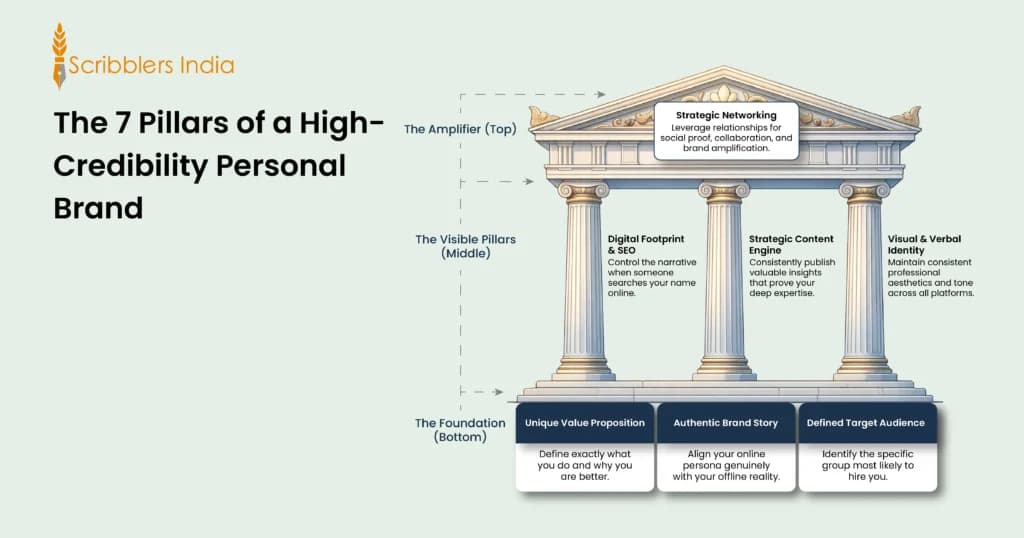
What Are the 7 Core Elements of a Personal Brand?
The seven elements of a personal brand connect what you want to become known for with how others encounter and evaluate that reputation. Each performs a different job. Weakness in one area can limit the others, even when profiles, visuals, or individual content pieces look polished.
Here is how these seven elements fit together:
| Element | Main Question | Role in the Personal Brand |
| Positioning | What should people associate with your name? | Creates a clear professional territory |
| Audience | Whose perception matters most? | Keeps communication relevant |
| Point of View and Voice | How should your thinking become recognizable? | Builds intellectual and verbal distinction |
| Proof | Why should people believe your positioning? | Converts claims into credibility |
| Content System | How will expertise become visible repeatedly? | Demonstrates thinking over time |
| Visibility Architecture | Where can relevant audiences discover and verify you? | Extends reputation across channels |
| Relationships and Validation | Who else reinforces your credibility? | Adds external trust and professional reach |
These components form a reputation system rather than seven isolated tactics. A professional can have excellent content but weak positioning. Another can have strong credentials but limited visibility, leaving valuable expertise difficult for relevant audiences to discover.

1. Personal Brand Positioning to Define What You Want to Own
Personal brand positioning defines the professional association you want people to make with your name. It gives direction to everything that follows, including profiles, content, speaking topics, and visibility efforts. Strong personal brand positioning connects existing expertise with the reputation you want to build next.
The following decisions shape that positioning:
- Authority territory: Choose the professional problem, capability, or area of expertise you want audiences to associate with you. The goal is not to squeeze your career into one narrow label. It is to create enough focus that people can explain what you are particularly well placed to contribute.
- Future direction: Positioning should reflect where your career or business is heading rather than functioning as a summary of past roles. A founder building category authority may need different emphasis from an executive seeking board opportunities or a consultant expanding into strategic advisory work.
- Meaningful differentiation: Distinction often comes from how you approach a familiar problem rather than from inventing an entirely new category. Your operating experience, methodology, professional beliefs, market exposure, or unusual combination of expertise can create a position that feels both credible and recognizable.
- Position before messaging: A polished tagline cannot fix unclear positioning. Define the audience, expertise territory, contribution, and supporting evidence before compressing them into a statement.
2. Audience Clarity to Keep Your Brand Relevant
A personal brand becomes useful only when it matters to the people who influence your professional goals. That audience may include customers or employers, but it can also include investors, board members, employees, industry peers, journalists, or potential collaborators, depending on your role.
The first step is identifying which audience should guide most public communication. A consultant may prioritize prospective clients, while a senior executive may need to consider employees and industry peers alongside future employers. Trying to speak equally to every possible stakeholder usually weakens relevance.
The next step is understanding what those people evaluate. Buyers may look for problem-solving ability, while recruiters may assess leadership scope and career progression. Investors can care about category knowledge or founder credibility. These differences should influence which proof, examples, and topics receive the most attention.
Audience priorities can also change as professional goals evolve. Moving into entrepreneurship, advisory work, international leadership, or board roles may require a different reputation. Revisiting audience definition helps the personal brand remain connected with the opportunities the individual now wants to create.
3. Point of View and Voice to Make Your Expertise Recognizable
Expertise becomes easier to remember when audiences can recognize how someone thinks as well as what they know. Point of view reflects professional judgment, while voice shapes how that judgment is communicated. Together, they make content feel connected with a real professional rather than an interchangeable content engine.
Here are five areas worth developing deliberately:
- Recurring professional beliefs should emerge from real decisions, repeated experience, and lessons about what succeeds or fails in practice.
- Reasoning should accompany conclusions clearly so readers understand why you support one approach and where its limitations begin.
- Natural communication habits should remain across vocabulary, sentence rhythm, examples, explanation style, and the level of certainty you normally use.
- Stories should support professional meaning by explaining how experience shaped a belief, a decision, a method, or a change in perspective.
- Ghostwriting should preserve original thinking rather than replace the individual’s judgment with a polished, interchangeable creator-style voice.
4. Proof and Credibility to Turn Expertise Claims Into Credibility
Positioning tells people what you want to be known for, but proof determines whether they believe it. Strong personal brands, therefore, connect claims to evidence that others can inspect. The most useful proof usually combines demonstrated work, visible thinking, and independent recognition.
Here is how different proof types contribute:
| Type of Proof | What It Demonstrates | Useful Examples |
| Professional outcomes | Expertise has produced meaningful results | Transformations, programs, measurable improvements |
| Experience depth | Judgment comes from repeated exposure | Roles, responsibilities, complex decisions |
| Intellectual proof | Expertise can be examined publicly | Articles, frameworks, research, presentations |
| External validation | Others recognize the expertise | Recommendations, speaking invitations, media references |
No single type of proof is enough in every situation. Results without explanation can lack context, while published opinions without practical experience may feel theoretical. A stronger credibility system combines evidence of what the professional has done, how they think, and how others recognize their contributions.
5. Strong Content System for Consistent Expertise Visibility
Content makes expertise visible before a meeting, a sales conversation, an interview, or a referral. A strong content system does not begin with a posting calendar. It begins by deciding which ideas deserve repeated attention and which formats best demonstrate the depth of knowledge behind the personal brand.
The following four parts help create this system:
- Recurring authority themes: Build content around a limited set of subjects connected with the intended positioning. Repetition at the topic level improves association, while different arguments, examples, and experiences keep the material useful rather than making the feed feel repetitive.
- Different depths of content: Short posts can introduce an observation, while articles or newsletters can explain the reasoning behind it. Research, frameworks, presentations, or case-based analysis can provide deeper proof when audiences need more evidence before trusting the expertise.
- First-hand source material: Meetings, operating decisions, project experience, client questions, and professional disagreements often provide stronger content inputs than general web research. These sources create details generic AI summaries struggle to reproduce and give thought leadership content a more defensible foundation.
- Editorial continuity: Individual posts should contribute to the same broader professional association. A strong personal branding strategy can then define cadence, channel roles, and measurement once the authority territory and content themes are already clear.
6. Visibility Architecture to Expand Brand Discoverability
A strong personal brand requires more than regular posting, as audiences discover professionals through different channels. Someone may first encounter a LinkedIn post, while another person searches the name after a referral. Others may find an interview, an article, a company profile, or an AI-generated answer before visiting a social profile.
Social platforms often provide the most frequent discovery layer. LinkedIn can help professionals repeatedly demonstrate expertise and provide audiences with current context. However, a focused LinkedIn personal branding approach works better when the profile and content support the same positioning rather than when they function as separate activities.
Owned assets provide greater control over depth and longevity. Personal websites, author pages, newsletters, or long-form resources help ensure important ideas remain accessible beyond the short lifespan of social feeds. They also give searchers more substantial material when evaluating the person later.
Search results and AI-led discovery add another layer. Profiles, articles, interviews, and reputable third-party references can collectively shape how a professional is represented. Building a strong personal brand for online reputation, therefore, requires consistent expertise signals across several discoverable sources rather than dependence on a single platform.
7. Relationships and External Validation to Drive Brand Trust
Personal reputation becomes stronger when other people reinforce it. Relationships create referrals, collaborations, recommendations, speaking opportunities, and professional introductions that owned content cannot generate on its own. External validation also shows that expertise is recognized beyond the individual’s own profiles and publishing channels.
The following signals can strengthen that wider reputation:
- Specific recommendations carry greater weight when they describe observed expertise, contributions, working relationships, or outcomes instead of offering general praise.
- Relevant professional communities create context for expertise to become visible through discussions, contribution, collaboration, and repeated peer interaction over time.
- Reciprocal relationships build stronger networks when professionals share useful work, make introductions, exchange ideas, and contribute before requesting opportunities themselves.
- Third-party platforms extend professional reach through podcasts, events, media commentary, guest articles, research collaborations, or carefully selected industry appearances.
- Validation should reinforce positioning consistently because unrelated awards, testimonials, or appearances may add prestige without strengthening the association you want remembered.
How Do These Elements of a Personal Brand Work Together?
The elements of a personal brand become useful when one component creates evidence for another. Positioning defines the professional association, while audience selection determines whose perception matters. Point of view makes that expertise recognizable, and evidence gives others a reason to believe the position reflects genuine capability.
Content then makes the expertise observable before direct interaction. The purpose is not filling a calendar. Repeated public reasoning gives audiences several opportunities to understand how someone approaches important problems, while deeper assets provide more evidence when a decision requires greater confidence or research.
Visibility determines whether that evidence can be found. Social profiles can create frequent discovery, while search and owned assets support longer-term evaluation. External references add another layer, showing that professional recognition does not exist entirely within self-controlled channels.
This explains why isolated personal branding tactics often disappoint. A better profile cannot compensate for vague positioning, while frequent publishing cannot compensate for weak expertise. The system improves when each component reinforces the same professional association through different forms of evidence.
Are Visual Identity and Personal Story Core Branding Elements?
Visual identity and storytelling support personal branding, but they work best when they express deeper strategic decisions. A polished color palette cannot define professional expertise, and a compelling life story cannot establish relevant authority on its own. Both become more useful after positioning and audience priorities are clear.
Visual consistency can improve recognition across LinkedIn banners, websites, presentations, and other professional materials. The level of sophistication should fit the role. An independent consultant may need a more developed visual system than an executive whose identity is already embedded in a corporate environment.
Personal stories can explain how experience shaped professional judgment. The strongest stories have a reason to appear because they clarify a belief, decision, lesson, or point of view. Sharing hardship or private information merely because personal content receives engagement can weaken professional relevance.
The distinction helps prevent personal branding from becoming cosmetic. Visuals and stories should express the underlying reputation rather than become separate exercises. They matter, but their value depends on the strategic foundation they communicate.
Which Personal Brand Elements Are Critical for Different Professionals?
The same framework applies across professional roles, but the emphasis shifts with the outcome and the stakeholder environment. A founder may link reputation to company growth, while a senior executive assumes organizational responsibilities. Consultants need visible expertise before sales conversations, and career professionals may prioritize discoverability among employers.
Here is how that balance can differ:
| Professional Role | Elements Requiring Greater Emphasis | Why They Matter |
| Founder | Positioning, content, visibility, relationships | Personal authority can support company category and stakeholder trust |
| Senior executive | Audience, point of view, proof, governance-aware visibility | Public communication can affect both leader and organization |
| Consultant | Positioning, proof, content, relationships | Buyers often assess expertise before initiating a conversation |
| Career professional | Positioning, proof, search visibility, network | Recruiters and employers need clearer evidence of fit and capability |
| Subject expert | Point of view, content, proof, external validation | Authority depends on depth and recognized expertise |
The differences matter more as seniority increases. Professionals representing organizations may need stronger communication boundaries than independent experts. Our take on personal branding and executive branding explains how stakeholder complexity changes at the leadership level.

How Can You Audit the Elements of a Personal Brand?
A personal brand audit should compare the association you want with the evidence people can currently find. Review your profiles, search results, published content, external references, and recent opportunities as one system. The following five questions can reveal where the largest gap exists.
- Test positioning clarity first by asking whether an unfamiliar reader can explain what professional association your public presence communicates.
- Review audience relevance carefully by checking whether the people engaging with your work resemble stakeholders connected with your actual goals.
- Look for credible supporting proof across profiles, content, case evidence, external references, and recommendations connected with your claimed expertise.
- Compare content with positioning to see whether recurring topics reinforce your authority territory or scatter attention across unrelated professional interests.
- Measure meaningful reputation outcomes through audience quality, authority signals, opportunities, and financial results using a structured personal branding ROI framework.
Which Personal Branding Mistakes Weaken These Elements?
Most personal branding problems do not begin with poor graphic design or low posting frequency. They arise when professionals confuse activity with reputation building. Clear positioning, defensible evidence, and sustained professional association matter more than appearing busy online. Watch for these five patterns during planning and review.
- Trying to become known for everything: Broad experience can support a career without becoming the public positioning itself. Choose the expertise association most connected with future goals. Related capabilities can remain visible, but they should not compete equally for audience memory across all profiles and content assets.
- Copying successful creators: Formats can be adapted, but another person’s personality or editorial style usually cannot. Creator tactics may also conflict with an executive’s role. Build around your own professional context and audience rather than assuming high engagement proves strategic relevance.
- Treating content volume as consistency: Consistency means repeatedly aligning around recognizable expertise, not publishing every day. A smaller body of substantial work can strengthen authority more effectively than frequent generic commentary that gives audiences no clear reason to remember the person.
- Depending entirely on LinkedIn: Platforms are useful discovery channels but remain rented environments. Important ideas should sometimes move into deeper or owned assets where they can remain searchable and reusable. Diversifying discovery also protects the reputation system from changes in platform reach.
- Measuring impressions without context: Reach says little about who noticed the content or what happened next. Review audience relevance, profile behavior, meaningful engagement, authority signals, and professional opportunities together. High visibility among the wrong audience can produce impressive dashboards without advancing the original objective.
How Can Scribblers India Strengthen the Core Elements of Your Personal Brand?
Scribblers India develops the elements of a personal brand into a single, connected reputation system rather than a series of isolated posts. We begin with what the professional should become known for and who needs to recognize that expertise. Execution then follows those strategic decisions.
Here is how we strengthen different parts of that system:
- Positioning before publishing: The work starts by connecting professional goals with a defensible authority territory and relevant audiences. Existing experience and available evidence help determine which position can be credibly sustained. That foundation then guides profiles, content themes, and future authority-building decisions.
- Voice from real communication: Interviews, existing writing, presentations, and professional discussions reveal how the individual naturally reasons and explains ideas. We document those patterns before drafting at scale. This helps content remain recognizable without reducing someone’s voice to a few generic personality adjectives.
- Expertise into publishable content: First-hand knowledge is converted into LinkedIn posts, articles, thought leadership pieces, newsletters, or deeper authority assets where appropriate. The individual remains the source of experience and judgment, while the editorial process adds research, structure, clarity, and consistency.
- Visibility beyond one channel: Profiles and content support broader professional discovery when the goal requires it. Owned pages, search visibility, external authority opportunities, and reusable content can reduce dependence on a single social feed while keeping the underlying professional position consistent.
- Measurement tied to purpose: Our personal branding services track performance against the intended reputation outcome, not reach alone. Audience quality and authority signals show early movement, while conversations and opportunities reveal whether visibility is becoming professionally useful.
Get in touch with our team to turn your expertise into a clearer, credible personal brand that builds recognition across meaningful professional channels.
Frequently Asked Questions
What are the most important elements of a personal brand?
The most important components are positioning, audience clarity, recognizable thinking, credible proof, useful content, professional visibility, and external validation. Together, they explain what someone should become known for and why others should believe that association. Visual identity and storytelling can support these foundations but should not replace them.
What is the first element you should define in personal branding?
Start with positioning because later decisions depend on what professional association you want to create. Define the expertise territory, future direction, relevant audience, and credible differentiation before writing profiles or planning content. A strong personal brand statement can then express that position more clearly.
Can the elements of a personal brand change over time?
Yes. The elements of a personal brand can evolve as professional goals, expertise, responsibilities, and stakeholder groups change. The underlying reputation should not change randomly, however. Repositioning works best when there is a clear reason and enough new evidence to support the professional association you want to build next.
Is personal branding mainly about LinkedIn?
No. LinkedIn can be an important channel for professional discovery, especially for B2B leaders and specialists. A complete personal brand may also include search results, owned content, speaking appearances, professional communities, media references, newsletters, websites, or other channels that influence how relevant audiences evaluate the person.
Does a personal brand need a unique value proposition?
A clear value proposition can help, but broader positioning matters more than forcing every professional into a single formula. Executives, researchers, founders, consultants, and career professionals create value in different ways. Define the association and evidence first, then decide whether a concise value proposition improves communication.
How important is visual branding for a professional?
Visual consistency can improve recognition and make professional assets feel coherent. It cannot establish authority without relevant expertise and supporting evidence. The required sophistication also varies by role. A consultant building an independent practice may need a stronger visual system than an executive working within corporate brand guidelines.
How often should personal brand content be published?
There is no universal publishing frequency that guarantees authority. Choose a cadence that allows you to contribute meaningful ideas consistently without lowering quality. Strong content should reinforce recognizable expertise over time. Platform frequency matters less than whether the resulting body of work strengthens the professional association you want.
How do you know whether your personal brand is working?
Start by measuring whether relevant audiences can find you and understand what you represent. Then track audience quality, authority indicators, qualified conversations, invitations, referrals, opportunities, and, where appropriate, attributable financial outcomes. These measures provide more useful guidance than impressions or follower growth viewed in isolation.