
AI tools can produce a complete article quickly, but speed does not make the result ready for publication. AI content editing adds the editorial judgment needed before publication. Editors decide whether the draft answers the right question and uses defensible evidence. They also test whether it provides useful information and accurately represents the brand.
That distinction is crucial as AI-assisted production becomes the norm within marketing teams. Ahrefs found that 87% of surveyed marketers used AI to help create content. Another 97% reviewed or edited AI output before publishing. The editing layer is therefore becoming more important, not less.
A strong process also helps teams use AI without turning every article into a predictable, same-sounding summary. This blog explains how to review intent, facts, originality, and structure before publication. It also covers the impact of editing AI-generated content on brand voice, search readiness, and post-publication performance.
Key Takeaways:
|
What Does AI Content Editing Involve?
AI content editing is the structured review of AI-assisted writing before publication. It goes beyond grammar because editors must judge whether the argument is correct, useful, complete, and suitable for its audience. The table below shows where deeper editorial work begins.
| Review Layer | Main Question | Typical Work | Human Judgment Needed |
| Proofreading | Is the language correct? | Grammar, spelling, punctuation | Limited |
| Humanization | Does the writing sound natural? | Rhythm, phrasing, repetition | Moderate |
| Content editing | Is the article worth publishing? | Logic, evidence, depth, examples | High |
| Search review | Can the right audience find and use it? | Intent, headings, links, answer structure | High |
A grammar tool may improve a sentence while missing a weak argument. Good editorial review starts with the page’s purpose. It moves into paragraphs and sentences only after the editor confirms the content deserves publication.
Why Does AI-Generated Content Need Human Editing?
Human review remains necessary because fluent language can hide weak reasoning, missing evidence, or generic coverage. Semrush found that 70% of SEO teams saw faster production as AI’s main benefit. Only 19% said it improved content quality. That gap explains why editorial judgment still matters.
Faster drafting can save production time, yet it can allow weak assumptions to sink deeper into the workflow before anyone questions them. Editors need to challenge the article’s premise and confirm important claims. They should also identify missing context before teams polish a structure that needs rebuilding.
AI content editing also gives subject experts a defined role inside production. They can challenge oversimplified claims, add operational detail, and explain where common advice fails in practice. Their contribution turns familiar summaries into content grounded in real experience rather than in information a model can easily reproduce.
The finished article should aim for more than polished, human-sounding AI. It should help readers understand a problem or make a better decision. How the first draft was produced matters less than the finished quality.

What Should You Check Before Editing Individual Sentences in AI Content?
Before changing wording, confirm that the draft solves the right content problem. A polished article can still fail when it targets the wrong intent or duplicates another page. It may also answer a question the website already covers better elsewhere. Start with these five checks before line editing begins.
- Search intent fit: Confirm what the reader is trying to accomplish and whether the page format supports that task. A comparison query needs clear evaluation criteria and trade-offs, while an implementation query needs ordered steps, dependencies, realistic limits, and enough context to act.
- Page role: Decide what the asset should contribute inside the wider content library before expanding it. A discovery article should not compete with a commercial page already serving evaluation intent. our content strategy services use this distinction when prioritizing content actions across a website.
- Cannibalization risk: Compare the draft with existing URLs that cover similar questions, keywords, or buyer stages. If another page already owns the same intent, strengthen that page or consolidate useful material. Another option is to narrow the new article to a meaningfully different reader need.
- Reader promise: State what the reader should understand, compare, decide, or complete after finishing the article. Then test every major section against that promise. Sections that do not advance the promised outcome should be removed, merged, or repositioned before sentence-level editing begins.
- Evidence availability: Check whether reliable sources, internal data, or subject experts can support the article’s important claims. If essential evidence is unavailable, reduce certainty or change the angle. Strong wording should never substitute for information the organization cannot responsibly support.
What are the Steps to Fact-Check AI-Generated Content?
Fact-checking should happen before stylistic polishing because incorrect information can invalidate an entire section. AI content editing should treat every verifiable claim as unconfirmed until a reliable source supports it. That includes numbers, dates, product details, quotations, technical statements, and regulatory references. Use these five checks systematically.
- Highlight checkable claims first: Mark every statement a reader could verify elsewhere, rather than relying solely on statistics. Product capabilities, timelines, market claims, and research findings can all contain errors. Technical explanations, legal references, and named examples need the same scrutiny.
- Trace claims to original sources: Prefer regulators, official documentation, first-party research, or the organization that produced the underlying data. Secondary summaries may help locate evidence. However, they can remove methodology notes or caveats that materially change what the original source supports.
- Check source recency carefully: Fast-moving subjects can make formerly accurate information stale within months. Review current product documentation, regulations, search guidance, pricing pages, or platform policies before retaining an older claim. A valid historical source may still be unsuitable for a current recommendation.
- Match wording with evidence: A credible source may still fail to support the sentence written in the draft. Check population, geography, timeframe, sample size, and measured outcome before drawing conclusions. Narrow the language whenever the evidence supports a smaller claim than the draft makes.
- Remove unsupported certainty: Do not preserve a strong claim because it sounds authoritative or supports the article’s argument. Reframe it, explain the limitation, or remove it when evidence remains weak. Scribblers India’s Google penalty guide for AI content explains the related search-quality risks in greater detail.
Can You Identify Generic AI Writing Patterns?
Generic AI language usually becomes apparent through repetition rather than a single suspicious word. Editors should look for predictable openings, symmetrical sentences, vague authority, abstract verbs, and summaries that add nothing new. These five signals help identify patterns without turning editorial review into a detector-chasing exercise.
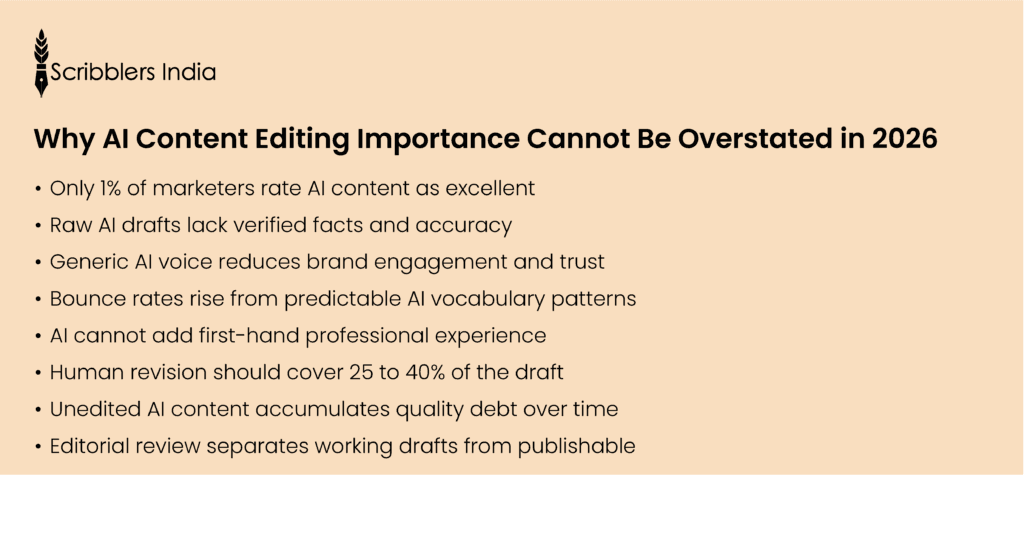
- Generic openings delay useful information when broad statements about change replace the reader’s real problem, evidence, or decision.
- Vague authority weakens factual trust when phrases such as “experts agree” replace a named study, source, practitioner, or example.
- Repeated sentence shapes feel mechanical when paragraphs follow the same explanation, transition, example, and closing pattern throughout the article.
- Abstract verbs hide useful actions when words such as “optimize” or “enhance” replace specific changes the reader can make.
- Predictable conclusions waste readers’ attention when sections repeat their opening rather than adding a decision, a caution, an example, or a next step.
How Do You Add Original Value Instead of Rewriting Existing Search Results?
Original value comes from information a generic model cannot reliably reproduce from common web summaries. AI content editing should look for missing experience and internal evidence. Specialist reasoning or practical frameworks often add more value than longer familiar explanations. The following sources can add information readers would struggle to obtain elsewhere.
- Subject-matter interviews: Ask experts where standard advice breaks down, which problems recur, and which decisions lead to costly consequences. Specific observations give the article practical depth by explaining what happens during real-world execution. They move beyond the ideal process most competing pages already describe.
- Internal operating knowledge: Delivery teams, product specialists, sales leaders, and customer-facing employees often understand recurring friction that public articles overlook. Editors can turn those lessons into examples, cautions, or decision criteria. They can also add implementation guidance without revealing confidential information or making unsupported performance claims.
- Original frameworks: Build a framework when readers need a repeatable way to assess choices or sequence work. The framework should reflect genuine operating logic rather than forcing ordinary advice into a catchy acronym. Its value comes from simplifying a difficult decision without removing important nuance.
- Small proprietary analyses: Internal audits, anonymized reviews, recurring customer questions, or content-performance observations can reveal useful patterns. Explain the sample, period, and limitations clearly so readers know what the finding can support. Even modest original evidence becomes useful when its boundaries remain transparent.
- Defensible expert positions: Strong content can challenge common advice when experience and evidence support a different conclusion. Our thought leadership services follow this principle by developing ideas experts can explain and defend. The aim is useful differentiation rather than manufactured disagreement.
Should You Restructure AI Content for SEO?
Search-focused editing should organize the page around the reader’s decision path, not the order produced by the model. Headings need distinct purposes, important questions need early answers, and supporting sections should deepen the topic without repeating it. The table below connects common structural problems with clearer editorial decisions.
| Draft Problem | Better Editorial Decision | Why It Helps |
| Several headings answer the same question | Merge them under one clear H2 | Reduces repetition and overlapping subtopics |
| Long setup appears before the answer | Answer within the opening paragraph | Improves scanning and answer extraction |
| Keyword-led headings lack progression | Reorder around reader decisions | Creates a stronger learning journey |
| Related pages are ignored | Add contextual internal links | Clarifies topic relationships and next steps |
| Examples appear without interpretation | Connect each example to a decision | Converts description into practical guidance |
The final search review should check metadata, anchor text, image descriptions, and visible update information. These elements cannot rescue weak content. However, they help readers and search systems understand a strong page once its editorial foundation is sound.
Can AI Content Editing Support AEO and Generative Search?
AEO and generative search depend on many qualities that already make content easier for people to use. AI content editing can strengthen entity clarity and answer completeness without creating separate copy for every platform. It can also improve source attribution and passage-level meaning. The goal is stronger retrieval and clearer interpretation.
Google’s 2026 guidance states that established SEO fundamentals remain relevant to generative AI features in Search. It also emphasizes valuable, unique content over a separate technical trick for AI visibility. Editors should therefore improve the usefulness of the source page first. Platform-specific formatting adds little when it does not improve the underlying answer.
Question-led sections should answer their question early and then explain the reasoning behind that answer. Important organizations, products, experts, and concepts should also be named clearly when they first appear. This approach supports Answer Engine Optimization (AEO) by making important passages easier to understand independently without reducing complex topics to shallow summaries.
The same principle extends to Generative Engine Optimization (GEO), where visibility depends on more than one well-optimized page. Generative systems can draw from owned content and external sources when forming responses. Brands, therefore, need clear source relationships, consistent entity information, and useful content across a broader information ecosystem.
Should AI Detectors Decide Whether Content Is Ready to Publish?
AI detectors should not decide editorial approval because their scores do not measure factual accuracy, usefulness, or search intent. AI content editing should use quality criteria that remain useful even when detector models change. These five rules show where detector tools can assist without controlling publishing decisions.
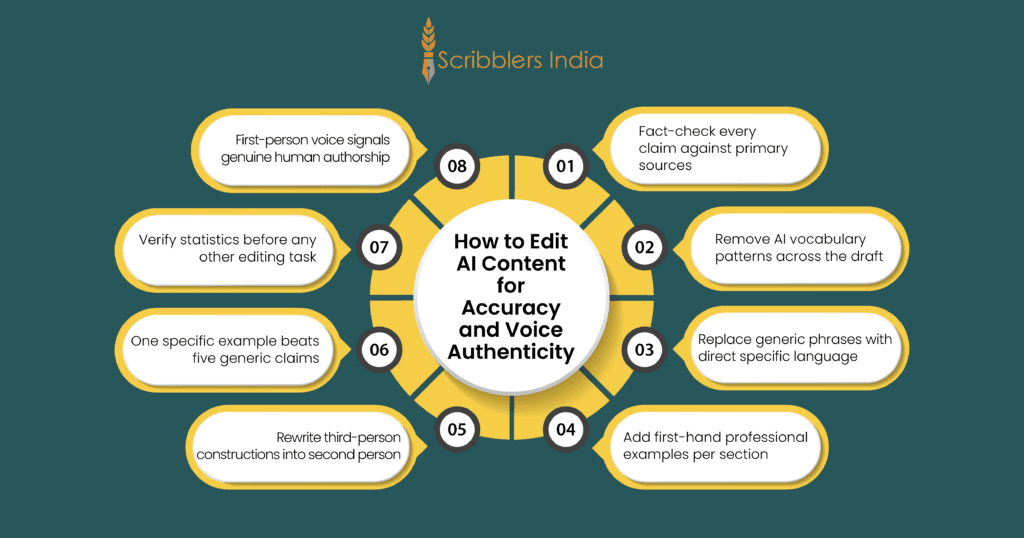
- Use detectors as diagnostics: A tool may highlight unusually repetitive phrasing or sentence patterns that deserve another look. Treat that output as a prompt for editorial inspection. It does not prove that the content is machine-written, inaccurate, low-quality, or unsuitable for publication.
- Do not edit toward a score: Rewriting accurate sentences only to reduce an AI probability can make content awkward. It can also reduce precision without improving substance. Publication decisions should prioritize meaning, evidence, reader usefulness, and brand fit rather than an opaque classification model.
- Check the underlying weakness: A high score may coincide with generic wording, but that wording is the real editorial problem. Improve repeated ideas, weak examples, vague explanations, or predictable structure. Superficial word changes can leave the content equally shallow.
- Respect client requirements carefully: Some organizations still require detector checks for internal review, academic rules, or vendor governance. Editors can complete those checks while documenting what the score does and does not establish. This matters when authorship or factual quality carries material consequences.
- Keep final approval accountable: A named editor, content owner, or qualified reviewer should remain responsible for publication. Automated tools can support QA, but they should not make the final judgment. Humans must decide whether the evidence is sufficient, whether nuance is missing, or whether a claim could mislead.
When Should You Rewrite an AI Draft Instead of Editing It?
Editing is efficient when the draft has a usable foundation, but some pages are too weak to repair economically. AI content editing should identify those cases early rather than protecting text because time was already spent generating it. These four conditions usually make a structured rewrite more sensible than repeated polishing.
- The search intent is wrong: A generic explainer cannot become a strong buyer comparison through sentence edits alone. Rebuild the outline around the real task and the criteria the searcher needs. Add relevant alternatives, evidence, and trade-offs before drafting the page again.
- The factual foundation is unreliable: When important claims cannot be traced, verification may take longer than rebuilding. Start again from reliable sources and document the evidence behind key claims. Use AI only after the research foundation becomes defensible.
- The article adds no information gain: If every section repeats common ranking pages, changing vocabulary will not create differentiation. Rebuild around expert experience, original examples, or proprietary observations. Stronger decision support can also give readers a clear reason to choose this page over competing explanations.
- The page duplicates existing coverage: Similar articles can split links and blur topic ownership across the site. Use an AI content gap analysis before investing in another rewrite. It can show whether consolidation, refreshing, or repositioning the weaker URL makes more sense.

How Can You Preserve Brand Voice During AI Content Editing?
Brand voice should come from recognizable communication habits rather than generic adjectives such as professional or conversational. Editors need to understand how the organization explains difficult ideas, handles certainty, addresses readers, and chooses examples. Use these five checks to preserve identity while still making the draft clearer.
- Match the brand’s certainty level by separating confident expertise from areas where evidence requires caution, qualification, or explicit practical limits.
- Preserve familiar explanation patterns when the organization regularly uses examples, comparisons, definitions, or scenarios to make difficult concepts easier.
- Remove borrowed AI mannerisms when generated phrasing introduces vocabulary, enthusiasm, or rhetorical habits that rarely appear in approved brand content.
- Keep important terminology consistent so service, product, process, and audience labels remain stable across sections unless a reason requires change.
- Adapt tone to the content’s purpose because technical guides, founder articles, service pages, and customer explanations naturally require different levels of formality.
What Should a Final Pre-Publication Checklist Cover?
The final review should test whether the article is strategically complete before minor formatting receives attention. AI content editing works best with a repeatable quality gate. It should cover intent, evidence, originality, search structure, and next-step relevance. These five checks can form the core approval process.
- Confirm one dominant search intent so every major section supports the same reader task without drifting toward loosely related queries.
- Verify every material factual claim against reliable evidence, then reduce certainty wherever the available source supports only a narrower conclusion.
- Check for genuine information gain through expert insight, useful examples, original frameworks, internal observations, or stronger decision guidance than competitors.
- Review structure and internal links so headings progress logically and related pages receive contextual links where they genuinely help readers.
- Extend the final visibility review with Scribblers India’s AI Search Visibility Scorecard when AI-led discovery matters to the page.
What are the Key Metrics To Measure Whether the Editing Actually Improved Performance?
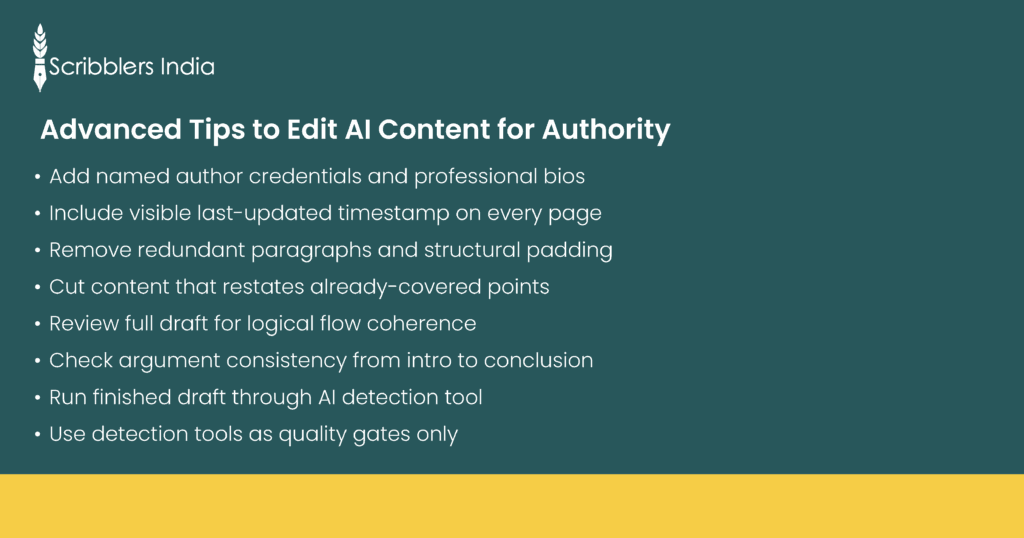
Performance measurement should connect each edited page with the job it was meant to perform. AI content editing may improve rankings, engagement, conversion support, or citation readiness. However, each page will not move equally across every measure. Establish a baseline first, then review metrics that match the page’s purpose.
| Metric | What It Can Reveal | Useful Follow-Up |
| Search impressions | Broader or stronger query relevance | Review query mix for intent drift |
| Organic clicks | Search-result response | Revisit title and description when impressions rise alone |
| Engagement | Whether readers continue using the page | Review weak sections and content progression |
| Conversions | Commercial contribution | Improve CTA relevance and supporting proof |
| AI mentions or citations | Visibility in generative discovery | Review cited sources, entities, and answer gaps |
Measurement needs context because content rarely changes in isolation. Internal links, technical fixes, competitor updates, and search-system changes can influence results during the same period. Teams should avoid crediting every movement to editing alone.
How Can Scribblers India Improve AI-Assisted Content Before Publication?
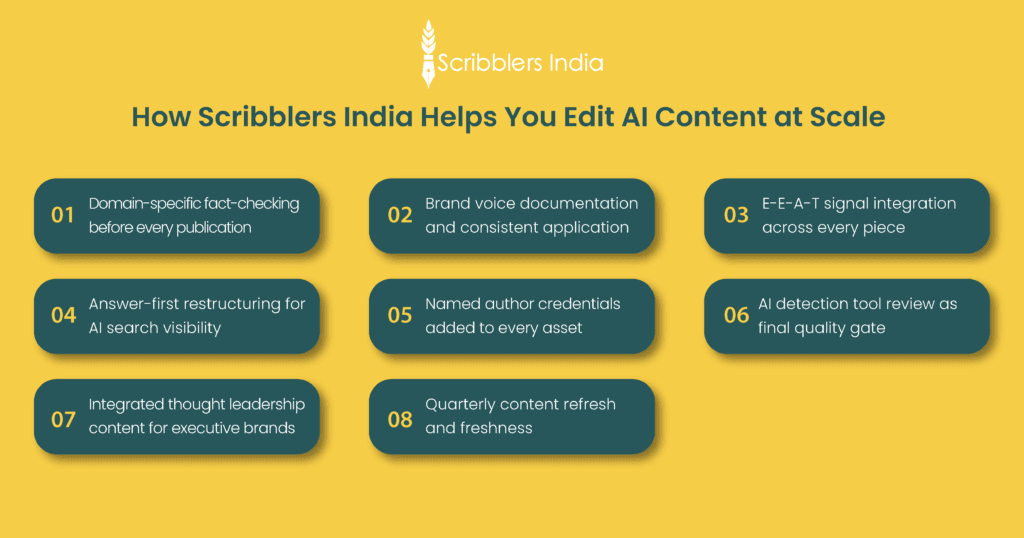
Scribblers India treats AI content editing as an editorial strategy rather than a grammar service. We first determine whether the asset has the right purpose. From there, we strengthen its evidence, structure, expert contribution, brand expression, and search readiness before it reaches publication.
Here is how that process works across different stages:
- Content diagnosis: Every review starts by understanding what the page is meant to achieve and whether another URL already serves the same intent. Performance data, competing coverage, and existing site content help determine whether the right action is focused editing, consolidation, repositioning, or a more substantial rewrite.
- Evidence and accuracy review: Strong writing loses credibility when the underlying information is dated or unsupported. Important claims are checked against reliable sources, while technical or specialist points are flagged for subject-matter review. This gives experts a focused list of issues instead of asking them to recheck an entire draft.
- Structural editing: Repetition, weak sequencing, and unnecessary sections are addressed before sentence-level polish begins. The article is reorganized around the reader’s learning or decision path, while examples, tables, direct answers, and internal links are added only where they make the explanation easier to follow. Our content marketing services can extend this approach across ongoing publishing programs.
- Search and AI visibility review: On-page SEO, answer-led structure, and citation readiness are reviewed as connected parts of the same publishing process. Important entities are clarified, evidence becomes easier to verify, and related pages are logically connected so that readers and search systems can understand how topics fit together.
- Expert-led differentiation: Generic web summaries are replaced wherever first-hand knowledge can make the content more useful. This may come from specialist interviews, internal operating experience, or defensible viewpoints. Brands that need a managed editorial layer can use our AI content-editing services to strengthen their editorial content before publication.
Get in touch with our team to strengthen your AI-assisted drafts with deeper editorial judgment, sharper positioning, and content built for lasting visibility.
Frequently Asked Questions
How much of an AI-generated article should a human editor rewrite?
There is no useful, fixed percentage because draft quality varies by topic, prompt, evidence, and available expertise. An editor may retain most of a well-researched structure while completely rewriting weak sections. The right measure is whether every retained passage is accurate, useful, necessary, and consistent with the intended audience.
Is AI content humanization the same as content editing?
No. Humanization mainly improves phrasing, sentence rhythm, and natural expression. Content editing evaluates the argument, evidence, structure, audience fit, and overall usefulness. Humanization can form one stage of a wider editorial process, but it cannot replace fact-checking, intent validation, or substantive review.
Does Google penalize AI-generated content?
Google does not prohibit content because AI helped create it. Its current guidance focuses on user value. It warns that generating many pages without added value may violate scaled content abuse policies. Teams should therefore assess the finished page rather than the drafting method alone.
Can AI-generated content rank well in organic search?
Yes, AI-assisted pages can rank, but the production method does not guarantee performance. Semrush’s 2026 study found human-written content held an advantage across top positions in its analyzed sample. Most SEO teams still used human-led workflows. Quality and relevance remain central.
Can an AI tool effectively edit its own draft?
AI can help locate repetition, simplify wording, reorganize sections, or suggest missing questions. It cannot independently verify every claim or decide which internal knowledge should shape the final position. A human editor still needs to judge evidence quality, business context, audience fit, and publication risk.
How often should published AI-assisted content be reviewed?
Review frequency should reflect how quickly the topic changes and how commercially important the page is. Product, regulatory, pricing, software, and search guidance may need frequent checks. Stable educational topics can follow a slower cycle, while performance drops should trigger an earlier review regardless of age.
What is the biggest mistake teams make when editing AI content?
The biggest mistake is starting with sentence polish before checking strategy and evidence. Teams can spend hours humanizing a draft that targets the wrong intent or repeats an existing page. A better workflow checks purpose, factual support, and information gain before spending time on voice or stylistic refinement.
Can AI content editing improve visibility in AI search?
It can improve citation readiness by making important information clearer, more verifiable, and easier to extract. However, a single edited article cannot control AI search visibility on its own. Wider brand representation, external sources, entity clarity, and recurring measurement also influence how generative systems describe and cite brands.