Choosing between ghostwriting vs copywriting vs content writing becomes easier when you stop comparing writing styles and start with the job the finished asset must perform. A sales page, executive article, educational guide, founder newsletter, and business book can all contain polished writing while requiring very different inputs and editorial processes.
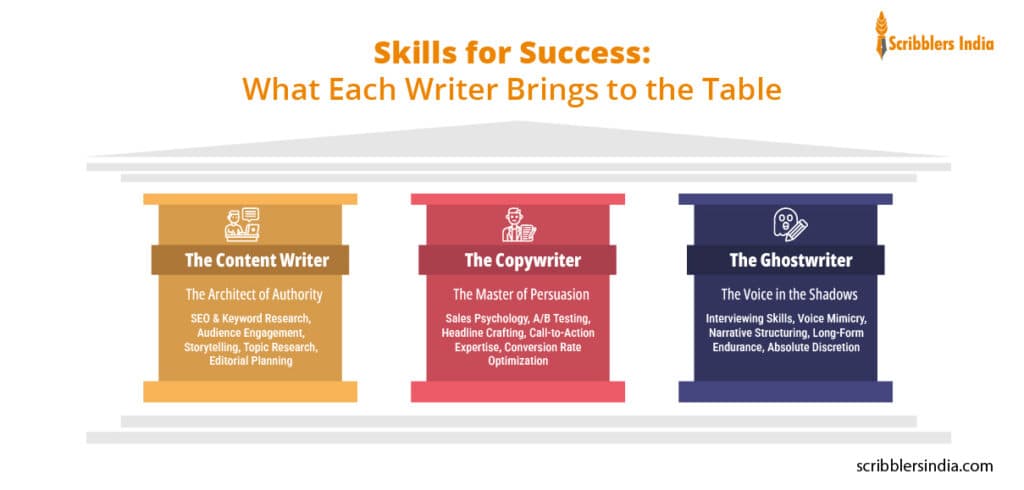
A ghostwriter usually turns another person’s expertise into publishable work under that person’s name. A copywriter helps readers understand an offer and move toward a defined action. A content writer develops useful information that helps audiences discover, understand, or evaluate a subject over a longer journey.
The practical ghostwriting vs copywriting vs content writing decision therefore depends on more than format. You need to consider whose knowledge supplies the material, whose voice appears publicly, what the reader should do next, how claims are verified, and which outcome determines whether the writing worked.
Key Takeaways:
|
What Is the Difference Between Ghostwriting vs Copywriting vs Content Writing?
The main difference in ghostwriting vs copywriting vs content writing is the responsibility each writer carries. Ghostwriting represents another person’s thinking, copywriting supports a defined reader decision, and content writing develops useful information for discovery or education. The format alone does not determine which specialist you need.
Here is a comparison between the three options:
| Comparison Area | Ghostwriting | Copywriting | Content Writing |
| Primary Job | Express another person’s expertise credibly | Move readers toward a defined action | Explain, educate, or support discovery |
| Primary Source | Client interviews, experiences, views, approved evidence | Offer, customer insight, proof, objections | Research, SME inputs, search intent, brand expertise |
| Voice | Individual professional or author | Brand, campaign, or offer | Brand or editorial voice |
| Public Credit | Usually credited to the client | Usually published as brand copy | Brand or named author depending on format |
| Typical Assets | Articles, LinkedIn posts, books, speeches, newsletters | Landing pages, ads, sales pages, campaigns | Blogs, guides, resource pages, educational articles |
| Interview Depth | Usually substantial | Depends on offer complexity | Depends on subject complexity |
| Main Risk | Misrepresenting expertise or voice | Making weak or unsupported persuasive claims | Publishing generic or inaccurate information |
| Success Signal | Source fidelity, voice, authority, usable output | Conversion behaviour and message performance | Discovery, usefulness, engagement, search performance |
| Approval Need | Usually high for executive work | High for claims and commercial messaging | Variable by subject and risk |
| Best Starting Question | What does this person genuinely know or believe? | What decision should this reader make? | What does this audience need to understand? |
This broader ghostwriting vs copywriting vs content writing framework also explains why one writer cannot automatically replace another. Strong sentence-level writing remains useful across all three roles, while the discovery process, evidence requirements, approvals, and definition of success change substantially.

How Does a Ghostwriter Work Differently From Other Writers?
A ghostwriter begins with another person’s knowledge, experiences, opinions, and professional context. In ghostwriting vs copywriting vs content writing, the source relationship is the most important distinction because the finished work usually appears under the client’s name rather than the writer’s.
Professional ghostwriting therefore requires more than matching tone. The writer may interview the client, review previous communication, identify recurring viewpoints, separate factual claims from opinions, research missing context, and develop arguments that the credited author can genuinely defend.
Scribblers India’s ghostwriting services in India use this source-led model. Client expertise remains the intellectual foundation, while the editorial process adds structure, research, clarity, and refinement without manufacturing experiences or professional positions.
What Matters Most in a Ghostwriter vs Content Writer Comparison?
The ghostwriter vs content writer question often comes down to who owns the underlying expertise. A ghostwriter may interview a founder for an article published under the founder’s name. A content writer can research the same subject for a company blog without needing to reproduce one individual’s thinking.
This distinction affects review requirements. Executive ghostwriting usually needs tighter approval because an unsupported statement can be interpreted as the executive’s own position. Standard educational content still needs accuracy, although it may operate under broader brand-level editorial guidance.
The content writing vs ghostwriting boundary becomes particularly important for thought leadership. If an article claims to represent a leader’s first-hand judgment, the process should provide meaningful access to that leader rather than reducing generic internet research to a signed executive opinion.
Businesses deciding whether that deeper collaboration is necessary can use our guide to professional ghostwriting services to evaluate when a source-led ghostwriting program becomes worthwhile.
How Does Copywriting Differ From Ghostwriting and Content Writing?
Copywriting starts with the decision the reader needs to make. The writer works backward through audience context, product evidence, objections, message hierarchy, and the next action. Its primary responsibility is persuasive clarity rather than reproducing one executive’s intellectual voice.
The difference between ghostwriting and copywriting becomes clear on a founder-led business website. A signed founder article may need to preserve the founder’s personal judgment, while the service page needs to explain the offer well enough for a suitable buyer to request a consultation.
A copywriter can still work with interviews, research, and subject experts. The difference lies in how those inputs are used. Evidence supports the offer and buyer decision rather than creating an authored representation of one person’s expertise.
Our copywriting services follow this decision-first model across websites, landing pages, emails, advertising, and sales collateral. The copy is built around what readers need to understand before taking an appropriate next step.
When Does a Copywriter vs Content Writer Decision Matter?
The copywriter vs content writer distinction matters when the same subject appears at different stages of the buyer journey. A detailed guide may answer an informational question, while a service page needs to explain why the offer is a good fit and what the prospective customer should do next.
Content can still influence conversion, and copy can still educate. The distinction concerns the asset’s primary job. A page should not become aggressively promotional just because someone labels it “copy,” and an educational guide does not need to avoid commercial context simply because it is content.
What Does a Content Writer Contribute That the Other Roles Do Not?
Content writers develop informational assets that help audiences discover, understand, compare, or learn about a subject. Research, search intent, SME input, evidence, structure, and internal linking often play a larger role than recreating an individual’s speaking style.
In ghostwriting vs copywriting vs content writing, the content writer often carries the broadest informational remit. Projects can include blogs, resource centres, educational website pages, industry explainers, comparison articles, case studies, or long-form guides supporting organic and AI-assisted discovery.
This work has changed considerably from the older model of “write a blog around a keyword.” Google’s current generative-search guidance emphasizes useful, unique, non-commodity material and warns against creating large volumes of pages merely to capture query variations.
A strong content writer therefore needs to understand why the page deserves to exist. Search intent, information gaps, subject expertise, supporting evidence, internal links, and the role of the URL within the broader site matter alongside writing quality.
For website projects, our website content writing services connect these decisions with page architecture, search intent, wireframes, proof, and internal linking before full drafting begins.
When Should You Hire a Ghostwriter Instead of a Content Writer?
Hire a ghostwriter when the content needs to represent a specific person’s expertise, experiences, or professional point of view. A content writer is usually sufficient when the asset can be developed from approved brand information, research, subject-matter inputs, and a broader editorial brief.
Use ghostwriting when:
- An executive byline carries meaning because readers expect the ideas to come from that individual.
- Firsthand experience drives the argument and cannot be accurately reconstructed through external research alone.
- Voice continuity matters across articles, newsletters, LinkedIn posts, speeches, or other recurring executive communication.
- The subject carries reputation risk because the named author remains accountable for claims and professional judgments.
- The project requires deep source extraction through interviews, presentations, notes, previous writing, or recorded conversations.
- The intellectual property belongs to the author while the writer provides editorial development and execution.
This is why founder thought leadership and business books often need different support from standard company blogging. Our book ghostwriting process shows how discovery, interviews, structure, chapter development, revisions, and author approval work across longer projects.
When Should You Hire a Copywriter Instead of a Content Writer?
Choose a copywriter when the central challenge is moving a reader toward a defined decision. This commonly applies to product pages, landing pages, sales emails, advertising, campaign assets, and sections where offer clarity or objection handling directly affects commercial performance.
Choose a content writer when readers primarily need to understand before they are ready to make that decision. Educational guides, resource articles, explanatory pages, research-led blogs, and informational comparisons often need deeper topic coverage than a tightly focused commercial asset can support.
The distinction should remain practical. A conversion page can contain educational content when buyers need explanation, while an informational article can guide interested readers toward a relevant service. The dominant reader job determines which skill set should lead the assignment.
Can the Same Business Need Ghostwriting, Copywriting, and Content Writing?
Yes. Most content programs require multiple writing disciplines because authority, education, and conversion occur across different assets. The ghostwriting vs copywriting vs content writing decision should therefore assign the right specialist to each job rather than force one universal writer.
A B2B launch shows how these roles can work together without duplicating responsibilities:
- Ghostwriting turns founders’ experience into credible executive articles, newsletters, or thought leadership pieces.
- Content writing develops educational resources around buyer questions, search intent, and research.
- Copywriting builds landing pages, sales emails, and campaign assets designed to drive action.
- Shared insights can move across formats while preserving each asset’s distinct communication purpose.
- Clear ownership keeps voice, evidence, structure, and approvals aligned with every content objective.
One strong founder insight can therefore support several assets without becoming repetitive. The idea stays consistent, while each writer adapts the message to different audience needs, business objectives, publishing contexts, and overall approval requirements.

Which Writer Should You Hire for Different Content Assets?
The fastest way to resolve ghostwriting vs copywriting vs content writing is to define what the asset must communicate and who should appear to own that communication. Format helps with selection, although source ownership and reader intent remain more reliable signals.
| Content Requirement | Likely Lead Specialist | Why |
| CEO Thought-Leadership Article | Ghostwriter | Executive expertise and personal viewpoint drive the asset |
| LinkedIn Executive Posts | Ghostwriter | Voice continuity and recurring source capture matter |
| Business Book | Ghostwriter | Long-form intellectual and narrative development requires author collaboration |
| Keynote Speech | Ghostwriter | Personal voice and speaker delivery need close alignment |
| Company Blog | Content Writer | Research and audience questions drive the informational value |
| SEO/AEO Guide | Content Writer | Search intent, information coverage, and evidence lead |
| Industry Explainer | Content Writer | The asset primarily educates the target audience |
| Landing Page | Copywriter | The page supports a specific commercial decision |
| Paid Advertisement | Copywriter | Space and attention are limited around one action |
| Sales Email | Copywriter | Message, objection, offer, and response matter |
| Founder Newsletter | Ghostwriter / Hybrid | Personal voice may combine with strategic audience action |
| Corporate Website | Content Writer + Copywriter | Informational architecture and conversion messaging overlap |
This analysis is a starting point rather than a rigid professional boundary. Writer capability can overlap. The important question is whether the assigned person understands the intellectual, commercial, and editorial responsibilities associated with the asset.
Can One Writer Handle All Three Types of Work?
Some writers can work across several disciplines, particularly when they have developed research, interviewing, messaging, and editorial skills over time. The ghostwriting vs copywriting vs content writing distinction describes the job being performed rather than three mutually exclusive job titles.
However, range should be demonstrated through process rather than claimed broadly. Someone who writes excellent search-led articles may still struggle with executive voice. A strong ghostwriter may understand persuasive structure but lack experience in designing conversion-focused campaign messaging or testing commercial variations.
For larger programs, specialization can improve efficiency. The ghostwriter can focus on executive ideas, the content writer can build informational depth, and the copywriter can translate product evidence into commercial messaging while editors maintain standards across the system.
How Does AI Change Ghostwriting vs Copywriting vs Content Writing?
AI can accelerate research organization, transcription, outline development, editing, ideation, and early drafting across ghostwriting vs copywriting vs content writing. It does not remove the underlying responsibilities around source ownership, approved claims, audience understanding, voice, evidence, or human accountability.
The practical AI boundary differs by role.
How Should AI Support Ghostwriting?
AI can organize interview transcripts, identify recurring themes, compare drafts against approved voice references, and help explore the structure. The professional still needs to supply genuine experiences, judgments, examples, and final approval because the content appears under that person’s identity.
This requirement has become more visible on professional platforms. LinkedIn now describes low-effort AI content as material lacking clear perspective or substance and reports that views of content classified as “AI slop” have fallen 40% following recent changes.
How Should AI Support Copywriting?
AI can generate messaging alternatives, organize customer objections, produce early variations, and help inspect repetition. Approved claims, buyer evidence, offer mechanics, and final persuasive decisions should remain grounded in reliable business information rather than model-generated assumptions.
How Should AI Support Content Writing?
AI can help cluster questions, summarize supplied material, organize outlines, and identify potential gaps. Writers still need to verify sources, determine which information is useful, remove commodity explanations, and create material that adds more than a synthesis of existing pages.
The common principle is simple: automation should reduce processing work without inventing the expertise or evidence that gives the final asset credibility.
How Do Pricing Models Differ Across the Three Writing Services?
Pricing in ghostwriting vs copywriting vs content writing cannot be compared fairly through word count alone because the inputs differ. A 1,000-word executive article requiring an hour-long interview and voice calibration can involve more editorial work than a longer informational page developed from an established brief.
| Service | Common Pricing Approach | Main Scope Variables |
| Ghostwriting | Project fee, retainer, manuscript milestone | Interviews, voice work, research, approvals, confidentiality |
| Copywriting | Page, project, campaign, or retainer | Offer complexity, research, variations, testing needs |
| Content Writing | Article, page, project, or retainer | Research depth, SEO requirements, SME review, volume |
Ghostwriting often requires more client access, although that does not automatically make every ghostwriting assignment more expensive. A complex enterprise website or regulated copywriting project can require substantial research and stakeholder review. Compare equivalent scopes before judging one provider by headline pricing.
For recurring executive work, our analysis on affordable ghostwriting services in India explains why internal review time and unusable drafts can change the true cost of a seemingly inexpensive engagement.
What Should You Ask Before Hiring Any Professional Writer?
A good ghostwriting vs copywriting vs content writing decision should survive deeper questions about workflow. Portfolio quality matters, but the buyer also needs to understand where the source material comes from, how factual claims are verified, and what the writer expects from internal reviewers.
Ask the following questions of prospective writers or agencies:
- What information do you need before drafting? The answer reveals whether the workflow starts with appropriate evidence.
- Who will write the work? Agency buyers should understand writer assignment and editorial oversight.
- How do you handle factual claims? Responsibility for sources and verification should be explicit.
- How do revisions work? Define review stages and what happens when the brief changes.
- How do you learn our voice? This is particularly important for ghostwriting and brand-sensitive copy.
- Which results can you reasonably influence? Writers should avoid guaranteeing rankings, virality, sales, or commercial outcomes.
- How is AI used? Understand which stages receive automation and which remain human-controlled.
- Who owns the final work and underlying materials? Important rights should appear in the agreement rather than assumptions.
These questions reveal more than a generic request for “writing samples.” The strongest provider should understand the specific job you are hiring them to perform and explain the process they will use to ensure that outcome.
How Does Scribblers India Approach Ghostwriting, Copywriting, and Content Writing?
At Scribblers India, we treat ghostwriting vs copywriting vs content writing as three different editorial jobs within a wider content system. The appropriate workflow begins with the asset’s objective, source material, audience, publishing context, and the person or brand responsible for the finished message.
Our ghostwriting work focuses on extracting and preserving real executive expertise. Copywriting begins with buyer decisions, approved claims, proof, and conversion paths. Content writing connects research and subject expertise with search intent, information gaps, internal linking, and wider content architecture.
This distinction also allows the disciplines to work together. A founder interview can support thought leadership through ghostwriting, inform a deeper educational resource, and eventually strengthen commercial messaging when the insight is relevant to the buyer decision.
Founders and CXOs building recurring authority programs can also connect ghostwriting with our thought leadership services and personal branding services rather than treating each published asset as an isolated writing assignment.
Get in touch with our team to identify the right writing model for your content, audience, expertise, and commercial objectives.
Frequently Asked Questions
What Is the Simplest Way to Compare Ghostwriting vs Copywriting vs Content Writing?
The simplest ghostwriting vs copywriting vs content writing comparison starts with purpose. Use ghostwriting when another person’s expertise and voice need to appear under their name and copywriting when readers need to take a defined action. Consider content writing when audiences primarily need information, education, or deeper understanding.
What Is the Difference Between Ghostwriting and Copywriting?
Ghostwriting usually represents another person’s ideas, experiences, and voice under that person’s name. Copywriting primarily persuades readers to take a specific action using product information, buyer insights, objections, and evidence. Both can require interviews and research, although the intellectual ownership and intended reader response differ.
Can a Ghostwriter Write Blogs and LinkedIn Posts?
Yes. Ghostwriting is defined by authorship and source relationship rather than content length. Executives often use ghostwriters for articles, LinkedIn posts, newsletters, speeches, and books when those assets need to communicate personal expertise consistently under the executive’s name.
Can a Content Writer Write Website Copy?
Yes, especially when website pages require search research, information architecture, educational depth, and internal linking. Conversion-focused pages may also benefit from dedicated copywriting skills. Large website projects often combine content writing and copywriting rather than assigning every page to a single discipline.
Do Ghostwriters Always Remain Anonymous?
Ghostwriters are generally uncredited in the published work, although arrangements vary by project. Some relationships use acknowledgments, co-writing credits, or other agreed forms of disclosure. Contracts should define authorship, confidentiality, portfolio use, ownership, and any permitted public reference to the engagement.
Which Writer Is Best for SEO and AI Search Visibility?
Search-led informational assets generally fit content writers with strong SEO, research, and editorial skills. However, unique executive insights created through ghostwriting can also become valuable searchable material. Google’s current guidance emphasizes unique, useful, non-commodity content rather than prioritizing any one writing discipline.
Is Ghostwriting More Expensive Than Copywriting or Content Writing?
Ghostwriting can cost more when the engagement requires interviews, voice development, deep research, extensive revisions, or executive-level confidentiality. The comparison is not universal. Complex copywriting and technical content projects can also require substantial specialist research and stakeholder review, so equivalent scopes should be compared first.
Can AI Replace Ghostwriters, Copywriters, or Content Writers?
AI can reduce repetitive work across all three disciplines, including transcription, research organization, outlining, and editing. Human responsibility remains important for professional judgment, evidence, claims, audience context, and final approval. The more closely the content represents a person or a high-risk business claim, the more consequential the review becomes.