A customer looking for a nearby business no longer needs to search with a short phrase. They can ask for an accountant experienced with startups near Indiranagar or a dentist who is open on Saturdays with strong recent reviews. AI search can interpret several conditions before suggesting businesses. This trend redefines the importance of GEO for local business.
Visibility now depends on whether search systems can connect a company with the right location and service. Accurate business information and useful local evidence become important parts of that matching process.
Multi-location businesses face an additional challenge. Every branch needs sufficient distinct information to accurately represent its location without fragmenting the wider brand. This blog explains how local businesses can build that information system and measure whether AI-led discovery improves.
Key Takeaways
|
What Is GEO for Local Business?
GEO for local business improves how a company appears inside AI-generated recommendations tied to a geographic need. It connects accurate location information with useful website content and credible external evidence. The goal is to help AI systems understand which location best fits a specific customer question and why.
Traditional local SEO remains the foundation. Google still uses local information to match businesses with nearby users across Search and Maps. GEO adds another layer, allowing people to describe complete situations rather than entering short service-plus-city keywords.
For example, a user may ask for a coworking space near Koramangala that supports day passes and late-evening access. Another may ask which physiotherapy clinic near Powai specializes in sports rehabilitation and has weekend appointments. Those prompts require more than basic category relevance.
Scribblers India’s Generative Engine Optimization services examine this wider discovery environment. Local GEO narrows that work around geographic relevance and location-level accuracy while keeping the brand understandable across every branch. This distinction becomes more important as local discovery begins to span several search experiences.
Why Does AI Search Matter for Local Businesses in 2026?
AI search matters because consumers increasingly use AI tools in their local business research. Google has also integrated conversational AI directly into Search and Maps-related journeys. Local businesses therefore need accurate information across the sources people use before they decide which company deserves further consideration.
An industry study found that 84% of consumers searched online for a local business in the previous three months, according to its 2026 research. The same study found AI tools appeared during 23% of consumers’ most recent local search journeys.
Google’s behavior is changing as well. AI Mode supports complex local recommendation questions, while Google says early AI Mode queries were two to three times longer than traditional searches. Longer prompts create more opportunities for customers to specify location and service needs together.
The implication of GEO for local businesses is functional: brands now compete in richer recommendation contexts, where incomplete information can remove them before a customer reaches their website.

How Do AI Search Systems Find Information About Local Businesses?
AI search systems can combine official business information with website content and wider public sources. Google explicitly states that Local Business Profiles draw information from business owners and public web content. Licensed third-party data and user contributions can provide additional details about real-world businesses.
Google explains that its Business Profiles may combine company-submitted details with information from official websites and external providers. Customer photos or reviews can also contribute to the profile users eventually see.
ChatGPT can also use location information when answering requests that benefit from local results. OpenAI states that ChatGPT search can find local results and use location context where available. It may use third-party providers to help return relevant nearby information.
This creates an important GEO principle. Your website is one source within a wider local information environment rather than the only source defining the business.
A strong GEO strategy for local business must therefore make the same essential facts understandable across owned pages and important public profiles. Once those facts align, content can provide the additional evidence needed for recommendation.
How Is GEO for Local Business Different From Traditional Local SEO?
Local SEO improves visibility across geographically relevant Search and Maps results, while GEO adds AI-generated recommendations and conversational discovery. The two approaches share important foundations. GEO for local business places additional emphasis on detailed prompt matching, information consistency, recommendation context, external evidence, and location-level measurement across generative experiences.
Google says conventional local results mainly depend on relevance and distance, with prominence providing another major factor. Complete Business Profile information helps Google understand how closely a business matches what someone needs. Reviews and links can contribute to prominence.
GEO for local business builds on those fundamentals rather than replacing them.
| Local SEO Focus | GEO for Local Business Focus |
| Local pack and Maps rankings | Inclusion inside AI-generated recommendations |
| Service plus location queries | Detailed conversational local questions |
| Google Business Profile optimization | Cross-source location understanding |
| Local landing-page rankings | Location-level answer and recommendation readiness |
| Review quantity and rating | Review themes, recency, and recommendation evidence |
| Organic calls and visits | AI mentions, referrals, and assisted actions |
The strongest strategy therefore avoids choosing between local SEO and GEO. Businesses need a reliable local search foundation before expecting generative platforms to interpret their locations consistently.
Which Signals Matter Most for Local AI Search Visibility?
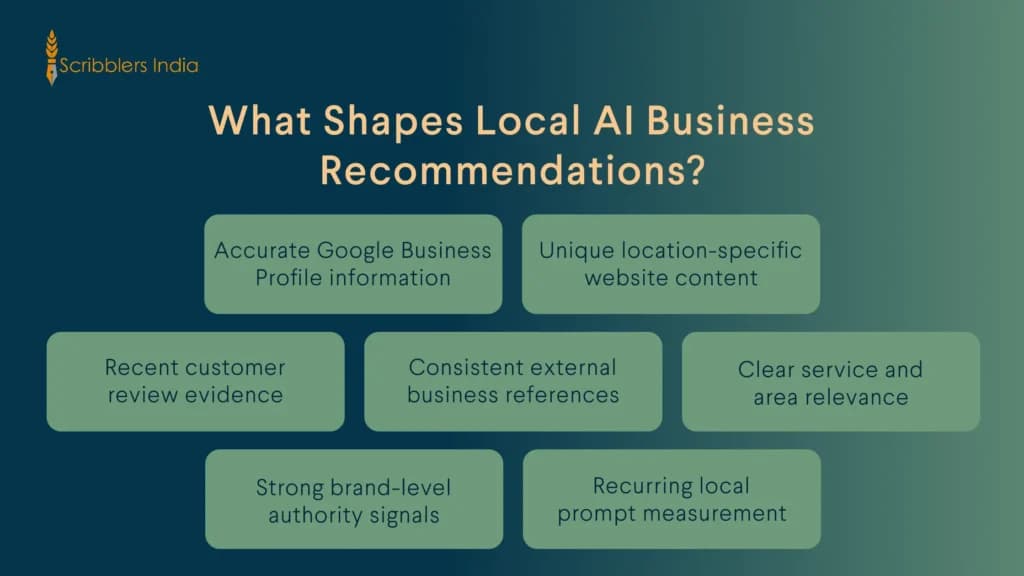
Local AI search visibility depends on a connected set of signals rather than on a single optimization tactic. Accurate Business Profiles establish core facts, while location pages explain individual branches. Reviews and external sources provide supporting evidence. Consistency across those layers reduces ambiguity when AI systems evaluate local recommendations.
A practical GEO for local business strategy should focus on four layers of information.
- Business Profile accuracy establishes the essential facts that publicly define each location. Addresses, operating hours, categories, contact details, services, and relevant attributes should remain up to date enough to support confident local matching.
- Location pages explain what each branch offers within its geographic context. Strong pages connect services to real local needs rather than just changing the city name in a repeated corporate template.
- Customer reviews reveal experience patterns that owned content cannot establish independently. Recent location-specific reviews can reveal recurring strengths or limitations and provide prospective customers with additional evidence before contacting the business.
- External local references reinforce whether the wider web describes the business consistently. Relevant directories, local publications, professional associations, community sources, and industry platforms can help verify category position or location-specific authority.
This model explains why our GEO audit checklist examines source consistency and brand accuracy alongside prompt coverage. Local businesses need the same discipline at the location level.
How Should a Single-Location Business Optimize for GEO?
GEO for local business with a single location should begin by making its core facts consistent and its service expertise specific. The website needs to explain what the company does within the area it serves. Supporting profiles and reviews should confirm the same story rather than creating conflicting descriptions or outdated information.
Start with the local questions customers ask before contacting the business. A clinic may need answers about treatment availability and appointment timing. A home-services company may need clearer service-area information and emergency availability. A restaurant may need details about dietary requirements or reservation options.
The website should then answer those questions where users naturally expect the information. Important service pages need location context without forcing place names into every sentence. Contact pages should state operating details clearly and match the Business Profile.
Scribblers India’s AI content gap analysis framework helps identify missing answers at the decision stage before more content is created. For local companies, those gaps should be reviewed alongside profile information and customer feedback.
Once one location is accurate, the same principles can scale. Multi-location businesses need stronger governance because each additional branch introduces another possible inconsistency.
How Should Multi-Location Businesses Structure Location Pages?
Multi-location businesses should create one useful page for each genuine branch or service location. Every page needs accurate operational details and distinctive local information. Templates can standardize structure, although the visible content should explain how that specific location serves customers rather than repeating corporate copy.
A useful location page should answer the practical questions surrounding that branch.
- Explain exactly which services the location provides rather than assuming every branch offers identical capabilities. Differences in facilities, specialist availability, opening hours, delivery coverage, or appointment types should be clearly indicated where they affect customer choice.
- Include distinctive local context that genuinely helps customers understand or use that location. Nearby landmarks, access guidance, parking details, service neighborhoods, or location-specific facilities can add value when they reflect real customer needs.
- Show relevant evidence from the location rather than relying entirely on company-wide claims. Branch-specific testimonials, team expertise, local project examples, community activity, or location imagery can make the page more informative and independently useful.
- Connect the location page with relevant service content and the wider brand structure. Internal links should help users navigate between branch information and deeper service explanations without creating separate, isolated content ecosystems for each location.
The objective is controlled differentiation. A 100-location company should sound like one brand with 100 real operating contexts, rather than 100 cloned pages competing for similar terms.
How Should Google Business Profiles Support Multi-Location GEO?
Google Business Profiles should act as a reliable location data layer for each eligible branch. Every profile should accurately represent the business and use consistent, real-world naming. Multi-location businesses also need centralized processes to maintain opening hours and profile attributes as local operations change.
Google explicitly recommends complete and accurate information because Business Profiles help determine local relevance. It also requires businesses to represent their names and locations as they exist in the real world.
For larger networks, governance becomes operationally important. Google allows businesses to manage multiple profiles through Business Profile Manager and supports spreadsheet-based bulk updates. Businesses with ten or more locations can also use bulk verification workflows where eligibility requirements are met.
That scale creates a new risk with GEO for local businesses. One incorrect holiday schedule or outdated phone number can spread confusion across a large location estate if central data processes remain weak.
Website pages and Business Profiles should therefore share a controlled location source. GEO becomes easier when factual updates do not depend on multiple disconnected teams manually updating the same information.
How Important Are Reviews for Local AI Recommendations?
Reviews are crucial because local recommendations depend heavily on trust and real customer experience. They provide information about service quality that a business cannot establish through its own marketing copy. Detailed feedback can also show what customers value at a specific location before another customer decides to visit.
A 2025 Yelp and YouGov study surveyed 2,352 people who use reviews when choosing local businesses. It found that 72% now read more online reviews than before when making local purchase decisions. This shows that reviews remain an important verification step during local discovery.
The details in those reviews also matter. The same study found that 88% of reviewers trust written reviews more than star ratings alone. This suggests businesses should value feedback describing real service experiences rather than focusing entirely on increasing their average rating.
Authenticity becomes even more important with GEO for local business. The YouGov-backed study found that 88% of review readers oppose AI-generated reviews, while 94% believe reviews should reflect actual customer experiences. AI visibility therefore increases the importance of genuine customer evidence rather than reducing it.
Local businesses should encourage authentic feedback throughout the year instead of relying on occasional review drives. Responses should address genuine concerns in a natural way. Our research into content formats that support AI brand mentions also identifies review and listing profiles as important components of the broader information environment surrounding a brand.
How Should Service-Area Businesses Approach GEO Without a Storefront?
Service-area businesses should clearly indicate where they operate, rather than creating artificial location pages for places they do not genuinely serve. Their content should connect specific services with realistic coverage areas. Business Profile settings should also reflect actual service operations and follow Google’s eligibility rules.
Google allows eligible businesses that travel to customers to create Business Profiles. Its guidelines require accurate service areas and real-world representation rather than virtual locations created mainly for search visibility.
A plumbing company serving Pune may legitimately explain different service zones where response times or coverage differ. It should not create dozens of near-identical “plumber in neighborhood” pages when those pages contain no meaningful local information.
Service-area content becomes stronger when it explains operational differences. Emergency response zones and service availability can vary geographically. Travel charges and booking lead times may also change. This approach supports generative search for local SEO because AI systems receive clearer information about where the business can realistically serve customers. Accuracy should take priority over geographic page volume.
Does LocalBusiness Schema Improve Local GEO Visibility?
LocalBusiness structured data can help Google understand business information, although it does not guarantee AI recommendations. Google supports LocalBusiness markup for information such as opening hours and business details. Multi-location companies can define individual locations separately, with the markup accurately matching the visible page content.
Google’s Search Central documentation recommends using the most specific appropriate LocalBusiness subtype for each genuine location. It also advises businesses to validate markup and ensure pages remain accessible to Google.
The strategic role of schema should remain proportionate. Accurate markup can reinforce a strong location page, while inaccurate markup can create another conflicting version of the business information.
Brands should therefore treat structured data as representation rather than reputation. Schema can describe a location and its visible facts. It cannot manufacture strong reviews, meaningful local expertise, or community evidence.
The earlier article in this series on schema markup follows the same principle. Technical clarity supports search understanding, while stronger AI visibility depends on the quality and consistency of the wider information system.
How Can Multi-Location Brands Prevent Conflicting Local Information?
Multi-location brands need centralized governance for core facts while allowing controlled local variation in content. Addresses and operating details should follow one trusted source. Local teams can contribute branch-specific information, but shared approval rules should prevent outdated profiles or contradictory pages from being included in the public information footprint.
A realistic governance model separates fixed facts from editable local context.
| Information Type | Central Control | Local Input |
| Official brand name | Required | None |
| Address and contact information | Required | Verification |
| Opening hours | Central system | Local confirmation |
| Service availability | Shared | Location-specific updates |
| Team profiles | Editorial standards | Local information |
| Reviews and responses | Brand guidelines | Local response context |
| Local stories | Quality review | Strong local ownership |
Google can also update Business Profiles using public sources or user reports when it detects conflicting information. Businesses should review those updates rather than assume that submitted details remain unchanged.
The governance challenge increases with scale. A central location database and clear update responsibilities reduce the chance that websites or profiles drift apart across hundreds of branches. Once the information layer is under control, local teams can spend more time creating evidence that truly differentiates their locations.
What Local Content Helps Businesses Earn Stronger AI Visibility?
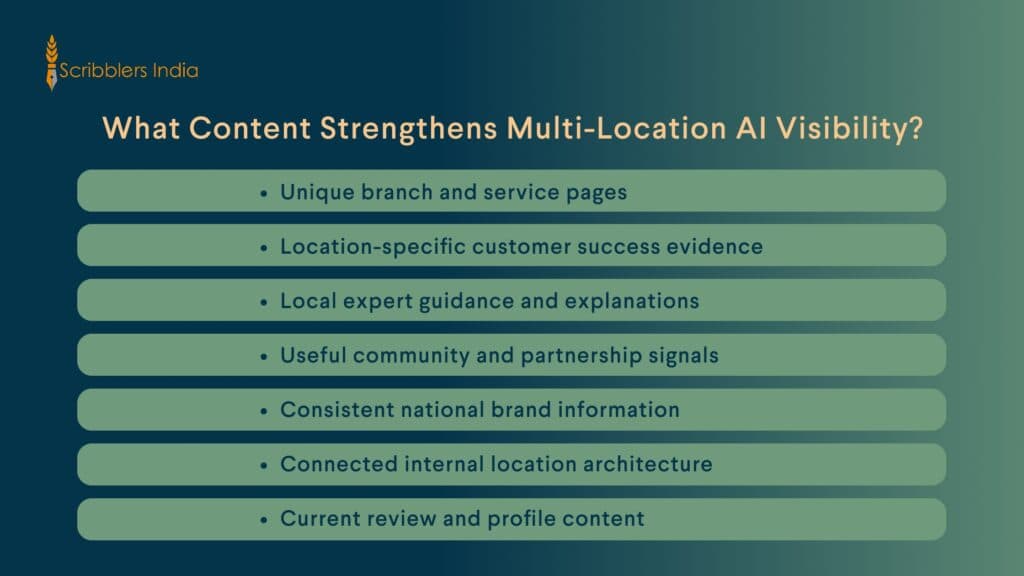
Local content helps when it answers genuine geographic questions rather than attaching city names to generic articles. Useful assets can explain service differences and, where relevant, local regulations. Location-specific case evidence or expert guidance can also provide search systems with information unavailable in basic business profiles.
The following content types can strengthen the information ecosystem for GEO for local business.
- Location-specific service explainers should address operational questions that genuinely change between markets. These pages can clarify availability and local requirements while connecting customers with the branch that best meets their needs.
- Local case studies can show how a branch solved a real customer problem within that market. Specific outcomes and situational context provide stronger evidence than replacing the city name inside a national case-study template.
- Expert guidance can address regulations or practical conditions that differ by geography. The content needs substantive local expertise, since generic advice rewritten for multiple cities results in duplication and lacks meaningful information.
- Community-focused content can document credible partnerships or initiatives when those activities genuinely exist. Local involvement becomes useful as authority evidence when it reflects real relationships rather than promotional articles designed mainly to insert geographic keywords.
Scribblers India’s content marketing guide for AI search explains why each asset needs a defined role across the discovery journey. Local content deserves the same discipline.
What Framework Can Businesses Use for GEO for local business?
Businesses can implement GEO for local business through six connected layers covering accurate facts, location pages, customer evidence, external consistency, prompt testing, and measurement. The sequence begins with information reliability before expanding into content. This prevents teams from tracking AI recommendations while the underlying location data remains inconsistent.
Use this Six-Layer framework for GEO for local business:
1. Establish Location Truth
Create a single trusted source for names, addresses, opening information, and contact details. Every important customer-facing system should receive updates from this controlled source. Accurate foundational information prevents conflicting facts from weakening later optimization work.
2. Strengthen Location Pages
Review whether each genuine branch page clearly explains the location for customers and search systems. Include available services and useful operational details. Add distinctive proof or local context where it improves customer understanding.
3. Build Review Evidence
Develop an ongoing process to collect authentic, location-specific reviews after real customer interactions. Monitor recurring themes and correct service issues when negative patterns appear. Reviews should inform both operational improvement and marketing.
4. Align External Sources
Audit key directories and industry platforms, as well as local association profiles and relevant publications. Essential facts should remain consistent enough to avoid confusion. External descriptions should also reflect the company’s current services and positioning.
5. Test Local Prompts
Build prompt sets around specific location-and-service combinations rather than broad brand questions. Test realistic constraints such as availability or special requirements. Record which locations appear and which competitors receive recommendations.
6. Connect Visibility With Outcomes
Combine prompt findings with Business Profile activity and organic search performance. AI referral traffic and location-level inquiries can provide additional evidence. The objective is to understand whether greater visibility contributes to actual customer actions.

How Should Businesses Measure Local GEO Performance?
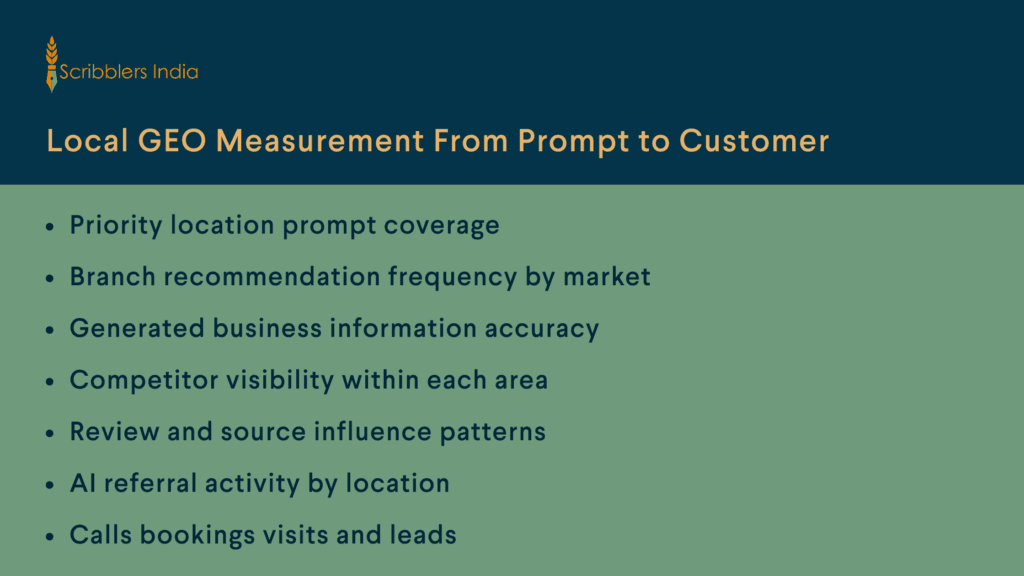
GEO for local business measurement should track visibility at the level where customers search. A national brand mention cannot prove that individual branches appear for local recommendations. Businesses need to conduct repeated prompt testing across priority locations, alongside Business Profile activity, answer accuracy, referrals, and commercial actions.
The same principle appears in the Scribblers India AI Search Discovery Benchmark 2026. AI visibility requires recurring measurement because answers can vary across platforms and over time.
| Metric | What It Shows | Local Decision |
| Location mention rate | Frequency across tracked local prompts | Finds invisible branches |
| Recommendation share | Presence against nearby competitors | Measures local consideration |
| Location accuracy | Correctness of generated information | Finds conflicting data |
| Review themes | Recurring customer experience signals | Identifies trust gaps |
| Cited source mix | Sources influencing recommendations | Guides authority work |
| AI referral activity | Visits from identifiable AI systems | Measures direct discovery |
| Location conversions | Calls, bookings, visits, or leads | Connects visibility with outcomes |
Businesses should avoid testing only brand-name prompts. Strong GEO for local business means appearing when a customer has a problem but has not already selected the company. That distinction helps determine which locations deserve further investment.
How Can Scribblers India Help With GEO for Local Business?
Scribblers India helps local and multi-location brands strengthen the content layer surrounding local AI discovery. We examine location-specific prompts and existing pages before recommending new assets. Our approach also considers source consistency and competitor visibility, so that content work remains connected to real recommendation gaps.
Our GEO services can begin with a focused review across priority locations. We examine how the brand is described and which competitors appear. We then identify where owned content lacks enough detail to support important local questions.
The roadmap can include stronger location pages and service explainers alongside local case evidence or useful supporting articles. Our AI content gap analysis helps distinguish pages that need deeper information from areas where new content is genuinely warranted.
For multi-location brands, we also help develop repeatable editorial structures without turning every branch page into duplicate copy. Our role remains content-led, while internal teams or specialist partners can manage Business Profile operations and technical location-data systems.
Effective GEO for local business makes each location easier to understand before customers decide where to call or visit. Get in touch with our experts to build a local AI visibility strategy around real locations and measurable buyer discovery gaps.
Frequently Asked Questions
What Is GEO for Local Business?
GEO for local business improves how a company appears in AI-generated recommendations aligned with geographic intent. It combines accurate location information with useful website content and external evidence. The approach complements local SEO by focusing additionally on conversational prompts and generated recommendations across relevant AI search experiences.
Does GEO Replace Local SEO for Local Businesses?
GEO does not replace local SEO because conventional local search signals remain important foundations for discovery. Google still uses Business Profile information and other local relevance signals across Search and Maps. GEO extends this work by improving how locations are understood when users ask more detailed conversational questions.
How Does Google Business Profile Affect AI Search Visibility?
Google Business Profile provides Google with important location information, including category details and operating hours. Google can combine those details with public web sources and user contributions. A complete profile improves the reliability of the local information ecosystem, although no profile setting guarantees inclusion within generated AI recommendations.
Do Multi-Location Businesses Need a Separate Page for Every Branch?
A genuine branch should usually have a dedicated page for location-specific information. The page should explain actual services and practical details rather than repeating the same corporate paragraph. Unique proof and operating context can make each location page useful without creating unnecessary keyword-driven duplication.
How Important Are Reviews for Local AI Recommendations?
Reviews provide independent evidence about what customers experience at a business. They can influence conventional local search and help prospective customers verify AI recommendations. Local businesses should focus on authentic, recent feedback and respond meaningfully to recurring concerns, rather than chasing review volume without service improvements.
Can Service-Area Businesses Use GEO Without Physical Locations?
Service-area businesses can use GEO by clearly explaining the areas they genuinely serve and the services available there. Google allows eligible businesses that travel to customers to maintain Business Profiles. The website should avoid creating artificial city pages for markets where the business lacks meaningful service coverage or evidence.
How Should Multi-Location Brands Measure AI Visibility?
Multi-location brands should test a controlled set of local prompts across representative markets and track which branches appear. Measurement should also review the accuracy of answers and the presence of competitors. AI referrals and location-level conversions can provide additional context when the relevant analytics or attribution data is available.
How Long Does Local GEO Take to Show Results?
Local GEO has no fixed timeline for results because starting conditions vary and AI recommendations can change over time. Businesses should first measure implementation quality and information accuracy. Repeated prompt testing after profile or content improvements can then show whether individual locations gain more consistent visibility in recommendations.