A GEO audit checklist should answer a practical question: why does your brand appear, disappear, or get described inaccurately during AI-assisted research? Checking whether ChatGPT mentions the company once cannot answer that question. A useful audit examines the broader information system that supports discovery.
The scale now warrants more structured measurement. Google reported at I/O 2026 that AI Overviews had surpassed 2.5 billion monthly active users, while AI Mode had exceeded one billion. These experiences increasingly support complex exploration and comparison across Search.
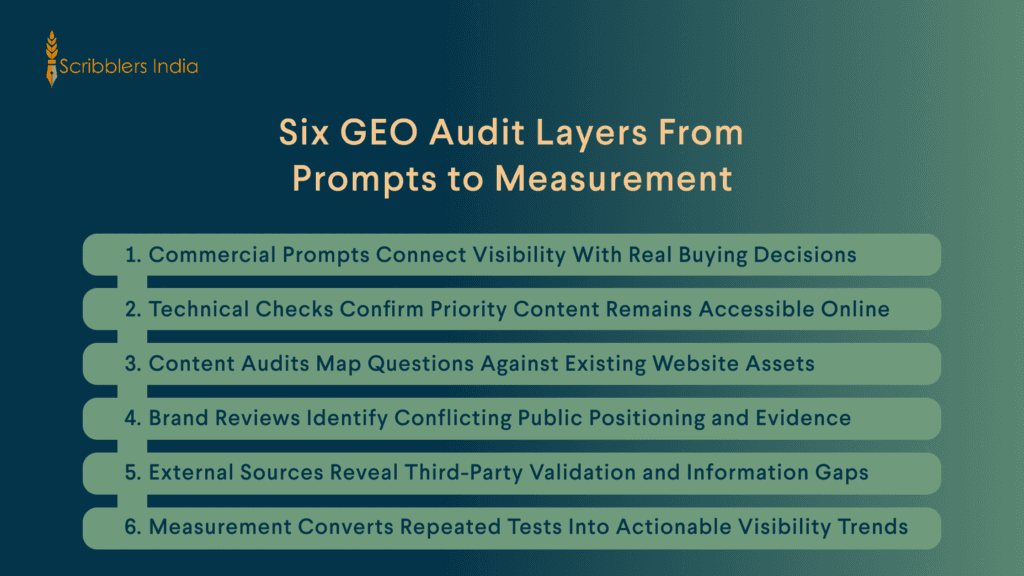
A complete audit should therefore connect commercial prompts with technical access, content coverage, public evidence, and recurring measurement. The framework below covers 25 checks across six diagnostic layers, then shows how to prioritize the findings and convert them into an implementation roadmap.
Key Takeaways
|
What Is a GEO Audit?
A GEO audit examines how a brand appears across AI-assisted discovery and identifies factors that may limit accurate visibility. It reviews relevant prompts, technical accessibility, content coverage, external evidence, and measurement. The output should explain what needs attention and why each recommendation deserves priority.
A GEO audit overlaps with existing search and content diagnostics, although it serves a different purpose. Teams that already understand Generative Engine Optimization can think of the audit as the diagnostic layer that identifies where their wider GEO system breaks down.
| Audit Type | Primary Question | Typical Output |
| SEO Audit | Can search engines access and understand the site? | Technical and search recommendations |
| Content Audit | Is existing content useful and strategically aligned? | Keep, refresh, consolidate, or remove decisions |
| AI Content Gap Analysis | Which important buyer questions remain weak? | Page-level content opportunities |
| GEO Audit | How does the brand appear across AI-led discovery? | Visibility, source, content, and action roadmap |
This distinction prevents duplicated work. A content audit may identify an outdated service page, while a GEO audit asks whether that page supports commercially important prompts and whether external AI-assisted research accurately represents the brand.

Why Should a GEO Audit Start with Commercial Questions?
A GEO audit should start with questions connected to discovery, comparison, validation, or purchase decisions. Generic industry prompts can create impressive screenshots without revealing valuable gaps. Commercial questions give each test a clear reason for inclusion and make later prioritization easier for the business.
Start with the decisions customers make rather than converting an SEO keyword list directly into prompts. A SaaS brand may need category comparisons, while a professional services company may care more about provider recommendations, expertise questions, and evidence supporting its credibility.
Useful prompt families that can feature on your GEO audit checklist are:
- Category Discovery: Questions identifying relevant products, providers, or service categories.
- Best-Fit Recommendations: Questions adding industry, audience, geography, or business constraints.
- Alternatives: Questions exploring substitutes for known brands or existing solutions.
- Direct Comparisons: Questions comparing two or more shortlisted options.
- Use Cases: Questions connecting solutions with specific operating problems.
- Commercial Validation: Questions covering pricing, scope, implementation, or suitability.
- Trust Questions: Questions examining credibility, evidence, expertise, or relevant experience.
- Implementation Questions: Questions addressing practical adoption or service delivery requirements.
Google says AI Mode is particularly useful for nuanced questions involving exploration and complex comparisons. Its systems can also use query fan-out across related searches, which makes buyer journeys a stronger audit foundation than isolated keyword substitutions.
The prompt library serves as the anchor for every subsequent audit layer. Content, technical access, external sources, and measurement should all connect back to the questions that the business has decided are worth influencing.
Which Commercial Prompt Checks Belong in a GEO Audit Checklist?
The first layer of a GEO audit checklist establishes what will be measured and how subsequent comparisons will be conducted. The audit needs commercially relevant prompts, a stable baseline, competitive context, and answer-quality review. Without these elements, later visibility changes become difficult to interpret reliably.
| S. No. | Check | What to Review | Useful Audit Output |
| 1 | Define High-Value Prompt Families | Group questions around actual buyer decisions | Commercial prompt map |
| 2 | Build a Stable Core Prompt Set | Keep important questions unchanged across tests | Repeatable baseline |
| 3 | Record Brand and Competitor Visibility | Capture which relevant brands appear | Competitive visibility record |
| 4 | Test Description Accuracy | Review category, audience, capabilities, and context | Accuracy gap log |
A stable core prompt set should remain separate from experimental prompts. New questions can still be added as markets or products change, while the stable group protects comparability across reporting periods.
For each test, record the exact wording, platform, date, brand appearance, cited sources, competing brands, and answer context. A mention should never automatically receive a positive score in your GEO audit checklist, as an inaccurate or unfavorable description can create a more serious issue than absence.
Another analyst should be able to understand how the baseline was created. If the documentation cannot explain why each prompt matters or how the result was interpreted, the methodology needs improvement before the findings guide content decisions.
Which Technical Access Tests Should a GEO Audit Checklist Include?
An AI search visibility audit should verify that priority information remains technically accessible before recommending major content changes. Google requires no separate technical standard for AI Overviews or AI Mode. Normal Search eligibility still matters, while ChatGPT Search provides its own crawler guidance for public websites.
The next four checks in your GEO audit checklist will help establish that technical foundation:
| S. No. | Check | What to Review | Why It Matters |
| 5 | Confirm Google Eligibility | Indexing and snippet eligibility | Supporting links need normal Search eligibility |
| 6 | Review Robots and Access Controls | Robots.txt, CDN, firewall, hosting restrictions | Important crawlers should not be blocked unintentionally |
| 7 | Review OAI-SearchBot Access | ChatGPT Search crawler permissions | Public content needs suitable access for discovery |
| 8 | Confirm Important Text Is Accessible | Product, service, pricing, or documentation content | Critical facts should not exist only inside inaccessible elements |
Google states that pages appearing as supporting links within its AI features must be indexed and eligible for Search snippets. It also says there are no additional technical requirements and no special schema needed for AI Overviews or AI Mode.
OpenAI separately advises publishers seeking ChatGPT Search discovery to avoid blocking OAI-SearchBot. GPTBot serves a different purpose, so the audit should distinguish search discovery controls from settings related to potential training.
Structured data can still belong inside the review. The useful question is whether the existing markup accurately matches the visible page content, rather than whether another schema type can provide a shortcut to generated answers.
Which Content Checks Should a GEO Audit Checklist Include?
The content layer of a GEO audit checklist determines whether high-value buyer questions have suitable destination pages. It should identify incomplete answers, weak comparisons, missing commercial detail, and outdated information. The purpose is to decide whether each problem needs a refresh or an entirely new asset.
| S. No. | Check | What to Review | Possible Action |
| 9. | Map Prompts to Existing Pages | Find the strongest destination for each prompt | Refresh or create |
| 10. | Review Answer Completeness | Check whether the page answers the core question | Expand missing sections |
| 11. | Audit Comparison Coverage | Review fit, differences, limitations, and evidence | Strengthen evaluation content |
| 12. | Review Commercial Detail | Check pricing logic, scope, use cases, or process | Add buyer information |
| 13. | Test Freshness and Accuracy | Review dates, statistics, claims, and product facts | Update stale information |
Prompt-to-page mapping is where many audits discover that another article is unnecessary. An existing service page may already serve the correct search job but lack one important comparison, a pricing explanation, an evidence point, or an implementation detail.
Scribblers India’s AI content gap analysis goes deeper into these page-level weaknesses. Within a GEO audit, that analysis becomes one layer of a broader diagnosis that connects content gaps to technical access, public sources, and visibility measurement.
How Should You Choose Between Refreshing and Creating Content?
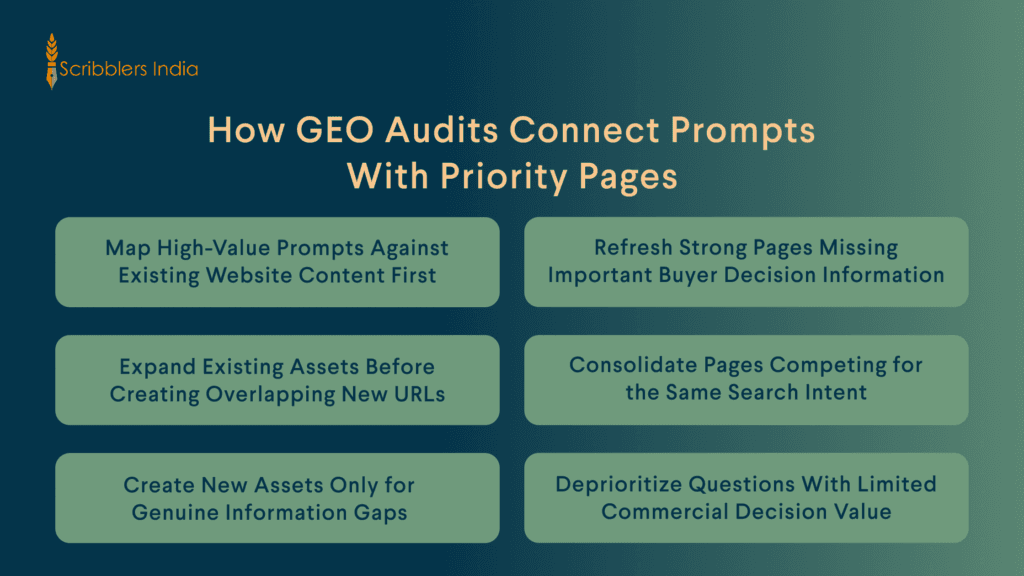
A refresh makes more sense when an existing page already reaches the right audience and serves the right intent. New content is useful when no page answers the question or when the required format differs substantially. This decision helps mature sites avoid cannibalization and unnecessary publishing.
| Finding | Recommended Action |
| Strong Page With Old Evidence | Refresh |
| Useful Page Missing Buyer Detail | Expand |
| Two Pages Serving the Same Intent | Consolidate |
| No Page for a Valuable Prompt | Create |
| Existing Page Has Different Intent | Create a distinct asset |
| Prompt Has Low Commercial Importance | Deprioritize |
A good GEO audit checklist therefore produces an editorial architecture rather than a list of missing keywords. Each important URL should have a clear search task, while every new page should address an information need that existing content cannot meet efficiently.
How Should a GEO Audit Review Brand and Expert Clarity?
A generative engine optimization audit should check whether the brand, its services, and relevant experts are described consistently across owned assets. It should also examine the evidence behind important claims. The objective is factual clarity rather than the manufacture of artificial entity signals.
Layer four of the GEO audit checklist covers the following related checks:
- Check 14 – Organization Consistency: Compare homepage, About page, service pages, and controlled profiles.
- Check 15 – Founder and Expert Information: Review relevant experience, role, authorship, and subject expertise.
- Check 16 – Evidence Behind Claims: Verify important performance, service, capability, or customer assertions.
- Check 17 – Structured Data Consistency: Confirm that the markup reflects the information users can see.
This layer often exposes contradictions that conventional content audits miss. A company may describe itself as belonging to a different category across service pages, LinkedIn profiles, and partner listings, while leadership biographies may list outdated roles or incomplete information on expertise.
Google specifically recommends ensuring structured data matches visible content. That guidance supports a simple audit principle: structured information should reinforce accurate public facts rather than introduce descriptions that users cannot verify on the page.
For teams evaluating broader readiness before commissioning a detailed audit, Scribblers India’s AI Search Visibility Scorecard provides a separate self-assessment across content, authority, answer readiness, and external validation.
Why Should an AI Visibility Audit Examine External Sources?
An AI visibility audit should examine credible public sources beyond the company website because buyers rarely evaluate brands through owned content alone. External pages can confirm expertise, expose inconsistent descriptions, and reveal evidence gaps. The GEO audit checklist should therefore review patterns rather than chase every individual mention.
Layer five includes the following checks:
| S. No. | Check | What to Review | Audit Question |
| 18. | Identify Recurring External Domains | Sources appearing around priority prompts | Which domains repeatedly influence relevant answers? |
| 19. | Review Third-Party Brand Coverage | Media, directories, partners, reviews, expert profiles | Is public information current and credible? |
| 20. | Compare External Evidence | Evidence supporting competing brands | Where does the brand lack credible proof? |
| 21. | Test Description Consistency | Category, audience, geography, service scope | Do external descriptions match current positioning? |
A competitor may have stronger customer evidence, more complete partner profiles, or deeper independent coverage around an important use case. The appropriate response is to address the underlying evidence gap rather than manufacture mentions or manipulate public discussions.
This distinction keeps GEO work connected to legitimate marketing activity. Public evidence becomes useful when it reflects real customer outcomes, subject expertise, partnerships, research, or market participation that buyers can independently evaluate.
How Should a GEO Audit Measure AI Search Visibility?
A good GEO audit checklist should measure visibility through repeatable prompts and clearly defined metrics. It should record appearance, answer context, citations, competitor presence, and referral activity where measurable. The measurement layer should explain change over time without reducing a proprietary score to a prediction of future AI outputs.
Generative AI usage continues to expand. Industry reports suggest that generative AI platforms averaged 9.5 billion monthly web visits between June 2025 and May 2026, representing 70% year-over-year growth. That growth increases the importance of structured measurement across relevant discovery surfaces.
Layer six of your GEO audit checklist must feature the following checks:
- Check 22, Repeat Core Prompts: Test comparable questions across agreed review periods.
- Check 23, Track Citation and Source Mix: Record which owned or external assets support answers.
- Check 24, Measure Referral Behavior: Review identifiable AI-originated traffic where reliable tracking exists.
- Check 25, Build an Action Backlog: Convert every material finding into an owned next step.
OpenAI states that ChatGPT referral URLs include utm_source=chatgpt.com, allowing publishers to identify some ChatGPT Search referrals through analytics. Referral traffic still captures only visits, so an audit should avoid treating clicks as the complete measure of AI influence.
Which Metrics Should a GEO audit checklist Include?
GEO metrics become useful when their limitations are explicit. A mention rate does not prove preference, while citation frequency does not prove a commercial outcome. Teams should interpret several signals together and connect each one with an appropriate next action.
| Metric | What It Shows | Main Limitation |
| Prompt Coverage | Presence across tracked questions | Limited to monitored prompt set |
| Brand Mention Rate | Frequency of appearance | Does not show recommendation quality |
| Citation Rate | Source inclusion | Does not prove conversion |
| Description Accuracy | Correct representation | Requires human review |
| Competitor Visibility | Relative presence | Does not equal market share |
| Cited-Page Mix | Assets supporting answers | Can change across tests |
| AI Referral Traffic | Identifiable visits | Misses zero-click influence |
| Assisted Outcomes | Possible downstream value | Attribution can remain uncertain |
Scribblers India’s AI Search Discovery Benchmark provides a broader example of why recurring measurement matters. The useful objective is to understand visibility patterns, prioritize content, and use subsequent testing to determine whether the implementation warrants further investment.
How Should You Prioritize Findings From a GEO Audit Checklist?
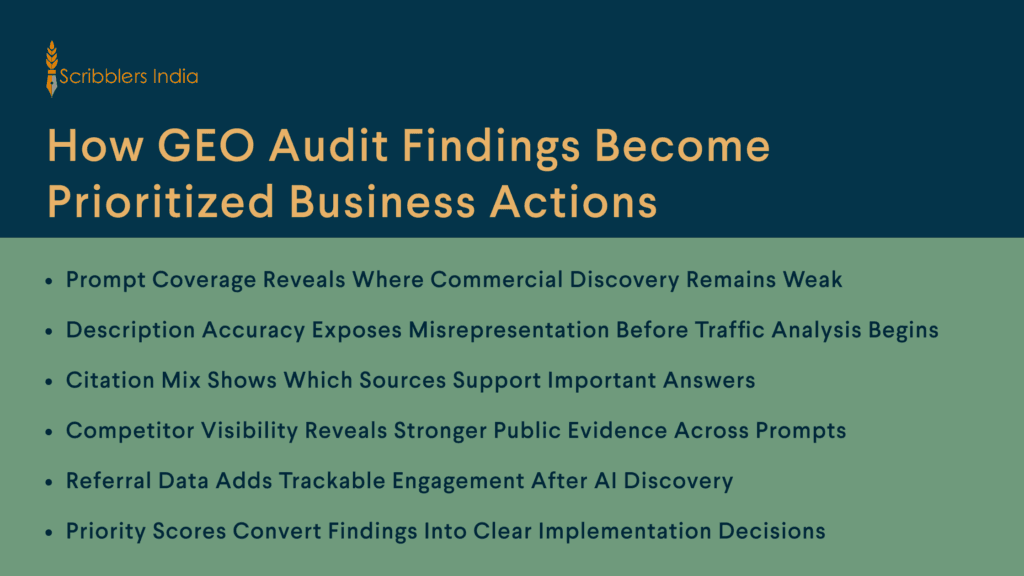
A GEO audit checklist becomes actionable when findings receive a clear implementation order. Prioritization should consider commercial importance, visibility weakness, evidence strength, and implementation effort. Accessibility or factual risks deserve early attention, followed by high-value content and by authority gaps that affect important buyer decisions.
Use three practical priority levels:
| Priority | Definition | Example |
| P1 | Blocks discovery or creates material factual risk | Priority page inaccessible |
| P2 | Limits commercially important visibility | Missing comparison content |
| P3 | Improves an existing foundation | Additional supporting evidence |
A P2 issue can deserve action before several easy P3 improvements when it affects a high-value buying question. Teams should therefore resist prioritizing work simply because a technical fix is quick or because an automated tool assigns it a dramatic warning score.
Four questions help resolve competing priorities:
- Commercial Importance: Does the issue affect a meaningful buyer decision?
- Visibility Gap: Is the brand absent, inaccurate, or weakly represented?
- Evidence Strength: Does the audit support the recommendation clearly enough?
- Implementation Effort: What resources are required to correct the issue?
The objective is better decision-making, not the completion of a GEO audit checklist. A shorter action list with clear commercial reasoning can create more value than hundreds of undifferentiated observations.
What Should the Final GEO Audit Deliverable Include?
A final GEO audit should show what was tested, what the evidence indicates, and what happens next. The client should understand the methodology without relying on an unexplained dashboard. Each major recommendation should be linked to a finding, a priority level, a responsible owner, and a future measurement requirement.
The final package should include:
- Commercial Prompt Library: Exact questions tested with their business relevance explained.
- Baseline Visibility Record: Brand and competitor appearances across selected discovery surfaces.
- Citation Source Inventory: Owned and external pages supporting important generated answers.
- Technical Access Review: Search eligibility and relevant crawler-access findings.
- Priority Page Assessment: Content weaknesses, factual issues, and refresh opportunities.
- External Evidence Review: Public authority, proof, and description gaps.
- Prioritized Action Backlog: P1, P2, and P3 recommendations with ownership.
- Measurement Plan: Stable prompts, reporting cadence, metrics, and review triggers.
A long PDF is not automatically a better deliverable. The audit succeeds when an internal team understands why each priority exists and can begin implementation without commissioning another discovery exercise to interpret the original report.

How Often Should You Repeat a GEO Audit?
A full GEO audit does not need to run every month. Most businesses need a baseline before major implementation, then recurring prompt monitoring between larger reviews. A strategic re-audit is useful after substantial changes to the website, product, market, or positioning alter the original diagnostic picture.
| Activity | Purpose | Useful Trigger |
| Baseline GEO Audit | Diagnose the current state | Before major strategy work |
| Prompt Monitoring | Track recurring visibility | Ongoing |
| Strategic Review | Reassess priorities | Quarterly or after meaningful changes |
| Full Re-Audit | Rebuild the diagnostic picture | Major structural change |
Cadence should reflect category volatility, publishing activity, product changes, competitor activity, and commercial importance. A fast-moving SaaS market may require more frequent monitoring than a stable professional-services category, where product changes or buyer questions tend to be slower.
The original audit should define the trigger for the next deeper review. This turns the document into part of an operating process rather than a one-time report that disappears once the immediate recommendations are implemented.
How Can Scribblers India Help Conduct a GEO Audit?
At Scribblers India, we build each GEO audit around commercially relevant buyer questions and measurable visibility gaps. Our GEO audit checklist first establishes where the brand appears, how accurately it is represented, and which priority pages or public sources support those answers across important discovery and comparison journeys.
That baseline guides a deeper review of content, technical accessibility, and external evidence. Our GEO services connect these findings with AEO-focused planning, page refreshes, selective content development, and recurring measurement so every recommendation addresses a documented weakness in the visibility system.
From there, we convert findings into a practical implementation roadmap. Prompt gaps, weak commercial pages, authority gaps, and crawler issues receive clear P1, P2, or P3 priorities. Stable prompt sets then help teams measure whether those changes improve visibility during later review cycles.
Businesses comparing providers can also use our guide to choosing a GEO agency to assess methodology, evidence standards, reporting quality, and realistic commitments before selecting an implementation partner.
Talk to our experts to identify meaningful AI visibility gaps, prioritize the right fixes, and build a measurable GEO roadmap.
Frequently Asked Questions
What Does a GEO Audit Include?
A GEO audit reviews commercially relevant prompts, current brand visibility, technical accessibility, priority content, public evidence, and measurement. The final deliverable should explain where meaningful visibility gaps exist and what should happen next, while separating urgent problems from improvements that can wait.
How Is a GEO Audit Different From an SEO Audit?
An SEO audit focuses heavily on search accessibility, technical health, organic performance, and page optimization. A GEO audit adds prompt-led visibility, answer context, source analysis, brand-description accuracy, and external evidence. The two overlap because established Search foundations remain relevant to Google’s AI experiences.
How Many Prompts Should a GEO Audit Test?
There is no universal prompt count that suits every business. The audit should cover the most important discovery, comparison, recommendation, and validation questions for the relevant buyer journey. A smaller commercially meaningful set usually creates better decisions than hundreds of generic prompts with limited business relevance.
Which Platforms Should a GEO Audit Cover?
Platform selection should be guided by customer behavior and category relevance. ChatGPT, Perplexity, Gemini, Google AI Mode, or AI Overviews may all matter, but not every business needs the same combination. The audit should explain why each monitored surface deserves inclusion before expanding measurement scope.
Can a GEO Audit Guarantee Future AI Citations?
No. A GEO audit can identify gaps and recommend improvements within the business or agency’s control. External systems determine which pages they retrieve, cite, or surface. Google explicitly states that meeting its requirements does not guarantee crawling, indexing, serving, or inclusion.
How Long Does a GEO Audit Take?
Audit duration depends on website size, prompt scope, platform coverage, external-source research, and the depth of content analysis required. A focused service business needs less investigation than a multi-product SaaS company. The provider should define the evidence required before setting a realistic delivery schedule.
Should Technical SEO Be Included in a GEO Audit Checklist?
Yes, when technical conditions affect priority content. A GEO audit should confirm essential crawling, indexing, textual accessibility, and relevant crawler controls. It does not need to duplicate every item from a comprehensive technical SEO audit when those issues are unrelated to the GEO diagnostic.
What Should Happen After a GEO Audit Is Complete?
The findings should be incorporated into a prioritized implementation roadmap with clear ownership and review triggers. P1 issues need early attention, while commercially important P2 improvements should follow. The team should also preserve a stable core set of prompts so that later testing can evaluate whether implemented changes affect visibility.