

A GEO retainer can describe very different agency engagements. One proposal may combine prompt tracking, page refreshes, technical reviews, content development, external-source analysis, and recurring measurement. Another may provide a monthly dashboard with limited explanation of what the team will change once new findings emerge.
That difference matters as AI-assisted discovery becomes a larger part of search behavior. Google says AI Overviews now reach more than 2.5 billion monthly active users, while AI Mode has surpassed one billion. These search experiences create new discovery opportunities while making measurement more complex.
A useful engagement should therefore connect diagnosis with execution and repeat measurement. This guide explains what businesses should receive during the first 90 days, which services fall within the ongoing scope, how reporting and SLAs should work, and when a recurring arrangement warrants continued investment.
Key Takeaways
|
What Is a GEO Retainer?
A GEO retainer is an ongoing engagement focused on improving and measuring how a brand appears across AI-assisted discovery. The work can include prompt monitoring, content updates, technical checks, source analysis, authority development, and reporting, with priorities changing as new evidence emerges.
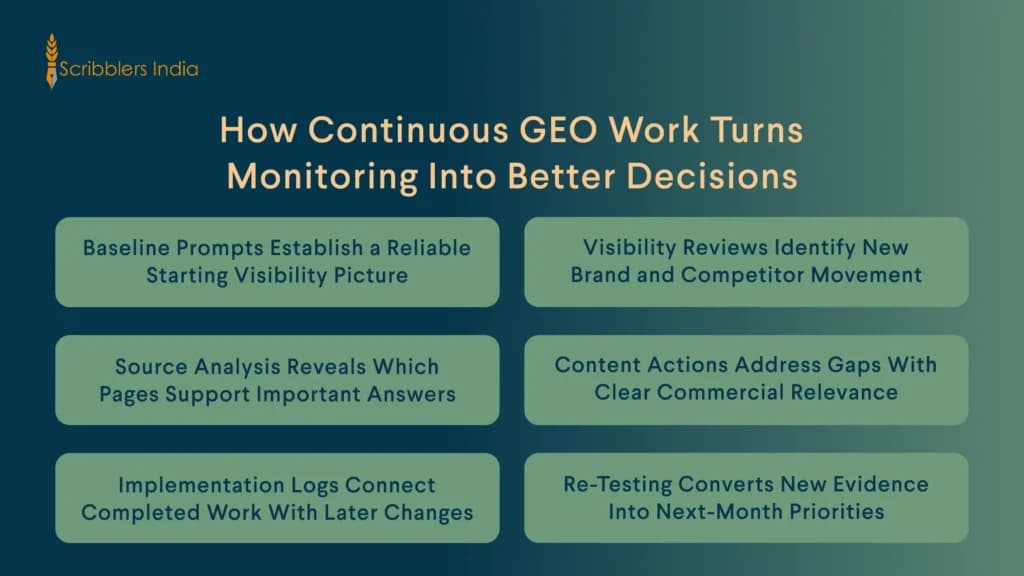
The important distinction is recurrence. AI-generated answers can change as public information, competing content, platform behavior, and buyer questions evolve. A recurring engagement gives the team a structured way to observe those changes, implement improvements, and test whether the resulting AI visibility pattern changes afterward.
That does not mean every company needs monthly support. Some businesses need a baseline first, while others already know which pages or information gaps require attention. The engagement model should therefore follow the problem’s maturity rather than immediately default to a retainer.
| Engagement Model | Primary Purpose | Best Fit |
| GEO Audit | Diagnose current visibility and information gaps | Brands without a reliable baseline |
| Fixed Sprint | Address a defined group of priorities | Teams with known implementation needs |
| Ongoing Engagement | Measure and improve recurring visibility | Brands with sustained AI-search opportunity |
| Internal Program | Build and manage capability in-house | Mature teams with adequate expertise |
Teams that are still assessing overall readiness can use Scribblers India’s AI Search Visibility Scorecard to identify broad weaknesses before deciding whether deeper diagnosis or recurring implementation is justified. The next question is whether the visibility environment changes enough to warrant continuing work.

Why Does GEO Require Ongoing Work in 2026?
Ongoing GEO work is useful because AI search visibility can change over time. A brand may appear for one prompt and disappear for another, while cited sources and recommendation context can also shift. Repeated testing helps businesses identify consistent patterns instead of reacting to individual responses.
The wider environment is changing quickly too. After a May 2026 update to the ChatGPT interface that made brand links more prominent, total referral traffic increased by 157.7% week over week. Changes like this can quickly affect how users discover and visit brands through AI platforms.
A recurring GEO program should therefore monitor both the information a brand controls and changes happening outside its website. Content quality, factual accuracy, technical access, and published evidence can be improved directly, while competitor activity, platform updates, cited sources, and evolving buyer questions require ongoing monitoring.
What Services Should a GEO Services Retainer Include?
A GEO retainer should connect measurement with practical improvements across priority content and supporting public evidence. The exact mix should follow the baseline findings. Strong programs avoid treating monthly content volume as the objective when existing pages or source gaps create the larger visibility problem.
1. Commercial Prompt Mapping and AI Visibility Monitoring
Prompt Mapping defines the category, recommendation, comparison, alternative, and validation questions to monitor. Each prompt should have a clear business reason for inclusion, while the baseline should record brand appearances, relevant competitors, description accuracy, and cited sources using consistent testing rules.
2. Prompt-to-Page Content Mapping
Content Mapping connects commercially important questions with the strongest existing destination pages. Some prompts reveal missing assets, while others expose incomplete service pages or comparisons. Scribblers India’s AI content gap analysis explains why many visibility gaps can be solved by strengthening existing pages rather than adding another URL.
3. Technical Search and Crawler Review
Technical Review checks whether priority information remains accessible to relevant search systems. Google says existing SEO fundamentals remain relevant for AI Overviews and AI Mode, with no special AI-specific technical requirements. OpenAI separately recommends allowing OAI-SearchBot when publishers want their public content to be discoverable in ChatGPT Search.
4. Priority Page Refreshes
Page Refreshes improve existing commercial assets when they already serve the right search job. Updates can strengthen direct answers, product or service detail, comparison depth, evidence, freshness, internal pathways, and factual consistency without creating unnecessary content overlap across the site.
5. New Authority Assets
Authority Assets become useful when no existing page can answer an important question properly. These may include research reports, buyer guides, comparison resources, case studies, glossaries, or expert-led thought leadership that provides buyers with deeper evidence on a category or decision.
6. External Source and Brand Evidence Review
Source Review examines how credible third-party pages describe the company and its expertise. Relevant publications, review platforms, partner profiles, directories, customer evidence, or expert pages can reveal inconsistencies that website-only analysis misses and may influence how buyers validate AI-generated recommendations.
7. Measurement and Monthly Reprioritization
Recurring Measurement repeats the stable prompt panel and connects observed movement with the next implementation cycle. Scribblers India’s GEO services apply the same connected approach, linking search foundations, answer-led content, authority development, and visibility measurement to documented business gaps.
What Should Happen During GEO Onboarding?
GEO onboarding should establish business priorities, responsibilities, access requirements, and measurement rules before implementation begins. The agency needs enough context to understand which products matter, which buyer questions influence commercial decisions, and which platforms, competitors, markets, and internal experts should shape the initial visibility baseline.
The checklist should cover the following aspects:
| Checklist Aspect | What to Confirm |
| Priority Offerings | Products or services included in the engagement |
| Customer Groups | Audiences whose discovery journeys matter commercially |
| Buyer Questions | Category, comparison, validation, and implementation prompts |
| Competitor Set | Relevant alternatives included in baseline tracking |
| Target Markets | Priority geographies, languages, and market considerations |
| Existing Evidence | Current AI mentions, citations, referrals, and known gaps |
| Platform Scope | AI search surfaces relevant to buyers |
| Access Requirements | Analytics, Search Console, CMS, and technical access |
| Expert Inputs | Subject-matter experts needed for factual review |
| Approval Ownership | People responsible for content and claim approvals |
| Reporting Cadence | Frequency of reports and strategic reviews |
| Scope Boundaries | Exclusions, optional work, and client-owned responsibilities |
A strong onboarding process should end with a clear definition of success and a repeatable starting point. Remove prompts that lack commercial relevance before committing editorial, technical, or measurement resources to the program.
What Should Happen During the First 90 Days of a GEO Retainer?
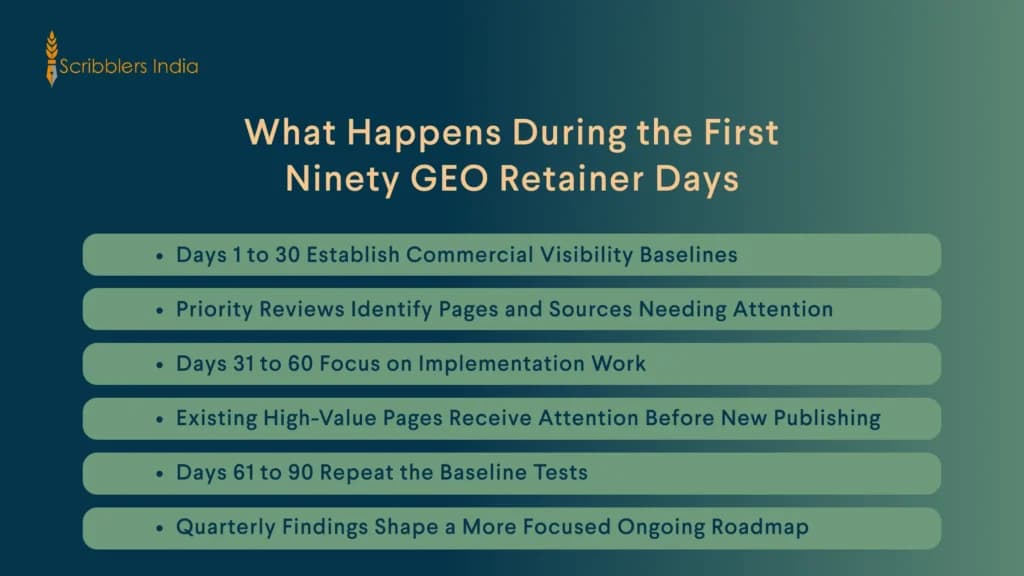
The first 90 days of a GEO retainer should progress from diagnosis to focused implementation, then to repeated measurement. The agency should reduce uncertainty in the first month, act on the strongest findings in the second, and use the third month to determine what warrants continued investment.
Days 1–30: Establish the Baseline and Priority Gaps
Baseline Work should document current brand visibility across the agreed prompt panel and relevant platforms. The team should record competing brands, answer context, cite sources, identify priority pages, note technical issues, and address factual inconsistencies, then convert those findings into a sequenced implementation roadmap.
First-month outputs should include a prompt baseline, a competitor benchmark, a source inventory, a priority-page review, technical findings, and a 60-day action plan. The result should be a narrower implementation agenda focused on commercially important gaps relative to the baseline.
Days 31–60: Implement the Highest-Value Improvements
Focused Implementation should start with existing high-value pages that already address important buyer questions. The agency can improve missing detail, evidence, examples, comparison logic, or internal linking before deciding that another article or landing page is necessary.
New assets should be added to the roadmap only where a genuine information gap exists. External evidence may also need attention when partner descriptions, customer proof, or expert information remain incomplete, while every material change should be recorded for later comparison.
Days 61–90: Re-Test Visibility and Set the Next Cycle
Repeat Testing should use the same core prompts and comparable conditions established during month one. The review should examine changes in brand appearances, description accuracy, citation sources, competitors’ movements, visible pages, and identifiable referral behavior, while acknowledging that generated answers naturally vary.
By day 90, the business should know which interventions appear promising, which gaps remain persistent, and where opportunity is weaker than originally assumed. Our guide to choosing a GEO agency explains why this first-quarter evidence is also useful for evaluating whether the provider’s methodology and execution deserve continuation.
| Period | Main Focus | Primary Output |
| Days 1–30 | Baseline and diagnosis | Benchmark and implementation roadmap |
| Days 31–60 | Focused implementation | Updated priority assets and evidence |
| Days 61–90 | Re-testing and interpretation | Evidence-based next-quarter plan |
| After Day 90 | Selective iteration | Narrower recurring roadmap |
What Data You Should Receive From a GEO Agency Every Month?
Monthly deliverables under a GEO retainer should explain what changed, what the agency completed, and why the next priorities follow from that evidence. A dashboard without implementation creates limited value, while production without measurement makes later attribution difficult. The monthly package should clearly connect observation, execution, and decision-making.
| Monthly Deliverable | What It Should Explain |
| Prompt Visibility Update | Where relevant brand appearances changed |
| Citation and Source Review | Which sources gained or lost importance |
| Competitor Comparison | Who appears across agreed commercial questions |
| Content Work Log | Which pages changed and why |
| Technical Action Log | Which accessibility issues were addressed |
| External Evidence Activity | Which credible off-site gaps received attention |
| Performance Interpretation | What observed movement may indicate |
| Next-Month Priorities | Why selected actions deserve attention next |
The monthly mix should evolve as evidence improves, with different cycles prioritizing page refreshes, customer proof, or source research. A mature GEO retainer should buy better decisions alongside execution, while deliverable counts remain tied to the commercial problem and documented findings.
What Should GEO Reporting Include?
GEO reporting should show how a brand appears across a stable set of commercially relevant prompts and explain why the observed movement matters. Reports should separate brand mentions, citations, recommendation context, competitor visibility, description accuracy, referrals, and implementation actions, rather than collapsing everything into a single proprietary score.
| Metric | What It Shows | What It Cannot Prove |
| Prompt Coverage | Presence across monitored questions | Complete market visibility |
| Brand Mention Rate | Frequency of appearance | Buyer preference |
| Citation Rate | Source inclusion | Commercial outcome |
| Recommendation Context | How the brand is positioned | Purchase intent |
| Competitor Visibility | Relative presence | Market share |
| Description Accuracy | Correctness of brand information | Conversion probability |
| AI Referral Traffic | Identifiable visits | All AI influence |
| Assisted Outcomes | Possible downstream response | Perfect attribution |
This AI Search Discovery Benchmark provides a wider measurement context for this shift. The useful goal is to connect recurring prompt evidence to page quality and future content priorities, rather than to chase citation counts in isolation.
What Should a GEO Service Level Agreement (SLA) Cover?
A GEO Service Level Agreement (SLA) should define activities the agency can directly control, including reporting dates, monitoring cadence, review timelines, agreed implementation work, and communication standards. It should avoid making guarantees about citations or the positions of generated recommendations, as external platforms determine which sources and brands appear.
| Reasonable GEO SLA | Risky Promise |
| Prompt Tests Delivered on Schedule | Guaranteed ChatGPT ranking |
| Agreed Page Updates Completed | Guaranteed citation volume |
| Reports Delivered on Fixed Dates | Guaranteed recommendation position |
| Technical Reviews Completed Promptly | Guaranteed platform inclusion |
| Quarterly Scope Review Completed | Guaranteed visibility percentage |
Google explicitly states that meeting its requirements does not guarantee crawling, indexing, serving, or inclusion. A strong SLA should therefore separate deliverables, target outcomes, and external dependencies, giving both parties a clearer basis for accountability without pretending the agency controls final platform behavior.
Which Activities are Not Included in a GEO Services Retainer?
A monthly GEO retainer scope may exclude work that requires separate specialists, large external budgets, or major technical implementation. Buyers should understand these boundaries before comparing prices, because two apparently similar proposals can differ substantially once the requirements for research, development, design, localization, or paid distribution are separated.
Common exclusions under a GEO retainer can include:
- Website Development: Major redesigns or engineering projects outside content scope.
- Advanced Technical Implementation: Development work requiring specialist infrastructure or security teams.
- Paid Media Budgets: Advertising spend should remain separate from agency service fees.
- Third-Party Tools: Monitoring or research subscriptions may require separate licenses.
- Large Original Research: Survey panels or specialist data collection can add costs.
- Design and Video Production: Rich media production may sit outside editorial delivery.
- Translation and Localization: Multi-language production can require separate language specialists.
- Paid Placements: Editorial coverage should never be implied as guaranteed organic authority.
Clear exclusions make proposals easier to compare and reduce surprises after onboarding. Ask agencies to classify work as included, excluded, optional, or client-owned before the engagement begins, then document ownership for any work outside the agreed scope.
How Much Does a GEO Retainer Cost in India?
The cost of a GEO retainer in India depends on the size and complexity of the engagement. Products, markets, monitored prompts, platform coverage, content work, technical support, authority development, and reporting depth can all affect monthly fees. These factors should be compared before evaluating any headline price.
| Cost Driver | What It Includes |
| Business Scope | Products, brands, markets, and customer groups covered |
| Prompt Scope | Size and complexity of the monitored prompt library |
| Platform Scope | Number of relevant AI discovery platforms tracked |
| Content Scope | Page refreshes, new assets, research, and editorial review |
| Technical Scope | Audits, implementation support, and developer coordination |
| Authority Scope | External-source analysis, expert assets, and customer evidence |
| Reporting Scope | Testing frequency, analysis depth, and strategic interpretation |
When Should You Choose a GEO Retainer Instead of an Audit?
Choose the engagement model based on how clearly you understand the problem and how often visibility requires attention. A GEO retainer suits recurring measurement and implementation, while an audit works better when the baseline remains unclear. Fixed projects can address defined gaps without creating an unnecessary monthly commitment.
When Does a GEO Audit Make More Sense?
Start with a GEO audit when you lack a reliable visibility baseline or remain unsure about the highest-value gaps. It also works well when your internal team can handle implementation once it receives clear priorities. Businesses undergoing major positioning changes should complete those changes before investing in recurring monitoring.
| Situation | Better Starting Model |
| No Reliable Visibility Baseline | GEO audit |
| One Known Content Problem | Fixed sprint |
| Strong Internal Execution Team | Audit or strategic support |
| Limited Commercial Prompt Demand | Small audit first |
| Major Positioning Change Underway | Audit after positioning settles |
When Does a GEO Retainer Make More Sense?
A GEO retainer makes more sense when several products, markets, or high-value prompt groups need recurring monitoring. It also suits businesses where competitor visibility, cited sources, product information, or buyer questions change often enough to require regular review and implementation across multiple content or authority priorities.
Ongoing support becomes more valuable once the initial baseline is clear and the team knows which gaps deserve continued attention. A mature program can use repeated testing to refine priorities, refresh important pages, and respond to new opportunities. Monthly work should continue only while the evidence supports further investment and commercially relevant improvements.
How Can You Tell Whether a GEO Retainer Is Working After 90 Days?
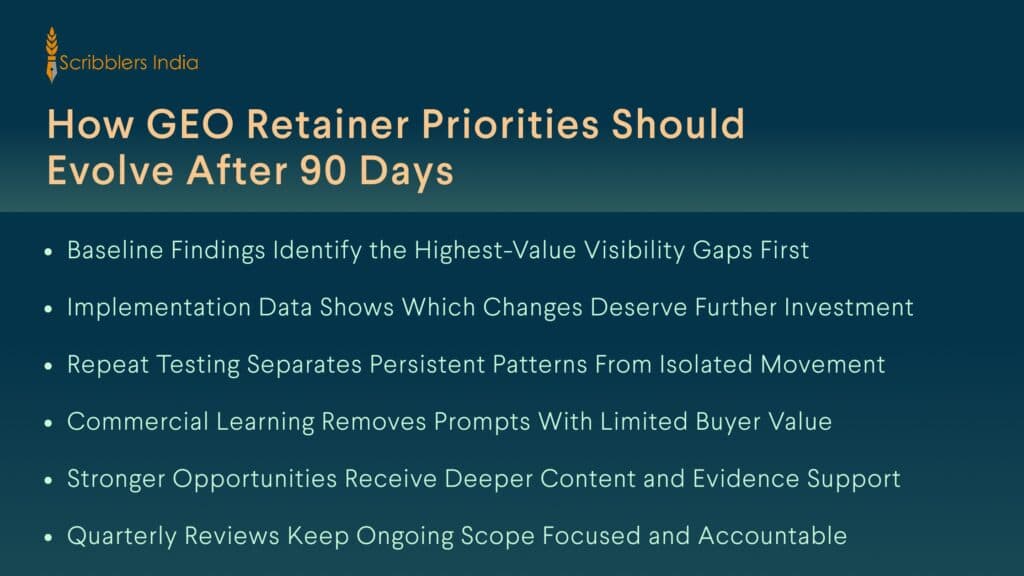
A useful 90-day review should show whether the business understands its AI-search visibility better and has acted on the highest-value gaps. Citation gains can support that assessment, while stronger baselines, improved content coverage, better brand accuracy, and clearer next decisions provide additional evidence. Review five areas together:
- Baseline Quality: Can the team explain where the brand appears across priority questions?
- Implementation Quality: Were the highest-value findings actually addressed during the quarter?
- Visibility Movement: Did mentions, citations, accuracy, or competitor gaps change meaningfully?
- Commercial Learning: Did the team identify stronger or weaker prompt opportunities than expected?
- Decision Clarity: Does the next quarter have more focused priorities than onboarding?
Use the continuation framework below to turn those findings into a commercial decision. It helps separate a program that needs more time from one that needs a different scope, stronger execution, or a lower level of investment:
| Finding | Recommended Decision |
| Useful Movement and Clear Opportunities | Continue |
| Limited Movement With Valuable Learning | Adjust scope |
| Strong Monitoring but Weak Execution | Shift budget toward implementation |
| High Output but Weak Measurement | Strengthen reporting |
| Limited Commercial Opportunity | Reduce engagement |
| Repetitive Work Without Learning | Reconsider provider |
After the first quarter, the roadmap should become more selective. High-value prompt families can receive deeper attention, while weak opportunities should be subject to intensive monitoring as evidence improves and stronger commercial priorities become clearer to the team.

How Should Businesses Measure GEO Progress Beyond Citations?
Businesses should measure AI search visibility alongside the quality of resulting discovery. Citations matter when they support relevant buyer questions, while a broader model should also consider recommendation context, brand-description accuracy, competitor presence, referral quality, and downstream activity influenced by AI-assisted research.
Use the following measurement layers:
- Discovery tracks whether the brand appears across selected commercial prompts.
- Context examines whether those appearances accurately represent the company to the intended audience or use case. A mention can create limited value when the surrounding answer is misleading.
- Engagement measures identifiable AI referral traffic and the quality of the resulting site behavior where data is available.
- Business Response then considers qualified inquiries, demos, branded searches, newsletter signups, or other outcomes relevant to the company without forcing perfect last-click attribution onto a multi-touch discovery journey.
The objective is to understand whether the GEO retainer improves commercially useful visibility rather than one headline metric. Fewer appearances around high-value buyer questions can matter more than broad mention growth across low-value prompts.
How Can Scribblers India Structure an Ongoing GEO Engagement?
At Scribblers India, we structure recurring GEO work around commercially relevant buyer questions and measurable visibility gaps. We map priority prompts against existing pages and public evidence, then use that diagnosis to strengthen commercial content first, adding new research or authority assets only where deeper evidence is genuinely needed.
Recurring reviews then compare visibility against the stable prompt panel and identify where priorities should change. Our AI Visibility Measurement Framework explains why fixed prompt libraries, consistent scoring rules, repeated testing, and structured review cycles are important when measuring AI search performance. This approach helps us distinguish routine variation in answers from persistent gaps that require changes to content, authority, or positioning.
Book a 1:1 discussion with our team to build recurring GEO support around measurable buyer prompts, stronger content, and evidence-led monthly priority decisions.
Frequently Asked Questions
How Long Should an Ongoing GEO Engagement Run?
A GEO retainer should run long enough to establish a baseline, implement meaningful changes, and repeat the measurement cycle. Ninety days provides a useful first review point for many businesses. Longer engagements should continue when the evidence identifies commercially relevant opportunities requiring further implementation or monitoring.
Can I Start With a GEO Audit Before Signing a Retainer?
Yes. An audit makes sense when you do not yet know where AI search visibility problems exist. It should identify key prompts, competitor patterns, source gaps, content weaknesses, and technical issues, and provide sufficient evidence to determine whether internal teams or recurring agency support should handle implementation.
How Often Should GEO Reporting Happen?
Monthly reporting works for many ongoing programs because it gives teams a consistent review cadence without overreacting to daily variation in answers. Faster-moving categories may need additional monitoring, while broader strategic reviews can happen quarterly. Keep the core prompt baseline stable across each comparison period.
Does a Monthly GEO Engagement Include SEO?
It can include SEO-related work because several foundations overlap. Crawlability, indexing, internal linking, page quality, and accessible text still matter for Google’s AI experiences. The proposal should explain which SEO responsibilities fall within the GEO scope and which are handled by another internal or external team.
Can a GEO Agency Guarantee ChatGPT Citations?
No responsible provider should guarantee a specific ChatGPT citation. Agencies can improve public content, access, supporting evidence, measurement, and other factors within their control. OpenAI decides what ChatGPT Search surfaces, so contracts should focus on defined work and transparent measurement rather than promised citation positions.
Which Internal Teams Should Support GEO Onboarding?
Marketing and content teams usually provide the core input, while product experts, founders, sales teams, legal reviewers, or technical specialists may contribute when the subject requires them. Assign one internal owner who can coordinate access, expert review, approvals, factual corrections, and changes in business priorities.
Should Technical Implementation Be Included in GEO Services?
The answer depends on the provider’s capabilities and the agreed contract. Some agencies identify technical issues and supply recommendations for developers, while others implement selected changes directly. Confirm responsibility for robots directives, templates, structured data, analytics, and broader development tasks before the engagement begins.
Can the Monthly GEO Scope Change After the First 90 Days?
Yes. The scope should change when evidence reveals a different priority from the original plan. Existing pages may need more work than new publishing, or external evidence may become the larger gap. Review the roadmap after each major measurement cycle, rather than repeatedly revisiting outdated deliverables.