AI search trends now shape how buyers discover categories, compare providers, assess credibility, and shortlist brands. Visibility no longer starts or ends with ranked links. AI systems can influence perception before a website receives a visit, shaping branded searches, consideration, and later conversion paths. This makes early visibility commercially meaningful, even before measurable traffic appears.
That shift does not make SEO less important. Technical accessibility, useful pages, internal linking, and clear positioning still provide the foundation for discoverability. However, rankings alone cannot reveal whether ChatGPT recommends a brand, whether Google cites its content, or whether AI systems describe its services accurately across different buyer questions and decision stages.
This guide examines observed developments in 2026 alongside 10 evidence-based projections for 2027. It explains what each trend means for B2B brands, founders, content teams, and marketing leaders. It also shows how stronger AI search visibility can translate changing search behavior into a practical roadmap for content, measurement, authority building, and brand growth.
Key Takeaways
|
#1: AI Search Trends Are Reshaping Brand Discovery
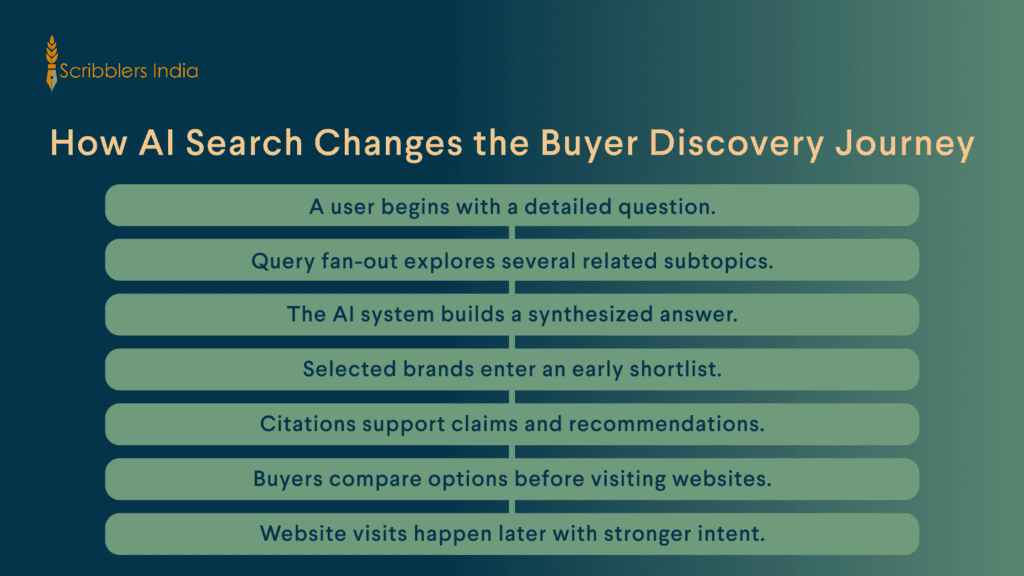
AI search is becoming a discovery layer because users ask systems to explain categories and identify options. They also compare providers, assess trade-offs, review evidence, and request recommendations. A brand can enter or miss the shortlist before a website visit. AI search visibility therefore includes influence without an immediate click.
- Prompt-led category research: Buyers can explore an unfamiliar market through one detailed question. AI systems combine definitions, provider types, evaluation criteria, use cases, and risks. Brands need content that addresses the full research need rather than a single isolated keyword.
- Provider comparison before website visits: AI Mode surpassed one billion monthly users and queries more than doubled every quarter after launch. Follow-up questions let users compare providers without restarting research or opening several result pages.
- AI-first product discovery: 35% of US consumers started product discovery with an AI tool. Only 13.6% began with traditional search. This shift can influence the initial shortlist before branded research begins.
- Influence beyond referral traffic: An AI answer may name a brand without sending a visit. That mention can shape awareness, credibility, sales conversations, and later branded searches. Traffic therefore measures only one part of AI-led discovery.
2027 projection: As per AI search trends for 2027, AI-led shortlisting will likely become a standard measurement area for categories with complex research cycles. Marketing teams may track which brands appear, how often they are recommended, and which sources support those recommendations. This view will help connect early discovery influence with later commercial outcomes across the funnel.

#2: AI Overviews Are Expanding Beyond Informational Searches
AI Overviews increasingly appear for instructional, commercial, comparison, and navigational searches. This creates more opportunities for useful content to surface. It also increases the chance that Google answers part of the query before users open a result. The shift changes which pages influence later evaluation.
| Query type | Likely AI behavior | Content opportunity | Recommended format |
| Informational | Summarizes a concept | Provide an extractable definition | Definition with examples |
| Instructional | Builds a process | Explain stages and decisions | Step-by-step guide |
| Comparison | Contrasts options | Clarify real selection factors | Comparison table |
| Commercial | Supports evaluation | Explain fit, limits, proof, and pricing | Buyer guide |
| Navigational | Explains an entity | Clarify brand or product details | Strong entity page |
| Product research | Combines evidence | Address use cases and risks | Evidence-led review |
AI Overviews appeared for 6.49% of tracked keywords in January 2025 and reached nearly 25% by July. This growth shows why brands should strengthen content for AI Overviews while measuring citations and clicks separately.
2027 projection: As per AI search trends for 2027, AI Overviews will likely appear across more comparison and decision-stage searches. Their expansion will remain uneven because activation varies across query types, industries, devices, and user intent. Marketing teams should monitor where summaries appear, which pages earn citations, and how those placements influence later visits and conversions.
#3: ChatGPT Visibility Is Becoming a Core Brand Metric
ChatGPT influences research, recommendations, category education, and vendor discovery at mainstream scale. Marketing teams need to know whether their brand appears and which competitors receive recommendations. They should also verify sources and descriptions. Referral traffic cannot answer those questions alone. Brands need a dedicated view of visibility and accuracy.
| Metric | What it reveals | Review cycle | Recommended action |
| Mention frequency | How often the brand appears | Monthly | Strengthen missing topics |
| AI share of voice | Visibility against competitors | Monthly | Build distinct authority |
| Recommendation position | Placement within answers | Monthly | Improve category relevance |
| Cited domains | Sources shaping answers | Monthly | Strengthen source ecosystems |
| Description accuracy | How ChatGPT explains the brand | Monthly | Clarify entity messaging |
| Competitor inclusion | Brands appearing nearby | Monthly | Review competitor signals |
| Prompt coverage | Questions containing the brand | Quarterly | Fill content gaps |
| Referral quality | Value of generated visits | Monthly | Improve landing pages |
ChatGPT reached more than 900 million weekly users by March 2026. Use a fixed prompt set within a ChatGPT visibility strategy and repeat tests across dates and sessions. A few manual searches cannot prove lasting visibility.
2027 projection: By 2027, AI share of voice will likely become a standard metric for complex buying journeys. Teams may track recommendation frequency, competitor presence, citation sources, and answer accuracy across repeat prompts. This view can connect early brand influence with later searches, qualified visits, sales conversations, and revenue outcomes.
#4: AI Search Trends Are Bringing SEO, AEO, GEO, and Brand Strategy Together
Brands cannot treat these disciplines as separate campaigns. SEO supports crawling, indexing, rankings, and clicks. AEO improves direct answer extraction. GEO strengthens mentions and citations. Brand strategy clarifies the entity that search systems and buyers must understand. One workflow should connect these signals with business outcomes.
Only 37.9% of AI Overview citations appeared within Google’s first 10 result blocks. This gap shows why rankings alone cannot explain generative visibility.
| Discipline | Primary goal | Key content unit | Main measurement |
| SEO | Earn rankings and clicks | Search-focused page | Rankings and organic traffic |
| AEO | Earn answer extraction | Question-answer block | Answer inclusion |
| GEO | Earn mentions and citations | Authority asset | Mentions and cited URLs |
| Brand strategy | Build category recognition | Consistent narrative | Description accuracy |
A connected workflow begins with accessible pages and clear intent. It then adds direct answers, credible evidence, original expertise, and consistent external signals. This approach prevents separate teams from optimizing the same topic through conflicting messages.
2027 projection: By 2027, teams will likely manage SEO, AEO, GEO, and brand strategy within one visibility program. Shared planning may connect rankings, answer extraction, citations, and entity consistency across the buyer journey. This integrated model can reduce conflicting priorities while giving leaders a clearer view of discovery, influence, and commercial impact.
#5: Founder Authority Is Strengthening AI Search Visibility
AI systems need reliable evidence connecting a person with a company, category, role, and subject area. Strong founder profiles, published insights, interviews, and visible expertise can strengthen that connection. Founder activity supports entity clarity, although it cannot guarantee citations. The supporting evidence must remain public and consistent.
Founder Profiles Clarify Expertise and Organizational Relationships
A complete founder profile should state the person’s role, company relationship, experience, specialist subjects, and current responsibilities. Consistent details across the website, LinkedIn, media biographies, and speaker pages help systems connect the individual with relevant expertise.
Thought Leadership Gives AI Systems Distinct Expert Perspectives
Original viewpoints give AI systems material beyond standard definitions. Founder articles can explain market shifts, operational lessons, decision frameworks, and informed disagreements. Strong thought leadership content works best when it contributes evidence, experience, examples, or a defensible perspective.
Consistent Public Messaging Reduces Entity Ambiguity
Different descriptions across profiles can weaken category clarity. A focused founder personal branding strategy should align expertise, company positioning, preferred topics, and supporting proof. Each channel can vary in format while preserving the same core identity.
Ghostwriting Supports Founders With Limited Publishing Capacity
Strategic ghostwriting services for founders can capture genuine expertise through interviews, documents, recorded discussions, and source material. The final content should preserve the founder’s reasoning, examples, vocabulary, and informed point of view without creating a generic voice.
2027 projection: As per AI search trends for 2027, founder authority will likely become a measurable visibility factor across AI-led professional research and brand discovery. Teams may track founder citations, topic consistency, expert mentions, and source diversity across repeat prompts and platforms. This evidence can connect expertise with stronger entity recognition, trusted recommendations, and clearer market positioning.
#6: Third-Party Mentions Are Influencing AI-Generated Answers
AI systems often use independent sources when comparing brands or validating claims. Owned content establishes the official narrative. External sources provide context, source diversity, perceived neutrality, and evidence. Brands therefore need authority beyond their own websites without manufacturing fake coverage. Those sources can validate or challenge brand claims.
| Source type | Influence role | Suitable brand action | Main risk |
| Industry publications | Validate expertise | Contribute useful commentary | Promotional submissions |
| Review websites | Show customer experience | Improve product delivery | Manipulated reviews |
| Reddit discussions | Surface real objections | Study audience language | Fake participation |
| YouTube videos | Explain products visually | Publish demonstrations | Thin promotional clips |
| Podcasts and interviews | Connect experts with topics | Share informed views | Repeated talking points |
| Partner websites | Confirm relationships | Publish joint use cases | Weak partner relevance |
| Expert roundups | Associate brands with expertise | Offer specific insights | Generic quotations |
| Independent research | Provide neutral evidence | Support credible studies | Misrepresented findings |
Our AI Search Discovery Benchmark 2026 reinforces the importance of source quality, entity clarity, original expertise, and recurring visibility measurement. Brands should build earned visibility through credible insights and verifiable proof while avoiding fabricated reviews or artificial community mentions.
2027 projection: Our AI search trends for 2027 indicate that the quality of external sources will likely become more important in AI-generated comparisons and recommendations. Teams may track source authority, mention consistency, citation diversity, and factual accuracy across repeat prompts. Strong earned visibility can support clearer brand validation while reducing dependence on self-published claims and weak promotional sources.
#7: AI Search Trends Require Continuous Visibility Monitoring
AI search visibility can change for two broad reasons. Answers may drift across prompts and platforms, while geography, model updates, personalization, and limited testing can distort performance signals. Understanding both sources of variation helps teams design reliable monitoring frameworks and distinguish temporary fluctuations from visibility losses requiring action.
AI Answers Drift Across Prompts and Platforms
AI-generated answers change more frequently than conventional rankings. Prompt wording, retrieval updates, model changes, geography, and user context can alter cited sources or recommended brands. One successful citation cannot prove durable visibility. Teams need repeated tests with stable prompts and comparable conditions to measure consistency over time.
- Citation drift: A cited page may disappear when an AI answer refreshes or retrieves a different supporting source. Teams should track citation stability across repeated checks to distinguish temporary changes from sustained visibility losses that require corrective action.
- Entity drift: Named companies, products, or experts may change between responses even when the overall answer remains similar. Repeated testing helps teams determine whether brand inclusion is consistent or depends heavily on a particular recurring response pattern.
- Prompt variation: Small wording changes can shift intent, alter retrieved sources, and produce a different recommendation pattern. Teams should test several prompt versions to identify which questions consistently surface the brand and which expose meaningful visibility gaps.
- Cross-platform differences: ChatGPT, Perplexity, Gemini, and other AI platforms may recommend different brands for the same category question. Comparing results across platforms shows where authority signals remain strong and where additional content, evidence, or external validation is needed.
These changes make one-time visibility checks unreliable. Teams need fixed prompt sets, scheduled reviews, and documented testing conditions to determine whether movement reflects an isolated response or a broader pattern. This process creates a dependable baseline for later reporting.
Controlled Measurement Makes AI Search Volatility Actionable
Visibility can also vary because of location, platform updates, personalization, and weak sample sizes. Teams must control these variables and document every test. This approach improves comparability and prevents temporary fluctuations from being treated as meaningful performance changes.
- Geographic variation: Local availability, regional sources, language preferences, and market context can change the answer or citation mix. Brands should test priority prompts across relevant regions to confirm whether visibility and recommendations remain consistent for target audiences.
- Model updates: Retrieval policies, ranking logic, and answer-generation methods can change without visible notice to marketers. Regular monitoring helps teams identify sudden shifts in citations, brand descriptions, or recommendations that may require content or authority updates.
- Personalized context: Account history, prior conversations, and saved preferences may influence recommendations within supported AI search experiences. Teams should use controlled testing conditions wherever possible to reduce personalization bias and improve comparability across multiple repeated testing observations.
- Sample-size limits: A few manual checks can exaggerate isolated gains, losses, citation changes, or competitor movements. Teams need repeated observations across prompts, dates, platforms, and locations before treating any visibility shift as a dependable long-term performance pattern.
Across 730,000 paired responses, AI Overviews and AI Mode shared only 13.7% of citations, despite reaching similar conclusions 86% of the time. Use our AI Search Visibility Scorecard to assess prompt coverage, source trust, answer readiness, external validation, and recurring visibility gaps across AI platforms.
2027 projection: By 2027, AI search volatility will likely become a routine reporting concern rather than an occasional anomaly. Teams may track citation stability, entity consistency, prompt sensitivity, and cross-platform variation across fixed test sets. This monitoring can help brands distinguish temporary fluctuations from persistent visibility losses requiring content or authority changes.
#8: Indian-Language and Multimodal AI Search Will Expand Through 2027
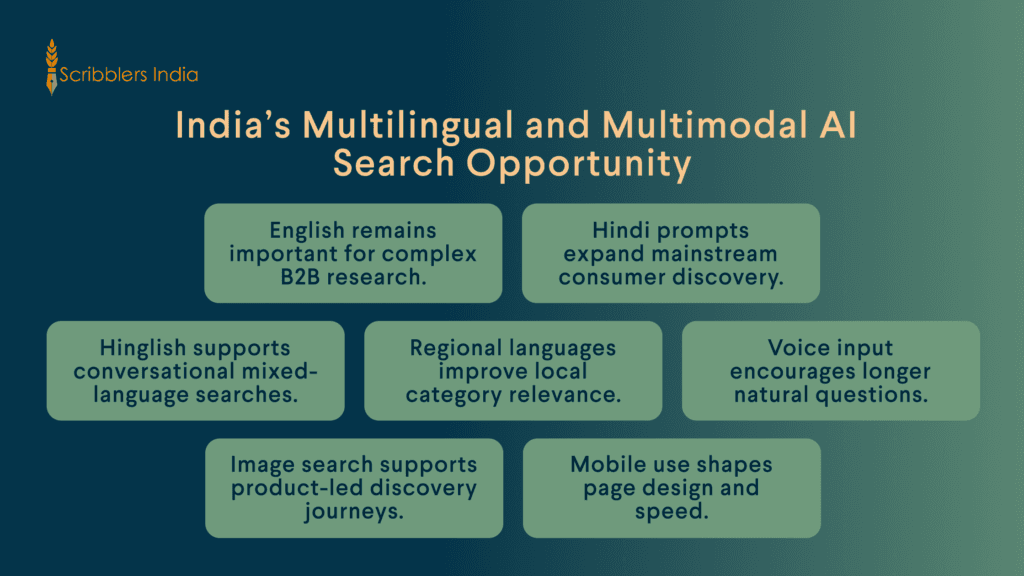
India combines massive internet adoption with mobile-first behavior, language diversity, growing AI use, and rising voice adoption. Early AI Mode queries in India were 2 to 3 times longer than traditional searches. This pattern shows why brands should prepare content for longer prompts, follow-up questions, voice input, and mixed-language discovery.
Search journeys increasingly include voice prompts, images, follow-up questions, and mixed-language queries. Brands should match language investment with audience behavior and category value. Category demand should determine language and format priorities.
B2B SaaS Brands Should Start With Decision-Stage English Content
Enterprise software research still relies heavily on English terminology. SaaS teams should first strengthen category pages, integration guides, comparison content, implementation resources, and proof assets. Regional-language content should be driven by verified demand from customers or sales teams.
Financial Services Need Clear Regional Explanations
Financial concepts require trust and contextual explanation. Brands can test Hindi or regional-language answers for eligibility, fees, documentation, product differences, and fraud prevention. Legal review should protect accuracy before pages reach public search or AI systems.
Healthcare Brands Must Prioritize Accuracy Over Scale
Healthcare searches combine local language with high-stakes intent. Providers need medically reviewed explanations, clear limitations, local service details, and escalation guidance. Direct translation without expert review can introduce errors that affect trust or safety online.
Education Brands Can Use Voice and Mixed-Language Discovery
Students and parents may combine English terms with Hindi or regional phrases. Education brands should test conversational FAQs, career outcomes, eligibility guidance, fee details, and application support. Search data should guide which language pages receive investment first.
2027 projection: By 2027, multilingual and multimodal AI discovery will likely expand fastest across consumer-facing sectors with large mobile audiences. Brands may need to track language-specific prompts, voice-led journeys, image-based searches, and regional content performance across markets. This approach can help teams invest where demand, content accuracy, and commercial value are strongest.
#9: AI Visibility Reporting is Becoming a Core Marketing KPI
Traditional dashboards cannot show how AI systems describe or recommend a brand. Teams need measures for mentions, citations, prompt coverage, answer accuracy, competitor presence, referrals, and assisted conversions. These signals reveal influence before a website visit. They also expose outdated or incomplete brand descriptions during evaluation.
Google introduced dedicated generative AI performance reports within Search Console in June 2026. The reports separate impressions from AI Overviews and AI Mode. They also cover generative Discover experiences.
The following AI search visibility metrics give marketing teams a broader view of brand discovery in the current era:
| Metric | What it shows | Review cycle | Business question |
| AI mentions | Brand inclusion across answers | Monthly | Are relevant answers naming the brand? |
| Cited URLs | Pages selected as sources | Monthly | Which pages earn AI citations? |
| Prompt coverage | Visibility across priority questions | Quarterly | Which buyer questions remain uncovered? |
| Answer accuracy | Correctness of brand descriptions | Monthly | Do answers describe the brand correctly? |
| Competitor presence | Relative AI share of voice | Monthly | Which competitors appear more often? |
| Recommendation position | Placement within brand shortlists | Monthly | Where does the brand appear in recommendations? |
| Source diversity | Range of supporting domains | Quarterly | Do answers rely on varied credible sources? |
| AI referrals | Visits from AI platforms | Monthly | Which platforms send qualified traffic? |
| Conversion quality | Commercial value of AI traffic | Quarterly | Do AI-referred visitors take valuable actions? |
| Citation volatility | Stability of cited sources | Monthly | How frequently do citations change? |
2027 projection: The AI search trends for 2027 indicate that AI visibility reporting will likely enter executive dashboards for brands with measurable prompt-led discovery. Leaders may review recommendation share, citation quality, answer accuracy, referral value, and competitor movement alongside established search metrics. This broader view can connect early AI influence with traffic, branded demand, pipeline contribution, and revenue outcomes.
#10: Commodity Content Will Lose Value as AI Search Trends Evolve
AI systems can generate basic summaries at scale. Content that repeats widely available information gives readers little reason to choose one source. It also provides weak differentiation for systems selecting supporting material. Distinct evidence, expertise, original examples, and context give readers and retrieval systems a stronger basis for selection.
| Commodity content | Authority content |
| Repeats common definitions | Adds original interpretation |
| Summarizes existing articles | Uses firsthand expertise |
| Offers generic recommendations | Gives contextual guidance |
| Uses unsupported statements | Connects claims with evidence |
| Targets isolated keywords | Covers complete buyer questions |
| Lacks identifiable expertise | Features a credible author |
| Uses identical templates | Matches format with intent |
| Ends without action | Provides clear next steps |
Scribblers India insight: Research and expert input create stronger differentiation than surface-level rewrites. Effective content should help readers understand, decide, act, and measure progress.
2027 projection: By 2027, working with an AI content marketing agency will become a stronger requirement for both search visibility and citations. Success will depend on original research, expert experience, proprietary frameworks, and decision-ready guidance. Teams that continue publishing commodity summaries may struggle to earn sustained attention, citations, trust, and measurable commercial influence.

What Do These AI Search Trends Mean for B2B Brands Going into 2027?
B2B brands must influence discovery before a sales conversation begins. AI systems may explain a category, compare vendors, summarize objections, and recommend providers during early research. Content must support category understanding, decision confidence, implementation clarity, and verifiable expertise. AI search visibility today must support education and commercial evaluation before sales engagement.
Category Education Must Address Complete Buyer Questions
Category pages should explain the business problem, operating model, use cases, limitations, and implementation requirements. Each section should connect these ideas with specific questions buyers ask during early research. Strong pages also clarify who the category suits and where it may fall short in practice. Thin definitions rarely support complex buying journeys or dependable AI-generated comparisons.
Comparison Content Must Explain Real Decision Factors
Useful comparison content should explain fit, deployment, integrations, governance, support, and major cost drivers. Brands should present trade-offs through fair criteria, current evidence, and realistic implementation considerations. Each comparison should help buyers understand which option suits their situation during the active evaluation process. Promotional scorecards rarely provide the depth needed for confident evaluation or AI-led recommendations.
Service Pages Must Clarify Brand Positioning
A strong service page should state who the company serves and which problem it solves. It should explain the delivery process, relevant proof, expected outcomes, and the next step. Clear positioning helps buyers understand the offer without interpreting vague marketing language. It also helps AI systems classify the company, service category, and intended audience more accurately.
Authority Content Must Extend Beyond the Company Website
Authority content should extend beyond the company website through research reports, founder articles, podcasts, partner contributions, and expert commentary. Owned pages remain essential because they define the brand’s position and explain its expertise. External evidence strengthens those claims through independent context and validation. Brands should choose channels that match their audience, category, and research behavior.
For example, a SaaS company may rank for a category term while remaining absent from AI comparisons. Comparison content and third-party proof can address that gap.
How Should Brands Build an AI Search Roadmap for 2026 and 2027?
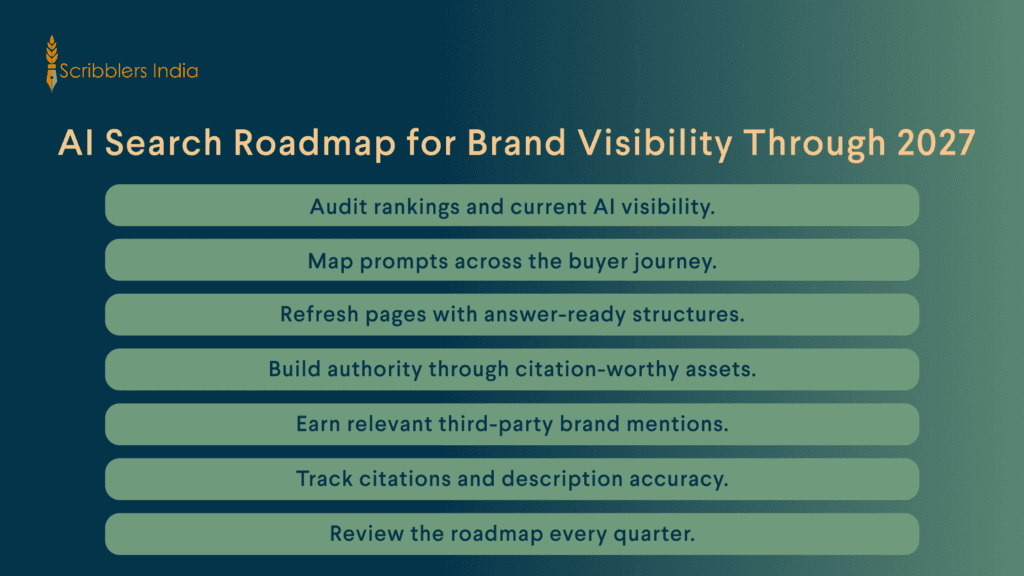
Brands need a phased roadmap based on these AI search trends instead of scattered optimization tactics. The roadmap should strengthen search performance, build answer-ready content, expand citation authority, and establish measurement. Each stage should solve a defined visibility problem before the next investment begins. A clear sequence prevents weak measurement and duplicated work.
Stage 1: Audits Current Search and AI Visibility
Review rankings, indexed pages, buyer prompts, AI mentions, cited URLs, answer accuracy, and competitor inclusion. Establish separate baselines by platform and topic. Distinguish missing visibility from inaccurate descriptions, weak citations, missing referrals, or low-quality traffic before planning changes. This distinction prevents teams from treating every gap as a content problem.
Stage 2: Builds Answer-Ready Content Through AEO
Refresh priority pages with question-led headings, direct answers, clear definitions, comparison tables, and useful FAQs. Improve internal links between category pages and deeper resources. Each section should answer one reader need while supporting the wider decision journey. It should also preserve useful rankings and conversion paths.
Stage 3: Builds Citation-Ready Authority Through GEO
Create original research, expert explainers, comparison guides, case studies, and relevant third-party contributions. Strengthen author profiles and external references around priority topics. Avoid fake community activity, manufactured reviews, misleading claims, or artificial citation schemes that weaken trust. Each asset should clearly connect expertise with searchable buyer questions.
Stage 4: Tracks Visibility and Improves Weak Areas
Review fixed prompts, cited pages, brand descriptions, competitor presence, referral quality, and assisted conversions. Use repeated tests instead of isolated checks. Prioritize changes where AI visibility affects buyer questions, qualified traffic, assisted conversions, or sales conversations. Document every change so later reviews remain fully comparable.
How Can Scribblers India Help Brands Act on AI Search Trends?
AI search trends create value by shaping content priorities, authority development, optimization, and measurement. At Scribblers India, we help brands translate changing discovery behavior into defined actions and measurable visibility goals. Our services connect established search foundations with emerging AI discovery requirements.
- AI Search Visibility Audits: Scribblers India tests priority prompts, cited pages, competitor presence, and the accuracy of brand descriptions across relevant AI platforms. Our AI search visibility audit reveals discovery gaps, establishes measurable baselines, and shows where content, authority, positioning, or entity signals require improvement.
- AEO Content Strategy Planning: We plan question-led pages, direct answers, comparison structures, definitions, tables, and FAQs around complete buyer needs. Our AEO strategy services improve extractability while preserving editorial depth, factual accuracy, readability, and a coherent journey from discovery to decision.
- GEO Authority Content Development: Our team develops original research, expert explainers, comparisons, case studies, and authority-led resources for priority topics. Our GEO content strategy strengthens entity clarity and source credibility while expanding citation opportunities across owned pages, earned media, partner channels, and external platforms.
- Founder Personal Branding Programs: We align founder profiles, LinkedIn content, bylines, interviews, and recurring themes around a defined area of expertise. Our personal branding services build consistent public authority and improve entity recognition by connecting the founder’s experience with the company’s market position.
- Thought Leadership and Ghostwriting Services: Our experts turn founder knowledge, executive viewpoints, and internal expertise into articles, reports, opinion pieces, and platform-ready content. Our ghostwriting strategy preserves the author’s natural voice while producing consistent thought leadership that supports visibility, credibility, trust, and long-term category authority.
Get in touch with our team to build an evidence-led AI search roadmap aligned with measurable visibility and commercial goals.
Frequently Asked Questions
What Are AI Search Trends?
AI search trends are measurable changes in how users discover information through generative search experiences. They include longer prompts, synthesized answers, source citations, brand recommendations, and new referral patterns. Marketers study these changes to improve content planning, visibility measurement, source strategy, and buyer-journey coverage across key platforms.
What Are the Biggest AI Search Trends in 2026?
The largest AI search trends in 2026 include prompt-led discovery, wider AI Overviews, growing ChatGPT visibility, and citation monitoring. Brands also need stronger external authority, clearer founder signals, answer-ready content, and dedicated reporting. Measurement now extends beyond rankings toward mentions, citations, accuracy, and commercial influence.
How Will AI Search Change SEO in 2027?
A reasonable 2027 projection is that SEO will remain foundational while measurement expands. Teams will still need crawlable pages, clear intent, internal links, and useful content. They will also track AI mentions, cited URLs, answer accuracy, referral quality, and brand inclusion across several generative platforms.
Will AI Overviews Reduce Website Traffic?
AI Overviews may reduce clicks when users receive a complete answer immediately. The effect varies by query intent, device, citation presence, topic, and result layout. Some cited pages may gain stronger visits. Brands should assess affected queries, citation presence, conversion quality, and assisted outcomes rather than applying a single forecast across the board.
Why Does ChatGPT Visibility Matter for Brands?
ChatGPT visibility matters because users employ the platform for category research, vendor comparison, objection handling, and buying guidance. A brand can influence consideration without receiving an immediate visit. Teams should track mention frequency, recommendation position, answer accuracy, competitor inclusion, citations, and referral quality across consistent prompts.
What Is the Role of GEO in AI Search?
GEO helps brands strengthen the entities, evidence, citations, and authority assets that generative systems may use. It includes citation-ready content, original research, consistent brand descriptions, and relevant external mentions. GEO should build on sound SEO rather than replace it. No tactic can guarantee a citation.
Which AI Search Trends Should Indian Brands Watch?
Indian brands should monitor AI Mode adoption, longer conversational prompts, regional-language demand, voice input, image search, and mobile-first discovery. Different categories will move at different speeds within each target market. B2B companies may prioritize English, while education, healthcare, financial services, and local providers may need regional content sooner.
How Can Companies Prepare for AI Search in 2027?
Companies should begin with a visibility audit and buyer-prompt map. They should refresh priority pages, build authority assets, strengthen expert profiles, and establish recurring measurement. A quarterly review can identify citation changes and missing prompts. It can also surface weak descriptions and competitor gains without chasing each update.