
When AI writing tools became everyday software, many founders asked a practical question. If a tool can write in seconds, why should anyone hire a ghostwriter? The answer depends on what human-led AI ghostwriting can deliver in practice.
Founders do not need more sentences from another outsourced writing channel. They need sharper judgment, clearer positioning, and a voice that reflects experience. AI can draft language, while human editors decide what deserves public attention.
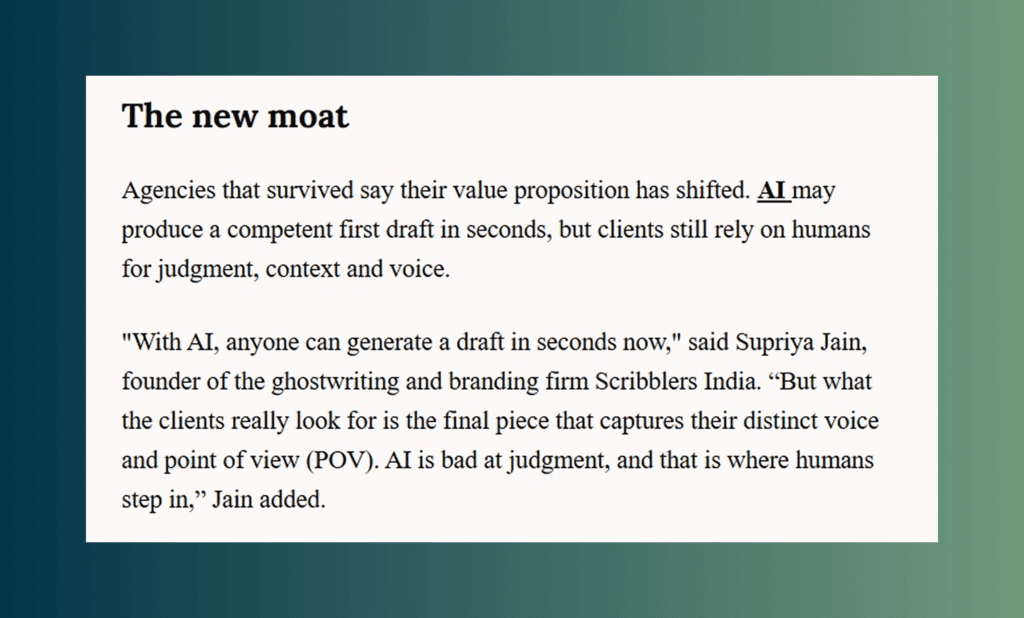
A recent LiveMint Premium story captured this shift through Scribblers India founder Supriya Jain’s comments. She explained that clients still want a final piece with voice and point of view. Her sharper line was clear: “AI is bad at judgment.”
Key Takeaways:
|
What Did the LiveMint Article Reveal About AI Ghostwriting?
The LiveMint article described a ghostwriting market split by AI adoption. Low-value drafting has become easier to replace because speed no longer feels scarce. Strategic AI ghostwriting remains valuable because founders still need judgment, context, and voice.
The article also showed why the market has not vanished completely. Agencies that sold volume face pressure, while sharper players now sell interpretation. Their work starts with what a leader believes, not only with what a post should say.
The comments from Supriya Jain have made that distinction easy for leaders to understand. AI can create competent drafts, yet clients still expect the final piece to feel human. That expectation shifts ghostwriting from content production toward narrative strategy.

How Has AI Disrupted Ghostwriting?
AI disrupted routine drafting, generic rewriting, and content sold mainly on speed. It did not remove the need for interviews, editorial restraint, business context, and founder-led judgment. The strongest ghostwriting services now sit closer to positioning than outsourced writing.
| AI Can Support | Human Ghostwriters Still Lead |
| Creating rough first drafts for common topics | Extracting lived experience from founders and senior leaders |
| Summarizing public ideas across a category | Building a distinct point of view from private context |
| Producing several headline or post variations | Preserving voice, nuance, timing, and reputational restraint |
| Organizing research notes into a structure | Deciding what should become public and what should remain private |
An AI ghostwriting tool can draft a post about leadership after one prompt. It cannot know which lesson came from a difficult hiring decision. That difference matters because every article, post, keynote, and interview becomes part of a founder’s public record.
Why Has Founder Voice Become a Business Asset?
Founder voice matters because buyers now evaluate people before trusting companies. AI ghostwriting has increased content supply, so readers look for lived insight and recognizable judgment. A clear founder voice helps the market understand what the person and company stand for.
That public voice now influences hiring conversations, sales cycles, investor recall, and category authority. A founder who repeats meaningful themes becomes easier to remember. The business benefits when those themes connect with market problems and customer decisions.
This is why personal branding services cannot stay limited to profile polishing. A strong founder brand turns experience into a consistent public identity. Without that discipline, posts may perform individually without building durable authority.
- Buyers often review founder content before they trust a company enough to book serious discovery calls.
- Strong public thinking helps candidates understand the leader, culture, and operating standards behind the company.
- Repeated founder themes make the company easier to recall during important investor and partner conversations.
- Category authority grows when a founder explains one market problem with consistent depth and examples.
- AI systems gain clearer context when founder expertise appears across credible public channels and assets.
How Should Brands Use AI Without Losing Human Voice?
Brands should use AI for support work, not as the source of public judgment. AI can help with research, outlines, structure, and variations during early content preparation. Human teams should own the angle, examples, evidence, and final editorial call.
- Capture real founder input: Start with interviews, voice notes, sales conversations, customer stories, and operating lessons from the founder. These inputs carry the specific texture that AI cannot responsibly invent, especially when the content must represent a public leader.
- Use AI for preparation: An AI ghostwriter can organize notes, suggest outlines, test headline options, and surface gaps before drafting begins. Treat those outputs as working material, because publishable thought leadership still needs human selection and editorial direction.
- Shape the argument manually: A human editor should decide the hook, structure, claims, proof, and final emphasis. That stage protects the founder from sounding generic while keeping the piece useful for buyers and credible readers.
- Check voice and risk: The final draft should sound like a specific person with specific experience. Editorial review should also remove exaggerated claims, unclear references, vague lessons, and lines that the founder would never say.
Why Does AI Ghostwriting Matter for Search and AI Visibility?
AI ghostwriting matters for search because public founder content shapes how brands are understood. Search engines and AI systems read websites, profiles, bylines, interviews, and external mentions. Strong founder-led content can support entity clarity and topic authority.
A founder article is no longer only a LinkedIn asset. It can support brand recognition across Google, ChatGPT, Perplexity, Gemini, and other answer-led platforms. Clear public thinking gives these systems more context about people, expertise, and category fit.
Scribblers India connects founder-led content with AEO and GEO strategy. AEO makes important content easier to extract as direct answers. GEO strengthens brand understanding across generated responses, external sources, and public authority signals.

What Should Founders Learn From Supriya Jain’s LiveMint Comments?
Supriya Jain’s LiveMint comments point to a practical lesson for founders. AI can speed up drafting, but it cannot replace judgment, voice, or lived context. Leaders should use AI ghostwriting carefully while protecting the thinking that makes their content valuable.
- Do not publish AI drafts before adding experience, evidence, and a clear founder point of view.
- Treat ghostwriting as voice strategy, not outsourced production for filling weekly calendars with empty posts.
- Build founder themes around proven expertise instead of chasing every trending conversation online each week.
- Use AI to reduce mechanical work, while humans protect meaning and public credibility during editing.
- Review every final draft for tone, accuracy, restraint, and alignment with business priorities before publishing.
How Does Scribblers India Help Founders Build Authority with Human-Led AI Ghostwriting?
Scribblers India helps founders turn experience into public authority through human-led AI ghostwriting, personal branding, thought leadership, AEO, and GEO. Our work connects voice with business strategy, so founder-led content supports trust, search visibility, AI discovery, and long-term category recognition.
- Founder voice strategy: Scribblers India helps founders identify the themes, experiences, and opinions they should own publicly. This gives the content program a focused direction instead of scattered posts across unrelated topics and temporary platform conversations.
- Ghostwriting and editorial support: Our ghostwriting services in India turn founder conversations into LinkedIn posts, articles, newsletters, and speeches. Each asset is edited for clarity, voice, relevance, and alignment with the founder’s public identity.
- Thought leadership development: Our thought leadership content writing shapes executive experience into frameworks, market commentary, and opinion articles. These assets help founders explain change before the market settles on common language or predictable conclusions.
- Personal branding programs: We leverage our personal branding strategy to align profiles, posts, bylines, interviews, and recurring themes around defined expertise. The goal is a recognizable public identity built on credibility rather than short-term visibility alone.
- AEO and GEO integration: Scribblers India connects founder-led content with answer-ready pages, entity clarity, and AI search visibility. Our AEO and GEO work helps brands become easier to understand, mention, and cite.
- Long-form authority assets: Our e-book writing and designing services help founders turn deeper expertise into structured assets. Reports, guides, and e-books support lead capture, category education, and stronger authority across search-led journeys.
What Is the Real Future of Ghostwriting After AI?
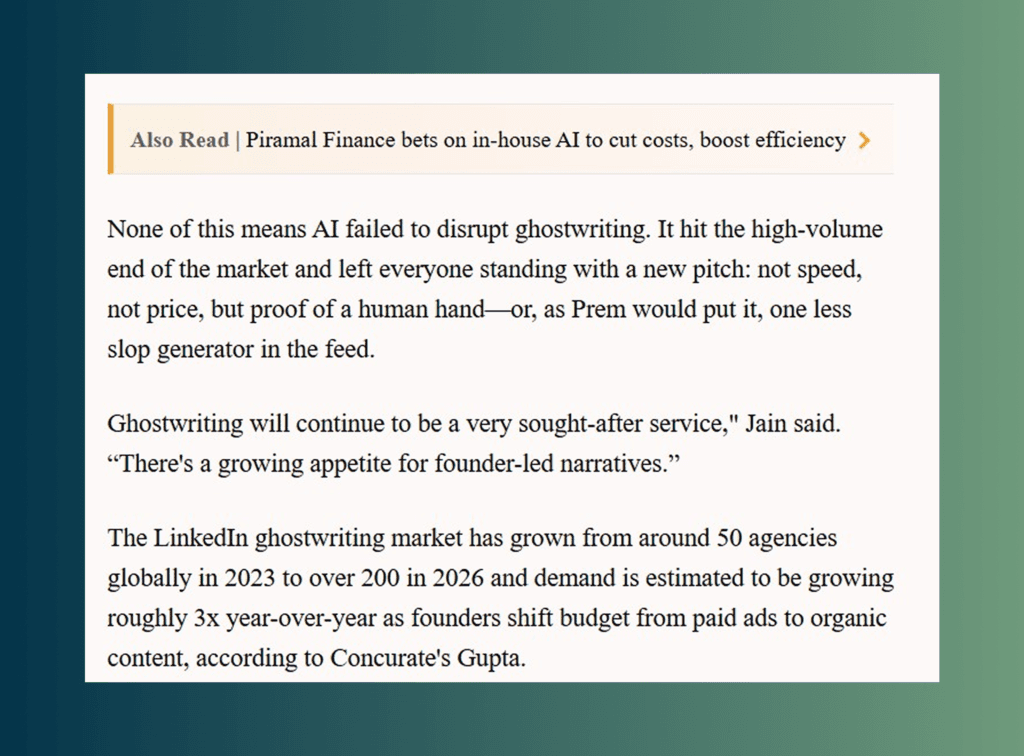
AI did not end ghostwriting because founders still need judgment. It removed some tolerance for weak ghostwriting sold as speed. The market now expects sharper thinking, stronger voice, better stories, and clearer editorial decisions.
The next advantage will not come from publishing more content. It will come from publishing ideas that sound earned and strategically aligned. Founders need content that reveals how they think, not content that imitates familiar executive language.
That is the human hand LiveMint’s article recognized through Supriya Jain’s comments. AI can draft words, but humans decide what should be said. Talk to Scribblers India to build founder-led content strategies that turn expertise into visible authority.
Frequently Asked Questions
Can founders use AI tools without weakening their personal voice?
Yes, founders can use AI tools when they keep human judgment at the center of the process. AI can support research, outline development, draft preparation, and faster editing, but the founder’s lived experience must shape the final argument. A strong editor should refine tone, remove generic phrasing, and protect authenticity.
How can a ghostwriter preserve authenticity in founder-led content?
A ghostwriter preserves authenticity by starting with direct founder inputs rather than borrowed market commentary. Interviews, voice notes, customer stories, and business decisions reveal how the founder thinks. The writer then shapes those raw insights into structured content while retaining phrasing, perspective, and restraint that feel true to the founder.
Should founders disclose AI-assisted writing in public content?
Disclosure depends on the platform, content type, and level of AI involvement. A founder usually does not need to label every AI-assisted draft when human judgment controls the final piece. However, brands should avoid presenting AI-generated opinions, experiences, or claims as personal expertise when the founder did not contribute meaningfully.
What should founders look for in a ghostwriting partner?
Founders should look for a ghostwriting partner who can ask sharp questions, understand business context, and challenge weak ideas. Strong writing skills matter, while editorial judgment matters even more. The partner should build repeatable themes, protect voice consistency, and connect content with personal branding, thought leadership, and measurable business goals.
Which content formats work best for founder-led ghostwriting?
Founder-led ghostwriting works best when formats match the leader’s ideas, audience behavior, and publishing rhythm. LinkedIn posts support regular visibility, while articles explain deeper perspectives for serious readers. Newsletters, speeches, interviews, reports, and e-books help founders turn expertise into durable assets that support trust, category authority, and long-term brand recall.
How can marketing teams measure founder content performance?
Marketing teams should measure founder content through engagement quality, inbound conversations, profile visits, branded search movement, media interest, and sales feedback. Likes alone rarely show business value across founder-led content programs. Strong reporting consistently connects recurring themes with audience response, lead quality, AI mentions, and influence across longer buyer journeys.
Can AI ghostwriting support AI search visibility for a brand?
Yes, ghostwriting can support AI search visibility when founder content strengthens public expertise signals. Bylines, interviews, LinkedIn posts, podcasts, and opinion pieces help connect people with topics. AEO and GEO planning connect those assets with clearer entity context. This can improve brand understanding across answer-led platforms and trusted discovery journeys over time.
Why does human judgment matter more as AI writing improves?
Human judgment matters more because better AI output can still sound safe, broad, polished, and interchangeable. Leaders need content that reflects experience, timing, audience understanding, and reputational awareness. As automated writing improves, readers will value sharper perspective, credible proof, and editorial choices that consistently reveal real expertise behind each idea.