
Software buyers rarely research products using a single broad keyword anymore. They ask whether a platform fits their company’s size, integrates with their existing stack, supports the required workflow, or compares favorably with another product already under consideration. This makes GEO for SaaS different from generic AI search optimization.
SaaS companies need accurate information across product pages, comparisons, pricing, integrations, documentation, customer proof, and other assets that support evaluation before a buyer reaches sales. The shift is already visible in buyer research. G2 reports that 51% of B2B software buyers now start their research with an AI chatbot more often than Google. Another 71% use AI chatbots at some point during software research.
For SaaS teams, the opportunity extends beyond publishing more educational content. The stronger question is whether buyers can find enough current information to understand, compare, validate, and shortlist the product during AI-assisted research.
Key Takeaways
|
What Is GEO for SaaS?
GEO for SaaS improves how a software product is discovered, understood, compared, and referenced during AI-assisted research. It connects buyer questions with accurate product information, decision-focused content, credible public evidence, and recurring visibility measurements across the search experiences that influence software consideration.
A SaaS buyer may ask which payroll software supports several countries or which CRM connects with an existing finance system. Another buyer may ask for alternatives based on reporting depth, pricing structure, security requirements, or implementation effort.
These prompts combine product category with business context. They can shape which vendors receive deeper evaluation before the buyer visits a product website, reads the documentation, or enters a sales conversation.
This means SaaS GEO cannot depend on blogs alone. Product pages, comparison assets, pricing information, integrations, case studies, and technical resources need enough detail to support the same buying journey.
SaaS teams new to this discipline should first understand Generative Engine Optimization and how it extends traditional search visibility to AI-assisted discovery. For software companies, the next step is to apply those principles to product comparisons, integrations, validation questions, and other information buyers use to create shortlists.

Why is GEO for SaaS Companies Different from Others?
SaaS buying involves repeated comparison and validation before a contract begins. Buyers need to understand product fit, pricing, compatibility, implementation requirements, and risk. A strong SaaS GEO strategy must therefore improve information across several decision stages rather than concentrate only on informational content.
G2’s 2026 research found that 53% of surveyed software buyers considered AI chatbot research more productive than traditional search, compared with 36% seven months earlier. The finding suggests that AI-assisted research is becoming a normal part of software evaluation.
Google is seeing a related shift inside Search. AI Mode has surpassed one billion monthly active users globally, while its queries have more than doubled every quarter since launch. Google says people use the experience for longer and more exploratory questions.
Those behaviors fit software buying especially well because buyers often need several conditions evaluated together.
| SaaS Buying Characteristic | What It Means for GEO |
| Buyers Compare Several Vendors | Comparison information needs meaningful depth |
| Requirements Depend on Context | Use-case content needs specific operating detail |
| Integrations Influence Selection | Integration pages must remain accurate |
| Features Change Regularly | Product information needs scheduled reviews |
| Reviews Shape Validation | Third-party descriptions need monitoring |
| Security Affects Enterprise Deals | Compliance claims require clear evidence |
| Pricing Influences Shortlists | Commercial information needs clarity |
| Several Stakeholders Join Evaluation | Content must answer different buyer questions |
A strong program therefore starts with the buying journey. Once the team understands which questions influence discovery and evaluation, it can map those questions to the pages that should answer them.
Which AI Search Prompts Should SaaS Companies Track?
A GEO for SaaS program should track prompts across discovery, shortlisting, evaluation, and validation. Broad category questions provide one part of the picture. Commercial prompts involving product fit, alternatives, integrations, pricing, or security often reveal more useful visibility gaps.
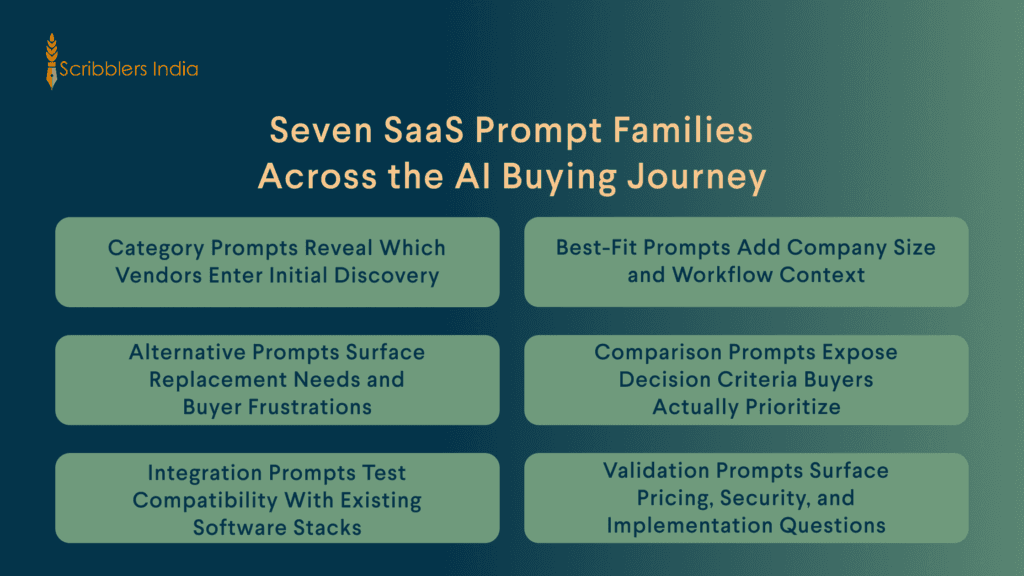
A practical prompt library can use seven groups. Each group should connect with a real buyer decision and a suitable content asset, rather than be included just because the wording resembles an SEO keyword.
1. Category Discovery Prompts
Category Prompts help buyers identify available products before they create a shortlist. Examples include “best payroll platforms for global companies” or “software for managing field service operations.” Track categories where the product genuinely fits, rather than trying to appear for every broad market term.
2. Best-Fit Recommendation Prompts
Best-Fit Prompts introduce company size, industry, workflow, or operating context. A buyer might ask for a CRM for a 50-person SaaS company or an HR platform for distributed teams. These questions test whether the public information clearly defines the intended audience.
3. Alternatives Prompts
Alternatives Prompts often appear when buyers already know the category or incumbent product. They may want stronger reporting, easier implementation, different pricing, or another deployment model. Useful alternative content should explain differences in fit rather than attack the competing product.
4. Direct Comparison Prompts
Comparison Prompts appear as buyers narrow the consideration set. They can ask which product suits enterprise teams or how two platforms differ on workflows. These questions require current, evidence-based comparison content rather than broad superiority claims.
5. Integration and Compatibility Prompts
Integration Prompts carry high decision value because software rarely operates alone. Buyers may need a CRM that integrates with Xero or payroll software that connects to Workday. Dedicated integration content can answer these questions more precisely than general product pages.
6. Use-Case and Industry Prompts
Use-Case Prompts introduce workflow, industry, team, or operating constraints. They show whether a SaaS company explains where its capabilities apply beyond broad feature descriptions. These questions can also reveal missing vertical pages or incomplete examples.
7. Commercial Validation Prompts
Validation Prompts appear closer to a buying decision. Buyers may ask about pricing, deployment, data residency, certifications, migration, onboarding, or support. These questions often depend on product information and documentation rather than another educational article.
Here is a SaaS Prompt-to-Page framework for your reference:
| Prompt Family | Buyer Stage | Best Supporting Asset |
| Category | Discovery | Category or product page |
| Best Fit | Discovery | Use-case page |
| Alternatives | Shortlisting | Alternatives page |
| Comparison | Evaluation | Comparison page |
| Integration | Validation | Integration page or documentation |
| Industry Use Case | Evaluation | Industry page |
| Commercial Validation | Decision | Pricing, trust, or product page |
Prompt mapping will often show that the problem is not a missing page. An existing product or comparison asset may answer the right question but lack sufficient depth. A structured AI content gap analysis can help separate refresh opportunities from genuine gaps that require a new page, reducing unnecessary content creation.
Which SaaS Pages Matter Most for AI Search Visibility?
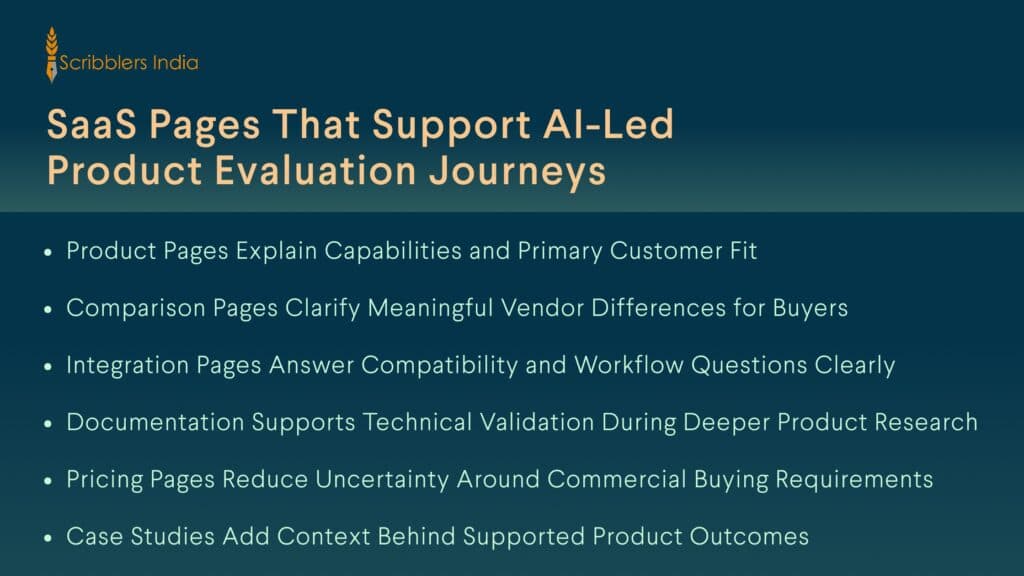
SaaS AI visibility depends on more than informational blogs. Product pages establish capabilities, while comparison pages help with evaluation. Pricing, integrations, documentation, security information, and case studies support later-stage validation. Each important buyer question should have a clear and accurate destination.
| SaaS Asset | Question It Should Answer |
| Homepage | What does this product do? |
| Product Page | Which capabilities does it provide? |
| Pricing Page | How does the commercial model work? |
| Feature Page | How does this capability work? |
| Integration Page | Does it work with my stack? |
| Use-Case Page | Does it fit this problem? |
| Industry Page | Does it fit this operating context? |
| Alternatives Page | When should buyers consider this option? |
| Comparison Page | How do these products differ? |
| Documentation | How does setup or configuration work? |
| Security Page | Which controls or certifications apply? |
| Case Study | Has this worked in a comparable situation? |
This analysis reveals a common content-strategy problem. A SaaS company can maintain hundreds of informational articles while leaving high-intent product information incomplete. Publishing another top-of-funnel guide rarely fixes vague pricing or unclear integration capabilities.
The stronger sequence is to improve decision-stage pages before expanding informational coverage. Our AI Search Discovery Benchmark reaches a similar conclusion: brands need connected content systems that support search visibility, answer quality, credible evidence, and recurring measurement, rather than relying on publishing volume alone.
How Should Product and Category Pages Improve Clarity?
Product Clarity starts with consistent information around category, audience, use cases, capabilities, and commercial fit. Different pages can emphasize different needs, although the underlying description should remain stable enough for buyers to understand where the product belongs.
Review product naming, category terminology, customer segments, core workflows, major integrations, geographic availability, and current feature descriptions. A homepage that calls the product an “AI revenue platform,” while directories categorize it differently, can create ambiguity even when both descriptions contain some truth.
How Should Pricing Pages Support SaaS AI Search Visibility?
Pricing Clarity helps buyers understand the commercial model without requiring that every enterprise quote be made public. Useful pages explain billing units, plan differences, meaningful usage limits, minimum commitments, optional add-ons, and custom quotation conditions that affect the selection.
Pricing information also needs coordinated updates. Old comparison pages should not continue displaying outdated rates after packaging changes. Public profiles controlled by the company should receive the same review when their commercial information becomes stale.
How Should Security Pages Support Product Validation?
Security Evidence should answer the exact risk questions relevant to intended buyers. Generic statements about being “enterprise secure” provide limited information when procurement teams need evidence around certifications, access controls, hosting arrangements, data residency, or auditability.
Marketing teams should distinguish between being certified, supporting customer compliance needs, or aligning internal practices with a framework. Those statements carry different meanings and should receive appropriate technical or legal review before publication.
How Should SaaS Case Studies Support Buyer Decisions?
Case Study Context gives product outcomes enough detail to be useful during evaluation. Strong cases explain the customer type, original problem, implementation conditions, relevant product use, measured result, and timeframe rather than presenting a single unsupported headline number.
That context can support narrower prompts such as whether the product has worked for a particular operating model. A comparable customer story often provides stronger evidence than another feature page when the buyer needs proof rather than description.
Why Are Comparison Pages Crucial for GEO for SaaS?
Comparison content deserves high priority in GEO for SaaS because software buyers frequently use AI to evaluate competing vendors. Strong pages explain meaningful differences in audience fit, commercial structure, integrations, implementation, and capabilities. Weak pages simply declare the publishing company superior without supporting the decision.
Comparison intent deserves special attention because AI chatbots are increasingly used to create software shortlists and compare options. G2 reports that AI now influences which vendors many buyers evaluate before they reach vendor websites or sales teams.
A useful SaaS comparison page should clarify:
- Audience Fit: Explain which type of buyer each product serves best.
- Current Pricing: Verify public pricing and include a review date.
- Important Capabilities: Compare features that influence the buying decision.
- Integration Coverage: Focus on connections that affect product suitability.
- Implementation Requirements: Explain meaningful differences in setup or migration.
- Relevant Limitations: Acknowledge constraints that can change product fit.
- Supporting Evidence: Link important factual claims to current public information.
Avoid designing a table where your product wins every row. Buyers gain more value when different scenarios can produce different conclusions, especially when the products serve overlapping audiences with different priorities.
Comparison pages can also support traditional search by satisfying a defined evaluation intent. One useful page can therefore support Google Search and AI-assisted research without creating a separate “AI version” of the same comparison.
How Do Integration Pages and Documentation Support GEO for SaaS?
Integration pages and documentation answer detailed questions that broad product copy cannot resolve. They help buyers understand compatibility, implementation, APIs, configuration, workflows, and platform limits. For AI search optimization for SaaS, these resources provide factual depth during technical evaluation.
A meaningful integration page should explain more than whether two products connect. Buyers may need to know which data moves between systems, whether synchronization works in both directions, which plan supports the connection, or which limitations affect the intended workflow.
| Asset | Buyer Question | Useful Information |
| Integration Page | Does it connect? | Data flows, plans, workflows, limitations |
| Documentation | How does it work? | Setup, APIs, permissions, configuration |
| Help Center | What happens when issues occur? | Troubleshooting, administration, common workflows |
Documentation extends product information without forcing every technical detail onto marketing pages. A comparison article may state that a feature exists, while documentation can explain exactly how that feature behaves under real implementation conditions.
How Do Third-Party Sources Affect SaaS AI Visibility?
Third-party sources add independent context around SaaS products. Review platforms, partner marketplaces, industry publications, public customer evidence, and expert commentary can influence how buyers validate product claims. A SaaS GEO strategy should therefore review the external information environment alongside owned content.
G2’s 2026 research suggests that buyers still seek verification after AI-assisted discovery. AI can accelerate shortlisting, while buyers continue to use other sources to confirm whether recommendations deserve their trust.
Review the external footprint through several categories:
- Software Profiles: Check whether product positioning remains current and accurate.
- Partner Marketplaces: Verify controlled descriptions and integration information.
- Customer Reviews: Study recurring strengths or limitations buyers mention.
- Industry Coverage: Identify credible discussions around the category or product.
- Customer Evidence: Review public proof supporting important use cases.
- Expert Commentary: Assess founder or subject-matter expertise where relevant.
- Public Discussions: Study buyer language without manufacturing participation.
A company may need stronger customer proof points for enterprise implementations or a clearer product profile across partner ecosystems. Publishing another educational blog would not solve either problem, which is why source analysis belongs inside the wider GEO process.
What Should a SaaS GEO Content Strategy Cover Across the Buyer Journey?
A strong SaaS content strategy follows questions from early problem discovery through commercial validation. Educational assets can introduce the problem, while product and comparison content support evaluation. Documentation, pricing, and security pages, along with customer evidence, then help buyers validate shortlisted products.
| Buyer Stage | Typical AI Question | Best Supporting Asset |
| Problem Discovery | How do I solve this problem? | Expert guide |
| Category Discovery | Which software can solve it? | Category or use-case page |
| Shortlisting | Which tools fit this scenario? | Comparison or authority content |
| Evaluation | How do Product A and Product B differ? | Comparison page |
| Compatibility | Does this product work with my stack? | Integration page |
| Technical Validation | How does this feature work? | Documentation |
| Commercial Validation | What does this product cost? | Pricing page |
| Risk Validation | Does it meet this requirement? | Security or trust page |
| Proof | Has it worked for similar companies? | Case study |
This framework makes content overinvestment easier to identify. A SaaS company may have hundreds of informational articles while maintaining only a few weak evaluation assets. The library looks substantial, yet several high-value buyer questions remain unanswered.
Once these buyer stages are mapped, teams need a practical way to identify which parts of the visibility system remain weak. The AI Search Visibility Scorecard provides a useful starting point for reviewing content depth, answer readiness, external validation, and other gaps before deciding where to allocate the next content investment.
What Does a GEO for SaaS Engagement Actually Include?
A GEO for a SaaS engagement should begin with commercial prompt mapping and a product information review. The team can then strengthen high-intent pages, fill genuine information gaps, assess credible external evidence, and repeat visibility tests. The work should follow observed weaknesses rather than fixed content quotas.
Phase 1: Build the Commercial Prompt Baseline
Prompt Mapping should cover category discovery, comparisons, alternatives, integrations, use cases, and validation questions. Record current product visibility alongside relevant competing vendors, then maintain a stable core set for later comparisons.
Phase 2: Audit High-Intent Product Information
Product Auditing should review product pages, comparisons, pricing, integrations, documentation, and security information. Correct significant factual or structural gaps before investing heavily in new editorial content.
Phase 3: Strengthen Existing Commercial Assets
Page Refreshes should focus first on URLs already serving important buyer questions. A comparison page missing current pricing may need improvement, while a weak integration page may need deeper workflow information.
Phase 4: Fill Genuine Content and Authority Gaps
New Assets become useful when no existing page can answer an important question well. Research reports, expert guides, customer evidence, or implementation resources can add depth when the audit identifies a clear gap.
Phase 5: Re-Test and Reprioritize
Recurring Measurement should repeat the stable prompt set after meaningful changes. Review product appearances, competing vendors, citation sources, and the accuracy of descriptions before deciding which content group deserves the next investment cycle.
This process works best when the diagnosis occurs before repeated execution. Businesses that need broader strategic support can review Scribblers India’s GEO services to understand how content audits, gap analysis, authority development, and ongoing visibility work can fit within a wider generative search program.
How Should SaaS Companies Measure GEO Performance?
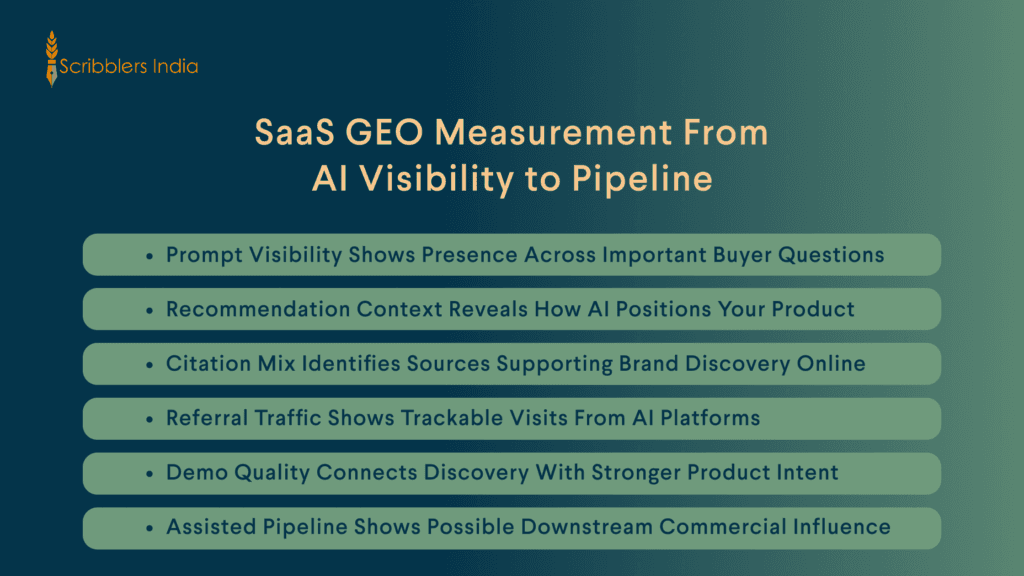
SaaS companies should measure SaaS AI visibility against the software buying journey rather than report citations alone. Prompt presence shows discovery, while recommendation context explains positioning. Referral traffic provides evidence of engagement, and demo quality or assisted pipeline can indicate commercial value when attribution supports the connection.
| Metric | What It Tells a SaaS Team |
| Category Prompt Visibility | Whether the product appears during discovery |
| Recommendation Context | How the product is positioned |
| Competitor Visibility | Relative presence across tracked questions |
| Description Accuracy | Whether product information is represented correctly |
| Citation Mix | Which owned or external assets support answers |
| AI Referral Traffic | Identifiable visits from AI sources |
| Demo or Trial Quality | Whether visitors show product intent |
Avoid combining all signals into a single unexplained score. A product may appear frequently across broad prompts with little commercial importance, while another appears less often across a smaller group of high-value enterprise questions.
The second scenario can create greater business value because the prompts sit closer to meaningful evaluation. This is why prompt selection should happen before reporting, rather than treating every mention or citation as equally important.
How Much Does GEO for SaaS Cost?
The cost of GEO for SaaS depends on the product portfolio, markets, prompt scope, existing content quality, and required implementation. A single-product startup needs a different program from a multi-product SaaS company serving several industries across different geographic markets.
Four variables explain most scope differences:
- Market Scope: More products, industries, or geographies increase research requirements.
- Visibility Scope: Larger prompt sets and more platforms require deeper monitoring.
- Content Scope: Existing page refreshes and new assets change the editorial workload.
- Research Scope: Documentation, comparison research, and reporting depth affect effort.
A company with strong commercial pages may need selective improvements and recurring measurement. Another business may need foundational product work before a larger visibility program makes sense. Start with an audit when the baseline remains unclear. The findings can show whether a fixed project or recurring program better matches the opportunity.

When Should a SaaS Company Invest in GEO?
A SaaS company should invest when AI-assisted research influences its buyers and important product questions remain weakly represented. The strongest trigger is a measurable discovery, accuracy, or decision-coverage gap. Category enthusiasm alone provides a weak reason for allocating a recurring budget.
Useful investment signals include:
- Competitors Appear Frequently: Your product remains absent across relevant commercial prompts.
- Descriptions Are Inaccurate: AI answers misunderstand the category or intended customer.
- Comparison Coverage Is Weak: Important evaluation questions lack suitable supporting pages.
- Public Information Conflicts: Controlled profiles contain inconsistent product or pricing details.
- Commercial Pages Are Stale: Product information no longer reflects current capabilities.
- AI Referrals Already Exist: Analytics shows measurable AI-assisted discovery.
- Sales Teams Hear AI References: Prospects arrive with generated comparisons or recommendations.
A young SaaS company may first need strong category positioning and complete commercial pages. A mature vendor with several products may require recurring visibility measurement much sooner because more categories and competitors create a larger monitoring surface.
The decision rule is simple: Fix the information system before expanding the visibility program. Once the core product information is reliable, GEO work can focus on where discovery and evaluation remain weak.
How Can Scribblers India Help SaaS Companies Improve AI Search Visibility?
At Scribblers India, we approach GEO for SaaS through the software buying journey. We identify the prompts that influence discovery, comparison, and evaluation, then assess whether existing product content addresses them clearly. GEO services connect these findings to practical content priorities rather than defaulting to higher publishing volume.
That assessment often begins with high-intent assets such as product pages, comparison content, integrations, pricing, and supporting resources. Our AI content gap analysis helps distinguish pages that need stronger information from buyer questions requiring entirely new assets, keeping the content roadmap focused.
Once the information gaps are clear, we strengthen the wider visibility system through evidence-led comparisons, research-backed authority content, founder thought leadership, and recurring prompt measurement. Insights from our AI Visibility Scorecard also help us evaluate visibility patterns and refine priorities as buyer questions and AI search experiences evolve.
Get in touch with our team to start building your SaaS GEO strategy around buyer questions, stronger product evidence, and measurable AI search visibility growth.
Frequently Asked Questions
What Is the Need for GEO for SaaS?
GEO for SaaS helps software companies improve how products appear during AI-assisted research. It connects buyer prompts with product pages, comparisons, pricing, integrations, documentation, and credible public evidence. The process also assesses whether relevant AI systems accurately describe the product during discovery and evaluation.
How Is GEO for SaaS Different From SaaS SEO?
SaaS SEO primarily addresses organic search discovery, technical visibility, rankings, and search traffic. GEO adds analysis of generated answers, prompt visibility, citations, recommendation context, and product representation. The disciplines overlap because Google’s AI features still rely on normal Search eligibility and established SEO foundations.
Which SaaS Pages Should Be Optimized First for AI Search?
Start with pages closest to buying decisions. Product pages, comparisons, pricing information, integrations, use cases, documentation, security resources, and case studies usually deserve early review. Test commercial prompts first so the team knows whether an existing page needs improvement or a new asset.
Do Software Review Sites Affect SaaS AI Visibility?
Review platforms can form part of the public information environment around a SaaS product. Their influence varies by platform and query. Teams should keep legitimate profiles accurate, study recurring external sources, and strengthen real customer evidence without manufacturing reviews or artificial public discussions.
Should SaaS Companies Create Competitor Comparison Pages?
Yes, when buyers genuinely compare those products. The page should explain meaningful differences through current evidence and useful decision criteria. Include audience fit, pricing, capabilities, integrations, implementation considerations, and limitations where appropriate instead of designing every comparison to favor your own product.
Does Product Documentation Help SaaS AI Visibility?
Documentation can provide detailed information about setup, APIs, integrations, permissions, workflows, configuration, and product limitations. This depth makes it useful during technical evaluation. Keep important documentation current and accessible where possible, while measuring visibility rather than assuming documentation automatically creates AI citations.
How Should SaaS Companies Track AI Search Performance?
Track a stable set of commercially relevant prompts over time. Record product appearances, recommendation context, citations, competing vendors, and description accuracy. Add identifiable AI referral traffic where available, then connect those visibility signals with trials, demos, or assisted pipeline when attribution supports the relationship.
How Long Should SaaS Companies Test GEO Before Evaluating Results?
The evaluation period needs enough time to establish a baseline, implement meaningful changes, and repeat comparable tests. A 90-day review can provide a useful first checkpoint for many programs. Larger sites may require longer before teams can distinguish useful movement from routine answer variation.