
A LinkedIn post can reach 100,000 people without generating one relevant opportunity. Another article may reach a much smaller audience and lead to a board introduction, a consulting inquiry, a speaking invitation, or a qualified sales conversation. Both results have value, although they belong to different stages of measurement.
That distinction sits at the center of personal branding ROI. Reach, audience quality, authority, conversations, opportunities, and financial outcomes should not be grouped into a single return metric. Doing so can make performance reports appear stronger while making future investment decisions considerably less reliable.
A useful measurement system starts with three questions: What are you investing? What professional outcome should change? How confidently can that change relate to the personal brand? The framework below answers those questions through cost calculation, attribution rules, worked examples, and practical reporting.
Key Takeaways
|
What Does Personal Branding ROI Measure?
Personal branding ROI compares the value created by a professional reputation program with the resources invested in building it. Financial ROI can be calculated when monetary outcomes are defensibly attributable. Wider professional value needs separate measures when reputation influences decisions without immediately creating a financial transaction.
The standard financial formula remains useful:
ROI (%) = (Attributed Financial Value − Total Investment) ÷ Total Investment × 100.
The arithmetic is simple. The difficult part is deciding which outcomes deserve monetary value and how much credit the personal brand should receive.
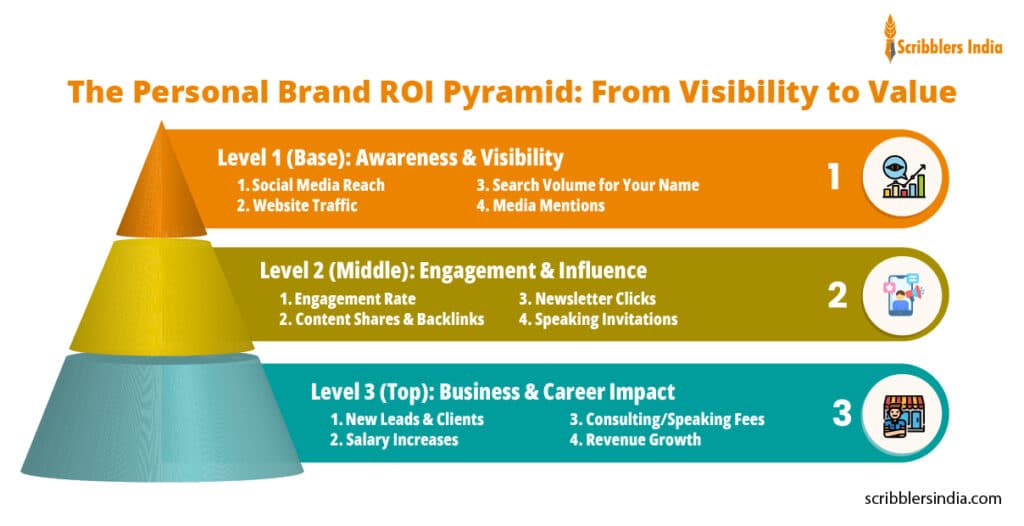
A follower, profile visit, search appearance, comment, or speaking invitation does not have an automatic financial value. Each belongs to a different stage of the reputation journey, so return on investment personal branding analysis should separate the following layers:
| Measurement Layer | What It Answers | Examples |
| Visibility | Are relevant people encountering you? | Impressions, searches, profile appearances |
| Audience Quality | Are the right people seeing you? | Companies, roles, industries, seniority |
| Authority | Is your expertise receiving meaningful response? | Saves, citations, media or speaking requests |
| Conversation | Is reputation creating professional interaction? | DMs, replies, introductions, calls |
| Opportunity | Are conversations creating valuable possibilities? | Leads, interviews, partnerships, board discussions |
| Financial Outcome | Has attributable monetary value been created? | Revenue, fees, retained business |
LinkedIn currently provides members with profile appearances and Search Appearances information, including available context such as the companies and job titles associated with people finding them. These signals can help assess professional discovery and audience relevance, although they remain upstream of financial return.

What Should Count as the Cost of Personal Branding?
To measure personal branding ROI accurately, calculate more than the agency or freelancer invoice. The real investment can include content production, specialist tools, paid distribution, website work, and the professional’s own time. Missing significant inputs artificially lowers the denominator and overstates the eventual return.
Here is a useful model you can refer to:
Total Investment = External Professional Spend + Production and Tools + Paid Distribution + Professional Time
Apply the same cost method across reporting periods so changes in ROI reflect actual performance rather than a different accounting approach.
| Investment Category | Examples | How to Treat It |
| Professional Support | Strategy, ghostwriting, design, video, PR | Include agreed fees |
| Production and Tools | Hosting, analytics, software, research tools | Allocate relevant program cost |
| Paid Distribution | Sponsored posts, event promotion, media amplification | Keep separate from earned reach |
| Professional Time | Interviews, reviews, events, networking | Track hours or apply agreed rate |
| Additional Assets | Photography, websites, research, reports | Include when created for the program |
Professional time needs particular care. A founder who spends ten hours each month discussing ideas, reviewing content, attending events, and networking has contributed a meaningful resource. Businesses can assign an agreed opportunity-cost rate where financial analysis requires it, while simpler programs can record those hours separately.
If you are still establishing the investment side of the equation, our personal branding services cost guide explains how strategy, ghostwriting, visual production, senior involvement, websites, PR, and other scope variables affect the cost of a professional branding program.
Which Personal Branding Metrics Should You Track?
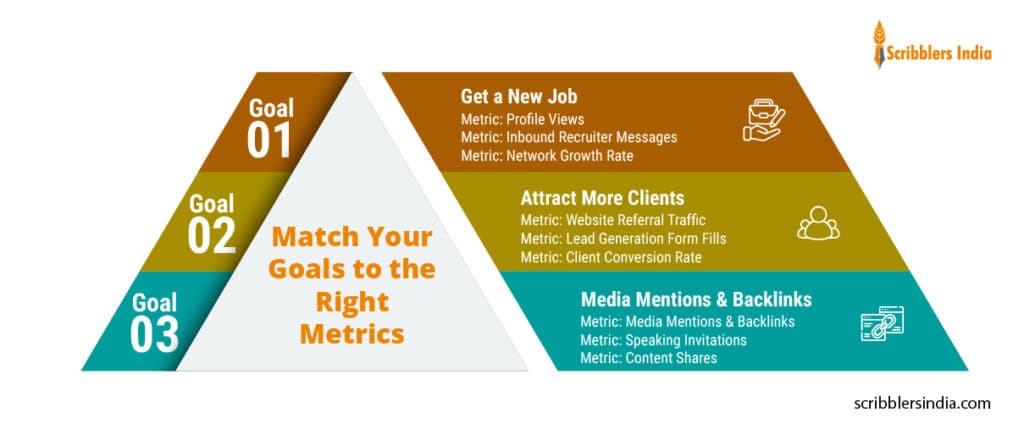
The right personal branding metrics depend on the job the reputation is expected to perform. A consultant looking for qualified inquiries needs a different scorecard from an executive building board visibility or a professional preparing for a career move. Start with the objective and work backward.
This prevents one of the most common measurement errors: reporting the metrics that are easiest to collect rather than those most closely tied to the desired outcome. A smaller, more relevant audience can create greater professional value than a large audience that is not relevant to the objective.
| Primary Goal | Leading Indicators | Outcome Indicators |
| Founder Demand Generation | Relevant reach, buyer engagement, site visits | Qualified inquiries, influenced pipeline |
| Consulting Growth | Case activity, referrals, target-audience engagement | Calls, proposals, attributable clients |
| Executive Visibility | Stakeholder discovery, media interest | Speaking, board, industry opportunities |
| Career Mobility | Search appearances, recruiter activity | Interviews, role conversations, offers |
| Speaking or Advisory Work | Content citations, invitations, expert response | Paid engagements, advisory mandates |
| Thought Leadership | Saves, citations, expert engagement | Media, partnerships, category influence |
What Is the Difference Between Leading and Lagging Personal Branding Metrics?
Leading indicators show whether the reputation system is moving in the intended direction. Visibility, search appearances, relevant profile visits, content saves, website traffic, and target-audience engagement help teams understand early movement before a meaningful professional opportunity appears.
Lagging indicators sit closer to the intended result. Qualified inquiries, speaking invitations, interviews, proposals, partnerships, board conversations, and attributable revenue provide stronger evidence that reputation has influenced a real decision. They usually take longer to accumulate and therefore deserve a longer reporting window.
Authority belongs between these two stages. When relevant peers cite your ideas, conference organizers invite you to speak, or publications request commentary, the audience is doing more than seeing your name. These responses show that professional expertise is becoming useful to other people.
The wider benefits of personal branding can include career, network, authority, and organizational effects. This page focuses on measuring those effects without incorrectly turning each benefit into financial ROI.
How Do You Attribute Business Outcomes to Personal Branding?
Measurement confirms that an outcome occurred. Attribution determines how much credit the personal brand deserves. That distinction is essential because professional reputation often works across LinkedIn, websites, search, podcasts, conferences, private recommendations, email, and offline conversations before a final action occurs.
Google Analytics demonstrates the same underlying challenge for digital journeys. GA4 currently supports data-driven attribution and paid-and-organic last-click models, with the chosen methodology determining how credit is allocated among measurable touchpoints. Personal branding requires a broader approach because many relevant interactions occur outside the website.
What Are the Different Levels of Personal Brand Attribution?
Use an attribution hierarchy rather than assigning the same confidence to every opportunity:
| Attribution Level | When to Use It | Example |
| Direct | A clear content or profile interaction creates the outcome | Prospect replies to newsletter and becomes a client |
| Assisted | Brand activity contributed alongside other channels | Buyer follows posts before later converting through search |
| Influenced | Reputation clearly affected the decision but contribution cannot be isolated | Prospect says they followed your work for months |
| Self-Reported | The person identifies how discovery or influence happened | “I heard you on a podcast” |
| Qualitative | Strategic reputation change exists without defensible monetary attribution | Better media or board access |
Direct attribution deserves the greatest confidence. If an event organizer reads a published article and then offers a paid speaking engagement, the pathway is unusually clear. The source, resulting opportunity, eventual value, and supporting evidence can all be recorded in the CRM or measurement log.
Assisted attribution is more common. A buyer may read founder posts for several months, visit the company website through search, speak with sales, and then purchase. The personal brand deserves influence credit, whereas allocating the entire contract value to a single LinkedIn post would exaggerate the available evidence.
Self-reported attribution helps capture what analytics misses. Ask prospects, recruiters, partners, organizers, or other contacts how they first heard about the professional and what prompted the conversation. This can surface podcasts, forwarded posts, private communities, conference appearances, and word-of-mouth introductions that are invisible in website analytics.
How Do You Calculate Personal Branding ROI? (with Real Examples)
A financial calculation becomes appropriate only when both the investment and attributable monetary value can be defended. Open pipeline, increased impressions, or estimated media value should remain outside the ROI numerator until the organization has a clear methodology for assigning actual monetary value.
The examples below show why different personal-brand objectives need different reporting treatments.
Example 1: How Do You Calculate Direct Personal Branding ROI?
Consider a consultant investing ₹2,40,000 over four months. The amount includes ₹1,60,000 for professional support, ₹20,000 for tools and design, and ₹60,000 of time, valued consistently under the consultant’s internal methodology.
One directly attributable inquiry becomes a consulting engagement generating ₹3,60,000 in contribution after directly associated delivery costs. The calculation is therefore (₹3,60,000 − ₹2,40,000) ÷ ₹2,40,000 × 100 = 50% personal branding ROI.
Two additional inquiries that have not converted remain opportunity metrics. They should not be added to the financial numerator until value is realized under the organization’s agreed accounting and attribution rules.
Example 2: How Should Influenced Pipeline Be Reported?
Consider a founder whose content generates seven qualified conversations, three of which enter the company’s sales pipeline. One becomes a significant enterprise opportunity, although the deal remains open at the reporting date. The personal-brand system has clearly influenced commercial activity, but has yet to generate attributable realized value.
The report should state seven content-influenced conversations, three assisted opportunities, one influenced open opportunity, and zero closed attributable revenue. Reporting the entire open pipeline as personal branding return would confuse opportunity creation with realized financial performance.
Example 3: How Do You Measure Executive Personal Branding Without Revenue?
A CHRO may use personal branding to improve peer recognition, conference visibility, media access, and board opportunities rather than sell a service. Suppose two quarters produce three conference invitations, two specialist media requests, stronger relevant search visibility, and one board conversation influenced by published content.
A financial percentage would add false precision. The appropriate report should show the original executive-visibility objective, leading discovery signals, authority outcomes, and the resulting strategic opportunity. This still represents measurable value even though no responsible monetary ROI calculation is available.
What Should a Personal Branding ROI Dashboard Include?
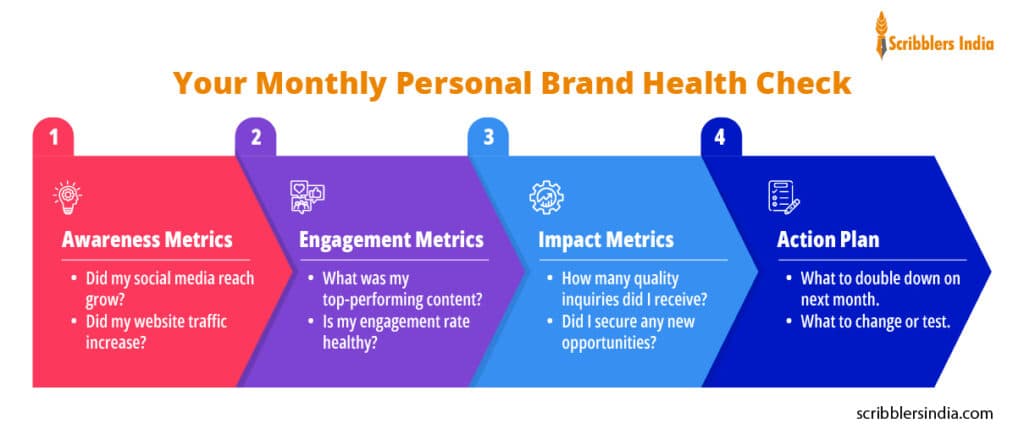
A practical dashboard should separate activity, visibility, audience quality, authority, opportunities, and financial outcomes. This prevents the monthly report from becoming a list of large social numbers while also providing the team with enough operational information to improve content, positioning, distribution, and conversion paths.
Use different reporting cadences for different decisions:
| Reporting Layer | Review Frequency | What to Track |
| Production | Monthly | Content, interviews, professional time |
| Visibility | Monthly | Reach, profile appearances, searches |
| Audience Quality | Monthly | Relevant roles, companies, industries |
| Authority | Monthly/Quarterly | Saves, citations, media and speaking interest |
| Conversations | Monthly | DMs, introductions, qualified calls |
| Opportunities | Quarterly | Leads, interviews, partnerships, board discussions |
| Financial Outcomes | Quarterly/Annual | Attributable revenue or fees |
| Strategic Reputation | Quarterly/Annual | Association with intended expertise |
LinkedIn’s current analytics can support parts of this operating layer through profile appearances, search appearances, post analytics, audience analytics, profile viewers, and newsletter information where applicable. These platform signals help explain discovery and response rather than proving downstream financial causality.
Quarterly reviews should then look beyond post performance. Ask whether the intended audience is becoming easier to reach, whether professional conversations are improving, and whether authority signals are translating into useful opportunities. Annual reviews can address the larger investment question: maintain, expand, reduce, or redirect the program.
What Can Personal Branding Case Studies Prove About ROI?
Case studies can demonstrate measured visibility and audience response, although those results should not automatically be described as financial return. Scribblers India’s own work provides useful examples of why the measurement stages need to remain separate rather than be collapsed into a single success claim.
In our study abroad consultant personal branding case study, account reach increased by more than 640% during the measured 30-day period, over 92% of content views came from non-followers, and profile visits grew by more than 135%. These results establish stronger discovery and profile interest.
A separate EdTech leader personal branding case study recorded 109,040 reel views, 94,301 accounts reached, 654 follows, 624 profile visits, and 43 bio-link taps. These signals indicate that discovery is moving toward profile-level action, while the published evidence does not establish attributable revenue.
That distinction strengthens the case study rather than weakening it. Reporting only what the evidence supports gives decision-makers a clearer view of where the strategy is working and what additional data would be required before financial personal branding ROI could be calculated.
Why Can Personal Branding Metrics Look Strong While ROI Remains Weak?
Weak returns often stem from a break between two stages of the reputation journey rather than from poor content alone. Diagnose where performance stops progressing before increasing publishing volume, advertising spend, or the number of channels used.
| Observed Pattern | Likely Problem | What to Review |
| High Reach + Wrong Audience | Topics attract irrelevant attention | Audience and content themes |
| Relevant Reach + Few Profile Actions | Positioning remains unclear | Headline, biography, proof |
| Strong Profile Activity + Few Opportunities | Conversion path is weak | Offer relevance, contact path, evidence |
| Good Content + Low Reach | Distribution is limited | Network, collaborations, owned channels |
| More Opportunities + No Source Data | Attribution design is missing | CRM fields, UTMs, self-reporting |
| High Activity + Vague Objective | Strategy is unclear | Original professional goal |
For example, strong profile traffic with few qualified conversations may indicate that people are curious but cannot understand what the professional offers or why their expertise is credible. The response should be stronger positioning and proof, rather than automatically publishing more frequently.
When the problem sits earlier in the system, use our “how to build a personal brand online“ analysis to review positioning, proof, channel selection, content, networking, searchability, and the broader execution model.
What Are the Limits of Measuring Personal Branding ROI?
No attribution system can observe every way reputation influences professional decisions. A buyer may follow someone for a year, attend a webinar, receive a private article, search the person’s name later, and finally make contact through another route that receives the visible conversion credit.
Offline influence creates another gap. Conferences, referrals, private communities, WhatsApp conversations, forwarded screenshots, and introductions can affect decisions without creating clean analytics trails. Self-reported attribution improves the evidence while still depending on imperfect human recall.
Career outcomes require similar caution. A promotion or job offer can reflect performance, experience, organizational needs, relationships, compensation terms, timing, and public reputation. Assigning an entire salary increase to personal branding usually creates more precision than the evidence can support.
Attribution is therefore a methodology rather than an objective fact hidden inside the raw data. GA4 itself allows organizations to choose how credit is assigned across measurable touchpoints. Personal branding teams should document their own rules and apply them consistently, rather than changing attribution whenever results look more favorable.
How Should You Start Measuring ROI on Personal Branding?
Start measuring personal branding ROI before the next publishing cycle by defining the objective, baseline, total investment, meaningful outcomes, and attribution rules. A starting point makes later comparisons more reliable and prevents stronger visibility from being mistaken for stronger return.
- Record how relevant audiences currently discover the professional across search, social platforms, referrals, events, and direct recommendations.
- Track existing opportunities, including inquiries, speaking requests, media interest, partnerships, interviews, and board-level conversations already coming in.
- Calculate agency fees, production costs, tools, distribution spend, and professional time using one consistent measurement method.
- Set attribution rules for direct, assisted, influenced, and qualitative outcomes before reviewing new campaign performance data.
- Choose analytics, CRM fields, source questions, links, and internal records that capture evidence without overcomplicating reporting.
- Match reporting depth to the objective, using stronger lead tracking for consultants and authority signals for executives.
How Can Scribblers India Help Improve Personal Branding Measurement?
At Scribblers India, we connect personal-brand measurement with the professional objective established at the beginning of the engagement. Our personal branding services combine positioning, content strategy, ghostwriting, profile development, and performance review so reporting reflects the role each activity is expected to play.
We separate visibility from deeper outcomes instead of treating every increase in reach as ROI. Campaign reporting can examine audience quality, profile actions, authority signals, inquiries, and other relevant responses, while commercial attribution is introduced when enough evidence exists to support it responsibly.
Our case studies also preserve that distinction by reporting measurable campaign outcomes without converting every visibility gain into an unsupported revenue claim. This gives clients clearer evidence for deciding what should continue, change, or receive greater investment during the next measurement period.
Get in touch with our experts to build a personal branding program with clearer goals, stronger attribution, and measurable professional outcomes today.
Frequently Asked Questions
How do I calculate the ROI on personal branding?
Calculate personal branding ROI with the formula (Attributed Financial Value − Total Investment) ÷ Total Investment × 100. Include relevant external costs, production expenses, distribution, and professional time consistently. Use the formula only when the financial value can be reasonably attributed to the personal-brand program.
What are the best personal branding metrics to track?
The best personal branding metrics depend on your objective. Track visibility and audience quality early, then authority signals, conversations, opportunities, and financial outcomes where appropriate. A consultant may prioritize qualified inquiries, while an executive may place greater weight on stakeholder visibility, speaking invitations, and board conversations.
How should I value my own time in a personal branding ROI calculation?
Using a consistent internal rate when converting professional time into money improves the financial analysis. Consultants may use opportunity cost, while organizations may apply an agreed executive-time estimate. When any rate would be highly speculative, recording hours separately can provide a more defensible view of the investment.
How do I attribute an opportunity after several content touchpoints?
Treat the opportunity as assisted or influenced unless one touchpoint clearly caused the contact. Combine analytics with CRM notes and self-reported attribution by asking what the person encountered and what prompted their outreach. Avoid automatically giving the final visible channel complete credit for a longer reputation journey.
How do you measure ROI of personal branding for an executive?
Executive measurement should follow the leader’s actual objective rather than force a revenue calculation. Relevant outcomes may include stakeholder visibility, media requests, speaking invitations, talent engagement, board conversations, or industry recognition. Financial ROI is appropriate only when a defensible monetary outcome can be linked to the program.
How often should personal branding ROI be reviewed?
Review operating metrics monthly, while evaluating opportunities and attribution over quarterly or longer periods. Content reach can change quickly, whereas professional reputation and commercial outcomes often develop more slowly. Comparing every month solely on revenue can encourage short-term decisions that weaken a longer reputation-building strategy.
Can increased LinkedIn reach be counted as personal branding ROI?
Increased LinkedIn reach is a visibility indicator rather than a financial ROI for personal branding. It becomes more useful when the audience aligns with your professional objective and moves toward profile activity, conversations, opportunities, or other meaningful outcomes. Reach should therefore sit near the beginning of the measurement funnel.
When should you stop or change a personal branding strategy?
Change the strategy when sustained activity fails to improve the intended audience, authority, conversations, or opportunities after enough time for meaningful evaluation. Diagnose positioning, proof, distribution, channel fit, conversion paths, and measurement first. Reducing or redirecting investment can be more sensible than continuously increasing content volume.