
A shopper can now ask for lightweight running shoes under ₹8,000 for wide feet and hot weather. AI shopping can narrow hundreds of options before the shopper reaches an ecommerce website. This changes which products enter consideration before any retailer receives a visit. This shift changes GEO for ecommerce.
Brands must provide AI systems with sufficiently reliable information to identify and compare products. They must also explain their fit for the shopping situation. Category rankings still matter, yet they no longer cover the complete discovery journey. NIQ found that 42% of consumers had used an AI tool for shopping during the previous month in May 2026.
AI is entering product decisions before many retailers have adapted their content systems. Early product understanding is already a practical visibility problem. This blog will help you understand how GEO for ecommerce helps brands improve their AI citations.
Key Takeaways
|
How Has AI Shopping Changed What Ecommerce Brands Need to Optimize?
AI shopping has shifted product discovery from keyword matching toward constraint matching. Shoppers can describe price limits, intended use, preferences, dimensions, performance needs, and known concerns in a single prompt. Brands must therefore optimize the information needed to narrow options, rather than focusing only on individual category keywords.
Google supports conversational shopping across AI Mode and Gemini in India. Its systems combine listings with prices, reviews, inventory information, and product-specific comparisons. The Shopping Graph contained over 60 billion listings by May 2026. Shoppers can therefore compare products across an enormous catalog.
ChatGPT follows a similar path. OpenAI says shoppers can refine their choices based on budget, preferences, and constraints, then compare suitable options side by side. Product discovery can use merchant feeds through the Agentic Commerce Protocol alongside public retail information.
Our AI search trends analysis explains this broader move toward AI-led shortlisting. Ecommerce brands experience it most directly because generated recommendations can decide which products earn further consideration before shoppers search for a specific retailer or brand.

What Features Does GEO for Ecommerce Optimize?
GEO for ecommerce improves the information environment surrounding a product so AI systems can understand when it fits a shopper’s request. It connects current product data with useful page content, supporting buying information, external evidence, and measurement. Each layer solves a different problem within the recommendation process.
This is broader than a schema project or another product description rewrite. The broader discipline of Generative Engine Optimization explains how brands become understandable across generative discovery. Ecommerce introduces rapidly changing commercial facts and purchase-specific evidence, so AI systems need more than editorial authority as product details change.
Our guide to GEO services provides the wider context for this source ecosystem. Product discovery adds another layer because merchant feeds, product pages, reviews, buying guides, and external sources can all shape how a product is identified, compared, or recommended.
| Recommendation Question | Information Needed | Best Source |
| Is the product available? | Identity, price, stock, seller information | Feed and product page |
| Does it match the request? | Attributes, size, compatibility, intended use | Product data and copy |
| Which option fits better? | Differences, trade-offs, suitability | Comparison or buying guide |
| Can the claim be trusted? | Reviews, proof, external validation | Reviews and credible sources |
| Did visibility improve? | Impressions, recommendations, referrals, sales | Merchant and analytics data |
Traditional ecommerce SEO still supports crawling and discoverability. This GEO vs AEO vs SEO comparison helps explain the overlap, while ecommerce GEO extends the target toward generated product recommendations that can shape the shortlist before an organic click happens.
Why Do Strong Ecommerce Products Still Get Missed by AI?
Good products can remain invisible when their public information is incomplete, generic, inconsistent, or difficult to compare. An AI system may identify the SKU without understanding who should buy it. Another product can win because its surrounding information better addresses the shopper’s constraints.
We call this the product evidence gap. It appears when product quality exceeds the information available about that product, leaving AI systems with too little context to understand the fit, explain trade-offs, or confidently recommend the item for a detailed shopping request.
- Product facts are incomplete: A backpack may have excellent rain protection, yet the page never clearly states the laptop size, empty weight, or water resistance. A detailed commuting prompt can favor another option because its visible information makes the buying fit easier to judge.
- Specifications lack buying meaning: A mattress page may list foam density without explaining which sleeping preferences it suits. The facts exist, yet the shopper still cannot understand the practical difference between two models or why one specification should influence the final choice.
- Independent evidence is weak: Product pages naturally make the retailer’s strongest case. Specific customer reviews and credible external sources can show how claims hold during real use, especially when the purchase requires more confidence, comparison, or evidence before a buyer decides.
- Different sources can conflict: price, stock, variant names, or specifications can drift across feeds and webpages. Conflicting facts create uncertainty when an AI system needs current information to narrow a shortlist and determine which product is genuinely available for the shopper’s request.
An AI content gap analysis should therefore examine product evidence as closely as missing topics. That diagnosis shows whether the next fix belongs in the catalog, PDP, supporting content, or external source ecosystem.
What Information a Product Must Provide Before AI Can Recommend It?
A recommendable product needs more than complete specifications. AI systems must recognize the exact item, map its attributes to shopper needs, and understand the relevant trade-offs. Clear limitations, current commercial facts, and credible evidence make that matching process more dependable across detailed shopping prompts.
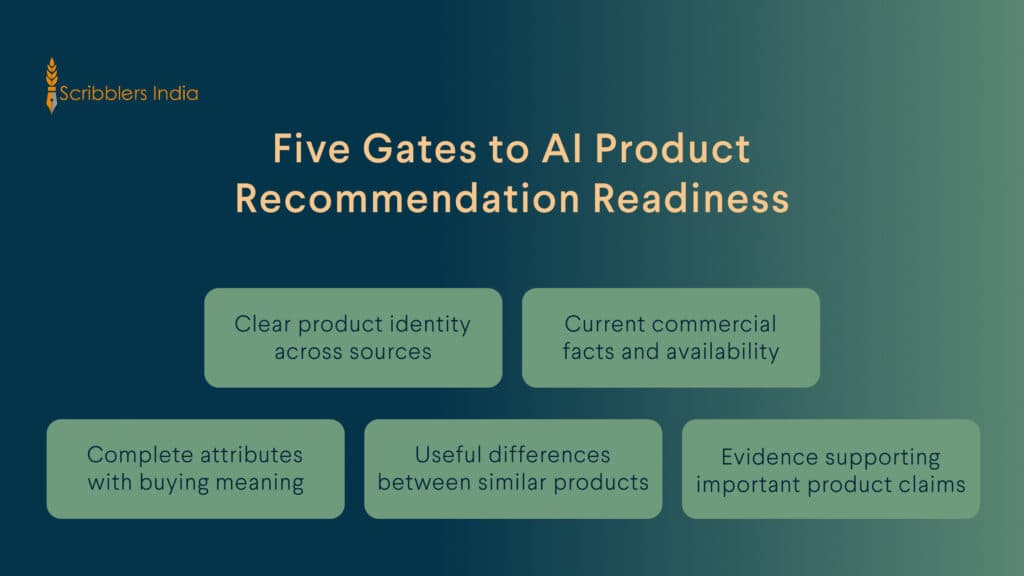
A useful GEO for ecommerce model moves products through five recommendation gates.
| Recommendation Gate | What the Product Must Provide | Why It Changes AI Shopping Fit |
| Clear product identity | Consistent names, identifiers, variants, and seller details | Prevents confusion between similar models or configurations |
| Current commercial facts | Reliable price, stock, shipping, and promotion information | Keeps recommendations aligned with products shoppers can buy |
| Attributes with buying meaning | Specifications connected with realistic shopper needs and situations | Helps AI match features with stated constraints |
| Useful product differences | Clear trade-offs between variants, models, or alternatives | Supports comparison after shoppers narrow the category |
| Evidence behind important claims | Reviews, tests, warranties, certifications, or credible coverage | Gives stronger context for claims requiring buyer confidence |
Feeds establish current facts, while content explains what those facts mean for shoppers. This division keeps AI shopping optimization focused. It also prevents editorial teams from duplicating information that catalog systems can maintain more reliably as prices, stock, variants, or availability change.
How Should Product Pages Answer Conversational Shopping Questions?
Product pages should answer the questions that appear after shoppers add constraints to a category. Instead of repeating generic benefit statements, strong pages explain suitable use cases, meaningful product differences, relevant limitations, and common pre-purchase concerns. This gives AI systems clearer material for matching products with detailed requests.
Consider skincare copy stating “lightweight hydration for everyday use.” That offers little help when someone asks for fragrance-free moisturizer under ₹1,500 for oily skin in humid weather. The page needs specific information that connects product properties to the shopper’s situation.
A stronger PDP can cover four practical areas:
- Best-fit use cases: Explain which buyers or situations align closely with the product’s actual strengths and design.
- Decision-changing limitations: State relevant constraints involving size, compatibility, climate, maintenance, ingredients, or expected performance.
- Variant guidance: Explain when another size, material, model, formulation, or configuration may suit the buyer better.
- Pre-purchase answers: Address recurring questions about setup, warranties, returns, care, fit, delivery, or expected product life.
The answer-led discipline used in AEO services in India is useful here, although ecommerce answers must remain closely tied to specific product facts. The page should answer buying questions directly without adding broad explanatory copy that weakens product focus.
How You Should Plan the Content Strategy Around the Product Page?
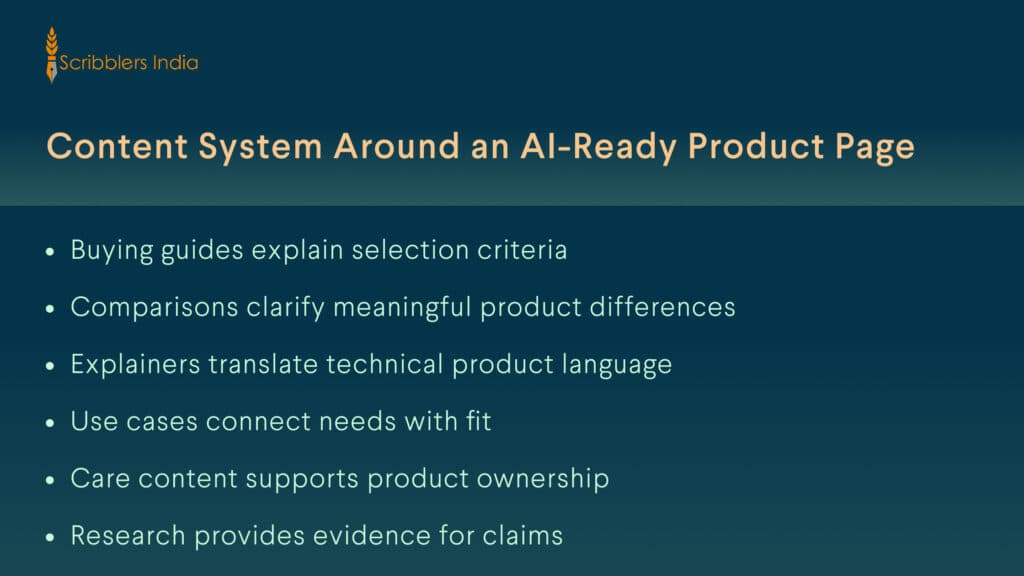
Product pages cannot carry every question involved in a complex purchase. Brands need supporting assets for category education, comparisons, selection criteria, use cases, maintenance, and evidence. Each page should answer a distinct shopping question and guide the reader toward relevant products without competing with another asset.
The content marketing guide for AI search recommends assigning a clear buyer role to every asset. Ecommerce teams can apply that principle directly to their catalog by separating category education, product comparison, use-case guidance, ownership support, and evidence into distinct content jobs.
| Shopper Question | Best Asset | Content Job | Product Connection |
| What should I look for? | Buying guide | Explain selection criteria | Link suitable categories |
| Which option fits me? | Comparison guide | Interpret meaningful differences | Link specific products |
| What does this feature mean? | Category explainer | Translate technical language | Support PDP understanding |
| Will it work for my need? | Use-case article | Connect problem with product fit | Recommend options |
| How do I maintain it? | Care guide | Support ownership | Link compatible products |
| What proves the claim? | Research page | Provide evidence | Support product claims |
This architecture also reduces cannibalization. Instead of publishing several similar “best product” articles, a brand can build one strong buying guide and narrower assets with separate jobs, giving each page a clearer search purpose and a more useful place within the shopping journey.
Our AI Search Visibility Scorecard reaches a similar conclusion: useful authority assets build a stronger information base than large volumes of generic blog posts. For ecommerce teams, that means publishing fewer overlapping guides and improving the evidence supporting priority product decisions.
How Should Large Catalogs Prioritize GEO for ecommerce?
For GEO for ecommerce, large catalogs should not optimize every SKU equally. Prioritization should combine commercial value with demand for recommendations, information gaps, competitive pressure, and readiness for improvement. A smaller test group produces clearer learning than thousands of product edits completed before the brand knows which information affects discovery.
Use the following simple five-factor score:
| Factor | Low Priority | High Priority |
| Commercial value | Low revenue contribution | High revenue or strategic value |
| Recommendation demand | Rare conversational research | Frequent complex shopping questions |
| Evidence gap | Information already complete | Major product understanding gap |
| Competitive pressure | Limited alternatives | Competitors dominate recommendations |
| Improvement readiness | Weak source information | Strong facts ready for optimization |
A sensible pilot may begin with 15–30 products across two or three important categories. Include strong sellers and strategic products alongside items where competitors appear more consistently, so the first test covers both commercial value and clear opportunities to improve the visibility of recommendations.
A wider GEO audit checklist can structure prompt testing and source review before page changes begin. Diagnosis should determine what gets rewritten, which supporting assets are missing, and which visibility gaps are commercially too weak to warrant immediate work.
Which GEO for Ecommerce Mistakes Create False Progress?
Some activities create visible output without improving recommendation readiness. Teams can publish more articles, add schema, or monitor hundreds of prompts while weak product evidence remains unchanged. The work looks productive inside project trackers, yet AI systems still lack the information needed for better product matching.
| False Progress Signal | Why It Fails | Better Action |
| Rewriting every PDP immediately | Many pages may already contain useful decision information | Test priority products before expanding copy production |
| Treating schema as the main strategy | Machine-readable data cannot replace weak visible product evidence | Fix product facts and buyer context first |
| Celebrating every product mention | The wrong SKU can still appear for shopper constraints | Review recommendation fit alongside visibility |
| Publishing specification-only comparisons | Feature tables rarely explain which difference affects suitability | Interpret trade-offs for specific buying situations |
| Ignoring feed and page conflicts | Conflicting price or availability weakens recommendation confidence | Align merchandising, technical, and content ownership |
Our schema markup and AI search analysis explain why structured data should support accurate information rather than become the entire optimization plan. The strongest ecommerce workflow fixes product evidence before increasing page volume or dashboard activity.
How Should Ecommerce Brands Measure AI Shopping Visibility?
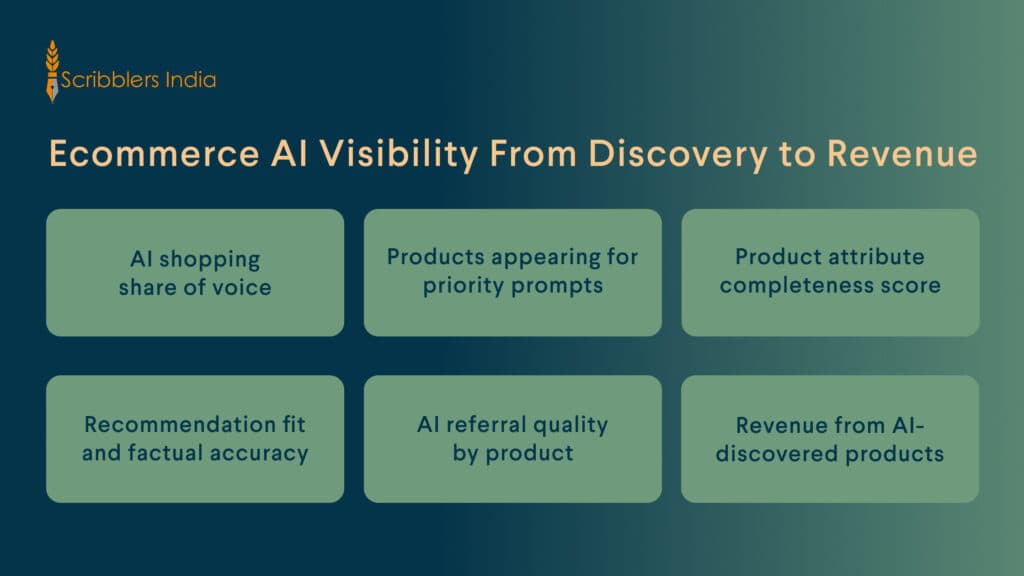
Ecommerce brands should measure visibility at the product and category levels, then connect it to commercial outcomes. Useful reporting shows which products appear, which attributes influence discovery, how competitors perform, whether information stays accurate, and whether AI-led visits contribute to valuable customer actions.
Google has made this easier in 2026. Merchant Center’s AI performance insights are now available for eligible English-language queries in India. The report covers AI Mode and AI Overviews, including share of voice, products showing, shopping stages, query frequency, and popular product attributes.
This gives GEO for ecommerce a first-party measurement layer alongside controlled prompt testing.
| Metric | Question It Answers | Review |
| AI share of voice | Are products visible against competitors? | Monthly |
| Products showing | Which SKUs enter AI shopping journeys? | Monthly |
| Attribute completeness | Which missing fields may limit matching? | Monthly |
| Recommendation accuracy | Does the product fit the prompt? | Monthly sample |
| AI referral quality | Do AI visitors engage or convert? | Monthly |
| Product revenue | Do visible products create value? | Quarterly |
Adobe’s July 2026 retail data adds useful context. AI-referred visitors converted 60% better than non-AI traffic across the US retail sites Adobe analyzed. That result cannot be generalized to every store. It still shows why referral quality deserves separate tracking from total AI traffic.
The AI Search Discovery Benchmark 2026 can add a broader brand-level view of these product metrics. This helps ecommerce teams connect product recommendations with wider brand discovery. It also links product metrics with source quality and AI visibility.
What Should a 90-Day Ecommerce GEO Pilot Look Like?
A 90-day GEO for ecommerce pilot should test whether better product evidence changes discovery before the brand scales investment. The first month establishes a baseline, while the second improves selected products and supporting assets. The third repeats those tests and reviews commercial signals.
| Period | Main Job | Expected Output |
| Days 1–30 | Test 15–30 products across realistic shopping prompts | Baseline recommendations, gaps, competitors, and source evidence |
| Days 31–60 | Fix missing facts and weak decision content | Improved PDPs, supporting assets, and cleaner product information |
| Days 61–90 | Repeat the same prompts under comparable conditions | Directional visibility, fit, referral, and Merchant Center changes |
The pilot should pause expansion when feeds, indexing, inventory data, or category architecture remain unreliable. The AEO vs SEO guide explains why answer-led discovery still requires a healthy search foundation. Fix those foundations before expecting to learn anything useful from advanced optimization.

How Can Scribblers India Build a Stronger Ecommerce GEO Content System?
Scribblers India helps ecommerce brands identify where product information stops being useful during AI-led buying journeys. We connect prompt research with product-page analysis, supporting content, external source review, and visibility measurement. The objective is to provide better information to shoppers and recommendation systems before products reach the shortlist.
Our GEO for ecommerce approach starts with important categories first rather than rewriting the catalog. We review how products appear in response to real shopping prompts and which competing items make the shortlist. We then identify which missing details weaken the recommendation’s fit.
The roadmap can include product decision copy, category explainers, buying guides, comparison assets, care resources, or evidence-led pages. Product feeds and inventory synchronization should remain closely owned by ecommerce teams. Merchant Center operations and technical structured data also need operational control.
Effective GEO for ecommerce makes the right product easier to understand for each shopping question. Get in touch with our team today to start building an evidence-led discovery system around the categories that matter most. The roadmap will reflect buyers’ questions and measurable gaps in recommendations.
Frequently Asked Questions
What Is GEO for Ecommerce?
GEO for ecommerce improves how products and ecommerce brands appear across AI-led shopping discovery. It connects reliable product information with useful buying content, reviews, external evidence, and recurring measurement. The goal is helping AI systems understand which products match specific shopper needs before the buyer reaches a retailer.
How Can Products Appear in ChatGPT Shopping Results?
ChatGPT selects products based on the shopper’s request and the available product information. OpenAI says it can consider query context, price, reviews, ease of use, merchant information, and other relevant factors. Merchants can also provide current product feeds through supported commerce infrastructure to improve catalog representation.
Does Google Merchant Center Help With GEO for Ecommerce?
Yes. Merchant Center supplies structured product information used across Google shopping experiences. Its AI performance insights now help eligible Indian merchants understand visibility across AI Mode and AI Overviews. Brands can review share of voice, product attributes, search terms, shopping stages, and the products that appear within these journeys.
Do Product Pages Need More Copy for AI Search?
Product pages need better decision information, not automatically more words. Add detail when shoppers need clearer suitability guidance, meaningful differences, limitations, compatibility information, or pre-purchase answers. Avoid expanding every page with generic copy because additional length alone does not improve product relevance.
Are Reviews Important for AI Product Recommendations?
Reviews can add customer experience that owned product copy cannot convey on its own. Specific feedback on fit, durability, comfort, performance, or ease of use can improve the context for comparison. Brands should encourage authentic reviews and use recurring themes to improve product information rather than trying to manipulate recommendation signals.
Should Large Stores Optimize Every SKU for AI Shopping?
Large stores should begin with commercially important products and categories. Prioritize strong revenue opportunities, frequent demand for comparisons, clear information gaps, and active competitive pressure. A controlled pilot gives teams evidence before the same optimization process expands across hundreds or thousands of SKUs.
How Is Ecommerce GEO Different From Ecommerce SEO?
Ecommerce SEO mainly improves discoverability through conventional search rankings and shopping surfaces. GEO adds generated recommendations, conversational comparisons, and AI-led shortlisting. Both depend on strong search foundations. GEO places greater emphasis on shopper constraints, recommendation evidence, external sources, and AI-specific measurement.
How Can Ecommerce Brands Measure GEO Performance?
Track product appearances across priority shopping prompts, recommendation accuracy, competitor visibility, source patterns, AI referrals, and product-level conversions. Google Merchant Center AI performance insights can add first-party data for eligible merchants. Keep a fixed prompt sample so changes remain comparable across review periods.