

Schema markup for AI search has acquired a new reputation since generative search entered mainstream marketing discussions. Some advice now presents structured data as a direct route into ChatGPT responses or Google AI Overviews. Other recommendations suggest creating an extensive “GEO schema” layer before addressing weak website content.
The evidence does not support that interpretation. Schema markup for AI search can still serve useful technical purposes, yet current Google guidance does not treat it as a generative ranking requirement. Recent independent testing also fails to show a clear increase in citations from adding JSON-LD alone.
That distinction changes how businesses should prioritize technical work. Schema remains part of a healthy search foundation, while greater AI visibility depends on a broader information ecosystem. Brands need accurate entities, useful answers, credible evidence, sound search access, and content that deserves retrieval.
Key Takeaways
|
Does Schema Markup Directly Improve AI Search Visibility?
Schema markup for AI search does not currently have proven direct impact on citation visibility. Google explicitly says structured data is not required for generative AI Search. Independent 2026 testing also found no meaningful increase in citations after pages added JSON-LD in Google AI Mode or ChatGPT.
This conclusion differs from a common marketing claim that schema automatically makes content easier for large language models to cite. Structured data can provide machine-readable context, yet that technical function should not be confused with a confirmed citation-ranking signal.
A 2026 industry study tracked 1,885 pages that added JSON-LD between August 2025 and March 2026. The researchers matched those pages against control URLs and measured citation changes across AI Overviews, AI Mode, and ChatGPT. No clear positive citation effect appeared.
Google reaches the same practical conclusion from a platform perspective. Its current generative search guidance says there is no special Schema.org markup that websites must add for AI Overviews or AI Mode.
The crucial question is therefore not whether Schema markup for AI search is “good” or “bad.” Businesses need to understand what it genuinely does before deciding how much effort it deserves.

How Does Structured Data Help Search Engines?
Structured data provides standardized information that helps search engines classify page content and specific entities. It can support rich-result eligibility and clarify facts about products or organizations. Its established value lies mainly in search understanding and search presentation, rather than in guaranteed visibility for generative citations.
Schema.org provides the vocabulary, while formats such as JSON-LD carry that vocabulary inside webpages. A search engine can use the markup to identify an author, product, organization, location, rating, price, event, or another supported entity.
Google explains that structured data provides explicit clues about a page and can make eligible content available for richer search experiences. Google currently recommends JSON-LD for many implementations because teams can usually maintain it more easily.
That function remains useful even when schema does not create an independent AI-ranking advantage. A product page with accurate Product markup can support search features. An organization page can provide clearer administrative details.
This distinction creates the first practical rule: implement schema for supported information and search functions, not as an isolated shortcut into generative answers.
Why Do So Many AI-Cited Pages Still Use Schema Markup?
AI-cited pages frequently use schema because well-maintained websites often invest in several search fundamentals together. Those sites may publish stronger content and maintain cleaner technical infrastructure. Schema markup for AI search can therefore correlate with AI visibility without causing the visibility that marketers observe.
The difference between correlation and causation is especially important here. Ahrefs first analyzed 6 million URLs and found that schema markup for AI search was substantially more common among pages receiving AI citations. In that dataset, 53% of AI-cited pages used schema markup.
This observation could easily support the wrong conclusion. Websites that use structured data often invest in content quality, page maintenance, internal linking, authority development, and stronger conventional SEO.
Ahrefs therefore ran a second analysis designed to isolate the schema change. The citation advantage largely disappeared when pages adding JSON-LD were compared with matched controls.
| Observation | Easy Conclusion | Better Interpretation |
| Cited pages often contain schema | Schema causes citations | Strong websites often use schema |
| JSON-LD is common on authoritative sites | AI systems reward JSON-LD | Technical maturity may correlate with authority |
| Schema pages earn rich results | Schema improves all search visibility | Rich-result eligibility is a separate outcome |
| Adding schema changes machine-readable data | Citations should increase automatically | Retrieval still depends on wider signals |
This is why the broader Scribblers India AI Search Discovery Benchmark evaluates AI readiness across multiple information signals instead of assigning schema disproportionate weight.
Does Google Require Schema markup for AI search for AI Mode or Overviews?
Google does not require structured data for AI Overviews or AI Mode. Its 2026 guidance explicitly states that generative search requires no special schema markup for AI search. Google recommends continuing normal structured data practices where they support conventional Search features, while keeping established SEO fundamentals in place.
This clarification addresses one of the biggest misconceptions around structured data for AI search. Google’s generative features rely on its Search index and core ranking systems rather than a separate schema-driven submission process.
A valid schema implementation, therefore, does not automatically make a page eligible for citation in an AI Overview. The page still needs to be accessible and relevant. Its visible content must also provide information worth retrieving in response to the query.
The same logic applies to elaborate “GEO schema” packages. Schema can document real entities or relationships already present on the website. It cannot manufacture expertise or make unsupported claims more trustworthy.
Brands evaluating technical recommendations should ask one question before implementation: what established search function or information problem will this markup solve? That question keeps schema markup for AI search connected to useful SEO infrastructure rather than allowing it to become a substitute for content work.
Does Adding Schema for ChatGPT Increase Citation Chances?
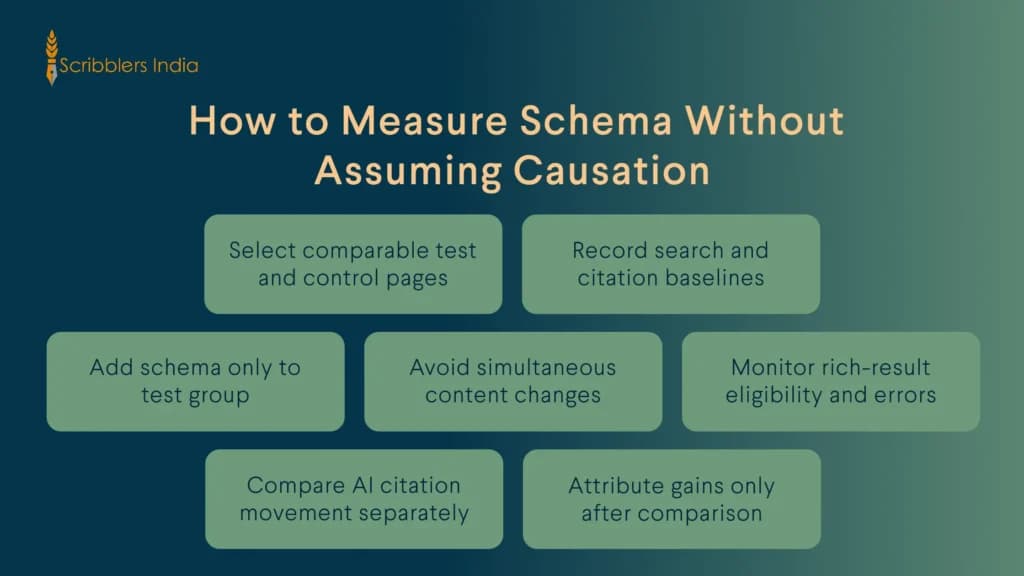
There is currently no reliable evidence that adding schema markup for AI search alone increases ChatGPT’s chances of citation. The strongest recent controlled test found a small positive movement after JSON-LD implementation, yet the result was statistically indistinguishable from zero. Visible content quality therefore remains a safer priority.
Ahrefs measured ChatGPT citation behavior alongside Google AI Mode and AI Overviews during its 2026 study. Pages that added JSON-LD showed a 2.2% relative change for ChatGPT, yet researchers concluded that the result could reflect random variation rather than a real schema effect.
That does not prove ChatGPT will never use machine-readable information in any workflow. Platforms can change retrieval methods, commerce infrastructure, app ecosystems, or crawling behavior over time. It does mean brands should avoid claims that “schema for ChatGPT” is already a proven visibility tactic. Current evidence does not support that certainty.
For teams building a broader generative engine optimization strategy, schema should remain one of several technical components. Better source content and stronger information coverage deserve more strategic attention.
Which Schema Types Can Still Be Useful in an AI Search Strategy?
Several schema types remain useful because they clarify important information and support existing Google Search experiences. Their value depends on page type and business model. Enterprises should implement markup that accurately represents visible information rather than adding every available schema type for perceived AI benefits.
The most useful starting points for schema markup for AI search differ considerably across websites.
| Schema Type | Useful For | Practical Role |
| Organization | Company websites | Clarifies organizational details and identity |
| LocalBusiness | Location-based businesses | Communicates location-specific business information |
| Product | Ecommerce websites | Describes products, offers, pricing, and availability |
| Article | Editorial publishers | Describes articles and author relationships |
| ProfilePage | Expert or author profiles | Clarifies the person or organization represented |
| BreadcrumbList | Structured websites | Describes page position within site hierarchy |
An ecommerce store and consulting company should therefore have different priorities. Product markup can influence product-rich experiences, while organization markup may help clarify business details elsewhere in Search. This principle should guide implementation: use schema markup for AI search to accurately describe important visible content, then invest elsewhere once the technical foundation is sound.
Scribblers India’s AI Visibility Scorecard treats schema as supporting evidence within wider source trust. It does not treat markup as an independent route to AI citations.
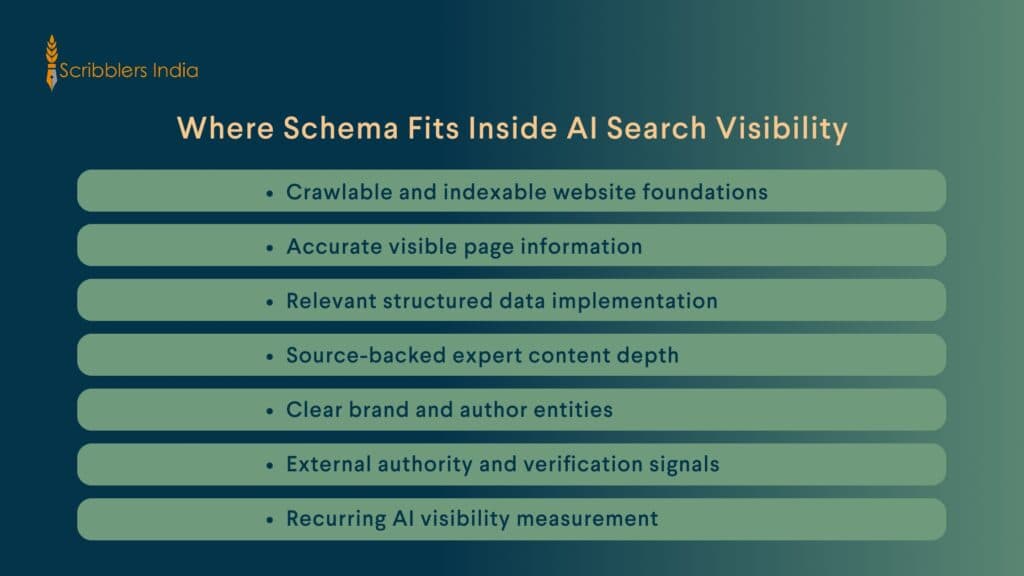
How Should Brands Decide Which Schema Markup for AI search to Implement?
Brands should choose schema markup for AI search based on the page’s actual meaning and the search functions it supports. Start with important entities and commercially valuable page types. Then validate that the markup accurately reflects the visible content before expanding the implementation across the website or introducing more specialized properties.
A realistic schema priority framework keeps the process focused:
- Start With Page Purpose: Identify what the page represents before selecting a schema type. A product, local branch, article, author profile, or organization page needs markup that matches its visible purpose and primary information.
- Prioritize Business-Critical Pages: Implement schema first where richer search understanding can support important discovery journeys. Commercial pages and authoritative editorial assets usually deserve attention before low-value archive pages or thin content with little search demand.
- Match Markup With Visible Content: Every important structured-data claim should reflect information users can verify on the page. Markup should clarify existing content rather than introduce facts, relationships, reviews, or credentials that visible website copy does not support.
- Validate Before Scaling Implementation: Test representative pages before deploying schema across large templates. Search Console and Google validation tools can reveal technical errors. Controlled implementation also reduces the risk of replicating inaccurate markup across hundreds of pages.
This process keeps the technical layer proportional to the opportunity. Once core schema is accurate, further gains usually require improving the content surrounding those entities.
When Should Schema Markup Become a Technical Priority?
Schema markup for AI search should become a priority when important pages lack clear, machine-readable information to support established search functions. It also deserves attention when templates generate errors or business details remain inconsistent. The strongest use cases involve identifiable technical gaps rather than speculative benefits from AI citation.
The following situations justify immediate action:
- Ecommerce catalogs need accurate product markup when pricing and availability support important Google shopping experiences. Structured product data can clarify commercial information, while broader ecommerce visibility still depends on feeds, useful page content, and reliable inventory information.
- Multi-location businesses benefit when each location has clear information that matches real-world business details. LocalBusiness markup can support machine understanding, while local visibility still requires accurate listings, relevant location pages, and credible local information.
- Publisher websites should connect important editorial assets with accurate authorship information where supported. Article-related markup can clarify publication details, while expert biographies and visible credentials provide the human-readable evidence needed to support genuine authority.
- Organizations should correct conflicting entity information before expanding advanced schema across content libraries. Accurate names, logos, addresses, URLs, and relevant organizational details provide a cleaner base than complex markup built over inconsistent public information.
These are defensible technical investments because each begins with a known information problem. Speculative schema implementation deserves a different level of scrutiny.
When Does Schema Become a Distraction From Better AI Search Work?
Schema markup for AI search becomes a distraction when teams spend substantial resources expanding markup while important content remains weak or inaccessible. Generative systems still need useful source information. A technically perfect page with generic explanations offers little advantage when competing pages provide clearer evidence and stronger answers.
The pattern often appears during premature GEO programs. Teams create elaborate entity graphs or add several nested schema types before reviewing whether priority pages answer the questions buyers ask. This sequencing reverses the real dependency. Structured data describes information. It does not create the missing information required for useful retrieval.
Our AI content gap analysis framework starts with unanswered questions and weak evidence before technical embellishment. This approach usually reveals larger opportunities than another layer of markup.
A weak service page may need specific process information or better comparison depth. A thin article may need current evidence, expert commentary, or a clearer point of view. Schema cannot supply those missing insights. Once visible information becomes useful and accurate, structured data can reinforce the technical representation of what the page already communicates.
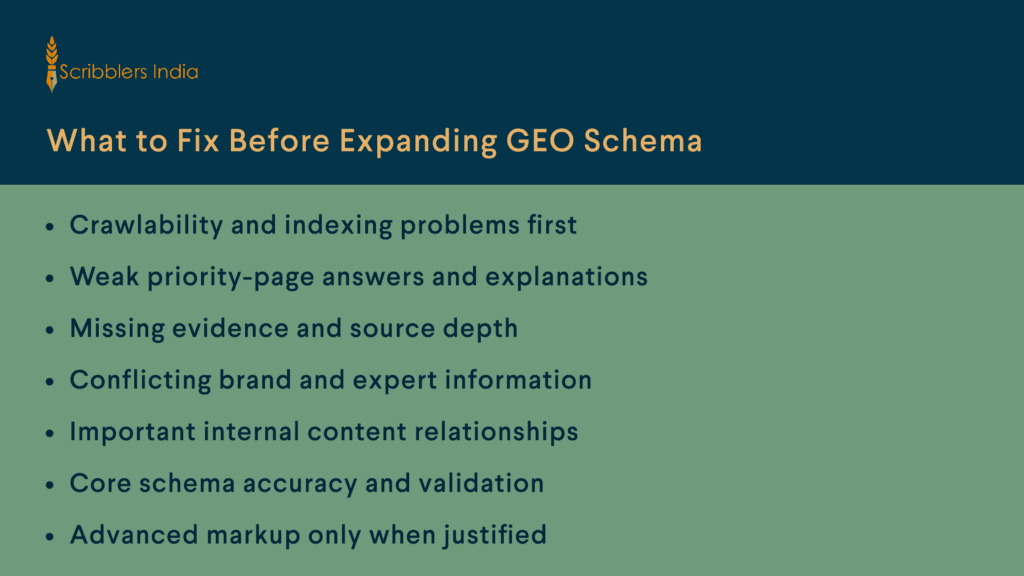
What Should Brands Improve Before Adding More GEO Schema?
Brands should improve accessibility and information quality before expanding their use of the GEO schema markup for AI search. Search systems need crawlable pages and useful content first. Clear answers, reliable facts, relevant examples, expert evidence, and strong internal relationships usually create more substantive retrieval value than additional markup layered over weak pages.
A simple order of operations helps prevent misplaced investment.
- Fix crawl and index problems before optimizing how page information is described through schema. Structured data provides limited value when important URLs remain blocked, duplicated, incorrectly canonicalized, or otherwise difficult for normal search systems to process reliably.
- Strengthen direct answers where important buyer questions receive vague or incomplete explanations. Answer-first content helps readers understand the page quickly while creating clearer passages that relevant retrieval systems can evaluate within the wider context.
- Add source depth where claims lack enough evidence to establish why readers should trust them. Current references, first-hand experience, original data, and meaningful examples create information value that technical markup alone cannot reproduce.
- Improve entity consistency across service pages and expert profiles before creating elaborate relationships in JSON-LD. Search systems should encounter the same consistent brand story across visible content, structured data, and key external sources.
This order connects directly with the difference between GEO, AEO, and SEO. Technical foundations support discoverability, while answer quality and authority determine whether the underlying information deserves wider use.
Does Answer-First Content Need FAQ Schema to Work?
Answer-first content does not require the FAQ schema to be useful to readers or AI systems. Clear question-led sections can work through normal visible HTML. FAQ structured data may serve specific implementations, yet brands should avoid if adding it automatically improves generative extraction or citation frequency.
This distinction is important for AEO planning. The structure that helps a reader find an answer does not depend on whether that paragraph has additional machine-readable FAQ markup attached.
Our Answer Engine Optimization analysis focuses on clear answers and useful page organization within a wider content system. Schema markup for AI search can support understanding where applicable, yet the answer itself still needs to be of sufficient quality.
Businesses should therefore separate two implementation decisions. First, determine whether a page needs a clearer question-and-answer structure for users. Second, decide whether a supported schema type adds meaningful technical value to that page. Combining those decisions into one rule often creates unnecessary markup. Good answer design remains valuable even when no FAQ schema is present.
How Should Content and Technical Teams Work Together on Schema Markup for AI search?
Content teams should define accurate entities and visible information before technical teams encode them as structured data. Technical specialists then validate implementation and maintain template consistency. Shared ownership reduces cases where markup becomes technically valid while misrepresenting outdated or incomplete content.
The workflow can begin during content planning rather than after publication. Writers should know whether a page represents a product, location, organization, article, expert profile, or another supported entity.
Technical teams can then select the appropriate properties and confirm that page templates consistently expose the required information. Editorial teams remain responsible for keeping the underlying facts current.
This connection is especially important for businesses investing in AEO services in India. Answer structure cannot remain separate from technical accessibility when both affect how search systems process the same content.
The handoff also needs governance. When a price changes or an author leaves, the visible page and the structured data should not conflict. Schema markup for AI search works best as a representation layer connected with editorial operations rather than a one-time code deployment.
What Should a Useful Schema Strategy for AI Search Look Like?
A practical schema strategy should be conservative, accurate, and connected with established search value. Implement markup where it describes meaningful entities or supports relevant search features. Then redirect additional resources toward content quality and authority once the technically useful schema layer is complete.
The schema markup for AI search strategy can follow four principles:
- Use supported markup first. Prioritize schema tied to actual business pages and Google-supported search experiences. Avoid creating an extensive technical backlog merely because a property exists in Schema.org.
- Keep visible content authoritative. Structured data should reinforce reliable information already available to users. Strong source material remains essential when generative systems determine which information best answers a query.
- Treat experimental GEO schema claims carefully. Ask providers for evidence when they claim a specific markup pattern increases ChatGPT citations or AI Overview inclusion. Correlation should not be presented as causal proof.
- Measure the intended outcome. Product schema can be evaluated via product search features, while organization markup can support clearer entity information. Neither should be automatically judged by AI citation counts.
This approach gives structured data an important role without asking it to solve problems outside its demonstrated function.

How Can Scribblers India Improve AI Search Visibility Beyond Schema?
Scribblers India helps brands identify where technical improvements end and content problems begin. We examine buyer prompts, priority pages, answer quality, source depth, entity clarity, and external representation before recommending an AI search roadmap. Schema becomes one supporting element rather than the entire strategy.
Our Generative Engine Optimization services begin with how the brand appears across relevant discovery journeys. We then identify whether weak visibility comes from missing answers or unclear positioning. Incomplete source coverage and limited external authority can create additional gaps.
Content changes can include stronger service pages and evidence-backed articles alongside comparisons or original authority assets. Our AI content gap analysis approach helps distinguish pages that need focused refreshes from topics that require new content.
We also work with technical teams where schema or page architecture requires adjustment. Our role is to ensure the structured information represents accurate and useful visible content. This prevents technically sophisticated implementations from being built over weak editorial foundations.
The right approach to schema markup for AI search is therefore balanced. Keep structured data accurate and useful for established search functions. Invest the greater strategic effort in creating information that search systems and buyers can genuinely use.
Contact our team today to build an AI search strategy grounded in content quality, technical reality, and measurable visibility gaps.
Frequently Asked Questions
Does Schema Markup Improve AI Search Rankings?
Schema markup has no proven direct effect on AI rankings across generative platforms. Google says structured data is not required for AI Overviews or AI Mode. Schema can still support normal Search understanding and rich-result eligibility. Brands should treat it as technical infrastructure rather than a guaranteed AI visibility multiplier.
Is There a Special GEO Schema for AI Search?
There is no special Google-required GEO schema for generative Search in 2026. Businesses can use appropriate Schema.org types where they accurately describe visible website information. Custom or advanced implementations may serve internal purposes, yet agencies should not present them as mandatory requirements for AI Overview visibility.
What Is the Best Schema for ChatGPT Visibility?
No schema type has been proven to directly increase ChatGPT citations. A 2026 controlled study found no statistically meaningful increase in ChatGPT citations after pages added JSON-LD. Brands should prioritize accessible pages, strong visible content, clear entities, and credible evidence before experimenting with schema specifically for ChatGPT.
Does JSON-LD Help AI Search Visibility?
JSON-LD remains a useful structured data format, and Google commonly recommends it for maintainable implementations. Its presence can help search systems interpret supported information. Current evidence does not show that adding JSON-LD alone yields meaningful gains in AI citations across already visible pages.
Should Every Blog Post Have Article Schema?
An article schema can be appropriate when a page genuinely represents an article and its implementation accurately reflects the visible information. That does not mean every blog requires additional properties purely for GEO. Teams should prioritize correct authorship, dates, content quality, and page accessibility alongside any relevant structured data.
Does FAQ Schema Help Content Appear in AI Answers?
FAQ schema does not guarantee inclusion in AI-generated answers. Clear question-led content can remain useful without FAQ markup because the visible answer carries the substantive information. Businesses should add schema only when it fits the page and their technical strategy rather than using it as an AI citation shortcut.
Can Too Much Schema Hurt AI Search Visibility?
Large amounts of accurate schema do not automatically create an AI visibility penalty. Problems arise when markup becomes misleading, incorrect, outdated, or disconnected from visible page content. Excessive implementation can also consume resources that would create more value through stronger content or technical search improvements.
Should GEO Audits Include Structured Data Reviews?
A GEO audit should review structured data where it affects important pages or entity information. The review should remain proportionate to the problem. A strong audit should also examine prompt visibility, content gaps, source quality, brand accuracy, and external representation rather than treating schema as the primary GEO lever.