Choosing to hire a ghostwriter in India can give founders, executives, consultants, and authors access to strong writing expertise without having to manage every draft personally. The risk comes from selecting a provider based solely on a polished website, a low quote, an impressive sample, or a promise of unusually fast delivery.
A safer decision requires deeper due diligence. You need to understand who will write the work, where ideas will come from, how the writer will learn your voice, which claims they will verify, how confidential material will be handled, and what happens if the relationship ends.
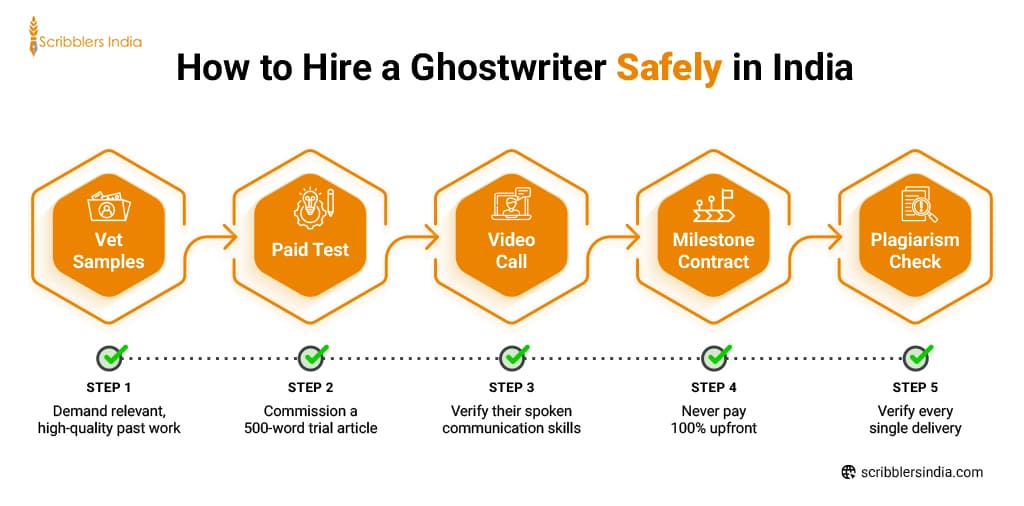
The objective when you hire a ghostwriter in India should therefore be risk reduction rather than risk elimination. No hiring process can guarantee a perfect fit. A structured evaluation can still expose weak processes early and give both sides clearer expectations before substantial money, time, or reputation is invested in the engagement.
Key Takeaways
|
What Should You Verify Before You Hire a Ghostwriter in India?
Before you hire a ghostwriter in India, verify the provider across five areas: relevant writing ability, source-capture process, editorial judgment, commercial terms, and information handling. A strong writer should be able to explain how their raw expertise becomes finished content, rather than discussing quality solely in terms of word counts.
Use the first conversation to understand how the provider works when the brief is incomplete, when facts need to be checked, when your voice is still being learned, or when the first draft misses the mark. These situations reveal far more about professional maturity than an idealized description of the standard process.
| Evaluation Area | What to Ask | What Strong Practice Looks Like |
| Writer Fit | Who will write my content? | Named or clearly defined writer with relevant experience |
| Source Capture | How will you learn what I think? | Interviews, notes, recordings, previous writing, or structured briefs |
| Voice Development | How will you learn how I communicate? | Reference material, calibration, feedback, and evolving guidance |
| Research | How are facts and claims checked? | Defined source standards and verification responsibilities |
| Editorial Review | Who reviews drafts before delivery? | Writer plus editor or another quality-control layer |
| Confidentiality | Who can access my materials? | Clear access boundaries and contractual restrictions |
| AI Use | Where does AI enter the workflow? | Specific, explainable use with human control over consequential content |
| Handover | What happens when the project ends? | Defined return, transfer, retention, or deletion rules |
Do not expect every provider to use the same operating model. A book project requires a more in-depth process than four monthly LinkedIn posts. The important question is whether the workflow matches the complexity, sensitivity, and professional consequences of your specific assignment.
How Should You Evaluate Samples Before You Hire a Ghostwriter in India?
Writing samples are useful only when they demonstrate the skills your project requires. Before you hire a ghostwriter in India, compare each sample’s format, audience, subject complexity, argument quality, evidence, and editorial depth with the work you expect the writer to produce consistently across the engagement from the beginning.
Confidentiality can limit what experienced ghostwriters are permitted to show publicly. A credible provider may therefore share permission-based work, anonymized excerpts, credited projects, original samples, or another suitable evaluation method. The objective is to verify relevant capabilities without requiring the writer to disclose confidential client relationships or restricted assignments unnecessarily.
Evaluating the Relevance and Quality of Writing Samples
Look beyond grammar, polish, and surface-level style when reviewing a ghostwriting sample. Check whether the piece develops a clear argument, uses credible evidence, includes specific examples, and maintains logical flow. For executive work, the writing should feel informed by genuine expertise rather than generic public information.
Relevance is crucial as different formats require different capabilities. A writer handling executive LinkedIn content needs to extract ideas quickly and maintain voice across recurring posts, while a business-book ghostwriter must sustain structure, narrative continuity, evidence, and author perspective across a much longer manuscript and greater complexity.
Compare the sample with your intended project before judging overall quality. A polished social post proves little about long-form writing, just as a strong book chapter may not demonstrate concise platform writing. Our book ghostwriting process explains the additional discovery, outlining, interviews, and staged reviews longer projects require.
Using a Paid Trial to Test Working Fit
A paid trial can reduce uncertainty when the planned engagement is recurring, high-value, or highly voice-sensitive. The trial should reproduce a realistic part of the working process, including the kind of source material, briefing, review, and feedback the writer would handle during the full engagement.
For example, a founder-content trial could begin with a short interview and end with one draft plus a revision round. This gives you evidence of the writer’s questioning, interpretation, voice alignment, responsiveness, factual care, and ability to turn specific feedback into a stronger second version.
A provider declining a trial is not automatically a warning sign. Experienced ghostwriters may use minimum engagements, existing client references, or other qualification methods instead. What matters is whether they offer a credible way to assess process and fit before you make a substantial commercial commitment.
What Should a Ghostwriting Contract Include in India?
A ghostwriting contract should explain the work both sides have agreed to perform. When you hire a ghostwriter in India, written terms should cover deliverables, timelines, payment stages, revision limits, confidentiality, intellectual property rights, attribution, source materials, cancellation, AI use where relevant, and post-engagement handover.
The agreement does not need to become unnecessarily complicated, although vague commercial terms create avoidable disputes. A recurring LinkedIn engagement and a 60,000-word book require different contracts because the deliverables, source material, timelines, approval cycles, and intellectual-property implications differ significantly.
Here is how a functional arrangement should look:
| Contract Area | What to Clarify |
| Scope | Formats, quantity, approximate length, meetings, research, and editing |
| Source Responsibilities | What the client supplies and what the writer researches |
| Milestones | Draft dates, review dates, and final delivery expectations |
| Revisions | Included rounds and how major scope changes are treated |
| Payment | Deposit, milestones, invoices, taxes, and late-payment provisions |
| Confidentiality | Access, disclosure, portfolio use, and sensitive information |
| Copyright | Rights assigned or licensed and when transfer takes effect |
| Attribution | Whether the writer is anonymous, credited, or acknowledged |
| AI Use | Permitted tools, restricted materials, and review expectations |
| Termination | Notice, completed work, outstanding fees, and unfinished deliverables |
| Handover | Drafts, recordings, transcripts, research, and supporting files |
Specific legal wording should be reviewed by an appropriate professional when the engagement involves substantial rights, regulated material, valuable intellectual property, or cross-border contracting.
Who Owns Ghostwritten Content Under Indian Copyright Law?
Copyright ownership in ghostwriting should be defined clearly rather than assumed. Under India’s Copyright Act, the author is generally the first copyright owner, subject to stated exceptions, while Sections 18 and 19 permit rights to be assigned by written agreement that specifies the important terms of the transfer in detail.
The agreement should therefore make the following points explicit before the project begins:
- Identify the work covered so the assignment applies to clearly defined deliverables.
- Specify which copyright rights are assigned and whether any rights remain reserved.
- State the duration and territorial extent of the assignment within the written agreement.
- Record the agreed consideration and any conditions that affect when rights transfer.
- Separate copyright ownership from public attribution because the two issues are legally distinct.
For substantial manuscripts or valuable intellectual property, obtain legal advice tailored to the agreement. Clear written terms reduce uncertainty around ownership, attribution, permitted uses, and future exploitation of the work.
Do You Need an NDA When You Hire a Ghostwriter in India?
A ghostwriter NDA is useful when the engagement involves information that should remain confidential outside the project. The key issue is not whether every assignment requires a separate NDA, but whether the confidentiality obligations are sufficiently specific to protect sensitive material.
- Protected Information: Define which business plans, customer information, executive experiences, manuscript ideas, research, internal documents, and personal material are confidential. Clear definitions reduce disagreements about whether information shared during interviews or reviews falls within the confidentiality obligation.
- Access and Use: For agency engagements, professional ghostwriting services in India should explain whether writers, editors, researchers, project managers, subcontractors, or external systems can access the material and what each party may do with it throughout the engagement lifecycle.
- Disclosure Exceptions: Clarify situations where disclosure may be permitted or required, such as information already public or legally compelled disclosures. This prevents an NDA from becoming so broad that normal business, legal, or regulatory obligations become difficult to manage.
- Retention and Deletion: Agree what happens to recordings, transcripts, drafts, research files, and other sensitive material after the engagement ends. The terms should explain whether information is returned, retained for a defined period, or securely deleted.
How Should Payments Work When You Hire a Ghostwriter in India?
The payment structure should reflect the project’s size, duration, provider history, and delivery risk. When you hire a ghostwriter in India, an upfront deposit can be commercially reasonable because the writer reserves time and begins discovery work. Large projects often benefit from additional milestones tied to defined stages.
Avoid treating one percentage as a universal industry rule. A short assignment from an established agency may reasonably follow different payment terms from a six-month manuscript project with a writer you have never worked with before.
| Project Type | Possible Payment Structure | What to Verify |
| Small Defined Assignment | Upfront or split payment | Exact deliverable and revision terms |
| Paid Trial | Full payment for small test | What rights apply to the trial |
| Monthly Retainer | Monthly advance or scheduled invoice | Included output and cancellation terms |
| Book Project | Deposit plus milestone payments | What completion triggers each payment |
| Large Ongoing Program | Recurring payments against agreed scope | Review, reporting, and change-control process |
Be cautious when payment expectations and deliverables remain unclear, especially when the provider pressures you to transfer substantial funds before supplying a written scope. The risk comes from a lack of commercial clarity rather than from a single payment method.
What Process Should a Professional Ghostwriter Explain Before You Hire Them?
Before you hire a ghostwriter in India, ask the provider to walk you through the engagement from the first briefing to the final delivery. A mature process should explain how source material enters the project, how the writer develops the argument, what research happens, where you review drafts, and how feedback affects later work.
The exact workflow can change by project, but a professional process often includes these stages:
- Discovery establishes the audience, objective, format, voice requirements, scope, and publishing context before drafting begins.
- Source capture collects interviews, notes, existing content, presentations, research, experiences, and approved professional positions.
- Editorial planning converts raw material into themes, outlines, arguments, content angles, or chapter structures before full drafting.
- Research and drafting add supporting evidence while keeping the client’s actual expertise at the center of the work.
- Review and revision allow the client to correct facts, refine emphasis, and improve voice alignment before publication.
- Final delivery provides approved files and any agreed supporting materials in the required format.
A provider who cannot explain how genuine client thinking enters the work deserves closer scrutiny. The best professional ghostwriting services start with existing expertise rather than manufacturing a public persona from generic research.
What Questions Should You Ask Before You Hire a Ghostwriter in India?
When you hire a ghostwriter in India, ask questions that clarify how the engagement will work after the sales call. A portfolio shows finished output, while operational questions reveal writer assignment, source quality, editorial controls, confidentiality, continuity, and what happens when the first draft needs substantial adjustment.
Use the following questions to compare serious candidates:
- Ask who will conduct interviews, write drafts, edit deliverables, and manage your ongoing communication.
- Clarify how the writer captures your expertise, recurring opinions, examples, vocabulary, and editorial boundaries.
- Confirm which factual claims the writer researches and which information you must verify internally.
- Review revision limits, feedback timelines, scope changes, missed deadlines, and cancellation procedures before signing.
- Check whether AI tools receive interviews, confidential documents, personal data, or unpublished source materials.
- Discuss copyright, attribution, portfolio use, confidentiality, and source-material ownership before any substantial drafting begins.
- Ask how another writer would take over if the assigned person becomes unavailable mid-engagement.
- Confirm which files, transcripts, research notes, and voice guides you receive after completion.
These questions give you a more reliable basis for comparison than labels such as premium, bestselling, award-winning, native-level, or AI-powered. A professional provider should be able to explain the operating system behind the work without relying on broad marketing claims.
How Should AI Use Affect Your Decision to Hire a Ghostwriter in India?
The use of AI is now a standard procurement question. Before you hire a ghostwriter in India, ask where AI enters the workflow, which information may be uploaded into external tools, which account or privacy controls are used, and where human judgment remains mandatory.
AI can reasonably support transcription, source organization, outline exploration, comparison, or selected editorial tasks. The larger risk appears when the provider uses models to invent experiences, positions, examples, or expert claims that are then published under the client’s identity.
For executive content, the client should remain the source of professional judgment and firsthand experience. Human editors should also control high-consequence claims, sensitive examples, evidence selection, and final approval. Our take on AI ghostwriting and human judgment explains this boundary in greater detail.
Do not assume “human written” automatically means safe or “AI assisted” automatically means poor. The more useful question is whether the provider can explain its workflow and preserve source integrity regardless of the tools used during production.
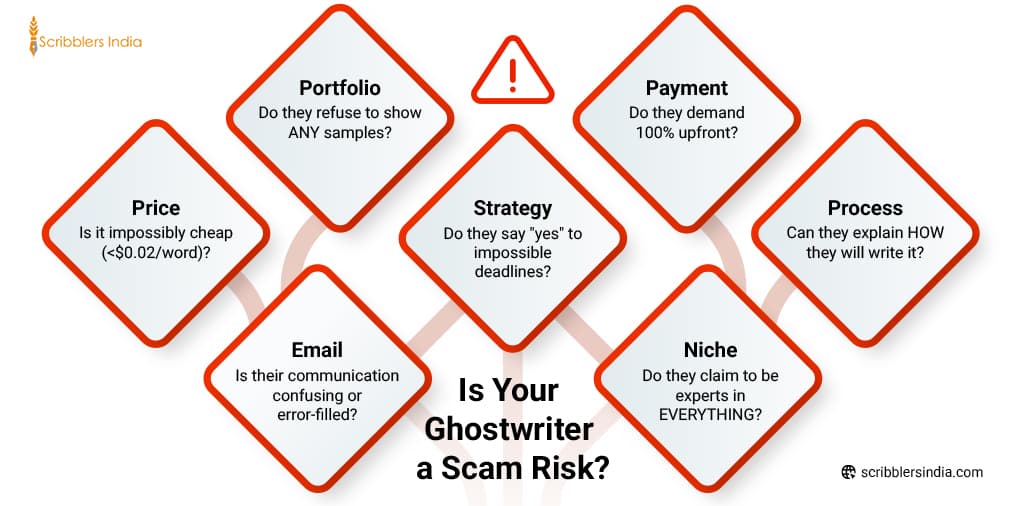
Which Ghostwriting Red Flags Deserve the Most Attention?
The most useful ghostwriting red flags are process failures that increase the chance of weak output, commercial disputes, or reputational damage. Instead of treating every unusual practice as evidence of ghostwriting scams in India, evaluate whether the provider gives you enough information to understand what you are buying.
| Red Flag | Why It Deserves Review |
| No Meaningful Source Process | The writer may rely on generic external material instead of your expertise |
| Unclear Writer Assignment | You cannot assess who actually produces or reviews the work |
| Guaranteed Outcomes | Rankings, virality, bestseller status, or leads cannot be responsibly guaranteed |
| Vague Revision Terms | Disagreement can quickly become an unexpected additional cost |
| Unclear Ownership Language | Valuable rights may remain undefined after delivery |
| No Confidentiality Boundaries | Sensitive information may move through people or tools you did not approve |
| Implausible Turnaround | Very fast timelines may leave insufficient room for discovery, research, or review |
| Unexplained AI Use | Source materials may enter systems without agreed governance |
| Pressure to Commit Immediately | You may lose time needed for normal due diligence |
| No Handover Process | Transcripts, ideas, and working materials may become difficult to recover |
Price alone is not a red flag. India supports many different provider models and cost structures. A lower fee may reflect a narrower scope, lower overhead, different experience level, or smaller service package. Compare what the provider includes before interpreting the rate.
Likewise, specialization should not be judged mechanically. A strong researcher can work across several related industries. The concern is whether the provider understands the subject deeply enough to ask useful questions, verify claims, and avoid transferring avoidable technical work back to your team.
Should You Hire a Freelancer or Ghostwriting Agency in India?
The safest provider model depends on your project, not on a universal hierarchy. A specialist freelancer can suit a defined book, speech, or recurring executive content requirement, while an agency may be more useful when research, editing, project management, continuity, or multiple formats require coordinated support.
An agency structure does not automatically guarantee stronger work, and an individual freelancer is not automatically riskier. Evaluate the actual writer, editorial oversight, contractual counterparty, continuity plan, access to source materials, and responsibility for deadlines in either model.
For provider-level comparison rather than risk assessment, use our analysis of the best ghostwriting agencies in India. Keeping agency ranking there allows this page to focus specifically on due diligence before signing.
What Should Happen When a Ghostwriting Engagement Ends?
The end of the engagement should be planned before work begins. When you hire a ghostwriter in India, the writer may accumulate valuable materials beyond the published drafts, including recordings, transcripts, outlines, unused ideas, research notes, style preferences, voice guidance, and versions containing detailed client feedback.
Agree which assets the client receives, what the provider retains, how long files remain stored, and whether confidential material should be deleted. These terms become especially important when the relationship lasts several months or supports multiple channels.
A useful handover can include:
- final approved drafts in editable formats;
- client-supplied source materials where appropriate;
- interview recordings and transcripts covered by the agreement;
- current outlines, research notes, and approved source lists;
- working voice or editorial guidance created for the account;
- unpublished ideas already developed from client interviews;
- status notes covering unfinished work or pending approvals.
For ongoing social content, continuity can become particularly important. Our LinkedIn ghostwriting agency guide explains how recurring executive programs preserve themes, voice references, feedback, and publishing context over the course of a longer relationship.
How Does Scribblers India Help You Hire a Ghostwriter in India Safely?
Scribblers India approaches ghostwriting as a source-led editorial relationship. Clients remain responsible for the expertise, experiences, positions, and final judgment behind the work, while our writers and editors handle interviews, research, structure, drafting, revision, and editorial refinement within the agreed scope.
Our ghostwriting services can support executive articles, LinkedIn content, speeches, newsletters, ebooks, reports, and longer manuscripts. The workflow changes by format, although source fidelity, clear approvals, factual care, and defined client responsibilities remain consistent throughout the engagement.
We also clarify operational questions before recurring production begins. These can include writer assignment, interview cadence, revision expectations, confidentiality, permitted AI use, delivery milestones, ownership provisions, and handover requirements, depending on the project.
The objective is not to eliminate every risk associated with ghostwriting. It is to make the working relationship transparent enough that clients understand what they are buying, what they need to provide, and how their expertise becomes publishable work.
Get in touch with our team before you hire a ghostwriter in India to build a clear, source-led engagement that centers on your voice, expertise, rights, and publishing goals.
Frequently Asked Questions
Is It Legal to Hire a Ghostwriter in India?
Yes, ghostwriting can be structured as a legitimate professional writing arrangement. The parties should clearly document the scope, confidentiality, attribution, and intellectual property terms. Copyright ownership should not be assumed from payment alone, particularly because Indian copyright law contains specific requirements governing assignment of rights.
Who Owns Copyright When I Hire a Ghostwriter in India?
Ownership depends on the applicable law and agreement. Under India’s Copyright Act, the author is generally the first copyright owner, subject to stated exceptions, and copyright can be assigned through a written agreement that meets statutory requirements. Have important manuscript or commercial rights documented clearly.
Should I Ask a Ghostwriter to Sign an NDA?
An NDA or contractual confidentiality clause can be appropriate when the writer receives sensitive business, customer, personal, or unpublished information. Define what information is protected, who can access it, what disclosures are permitted, and what happens to confidential source materials after the project ends.
Should I Ask for a Free Sample Before Hiring a Ghostwriter?
A custom free sample is not necessary in every engagement. Relevant portfolio material, permission-based excerpts, a detailed process review, references where available, or a small paid trial can all help evaluate fit. Paid trials are particularly useful when voice alignment matters over the course of a longer engagement.
How Much Should I Pay Before a Ghostwriting Project Starts?
There is no universal deposit percentage that fits every project. Small assignments may use upfront payment, while long books or recurring programs may use deposits and milestones. Focus on whether payment triggers, deliverables, cancellation terms, and revision responsibilities are documented before substantial work begins.
How Can I Tell Whether a Ghostwriter Is Using Too Much AI?
Ask the provider to explain exactly where AI is used and how your source materials are handled. Generic drafts, invented examples, shallow arguments, and inability to explain sources deserve scrutiny. AI can support production, while your experience, claims, voice, and final judgment should remain traceable.
What Should I Do if the First Ghostwritten Draft Does Not Sound Like Me?
Start by identifying specific problems rather than asking for a general rewrite. Flag unfamiliar language, incorrect positions, missing examples, excessive certainty, or argument patterns you would not use. A strong writer should incorporate that feedback so later drafts require fewer voice corrections.
How Do I Choose Between a Freelancer and a Ghostwriting Agency?
Choose according to scope, required continuity, editorial support, project management, specialist knowledge, and budget. A freelancer may be well-suited to a defined assignment, while an agency can coordinate multiple writers or formats. Evaluate the actual workflow rather than assuming one provider type is inherently safer.