A senior leader’s public reputation carries a wider set of consequences than an ordinary professional profile. Employees can read the same post as customers. Investors, partners, candidates, industry peers, and journalists may interpret the same comment through very different lenses. This wider audience changes the job of executive branding.
The work still begins with expertise, reputation, and professional visibility. It also must account for the organization the executive represents, the claims that require review, and the topics where personal perspective intersects with corporate responsibility.
This guide compares personal branding vs executive branding at the leadership level. It covers the stakeholders an executive needs to consider, governance boundaries, content depth, career transitions, measurement, and corporate alignment.
Key Takeaways:
|
What Is Executive Branding?
Executive branding is the deliberate management of how a senior leader’s expertise, judgment, values, experience, and public communication are understood by relevant stakeholders. It connects the individual’s professional reputation with the responsibilities that come with representing an organization.
An executive personal branding program can include positioning, profile development, thought leadership, speaking themes, media contributions, LinkedIn content, search visibility, and reputation monitoring. The exact mix should follow the leader’s role and stakeholder exposure.
The distinction from ordinary personal branding appears in the operating constraints. A consultant can often speak primarily for themselves. A CEO, CFO, CHRO, CTO, or business-unit leader can be interpreted as speaking with organizational authority, even when the topic begins from personal expertise.
That creates a second layer of work. The leader needs a recognizable professional position, while the company needs clarity around claims, sensitive subjects, review ownership, and where personal views end and official positions begin.
This is why the work functions best as a reputation system supported by an editorial workflow.

Personal Branding vs Executive Branding: What Changes?
The relationship between personal branding vs executive branding is evolutionary. Both build recognition around an individual. Executive branding adds organizational representation, more complex stakeholders, and stronger governance requirements.
| Area | Personal Branding | Executive Branding |
| Primary purpose | Build recognition around individual expertise and professional value | Build leadership reputation while supporting an organizational role |
| Core audiences | Peers, recruiters, clients, collaborators, professional communities | Employees, customers, board, investors, partners, candidates, media |
| Content source | Experience, opinions, work, interests, professional learning | Leadership experience, market insight, research, company context, approved evidence |
| Governance | Usually personal judgment and platform rules | May involve communications, legal, compliance, IR, HR, or specialist reviewers |
| Reputation risk | Concentrated mainly around the individual | Can affect both the leader and organization |
| Portability | Travels largely with the individual | Expertise travels; company-specific authority remains tied to the role |
| Measurement | Visibility, network quality, reputation, professional opportunities | Stakeholder reach, authority, audience quality, opportunities, alignment, risk signals |
The comparison also explains why copying a creator-style personal branding playbook can create problems for a senior leader. High publishing frequency has little value when the ideas lack depth, the evidence remains weak, or every post requires retroactive clarification inside the company.
A stronger approach begins with the leader’s expertise territory and the stakeholders whose decisions the public presence may influence. Governance and format follow from that map.
Why You Need an Executive Stakeholder Map Before Building a Content Calendar?
A useful leadership-reputation strategy begins by asking who is evaluating the leader and what each group needs to understand. One post can reach multiple stakeholder groups, so the public presence benefits from a broader audience model rather than a single target persona.
Employees and Future Talent
Employees often look to senior leaders for clarity around direction, priorities, operating principles, and leadership judgment. Candidates may also use public executive communication to understand how the organization thinks and what its leaders value.
Public content can draw on management lessons, organizational design, technical decisions, or industry change, while internal communications retain their separate role and confidential information remains protected.
That gives the leader space to demonstrate judgment without turning an external publishing program into an extension of the internal communications calendar.
Customers and Buying Groups
Customers may use executive content to understand the company’s expertise, market perspective, and approach to important problems. This becomes especially relevant in complex B2B categories where buying decisions involve several internal stakeholders.
The 2025 Edelman-LinkedIn B2B Thought Leadership Impact Report found that 56% of target buyers and 55% of hidden buyers use thought leadership during vendor evaluation. The research suggests that expert-led ideas can reach people beyond the obvious buyer contacts inside an account.
That does not make executive content a substitute for product proof, pricing, procurement, or sales engagement. It gives the leader another way to help stakeholders understand the category and the organization’s thinking.
Board, Investors, and Financial Stakeholders
For leaders with investor-facing responsibilities, public communication carries additional context. Market commentary, company performance, forward-looking subjects, acquisitions, financial claims, and strategy can require tighter coordination with official communication processes.
The publishing system should identify those boundaries before drafting begins. A strong point of view can still develop inside clear factual and governance rules.
This is also where content teams need a reliable source of truth. Current company descriptions, approved statistics, executive biographies, public commitments, and officially released information should be easy to retrieve during editorial review.
Partners and Industry Peers
Partners and industry peers may evaluate the executive’s ability to interpret category shifts, collaborate, and contribute useful expertise.
Research-led commentary, operating lessons, industry frameworks, and informed responses to market developments can create a more useful professional signal than broad motivational publishing.
This audience is also valuable for idea development. Questions raised by peers, industry events, customer conversations, and partnership discussions can reveal which subjects deserve deeper treatment in future content.
Media, Regulators, and Public Audiences
Some leadership roles attract attention beyond customers and peers. Statements can be quoted outside their original context and reach audiences the executive never intended to target.
PwC’s 2026 Global CEO Survey found that 66% of CEOs reported stakeholder trust concerns in at least one area of business operations during the previous year. The research places trust alongside issues such as AI, transparency, and wider business change.
Once these audiences are mapped, the team can decide which topics belong in public executive content and which require another communication channel.
When Does Executive Branding Need Formal Governance?
Executive branding requires formal governance when a leader’s public communication can affect the company’s claims, financial information, employees, customers, regulatory matters, or corporate reputation. The level of review should align with the subject’s risk, allowing routine expertise-led content to move quickly while sensitive topics receive appropriate internal oversight.
The level of review should follow the subject instead of forcing every post through the same approval chain.
| Content Type | Typical Review Level | Examples |
| Personal leadership experience | Leader or editorial partner | Career lessons, management reflections, professional learning |
| Market or category analysis | Leader plus relevant SME where required | Technology shifts, buyer behavior, operating trends |
| Company capabilities or customer claims | Relevant internal owner | Product claims, customer outcomes, implementation statements |
| Financial, legal, regulatory, or security topics | Formal company review | Results, forecasts, incidents, regulated claims |
| Active crisis or employee matter | Designated corporate process | Investigations, layoffs, security incidents, public controversy |
A practical framework needs enough flexibility for routine publishing. Excessive review can slow production until the executive disengages. Weak controls can create factual or reputational problems that require considerably more internal effort later.
The following three operating practices make governance easier.
Define Topic Boundaries in Advance
Create an approved map of open topics, coordinated topics, and restricted subjects.
Open topics may include leadership experiences or established areas of professional expertise. Coordinated topics may include current company programs, customer claims, or issues in developing markets. Restricted topics usually sit inside formal corporate, regulatory, legal, or crisis communication.
Defining these boundaries once reduces repeated uncertainty during drafting.
Separate Personal Perspective From Company Claims
An executive can develop a genuine perspective while maintaining accurate official company information.
A leader may interpret how an industry is changing, describe an operating lesson, or challenge an established assumption. References to customers, products, performance, employees, financial information, or company commitments require the appropriate factual controls.
This creates room for recognizable thinking without blurring factual ownership.
Maintain a Source of Truth
Approved company descriptions, executive bios, statistics, research sources, product terminology, public commitments, and current role information should remain accessible to everyone involved in content production.
That source library reduces avoidable errors across LinkedIn posts, articles, interviews, speeches, newsletters, and ghostwritten content. It also helps keep executive information consistent across the digital sources that search engines and generative systems may use to understand the leader.
The same core information should remain consistent across the executive biography, company leadership page, LinkedIn profile, speaker profiles, media materials, and other authoritative sources. Conflicting titles, outdated biographies, or inconsistent descriptions can make the leader’s current role and expertise harder for audiences and discovery systems to interpret.
Organizations that want to improve how their executives and brands are represented across generative search can complement this work with our Generative Engine Optimization services, which focus on clearer entity representation, corroboration, source coverage, and AI-search visibility.
For founders and leaders deciding how personal visibility should interact with institutional reputation, our personal branding vs company branding guide provides the broader brand-allocation framework.

How Should Executive Branding Content Differ From Personal Branding Content?
Executive branding content should demonstrate how a leader thinks about important problems within their professional remit. Compared with general personal-brand content, it requires stronger evidence, clearer delineation of expertise boundaries, greater awareness of the organizational context, and appropriate review when the executive discusses company-specific or sensitive subjects.
Company references can appear where they add context. A senior leader still needs sufficient individual perspective to be recognized as a thinker, while the content should remain credible for the role they occupy.
Use Expertise Territories Instead of Broad Content Pillars
An expertise territory needs enough focus to create repeated professional association and enough depth to sustain meaningful ideas.
A CTO might develop content around AI infrastructure economics, engineering governance, or platform reliability. A CHRO might explore workforce design, leadership systems, or skills transformation. A CFO could discuss capital allocation, operating discipline, or financial decision-making.
These territories create clearer leadership positioning than a rotation of generic leadership, productivity, culture, and inspiration posts. They also help the company understand where the leader can speak with the greatest credibility.
Build Ideas From Real Source Material
Strong executive content can originate from customer questions, boardroom discussions, internal presentations, research, conference notes, operating reviews, interviews, and recurring problems the leader sees in the market.
The source material should contain enough substance for the writer to build an argument. When publishing begins with a calendar and an empty brief, teams often fill the gap with broad observations that any competent executive could make. Source-led development produces more specific ideas and makes review easier because the underlying thinking already exists.
For leaders who need a structured process to turn expertise into publishable ideas, Scribblers India’s thought leadership services can support research, argument development, and editorial production.
Use Evidence According to the Claim
Different claims need different standards of support.
A personal leadership observation may need context. A market claim may require external research. A company outcome needs an approved internal source. A technical recommendation may benefit from specialist review. Evidence standards should rise with the consequence of the claim.
This discipline strengthens credibility and makes the review process more efficient because writers know which type of source each statement requires.
Let Format Follow the Idea
A short LinkedIn post can explain one observation. A longer article can develop a multi-part argument. A research report can support a category thesis. A presentation can convert a framework into a speaking asset.
Choosing the format after the idea is clear prevents every insight from being forced into the same social post structure. For platform-specific execution, our LinkedIn personal branding guide covers profile positioning, content, proof, networking, and measurement in greater depth.
Protect Voice Through Substantive Executive Input
Executives can delegate drafting while still providing the thinking that makes the content their own.
Interviews, voice notes, annotated drafts, internal material, presentations, and structured review can capture that input efficiently. The content team can then organize the argument, conduct supporting research, and improve the expression. Professional ghostwriting services become most useful when the executive retains ownership of the ideas, experiences, claims, and final judgment.
That operating model also keeps executive voice separate from manufactured personality. The writer shapes the material; the leader remains the source of the professional position.
How Should Executive Branding Change During Career and Company Transitions?
Executive branding should evolve when a leader’s responsibilities, organization, or professional direction changes. Promotions generally broaden the expertise the executive needs to demonstrate, while company exits require clearer separation between portable professional authority and company-specific information, positioning, or responsibilities.
That gap deserves deliberate management because old titles, earlier expertise areas, and previous company associations can continue shaping public perception after responsibilities have changed.
Promotion Into a Larger Leadership Role
A larger role usually expands the stakeholder map.
A newly appointed CTO may need to move beyond engineering expertise into technology strategy, business transformation, talent, risk, and capital decisions. A new CHRO may need to speak to employees, board-level workforce questions, and external talent audiences simultaneously.
The public profile can evolve gradually. Existing expertise still provides credibility, while new content begins reflecting the broader decisions now owned by the leader.
Founder Becomes a Scale-Stage CEO
A founder may begin as the product expert, salesperson, recruiter, and category educator.
As the organization grows, the CEO’s responsibilities broaden to include leadership systems, organizational design, capital allocation, culture, partnerships, and long-term direction. The public brand should reflect that development. At the same time, the company needs independent authority around products, customers, research, teams, and market evidence.
This prevents leadership growth from remaining invisible while the company’s entire reputation remains centered on its origin story.
Board, Advisor, or Investor Positioning
A leader preparing for board or advisory roles may need to make judgment, governance experience, pattern recognition, and sector knowledge easier to evaluate.
Their content can increasingly demonstrate how they assess trade-offs, interpret risk, guide transformations, or understand market structure. Evidence from previous operating experience strengthens that positioning, provided confidential company information remains protected.
Leaving an Employer
Departure requires a clean separation between portable expertise and company-specific authority.
The executive retains professional experience, judgment, relationships, and perspective. Company-owned data, confidential information, customer details, internal documents, and official corporate positions remain subject to the relevant obligations.
Profiles, biographies, speaking descriptions, and recurring themes should be updated promptly so the next professional identity becomes easier to understand.
How Should You Measure the Success of Executive Branding?
Executive branding should be measured against the program’s strategic purpose rather than by reach alone. Useful indicators include visibility among relevant stakeholders, audience quality, professional authority, strategic opportunities, and reputation health. The appropriate mix varies with the executive’s role and intended outcomes.
A CEO developing category authority needs a different scorecard from a CHRO strengthening employer visibility or an executive preparing for board opportunities.
A practical framework can track five layers, including how accurately the executive appears across search and answer-led discovery environments.
| Measurement Layer | Useful Signals |
| Visibility | Relevant profile views, search appearances, media mentions, speaking visibility |
| Audience quality | Seniority, roles, industries, organizations, and stakeholder groups engaging |
| Authority | Invitations, citations, peer engagement, expert requests, research or media interest |
| Strategic response | Partner conversations, candidate interest, customer feedback, board or speaking opportunities |
| Reputation health | Message consistency, stakeholder feedback, sensitive-topic issues, inaccurate public information |
When executive visibility also needs to extend into direct-answer search experiences, our Answer Engine Optimization services can help structure supporting brand and website content around relevant questions, entities, evidence, and answer opportunities.
A smaller audience composed of relevant stakeholders can carry greater strategic value than a much larger audience with limited connection to the leader’s role. Measurement should also separate correlation from attribution. A prospect may encounter executive content before a commercial conversation, while product fit, price, sales engagement, procurement, and other factors influence the eventual decision.
That still leaves useful signals to measure. The team can track who is engaging, which themes generate relevant conversations, where opportunities originate, and how stakeholder perception changes over time. For a deeper attribution model that spans direct, assisted, and influenced outcomes, our personal branding ROI guide addresses this measurement challenge effectively.
What Should an Executive Branding Operating Model Include?
An executive branding program becomes stronger when leadership expertise has a clear public role, and the organization has a practical system to support it.
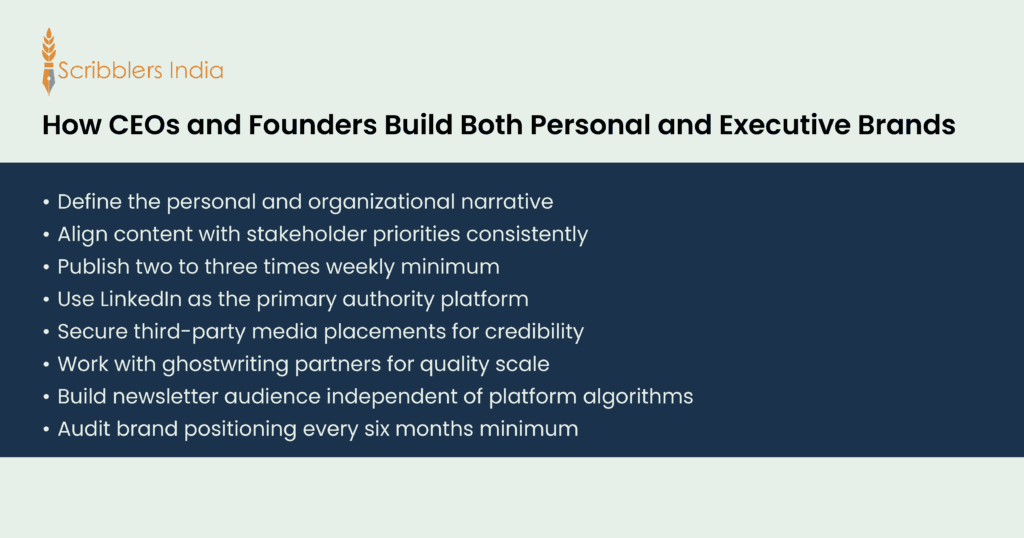
Start with positioning, stakeholders, evidence, and governance. Define the leader’s expertise territories and the sources that can sustain them. Establish review boundaries before volume increases. Then select channels and formats according to the audiences that matter.
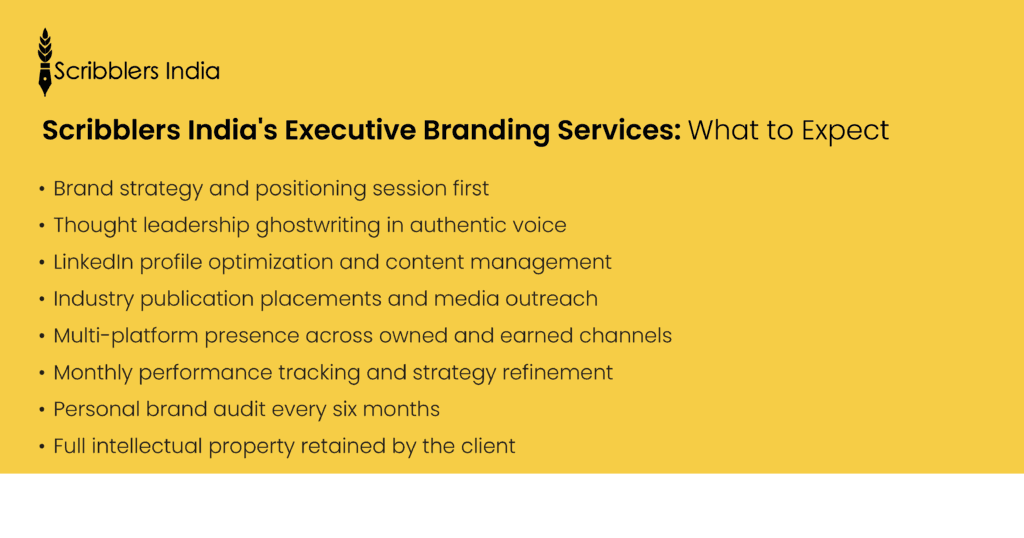
Executives who need managed positioning, thought leadership, LinkedIn content, and editorial support can explore Scribblers India’s personal branding services. The objective is a professional reputation that reflects the leader’s real expertise while remaining credible within the role’s responsibilities.
FAQs
Who Should Approve an Executive’s Public Content Inside a Company?
Approval should follow the subject and the organization’s existing responsibilities. Personal leadership commentary may require limited additional review. Product claims can need product input, while financial, legal, regulatory, employee, or crisis-related subjects may require specialist approval. A topic-based governance map keeps routine publishing efficient and gives writers clear escalation points.
How Is Executive Branding Different From Executive Communications or PR?
Executive branding manages the long-term professional reputation and public expertise associated with a leader. Executive communications can include internal messages, speeches, stakeholder updates, and formal company communications. PR focuses more heavily on earned media and external reputation activity. These disciplines can share information while retaining distinct objectives, owners, and approval processes.
Can an Executive Build a Personal Point of View Without Speaking for the Company?
Yes. A leader can discuss professional experience, market insights, operational lessons, and informed opinions in their own voice. Clear topic boundaries and accurate company references help audiences understand the context. Sensitive subjects can proceed through the relevant internal review process in accordance with the executive’s role and organizational policies.
What Changes in an Executive Brand After a Promotion, Board Appointment, or Company Exit?
The stakeholder mix and relevance of existing expertise change. A promotion can broaden leadership responsibilities. A board role may place greater emphasis on governance, judgment, and pattern recognition. After an exit, profiles and content should separate portable expertise from authority associated with the previous organization.
How Much Executive Involvement Is Required When Content Is Ghostwritten?
The executive should provide the substance that makes the content credible. Interviews, voice notes, presentations, research, and draft comments can capture that thinking efficiently. Writers can handle structure, research, drafting, and editorial refinement, while the executive reviews material claims, personal experiences, opinions, and the final version before publication.
Is executive branding only for CEOs?
No. Executive branding can support CEOs, CFOs, CTOs, CHROs, business-unit leaders, founders, board members, and other senior professionals whose expertise or public communication influences important stakeholders. The positioning, governance requirements, audiences, and content themes should reflect the responsibilities and visibility associated with the individual role.
How long does it take to build an executive brand?
Executive branding develops through consistent positioning, substantive ideas, credible evidence, and repeated exposure to relevant stakeholders. There is no universal timeline because existing reputation, publishing frequency, executive involvement, market visibility, and objectives differ. Early indicators may appear in engagement quality and invitations before wider reputation or commercial effects become measurable.