
Buyers no longer wait until a sales call to research founders. They ask ChatGPT for opinions, check LinkedIn feeds, and read AI Overviews before opening the vendor’s website. This shift means AI visibility for personal brands now sits at the heart of every founder-led growth program.
Founders who stay invisible across AI systems lose influence before conversations begin. The problem cuts across categories, from B2B SaaS to consulting and professional services. Buyers form opinions inside AI answers, and those opinions shape shortlists.
This blog explains what AI visibility for personal brands means for founders and executives, how it works across major platforms, and how founders can build a program that supports long-term authority. Every section connects strategy to specific actions your team can start this quarter.
Key Takeaways:
|
What is AI Visibility for Personal Brands?
AI visibility for personal brands measures how often a founder appears within AI-generated answers across professional queries. It covers mentions, citations, description accuracy, and share of voice against category peers. It also reveals whether platforms associate the founder with the right expertise and business context.
The concept extends personal branding into a new discovery layer. Traditional personal branding focused heavily on LinkedIn reach and speaking visibility. AI visibility adds another question: how do ChatGPT, Perplexity, Gemini, and Google AI Overviews describe the founder during buyer research?
Accurate visibility depends on entity clarity across the public web. AI systems need reliable evidence linking a founder with their category, company, professional role, and expertise. Consistent biographies, author pages, expert bylines, and regular public content help platforms build that picture. Weak signals may produce inaccurate answers or complete omission.
Building those signals requires a connected strategy rather than isolated profile updates. Professional personal branding services help founders align their positioning, profiles, thought leadership, owned content, and external authority signals. This creates a clearer professional identity across search engines and AI-led discovery platforms.

What is the Importance of AI Visibility for Personal Brands?
AI visibility for personal brands is crucial, as buyers now use AI systems to conduct early founder research across the category. Absent founders lose influence during the earliest, most impressionable stages of the buyer journey.
The evidence keeps building across major platforms. OpenAI reported more than 900 million weekly ChatGPT users in March 2026, with search usage nearly tripling across the previous year. Google AI Mode also crossed one billion monthly users by May 2026.
Professional platforms now feed AI answers at meaningful scale. Recent Profound data, covered by Axios, showed that LinkedIn citations in ChatGPT responses had doubled since November 2025 for professional queries. This trend confirms that AI systems increasingly pull founder content into vendor research answers.
The commercial implication runs deep. When a buyer asks ChatGPT to compare vendors, the AI answer often names founders alongside companies. When a buyer asks Perplexity about a category expert, the answer often cites LinkedIn profiles and published articles. Founders’ absence from these answers hands influence to competitors during the shortlisting stage.
How Do AI Systems Discover and Cite Personal Brands?
AI systems discover personal brands through training data patterns, live retrieval, entity signals, and third-party validation. Each pathway shapes how often a founder appears inside answers across generative platforms.
Training data feeds foundational model behavior. AI systems learn from web content across large datasets during model training cycles. Founders with steady mentions across trusted sources appear more often in category prompts. Consistent messaging across the web strengthens this pattern over time.
Live retrieval covers current information across recent pages. ChatGPT Search, Perplexity, and Google AI Mode retrieve information from indexed sources when generating answers. Well-structured LinkedIn articles, expert bylines, and interviews with clear positioning earn retrieval priority across professional queries.
Entity signals help platforms connect that evidence with the correct person. Consistent biographies across LinkedIn, personal websites, speaker pages, and company profiles reduce ambiguity. Clear author pages, contextual internal links, and suitable schema markup further explain how the founder, organization, expertise, and published content relate.
Independent validation strengthens this information trail by confirming expertise beyond self-published claims. Industry articles, podcast appearances, event profiles, and expert contributions provide additional context during professional research. A comprehensive thought leadership content strategy helps founders build credible external and owned signals through a single, connected authority program.
Which Signals Strengthen AI Visibility for Personal Brands?
Four signal categories shape AI discovery for personal brands across every generative platform. Founders who address each category build steady visibility gains over time.
- Consistent entity signals: Aligned bios across LinkedIn, personal websites, About pages, and speaker profiles reduce ambiguity across AI systems. This clarity helps ChatGPT and Perplexity describe the founder accurately across category prompts.
- Original expert content: LinkedIn articles, blog posts, and bylined pieces with distinct frameworks give AI systems attributable expertise signals. Generic commentary offers no such distinction across the wider category.
- External authority coverage: Industry publications, podcast appearances, and expert roundups strengthen credibility in response to professional queries. AI systems often prioritize third-party validation over founder-owned content when generating answers.
- Structured, extractable formatting: Question-led headings, direct answers, and clear definitions inside founder content improve extraction odds across AI Overviews. Well-formatted articles feed clean text chunks into generative answers.
Founders who address these four signals together see stronger visibility gains than those working across a single channel. Scattered efforts across single signals produce scattered results across AI platforms over time.
How Is AI Visibility Different from Traditional Personal Branding?
AI visibility and traditional personal branding share the foundation of expertise and audience trust. However, the two disciplines diverge across measurement, content structure, discovery channels, and authority signals.
| Dimension | Traditional Personal Branding | AI visibility for personal brands |
| Primary channel | LinkedIn, speaking, media | AI answer engines, generative search |
| Discovery trigger | Human search, referrals | Prompt-led AI queries |
| Success metric | Followers, engagement, reach | Mentions, citations, share of voice |
| Content priority | Storytelling, opinion, presence | Extractable authority, entity clarity |
| Authority proof | Recognition inside a network | Third-party mentions AI systems trust |
The two disciplines work together across a complete founder program. Traditional personal branding builds the audience that consumes founder content. AI visibility ensures that content also feeds AI answers across buyer research prompts. Programs that address one without the other leave visibility gaps across the buyer journey.
Founders who plan both disciplines in a single editorial calendar see the strongest visibility gains across quarters. Detailed thought leadership content programs help founders build this combined approach across LinkedIn along with generative platforms.
What Content Assets Support Personal Branding AI Visibility?
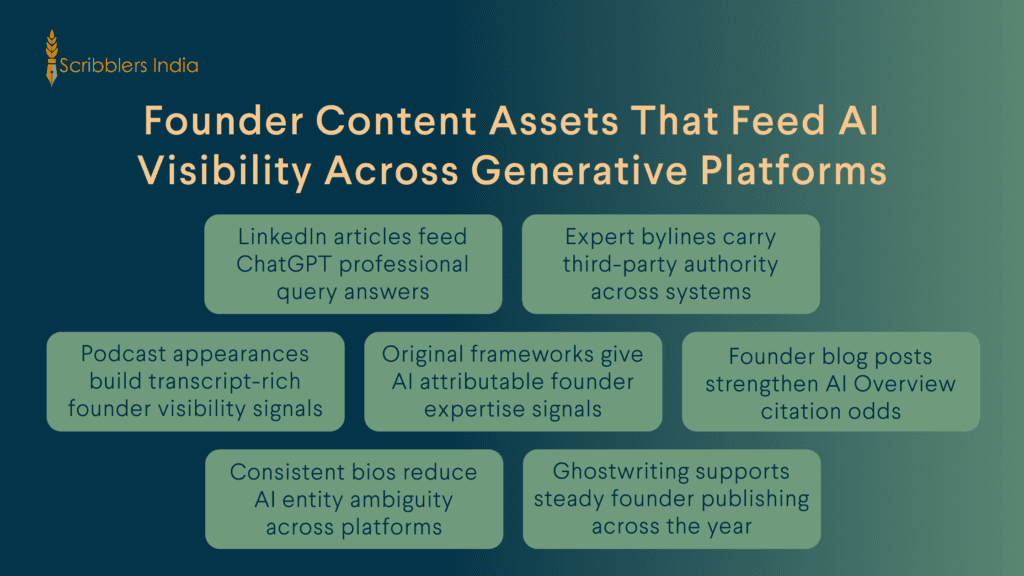
Five content assets carry the heaviest weight across AI visibility for personal brands. Each asset serves a different prompt category across the buyer research journey.
- Founder LinkedIn articles: Deep LinkedIn articles on category topics strengthen the entity signal that AI systems weigh across professional prompts. LinkedIn content also feeds retrieval across ChatGPT, Perplexity, and Google AI Mode during answer generation.
- Expert bylines: Contributed pieces across industry publications carry third-party authority that owned content alone cannot match. These bylines strengthen the founder as a recognized voice across the category over time.
- Podcast appearances: Long-form audio conversations produce transcript-friendly content that AI systems can index and cite. Regular podcast appearances also spread the founder’s expertise across audiences outside owned channels.
- Original frameworks and research: Named methodologies, proprietary frameworks, and small research studies give AI systems attributable content to cite across category prompts. These assets differentiate the founder from generic commentators across the field.
- Founder-led blog posts: Deep blog posts published on the company website with clear author attribution feed both AI Overviews and category prompt answers. Question-led H2s and direct answers improve extraction odds across generative platforms.
Together, these five assets build a founder-visibility base that supports mentions on every priority AI platform. Professional ghostwriting services for founders help time-constrained founders publish these assets consistently throughout the year.
How Should Founders Build AI Visibility for Personal Branding?
AI visibility for a founder’s personal brand has to be built through a phased approach. The path spans positioning, content development, external authority, and consistent measurement over quarters.
Positioning comes first. Founders need to define their category, their expertise territory, and their differentiated point of view. Weak positioning creates weak entity signals across AI systems. Strong positioning gives AI systems the clarity they need to describe the founder accurately across every category prompt.
Content development follows. Founders publish LinkedIn articles, expert bylines, blog posts, and long-form thought leadership across a steady editorial calendar. Content structure matters as much as content depth here. Question-led headings and direct answers feed AI extraction across generative platforms.
External authority builds through outreach, guest contributions, podcast appearances, and mentions across recognized industry sources. Steady measurement then ties the program together through prompt tracking, citation checks, description-accuracy reviews, and share-of-voice comparisons against category peers.
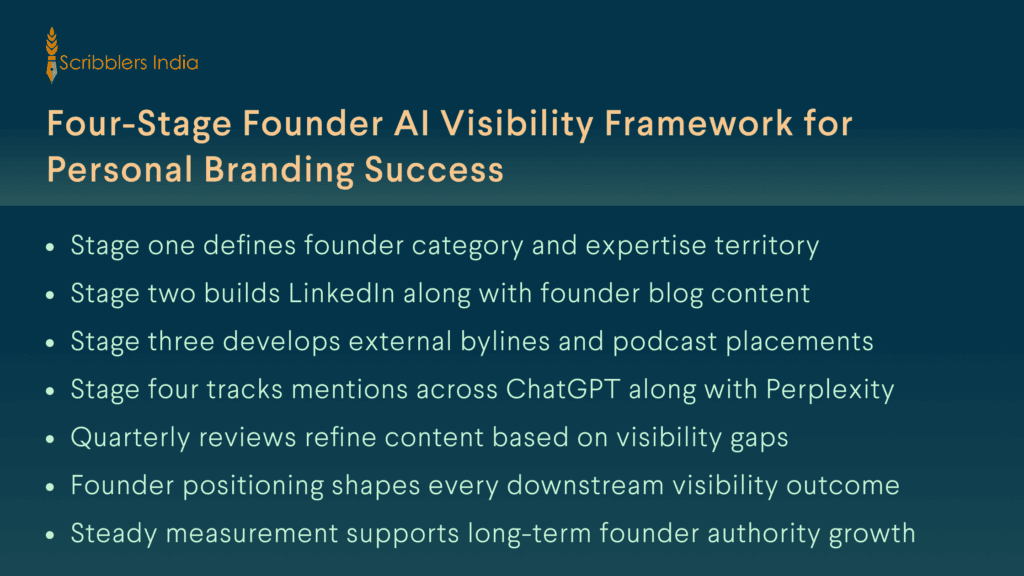
The Four-Stage Founder AI Visibility Framework
Use this AI search visibility framework across every founder personal branding program.
- Stage One: Positioning Foundation. Define the founder’s category, expertise territory, and point of view across a clear positioning document. Update bios and LinkedIn profiles to reflect this positioning across every discovery surface.
- Stage Two: Content Base Building. Publish two to four LinkedIn posts weekly and one long-form article every month. Build a founder blog on the company website with question-led H2s across every priority topic.
- Stage Three: External Authority Development. Pitch bylines to industry publications, book podcast appearances, and contribute to expert roundups across the category. Aim for one to two external placements every month across the year.
- Stage Four: Measurement and Refinement. Track founder mentions across ChatGPT, Perplexity, and Google AI systems every month. Adjust content priorities based on gaps in prompt coverage and reviews of description accuracy.
Founders that follow this four-stage framework see visibility gains across three to six months of steady work.
What Common Mistakes Weaken AI Visibility for Personal Brands?
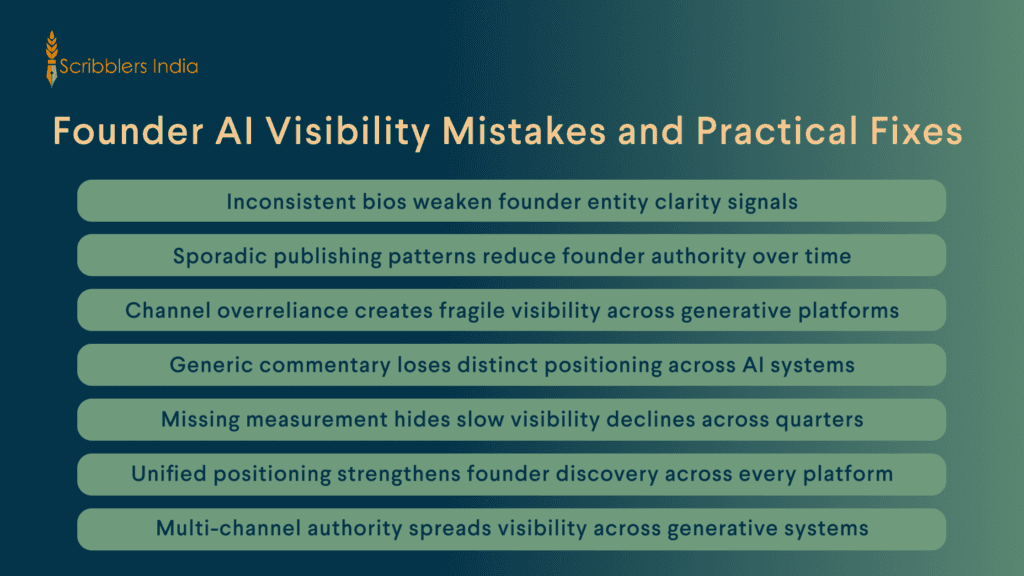
Several mistakes weaken AI visibility for personal brands by making founder expertise harder to identify, verify, or retrieve. Most gaps appear across identity consistency, publishing rhythm, channel coverage, content originality, and measurement. Left unresolved, these weaknesses allow better-structured competitors to gain stronger visibility across important professional prompts.
- Inconsistent biographies create entity confusion: Different titles, company descriptions, areas of expertise, or photographs make identity resolution harder. Founders should align their LinkedIn profiles, personal websites, company biographies, author pages, speaker profiles, and external contributor descriptions to reflect their current professional position.
- Sporadic publishing weakens topic association: Intensive publishing followed by long periods of silence creates an incomplete authority trail. A sustainable monthly rhythm provides AI systems with more up-to-date evidence that connects the founder to defined topics, questions, frameworks, and professional viewpoints across successive retrieval cycles.
- Dependence on a single channel limits verification: LinkedIn can support discovery, but it cannot carry the full authority program. Founders also need owned articles, expert bylines, interviews, case studies, and relevant external references that confirm expertise across several accessible sources.
- Generic commentary creates weak differentiation: Repeating common industry observations gives AI systems little reason to associate the founder with a distinctive perspective. Original frameworks, decision lessons, informed opinions, and detailed cases create stronger evidence around the founder’s specific experience and professional relevance.
- Missing measurement hides declining visibility: Founders without prompt tracking cannot identify description drift, lost citations, or competitor movement. Scribblers India’s 80+ AI Search Stats guide provides verified context around platform growth, citation behavior, AI referrals, and changing search patterns.
Fixing these mistakes strengthens visibility outcomes across three or four review cycles. A detailed content gap analysis helps founders identify which mistakes have the greatest impact in their specific category.
How Should Founders Measure Personal Branding AI Visibility?
Founders should measure AI visibility for personal brands through mention frequency, citation share, description accuracy, prompt coverage, and competitive share of voice. Each metric answers a different question. Together, they show whether AI platforms can identify the founder, understand their expertise, and represent it accurately.
Founder visibility measurement differs from company visibility measurement. Founder prompts often ask about expertise, opinions, and category leadership. Company prompts often ask about services, pricing, and comparisons. Founder measurement therefore needs its own prompt list built around professional research patterns.
| Founder Metric | What It Reveals | Review Cycle |
| Mention frequency | Founder inclusion across AI answers | Monthly |
| Citation share | LinkedIn content or bylines cited | Monthly |
| Description accuracy | How AI describes founder expertise | Monthly |
| Prompt coverage | Category prompts featuring the founder | Quarterly |
| Share of voice | Founder vs peer mention rate | Monthly |
| Sentiment tracking | Whether AI descriptions carry credibility | Monthly |
Measurement should distinguish reach from meaningful discovery. Scribblers India’s EdTech leader personal branding case study recorded 99.6% of viewers from outside the existing follower base. The result showed audience expansion rather than repeated exposure among established followers.
AI visibility needs a similar distinction. A founder mention has limited value when the description remains inaccurate or unrelated to priority expertise. The Scribblers India AI Search Discovery Benchmark 2026 recommends tracking presence, citations, answer accuracy, prompt coverage, and nearby competitors through recurring tests.
These combined measures help founders identify description drift, competitor gains, weak sources, and missing topic associations before those gaps become established across buyer research journeys.
Founder AI Visibility Measurement Checklist
Use this checklist across every monthly review cycle for a founder program.
- Build a fixed prompt list of 25 to 40 professional queries across your category
- Run each prompt across seven or more sessions per platform for reliable data
- Track mention frequency and citation share across ChatGPT along with Perplexity
- Review description accuracy across all major generative systems every month
- Compare AI visibility against three or four relevant peers in the category each month.
- Use the AI Search Discovery Benchmark to assess visibility and accuracy together
- Document coverage gaps that need fresh content across the coming quarter
This checklist provides founders with a repeatable measurement process for every review cycle.

How Does Scribblers India Support AI visibility for personal brands?
At Scribblers India, we help founders build AI visibility for personal brands through positioning work, editorial planning, ghostwriting support, and structured measurement across quarters. Our team combines content strategy with founder-led thought leadership to strengthen entity signals across every priority generative platform.
- AI Search Visibility Audits: We map founder mentions, citation share, description accuracy, and prompt coverage across ChatGPT, Perplexity, and Google AI systems. Baseline audits reveal the specific gaps that guide founder content priorities across the coming quarter.
- Founder-Led Thought Leadership: Our team develops LinkedIn articles, bylined pieces, and original frameworks that AI systems can attribute to the founder. This work strengthens the distinct positioning that separates founders from generic category commentators across every prompt.
- Ghostwriting for Founders: We support founders with limited time for publishing through structured content programs on LinkedIn and in industry publications. Every piece captures the founder’s voice while carrying the extractable structure AI systems reward across generative answers.
- Personal Branding Content Strategy: Our experts plan editorial calendars that align founder content with visibility goals across AI systems. Our content strategy services cover topic clusters, refresh cycles, and expansion across the professional research prompts your category peers already dominate.
- External Authority Development: We help founders pursue expert bylines, podcast appearances, and industry mentions across the year. This third-party coverage strengthens the credibility signals that AI systems weigh when evaluating founder recommendations across category prompts.
Get in touch with our team today to start building AI visibility for personal brands grounded in evidence, entity clarity, and steady founder-led content across the year.
Frequently Asked Questions
How Long Does AI Visibility for Personal Brands Take to Improve?
AI visibility for personal brands can show early movement after several months of consistent publishing and authority building. Stronger gains often require longer periods because platforms need enough connected evidence. Timelines depend on positioning clarity, content depth, crawlability, external mentions, and competition across priority topics.
Which Platforms Should Founders Track for AI Visibility?
Founders should track ChatGPT, Perplexity, Gemini, Google AI Overviews, and Google AI Mode. Each platform retrieves and presents information differently. A founder may appear accurately on one platform and remain absent elsewhere. Monitoring several systems provides a more reliable view of professional discovery and category visibility.
Can Ghostwriting Improve AI Visibility for Personal Brands?
Yes. Ghostwriting can improve AI visibility for personal brands when the content reflects the founder’s authentic expertise. Skilled writers extract original frameworks, experiences, opinions, and examples through structured interviews. They then turn those inputs into clear, source-backed content that strengthens topic associations without removing the founder from the thinking process.
How Does LinkedIn Support AI Visibility for Personal Brands?
Public LinkedIn profiles and content can enhance AI visibility for personal brands by providing up-to-date professional context. Profound data reported by Axios found that LinkedIn citation frequency doubled between November 2025 and March 2026. Founders still need owned articles and external validation alongside LinkedIn publishing.
How Many Prompts Should Founders Track Every Month?
Founders should monitor 25 to 40 prompts covering education, expertise, comparison, recommendation, and category questions. A broader set of prompts reduces the effect of session-level answer variation. Track the same prompts monthly to compare mentions, citations, description accuracy, competing experts, and missing topic associations over time.
How Does AI Visibility Support Traditional Personal Branding?
AI visibility extends traditional personal branding into answer-led discovery. LinkedIn and speaking activity build direct audience familiarity. AI visibility helps founders appear in search results across ChatGPT, Perplexity, Gemini, and Google AI Mode. A complete program connects human trust with accurate representation across generative search experiences.
Which Content Formats Improve AI Visibility for Personal Brands?
Question-led articles, detailed case studies, original frameworks, expert bylines, and founder interviews support AI visibility for personal brands. Each format should provide direct answers and first-hand value. Google recommends unique, useful content that satisfies real audience needs across AI Overviews and AI Mode.
Should Founders Publish Under Their Name or Company Name?
Founders should publish expertise-led content under their own names when the goal is to build personal authority. Company bylines suit organizational announcements or product education. Named authorship helps readers and platforms connect ideas with a specific expert. Use complete author pages and consistent profile information across every owned asset.