A capable founder can build a strong business but still remain difficult for prospective buyers to evaluate. Company pages explain products and services, yet buyers often want to understand the person shaping important decisions. Founder personal branding closes this gap by making relevant expertise, experience, and thinking easier to assess before a direct conversation.
This visibility becomes more credible when supported by clear viewpoints, practical evidence, consistent publishing, and third-party validation. Founders may build these systems internally or work with a personal branding agency to bring greater structure to positioning, content development, and distribution. In either case, repeated proof builds stronger trust than frequent claims about authority or experience.
The goal is to give buyers enough credible information to form their own conclusions during research and evaluation. This guide explains how to build a strong personal brand for a founder through positioning, thought leadership, LinkedIn personal branding, owned content, AI discovery, measurement, and a practical strategy.
Key Takeaways
|
What Is Founder Personal Branding?
Founder personal branding is a strategy that shapes how people understand a founder’s expertise, judgment, values, and relevance. It connects public communication with real experience. The result is a recognizable reputation that supports buyer trust, company credibility, talent attraction, partnerships, and long-term category authority.
The work begins with a clear answer to one question: What should the founder become known for? Content then gives that position visible proof across repeated audience encounters. A complete founder branding strategy covers four connected areas:
- Positioning: Defines the audience, area of expertise, point of view, and promised value.
- Proof: Shows experience through examples, outcomes, lessons, research, and informed commentary.
- Publishing: Distributes useful ideas through LinkedIn, articles, newsletters, videos, and interviews.
- Reputation: Aligns profiles, search results, media coverage, references, and company messaging.
Personal branding and self-promotion produce different audience experiences. Self-promotion asks people to accept a claim. Personal branding lets people inspect the evidence behind that claim.
A founder who repeatedly explains a difficult industry problem builds familiarity. A founder who shares decisions, constraints, trade-offs, and outcomes builds credibility in their personal brand. Over time, the audience associates that founder with a clear professional territory.
Refer to this personal branding strategy guide from Scribblers India to understand how positioning connects with voice, proof, channels, and long-form authority assets.

Why Does Founder Personal Branding Influence Company Decisions?
Founder personal branding influences company decisions when buyers connect leadership judgment with delivery confidence. This effect is strongest in startups, SaaS firms, professional services, and founder-led businesses. Before choosing a company, buyers often assess the founder’s clarity, consistency, and credibility as signals of whether the business can deliver reliably after engagement begins.
The 2026 Edelman Trust Barometer CEO Insights found that 66% trust their own CEO, while 54% trust CEOs generally. This 12-point difference shows how familiarity shapes confidence. Repeated exposure to a leader’s decisions, language, conduct, and responses helps audiences form a clearer view of professional reliability during major evaluations.
Founder-led content creates a similar observation layer for external audiences. Buyers can see how the founder frames problems, explains trade-offs, and responds to industry change. This becomes evaluable when the company sells expertise, software, advisory services, or another high-consideration solution that requires confidence before commitment or investment decisions.
This visibility also gives the company a human interpretation layer. Product pages explain capabilities, while founder content explains priorities, reasoning, customer understanding, and market direction. Clear communication reduces uncertainty earlier in the decision process, improving conversation quality, referral confidence, hiring interest, and internal buyer advocacy across the organization over time.
How Does Founder Personal Branding Build Trust Over Time?
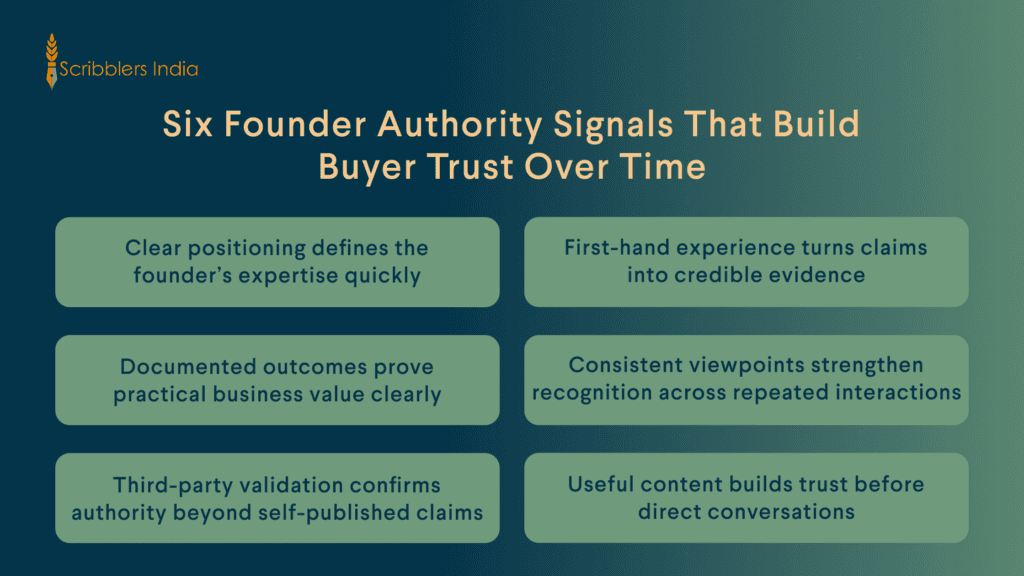
Founder personal branding builds trust through repeated signals that support the same professional promise. Each signal answers a buyer question: Clear positioning explains relevance, evidence proves capability, consistent viewpoints show judgment, third-party validation reduces self-claim risk, and accessible communication makes expertise easier to evaluate.
The trust process rarely depends on one viral post. Buyers often encounter a founder through several channels across different weeks. Every encounter either strengthens the same conclusion or creates confusion.
| Trust mechanism | Buyer question answered | Strong founder signal | Trust outcome |
| Positioning clarity | What does this founder understand deeply? | Specific audience and problem ownership | Faster category association |
| Evidence quality | Can this founder support the claim? | Cases, results, examples, and research | Lower perceived risk |
| Viewpoint consistency | Does this person think coherently? | Repeated principles across formats | Stronger recognition |
| Communication usefulness | Will this founder help before selling? | Practical explanations and frameworks | Greater goodwill |
| External validation | Do credible others support this reputation? | Testimonials, media, references, and invitations | Stronger belief |
Trust builds more effectively when these mechanisms reinforce one another across different touchpoints. A sharp LinkedIn headline may create the first impression, while a detailed article demonstrates depth, a case study shows how that expertise translates into practice, and a podcast appearance adds third-party validation.
Together, these signals create a credible trail that buyers can follow independently, without relying on a sales representative to explain the founder’s expertise. As that trail strengthens, the founder becomes easier to research, understand, and remember, while internal recommendations also become easier to make and support.
Which Signals Make Founder Personal Branding Believable?
Believable founder credibility combines lived experience with inspectable proof. Audiences need detail to judge the founder’s understanding. Strong signals include clear examples, documented outcomes, credible references, and accountability for previous decisions. Specificity gives every claim a visible foundation.
Experience Should Produce Transferable Insight
Experience gains value when the founder explains what others can learn from it. A project story should reveal the situation, decision logic, outcome, and reusable lesson. “Built three SaaS companies” provides a credential. “Here is why our second pricing model failed” provides judgment. The second form gives readers something they can test against their own work.
Proof Should Match the Strength of the Claim
Large claims require stronger evidence. A founder claiming category expertise should show frameworks, original observations, customer patterns, and sustained public work. Screenshots, anonymized outcomes, process notes, case studies, and original data can support the evidence layer. This EdTech leader case study shows how focused positioning can turn quiet expertise into structured discovery.
Viewpoints Should Reveal Decision Quality
Audiences learn more from a founder’s reasoning than from polished conclusions. Explain which options were considered. Share the constraint that shaped the final choice. A credible viewpoint carries context. It also admits scope. Founders strengthen trust when they separate direct experience from inference and external research.
External Signals Should Confirm the Narrative
Employees and customers can validate the founder’s stated position. Industry peers, publications, professional associations, and event organizers provide further confirmation. Specific descriptions carry the greatest credibility.
How Should a Founder Define a Credible Brand Position?
A credible brand position makes it clear who the founder helps, which problem they are known for addressing, and how their perspective differs from others in the space. It should also be supported by visible proof, giving the audience a specific reputation to associate with the founder over time.
Profiles, articles, interviews, case studies, and social posts should all reinforce that same professional territory rather than introducing disconnected messages. Broad positioning makes that association harder to build.
A description such as “technology entrepreneur” says very little about the founder’s expertise or relevance, while “founder helping regional banks modernize fraud operations” immediately establishes the audience, problem area, and domain in which the founder wants to be remembered.
Use this five-question positioning test:
- Who needs this expertise? Define a buyer group or stakeholder category.
- Which costly problem receives focus? Choose a problem with clear business relevance.
- What experience supports the position? Identify projects, decisions, outcomes, and lessons.
- Which viewpoint creates distinction? State the belief that shapes the founder’s approach.
- What action should the audience take? Define the next useful conversation or resource.
The answers should fit together naturally. A target audience without a relevant problem creates weak demand. A strong opinion without evidence creates skepticism. Proof without a clear position creates scattered recognition.
A concise personal brand statement can anchor the final position. It should explain who the founder serves and the value delivered. The statement then guides the LinkedIn headline, website biography, speaker introduction, and author profile.
Review positioning every six months. Update it after a major business shift, a category change, an acquisition, a new market entry, or an audience expansion. Stable core themes can remain while examples and emphasis evolve.
How Does Founder Thought Leadership Create Authority?
Founder thought leadership creates authority by exposing the quality of a founder’s thinking. Useful content helps readers understand overlooked problems and evaluate difficult choices. It enables them to act with greater confidence. The founder earns attention for the quality of their insights, then converts that attention into professional trust through consistency and proof.
The 2025 Edelman-LinkedIn report examined this influence. Strong thought leadership made 95% of hidden decision-makers more receptive to outreach. Hidden buyers often influence vendor approval while remaining outside early sales contact. Founder content can reach these people before a proposal reaches formal review.
The same report found that 74% viewed relevant category expertise as important during final vendor selection. Understanding business challenges scored 85%. These findings change the content goal. A founder should demonstrate an understanding of the problem before describing the company’s capabilities.
Strong thought leadership content from the founder explains pressures, constraints, failed approaches, emerging risks, and decision criteria. Effective topics often come from four sources:
- Decisions the founder makes repeatedly.
- Questions customers raise during evaluation.
- Industry assumptions the founder disputes.
- Operational lessons competitors rarely explain.
A founder can develop these ideas through interviews with a skilled writer. A structured thought leadership writing process uses viewpoint extraction to turn experience into substantial public ideas.
Which Content Formats Build Trust Across the Buyer Journey?
Different content formats build trust at different stages of the buyer journey. Short posts improve recognition, in-depth articles demonstrate expertise, case studies show practical results, interviews add personal credibility, and search-focused guides support independent research. Together, they create a content marketing approach that strengthens buyer confidence across multiple touchpoints.
| Buyer stage | Audience need | Useful founder format | Trust task |
| Early discovery | Understand the founder’s relevance | LinkedIn post or expert comment | Create clear association |
| Problem education | Understand the issue deeply | Guide or newsletter | Demonstrate teaching ability |
| Solution evaluation | Assess judgment and fit | Framework article or webinar | Show decision quality |
| Validation | Confirm delivery capability | Case study or process explanation | Reduce perceived risk |
| Final decision | Build internal confidence | Executive brief or evidence-led opinion | Support buyer advocacy |
| Post-purchase | Reinforce leadership confidence | Customer update or founder letter | Sustain trust |
This structure prevents repetitive posting. A LinkedIn post can introduce one insight. A long-form article can explain the complete framework. A newsletter can add recent evidence. A case study can show application. Each asset should lead naturally to another relevant resource. For example, a post about founder positioning can link to a detailed guide. The guide can lead to a case study showing the position in practice.
How to Connect LinkedIn With Owned Content for Stronger Founder Personal Branding?
Founder personal branding should use LinkedIn for reach and for owned content to build durable authority. LinkedIn creates frequent audience contact. A website preserves detailed ideas, case studies, author information, and conversion paths. The strongest system moves insights between the two environments while maintaining a consistent founder position.
A strong LinkedIn personal branding strategy starts with a profile that communicates the founder’s expertise and professional focus within seconds. Publishing then extends that positioning by turning ideas and experience into content that strengthens discovery and credibility over time.
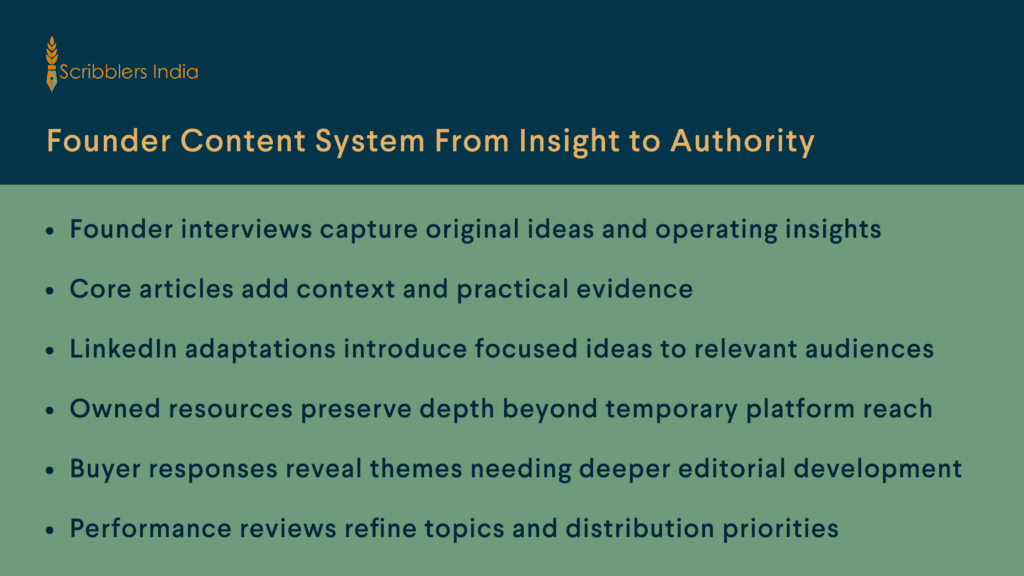
A connected founder content loop follows four stages:
- Capture: Record ideas through interviews, voice notes, sales questions, and project debriefs.
- Develop: Turn strong ideas into articles, frameworks, case studies, and newsletter editions.
- Distribute: Adapt each core idea into LinkedIn posts, videos, comments, and speaking notes.
- Consolidate: Link social content back to owned resources and relevant service pages.
This loop increases the useful life of every idea. A founder interview can produce one article, four LinkedIn posts, one carousel, two short videos, and a newsletter section.
Repurposing requires editorial adaptation because each format serves a different audience context. A long-form article can explore an idea in depth, while a LinkedIn post needs a sharper argument and immediate takeaway. Best personal branding agencies can help founders maintain this consistency across channels, while expert ghostwriting services turn interviews, experiences, and original viewpoints into platform-specific content that preserves the founder’s voice. This structured approach keeps the underlying ideas consistent without making every format sound or read the same.
How Can Founder Content Support AI Search Visibility?
Founder content can support AI search visibility by making expertise clear, crawlable, specific, and well supported. Search systems need accessible pages that connect a person with topics, evidence, organizations, and useful answers. Consistent author information and original insight strengthen those connections across the public web.
Google’s official Generative AI search guidance recommends unique, expert-led content with first-hand value. It also confirms that standard SEO foundations still support AI Mode and AI Overview visibility. This guidance aligns closely with founder authority building. A founder’s direct experience can produce non-commodity content that generic summaries cannot reproduce.
Use these practices across founder-owned assets:
- Maintain a complete author page with role, expertise, biography, and published work.
- Connect each article with relevant cases, sources, definitions, and company pages.
- Use consistent names, titles, topic language, and profile descriptions across channels.
- Publish first-hand frameworks, original observations, research, and documented examples.
- Keep important pages crawlable and technically accessible to search systems.
- Add descriptive internal links that explain relationships between related resources.
AI search visibility should remain an outcome of effective authority-building. Every page still needs to satisfy a real reader question. The AI search visibility scorecard from Scribblers India can help founders assess content depth, entity clarity, citations, technical readiness, and prompt coverage.
When to Start Working on a Founder Personal Branding Strategy?
A successful personal branding strategy for a founder starts working even before an urgent need for visibility arises. Early authority provides a stronger base for fundraising, hiring, market entry, partnerships, category creation, and sales. A founder with an established credibility trail can enter important conversations with existing recognition.
Several business events create a clear starting signal for founder personal branding:
- The company enters a crowded category with similar product claims.
- Buyers require education before understanding the solution’s value.
- Sales cycles depend heavily on leadership confidence.
- The founder plans to raise funds within the next year.
- Hiring requires stronger access to specialized talent.
- The company needs a public voice during market change.
- Competitors dominate public conversations despite weaker experience.
- Referral growth depends on clearer category recognition.
Starting early also allows authority to develop through repeated exposure. Buyers encounter the founder’s ideas across profiles, thought leadership, case evidence, and external conversations. Each interaction strengthens recognition before a commercial request or company announcement requires immediate attention.
This is where structured support can prevent scattered activity. Scribblers India’s personal branding services begin with discovery and positioning, then move into ghostwriting, LinkedIn content, thought leadership, and owned authority assets. The process helps founders build a coherent public presence around the business moments that drive commercial visibility.
What Mistakes Can Weaken a Founder Personal Branding Strategy?
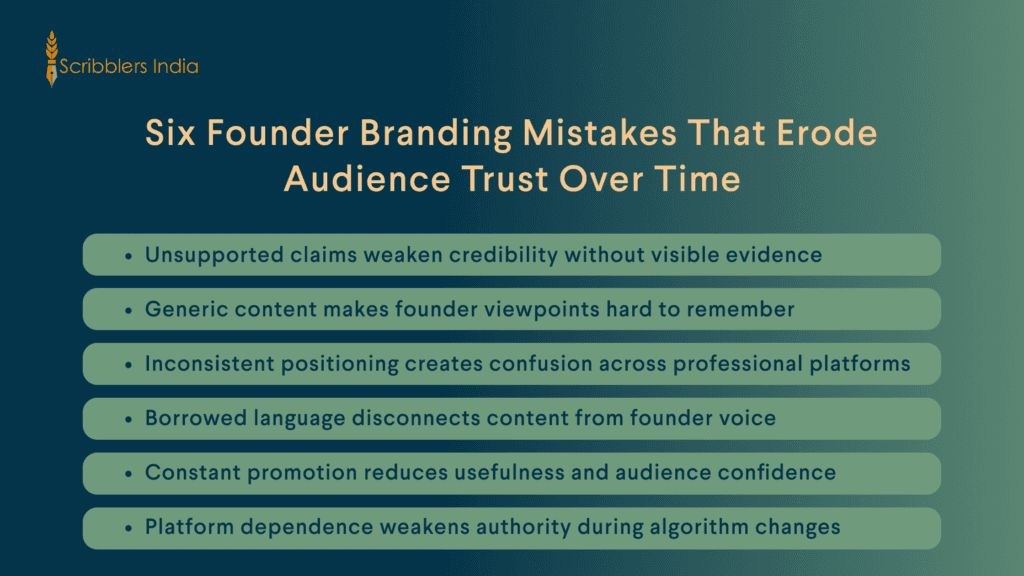
A founder’s personal branding strategy can be weakened when public claims exceed visible proof or messages change without explanation. Generic content creates another common problem. It increases activity while adding little evidence of judgment. Strong personal branding requires clear positioning, original thinking, consistent conduct, and measurement connected with business relevance.
| Trust mistake | What audiences may conclude | Practical correction |
| Broad motivational posting | The founder lacks a defined expertise area | Tie each post to a clear audience problem |
| Unsupported success claims | The founder expects belief without evidence | Add context, method, outcome, and limitations |
| Constant topic switching | The founder lacks a coherent professional position | Use four stable content pillars |
| Borrowed writing style | The content feels detached from the founder | Build a voice guide from real communication |
| Excessive product promotion | Every idea appears designed for immediate conversion | Teach first and connect offers contextually |
| Ignoring difficult questions | The founder may avoid accountability | Address trade-offs and realistic constraints |
| Measuring only reach | Visibility lacks proven business relevance | Track audience quality and downstream outcomes |
| Platform dependence | Authority disappears when reach changes | Build owned articles, newsletters, guides, and case studies |
Credibility can also decline when content promises a standard the company experience fails to deliver. Founder branding and operational behavior must support each other. Employee experience deserves close attention. Public leadership claims gain strength when employees, customers, partners, and industry peers describe matching behavior.
How Should Founder Personal Branding Align with the Company Brand?
Founder personal branding should support the company’s brand while showing the judgment behind it. Both brands need aligned audiences, customer problems, expected outcomes, and credible proof. The company explains what it delivers, while the founder explains why those priorities exist and how leadership decisions shape the company’s direction over time.
- Shared Audience: Both brands should speak to the same priority stakeholders, although their communication roles differ. Company content addresses organizational needs, while founder content adds leadership context that helps buyers understand the thinking behind solutions, services, customer outcomes, and operating commitments.
- Consistent Problem and Promise: Founder commentary should describe customer challenges in language that matches the company’s positioning. Different examples and viewpoints are useful, although both brands must reinforce the same core promise and avoid creating conflicting expectations about value or delivery.
- Connected Proof: Both brands should draw from compatible cases, customer outcomes, research, and operating evidence. The company can demonstrate delivery performance, while the founder explains the reasoning and leadership choices that produced those results under real business conditions.
- Governance and Voice: Alignment should never turn the founder into a corporate spokesperson. Clear governance can define confidential topics, approval needs, regulatory limits, and crisis ownership, while leaving room for personal lessons, career experiences, market interpretation, and informed leadership opinions.
When both brands remain aligned, founder content becomes evidence of the company’s culture and judgment. A message ownership guide can clarify which voice leads each topic and communication format clearly.

How To Measure the Success of a Founder Personal Branding Program?
Businesses should measure a founder’s personal branding strategy across four interconnected layers: visibility, audience relevance, authority growth, and commercial influence. Visibility shows reach, relevance confirms audience fit, and authority tracks recognition. Commercial influence reveals whether the strategy creates qualified conversations, referrals, hiring interest, partnerships, investor attention, or sales support over time.
| Measurement layer | What to track | What it reveals |
| Visibility | Profile views, content impressions, newsletter reach, website visits, and search appearances | Whether the founder is reaching a wider audience across relevant channels |
| Audience relevance | Job roles, industries, seniority, company types, locations, and target-account engagement | Whether visibility comes from people who can influence meaningful business outcomes |
| Authority growth | Branded searches, citations, backlinks, media requests, podcast invitations, and expert mentions | Whether audiences increasingly associate the founder with defined expertise and category authority |
| Commercial influence | Qualified inquiries, referrals, hiring conversations, partnerships, investor interest, and assisted sales opportunities | Whether founder visibility creates measurable trust and supports important business decisions |
Review these layers together each quarter to identify where visibility stalls. The AI Search Discovery Benchmark can extend this scorecard with prompt coverage, citation share, description accuracy, and competitor comparisons.
What Should Founders Do After Establishing Initial AI Search Visibility?
After improving AI search discovery, founders should strengthen the topic associations already producing relevant mentions. Expand cited ideas into deeper owned assets. Address unanswered prompts through focused content. Add stronger proof through cases, research, and external sources. Then improve source diversity, description accuracy, and competitive visibility across major AI platforms.
The next stage requires focus. Publishing across unrelated themes can weaken the category associations that currently support founder discovery.
Use this expansion sequence:
- Identify the topics already generating accurate founder mentions.
- Review which owned and external sources support those answers.
- Map out important prompts when the founder is absent.
- Expand frequently cited ideas into detailed owned resources.
- Add cases, original frameworks, research, and first-hand evidence.
- Build contextual links between related authority assets.
- Secure relevant bylines, interviews, or expert contributions.
- Retest prompts across ChatGPT, Perplexity, Gemini, and Google AI Mode.
- Compare description accuracy and share of voice against category peers.
- Refresh weak sources when roles, expertise, or market priorities change.
Prompt testing should reflect real audience research. Useful prompts include, “Which founders explain this problem clearly?” and “Who has practical experience in this category?” Record citations, competing experts, missing associations, and factual gaps. These findings should guide the next content cycle and strengthen the quality of visibility over time.
How Can Scribblers India Help With Founder Personal Branding?
Scribblers India helps founders turn professional expertise into a clear, searchable authority system. As a leading personal branding company, we integrate positioning, ghostwriting, thought leadership, long-form assets, and AEO and GEO planning to align with the founder’s broader business goals.
Our aim is to build consistent authority across LinkedIn, Google Search, AI platforms, and owned channels while keeping the founder’s experience and perspective at the centre of the strategy. Here is how we optimize a founder’s personal branding strategy:
- Personal Brand Positioning: We define the audience, expertise territory, differentiating viewpoint, and proof behind the founder’s public identity. This foundation aligns profiles, content themes, biographies, and commercial goals, helping every published asset reinforce one recognizable professional position across channels consistently.
- Founder Ghostwriting: Structured interviews capture the founder’s ideas, language, experience, and judgment. We transform those inputs into LinkedIn posts, articles, newsletters, and speeches that sound authentic, reduce writing pressure, and maintain a dependable publishing rhythm year-round without delays.
- Thought Leadership Content: Our team converts operating lessons, market observations, original frameworks, and informed opinions into substantial content. Each thought leadership content piece helps buyers understand the founder’s thinking, supports category authority, and creates credible material for media, speaking, sales, and partnership opportunities.
- Ebook and Long-Form Writing: We develop research-backed ebooks, guides, whitepapers, and signature reports around the founder’s expertise. These owned assets provide deeper proof, support lead generation, strengthen search visibility, and give sales teams educational resources for complex buyer journeys.
- AEO and GEO Optimization: Our experts structure founder content around real questions, direct answers, clear authorship, credible sources, and connected entity signals. This improves extraction readiness and helps Google Search, AI Overviews, ChatGPT, Perplexity, Gemini, and Google AI Mode understand expertise.
Book a 1:1 consultation with our team to start building a founder personal branding program that turns your expertise into sustained authority across AI search and buyer conversations.
Frequently Asked Questions
How can founder personal branding address multiple audiences?
Founder personal branding should maintain a single central authority position while tailoring evidence to different audiences. Buyers may value commercial judgment, while investors or employees may look for leadership signals. Professional personal branding services can build separate content paths around these needs without fragmenting the founder’s core expertise, voice, or public reputation.
What happens to the founder’s personal branding program after an exit or role change?
Founder personal branding should remain attached to the person rather than one company title. After an exit, biographies, proof assets, and content themes should reflect the new direction. A portable authority position helps the founder maintain recognition across advisory roles, new ventures, board appointments, and investment activities.
Can founder personal branding continue during a company rebrand?
Yes. During a company rebrand, founder personal branding should explain the strategic reasoning behind the change. The founder can clarify what remains consistent and how customers should interpret the new direction. Coordinated biographies, profile updates, and publishing dates prevent search results from presenting conflicting professional identities.
How can founder personal branding support AEO Visibility?
Founder personal branding supports AEO when content answers specific audience questions through clear, self-contained passages. Author pages and source-backed explanations improve extraction readiness. Scribblers India’s AEO services connect founder content with question clusters, schema, direct-answer sections, and contextual internal linking.
How can founder personal branding support GEO visibility?
Founder personal branding supports GEO when several credible sources connect the same person with defined expertise. Original frameworks, media references, expert bylines, and case evidence strengthen generative retrieval. Scribblers India’s GEO services organize these authority signals around priority prompts and relevant citation opportunities.
Can founders in regulated industries build their personal brands?
Yes. Founders in regulated industries can build credible personal brands through clear editorial boundaries and documented approval processes. A personal branding agency with experience in sensitive sectors can help define restricted claims, permissible evidence, and review requirements while consistently maintaining a practical publishing rhythm for educational, industry, and leadership content.
How should founders evaluate personal branding case studies before choosing an agency?
Founders should look beyond impressions and review whether a personal branding company demonstrates positioning expertise, editorial quality, and measurable outcomes through detailed case studies. Its capabilities should also align with the required content mix, including thought leadership, LinkedIn, reports, and ebook writing services, where relevant. Scribblers India’s case studies demonstrate this approach in practice.
Should founder and company content use separate editorial calendars?
Yes. Separate content calendars prevent duplicate messaging and clarify which voice owns each topic. The founder calendar should prioritize judgment and market interpretation. The company calendar can cover products, customer education, proof, and operational updates. A shared review point keeps both narratives aligned with current business priorities.