
Personal brand content pillars help professionals turn scattered publishing into a clearer and more recognizable body of work. Without them, someone may post about many subjects yet still leave audiences unsure about the expertise they should associate with that person. Regular activity alone does not always create a professional identity.
Clear content pillars organize expertise into a small number of recurring themes that support long-term positioning. They guide what deserves repeated attention and what should remain outside the main narrative. Over time, these themes can strengthen audience recall and make the professional’s authority easier to understand across different content formats.
Key Takeaways
|
What Are Personal Brand Content Pillars?
Personal brand content pillars are the recurring subject areas that organize a professional’s content around their expertise. Each pillar represents a meaningful theme connected with the person’s authority position, audience interests, and professional goals. Together, they create consistency without requiring every post or article to repeat the same idea.
For example, a SaaS founder focused on customer retention might use pillars around onboarding, customer behavior, product adoption, and retention economics.
Each pillar can then support several content angles:
- Direct answers to recurring audience questions
- Lessons drawn from first-hand experience
- Original frameworks or operating methods
- Commentary on relevant industry changes
- Cases showing the idea in practice
- Research that adds useful supporting context
- Contrarian or differentiated professional opinions
- Deeper guides that consolidate related knowledge
Content pillars are therefore editorial categories with strategic purpose. They do more than keep a publishing calendar organized.
Once content pillars are understood as recurring expertise themes, an important distinction follows. They should not be confused with the broader elements that make a personal brand credible, because content is one part of the wider authority system.

How Are Personal Brand Content Pillars Different From Personal Brand Elements?
Personal brand content pillars organize the subjects a professional repeatedly discusses. Personal brand elements describe the wider components that shape professional identity and credibility. Positioning, proof, voice, visibility, and relationships can influence the brand, while content pillars specifically determine which expertise themes deserve repeated public attention.
| Area | Personal brand content pillars | Personal brand elements |
| Main purpose | Organize recurring publishing themes | Build the complete professional brand |
| Primary question | What should I regularly discuss? | What makes my personal brand credible? |
| Common components | Expertise themes and audience questions | Positioning, narrative, proof, presence, and relationships |
| Editorial role | Guides topic selection | Guides wider brand development |
| Measurement | Topic association and audience response | Overall authority and professional outcomes |
| Typical change rate | Can evolve with audience needs | Usually changes more gradually |
Scribblers India’s insights into the core elements of a personal brand encompass the broader components underpinning professional authority. Content pillars sit inside that larger system by translating positioning into repeatable subject areas for publishing.
That distinction prevents teams from treating content planning as the entire personal branding strategy. Once the role of pillars is clear, the next decision is how many themes a professional can realistically own without making their public identity too narrow or scattered.
How Many Personal Brand Content Pillars Should You Have?
Most professionals can work effectively with three to five personal brand content pillars. Too few may limit useful discussion, while too many can weaken the association with the topic. The right number depends on the breadth of expertise, audience needs, publishing frequency, and the degree to which the selected themes align with a single authority position.
A useful structure should include:
- Core Expertise Pillar: The subject the professional most wants associated with their name. This pillar should receive the greatest depth and strongest proof.
- Problem Pillar: Recurring challenges the audience needs help understanding. These topics make the expertise commercially and professionally relevant.
- Perspective Pillar: Market changes, beliefs, or professional viewpoints that reveal how the person thinks rather than what they know.
- Experience Pillar: First-hand lessons, cases, mistakes, decisions, and operating observations that demonstrate practical knowledge.
- Adjacent Expertise Pillar: A closely related area that provides context without pulling the professional into an unrelated category.
The number should remain manageable enough to support repeated depth. A pillar that receives one post every six months is unlikely to create a meaningful audience association.
A manageable pillar system creates enough variety without losing professional focus. The next step is to choose themes based on evidence, because useful content pillars should emerge from real expertise and audience demand rather than from attractive labels created during a brainstorming session.
How Do You Choose Personal Brand Content Pillars?
Choose personal brand content pillars where professional expertise overlaps with audience interest, credible proof, and future goals. Each pillar should be broad enough to support repeated discussion, yet focused enough to reinforce a recognizable authority position. Topics chosen only for engagement can attract attention without strengthening professional relevance.
Use these questions to evaluate each potential pillar:
- Does the professional have meaningful experience in this area?
- Does the intended audience actively care about the problem?
- Can first-hand examples support repeated discussion?
- Does the topic strengthen the desired authority position?
- Can the theme support short and long-form content?
- Are there unanswered questions worth exploring?
- Can external proof strengthen the professional’s perspective?
- Will this topic remain relevant beyond one trend?
A personal brand audit can also reveal which existing topics already attract useful audiences and which themes create little meaningful response. Professionals should avoid selecting content pillars solely from high-volume keywords. Search demand can inform topics, although the final pillars must still reflect experience the individual can defend publicly.
Strong pillars create the editorial boundaries needed for consistent publishing. Once those boundaries exist, teams can decide which formats suit each theme, allowing one expertise area to produce short observations, substantial articles, visual frameworks, and deeper owned resources.
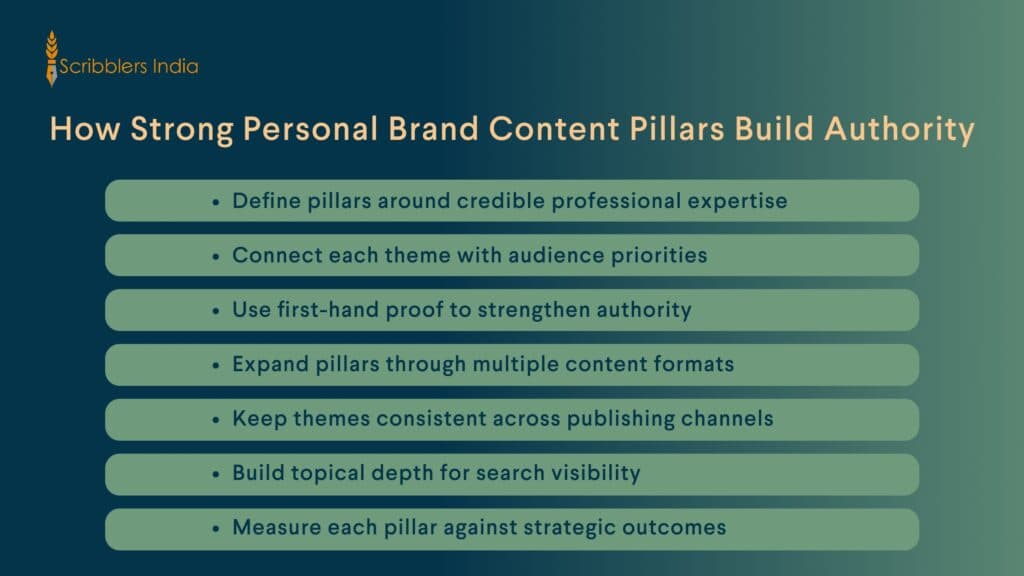
What Content Formats Can Support Each Personal Brand Pillar?
Each personal brand content pillar should support multiple formats, as different ideas require varying levels of depth. Short posts can introduce observations, while articles provide analysis. Interviews capture first-hand thinking, and ebooks or reports can consolidate substantial expertise into durable authority assets.
| Content format | Best role within a pillar |
| LinkedIn post | Introduce one clear observation or lesson |
| Carousel | Explain a framework or structured process |
| Long-form article | Develop an argument with evidence |
| Newsletter | Continue recurring audience conversations |
| Case-led post | Demonstrate practical application |
| Interview | Capture first-hand experience and opinions |
| Ebook or report | Consolidate deeper expertise into owned authority |
| Podcast or video | Extend voice and interpretation into richer formats |
One strong founder interview can generate ideas across several formats, with each version serving a different purpose.
Professionals who lack the time to write regularly can use ghostwriting services to convert interviews into connected assets while preserving the leader’s reasoning and established communication style.
The format should therefore follow the depth of the idea rather than platform habits. Once pillars begin generating content across several formats, the next challenge is adapting them to individual channels without altering the underlying professional association.
How Should Content Pillars Work Across LinkedIn and Owned Channels?
Personal brand content pillars should remain consistent across channels, although each platform can express them differently. LinkedIn may introduce ideas through concise observations and conversation-led posts. Owned articles can provide greater depth, while newsletters or reports can develop recurring themes without depending entirely on social distribution.
- Consider one pillar around responsible AI adoption.
- On LinkedIn, the professional might discuss a current implementation mistake.
- An article could explain a detailed decision framework.
- A newsletter might examine one recurring governance question each month.
- An ebook could consolidate the professional’s model into a substantial owned resource.
- The pillar remains consistent while the level of depth changes.
A clear LinkedIn personal branding system can therefore leverage the same authority themes that appear across articles or owned resources, rather than creating an isolated social media identity.
Cross-channel consistency makes the professional easier to understand without requiring identical content everywhere. That repeated subject association also provides a useful foundation for search and AI discovery, where systems need clear evidence linking a person to specific areas of expertise.
How Do Personal Brand Content Pillars Support AEO, GEO, and AI Discovery?
Personal brand content pillars can support AEO and GEO efforts by creating consistent depth across specific areas of expertise. Repeated coverage of related audience questions, first-hand examples, original frameworks, and credible sources gives search systems more context about the professional and the subjects associated with their public authority.
A strong pillar can evolve into a connected cluster of questions.
For example, an executive with a cybersecurity governance pillar may publish around:
- Cybersecurity oversight responsibilities
- Board-level cyber risk questions
- Incident response governance
- Vendor risk evaluation
- Regulatory changes affecting leadership
- Security investment decisions
- Cyber risk reporting frameworks
- Lessons from real governance failures
AEO can help each asset answer individual questions clearly. GEO planning can strengthen entity connections, source depth, and supporting authority around the broader subject. This does not guarantee inclusion within AI-generated answers. It creates clearer public evidence that systems can potentially retrieve and interpret.
The AI Search Discovery Benchmark provides teams with a broader framework for comparing prompt coverage, citation presence, source patterns, and description accuracy when evaluating whether those expertise themes are present across AI-led research.
How Do You Measure Whether Personal Brand Content Pillars Are Working?
Personal brand content pillars are working when relevant audiences increasingly associate the professional with those subjects. Measurement should compare topic-level reach with audience quality, authority development, business influence, and AI discovery. A pillar generating high engagement from unrelated audiences may still provide limited strategic value.
Track performance by pillar rather than grouping every asset together.
| Measurement area | What to review |
| Audience relevance | Roles, industries, seniority, and target-account engagement |
| Topic engagement | Saves, replies, shares, and meaningful discussion |
| Authority signals | Backlinks, expert references, interviews, and speaking interest |
| Search discovery | Queries and pages associated with the pillar |
| AI visibility | Mentions, citations, source patterns, and description accuracy |
| Commercial influence | Inquiries, referrals, partnerships, and assisted opportunities |
| Content depth | Number of useful supporting assets within the pillar |
One pillar may create strong reach while another produces fewer interactions but better commercial conversations. Both can remain valuable when they serve different strategic roles.
Review pillars quarterly. Remove or reshape themes that repeatedly attract the wrong audience, lack credible depth, or no longer support current goals.
Measurement keeps content pillars connected to business and authority objectives rather than editorial habit. When professionals need help defining themes and turning their expertise into consistent publishing, a comprehensive personal branding system can connect those pillars with positioning and distribution.
How Can Scribblers India Help Build Personal Brand Content Pillars?
At Scribblers India, we build personal brand content pillars around the expertise professionals can credibly own and audiences genuinely need. Our personal branding services connect positioning, first-hand experience, audience questions, content opportunities, search demand, and AI discovery so that recurring themes strengthen authority rather than filling publishing calendars with disconnected ideas over time.
From there, we turn those themes into a practical authority-building system:
- Authority and audience mapping: We begin by defining what the professional should become known for and who needs to recognize that expertise. Existing strengths are weighed against future positioning goals. This helps narrow the subject areas worth repeating and remove themes that would weaken the overall authority of the story.
- Content pillar architecture: Once the positioning is clear, expertise is grouped into a small number of focused themes. Each pillar gets enough room for sustained publishing without becoming too broad. Supporting topics are then mapped around real audience questions so the content remains useful and recognizable.
- Founder and executive interviews: Strong pillars need ideas that could only come from the professional. Structured conversations help surface decisions, lessons, and first-hand viewpoints that ordinary research cannot replicate. These inputs give each theme a distinct voice and prevent recurring content from sounding borrowed or generic.
- Thought leadership development: The strongest ideas within a pillar often deserve more depth than a social post can provide. We develop them into articles, frameworks, or longer authority assets where the topic supports it. These pieces create lasting evidence of expertise that audiences can revisit later.
- Search and AI alignment: Pillar themes are also reviewed through the lens of search and AI discovery. We identify where audience questions overlap with the professional’s area of authority. This helps build stronger topical context without changing the content merely to satisfy search systems.
- Performance and pillar refinement: Each pillar is reviewed separately so stronger themes are not hidden inside overall engagement totals. Audience quality and authority signals help show where momentum is building. We then refine weaker themes or expand areas that are creating more meaningful professional opportunities.
Contact our team today to build stronger personal brand content pillars and turn your expertise into consistent, credible authority across every channel.
Frequently Asked Questions
Can Personal Brand Content Pillars Overlap?
Yes. Closely related pillars can overlap when they support the same authority position. The distinction should still help editorial planning. If two pillars repeatedly produce identical topics, combine them. The goal is useful structure rather than maintaining separate categories that audiences cannot distinguish.
Should One Personal Brand Content Pillar Be Personal?
It can be, although personal content should still serve the professional identity being built. Leadership lessons, career experiences, decision-making principles, or behind-the-scenes observations can humanize expertise. Unrelated lifestyle content should not become mandatory simply because personal branding includes the word “personal.”
Can Founders Use Company Topics as Personal Brand Content Pillars?
Yes. Founders can discuss problems connected with their company category while maintaining an independent perspective. Their content should explain professional judgment and first-hand experience rather than repeat product messaging. This distinction allows the founder and company brands to reinforce each other without becoming identical.
How Often Should Personal Brand Content Pillars Change?
Review content pillars quarterly, although avoid changing them based on short-term engagement. Adjust a pillar when professional goals change, audience relevance declines, expertise develops, or the theme consistently produces weak strategic outcomes. Strong authority usually depends on sustained association with the topic over time.
How Do Personal Brand Content Pillars Prevent Repetitive Content?
Personal brand content pillars prevent repetition by defining a subject area rather than one fixed message. Each pillar can support questions, opinions, case examples, frameworks, research, and practical lessons. The theme stays recognizable while individual pieces explore different angles, depths, formats, and audience needs.
Should Personal Brand Content Pillars Align With Business Services?
Yes, when those services reflect the professional’s real expertise and authority goals. A founder can discuss problems closely connected with the company’s category without turning every post into promotion. The strongest pillars educate around the market, demonstrate judgment, and create natural relevance for the business.