
A personal brand voice gives a professional’s communication a recognizable character that audiences can identify across different topics and formats. Two people may share similar expertise, yet one may rely on clear examples while another prefers deeper analysis. Those choices shape how each person sounds and is remembered by audiences.
A consistent voice reflects how someone explains ideas, shares opinions, responds to disagreement, and shows professional judgment. It should feel natural rather than manufactured for a platform. Over time, that consistency helps audiences connect the person’s name with a familiar way of thinking and communicating across different relevant public channels.
Key Takeaways
|
What Is Personal Brand Voice?
Personal brand voice is the consistent way a professional communicates their ideas, expertise, and perspective. It reflects vocabulary, sentence style, formality, argument patterns, examples, and personal judgment. A strong voice helps audiences recognize how someone thinks while maintaining consistency across profiles, articles, interviews, speeches, and social content.
Voice develops from the person rather than from a list of adjectives such as “professional” or “friendly.”
A useful personal brand voice should reflect:
- The language the professional uses naturally
- How directly they express opinions
- The examples they prefer using
- How much detail they usually provide
- Their approach to disagreement
- The level of formality they prefer
- How they explain complex ideas
- Their recurring professional beliefs
A defined voice gives professional communication a recognizable character, although it should never become a rigid script. The next distinction is important because voice remains relatively stable, whereas tone varies with audience, platform, and situation.
How Is Personal Brand Voice Different From Tone?
Personal brand voice represents the professional’s underlying communication identity. Tone describes how that voice adapts to a particular situation. The voice may remain thoughtful and direct across channels, while the tone becomes more formal for an industry report or more conversational during a LinkedIn discussion.
| Area | Personal brand voice | Tone |
| Purpose | Creates a recognizable communication identity | Adapts communication to the situation |
| Consistency | Remains relatively stable | Changes according to context |
| Influenced by | Personality, beliefs, experience, and language habits | Audience, channel, topic, and emotional context |
| Example | Analytical and evidence-led | Reassuring during a crisis |
| Strategic role | Strengthens recognition over time | Makes communication appropriate for each situation |
A leader can therefore use the same voice across an article and keynote while adjusting the tone for each audience.
This distinction becomes particularly important when professionals publish frequently. A strong voice can remain recognizable across LinkedIn without turning every post into a formal company statement. Scribblers India’s take on building a personal brand on LinkedIn explains how positioning and content can work together across the platform.
What Shapes a Personal Brand Voice?
A personal brand voice develops from how someone naturally communicates and how they want audiences to experience their expertise. Professional background influences the language they use. Personal judgment affects how strongly they take positions, while repeated experiences shape the examples and stories they return to.
Here are the key elements that deserve attention:
- Professional Experience: Years spent solving particular problems influence vocabulary and reasoning. A cybersecurity leader may naturally discuss risk differently from a founder building consumer products.
- Beliefs and Principles: Strong voices reveal how the person evaluates professional questions. These principles help audiences understand the reasoning behind recommendations instead of seeing isolated opinions.
- Natural Language Patterns: Some professionals use short explanations and direct statements. Others prefer stories or detailed reasoning. Voice should refine these habits without replacing them.
- Degree of Certainty: Leaders differ in how they express confidence. Some state conclusions firmly, while others emphasize conditions and trade-offs. Both approaches can sound credible when they reflect genuine judgment.
- Audience Expectations: Voice should remain recognizable while respecting the intended audience’s knowledge level and expectations. Technical depth can increase without turning the professional into a different person.
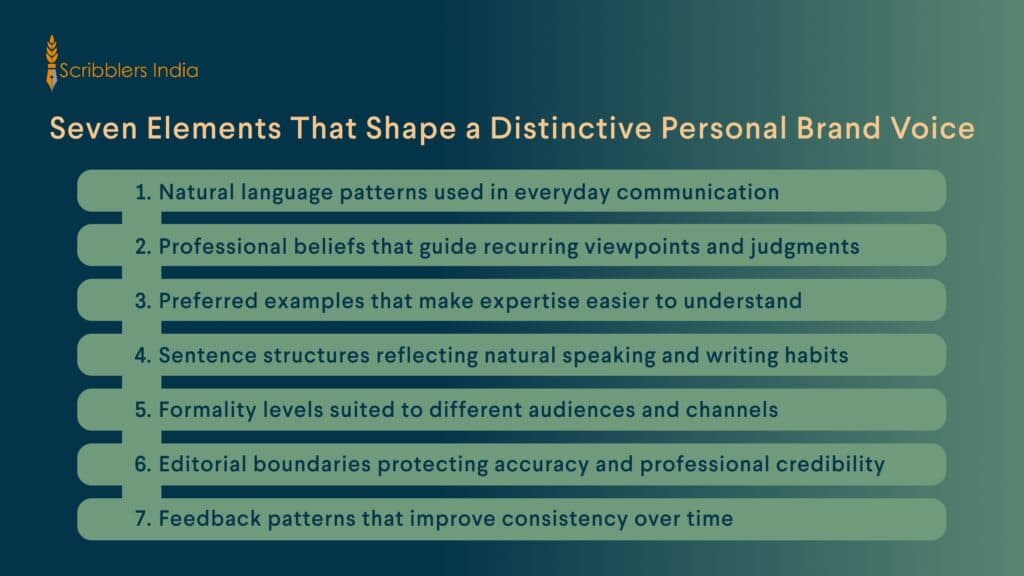
These elements give voice a foundation grounded in real communication rather than invented brand language. Once these elements are documented, professionals can convert those observations into practical voice guidelines that writers and internal teams can follow consistently.
How Do You Define Your Personal Brand Voice?
Defining a personal brand voice starts with observing existing communication rather than inventing a new personality. Review recorded conversations, personally written emails, presentations, interviews, and published content. Look for repeated language patterns and decision-making habits that sound natural enough to remain sustainable over time.
A practical voice-development process includes:
- Collect natural samples: Use recordings and personally written material rather than polished corporate copy.
- Identify repeated patterns: Review vocabulary, sentence length, examples, humor, formality, and argument structure.
- Document strong preferences: Record expressions the professional likes and language they would never use.
- Map recurring beliefs: Identify viewpoints that regularly influence how the professional interprets industry questions.
- Define boundaries: Clarify topics requiring caution, specialist review, or different levels of formality.
- Test real content: Apply the voice guide to several assets before treating it as complete.
- Update from feedback: Add recurring corrections so later drafts require less intervention.
Voice development often forms part of the wider process used by a personal branding agency. Positioning and voice should ideally become clear before higher publishing volumes make inconsistent communication harder to correct.
A written guide makes voice easier to preserve, although consistency is tested when one person appears across several formats. The next challenge is adapting that voice to LinkedIn, articles, newsletters, interviews, and deeper owned content without making everything sound identical.
How Should Personal Brand Voice Stay Consistent Across Content Formats?
Personal brand voice should remain recognizable across formats while adapting to each channel’s purpose. A LinkedIn post may use shorter explanations, while an ebook can develop the same reasoning in greater depth. Consistency comes from preserving perspective and language habits rather than forcing identical sentence structures everywhere.
Consider how one voice might travel across different formats:
| Format | How the voice can adapt |
| LinkedIn post | Direct observation with one focused idea |
| Long-form article | Deeper reasoning supported by examples |
| Newsletter | Conversational interpretation for a recurring audience |
| Podcast | Natural spoken language and spontaneous explanation |
| Ebook | Structured argument with sustained depth |
| Keynote | Memorable language designed for spoken delivery |
| Media quote | Concise viewpoint with limited context |
The underlying professional should still sound recognizable. Long-form assets can test voice especially well because the writer must sustain the professional’s reasoning across a larger argument. Professional ebook writing services can turn substantial expertise into an owned authority asset while adapting spoken ideas to a more structured format.
Consistency becomes harder when writing is delegated, a common situation for busy founders and executives. That creates an important question for personal branding programs: whether another writer can reproduce the leader’s voice without reducing authentic expertise to imitation.
Can a Ghostwriter Preserve Personal Brand Voice?
A skilled ghostwriter can preserve a personal brand’s voice when the process begins with direct access to the professional’s thinking. Voice calibration should study conversations, written samples, recurring opinions, preferred examples, and feedback patterns. The writer then structures the ideas while keeping the underlying perspective anchored in the named author.
Effective voice-preserving ghostwriting usually involves:
- Recorded interviews rather than briefs alone
- Existing emails and personally written material
- Examples of approved and rejected language
- A documented voice guide
- Direct access to first-hand experiences
- Clear editorial boundaries
- Focused review during early drafts
- Feedback carried into later content cycles
Scribblers India’s article on why AI ghostwriting still needs human judgment and founder voice explains why authentic ghostwriting depends on original thinking and editorial judgment rather than stylistic imitation alone.
A useful ghostwriting process should gradually require fewer voice corrections. Repeated feedback becomes part of the voice system, allowing future drafts to reflect the professional’s language and judgment more accurately.

How Does Personal Brand Voice Support Search and AI Visibility?
Personal brand voice is not a direct search ranking factor. Its value lies in helping professionals publish distinctive, consistent expertise. Original viewpoints, recognizable explanations, clear authorship, and repeated subject associations can create stronger public evidence around what the person knows and how they contribute.
Generic content creates fewer distinctive signals because similar explanations may already exist across many sources.
A recognizable professional voice can strengthen:
- Original frameworks connected with the author
- Consistent viewpoints across owned assets
- First-hand explanations of complex questions
- Memorable language around recurring expertise
- Clear separation from generic company content
- Stronger continuity between interviews and articles
- Consistent professional descriptions across sources
- Distinctive thought leadership themes
Voice alone cannot guarantee AI mentions or citations. Content still needs accessible pages, relevant answers, reliable evidence, and clear connections between the author and their expertise.
The AI Search Visibility Scorecard provides a wider framework for examining entity clarity, content depth, answer readiness, expert authority, and other signals that influence AI-led discovery.
AI discovery, therefore, depends on more than sounding distinctive, yet voice helps protect the originality behind authoritative content. The final challenge is to turn that voice into a repeatable publishing system without substantially increasing the leader’s writing workload.
How Can Scribblers India Help Develop a Personal Brand Voice?
Scribblers India develops brand voices by studying how founders and executives think, speak, explain ideas, and challenge assumptions. Our personal branding services connect communication patterns with positioning, audience expectations, content formats, and editorial workflows. The result is a voice system writers can preserve without making communication feel scripted or manufactured.
We build that voice system through the following five connected areas:
- Natural Voice Discovery: We start with material that shows how the professional communicates without heavy editing. Recorded conversations and past writing often reveal the strongest patterns. These examples help us understand how ideas are explained and which communication habits feel natural enough to preserve.
- Belief and Perspective Mapping: Voice becomes distinctive when it reflects judgment rather than style alone. We identify the principles behind the professional’s decisions and the positions they tend to defend. This gives future content a recognizable point of view instead of polished language with little personal substance.
- Voice and Tone Guidelines: Once those patterns are clear, we turn them into usable editorial guidance. The aim is not to reduce personality to a handful of adjectives. Writers receive enough direction to preserve language preferences and reasoning habits while still adapting tone to different situations.
- Ghostwriting and Format Adaptation: First-hand input is then shaped for the format in which it will appear. A LinkedIn post needs different pacing from an article or speech. The structure can change, while the underlying perspective should continue to sound recognizably like the same professional.
- Editorial Calibration and Refinement: Early drafts show where the voice guide still needs adjustment. We study the changes professionals make and the wording they repeatedly reject. Those patterns help refine the system over time, so consistency improves without freezing the person’s communication into a rigid template.
A strong personal brand voice should make delegated content feel more recognizable rather than more manufactured. It should also leave enough room for the professional to evolve as responsibilities, audiences, and ideas change.
Book a 1:1 consultation with our team to develop a personal brand voice with Scribblers India that keeps your expertise recognizable, credible, and distinctly yours across every channel.
Frequently Asked Questions
Can a Personal Brand Voice Change Over Time?
Yes. Personal brand voice can evolve as professional responsibilities and audiences change. The shift should still feel natural rather than abrupt. A founder moving into investing, for example, may become more reflective without abandoning the language patterns and viewpoints audiences already recognize.
Should a Personal Brand Voice Always Sound Conversational?
No. Conversational language works for many formats, although the right level of formality depends on the professional and audience. A regulatory leader may need greater precision than a consumer founder. The objective is clear communication rather than forcing everyone into a single style.
Can AI Create an Authentic Personal Brand Voice?
AI can help apply documented style preferences, although it cannot independently provide authentic professional experience. Useful voice still requires first-hand ideas, examples, beliefs, and judgment from the person. Human review becomes particularly important when content will appear publicly under the professional’s name.
How Often Should a Personal Brand Voice Guide Be Updated?
Review the voice guide whenever recurring feedback reveals a clear pattern. A quarterly review can also capture changing terminology, professional priorities, and audience expectations. The guide should improve gradually rather than changing after every isolated edit or short-term content preference.
How Should Personal Brand Voice Relate to Company Brand Voice?
A personal brand voice and company brand voice should feel compatible without becoming identical. A founder can draw on firsthand stories, personal judgment, and stronger opinions, whereas the company usually represents a broader institutional position. Shared values and terminology can connect both without making leadership content sound like corporate copy.
The distinction becomes especially useful for founders whose visibility influences business perception. Scribblers India’s guide to founder personal branding and company credibility examines how founder authority and company trust can reinforce one another while remaining separate brands.
How Can You Tell When Ghostwritten Content Has Lost Your Voice?
Compare ghostwritten drafts with recorded conversations, approved writing, and the leader’s usual explanations. Warning signs include interchangeable advice, unfamiliar vocabulary, missing personal examples, over-polished phrasing, or opinions the professional would never express naturally. Document repeated corrections so future drafts move closer to the authentic voice.