Entity SEO helps search engines understand a brand, person, product, place, or concept as a distinct entity rather than a loose collection of keywords. It focuses on identity, attributes, relationships, and supporting context so search systems can connect the right information with the right real-world subject across different search experiences.
Entity-based SEO does not replace keyword research or traditional SEO. It adds another layer that explains what a page is about, who or what it represents, and how related information connects. This is useful across Google Search, AI Overviews, ChatGPT, and other systems that interpret topics based on meaning and relationships.
Key Takeaways
|
What Is Entity SEO and What Counts as an Entity?
Entity SEO focuses on helping search systems identify a distinct subject and understand the information connected with it. Google introduced its Knowledge Graph around the idea of understanding “things” and their relationships rather than treating every search as a string of words.
An entity can represent a person, company, place, product, event, creative work, or recognizable concept. Google describes Knowledge Graph entities through identifiers, names, types, descriptions, images, URLs, and other attributes that help distinguish one subject from another.
Consider a software company called ABCS. Search systems need enough context to determine whether ABCD refers to that company, another business, a fictional brand, or another subject sharing the name.
The same challenge applies to people. Two consultants may share the same name, while their employers, locations, specialties, websites, profiles, and published work create distinct entity relationships.
Entity optimization therefore focuses on identity and context rather than on repeating a company or person’s name across multiple pages. The search system needs sufficient consistent information to understand which entity the page describes and how that entity relates to related subjects.
How Is Entity SEO Different From Keyword SEO and Semantic SEO?
Keyword SEO, semantic SEO, and entity SEO overlap because modern search interpretation integrates words, meanings, topics, and identifiable subjects. The difference lies in what each approach emphasizes when teams research queries, organize content, and communicate meaning across a website.
| Approach | Focus | Typical Question | Example |
| Keyword SEO | Search phrases and query demand | What words does the audience search? | Targeting “payroll software Australia” |
| Semantic SEO | Meaning, context, and related concepts | What wider subject does this query represent? | Covering payroll compliance and processing |
| Entity SEO | Identifiable subjects and relationships | Which company, person, product, or concept is involved? | Connecting a payroll platform with its company and features |
| Topic clustering | Organized coverage around connected questions | Which supporting pages build subject depth? | Connecting payroll guides and product pages |
A strong search strategy does not require choosing one approach and abandoning the others. Keyword research identifies demand, semantic coverage explains meaning, and entity SEO reduces ambiguity around the people, companies, products, and concepts represented.
How Do Search Engines Recognize and Connect Entities?
Search systems can build entity understanding from information gathered across webpages, structured databases, licensed sources, and other available resources. Google states that its Knowledge Graph maps attributes and relationships between real-world entities using information collected from several source types.
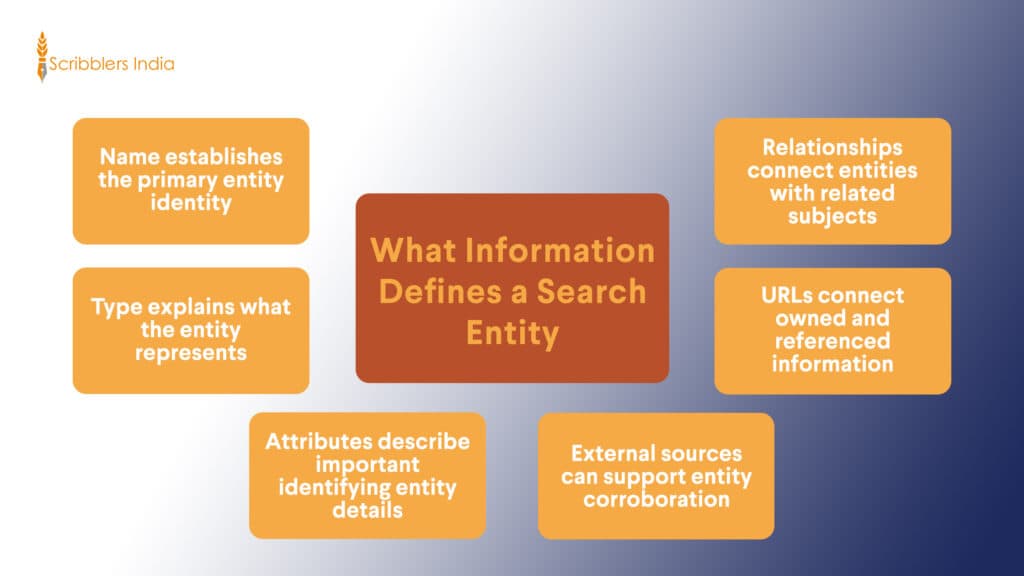
- A consistent entity name helps systems connect references that describe the same company, person, product, or service.
- A clear entity type distinguishes whether a name refers to an organization, person, place, product, event, or another subject.
- Relevant descriptive attributes provide context such as location, occupation, category, ownership, product type, or organizational role.
- Meaningful entity relationships connect companies with founders, products, locations, services, publications, partners, and other identifiable subjects.
- Supporting web references can provide corroborating information when credible sources describe the same entity using compatible facts and context.
- Structured machine-readable information can label entity details when suitable schema types and properties match the visible webpage content.
No individual signal guarantees entity status or a search outcome. Search systems combine available information, relationships, and context when determining whether references describe the same subject.
Which Signals Help Search Systems Understand a Brand Entity?
Brand entity clarity improves when important information agrees across the places where search systems and users encounter the organization. Companies should concentrate on accurate identity, connected owned content, credible external corroboration, and understandable relationships rather than manufacturing large volumes of repetitive mentions.
- Consistent brand information: Company names, locations, service descriptions, leadership information, and important product names should remain consistent across key owned pages. Small wording variations are natural, although conflicting facts can create uncertainty around identity or current positioning.
- Clear About and profile pages: An About page should explain what the organization does, who it serves, where it operates, and whom or what it connects with. Founder and author profiles should also explain professional relationships rather than functioning as thin biography pages.
- Connected service and product information: Important offerings should connect with the organization through descriptive copy, navigation, internal links, and relevant structured data. This helps prevent products or services from appearing as isolated names without clear ownership, category, or business context.
- Relevant external references: Industry publications, professional profiles, partner websites, customer reviews, directories, interviews, and event pages can provide independent context. These sources are more valuable when they reflect real relationships rather than placements created solely to manufacture entity signals.
- Accurate structured data: Organization, Person, Product, ProfilePage, and related schema types can describe relevant page information when implemented correctly. Structured data gives search systems explicit clues about page meaning, while Google does not present schema as a guarantee of rankings.
Our schema markup for AI search guide explains why structured data should support accurate page information instead of being treated as an independent route to AI citations.
How Should Content Connect Entities Across a Website?
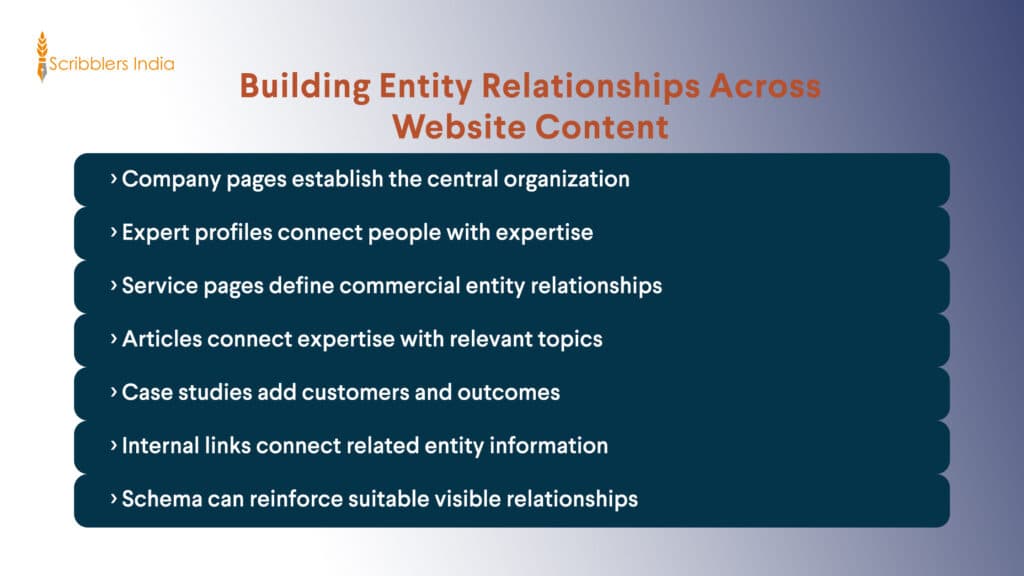
A website should show relationships through content that makes sense to readers before considering how machines may interpret those connections. An executive profile can link to the company, relevant expertise, published articles, and research without inserting unrelated entity references solely for search purposes.
Topic architecture also helps place entities within meaningful context. A cybersecurity company discussing zero trust, identity management, endpoint security, and compliance builds relationships between its brand and these subjects that reflect genuine expertise, provided the website offers useful evidence in those areas.
Internal links then help users move between those connected resources. Descriptive anchors can connect service pages, expert profiles, case studies, glossary entries, and research without repeating one keyword everywhere. This content architecture supports entity understanding while preserving a natural browsing experience.
This principle also applies to individual experts. Our personal branding services connect professional positioning, expert content, owned profiles, and public evidence so a leader’s online identity remains coherent across discovery channels.
How Do Schema Markup and External Sources Support Entity Clarity?
Entity SEO spans both owned and external information because a company cannot establish its complete public identity on a single website page. Structured data can describe known relationships within owned content, while credible external sources may confirm parts of that identity elsewhere on the web.
| Source or Signal | What It Can Clarify | Important Limitation |
| Organization schema | Company name, URL, logo, contact details, relationships | It cannot establish authority through code alone |
| Person schema | Identity, role, affiliation, profile information | It should match visible information |
| sameAs property | Reference pages representing the same entity | It does not guarantee Knowledge Graph inclusion |
| Author profiles | Expertise, employer, published work, professional role | Thin profiles provide limited useful context |
| Industry coverage | Category association and independent corroboration | Relevance and credibility vary across sources |
| Professional directories | Business or individual identity information | Inaccurate listings can reinforce outdated facts |
Schema.org defines sameAs as a URL referencing another page that identifies the same item. Some prominent examples include official websites, Wikipedia pages, Wikidata entries, and other suitable identity references.
This does not mean businesses need Wikipedia pages before search systems can recognize their entities. Google states that its Knowledge Graph draws on webpages, open-source resources, licensed databases, and other information sources to build factual relationships.
The stronger goal is consistency across evidence that already has a legitimate basis. Entity SEO weakens when businesses create profiles or references solely to generate artificial confirmation signals.
How Does Entity SEO Support AEO and GEO Visibility?
AEO and GEO depend in part on whether search systems can understand who produced the information, what the source represents, and which subjects are connected to the source’s expertise. Entity clarity can support that interpretation, although it does not guarantee an answer placement, citation, or recommendation.
For AEO, clear authorship, organization information, topic relationships, and supporting evidence help establish stronger context around answer-focused content. Our AEO services build on these signals by combining question-led content, search eligibility, source quality, authority, and query relevance within one answer-readiness strategy.
GEO complicates the problem because AI-generated responses may draw on multiple sources when representing a company, product, person, or category. Consistent entity information can reduce conflicting descriptions while supporting stronger connections between owned content and credible external evidence.
Our GEO services examine brand representation, source patterns, entity consistency, and content gaps together. We do not treat entity optimization as a separate tactic that automatically produces AI visibility.
How Does Scribblers India Approach Entity SEO?
At Scribblers India, we start entity SEO by understanding which organization, people, products, services, and expertise areas need consistent representation. We then review whether owned content and relevant external sources provide enough accurate information to connect those subjects without conflicting descriptions.
- Define the important entities first: We begin by identifying which people, offerings, locations, and subject areas matter most to discovery. This gives the strategy a clear foundation. It also prevents teams from building relationships around entities that have little business or search relevance.
- Review entity consistency across owned content: Our team compares important facts across website pages, author bios, service content, profiles, and case studies. The goal is to remove conflicts. Clearer information makes the connection between expertise and business positioning easier to understand.
- Map supporting content relationships: Existing pages should connect around meaningful topics rather than operate as isolated keyword targets. We review where useful relationships already exist. Genuine gaps can then become new resources that answer buyer questions or strengthen coverage around important entities.
- Check external corroboration separately: Our experts review relevant third-party references to confirm that public information remains accurate and up to date. Outdated profiles or conflicting mentions can weaken clarity. The focus remains on correcting useful sources rather than creating low-value listings solely to increase visibility.
- Connect entity work with wider visibility goals: Entity SEO should support the same information structure used across SEO, AEO, GEO, and personal branding. This creates a more consistent discovery system. Measurement can then focus on representation accuracy, source visibility, and related branded search signals.
This approach keeps entity optimization grounded in information quality rather than invented authority metrics. Search systems can change how entities are interpreted, so the strongest foundation remains accurate content and credible relationships that continue making sense to users.
Contact our team today to build a clearer entity footprint that helps search systems understand your brand, expertise, relationships, and supporting content.
FAQs
Does a Business Need a Wikipedia Page for Entity SEO?
A business does not need a Wikipedia page before entity SEO can support search understanding. Google gathers entity information from several web, database, licensed, and public sources. A company should prioritize accurate, owned information and credible external references rather than creating Wikipedia content primarily for search visibility.
Does Every Business Need a Google Knowledge Panel?
A Knowledge Panel can provide useful visibility, but it should not be the sole measure of an entity’s SEO success. Google generates Knowledge Panels automatically from its Knowledge Graph. Businesses should focus on accurate entity information, search visibility, branded results, and consistent representation rather than on a single search feature.
Can Entity SEO Help a New Brand With Limited Online Coverage?
A newer brand can start entity SEO by establishing consistent owned information before wider third-party coverage develops. The website should explain company identity, services, leadership, locations, and expertise without conflicting descriptions. Genuine partnerships, reviews, publications, directories, and customer evidence can strengthen the public information footprint over time.
How Can Scribblers India Support Founder Entity Visibility?
We connect founder positioning with website profiles, expert content, authorship, LinkedIn presence, thought leadership, and relevant external evidence. The objective is consistent professional representation, not repeated name mentions. This helps audiences and search systems understand the founder’s role, expertise, organization, and relationship with published ideas.
Does Scribblers India Create Entity SEO Content Without Keyword Research?
We do not separate entity SEO from search demand when keyword information can inform content decisions. Keyword research shows how people phrase questions, while entity analysis clarifies which people, organizations, products, services, and concepts those queries reference. Both inputs can guide the creation of useful content without creating duplicate pages.