A company can publish useful website content and still remain largely absent from AI-generated answers. The reason may sit outside its own domain. Competitors could receive stronger support from comparison pages, specialist publications, community discussions, or other sources that repeatedly appear around important buyer questions. The Scribblers India AI Source Analysis Framework helps teams investigate that missing layer.
Our approach connects priority prompts with observable AI answers, supporting sources, competitor representation, and the information gaps behind them. The objective is to turn source monitoring into better marketing decisions rather than another reporting exercise.
This AI source analysis framework does not assume that one citation caused an AI response. AI systems can retrieve several pages or run related searches before forming an answer. Instead, AI source analysis looks for recurring patterns that indicate where owned content, external evidence, or public brand information warrants closer attention.
Key Takeaways
- Start with high-value buyer prompts rather than random AI questions.
- Separate brand mentions from visible citations and retrieved sources.
- Look for recurring patterns in sources before drawing strategic conclusions.
- Compare competitor evidence with your own public information footprint.
- Diagnose the gap before choosing content, outreach, or correction.
- Prioritize sources using commercial value and recurrence signals.
- Improve genuine evidence rather than chasing AI-generated citations.
- Monitor source changes alongside brand representation over time.
What Gap Does the AI Source Influence Framework Solve?
AI visibility platforms can increasingly show where brands appear and which sources surround those answers. The harder problem begins after the dashboard identifies a gap. Marketing teams still need to determine why a source matters, what information it contributes, and whether any intervention is actually justified.
Semrush now surfaces cited sources, missing prompts, competitor visibility, and source opportunities. Peec provides domain-level and URL-level source gaps, while Ahrefs distinguishes mentions from citations and pages that were found during answer generation. These tools make source discovery much easier than before.
However, identifying a source does not automatically tell a marketing team what to do next. A competitor mention in an editorial article creates a different problem from outdated company information on a reference site. A missing owned page also requires a different response from weak customer evidence.
The AI source analysis framework fills this decision gap by adding four layers after source discovery. Teams assess source role, pattern confidence, gap type, and action priority before recommending an intervention. This avoids turning every AI visibility problem into another content brief or digital PR campaign.
Trust Marker: What the AI Source Analysis Framework Can and Cannot Tell You
The framework helps identify observable patterns that deserve investigation. It cannot reveal a proprietary ranking formula or prove that one source directly caused a brand mention. AI search platforms expose different levels of source information, while generated answers can also vary between repeated searches.
Google confirms that AI Mode can use query fan-out to run related searches before producing an answer. OpenAI also advises users to verify important citations because search results can sometimes be incomplete or incorrect. These limitations make repeated observation more useful than one isolated response.
Framework Version: 1.0
Designed For: 2027 AI search planning
Methodology Review: November 2026
Recommended Review Cycle: Quarterly, with priority prompts checked more frequently
What Should AI Source Analysis Measure?
AI source analysis should examine more than links appearing beside an AI answer. Teams need to understand whether the brand appears, which sources are visible, what information those sources provide, and whether competitors receive stronger support. These signals answer different questions and should therefore remain separate.
| Signal | What You Observe | What It Helps You Understand |
| Brand Mention | Brand appears within the generated response | Whether the brand enters the answer |
| Visible Citation | A page is referenced within the answer | Which supporting pages users can inspect |
| Retrieved Source | A monitoring platform reports source retrieval | Which pages may have contributed during retrieval |
| Source Recurrence | The same source appears across repeated tests | Whether the source pattern deserves investigation |
| Representation Quality | How the brand is described | Whether the answer is accurate and useful |
| Competitor Presence | Competing brands appear in answer or sources | Where competing evidence is stronger |
The distinction between citations and retrieval is particularly important. Peec and Ahrefs now separately report pages that were used or found during generation and pages that received visible citations. A brand can therefore have source visibility without receiving a direct citation or brand mention.
This creates an important diagnostic opportunity. If a company’s domain appears regularly as a source while its brand rarely enters answers, the problem may not be content access alone. The team should investigate whether its category association or brand representation needs strengthening.
Why Should Source Analysis Follow an AI Visibility Assessment?
An AI visibility assessment identifies where the brand is weak across important topics. AI source analysis takes the next step by investigating the surrounding information for those weak answers. Combining both views prevents teams from responding to every visibility problem by publishing more when another intervention may work better.
The AI Search Visibility Scorecard can first identify broader weaknesses around answer readiness, authority, evidence, or brand representation. The Source Influence Framework then investigates the source environment behind the most important gaps.
Consider a brand with strong website content but limited independent corroboration. Creating five more articles may add little new evidence. Another company may receive substantial media coverage yet lack a useful owned page for an important buyer question, which calls for a different response.
The diagnostic sequence therefore becomes:
Assess visibility → Identify the weak prompt → Examine supporting sources → Diagnose the information gap → Select an intervention → Monitor the pattern again
This sequence turns measurement into a decision process rather than another visibility dashboard.
Which Prompts Should Enter the Source Influence Map First?
A useful source map starts with questions that can influence a genuine customer decision. Tracking hundreds of broad prompts may produce more data without improving decisions. Start with a smaller set covering discovery and evaluation, then expand when recurring source patterns begin to appear.
| Prompt Type | Example | What It Can Reveal |
| Category discovery | “Best payroll platforms for global companies” | Which brands enter initial consideration |
| Comparison | “Platform A vs Platform B for payroll” | Which sources support competing choices |
| Problem solving | “How can companies reduce payroll errors?” | Which experts or resources shape guidance |
| Provider selection | “Which payroll providers support Asia?” | What evidence influences shortlists |
| Reputation | “Is Platform A reliable for enterprises?” | Which sources influence perceived trust |
| Expertise | “Who specializes in global payroll compliance?” | Which brands own category associations |
Prompt selection should combine buyer relevance with business value. Search demand can support the process, although raw volume should not determine the entire set. A low-volume question used near a purchase decision may deserve greater attention than a broad informational query.
Our AI Search Discovery Benchmark similarly recommends evaluating prompt coverage alongside citations and source patterns. Repeated measurement gives teams more context than treating one AI answer as a permanent representation of the market.
What Are the Seven Stages of the AI Source Influence Framework?
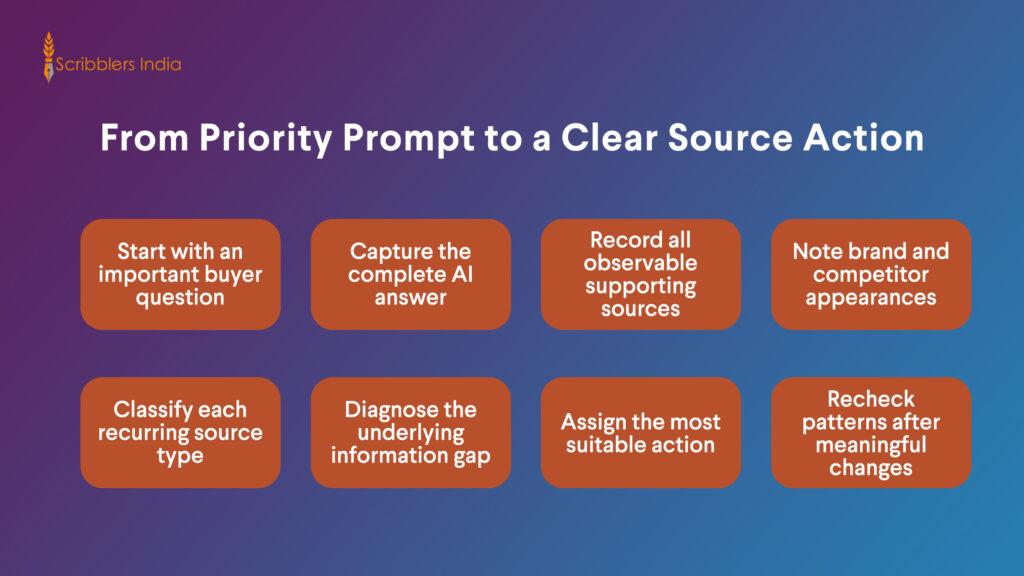
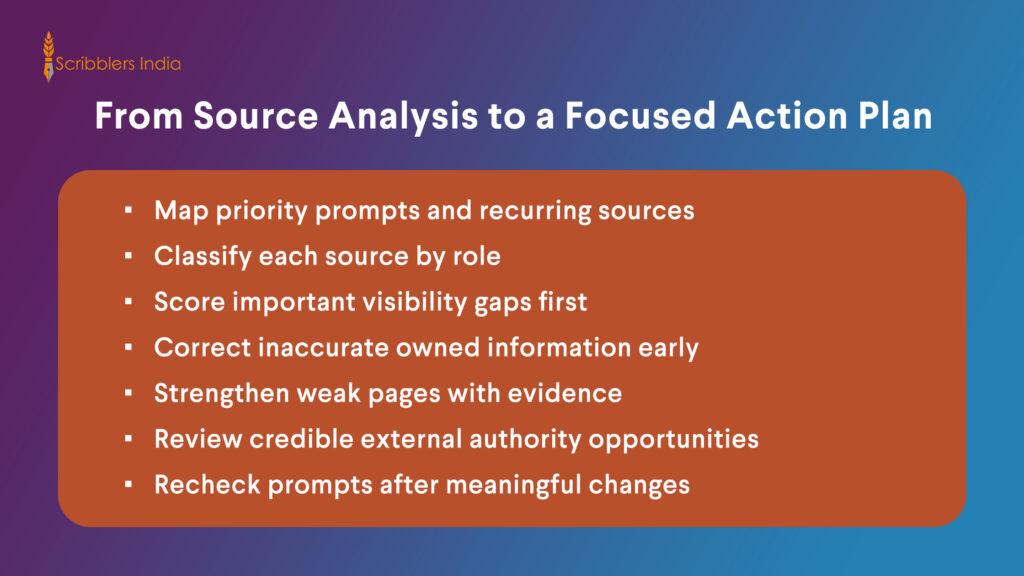
The AI source analysis framework moves through seven connected stages, beginning with buyer questions and ending with repeated measurement. Each stage removes one source of uncertainty before the next decision. This structure makes AI source analysis useful even when several competing explanations could exist for the same visibility problem.
Stage 1: Define the Decision Prompts
Start with prompts connected to real customer discovery or evaluation. Record the audience and commercial relevance before testing begins. This prevents teams from spending disproportionate effort on questions that may yield interesting AI responses but contribute little to business visibility.
For each prompt, document the exact wording and platform tested. Include the date because answers can change over time. Adding the intended buyer stage also helps teams distinguish early educational questions from prompts where brand recommendations could directly influence a shortlist.
Stage 2: Capture the Answer as It Appears
Record whether the brand appears and note how it is represented. The same exercise should cover key competitors so the audit captures relative visibility rather than focusing on a single company in isolation. Accuracy should receive as much attention as simple inclusion.
A brand mention can still create a problem when the description is outdated or incomplete. Teams should therefore record the language used around important capabilities, audiences, or category associations. This helps identify representation gaps that citation counts alone cannot reveal.
Stage 3: Record the Available Source Evidence
Capture visible citations and other source information exposed by the platform. If a monitoring tool reports retrieved pages separately, preserve that distinction in the worksheet. Combining the two signals can create more confidence than the underlying evidence actually supports.
ChatGPT search responses can include inline citations and a separate Sources panel. Other platforms may present supporting information differently, so the framework should preserve platform-specific observations rather than forcing every source into a single measurement definition.
Stage 4: Classify the Source Role
Determine what informational job each recurring source performs. An industry article may offer independent validation, while a company page provides first-party information. Review platforms contribute customer evidence, whereas reference sources often establish basic facts about the company or professional.
This step is more useful than treating all external domains as equally valuable. Two websites can appear equally often while contributing completely different information to the answer. Understanding that role gives the team a better basis for deciding whether action is required.
Stage 5: Diagnose the Actual Gap
Compare what the answer needs with the publicly available evidence about the brand. The problem could involve missing owned content, weak proof, inaccurate external information, or limited third-party validation. More than one gap can exist for the same prompt.
The diagnosis should explain why an intervention is needed before defining the intervention itself. This avoids recommendations such as “get featured on this site” when the deeper problem may be that the company lacks strong evidence worthy of independent inclusion.
Stage 6: Prioritize the Source
Not every recurring domain deserves equal investment. A source connected with high-value comparison prompts deserves greater attention than a one-off citation around a broad educational question. Recurrence and competitive advantage also help determine which source gaps warrant earlier investigation.
The framework uses a Source Action Priority Score later in this guide. The score measures how strongly a source deserves the team’s attention. It does not attempt to calculate the extent of a page’s influence on an AI model.
Stage 7: Select an Action and Monitor Change
Once the gap is understood, choose an intervention suited to the source and evidence problem. The action might involve improving an owned page or correcting public information. Some cases may justify credible editorial outreach, while other sources should simply remain under observation.
The final step returns the team to measurement. Recheck key prompts after meaningful changes, and look for patterns across multiple observations. The aim is to assess whether the information environment changes, rather than expecting a single optimization to produce an immediate citation.
Which AI-Answer Source Types Should Teams Examine?
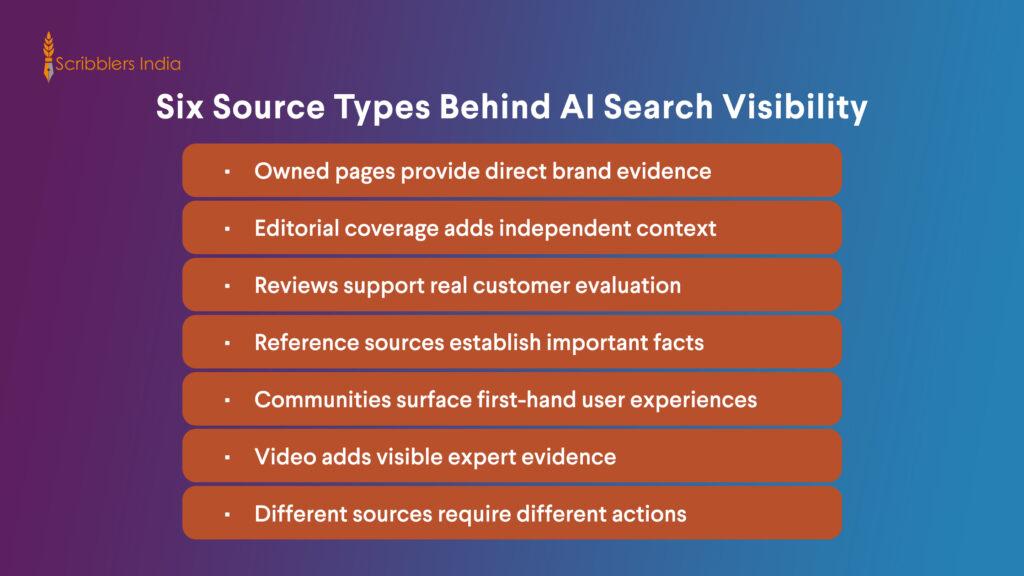
Source classification explains why a page may matter to the wider information environment. Our AI source analysis framework uses six categories that reflect different forms of public evidence. Teams can add industry-specific categories where necessary, although maintaining consistent definitions makes trend analysis easier across repeated audits.
1. Owned Authority Sources
These include service pages and product documentation published on the company’s own domain. Research reports or expert articles also belong here. They provide first-party explanations that the organization can improve directly when important information is missing or unclear.
The diagnostic question is whether the company already owns a useful page for the prompt. If one exists, examine its depth and evidence before commissioning another asset. If no relevant resource exists, the audit may have uncovered a genuine content gap.
2. Independent Editorial Sources
Industry publications and specialist media provide evidence that the company does not directly control. Interviews or independently produced reports can serve a similar role. Repeated inclusion of competitors across relevant editorial sources may indicate a gap in external visibility or expert recognition.
This does not mean every publisher deserves outreach. Teams should first understand why that source appears and whether the company can genuinely add value. An editorial relationship built solely to manufacture an AI mention creates little sustainable authority.
3. Review and Comparison Sources
Review platforms and comparison resources frequently appear around vendor selection questions. Their value comes from helping users evaluate alternatives rather than simply confirming that a company exists. These sources therefore deserve separate analysis from general editorial coverage.
The appropriate response may involve correcting product information or strengthening evidence of genuine customers. Teams should avoid manipulated ratings or artificial testimonials. The objective is to improve the quality of available information rather than manufacture a stronger reputation signal.
4. Reference and Entity Sources
Reference pages and structured company profiles often carry factual information. These sources can help establish what an organization does or how it describes its core offering. Errors become important when the same inaccurate information begins appearing across several discovery environments.
Where legitimate correction mechanisms exist, teams should update inaccurate details. Consistency should not mean copying identical marketing text everywhere. The priority is ensuring that basic facts and category descriptions do not conflict across important public sources.
5. Community and Experience Sources
Forums and professional communities can provide firsthand experiences with products or services. These environments become especially relevant for questions where users seek opinions or implementation experiences. Their value comes from real discussion rather than controlled corporate messaging.
Brands should participate only where expertise can genuinely help the community. Artificial posts or undisclosed promotion can create reputational risk. Google explicitly warns against seeking inauthentic mentions as a shortcut for generative search visibility.
6. Video and Social Evidence
Video and social platforms deserve closer attention as we head into 2027, as discovery becomes increasingly multimodal. Google states that images and videos can appear in generative search experiences, while Ahrefs now monitors sources across YouTube and other social platforms.
For brands with genuine expert demonstrations or interviews, these formats can add evidence that text pages cannot provide as effectively. The strategic question is not whether every company needs more video, but whether the format improves understanding around important buyer questions.
How Can You Tell Whether a Source Pattern Is Meaningful?
One appearance rarely provides enough evidence to justify action. AI source analysis becomes more useful when teams test whether a source recurs across related prompts or repeated checks. Cross-platform appearances can add further context, although different AI systems should never be expected to use identical sources.
Use a simple confidence model before placing a source into the action queue.
| Pattern Level | What You Observe | Recommended Interpretation |
| Level 1: Isolated | Appears once in one response | Record and monitor |
| Level 2: Repeated | Appears across repeated checks | Investigate relevance |
| Level 3: Prompt Recurrence | Appears across several related prompts | Analyze source role |
| Level 4: Competitive Recurrence | Repeatedly supports competitors | Diagnose the competitive gap |
| Level 5: Cross-Platform Pattern | Appears across several AI environments | Consider higher strategic priority |
Peec advises users to look for sources that appear consistently across prompts rather than reacting to unexpected one-off results. Ahrefs similarly recommends prioritizing sources with repeated citation patterns and relevance to commercially important questions.
This confidence layer fills an important gap in simple citation tracking. Without it, teams can spend time pursuing a website because it appeared only once in an unstable response. Repeated evidence provides stronger grounds for investigation, although it still does not establish direct causation.
What Does the AI Source Influence Map Record?
The Source Influence Map consolidates observations from different platforms into a single decision record. Each row connects a buyer prompt with its source pattern and the gap found around that source. This creates a working document that content teams can use alongside SEO or authority-building programs.
| Field | What to Record |
| Priority prompt | Exact buyer question being tested |
| Buyer stage | Discovery, evaluation, comparison, or reputation |
| Platform | AI environment tested |
| Test date | Date of the recorded answer |
| Brand present | Whether the brand appears |
| Representation | Accurate, incomplete, incorrect, or absent |
| Competitors present | Relevant competitors appearing |
| Source domain | Domain associated with the answer |
| Source URL | Exact page where available |
| Evidence type | Citation, retrieval, or repeated source pattern |
| Source role | Owned, editorial, review, reference, community, video |
| Brand status | Included or missing on the source page |
| Competitor status | Included or missing on the source page |
| Gap type | Information, evidence, representation, authority, or access |
| Priority score | Source Action Priority Score |
| Recommended action | Next justified intervention |
| Review date | When the prompt should be checked again |
The map should remain evidence-led rather than becoming a list of sites for outreach. A source can score highly because inaccurate information needs correction even when there is no opportunity for a new mention. That distinction keeps the AI source analysis framework connected with the actual user problem.
What Kind of Source Gap Are You Actually Facing?
A missing brand can result from a variety of information problems. The framework therefore diagnoses the gap before suggesting an action. This is one of its most important steps because a content problem, external authority problem, or representation problem should never receive the same treatment.
- Owned Information Gap: The company lacks a useful page for the question being asked. Before creating content, confirm that no existing asset can be improved to answer the need. New pages should solve a genuine audience problem rather than target another prompt variation.
- Evidence Gap: Relevant content exists, yet the claims remain generic or weakly supported. Original research or first-hand expertise can make the page more useful. Case evidence may strengthen important claims when the organization can substantiate its results.
- External Authority Gap: Competitors repeatedly appear across credible independent sources while the brand remains absent. This may justify stronger expert outreach or original research worthy of coverage. The solution should improve the quality of public evidence rather than simply increase the number of mentions.
- Representation Gap: The brand appears, although important information is outdated or incomplete. Teams should identify which recurring sources contain the problem and correct facts where possible. Improving accuracy deserves priority when misleading descriptions could affect evaluation or recommendation prompts.
- Entity Clarity Gap: Different websites describe the company or expert in conflicting ways. The issue may sit in category positioning or basic company information. Teams should align on essential facts without attempting to distribute identical promotional descriptions across all public platforms.
- Accessibility Gap: A useful page exists, yet technical restrictions may limit discovery or retrieval. Google requires pages to be indexed and eligible for snippets to appear within its generative Search features. Technical eligibility should therefore be checked before assuming that weak visibility is purely editorial.
Our AEO services address this broader answer-readiness problem by linking important questions to relevant pages and supporting evidence. Source analysis adds another layer by showing where external information may also influence the discovery environment.
Which Source Gaps Should You Prioritize First?
A recurring source is not automatically a priority. Teams should consider whether the related prompt affects an important buyer decision and whether competitors benefit from the gap. Risk and actionability also matter because some source problems can be addressed immediately while others remain outside direct control.
Source Action Priority Score
Score each factor from 0 to 3.
| Factor | 0 | 1 | 2 | 3 |
| Prompt Value | Little relevance | Supporting topic | Useful evaluation | High-value decision |
| Source Recurrence | Seen once | Appears occasionally | Repeats regularly | Repeats across key prompts |
| Competitive Gap | No advantage | Minor presence | Competitor often included | Several competitors dominate |
| Representation Risk | Accurate | Minor weakness | Important detail missing | Material information incorrect |
| Actionability | No realistic action | Limited influence | Clear option available | Direct action possible |
Maximum Score: 15
| Total Score | Recommended Response |
| 0–5 | Record and monitor |
| 6–9 | Investigate during normal optimization |
| 10–12 | Add to the active priority list |
| 13–15 | Review as an immediate visibility issue |
The score deliberately measures action priority rather than supposed algorithmic influence. No third-party framework can reliably quantify how much a given source controls an AI response. Google similarly advises caution regarding tools that claim access to internal ranking or AI system metrics.
This distinction gives leadership a more defensible number. A score of 14 means the source deserves attention because the business value and observed pattern are strong. It does not mean that the page carries a measurable 14-point influence inside an AI system.

What Action Should Follow Each Source Gap?
The value of AI source analysis appears when it changes what the team does next. A missing citation does not always warrant additional content, and competitor visibility does not always warrant outreach. Teams need an intervention that addresses the specific information problem uncovered during diagnosis.
| Source Situation | Likely Problem | More Useful Response |
| Relevant owned page exists but rarely appears | Weak usefulness or evidence | Improve the existing page |
| No suitable owned resource exists | Genuine information gap | Build a useful authority asset |
| Competitors dominate independent publications | External authority gap | Develop credible editorial opportunities |
| Review sources contain weak information | Customer evidence gap | Strengthen genuine reviews and proof |
| Public profiles contain errors | Representation gap | Correct factual information |
| Communities discuss competitors more often | Experience visibility gap | Participate where expertise genuinely helps |
| Competitor pages answer the need better | Utility gap | Improve the informational job of your asset |
| Source appears once with low relevance | Weak pattern | Monitor rather than chase |
| Brand appears inaccurately across sources | Information integrity gap | Trace recurring inaccuracies and correct them |
The framework should leave every high-priority source with a clear next action rather than another observation. Once the gaps are prioritized, teams can decide where intervention should begin. In many cases, the first place to investigate is the company’s own content and supporting evidence.
When Is Your Own Website the Main Problem?
The website becomes the priority when an important buyer question lacks a useful first-party answer or existing content provides weak evidence. Before pursuing external mentions, teams should determine whether their own pages offer something sufficiently clear and valuable for search systems and human readers.
Start by checking whether a relevant page already exists. If it does, compare its actual usefulness with the pages appearing around the target prompt. The objective is not to copy a cited competitor page, but to understand the information need that competing content serves more effectively.
Evidence deserves particular attention. Generic claims rarely add much when numerous companies make similar statements. Google’s current guidance specifically recommends unique, non-commodity content grounded in real experience or distinctive viewpoints, rather than material that simply repeats what is already available online.
Technical eligibility should then be reviewed before a content team rewrites the page. Google states that generative Search features still rely on core Search systems and require that eligible pages be indexed. Our guide to optimizing content for AI answers explores page-level improvements once that need is established.
When Does the Real Gap Sit Outside Your Website?
External authority becomes more relevant when owned content is already strong but competing brands repeatedly receive independent support around important prompts. In this situation, producing another article may add little. The missing evidence may exist across publications or customer sources that the organization does not directly control.
Semrush flags source opportunities where competitors appear frequently cited in external sources while the analyzed brand remains absent. Peec similarly provides gap analysis at the domain and URL levels, helping teams distinguish an owned-content problem from a broader public-evidence problem.
Teams should still evaluate why the external page is relevant before beginning outreach. A publication may feature original research or informed expert commentary. Another source may rely on customer reviews, which means the company needs stronger proof rather than a conventional PR pitch.
This is where thought leadership content can contribute to a wider authority strategy. Distinctive research or useful executive insights give independent publishers something meaningful to reference, while generic corporate commentary provides little reason for third parties to strengthen the brand’s public evidence.
What Should You Do When Competitors Keep Appearing Instead?
Repeated competitor visibility is useful when it reveals an information advantage rather than triggering imitation. The right question is not simply why another brand was mentioned. Teams need to determine what public evidence allows that competitor to enter important answers more consistently.
First, compare the competitor’s owned content with your own. The advantage may come from a useful comparison resource or stronger product documentation. If the competing page performs an informational job your website does not address, that need can inform a more useful content decision.
Next, examine independent evidence around the competitor. Several publications may repeatedly associate the company with the category, creating a stronger public footprint than owned pages alone. In this case, another SEO article may do little to close the actual gap.
Finally, compare how clearly each company is positioned. AI responses may describe one competitor consistently while giving your brand an incomplete category association. Our analysis of AI brand mentions explains why mentions should be evaluated alongside representation rather than treated purely as a frequency metric.
How Should AI Source Analysis Connect With GEO?
GEO becomes more useful when teams move from optimizing individual pages toward understanding the wider information environment around a brand. AI source analysis supports that work by showing where owned evidence and third-party representation differ. It then helps determine which visibility problem needs attention first.
Our GEO services connect this source perspective with broader content and authority planning. The aim is not to manipulate citations, but to make accurate and useful information easier to discover across the sources that shape buyer research.
This distinction becomes important when a brand has strong website content but limited independent representation. Another company may face the opposite problem, with broad public awareness but weak owned evidence. GEO strategy should respond differently to each situation rather than applying one standard checklist.
A strong framework, therefore, connects source analysis to SEO foundations rather than treating generative search as a completely separate channel. Google’s latest guidance reinforces this point by stating that its generative Search experiences remain grounded in core Search systems.
Why Can Citation Chasing Create the Wrong Strategy?
Chasing individual citations encourages teams to optimize for the visible output rather than the underlying information problem. A cited source may disappear on the next test, and another page may appear instead. Building strategy around every fluctuation can produce unnecessary content and low-value outreach.
The risk becomes greater when teams equate citation with endorsement or algorithmic trust. A page can be useful for one answer without becoming a permanent authority source. Ahrefs also describes AI visibility metrics as modeled indicators rather than direct measurements of actual audience exposure.
Source analysis should therefore focus on patterns and business relevance. A page that repeatedly appears in high-value buyer questions warrants investigation, while an isolated citation for a peripheral query may warrant none. This keeps resources focused on evidence rather than chasing visible links.
The same principle applies to external mentions. Google specifically advises against seeking inauthentic mentions as an AI-search tactic. A stronger long-term approach creates information customers genuinely need and evidence that independent sources have credible reasons to reference.
What Should Brands Avoid When Trying to Influence AI Sources?
Source work should improve the accuracy and usefulness of information available about a brand. It should not become a shortcut for manufactured authority. Tactics designed mainly to generate artificial mentions can waste resources and introduce trust problems that outweigh any temporary visibility gains.
Avoid these practices:
- Creating near-identical pages for every prompt variation
- Manufacturing Reddit or forum conversations
- Publishing fake customer reviews
- Copying competitor articles or comparison structures
- Building low-value listings only for brand mentions
- Making unsupported claims to appear authoritative
- Treating schema as guaranteed AI visibility
- Assuming every citation deserves outreach
- Paying for undisclosed editorial mentions
- Reporting modeled visibility as actual traffic
Google states that no special structured data is required for its generative Search experiences. It also advises against rewriting content specifically for AI systems or producing scaled pages around query variations. These points reinforce the need for useful content before optimization tactics.
A good content strategy should therefore use source findings to decide what deserves production rather than automatically expanding the editorial calendar. Sometimes the most useful outcome of the audit is deciding not to create another page.
How Should Teams Measure Whether Source Work Is Improving Visibility?
Measurement should connect source changes with the quality of brand representation rather than reporting citation totals alone. A useful dashboard tracks whether the brand appears across important prompts and whether supporting sources become stronger over time. Downstream business signals can add context when available.
| Metric | What It Helps Assess |
| Priority Prompt Coverage | Where the brand enters relevant answers |
| Brand Mention Rate | How consistently the brand appears |
| Owned Citation Visibility | Whether company pages receive citations |
| Source Recurrence | Which external sources repeatedly appear |
| Competitor Source Gap | Where competitors retain stronger evidence |
| Representation Accuracy | Whether important facts remain correct |
| Cited Page Diversity | Which owned assets contribute visibility |
| Source Mix | Balance between owned and external evidence |
| Branded Search Movement | Whether wider brand interest changes |
| Qualified Response | Leads or conversations where attribution exists |
Do not expect every intervention to change citation counts immediately. The objective is a stronger information environment around priority questions. Monitoring several related signals helps teams see whether representation improves even when a specific cited URL changes between AI responses.
This is also why absolute visibility scores should be interpreted carefully. Ahrefs explicitly describes AI visibility metrics as directional and modeled rather than direct audience measurement. The same principle should inform executive reporting across other AI-search monitoring platforms.
What Is Next for AI Source Influence in 2027?
The next phase of AI source analysis will likely move beyond counting web citations. AI discovery is already incorporating broader content environments and more complex retrieval patterns. Teams should therefore prepare for source influence to become a cross-channel information problem rather than an SEO reporting metric.
Source Visibility and Brand Visibility Will Be Separated More Clearly
A company can supply useful information without receiving a prominent brand mention. Peec and Ahrefs already distinguish variants of this pattern through source or retrieval reporting. Future measurement should therefore ask whether a brand is informing answers and whether it is being recommended.
Multimodal Sources Will Become More Important
Generative search increasingly includes images and video alongside text results. Brands with demonstrable expertise may therefore need stronger visual evidence, especially when a concept can be shown more clearly than it can be described. Google already includes image and video considerations in its generative Search guidance.
Query Fan-Out Will Complicate Simple Prompt Tracking
One user prompt can lead to several related searches before an answer is created. This means a company may need useful evidence to support its questions rather than a single exact phrase. The response should be broader topic coverage, not dozens of thin pages targeting every fan-out variation.
AI Agents Will Raise a New Source-Readiness Question
Google is already discussing agentic experiences that can inspect websites while completing tasks. This raises a future consideration beyond citation visibility: whether an agent can correctly understand the information required to compare or act on a user’s behalf.
Source Quality Will Matter More Than Source Volume
As monitoring tools make citation gaps easier to discover, chasing every available mention will become less defensible. The stronger competitive advantage will come from identifying which sources genuinely influence important buyer questions and creating evidence worthy of inclusion there.
The strategic shift for 2027 is therefore straightforward. Teams should move from asking “How many AI citations did we get?” toward asking “Which information sources shape important buyer decisions, where is our evidence weak, and what should we improve next?”
Example: From Competitor Visibility to a Better Decision
Consider a B2B payroll company tracking the question, “Which payroll platforms work well for companies operating across several countries?” The brand is absent from the answer while two competitors appear. The cited material includes an industry publication and an independent software comparison page.
The company already owns a multinational payroll service page, so the first response should not be another article. A review finds broad claims with limited supporting evidence. Competitors also appear more frequently within relevant independent sources, revealing both an owned evidence gap and an external authority gap.
The team can now separate the two problems. Its first action is to improve the existing page with stronger evidence and clearer buyer information. External opportunities can then be evaluated for genuine relevance rather than starting with indiscriminate link or mention outreach.
When the prompt is tested again later, the team should compare more than citations. Brand inclusion and representation accuracy also matter. Recurring changes to the source can indicate that the information environment is shifting, even when the exact answer differs across individual tests.
How Can Scribblers India Help Turn Source Findings Into Better Decisions?
The AI Source Influence Framework is designed for an internal marketing team to use independently. The harder stage often begins when several gaps appear together. A company may need stronger owned evidence while also facing inaccurate external information or limited independent validation.
At Scribblers India, we connect source findings with the wider search and authority strategy rather than forcing every issue into content production. Our team can review the evidence behind important prompts and identify where stronger pages or authority assets would improve the information environment.
Source findings can then support AEO or GEO work while informing thought leadership and personal-brand authority where subject experts are part of the discovery journey. The objective remains to provide clearer public evidence on the questions that potential customers actually use to evaluate expertise or providers.
Use this framework to build your first Source Influence Map. If the findings reveal several competing priorities, connect with our team to turn the audit into a focused AI search visibility strategy for 2027.
Frequently Asked Questions
What is AI source analysis?
AI source analysis examines the pages and domains associated with answers to commercially relevant AI prompts. It helps teams identify recurring sources and competitor gaps. The analysis then connects those observations with practical decisions around content improvement, information correction, or external authority development.
What is the difference between an AI source and an AI citation?
A citation is a page visibly referenced within an AI-generated response. Some monitoring systems also identify pages retrieved during answer generation without a visible citation. Teams should keep these signals separate because a retrieved source may contribute information without appearing as a clickable reference.
Does a frequently cited website automatically influence AI recommendations?
No. Frequent citation establishes an observable pattern rather than proving direct influence over recommendations. A source may appear because its information fits specific questions. Teams should examine recurrence and buyer relevance before deciding whether the website deserves strategic attention or further investment.
Should every competitor source gap become an outreach opportunity?
No. A competitor source gap should first be diagnosed to understand why the source appears. Some gaps indicate missing owned content or weak evidence rather than an outreach problem. External engagement makes more sense when the publication is genuinely relevant and the brand has something useful to contribute.
Can stronger website content improve AI source visibility?
Useful owned content can improve the publicly available evidence on important questions, although inclusion is never guaranteed. Pages should provide distinctive information and credible evidence while remaining technically accessible. Creating more pages without improving usefulness does not automatically strengthen source visibility or brand representation.
How many prompts should a source influence audit track?
There is no universal number because the right set depends on the business and buyer journey. A focused audit can begin with 10 to 20 meaningful prompts. Teams can expand later once recurring sources and visibility gaps reveal where additional testing would improve decisions.
How often should brands repeat AI source analysis?
High-value prompts can be checked monthly when AI visibility is an active priority, while broader source mapping may work quarterly. Teams should also retest after meaningful changes to content or positioning. The objective is to identify recurring movement rather than reacting to every individual response variation.
Can a company guarantee citations after fixing source gaps?
No agency or internal team can guarantee future citations from independent AI platforms. Source work improves the information environment and strengthens answer readiness, but retrieval remains outside the brand’s control. Success should therefore be measured through broader visibility patterns rather than promised citation placements.