
ChatGPT now influences how buyers research categories, compare providers, assess evidence, and validate expertise before contacting a company. This gives brands another discovery surface where clear positioning, credible sources, and public authority can shape early consideration. A strong ChatGPT visibility strategy helps marketing teams manage that surface with purpose.
It connects prompt research, answer-ready content, external authority, crawler access, and repeatable measurement. The goal is not random mentions. The goal is accurate brand inclusion across valuable buyer conversations.
OpenAI reported more than 900 million weekly active ChatGPT users and over 50 million consumer subscribers in February 2026. That scale makes ChatGPT visibility relevant for brands that depend on search, content, founder authority, and trust-led buying journeys.
Key Takeaways
|
What Does a ChatGPT Visibility Strategy Mean for Brands?
A ChatGPT visibility strategy is a planned approach for earning accurate mentions, citations, and descriptions inside ChatGPT answers. It connects content, entity signals, technical access, and measurement. The strategy focuses on prompts that influence buyer research.
This visibility matters because users may ask ChatGPT to explain a category, compare options, recommend providers, or validate a decision. A brand that appears accurately in those answers can enter consideration earlier, even before the user opens a website or searches its name directly.
The strategy should not chase every mention. It should prioritize prompts connected with real buyer intent, relevant markets, and accurate brand positioning. Scribblers India’s content strategy services help brands map priority prompts to pages, founder assets, external sources, and refresh opportunities across the complete decision journey.

How Does ChatGPT Search Use Sources and Citations?
ChatGPT Search can use web results when a question benefits from current or external information. Responses may include inline citations, and users can open a Sources panel when citations appear separately. This makes source visibility part of ChatGPT discovery, not only traditional search performance.
OpenAI states that ChatGPT may automatically search the web for answers to questions that require web information. It also explains that cited sources may appear as inline citations or inside a Sources panel. Brands therefore need content that can be discovered, understood, and trusted when ChatGPT Search retrieves information.
Publisher-side access also matters. OpenAI says publishers that allow OAI-SearchBot to access their content can track referral traffic from ChatGPT, and ChatGPT includes utm_source=chatgpt.com in referral URLs. This creates one measurable signal within a broader visibility program.
This does not mean every strong page will be cited. It means eligible, useful, and well-supported content has a clearer path into search-backed answers. Brands should combine crawler access, strong content, entity clarity, and external authority rather than relying on one technical fix.
What Signals Can Influence ChatGPT Brand Mentions?
ChatGPT brand mentions depend on the information available to the system, the prompt context, source retrieval, and the brand’s public visibility. No brand can force inclusion. However, companies can improve the information environment ChatGPT uses when answering relevant commercial or professional prompts.
- Clear entity signals: ChatGPT needs consistent information about who the brand is, what it does, who it serves, and why it is credible. About pages, service pages, author bios, founder profiles, directories, and external mentions should describe the company consistently across the web.
- Useful owned content: Service pages, glossary assets, comparison guides, case studies, and detailed blogs give ChatGPT clearer material to understand the brand. Thin pages that repeat common definitions provide little evidence for accurate descriptions or relevant mentions across buyer prompts.
- Search-backed source access: ChatGPT Search can retrieve information from the web when needed. Pages blocked from discovery or poorly structured for readers may have slighter chances of supporting search-backed answers. Technical access should therefore sit beside editorial quality and source depth.
- External validation: Third-party mentions, interviews, reviews, industry articles, research references, and founder bylines can help reinforce brand credibility. External sources are especially useful when prompts ask for comparisons, recommendations, or category leaders rather than one company’s own claims.
- Prompt relevance: ChatGPT answers depend heavily on the question asked. A brand may appear for narrow, high-fit prompts and remain absent from broad category prompts. That is why prompt research should reflect buyer journeys rather than vanity questions.
These signals work together. Scribblers India’s GEO services strengthen entity clarity, source quality, external authority, and expert visibility so brands become easier to understand and reference across relevant AI search journeys.
Why Does ChatGPT Visibility Matter for Modern B2B Brands?
ChatGPT visibility matters because B2B buyers increasingly use conversational tools to research problems, compare providers, and validate decisions. These answers can shape early shortlists. Brands absent from relevant ChatGPT conversations may lose influence before formal search or sales engagement begins.
The scale of usage makes the shift harder to ignore. OpenAI stated that more than 9 million paying business users relied on ChatGPT for work in February 2026, alongside more than 900 million weekly active users overall. This shows both consumer scale and workplace relevance.
Visibility alone is not enough. A brand may appear with outdated positioning, weak context, or inaccurate service descriptions. Teams must review whether ChatGPT names the brand correctly, cites the right pages, compares it fairly, and reflects the expertise the company wants to own.
This is where thought leadership content and personal branding services become important. Founder-led articles, expert commentary, bylines, and public frameworks provide ChatGPT with more consistent public signals about the brand’s expertise and category position.
Which Prompt Categories Should Brands Track for ChatGPT Visibility?
Brands should track prompts across the complete buyer research journey. Each category reveals a different visibility layer. Together, they show whether ChatGPT understands the brand during education, problem discovery, comparison, objection handling, implementation planning, and final provider evaluation.
| Prompt Category | Example Prompt Type | Visibility Signal |
| Category education | What is answer engine optimization? | Topical authority |
| Problem discovery | How can brands appear in AI answers? | Unaided brand discovery |
| Use-case research | Which agencies support B2B AI visibility? | Contextual relevance |
| Feature evaluation | Which agencies offer GEO services? | Service clarity |
| Vendor comparison | Best content agencies for AI search | Brand mention share |
| Alternative research | Alternatives to traditional SEO agencies | Competitive positioning |
| Objection handling | Is AI search optimization worth investing in? | Category credibility |
| Implementation planning | How should brands begin AI search optimization? | Process authority |
| Founder research | Who leads Scribblers India? | Founder entity recognition |
| Decision validation | Which AI visibility agency should brands choose? | Recommendation strength |
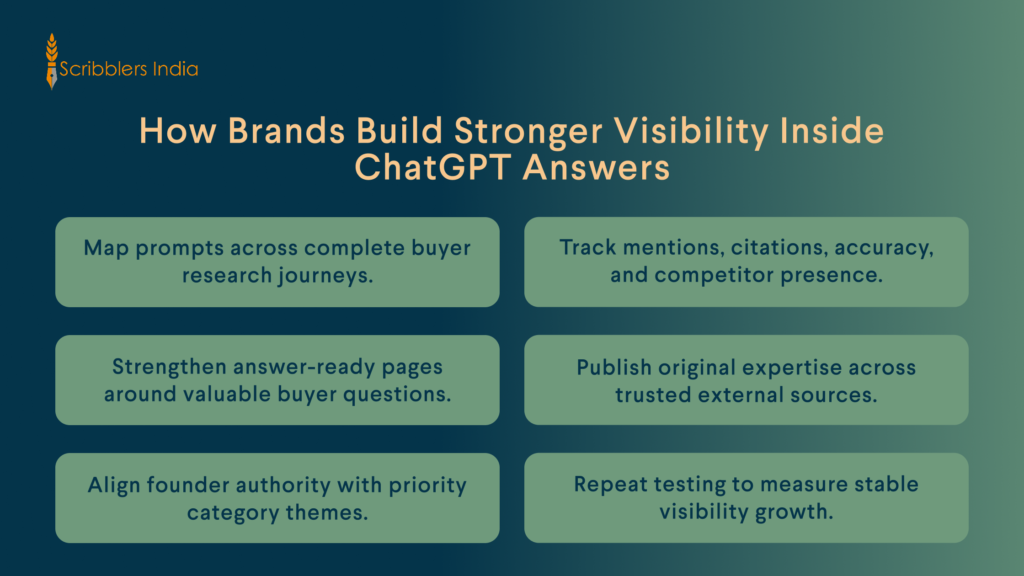
This prompt framework prevents teams from checking random questions and calling the result a strategy. A fixed prompt list helps compare performance over time, across platforms, and with competitors. It also helps teams identify whether the visibility gap sits in content, entity clarity, external authority, or measurement.
Our AI Search Visibility Scorecard helps teams organize these checks across mentions, citations, answer accuracy, prompt coverage, competitor presence, and visibility stability.
What Content Assets Support a Strong ChatGPT Visibility Strategy?
A strong ChatGPT visibility strategy needs content assets that answer real buyer questions and strengthen public authority. The best mix includes owned pages, external expert content, proof assets, and long-form resources. Each asset should support a defined prompt category.
- Pillar pages: Deep category pages help ChatGPT understand the brand’s relationship with an important topic. These assets should define the concept, explain use cases, answer related questions, and link to supporting pages across the website.
- Comparison guides: Comparison assets support evaluation prompts where users ask ChatGPT to compare providers, approaches, or categories. These pages should use fair criteria, practical differences, use-case fit, and transparent limitations instead of promotional scoring.
- Service pages: Service pages clarify what the brand offers, who it serves, how the process works, and when buyers should engage. They should include clear answers, supporting evidence, relevant links, and language that aligns with buyer questions.
- Case studies: Strong case studies provide ChatGPT with concrete evidence of outcomes, processes, and problem-solving ability. They should explain the starting problem, the intervention, the result, and why the work mattered to the customer.
- Expert bylines: Founder-led and expert-led articles strengthen public associations with topics beyond the website. They help connect people, expertise, and brand authority across trusted channels where buyers and AI systems may encounter the company.
- Structured FAQ hubs: FAQs help answer specific buyer questions that may not deserve standalone pages. Each FAQ should answer directly, then add useful context. Avoid repetitive questions created only for keyword coverage.
These assets perform best when connected through one editorial system. Scribblers India’s AEO services map direct answers, FAQs, comparisons, proof, and internal links across priority pages so ChatGPT can better understand the brand’s expertise.
How Should Brands Measure ChatGPT Visibility Performance?
Brands should measure ChatGPT visibility across fixed prompts, repeated checks, and defined review periods. Mentions alone are not enough. Teams should also track citations, answer accuracy, competitors, prompt coverage, referral quality, and whether the brand appears in commercially meaningful contexts.
| Metric | What It Measures | Review Cycle | Recommended Action |
| Mention frequency | How often ChatGPT names the brand | Monthly | Improve entity and authority signals |
| Citation rate | How often owned pages appear as sources | Monthly | Strengthen cited and uncited pages |
| Answer accuracy | Whether the brand is described correctly | Monthly | Correct unclear public messaging |
| Prompt coverage | Buyer questions where the brand appears | Quarterly | Fill content and authority gaps |
| Share of voice | Brand presence compared with competitors | Monthly | Build stronger category assets |
| Recommendation context | How ChatGPT frames the brand’s fit | Monthly | Improve proof and positioning |
| Referral traffic | Visits from identifiable ChatGPT links | Monthly | Assess engagement and conversion quality |
| Citation stability | Repeat appearance across checks | Monthly | Repeat testing before major changes |
OpenAI’s publisher FAQ says ChatGPT referral traffic can be tracked when publishers allow OAI-SearchBot and referral URLs include utm_source=chatgpt.com. That helps measure visits, but it does not capture zero-click influence, brand mentions, or the presence of recommendations in answers.
One-time prompt checks cannot establish a dependable trend. Repeat important questions across sessions, dates, locations, and comparable wording. Store full answers, cited URLs, and screenshots where needed so teams can review context rather than reporting isolated visibility wins.
What Common Mistakes Weaken a ChatGPT Visibility Strategy?
A ChatGPT visibility strategy weakens when teams chase random prompts, publish thin content, ignore entity clarity, or measure only mentions. Each mistake produces misleading conclusions. Strong programs need repeatable testing, useful content, public authority, and accuracy checks across the whole buyer journey.
- Chasing random prompts: Teams that test scattered questions cannot identify meaningful trends. Use a fixed prompt library across buyer stages, then test emerging variations separately. This keeps reporting stable while allowing the strategy to reflect changing buyer language.
- Ignoring entity signals: Inconsistent brand descriptions, incomplete founder profiles, weak About pages, and unclear service messaging can create description errors. Entity clarity matters because ChatGPT needs reliable public context to understand what the brand does and who it serves.
- Publishing thin content: Generic definitions and recycled summaries give ChatGPT little reason to mention or cite a brand. Original frameworks, examples, proof, comparisons, and expert commentary give the brand a stronger source base across important prompts.
- Skipping source access checks: ChatGPT Search depends on the availability of sources when web retrieval is used. Blocking relevant crawlers, hiding content behind poor rendering, or publishing shallow pages can weaken the brand’s ability to support search-backed answers.
- Measuring mentions without accuracy: A frequent mention can still be harmful if ChatGPT misdescribes the company. Teams should review the wording, the context of the recommendation, the cited sources, and the competitor framing before treating visibility as positive.
Correcting these mistakes requires structured reviews rather than scattered content changes. Our AI search visibility audits identify weak prompts, inaccurate descriptions, thin evidence, and inconsistent entities, then convert those findings into focused content and authority priorities.
How Scribblers India Helps Brands Build a ChatGPT Visibility Strategy
Scribblers India helps brands build ChatGPT visibility through prompt research, answer-ready content, entity clarity, founder authority, and repeatable measurement. We connect editorial planning with AI search visibility so teams can improve relevant mentions rather than chase vanity appearances.
- AI search discovery audits: We track brand mentions, citations, answer accuracy, share of voice, competitors, and prompt coverage across a fixed set of prompts. This baseline identifies where ChatGPT already understands the brand and where stronger content or authority is needed.
- AEO content planning: Our AEO strategy restructures priority pages around question-led headings, direct answers, FAQs, comparison sections, and source-backed explanations. This improves readability for buyers and makes key information easier to extract during answer-led discovery.
- GEO content development: We build research assets, comparison guides, expert explainers, glossary pages, and case-led resources that strengthen source depth. These assets help the brand become easier to mention, cite, and associate with priority topics across AI search experiences.
- Content strategy services: Our editorial calendars align priority pages with visibility goals across ChatGPT prompts. We plan pillar pieces, supporting assets, refresh cycles, internal links, and proof sections that support discovery across the buyer journey.
- Personal branding content: We publish founder bylines, LinkedIn thought leadership, expert commentary, and point-of-view articles that reinforce topic authority. This work strengthens entity signals and supports professional prompts where visible expertise influences brand recognition.
- Ongoing performance reviews: We review prompt movement, citations, descriptions, competitor inclusion, and referral quality across reporting cycles. Confirmed gaps guide refreshes, new assets, founder content, or external authority work across future planning periods.
Talk to Scribblers India to build an evidence-led ChatGPT visibility strategy connected with stronger content, credible authority, accurate brand positioning, and repeatable measurement across priority buyer prompts.
Frequently Asked Questions
How Often Should Brands Update ChatGPT Visibility Tracking Prompts?
Brands should review their fixed prompt library quarterly and monitor high-value prompts monthly. Fast-moving categories may need closer checks when buyer language changes. Keep core prompts stable for trend analysis, then test new variations separately so updates improve coverage without breaking comparisons across future reporting periods, competitors, and target markets.
Does ChatGPT Show Different Answers to Different Users?
Yes, ChatGPT can produce different answers because prompts, conversation context, product mode, search behavior, location, and account settings may vary. One manual check is therefore unreliable. Teams should repeat fixed prompts across comparable sessions, record complete answers, and report patterns rather than treating a single response as definitive evidence of visibility.
Can Small Brands Compete Inside ChatGPT Answers?
Yes, small brands can compete when they demonstrate focused expertise around specific buyer questions. Clear service positioning, original evidence, useful case studies, and credible external mentions can support inclusion. Specialist brands should target narrow prompt groups first, then expand once they have built dependable authority across related topics and buyer needs.
How Do LinkedIn and Founder Content Influence ChatGPT Visibility?
LinkedIn and founder content can influence public understanding when they communicate genuine expertise, consistent positioning, and useful perspectives. Their exact role varies by search and model experience. Brands should prioritize authentic founder profiles, bylined articles, interviews, and expert commentary rather than manufactured mentions that create trust or reputation risks.
Should Brands Optimize Differently for ChatGPT and Perplexity?
Brands should maintain consistent foundations across ChatGPT and Perplexity, including clear entities, useful content, up-to-date evidence, and credible external references. Measurement should remain separate because retrieval behavior, citations, answer formats, and source presentation differ. Test identical prompt groups before assigning content priorities across future reporting cycles.